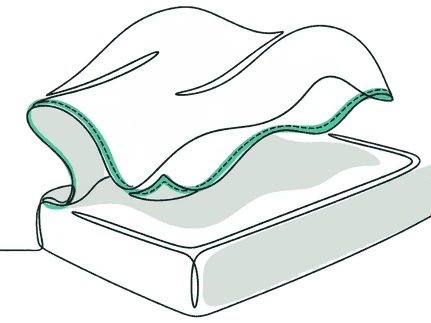


What’s in here9 sections
You stood in front of two sheet sets made of the same cotton, sitting in the same price bracket, and one of them said 200 and the other said 800. You bought the 800 and it slept hot. That number was never describing the thing you were choosing between: one of those sets was a plain weave, where a thread goes over one and under one and leaves a grid of gaps for air to pass through, and the other floated its threads four at a time across the surface and closed those gaps up. Six constructions get sold as sheet weaves, two of them are not weaves at all, and this is what each one physically does to the bed you sleep in.
Quick Answer
A weave is the pattern in which threads cross each other, and it decides airflow, feel and wear. Percale is one over, one under. Sateen floats three or four over one. Twill offsets its floats diagonally. Linen is percale’s pattern in flax. Flannel is a brushed finish on a woven base, and jersey is knitted, not woven at all.
What a Weave Actually Is
Before percale and sateen can mean anything, the word underneath them has to: a weave is nothing but the pattern in which the threads cross, and that pattern decides almost everything the sheet will do to you.
Every woven fabric is two thread systems at right angles to each other. One set runs the length of the cloth, the other runs across it, and the weave is simply the rule for how often one passes over the other.
In a plain weave the rule is the simplest one available: over one, under one, over one, under one, in every row. A satin weave runs three-over-one or four-over-one-under, depending on the mill. Change nothing else, not the fiber, not the yarn thickness, not the finish, and those two rules produce fabrics that behave nothing alike.
The distance a thread travels across the surface before it dips back under is called the weave float. That word is the whole article.
A short float locks the cloth in both directions and leaves regular gaps between the crossings, which is what weave density actually measures. A long float lies on top of the fabric, covering those gaps, catching the light along its length and sitting exposed to whatever rubs against it. If you want how cotton is woven into percale, sateen, twill and flannel laid out by a fiber producer rather than a bedding retailer, the structural definitions are the same ones used here.
Float length decides four things at once, and it decides them all from that one measurement: how the cloth feels under a hand, how much air moves through it, how it hangs off the edge of a mattress, and where it will wear out first. Not four separate properties to look up on four different labels. One structural fact with four consequences.
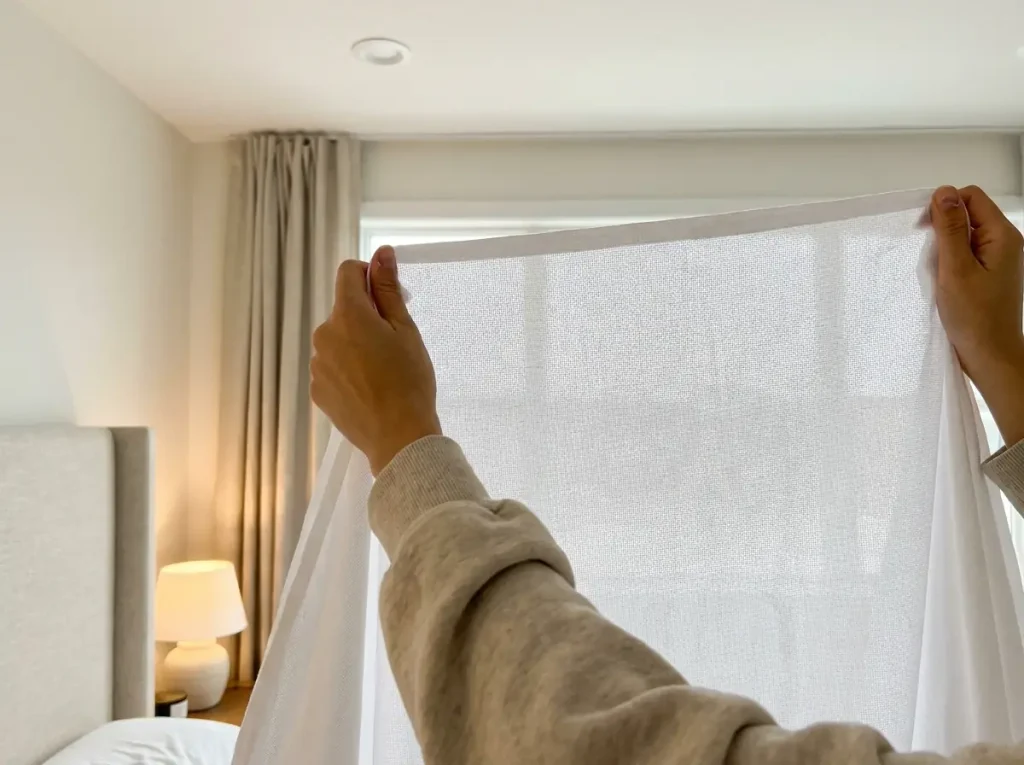
Here is the test that makes it visible in about ten seconds. Take a percale sheet and a sateen sheet and hold each one up to a window.
The percale shows a field of pinpricks of light, a regular grid of them, one at every crossing. The sateen shows almost none, because the floats have laid down over the holes. That is the entire thermal argument between the two, breathability and thermal conductivity both, and you can see it before you have slept on either one.
And here is where most shopping goes wrong. Fiber and weave are two different questions and they get collapsed into one constantly. Cotton, linen and bamboo viscose can all be woven in a plain weave, and organic cotton is a farming question that changes neither.
The same cotton woven two ways gives you two sheets that sleep differently, wear differently and cost differently. This correction comes up again and again for people about to overspend, usually right before someone buys a four-digit thread count because the fiber name on the box sounded expensive.
One more thing to flag before the sections that follow. Of the six things sold on the sheet aisle as weaves, two of them are not weaves. One is a finish applied after the weaving is done, the other was never woven in the first place, and the knit vs woven distinction is the one that catches most people. Both get corrected below.
Do the window test on the sheet already on your bed before you shop for a replacement. Grid of light means you own a plain weave and the crispness you may be missing is a fiber or finish problem, not a weave problem. No visible holes means you own a floated weave, and swapping to percale is the single change most likely to alter how that bed sleeps.
Percale, One Over and One Under
Percale is the plain weave with a name, and everything people like or dislike about it comes from the fact that every thread is locked on both sides.

One over, one under, in combed yarns, is the tightest and flattest interlace available in a sheet. There is no float anywhere on the surface, because every thread is pinned by the ones crossing it, in both directions, at every intersection.
That structure is what gives percale its crisp hand and its matte finish, with no direction for light to run along. It is why the sheet lies flat instead of draping, why it holds a crease so precisely, and why it takes a hot iron so well if you are the kind of person who irons sheets.
The gaps left between all those crossings are the reason percale moves air. Heat and moisture leaving your skin have a route out through the cloth rather than a closed surface to sit against. This is a mechanical fact about the structure, not a fiber claim and not a marketing one: the same cotton, in a denser sateen, has fewer of those routes. If your bed runs warm, the weave has already made most of the decision for you before the fiber gets a vote.
The words people actually use for percale are not “crisp.” They are papery, and rustling, and the complaint is common enough that people ask, honestly, why anybody wants sheets that make that noise. Nobody asking is wrong.
It is the same locked structure producing the sound, the flatness and the airflow, and you cannot take one and leave the others. If you want a bed that feels soft and yielding when you get into it, this is not your weave, and no thread count inside percale’s range will make it into one. It is also the weave most hotels put on a bed, for laundering reasons rather than comfort ones, and hotel quality turns out to mean something quite specific once you look at it — what hotels actually put on their beds is its own question.
Here is that structure on a real listing.
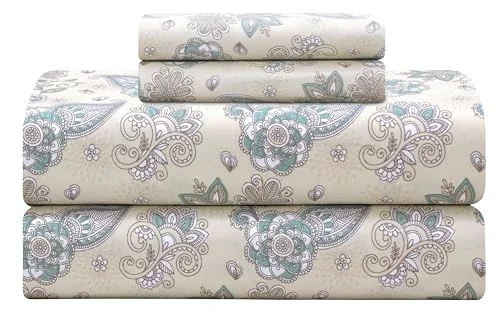
Percale generally runs between 200 and 400 threads. Inside that band the number is telling you something real about yarn fineness. Above it, in a plain weave, the number is usually being reached by twisting two thin threads together and counting both, which gives you a denser cloth rather than a finer one. That is a one-paragraph summary of a longer piece of arithmetic, and if you want what the thread count on a percale label is actually counting worked through properly, it has its own breakdown.
The level-three detail, the one that only shows up on a bed: a percale that has been through twenty washes stops sounding like paper and starts sounding like nothing at all. The starch and the sizing are gone by then and what is left is just the weave. That is the version worth judging. Not the one out of the bag.
Sateen, Three Over and One Under
Sateen is the same cotton doing the opposite thing, and the trade it makes is the clearest in the whole family: it buys its shine with the same floats that will eventually pill.
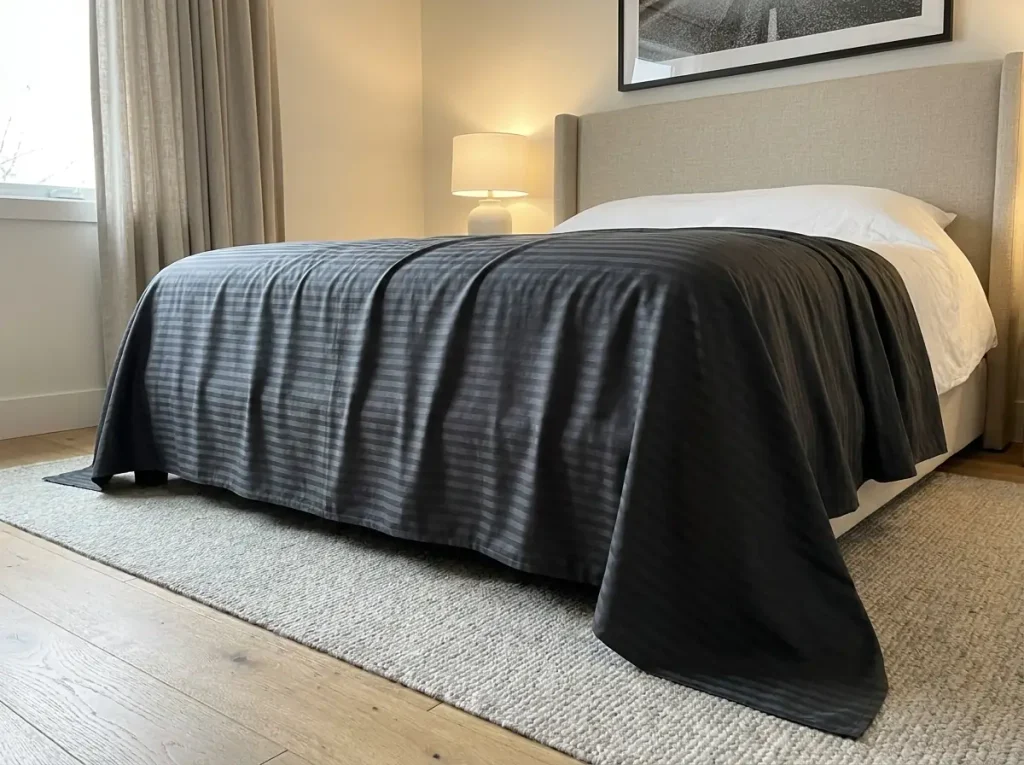
Three or four threads pass over the surface before one dips under. Those long floats all lie in the same direction, so they reflect light in the same direction, and that is where the sheen comes from.
It is geometry. Not silk, not a coating, not a finish that can wash out. You can wash a sateen a hundred times and it will still be a sateen, because the shine is the structure. And the satin vs sateen question people ask is not a weave question at all: same interlacing, silk filament in one and spun cotton in the other.
The same floats close the surface. Fewer gaps means less air moving through, which means body heat stays nearer the skin instead of leaving through the cloth. This is why sateen photographs beautifully and sleeps warm, and why it is the right answer for a cold bedroom and the wrong one for July.
Sateen also carries higher thread counts honestly at the same hand-feel, which almost nobody explains. Percale sits at 200 to 400; sateen commonly runs 300 to 600.
That is not sateen being a better cloth. It is the float geometry allowing more threads into the same square inch without the fabric turning into board. Thread count is weave-dependent, and comparing a 600 sateen to a 300 percale as though the bigger number wins is comparing two different measurements.
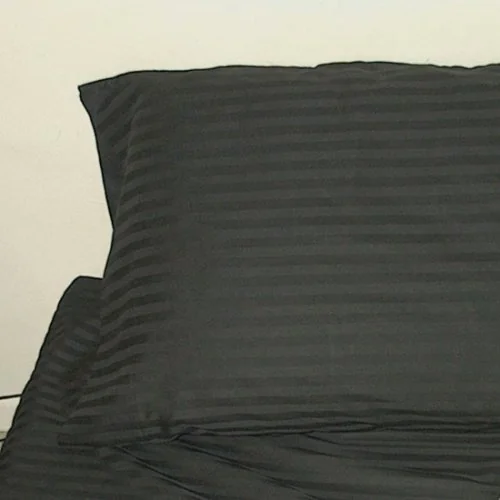
Now the failure mode, and it comes from the same sentence as the sheen. A float sits on the surface with nothing crossing over it, so anything abrasive (a duvet cover dragging, a hip turning over, a wash cycle on the wrong setting) hits the float first and hits it directly.
Percale’s threads are pinned on both sides and have nowhere to go. Sateen’s have slack. Its abrasion resistance is lower for exactly that reason, and snagging follows the same logic. That is the structural reason sateen pills sooner, and if you want which of the two actually wears out first with the timeline attached, that comparison has its own article.
Sateen-family failures show up at week six, not night one. A Quince bamboo set built on this construction was reported pilled after roughly three washes and six weeks, on a listing carrying thousands of top-rated reviews written by people who had owned the set for a fortnight. Week one lies about sateen more than about anything else here.
And when it goes, it goes in a stripe. Pilling appears where the frame sits and where the duvet rubs: the hip band of the flat sheet, the top edge where it folds over. Not the middle of the bed, not evenly. If you are checking a sateen for wear, check those two bands and ignore the rest.
Twill, and the Flannel Correction
Twill is the third real weave and almost nobody sells sheets by its name, and the fabric most people would put beside it in a list is not a weave at all.
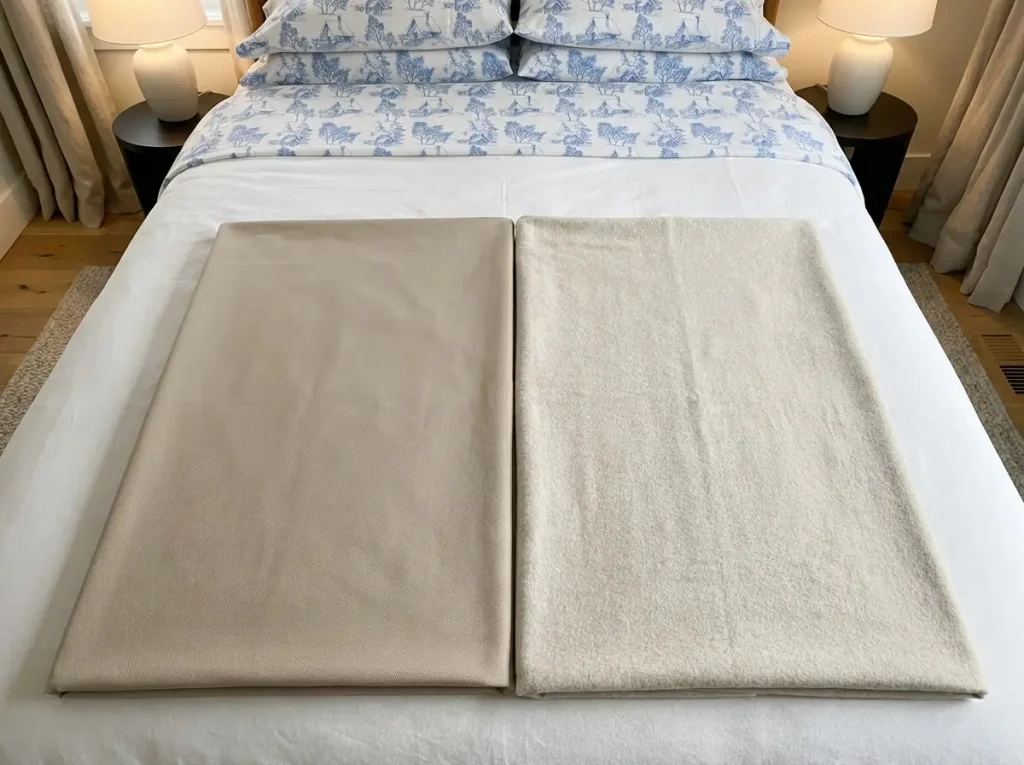
Twill offsets its floats by one thread on each row, so the floats form a diagonal line across the cloth. You already know what that looks like: it is denim, it is chino, it is the grain running corner to corner on a pair of work trousers. Structurally twill sits between the other two, with more give and drape than a plain weave and more lock than a satin one, because a diagonal float is shorter than a satin float and supported on one side.
That diagonal weave is why twill takes abrasion well, and why its wrinkle resistance beats percale’s without any finish being applied. It is also why it is nearly invisible on the sheet aisle: the least dramatic of the three, no marketing story in it, so almost no one prints the word on a package.
The Belem Luxury Hotel Sheets, Flat Twill Weave is a 70/30 long-staple cotton and polyester blend at 200 threads that actually names its weave on the listing, which is the entire reason it is worth pointing at. Its flaw, in writing: it is a thin shelf, and there is not a second declared twill waiting behind it if this one goes.
Now the correction. Flannel is a finish, not a weave. A flannel sheet is a plain or twill base fabric that has been run through a machine and mechanically brushed, or napped, until the fiber ends are raised off the surface into a fuzz. The warmth is not in the interlacing at all. It is in the air trapped in that raised nap, which is why flannel feels warm the instant you touch it and why a thin flannel disappoints in a way a thin percale does not.
Which is why flannel gets sold by GSM, grams per square meter, rather than by thread count. Grammage is the honest spec for brushed cotton: the nap is the product and the nap has mass, so counting threads on it measures a base you cannot feel.
The Pointehaven 180 GSM 100% Cotton Flannel Sheet Set publishes that figure and is double-napped, brushed on both faces, which makes it a legible example rather than an abstract one. Its flaw, in writing: the brushing loosens with washing, and by about a year and a half it has lost some of that initial fuzz.
If a flannel listing gives you a thread count and no GSM, it is describing the part of the fabric you will never touch. Ask for the weight. Under about 150 GSM you are buying a printed cotton sheet with a suggestion of fuzz on it; 170 and up is where a flannel behaves like a flannel through a winter.
The nap flattens as it washes, and that is normal wear rather than a defect. A flannel at wash forty is a thinner, quieter fabric than the one that came out of the bag. Double-napped sets are brushed on both faces, so they keep some hand even after the top face has gone down; single-napped sets feel identical in the shop and noticeably thinner by the second winter. That difference is invisible until it is a year old, which is precisely why nobody writing a review in week one has ever mentioned it.
Jersey Is Not Woven at All
The second correction is bigger than the first, because jersey does not belong on this list by structure at all. It is knitted, and everything odd about it follows from that.
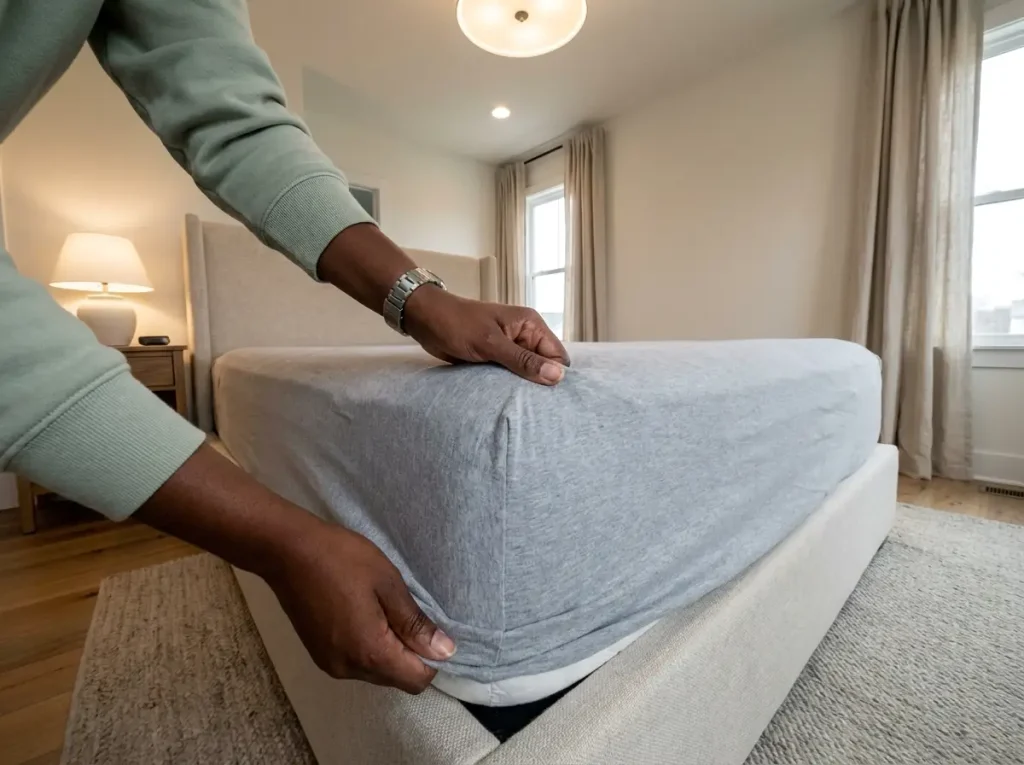
Woven fabric is two thread systems crossing at right angles. Knitted fabric is one continuous thread looped through itself, row after row, on a circular machine. It is the construction of a T-shirt, and a jersey sheet is a T-shirt cut and sewn into the shape of a mattress. There are no crossings anywhere in it.
Loops stretch. Crossings do not. That single difference explains everything jersey does. It is why a jersey sheet feels soft and yielding straight out of the package with no finish involved, why it never rustles, and why it goes onto a bed without a fight.
The stretch is also its one genuine advantage over every woven sheet here: it fits a deep or awkward mattress because it deforms to meet it, rather than needing a pocket cut to the exact mattress depth. The PURE ERA Jersey Knit Sheet Set is 100% cotton with a pocket stated to 20 inches, which on a knit means it will reach further than that on a thinner mattress and still sit tight. Its flaw, in writing: because it is knitted rather than woven, it deforms at the mattress corners over time — the deep pocket helps, but it does not prevent it.
That is the failure mode of a loop. A loop that has been pulled repeatedly does not fully return to its original size, and no woven fabric has this problem at all, because a crossing has nowhere to travel to.
It has good tensile strength in the direction of the stretch and poor recovery, which is a different thing from the tear strength a woven sheet trades on. Jersey is also sold by GSM, for the same reason flannel is: there is nothing to count.
Here is how it actually shows up in a bedroom. A jersey fitted sheet that has gone slack does not pop off in the night the way a shallow percale one does. It stays on.
It just wrinkles down into the mattress and sits there, loose and rumpled, and you keep making the bed over it for months without registering that it has stopped fitting. Jersey fails quietly, and that is why people replace it late. For the full comparison of the two that get left off every comparison, the knit and the brushed base get their own piece.
Linen Is a Plain Weave With a Different Fiber
Linen gets treated as its own category on every shelf in the country, and structurally it is the same weave as percale, which makes it the cleanest proof that the fiber and the weave are two separate questions.

Linen sheets are plain weave. One over, one under, exactly the interlacing described at the top of this article, made from flax instead of cotton. Same rule, same grid of gaps, same locked structure. If you hold a linen sheet to the window you get the percale result: a field of light.
So every difference between linen and percale is a fiber difference, not a weave one. Flax has a longer, stiffer fiber with a hollow core, and its moisture-wicking capacity is high enough that it holds a lot before it starts to feel damp against skin.
That is why linen sleeps the way it does in heat, and also why it creases the way it does: a stiff fiber that has been folded stays folded. Identical weave, opposite wrinkle behavior. The fiber did that, not the interlacing. The same logic runs through cotton’s own grades, where Pima cotton and Supima cotton are staple-length claims about the thread rather than anything to do with the weave.
Linen is sold by GSM as well, and for a third distinct reason. Flax yarn is naturally uneven in thickness along its length, so counting threads per inch measures something that is not consistent enough to mean anything.
The DAPU 100% French Linen Sheets declare 170 GSM on the listing, which is what makes the instruction actionable instead of theoretical: you can ask for the number because some sellers publish it. Its flaw, in writing, and it doubles as this section’s evidence: it wrinkles harder than percale despite being the identical plain weave, and the flax fiber does that, not the cloth structure. Whether linen earns what it costs, and at what GSM is a separate verdict with its own article.
This is where the article’s thesis closes. Change the fiber and you change the feel and the moisture behavior. Change the weave and you change the physics: the airflow, the drape, the place it wears out.
Two questions. The label answers neither of them properly.
One last thing about linen, and it is the reason most linen reviews are wrong in the same direction. A linen sheet at wash twenty has barely softened. At wash sixty it has. Nothing else in this article runs on that timescale, so a linen review written after a month is describing a fabric that has not started yet.
Which Number to Read, and Which to Ignore
Six weaves, three different numbers on the boxes, and only one rule that survives all of them: read the number that describes the thing the weave actually does.
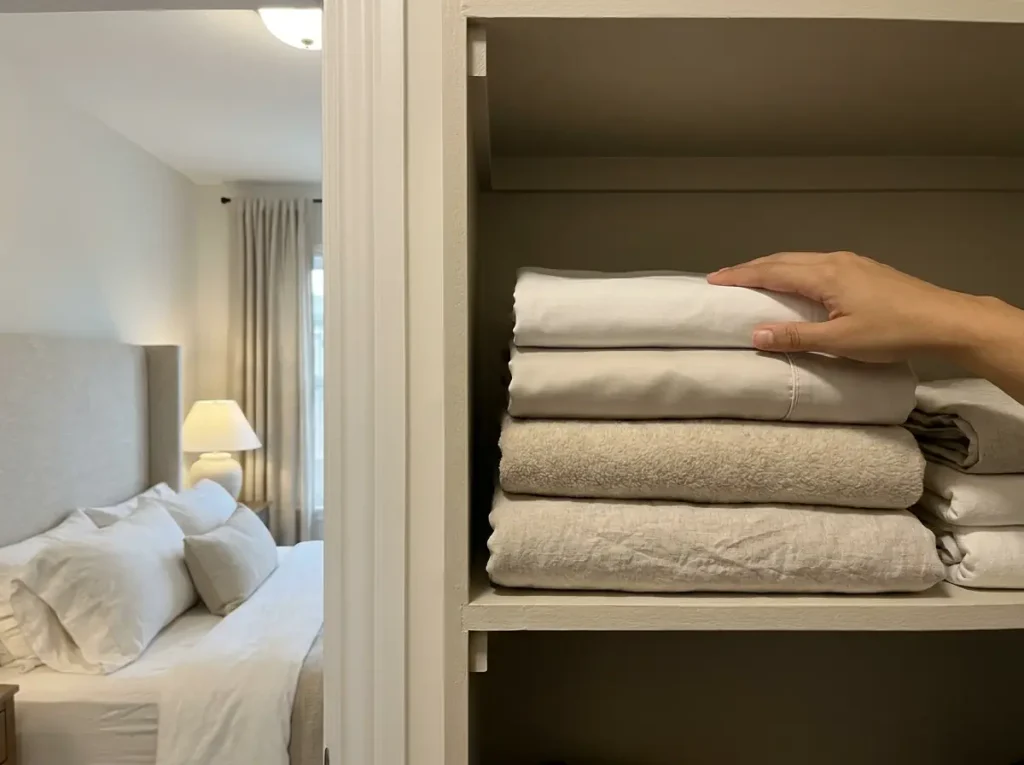
Start with the free one. Before buying anything, find out what you already own. Strip the bed, hold the sheet to a window, and read it:
- Grid of light through the crossings. Plain weave. Percale, or linen if it is flax.
- Sheen with no visible holes. Sateen, and now you know why that bed runs warm.
- A diagonal grain like denim. Twill.
- Fuzzy surface, no visible structure. A napped finish. Flannel.
- It stretches when you pull it. A knit. Jersey.
Most people have been sleeping on a weave they could not name, and half the time the sheet they were about to replace was never the problem. That test costs nothing and takes a minute.
Then the numbers, which sort cleanly once you know the construction. Thread count belongs to plain and satin weaves only, and only as a range check, 200 to 400 for percale and 300 to 600 for sateen.
Inside the range it describes yarn fineness. Outside it, it is ply arithmetic: a multi-ply yarn counted once per strand instead of once per thread, which is the whole thread-count trick. A single-ply 300 and a multi-ply 800 can come off the same loom.
An independent breakdown of what weave type actually changes walks through the same ranges without a sheet to sell you. For the fiber question underneath all of it, staple length is where that lives, and one of them is a fiber and one is a weave puts the argument on a concrete pair.
GSM belongs to flannel, jersey and linen, because there is no honest count to take on a brushed, knitted or irregular-yarn fabric. Three different constructions, one shared reason.
Everything else printed on the package is a different kind of claim altogether. OEKO-TEX Standard 100 and GOTS certified tell you what was done to the fiber chemically and agriculturally, and both are worth having. Neither one says a word about how the cloth was woven, which is the thing you are actually choosing between.
Now the part that gets left out of every weave comparison written. In a two-person bed, the weave is the one bedding variable that cannot be split down the middle. A duvet can be split, and two twin duvets on a queen is the standard answer half of Europe already uses. A mattress can be split.
The sheet cannot: there is one of it and it goes under both of you. So in a shared bed the sheet gets decided by the hot sleeper, and the cold sleeper adds a layer on top, because a layer on top is splittable. A warm sleeper and a cold sleeper can share a percale bed; they cannot share a compromise weave that suits neither. It is not a compromise, it is the only order that works — which weave to put on a bed that runs hot settles the buying side of that decision in more detail than fits here.
When two people disagree about the bed, buy the sheet for the hot sleeper and the top layer for the cold one. The sheet touches both of you all night and cannot be divided; the layer above can be a second duvet, a blanket on one side, or nothing at all. Solve the undividable thing first and the rest becomes an easy argument.
And every judgment in this article is made at wash twenty, not night one. Percale loses its starch and keeps its structure, and the rustle going quiet is the sheet arriving, not failing. Sateen shows its stripe of pills across the hip band or it does not.
Flannel’s nap is beginning to lie down. Jersey’s corners are beginning to give. Linen has barely started. Every one of those arrives sooner or later depending on whether it met a gentle cycle and a tumble dry on low, or did not.
One wash is a lottery: a widely praised 300 thread count percale from a name-brand seller was reported pilling and shrinking enough on its first wash that the fitted sheet no longer reached the mattress. Twenty washes is a measurement.
Conclusion
The weave decides the physics and the fiber decides the feel. Airflow, drape and where the cloth wears out come from the interlacing; softness, moisture behavior and wrinkle habit come from what the thread is made of. Two separate questions, and the number printed on the package answers neither. Laid out side by side, percale, sateen and linen compared spec by spec makes the split easier to see on a shelf.
Read the number that matches the construction. Thread count for percale and sateen, and only as a range check inside 200 to 400 and 300 to 600. GSM for flannel, jersey and linen, because none of the three has an honest count to take.
And two of the six are not weaves. Flannel is a brushed finish on a woven base. Jersey is a knit. Both are worth owning for what they do, and neither belongs anywhere near a thread-count comparison.
After a season of washes, look in three places: the hip band of the flat sheet for sateen’s stripe of pills, the corners of the fitted sheet for jersey’s slack, and the top face of a flannel for a nap that has gone flat. A percale that has lost its rustle has not failed. It has finished breaking in.
Hold the set that is on your bed right now up to the window before you buy anything at all. Whatever you see there tells you more than the box it came in ever did.
Frequently Asked Questions
01What are the types of weaves in bedsheets?
Three true weaves are common in bedding: plain (percale), satin (sateen) and twill. Flannel is a brushed finish applied to a woven base, and jersey is knitted rather than woven, which is why both are sold by weight instead of thread count.
02What type of sheet weave is considered the best?
There is no best weave, only a best match. Percale moves the most air, sateen drapes and holds warmth, twill resists abrasion, flannel traps warmth deliberately, and jersey stretches to fit. Pick by what your bed currently does wrong.
03Which is better, cotton sateen or percale?
Percale if you sleep hot or want a flat, crisp bed. Sateen if you want drape and sheen and do not mind that its surface floats pill sooner. Same fiber, opposite structures, opposite results.
04What are the disadvantages of cotton percale sheets?
It wrinkles more than any other weave here and it does not stop. The first few washes feel stiff before the starch leaves, and its flat hand reads as cold to sleepers who want a bed to feel soft rather than sharp.





Tried it on your own bed?
No comments yet. Tell us what you changed, and what the sheet did after a few washes.