







What’s in here7 sections
There is a thread on r/BuyItForLife asking which sheets give hotel vibes, and it has dozens of replies. The most repeated answer is one word, typed over and over by people who did not coordinate: Percale. Somebody eventually jokes back, “you can’t just say percale,” and they have a point, because the weave name is necessary and nowhere near sufficient.
What hotels use was never decided by anyone with taste in the room. It was decided by a machine: a sheet in a chain hotel gets washed at roughly 140 to 160°F, in bleach chemistry, then pressed on a heated ironer under pressure, several hundred times before anyone retires it. This is what actually goes on those beds: the weave, the fiber, a thread count far lower than the package you almost bought last week — and which parts of it come home with you.
Quick Answer
Most hotels, and nearly every chain, use percale rather than sateen: single-ply long-staple cotton at roughly 250 to 400 thread count, almost always white. Sateen shows up as a suite or resort upgrade. The 1,000-count number on a retail package is not what any hotel buys, and higher is not what they are chasing.
What Hotels Actually Put on the Bed
The question has a short answer and a longer one, and the short one is unsatisfying on its own, which is exactly why that thread keeps arguing about it. The short answer is percale. Percale and sateen are not fibers or brands; they are two ways of interlacing the same cotton, and if you want what the weave is actually doing under your hand, the pillar builds both of them thread by thread. Here the interesting part is which one a buyer with a thousand beds signs a contract for, and why.
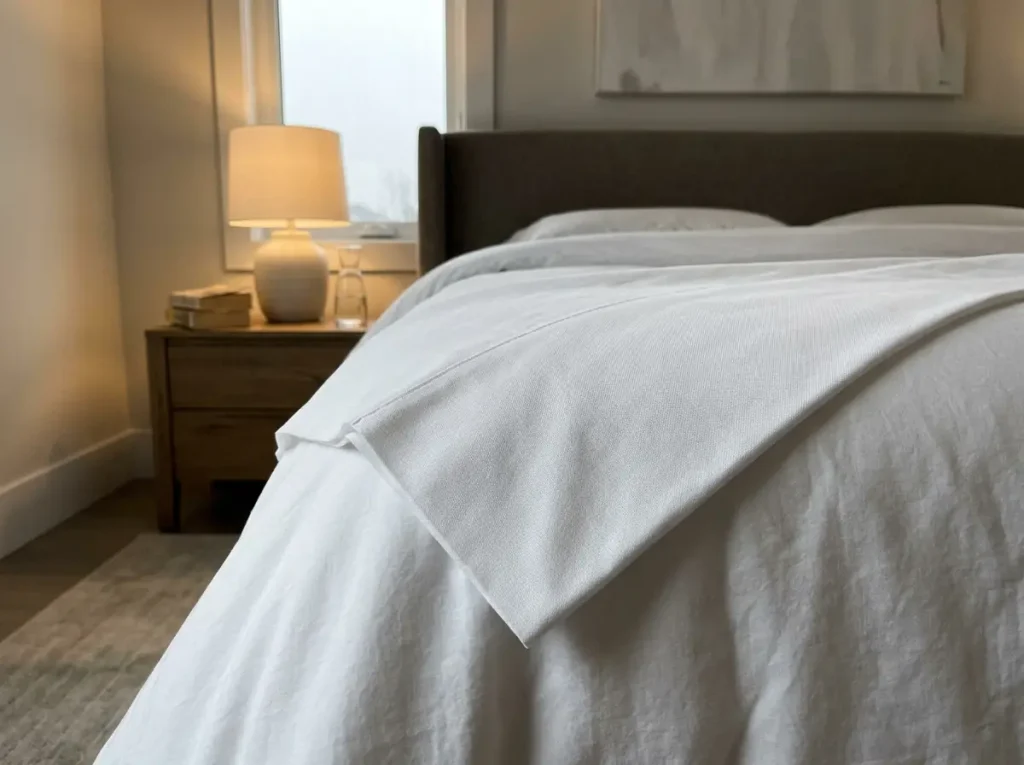
Hospitality percale runs T-200 to T-400 in the trade’s own notation, with most house programs landing between 200 and 300. When a property upgrades its suites to sateen, those programs sit around 300 to 500. Those are the real figures, and a hotel-linen supplier’s own procurement guide lays out the targets by weave and property tier.
None of them look anything like what is printed on retail packaging. A hotel buyer is not shopping for a bigger number. They are locking a construction.
The construction is single-ply, ring-spun combed cotton, and the ply is the part a retail label almost never prints. The fiber is long-staple, 1.1 to 1.4 inches, and sometimes extra-long-staple above 1.4 inches, which is under 3% of the world harvest. That top 3% is what gets sold under names like Supima cotton and Giza cotton, and the names are worth less than the measurement they stand for.
“100% cotton” on a package tells you none of that. It tells you the sheet is cotton, which is where the useful information stops.
And they are white, which everybody notices and almost nobody asks about. It is not a design decision. Bleach is the only chemistry that holds a shade steady across hundreds of cycles, so white is the only color that survives the laundry contract without drifting. Every other color would be visibly off by month eight, with fifty replacement sheets in a linen closet not matching the other fifty.
Here is the part that catches people out. The hotel sheet you remember as thick was almost certainly not thick. A 250 to 300 count percale in single ply is a light cloth, and often lighter than what is on your bed now. What you are remembering is the hand: flat, dry, papery, with an audible rustle when the top sheet gets pulled back.
Weight and crispness feel like the same thing under a palm at 11 p.m. They are not the same thing at all, and the whole retail category is built on the confusion.
Why the Laundry Picked Percale, Not the Designer
Nobody in a hotel chose percale because it feels nice. The choice was made by the machine the sheet goes into every single day, and by the arithmetic of replacing a thousand of them at once.
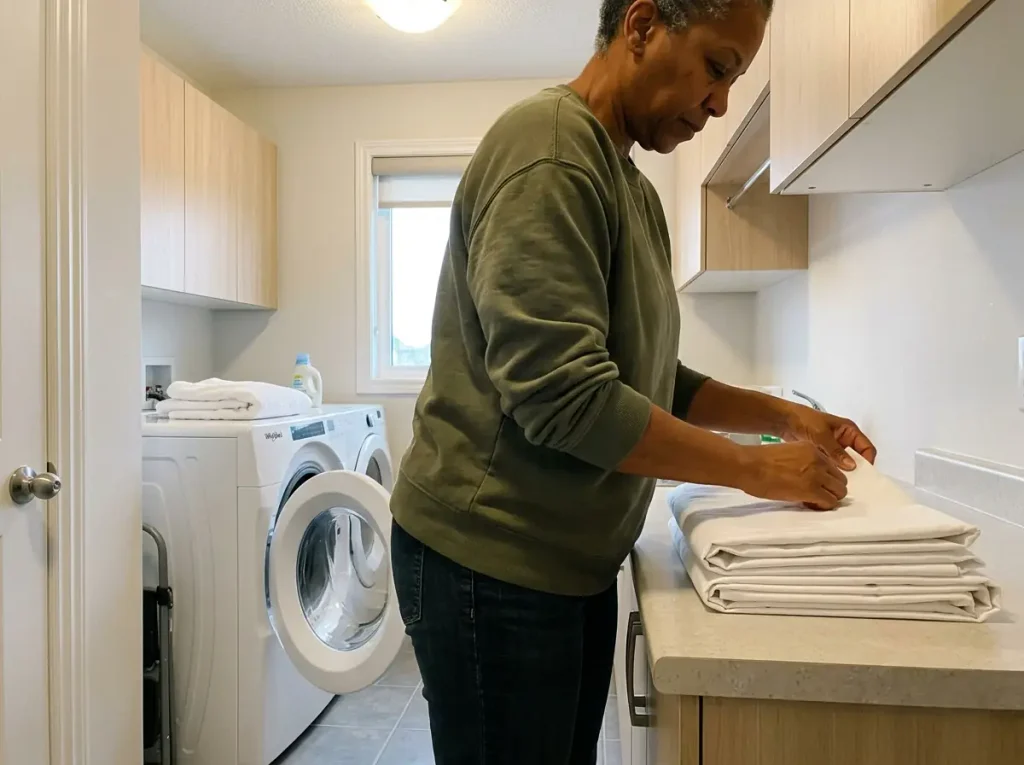
Percale is one over, one under. Every thread is locked at every crossing, on both faces of the cloth. There is no floating segment anywhere on the surface: nothing sitting proud, nothing loose enough for friction to catch. Sateen runs the opposite way: one under, three or more over, which leaves long floating threads lying across the face.
Those floats are what produce the sheen, and they are also the whole failure mode. One hospitality linen maker puts it plainly — thread count is only one part of the equation, and construction is the part that decides what happens under abrasion.
Now put that face into a tunnel washer at 160°F with oxidizing bleach, and finish it on a flatwork ironer under heat and pressure. Every cycle, a float gets dragged across something. Hotel-grade percale is reported to take roughly 300 to 500 commercial wash cycles before structural failure, and plain-weave literature cites 200-plus as the general benchmark. Sateen in the same program does not get there, which is why the properties that run it run it in suites and accept a shorter replacement cycle as the cost of the softer hand.
The mechanism shows up in living rooms too, not just laundries. A poster on r/BuyItForLife described going through three sets of sateen sheets shredded by a dog doing zoomies on the bed, switching to percale, and getting zero tears after that. That is the float-snagging mechanism demonstrated by a dog, and honestly it is better evidence than any spec sheet, because a spec sheet has never met a claw.
Worth noticing: the trade names it too. SFERRA sells both weaves and puts the word Hotel on its percale line, describing it as smooth, cool and crisp, while its sateen lines are sold on drape and sheen. That is the manufacturer’s own naming choice about which weave belongs on a hotel bed, not this article’s opinion.
Abrasion does not arrive evenly, so do not judge a set by holding it up to a window. It thins in four predictable zones: the hip band across the middle of the bed, the fold line where the top sheet turns back, the hems, and the corners. Put a flat hand on those four places. A sheet that reads even there has years left in it whatever the rest of it looks like.
That zone pattern is also the honest way to compare the two weaves over a full ownership cycle rather than a single season. How the two weaves age against each other over a full wash count is its own timeline, and percale’s advantage is not uniform across every month of it.
The Thread Count on the Package Is Not the One on the Spec Sheet
Which leaves the number. The one thing every shopper has been trained to read, and the one the hotel buyer treats as the least interesting line on the specification.
Thread count is a density indicator, not a performance guarantee. Two fabrics at the same count can wear and feel completely differently depending on yarn count, ply, cotton grade and GSM. The count tells you how many threads crossed a square inch. It does not tell you what those threads were made of, how thick they were, or how many of them were twisted together before anybody started counting.
That last one is where the number goes strange. The inflation is arithmetic, not fraud: a multi-ply yarn can have each thin strand counted separately, so a 1,000-count sheet may be a 250-count construction with four plies counted four times over. The label is not lying by number. It is lying by omission, because it never prints the ply, and the whole arithmetic of how a count gets inflated is worth reading once so the number stops working on you.
Which sets up the claim that needs correcting, because it is stated as fact on a widely-circulated retailer guide: that a higher thread count makes a sheet more breathable and better at regulating temperature. That is backwards. Packing more threads, thinner ones and multi-ply ones, into the same square inch raises density and closes the air gaps a plain weave depends on.
Percale moves air because its open one-over-one lattice leaves gaps and its single-ply yarn is not doing the work of four. The airflow is a property of the weave and the ply. The count is a byproduct.
GSM is the number nobody prints, and it is the one hospitality suppliers treat as more predictive than thread count. A high count paired with an unusually low GSM signals a delicate build no matter what the front of the package promises. So a listing that states its thread count and never states GSM or ply has already told you something by what it left out. The same goes for fiber: staple length decides whether a sheet is smooth or sandpapery at wash twenty, and which staple length you are actually getting is the question “100% cotton” was designed not to answer.
| What the label says | What it means | What to check instead |
|---|---|---|
| 1,000 thread count | Almost certainly a multi-ply yarn with every strand counted separately | Whether it says single-ply anywhere |
| 800 thread count Egyptian | Grown in Egypt, at best. Says nothing about staple length | Long-staple or ELS, stated as a number |
| 100% cotton | The fiber is cotton. Not the grade, not the staple, not the ply | Ring-spun combed, and the GSM if given |
| “Hotel quality” | Nothing. No standard, no certifying body, no definition | Percale, single-ply, 250 to 400 count |
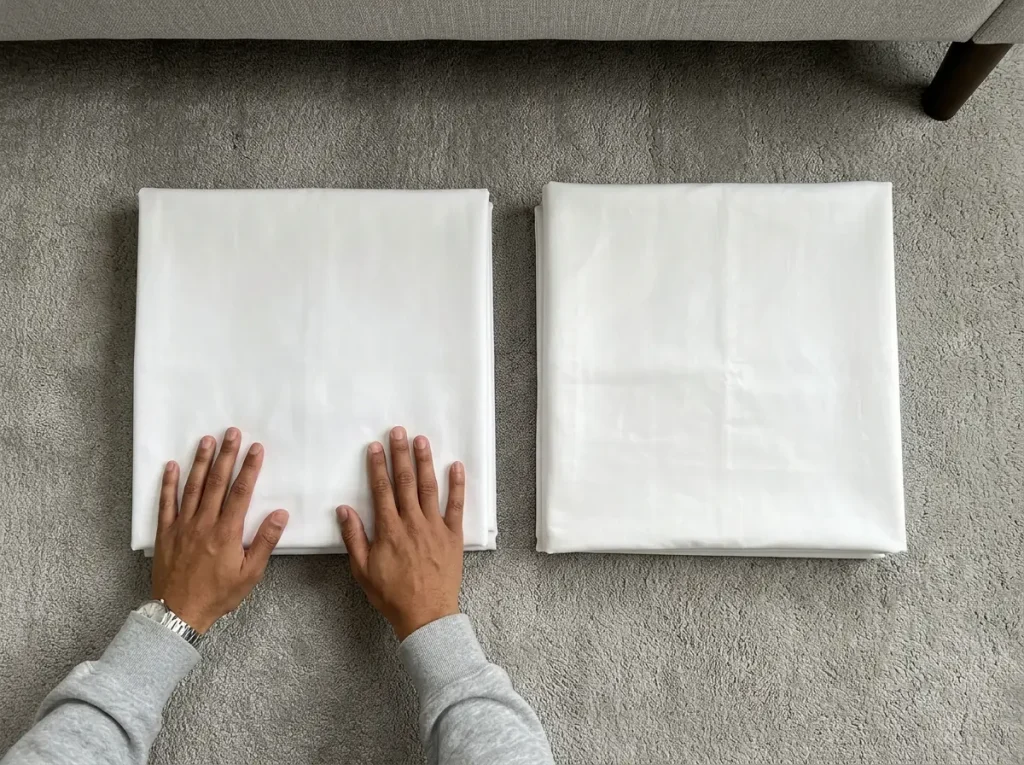
No listing prints GSM, so weigh the set against one you already own. Hold a folded flat sheet in each hand, same size, and a hotel-spec percale will feel lighter than you expect and drier under the fingers. If the higher-count one feels heavier and slicker, you are holding density, not quality. That two-second comparison tells you more than either number on either package.
The tell on a package is not a number at all. It is a missing word. A sheet built the way hotels buy will say single-ply or ring-spun combed somewhere on the back, because the manufacturer paid for those and wants credit for them. A sheet that names only its thread count is naming the only spec that flatters it.
The Crispness Is a Finish, and It Washes Out
There is one part of the hotel bed that does not come home with the sheets, and it is the part most people are actually trying to buy.
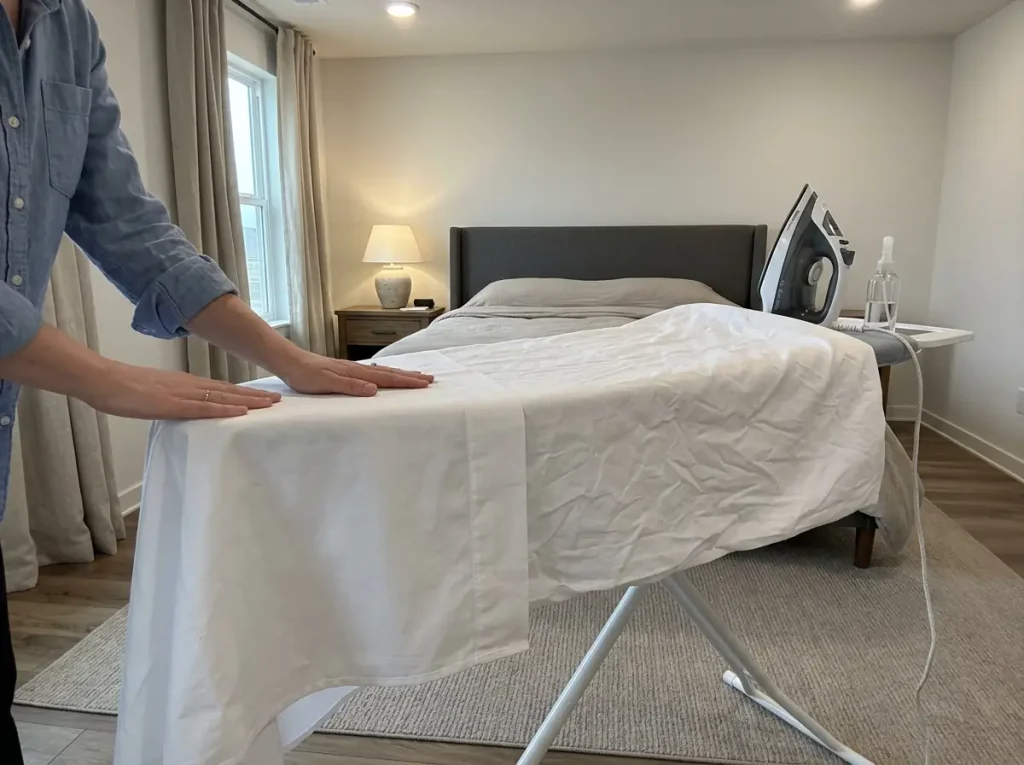
Two different things produce that hand, and they have completely different lifespans. The first is the weave: percale’s flat, locked, gap-leaving structure, which is permanent and lasts as long as the cloth does. The second is the finish: a light starch-like sizing plus calendering, the sheet pressed under heat and pressure on a flatwork ironer, reapplied every single time it goes through the laundry.
That one is temporary. It is reapplied in a hotel because a hotel launders the sheet three hundred times; it is not reapplied on your bed because your washing machine does not have a flatwork ironer bolted to the end of it.
So it fades. My estimate is roughly wash five to ten before a new percale set has lost the packaged crispness, and I want to be straight about where that number comes from: it is a synthesis, not a citation. No authority body publishes a home wash-count figure for a starch finish, and the sources describe the finish as diminishing with repeated washing and stop there. Five to ten is what the mechanism and the buyer reports converge on, and you should read it as an estimate.
The buyer reports are worth having, because they show the same thing from the other side. Commenters describe new percale as noticeably stiff or firm straight out of the package, then softening after a handful of washes. That is the sizing leaving, described by somebody who did not know they were describing sizing. One commenter who bought a 200-count Italian set reports getting “that crisp hotel feel, freshness, sound” right away, which is a fresh-purchase report and nothing more; it says the finish arrived, not that it stayed.
And notice what is in that phrase: sound. The sound goes before the feel does. That faint crackle when the top sheet gets pulled back is the sizing, not the cotton, and it is the first thing to disappear.
When the bed goes quiet, the finish has left — and the sheet underneath is exactly as good as it was the day it arrived. Nothing has failed. Something temporary has ended.
You can put the finish back, but only as a top-up, never as a purchase. Light spray starch on a damp sheet, hot iron, and press the top third. The turn-back and the pillowcases are the only parts anyone touches with a face. Skip the fitted sheet entirely; nobody has ever felt the crispness of a fitted sheet. It takes about ten minutes and it has to be repeated, which is precisely what a hotel laundry is: the same ten minutes, three hundred times.
Which leaves an honest split, and it is the one nobody in this search result closes. Buying the hotel weave buys you the durability and the airflow, permanently. It does not buy permanent crispness. Anybody selling you the crispness is selling the finish and delivering the weave — and the weave is the better half of that trade, but you should know which half you are getting.
Buying the Construction Instead of the Story
Which turns a vague ambition into a short shopping list, and the first item on it is free.

Before buying anything: wash the percale already in your closet, and iron it while it is still damp. If the set is percale and it has simply gone soft and quiet, the crispness is recoverable and it costs you nothing but the ten minutes. A lot of people replace a perfectly sound set because it stopped sounding like a hotel. That’s a finish problem wearing a fabric problem’s clothes.
If the set genuinely is not percale, here is what to look for on a listing. Four things, and a listing that gives you all four is describing the hotel construction:
- The word percale, not “crisp,” not “cool,” not “smooth.” Those are adjectives; percale is a construction.
- Single-ply, stated outright.
- A staple-length claim: long-staple, or extra-long-staple, ideally with the inches.
- A count between roughly 250 and 400. Not higher. Higher is the ply trick.
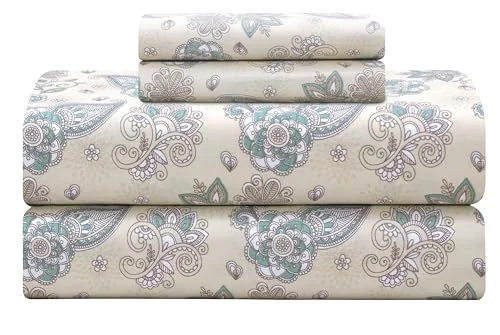
There is also a shortcut the community found on its own, and it is a good one. Commenters point out that The Company Store sells retail versions of sheets it supplies to hotels, so you can pick a property whose bed you liked and buy its equivalent instead of guessing from adjectives. Not a recommendation and not a link, just the cleanest example of buying the construction rather than the story.
Now the part hotels never have to answer. Percale is not for everybody. If you sleep cold, or you want drape and sheen more than a dry flat hand, sateen is the better sheet for you and the hotel’s answer is not your answer. A property standardizes one weave across every room precisely because it cannot ask each guest, and that constraint is theirs, not yours. Who a dry, flat weave actually suits is a question you get to answer for one bed instead of four hundred.
If you do run hot, the Brooklinen Percale 4-Pc Sheet Set for Hot Sleepers is 270-count long-staple percale with OEKO-TEX Standard 100, and that certificate is worth understanding for what that certification does and does not promise: it is a chemical safety standard, not a durability grade.
Its flaw is the same constraint read backwards. Hotels do not sort percale by who sleeps hot and who sleeps cold, they standardize one weave for the whole property, so a cold sleeper may well find this percale less warm than a sateen, and an OEKO-TEX tag does not change that one degree. And if the two-way choice is not enough, the three-way comparison with linen included is where the third option lives.
One last thing, and it is the failure that actually arrives. A commenter’s long-staple percale set outlived its own elastic. The fitted sheet’s band gave out while the cloth was still sound enough to be repurposed as drop cloths.
That is the pattern. The fitted sheet decides the real lifespan of a set, and it is never the piece the label describes: count, staple and ply are all specs about the cloth, and the cloth outlives the band that holds it on the mattress. No thread count predicts elastic.
What to Take From This
Hotels buy percale: single-ply long-staple cotton, roughly 250 to 400 count, white. And they buy it because their own laundry destroys everything else, not because it is the finer cloth. That is the whole decision, made by a machine and an accountant rather than by anyone with an eye for bedding.
The number on the package is the least useful spec printed on it. Ply, staple length and GSM decide how a sheet wears, and a listing that prints only its thread count has quietly told you which of its specs is the flattering one. Read the back, not the front.
And the weave is permanent while the crispness is not. Buying percale buys you durability and airflow for years; the papery hand is a finish that leaves by roughly the tenth wash and gets topped up at home with light starch and a hot iron. Knowing which half is which is the difference between a disappointing set and a set you understand.
After a season of washes, put a hand on the hip band and the top fold-over before you look at anything else. That is where a percale thins first, and a set that still reads even in those two places has years left whatever it feels like elsewhere.
Then, tonight: iron the percale you already own while it is still damp. If it comes back crisp, you never needed new sheets. You needed the finish back. And if you now want to know about the weaves that never make it into a hotel at all, the two weaves nobody puts in a hotel are a different argument entirely.
Frequently Asked Questions
01What kind of sheets do Marriott hotels use?
Marriott’s own retail shop sells percale, described as crisp, cool and lightweight. Most large chains run percale house programs in the 200 to 300 range, with sateen held back for suite upgrades at some properties.
02What thread count are 5 star hotel sheets?
Lower than most people expect: roughly 250 to 400, and often 200 to 300. Hotels buy single-ply construction and long-staple fiber rather than a higher number, because ply and staple length predict wear and the count does not.
03Are hotel sheets percale or sateen?
Percale, in the great majority of properties. Sateen turns up as a boutique or suite-level upgrade, chosen for drape and sheen rather than for how it survives a commercial laundry, and accepted with a shorter replacement cycle.
04Where can I buy hotel quality sheets?
Buy the construction rather than the phrase: percale, single-ply, long-staple, 250 to 400 count. Some suppliers sell retail versions of the sheets they make for hotels, so the equivalent of a bed you liked is often findable.
05Why do hotel sheets feel crisp and mine don’t?
Two reasons. The weave is percale, which is flat and dry rather than smooth. And commercial laundries add a light starch finish and press the sheets on a heated ironer — that second part washes out at home, and it is the part most people are missing.





Tried it on your own bed?
No comments yet. Tell us what you changed, and what the sheet did after a few washes.