







What’s in here8 sections
Most flannel sold online never prints the number that decides whether it will keep you warm. The listing says brushed, or velvety, or cozy, and none of those words is a measurement. Flannel is not even a fiber: it is a finish.
The cloth gets woven first, then the surface is raked with fine wire teeth until a fuzz stands up off it, and that fuzz holds still air against you. Warmth in a bed is trapped air, so the real question is how much of that raised surface there is and how much air it can hold.
Here is what the number is, when trapped air is exactly what your bed is missing, when it is exactly what you do not need, what happens when the other person in the bed disagrees, and what the set looks like two winters in.
Quick Answer
Flannel is worth it when the room runs cold and the sleeper does too: the raised nap traps still air, which is a real mechanism rather than a marketing word. Look for 5 ounces per square yard as the floor. It stops being the answer the moment a warmer-running partner shares the bed or the room is heated.
Flannel Is a Finish, Not a Fabric
The word sits on the package as though it named a material, the way linen or silk does. It does not, and that is why two sheets both labeled flannel can sleep completely differently. Stop reading the fiber content on a flannel listing; it is cotton on nearly all of them, and the cotton is not the point. Look at what was done to the surface.
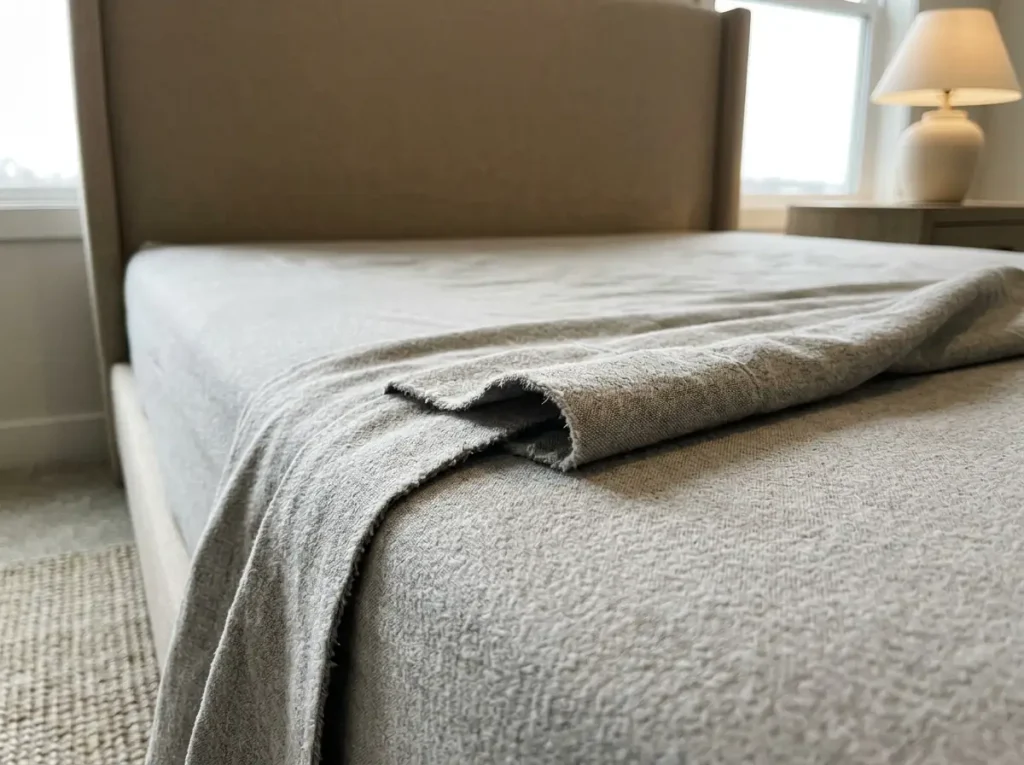
Flannel starts as an ordinary woven cotton cloth, usually a loose plain weave or a light twill. It becomes flannel at the napping machine, where rotating cylinders covered in fine wire teeth rake across the surface and pull short fiber ends up out of the yarn.
Those raised ends are the nap. They do not warm anything themselves; they hold a layer of still air against your skin, and still air is the insulator, the same principle as the loft in a duvet working at a fraction of the thickness.
Single-napped means one face was raked. Double-napped, sometimes written as double-brushed, means both were. The second pass costs more to run, and it tells you something beyond the extra fuzz: the base cloth had to be strong enough to survive being raked twice. A thin, cheaply woven flannel cannot take a double napping without going to holes, so mills do not try.
This is also why flannel behaves nothing like percale or sateen, which are defined by how threads crossing over and under each other decides everything else about a sheet rather than by what happened to the surface afterward. A percale is one over, one under, with the gaps built into the geometry. A flannel might be a perfectly ordinary weave underneath and still sleep twice as warm, because the argument is happening on top of the cloth instead of inside it.
The community describes the difference physically rather than technically. One cold sleeper on a long-running forum thread said plain cotton in winter feels like slipping into a drawer at the morgue, and that with flannel there is no cold feeling when you first get in, no cold spot.
And the nap is what wears out. Every wash pulls a few of those raised ends loose, which is the shedding you see in wash one and the pilling you see later. The mechanism that warms you is the same mechanism that degrades, which is the honest frame for judging how long a set will last.
Do not judge a flannel set out of the bag. The nap arrives compressed flat from being folded and pressed under weight in shipping, and the first hot wash and tumble is what lifts it. A verified buyer of a 6-ounce set wrote exactly that: out of the package she thought they were too light or thin, and after washing they seemed fluffier. Wash it before you decide whether to keep it.
The Number That Decides It, and What to Do When Nobody Prints It
If the nap is what holds the air, the useful question is how much nap there is. Unlike thread count, that one has an honest number behind it.
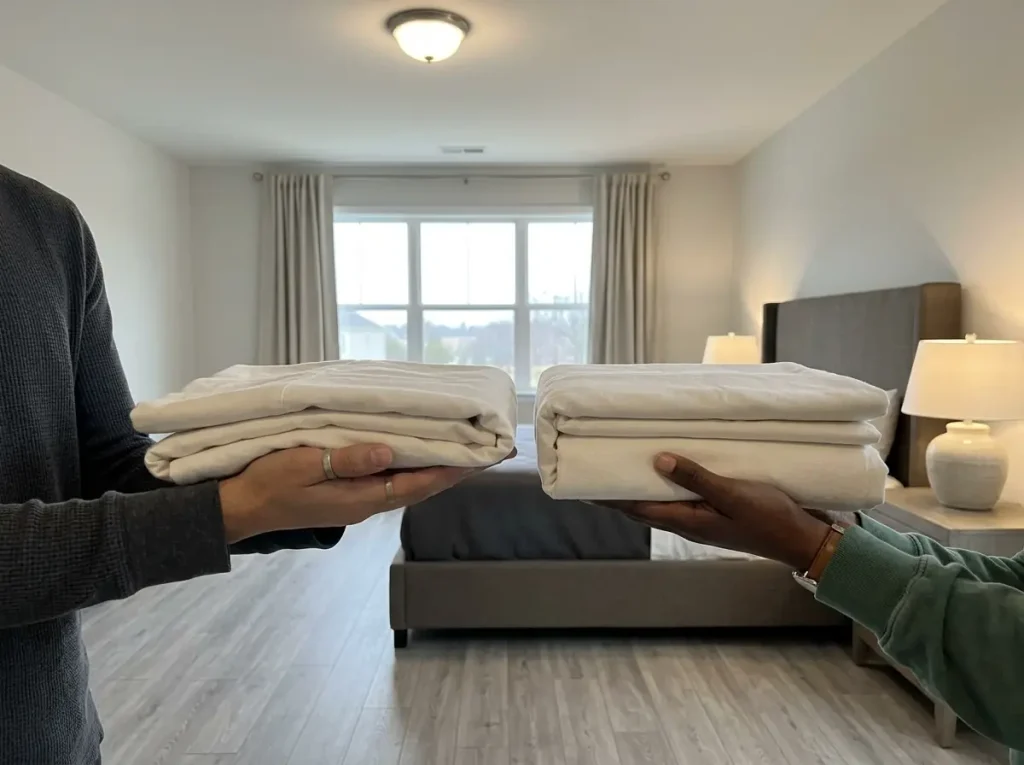
Flannel is measured by fabric weight, in ounces per square yard or grams per square meter, not by thread count. Thread count counts threads in a fixed area, which is a real measurement of a woven cloth and then gets used to imply things it never said. On a napped fabric it says almost nothing at all, because the raised surface is the product and the threads underneath it are just the scaffolding. This is the same trap from the other side as thread count measuring something real and then getting used to imply something it never said on percale and sateen, except on flannel the number is not just inflated, it is irrelevant.
Here is the number that is not. The accepted floor for flannel is about 5 ounces per square yard, with anything past 6 counting as heavyweight. Five ounces is roughly 170 GSM; six is roughly 200. Below five, the cloth is thin and the nap has very little to stand on, which is why lightweight flannel goes flat and shiny so much faster than the same brand’s heavier line.
Then there is the tiebreaker, and it matters more than a small difference in weight. Double-napped fabric reads thicker and warmer than single-napped at an identical GSM, because the same weight of cloth is carrying twice the raised surface. Two sets can print the same number and still sleep differently. When the weights match, the word double-napped or double-brushed in the listing is the one that decides it.
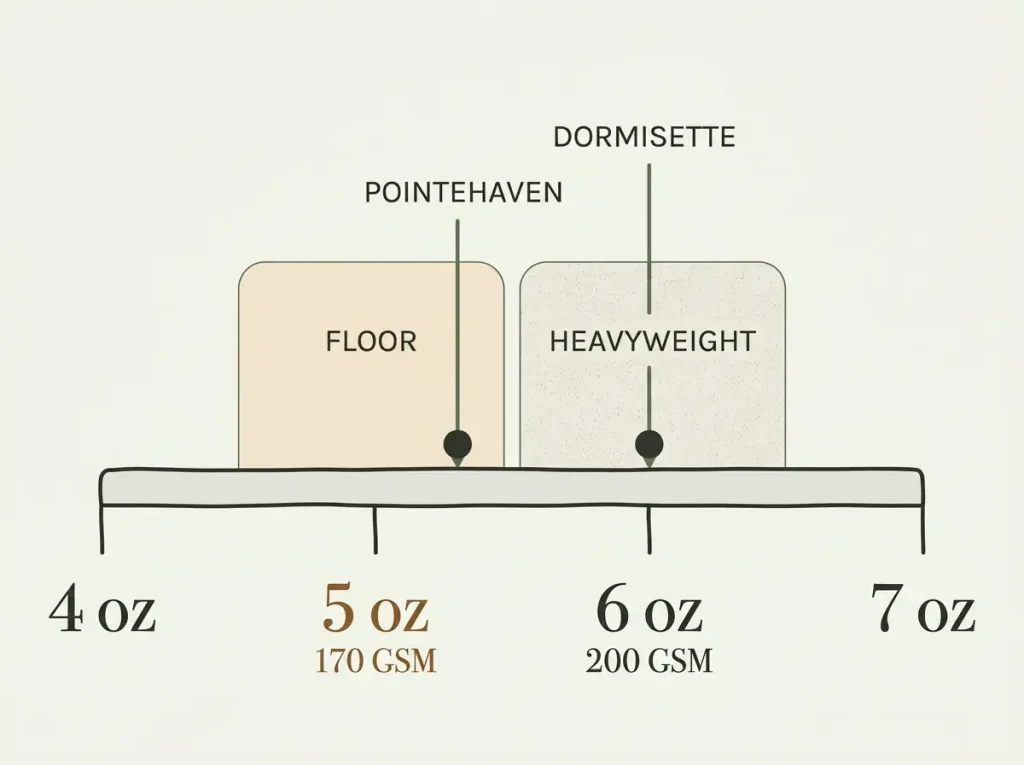
Now the awkward part: most retail flannel simply does not state a weight anywhere on the page. Treat that silence as information rather than as an inconvenience. A mill that hit 6 ounces advertises it, because the number is the entire selling point and it cost real money to reach. When the number is missing, do two things.
Search the description for double-brushed or double-napped, which unlike the weight is cheap to state and therefore usually stated when true. And if you are holding the folded set in a shop, lift it. Heft in hand is a crude proxy, but when the label has gone quiet it is the only one you have left.
Heft is the buyers’ own word for it, incidentally. A reviewer who moved from a 5-to-6-ounce Portuguese set to a German one described the new sheets as extraordinarily soft while still having excellent heft, in quotation marks, reaching for weight to describe quality because she had no number in front of her either.
One more thing nobody puts on a label. Two sets can reach the same GSM by opposite routes: one from a dense base cloth with a light nap, one from a looser weave raked hard on both faces. The second is warmer and the first lasts longer. That is the whole reason the double-napped wording carries more information than twenty grams of weight difference does.
Below are the two ends of that rule, side by side. Neither is here as a pick. They are here because both of them publish their number, which makes them readable in a category where almost nothing is.
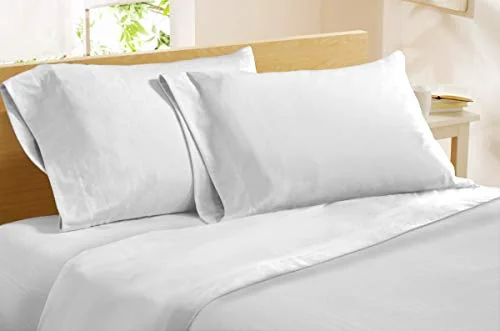
Twenty grams of GSM between those two is not much. The gap between a page that tells you its weight and one that does not is enormous, and that is the actual lesson.
One more number on the same listing, and it is the one that ruins more flannel purchases than weight ever has: pocket depth. Flannel is thicker cloth than percale, so a deep pocket has more fabric to gather at the corner and the elastic is fighting more bulk. Most flannel fitted sheets state a mattress depth somewhere in the fifteen-to-seventeen-inch range, and you want that figure measured against your mattress plus whatever is on top of it. A pillow-top mattress with a mattress topper over it pushes a lot of beds past a shallow pocket. And a flannel sheet that will not stay hooked under the corner is not a warmth problem, it is a fit problem, and no amount of grammage fixes it.
And a word about origin, since every roundup leans on it. Portuguese flannel and German flannel both get named as quality markers, and there is something behind it: those mills tend to spin longer fibers, and long-staple cotton sheds less loose end into the nap. But it is a proxy, not a specification. Origin without a stated weight tells you where the cloth was made and nothing about how much of it there is.
When Flannel Is the Right Answer
All of that machinery only matters if trapped air is the thing missing from your bed. For one particular reader it very much is.

Start with the room, because warmth in a bed is trapped air rather than weight and a cold bedroom drains it faster than any single layer can replace it. Room temperature is the variable nobody measures before shopping: a bedroom sitting in the low sixties overnight cools a plain cotton sheet faster than a sleeper can warm it, and the duvet does not fix that, because the duvet is above you and the sheet is against you. Those are two different jobs and only one of them is being done. Warmth retention in a sheet is almost entirely about what happens in the half-inch against your skin.
Then the sleeper. Somebody who runs cold spends the first twenty minutes of every night warming the bed up before sleep is even possible. Flannel cuts that to nearly nothing, not by producing heat but by holding onto the heat you have already given it instead of conducting it away.
The real sell, though, is the cold spot.
Plain cotton re-cools within about a minute of you rolling off it, so every turn in the night lands you on a fresh cold patch and you surface slightly each time without knowing why. Flannel’s nap keeps that patch warm. Readers who have this problem recognize the description instantly, and it is exactly how the community puts it: no feeling cold when you first get into bed, no cold spot, they always feel warm. That is the entire case, said by somebody who owns the sheets.
Flannel also works well as one layer of a cold-room system rather than as the whole answer. One poster runs flannel sheets with an electric blanket specifically so the thermostat can come down, and reports turning the heat way down at night and staying warm anyway. Whether the heat should come from a plug or from more layers is a separate argument, but the stacking logic holds either way: the sheet handles first contact, something else handles the hours.
Here is the boundary of all this, and it is sharper than the roundups let on. Flannel’s advantage lives at first contact and after every turn. It does not live at three in the morning. Once the bed is fully warm, an hour in, a percale sheet under a good duvet is doing very nearly the same job.
So if your complaint is that you are cold at bedtime, flannel is aimed precisely at you. If your complaint is that you are cold all night, the duvet is what is wrong and the sheet is a distraction from it.
Time your own complaint before you buy anything. Cold for the first twenty minutes and fine afterward is a sheet problem, and flannel solves it. Cold at four in the morning after the bed has been warm for hours is a fill problem, and no sheet on earth will touch it. People buy flannel for the second one constantly and then report that it barely helped, which is true and is not the fabric’s fault.
When Flannel Is Too Much, and the Free Fix to Try First
The same trapped air that rescues a cold sleeper is what wakes a warm one. And because the sheet is underneath you, it is the one layer you cannot throw off.
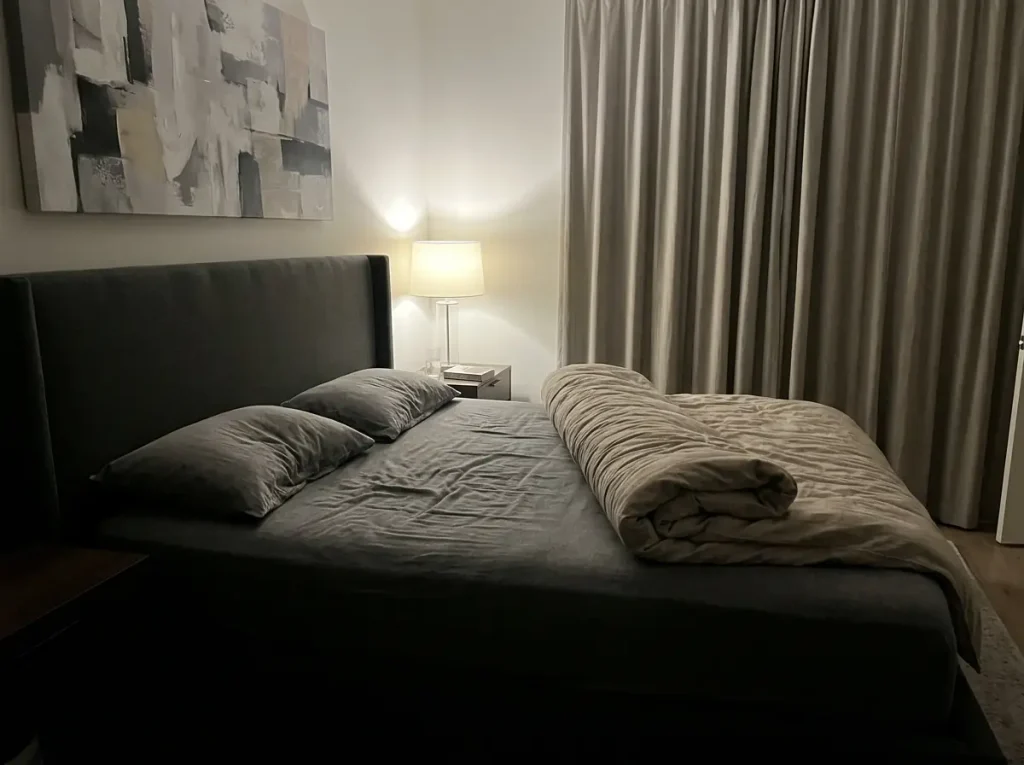
The first disqualifier is the heated room. A bedroom held at seventy overnight does not have a cold-sheet problem in the first place, and flannel in it is insulation solving nothing while adding a load of warmth you did not ask for.
The second is the hot sleeper, and the failure mode is not really discomfort. It is waking up half-uncovered. Flannel is a poor choice for anybody whose thermoregulation already runs on the warm side, and a genuinely bad one for anybody dealing with night sweats. The nap holds moisture as readily as it holds air, and its breathability is low by design, since the whole point of the raised fiber is to stop air moving through.
Nothing about it wicks, either. A brushed cotton surface has no moisture-wicking behavior to speak of, so what leaves your skin sits in the nap until it cools.
That is the overheating-then-chilling cycle nobody wants twice in a night. From the same thread as the cold sleepers, in the opposite direction: with flannel sheets he wakes in the middle of the night to find he has thrown half the bedding off in his sleep because he was so hot. His own fix was reverting to cotton sheets with an extra blanket he could remove, which turns out to be the structural point of this whole section. A removable layer beats a fixed one, every time, for anybody whose temperature moves during the night.
So before changing what is underneath you, change what is on top. If you are cold, the duvet is the cheapest thing to reassess and often it is already enough on its own; one poster on that thread said flatly that his duvet is more than warm enough so flannel is not needed. Another does not even reassess, he just adds: if he is cold at night, he throws on another blanket. There is a reason a blanket you can push off is worth more than a sheet you cannot, and it costs nothing to test tonight with what is already in the closet.
The second free move is the split set, and it is the best-kept trick in this whole category. Put a flannel top sheet over an ordinary fitted sheet. You get the warm layer where you can push it away, and the surface you actually lie on stays cool and smooth.
A community member arrived at this independently, saying she loves a regular fitted sheet with a flannel top sheet, that way she avoids the sweaty feeling. If you already own both, it costs nothing at all.
Only when the duvet genuinely is the gap does a purchase make sense here, and then it is a fill question rather than a fabric question, which means asking which fill is doing the trapping before anything else. Something like the Utopia Bedding Twin Duvet Insert, a down-alternative all-season fill, is the cheap way to add warmth in a layer you can shed, but be clear about its limit: it is a fill, not a sheet, so it does nothing whatsoever about the cold shock of first contact, which is the one thing flannel is genuinely better at. If your problem is the first two minutes in bed rather than the next six hours, a warmer duvet is the wrong purchase.
Why does any of this matter so much? Because the sheet is the only bedding layer you cannot adjust in the night. Everything else can be pushed down, folded back, kicked to the end of the bed. You are lying on the sheet, so its warmth is committed for the entire night at the moment you make the bed in the morning.
That asymmetry is the reason a warm-running sleeper should load the warmth into the removable layers and keep the fixed layer neutral, and it is the whole reason the split set works.
If you buy flannel and it turns out to be too much, do not return the whole set. Keep the flat sheet, put your old percale fitted sheet back on the mattress, and use the flannel as the top layer only. You end up with the split setup on purpose, and the fitted sheet you no longer need becomes the spare that lives in the closet for wash day.
Two People, One Bed, One Sheet
Every source in this search result writes as though one person sleeps in the bed. In a shared bed the sheet is the one layer that cannot be split down the middle the way the duvets can, which makes that omission expensive.
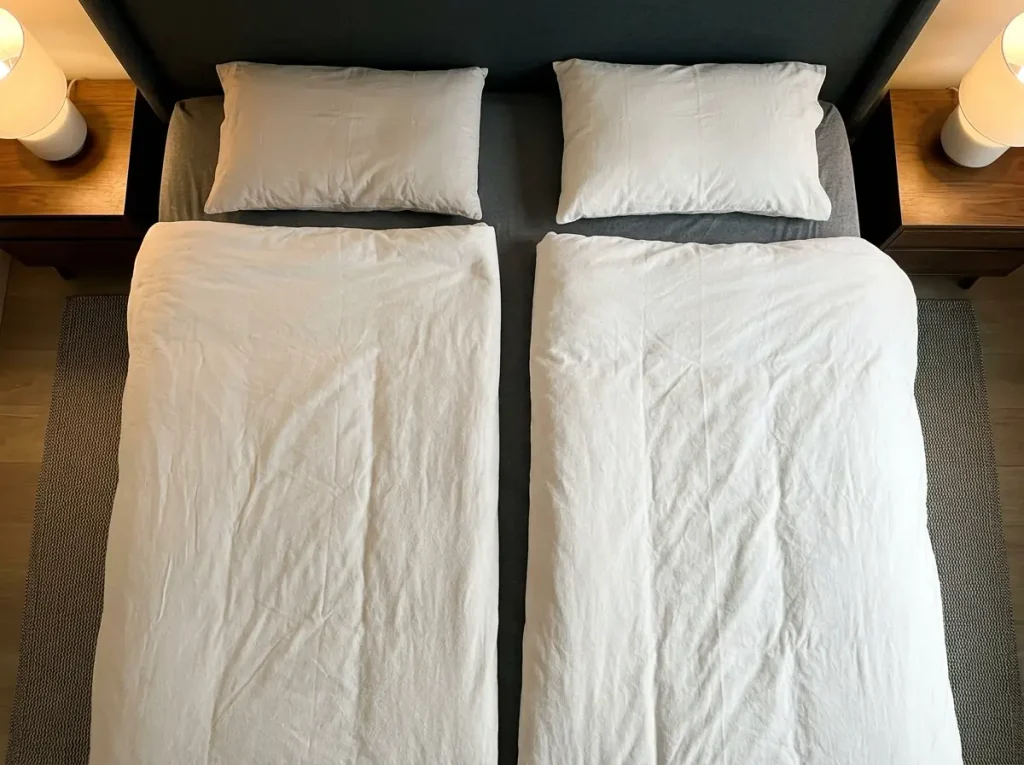
Think about why the sheet is the hard layer.
A couple with mismatched thermostats can run two duvets of different weights and both of them are right at the same time; nobody has to compromise, because the layers are independent. The fitted sheet is one piece of cloth under both people. Whoever it suits, the other one loses, and there is no version where it splits the difference. It just picks a winner.
The flattest statement of this in all the research is one line from a forum poster: he cannot use flannel sheets, he gets too hot and sweats enough as it is, and his wife will not touch him under flannel. One sentence, two people, an obvious problem, and not one competing article on this topic offers a solution to it.
There are three, in order. Start with the flannel top sheet over an ordinary fitted sheet, the same split from the last section, working here for a different reason: the warm layer becomes removable, so the cold sleeper keeps it pulled up and the warm one pushes it down to the waist, and neither of them has to lie on the other’s preference. Then two duvets of different weights over that neutral base, which is now well-known advice and works, though two duvets on one bed, and what size each of them has to be is a real question with an unintuitive answer. Two people one bed is the case the whole industry designs around and then never writes about; a lighter fill power on one side and a heavier one on the other, each in its own duvet cover, settles more arguments than any sheet ever will. If you want the arithmetic rather than the feel, that is what a tog rating is for. Then, if both fail, separate beds. That is not a joke and it is not a marriage verdict; for genuinely irreconcilable sleepers it is the answer, and plenty of households run it happily.
Some households solve it by buying for the sleeper rather than for the house. One buyer picked up a flannel set for her cold-running father and a separate set, in a different color, for herself, because she keeps the house cold and runs hot. Those were two different beds and she still had to sort each sleeper separately, which is the honest scale of the problem. The set she used for both, the Bare Home Flannel Sheet Set in 100% double-brushed cotton with a 15-inch pocket, earns its place in this article by being the evidence rather than the pick, and its own reviews are honest about the cost: it sheds a lot of lint on the first wash, enough that one buyer used a lint roller before making the bed, and it shows visible pilling near the foot by around the third wash.
Then there is the sticking complaint, which is real, specific, and mentioned by exactly nobody in the professional coverage. Flannel grabs other napped surfaces, and cotton flannel pajamas are the worst offender. A poster described it precisely: the sheets grab onto your clothing, so turning over is uncomfortable and you have to readjust too much. Somebody else in the same thread reached for the felt board an elementary school teacher used to stick shapes to, which is the right physical picture.
That is nap catching on nap, which means the fix is not a different sheet at all. Change the base layer to something smooth, and the problem disappears the same night.
One thing that trips up couples who have already done the reading: the pair that solved the duvet argument with two duvets very often still has the sheet wrong, because the two-duvet advice has spread and the sheet advice has not. If one of you is throwing the duvet off at two in the morning while the other is fine, check what you are both lying on before you buy a third duvet. The layer you cannot adjust is the one to look at first.
Year Two, Year Five
Every roundup on this subject tests flannel for about five washes and stops, which is roughly the point at which flannel starts telling the truth about itself.
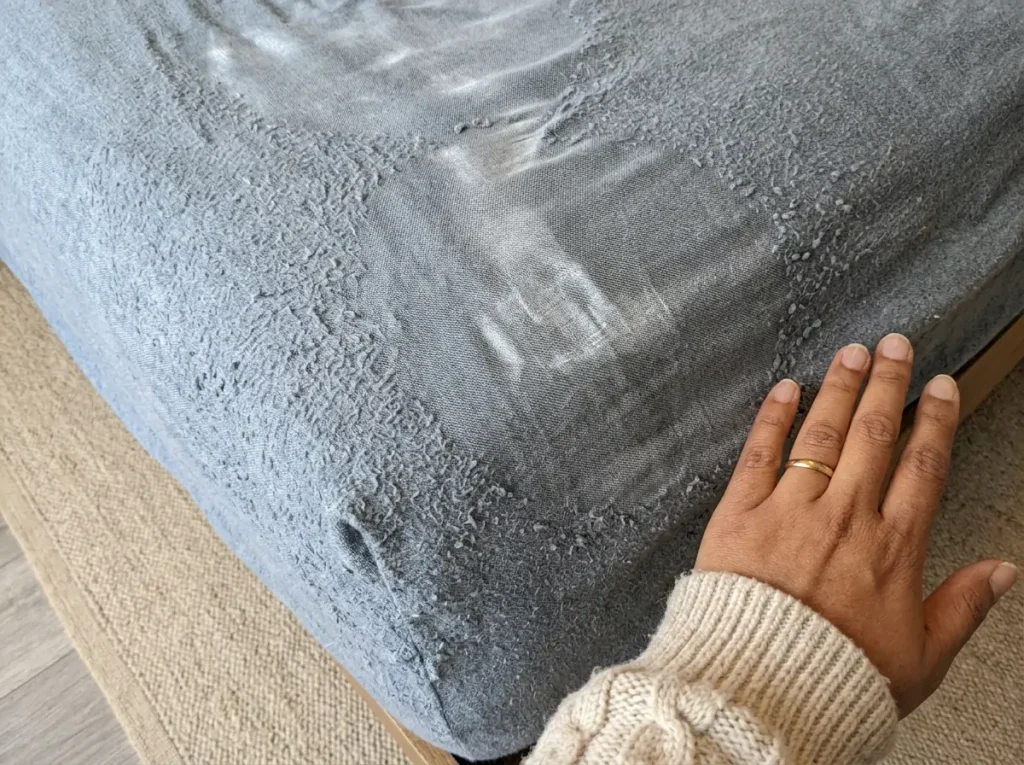
Wash one is shedding, not damage. A new double-brushed set sheds loose surface fiber heavily the first time through, and it can be alarming: one buyer needed a lint roller before she could make the bed, and expected it to lessen over time if she followed the care label. She was right to expect that. What is coming off is the loose ends the napping machine raised but never anchored, not the sheet coming apart.
Wash three is the first pilling, and it is normal. The same set showed visible pilling near the foot of the bed by about the third wash, which the buyer called no different from her experience with other flannel sets. That is the correct bar. The question is never whether a flannel pills; it is whether it pills worse than the last one did.
Then comes the fact the five-wash tests can never reach. Flannel does not decline steadily. From the community, and it is the single most useful sentence in all of the research on this keyword: flannel pills no matter what, it hits a point where it no longer gets worse, and that is essentially your final product. It sheds its loose nap, pills for a few cycles, and then plateaus.
What you have at month three is roughly what you will have for years. That plateau is a completely different shape of wear from how the same wash count treats a percale and a sateen, where the decline is gradual and never really stops.
Which explains why the community reports run so long. Sets running six years, eight, even fourteen turn up repeatedly in the same threads, a lifespan that a five-wash test implicitly says is impossible. The roundups are not lying. They are measuring the only part of the curve that fits inside a testing window, and it happens to be the part that looks worst.
You can slow the early part down. The one specific instruction from a longtime flannel owner: no special care required other than not using fabric softener, because it is bad for flannel. He is right about the mechanism: softener coats the raised fiber and mats it down, working directly against the nap that is doing all of the warming. Beyond that: wash warm rather than hot, or cold if the set is already broken in, because heat is what sets the shrinkage and cotton flannel has more of it to give than a plain woven sheet does. Tumble dry low and pull it out slightly early.
And wash less often than instinct suggests. Overwashing is what quietly ends most sets: every cycle costs nap, and nap is the product.
Weight does buy durability here, and there is testimony for it rather than just theory. The Dormisette buyer switched from a 5-to-6-ounce set she called generally good and reported the 6-ounce German one holding up very well to weekly washings. Same person, two sets, one bed, which is worth more than a lab number.
Both of those sets, like the Pointehaven, carry OEKO-TEX Standard 100 certification, and it is worth knowing what that does and does not tell you: OEKO-TEX Standard 100 tests finished textiles against more than a thousand regulated substances, with bed linens in the stricter direct-skin-contact class. It certifies what is not in the fabric. It says nothing about warmth, weight, or how the nap holds up.
Judge a flannel set with your eyes, not your hand. A pilled sheet still feels soft, sometimes softer than it did new, so running a palm over it tells you nothing. Put a lamp low at the side of the bed and look across the surface in raking light: where the nap is gone the cloth reads flat and slightly shiny against the fuzzy areas around it. It is always worst at the foot, where feet move most.
What to Do With All This
Three things carry the decision. Look for the ounce weight before anything else, because 5 ounces per square yard is the floor, 6 is heavyweight, and a listing that will not say is telling you something about itself. Flannel is for a cold room and a cold sleeper, both halves; if either one is missing, put the warmth in a layer you can throw off instead. And if you share the bed, remember that the sheet is the layer that cannot compromise, so solve it with a flannel top sheet over an ordinary fitted one before you buy a full set for two people with one thermostat between them.
After a season of washes, check it in raking lamplight at the foot of the bed. Flat, slightly shiny patches mean the nap has gone there. If those patches have stopped spreading, the set has plateaued and it owes you several more winters.
Tonight, put a flannel top sheet over the fitted sheet you already own. Sleep on it a week, both of you. Then decide whether you need the whole set.
Frequently Asked Questions
01Do flannel sheets actually keep you warmer?
Yes, by trapping still air in the raised nap rather than by generating any heat of its own. The effect is strongest at first contact and after you turn over. Once the bed is fully warm, the duvet is doing most of the work.
02How can you tell if flannel sheets are good quality?
Look for the fabric weight: 5 ounces per square yard, about 170 GSM, is the floor and 6 ounces is heavyweight. If no weight is printed anywhere, look for double-napped or double-brushed in the description, and lift the folded set if you can.
03Is flannel better than cotton?
Flannel is cotton, finished differently: woven first, then raked to raise a nap. Against plain woven cotton it is warmer and holds no cold spots. It is also heavier, slower to dry, and it pills where percale and sateen do not.
04When should you stop using flannel sheets?
When the room is heated above the mid-sixties overnight, when you or your partner run warm, or when you wake up having pushed bedding off in the night. The sheet is the one layer you cannot remove once you are lying on it.
05Do flannel sheets stop pilling eventually?
They do. Flannel sheds loose fiber in the first washes, pills for a few cycles, then plateaus. What the set looks like at month three is roughly what it looks like for the rest of its life, which is why community reports of six to fourteen years are common.





Tried it on your own bed?
No comments yet. Tell us what you changed, and what the sheet did after a few washes.