







What’s in here7 sections
Both fabrics get sold on the same word, cozy, and they sit side by side on the same shelf as if they were two settings of one dial. They are not the same kind of thing at all. Jersey is a knit: one continuous yarn looped through itself, row after row, which is why a jersey sheet pulls in every direction and a woven one does not. Flannel starts life as an ordinary woven cloth and only becomes flannel afterward, when machines brush its surface until a fuzz stands up on it, which is why the fuzz can leave while the cloth stays.
Every difference that matters after that comes out of this one split: what jersey and flannel each do to warmth, how each one breaks, the number neither prints honestly, and what happens when two people who disagree about heat have to share one sheet.
Quick Answer
Jersey is a knit that stretches and fails by going slack at the corners. Flannel is a brushed nap on a woven base that sheds for two washes, then pills. They are two constructions, not two points on one warm-to-soft scale, and in both the weight in GSM decides quality, not the softness you feel in the shop.
What Each One Actually Is
The two words sit next to each other on every shelf and in every list, which hides the fact that they answer completely different questions. One answers how is this cloth built? The other answers what was done to it after it was built? Jersey is a construction. Flannel is a finish, applied to a base that is already a proper woven cloth with a grid and a direction and everything else what a weave actually is implies. A fabric can be one, the other, neither, or in theory both.
Jersey Is Knitted, Which Is Why It Stretches
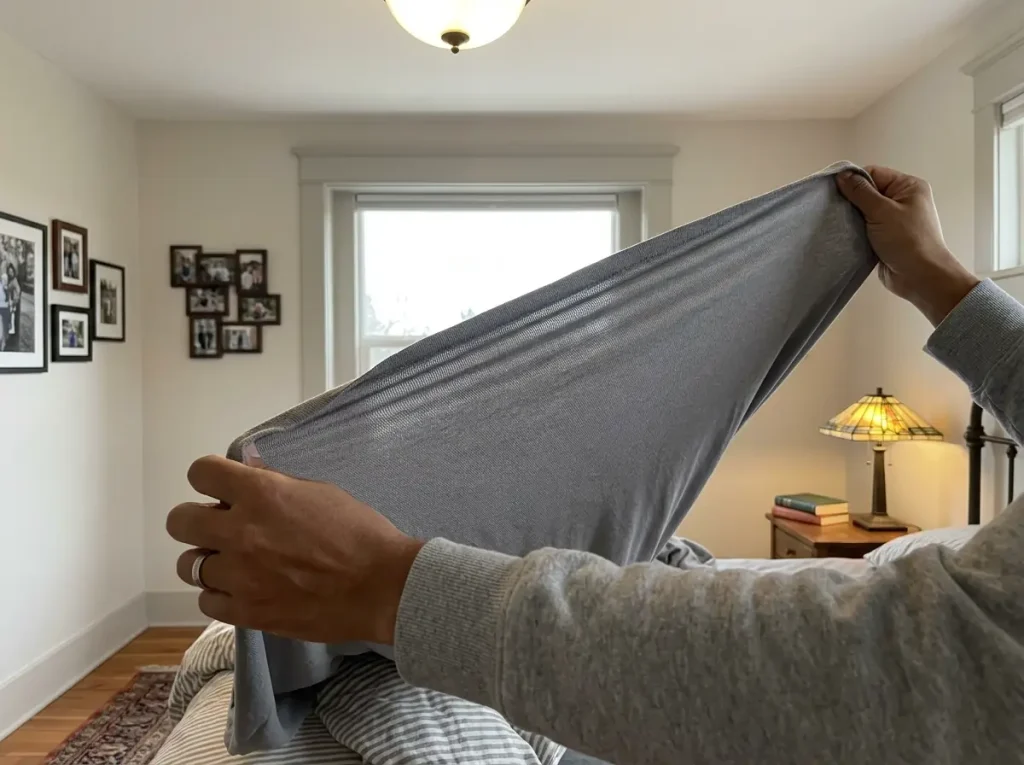
A knitting machine does not cross threads. It makes loops, and each loop hangs through the one above it, so the whole cloth is one long yarn holding hands with itself. Pull on it and the loops simply lean. There is no fixed grid to resist, which is where all of jersey’s give comes from.
That single structural fact is what separates a knit fabric from a woven fabric, and every difference below follows from it.
That is the same construction as the T-shirt you slept in last night, and the community shorthand for these sheets is exactly that: T-shirt sheets. It is the most accurate description anybody uses for them, and it appears on no package.
That give is a genuine advantage before it becomes a problem. A knit pulls over a tall mattress corner instead of fighting it, which is why people with a memory-foam bed and a topper end up here.
The PURE ERA Jersey Knit Sheet Set is one of the few listings that states its construction out loud (100 percent cotton, a true knit, a pocket that goes to 20 inches) instead of promising “T-shirt soft” and leaving the fiber unnamed. That deep pocket is not a bonus here, it is the point: a knit that will relax over time needs depth in reserve.
Its flaw is written into the same sentence as the recommendation: if there is polyester in a jersey, it pills fast, and even in all cotton the knit slowly relaxes until the fitted sheet stops gripping the corner.
You can tell what you own in five seconds without reading a label. Take the sheet on your bed right now and pull it between both hands, first across and then lengthwise. A knit gives noticeably more one way than the other, because the loops travel further across the rows than down them. A woven sheet, flannel included, refuses in both directions and only gives on the diagonal.
Flannel Is Brushed, Which Is Why It Sheds
Flannel begins as a plain or twill weave and goes through a napping machine, where fine wire rollers lift and comb the surface fibers into a raised fuzz.
Nothing about the underlying cloth changes. It still has a grid, it still has no stretch, and it still behaves like a woven sheet in every way a woven sheet behaves. What sits on top of it is a separate layer with its own lifespan, and that is the sentence most pages in this comparison never write.
Flannel is not a fiber and it is not a weave. It is something done to a weave. A napped fabric is a woven cloth wearing a raised surface, and the flannel finish is that surface, not the cloth beneath it.
Say that out loud once and half the confusion in this category disappears. Thread count still technically exists under a flannel, but it is describing the base cloth hidden beneath the part you actually touch. And loose nap fiber can leave the sheet while the sheet itself remains perfectly intact, which is exactly what happens in the first two washes, and which people mistake for a defect every single winter.
What “Double-Brushed” Does and Doesn’t Promise
Double-brushed means both faces of the cloth went through the napping machine rather than one. That is all it means. It tells you how much of the sheet is fuzzy, not how good the cotton underneath is, not how long the staple was, and not how much fiber there is to lose.
The trade calls the same thing double-napped or single-napped, depending on how many faces went through, and a cotton blend can carry either. A thin, cheap flannel can be double-brushed. It will just run out of nap on both sides instead of one.
Warmth, Side by Side
With the construction settled, the warmth question answers itself in a way the shelf label never does. One of these traps a still layer of air; the other traps almost none and simply sits close to the skin.
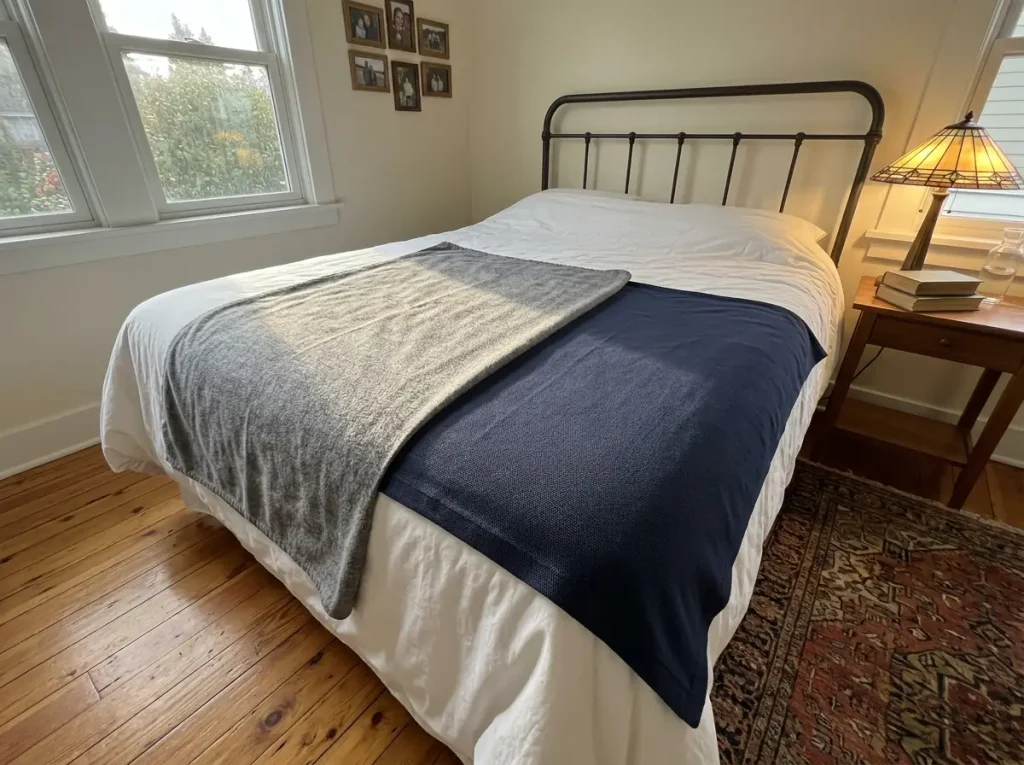
Which explains the most common complaint in this whole category: somebody buys jersey sheets because the listing said cozy, puts them on the bed in November, and is cold. They did not buy badly. They bought a different category.
Flannel Traps Air, Jersey Traps Body Heat
Flannel’s warmth is not in the cotton. It is in the fuzz, which holds a still layer of air against the sleeper, the same mechanism a fleece uses, and the same one a down duvet uses on a larger scale. Air is the insulator. The nap is just the thing holding it in place.
Jersey has no nap, so it has no air layer to speak of. What it has is drape: a knit falls close and follows the shape of whatever it is on, and it holds body heat against the skin by contact rather than by insulation. That reads as pleasantly warm in a mild room and thin in a cold one, and both impressions are correct.
The practical consequence is that flannel is a season and jersey is a year-round fabric. Jersey is year-round bedding; flannel is seasonal bedding. Nobody swaps jersey out in June. Everybody swaps flannel out, or should.
Whether flannel is worth owning for the season at all, and the ounce threshold it has to clear before it is, is a separate argument settled in whether flannel earns its place for the winter, a different question from this one, and not re-run here.
Why Jersey Feels Warm in October and Thin in January
There is a second thing going on with flannel that no listing mentions: its warmth peaks the week it comes out of the package. The nap is at its deepest and loftiest before anything has flattened it, and the same set is measurably warmer in year one than in year three. When somebody says their old flannel sheets “aren’t as warm as they used to be,” they are not being sentimental. The air layer got thinner because the fuzz holding it up got shorter.
Jersey does not do that. Its structure traps a small amount of air inside the loops themselves, and loops do not brush away. Whatever warmth jersey has on night one, it still has at wash fifty. Its clock runs on stretch instead, which is the next section.
The Sticking Nobody Warns You About
Flannel’s nap grabs. It grabs pajama fabric, it grabs the blanket above it, it grabs the flat sheet. The r/Bedding regulars call it sticky, and in one thread on whether flannel is actually cozy, two commenters described the same property and landed on opposite verdicts: one liked it because “it seems to secure all the bedclothes and blankets so they don’t slip around” (u/saltychica), and one flatly did not, reporting that in ordinary shorts and a t-shirt the layers “DO tend to stick to each other just a bit” (u/SuzyQ93).
Same fabric behavior, two honest answers. If you turn over a lot at night, that grab is the thing you will notice first, before the warmth.
How Each One Fails, and When
Both of these fabrics fail. That part is not in dispute and no brand escapes it. But they fail in opposite directions and on different clocks, and knowing which clock you are on is the difference between returning a set in week two and simply waiting out its first month.
The Two Washes That Come With Every Flannel Set
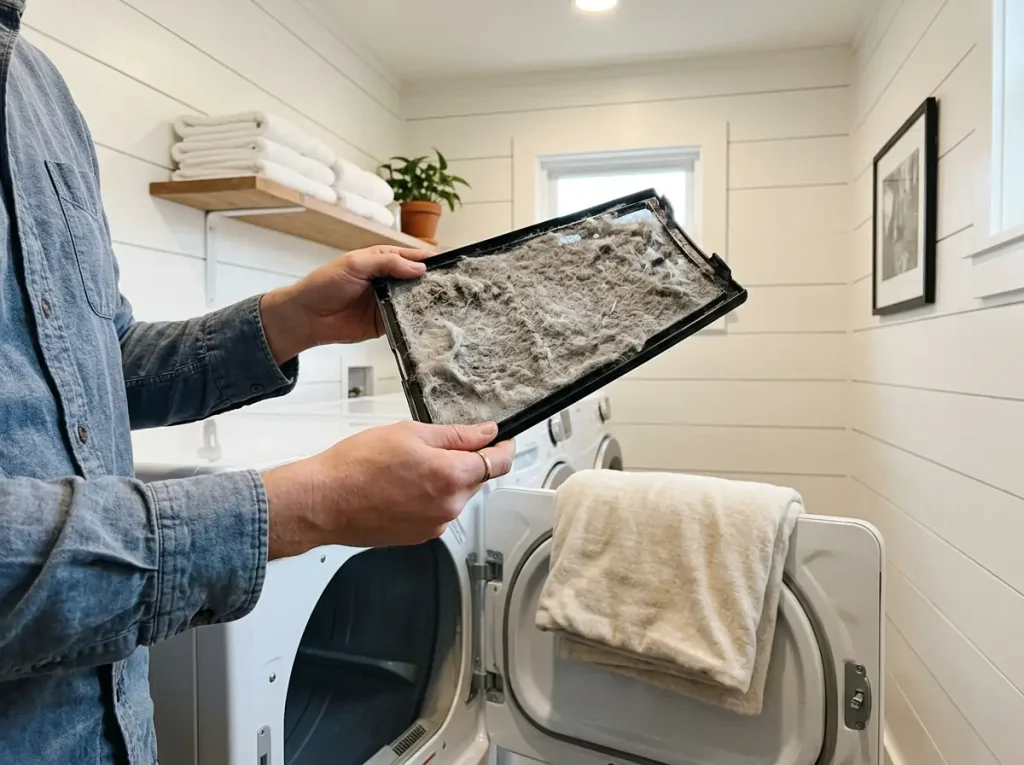
Somewhere out there tonight, a person is holding a dryer filter packed solid with lint after washing new flannel for the first time and wondering whether the sheets are defective. They are not.
The first two launderings are the shedding phase, and laundry guides describe a flannel set as “seasoned” after them. What comes out is loose nap fiber that was never firmly attached. Then it stops.
That is the important half of the sentence: flannel sheds and then it plateaus. The lint is a phase, not a trend. Week one looks alarming and month three looks fine, which is the opposite of how the wash cycle treats a jersey sheet.
The budget end of the category is where you meet this fastest, and it is also where the article’s own complaint lives. The Bare Home Flannel Sheet Set is 100 percent cotton, double-brushed, OEKO-TEX certified, deep-pocketed, and it does not print a GSM figure anywhere on the listing, which is exactly the pattern the next section takes apart. That silence is its flaw, stated plainly: with no weight printed there is no way to know in advance whether it will pill in a season or hold for years, and a flannel that declines to publish the number is usually at the light end of the range rather than the heavy one.
What comes after the shedding phase is pilling, which is a different failure entirely. Shedding is fiber leaving. Pilling is fiber staying and balling up, and it is measured, not guessed.
Mills score it on the standard abrasion tests mills actually run, where a fabric is tumbled or rubbed a set number of cycles and graded. Pilling resistance is a property with a number behind it, not an adjective a marketing team picked.
Why Jersey Sags Instead of Popping Off
Jersey does the opposite of all of that. There is no shedding week. Nothing dramatic happens at all for a long time, and then one morning you notice the fitted sheet is not really holding the corner anymore. The loops have relaxed, permanently, in the direction they get stretched every time the bed is made.
And here is the part that makes it worse than a woven failure: a percale or sateen fitted sheet that is too small pops off, loudly, at three in the morning, and you deal with it.
A stretched jersey sheet stays on, and what you get instead is corner slack. It keeps looking made. It simply stops gripping, and people re-make a bed over a sagging knit for months before admitting it needs replacing.
I have to correct the usual advice here, because the usual advice is “buy a deeper pocket and jersey will fit anything.” It will, at first. But depth does not stop loop fatigue, it only gives you more slack to spend before you notice.
And there is an honest gap worth naming: nobody has a wash count for when a jersey sheet’s loops actually give out. Not the guides, not the mills’ consumer-facing pages, and not one of the five community threads read for this piece.
Flannel has numbers everywhere. Jersey has only symptom descriptions: goes slack, thins enough to see light through it. That absence is a real finding, not an oversight.
The Dryer Does More Damage Than the Wash
For flannel, over-drying is the leading cause of pilling, because high heat and long tumbling cycles abrade the loosened nap and knot it into pills far faster than washing ever does. For jersey, polyester content is the accelerant.
As one r/Bedding commenter put it without any hedging at all, “Jersey has a lot of stretch and tends to be a poly blend or full polyester. It’s going to pill as a general rule” unless it is 100 percent cotton (u/Noidentitytoday5).
In the r/laundry thread on the same problem, a buyer shaving pills off their jersey sheets every few weeks compared notes with a friend who owned the exact same set and had none. The difference traced back to the wash, not the sheets. Cold water, medium dryer heat, washed alone, and a pillowcase is worth checking first because it takes the most friction of anything on the bed. A cold water wash and tumble dry low is the whole intervention on both fabrics, and fabric softener is the one thing to leave out of it: it coats the fibers and mats a raised nap flat, which costs a flannel set exactly the loft it was bought for.
And the uncomfortable truth about flannel: the price tier does not save you. A buyer of LL Bean Supima and Coyuchi sets, washing cold on gentle with a vinegar rinse and line-drying, still lost softness every season and asked the thread outright whether that was simply normal (u/Known-Ad-100).
The top reply said what nobody selling flannel says: most of it pills no matter what, and the brand only changes the timeline.
Which is not the same as saying every set is equal. The same community also has people on LL Bean sets at five-plus years, a Pinzon set at eight, and one Lands End set past a decade. The outcomes are genuinely inconsistent at every price point, and any page telling you otherwise is guessing. Where the two clocks sit relative to woven sheets is the subject of which weave outlasts which.
The two failures live in different places on the bed, so you can read a set without touching a label. Flannel pills where a sleeper moves against it — the hip-and-shoulder zone of the bottom sheet, and the spot on the top sheet where a knee rubs. A pilled flannel set carries a map of the person who slept on it. Jersey’s slack is at all four corners, symmetrical, and tells you nothing about where anybody slept.
The Weight Number Neither One Prints Right
Everything above comes down to how much fiber is actually in the cloth. There is a number for that. It is simply not the number on the front of the package, and a good half of the listings in this category never print it at all.
Why Thread Count Cannot Describe a Knit
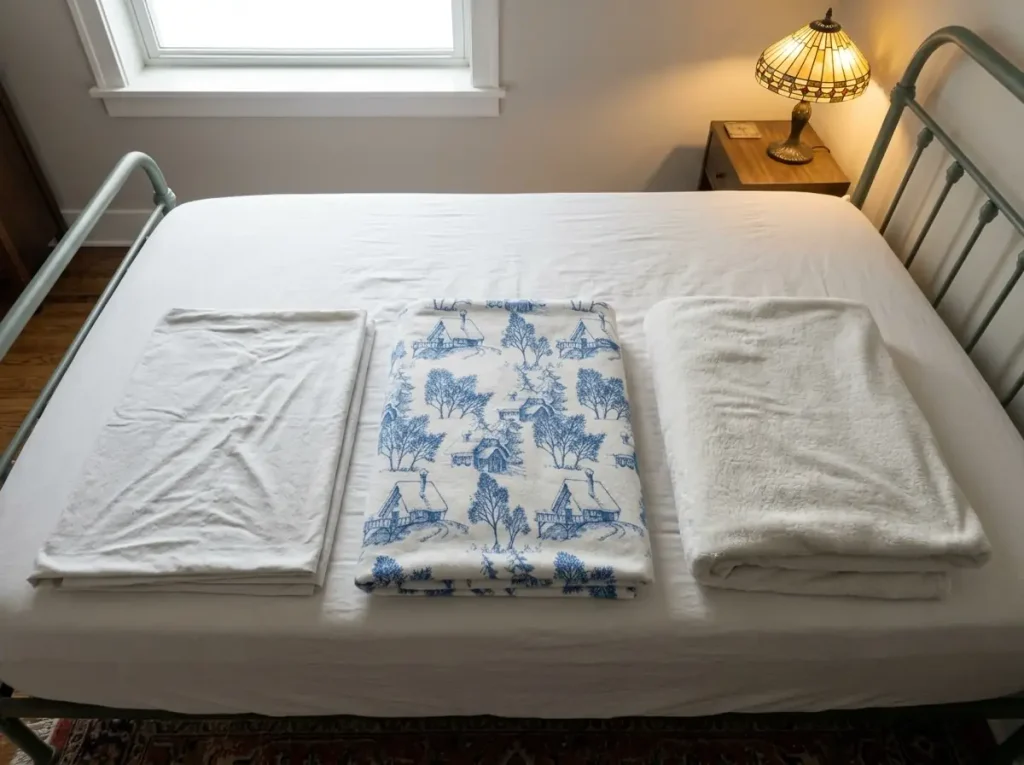
Thread count is a census of crossing threads per square inch. A knit has no crossing threads, only loops, so the figure is not low or high on a jersey sheet, it is undefined. Some listings print one anyway, which tells you something about the listing.
Jersey is sold by weight, in grams per square meter, and the usable band is roughly 150 to 200 GSM. Under that, the loops have less recovery and the sheet thins and goes slack sooner.
Flannel is also sold by weight, in GSM or in ounces per square yard, for the same reason: the count describes a base cloth you will never touch through the nap. If you want the longer version of why the count stopped carrying information even on the wovens where it does apply, that is why the thread-count number stopped meaning anything.
The GSM Bands, and What Each One Buys
What the weight physically means is this: how much fiber there is to lose. A light flannel has a shallow nap that abrades away inside a season because there was never much of it. A heavy one has more to spend before it runs out. A light jersey has less yarn in each loop, so the loop relaxes sooner under the same stretching.
In both fabrics the number is not a quality score handed down by a marketing team. It is the size of the account you are drawing down every wash.
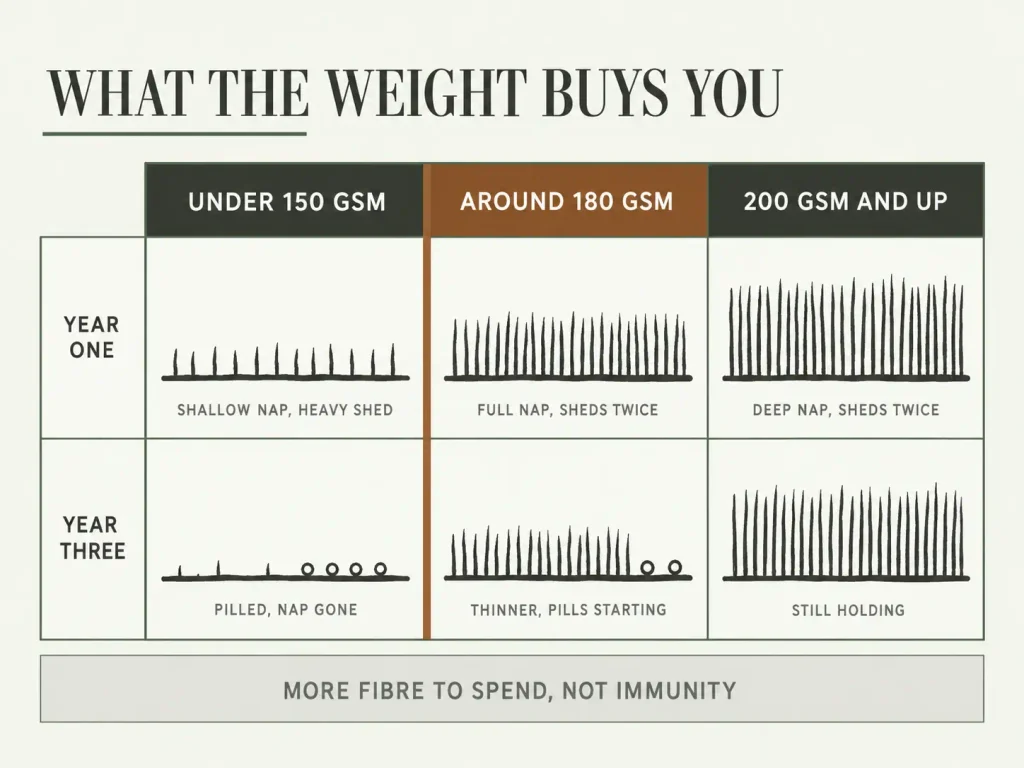
| Flannel weight tier | In ounces | What the nap does | Who it suits |
|---|---|---|---|
| Under 150 GSM | Under 4.4 oz | Shallow nap, sheds heavily, pilling starts inside the first season | Nobody, if you can read the number first |
| Around 180 GSM | 5.3 oz | Enough nap to survive several seasons before pilling shows | Most beds, most rooms |
| 200 GSM and up | 6 oz and up | Deep nap, most fiber to spend, longest clock — still not immune | Cold rooms and cold sleepers |
The mid-tier is where most people should land, and the Pointehaven 180 GSM cotton flannel set is useful mostly as proof the number exists and can be found: 180 GSM, printed as 5.3 oz on its own listing, sitting just above the decent line and well clear of the pilling-fast floor.
Its flaw is the one every flannel carries: it pills like any other, and the printed weight buys you time rather than immunity, which high dryer heat then spends fast.
One step up, the Dormisette German flannel set sits at 200 GSM, or 6 oz, at the top of the band with a 17-inch pocket, and exists in this article to make the mid-tier legible rather than to be a best pick. More weight lengthens the clock; it does not stop it. Premium sets pill too, and the community reports it happening inside a single season on Supima and Coyuchi.
The Listings That Don’t Print It
Here is the tell, and it is a reliable one. A flannel that publishes 180 GSM has a mill behind it that measured the cloth. A listing whose entire specification is “ultra-soft brushed cotton” is asking to be judged by adjective, and it is asking that for a reason. The silence is the specification.
The in-store test rewards exactly the wrong choice. A heavier flannel feels cooler to the hand on the shelf, because there is more mass to bring up to skin temperature before it feels warm. The set that reads instantly cozy under your palm is usually the light one — and the light one is the one that pills first. Find the weight on the tag and ignore your hand.
Two People, One Bed, Two Answers
Everything so far assumes one sleeper with one opinion about temperature. Plenty of beds do not work that way, and this is where these two fabrics stop being alternatives and start being a negotiation.

Why the Sheet Layer Can’t Be Split
Two duvets on one bed is the answer half of Europe already uses, and it works because the duvet is a layer that can be divided down the middle. The sheet cannot. Whatever goes on the mattress goes on both sides of it, so on a two-person bed with a mixed temperature problem the sheet choice actually matters more than the duvet choice. The duvet argument has a solution, and the sheet argument does not.
Flannel has the least room to compromise of anything you could put down there: the nap traps air for both people equally and there is no half setting. It is either on the bed doing its job to both of you, or it is not on the bed.
Jersey as the Compromise
Jersey is the middle position here, and it is not a theoretical one. A household in r/Bedding got there on their own.
“My only complaint is that they’re too hot sometimes. A good compromise for us was jersey sheets! Soft and cozy but not suffocating,” wrote u/smurphypup, describing exactly the trade this section is about.
The mechanism behind why it worked for them is the one from the warmth section: jersey drapes warm without a nap holding an air layer in, so the cold sleeper gets contact warmth and the hot one is not sealed under a fuzz.
In the same thread, another commenter described a partner heat-intolerant enough to rule flannel out entirely, resolved with a wool layer on one side and no flannel anywhere on the bed (u/Dirtheavy).
Different solution, same underlying problem. When one person runs hot on a schedule rather than on a bad night, the fuller version of that calculation is in when one person runs hot every night.
What to Try Before Buying Anything
Before any of this becomes a purchase, take the free fix. The flannel top sheet is doing most of the heat-trapping, not the fitted one. It is the layer directly against the sleeper on top and the one that gets thrown off at two in the morning.
Pull it off the hot sleeper’s side and leave the flannel fitted sheet where it is. Or run flannel on the bottom only, with a lighter top layer for both of you. That resolves a good share of mixed beds without anybody buying anything, and it takes about four minutes.
One more thing about shared beds and flannel, because it will happen and nobody warns about it: the pilling map splits down the middle. The hot sleeper moves more, the nap abrades where a sleeper shifts, and their side of the bottom sheet pills first and faster. A flannel set on a mixed bed ages asymmetrically and gets replaced on one person’s schedule, which is worth knowing before you conclude the set was defective.
Conclusion
Check what you already own before you shop for anything. Pull the sheet between both hands: if it gives, it is a knit, and nothing written about thread count applies to it.
Then find the weight before you find the adjective. If a listing prints no GSM and no ounces, that silence is the specification, and it is telling you which end of the range you are on.
Finally, match the failure mode to your patience. Flannel’s shedding ends after two washes and then the set settles; jersey’s sagging starts late, moves slowly, and never reverses.
After a season, look in the two places that talk. On a flannel bottom sheet, check the hip-and-shoulder zone for the first pills. On a jersey fitted sheet, check all four corners for slack by pulling each one and seeing whether it snaps back or just stays where you put it. Those two spots tell you where each set sits on its own clock long before either one stops working.
Pull the fitted sheet on your bed right now between both hands. If it stretches, you own a knit, and you can stop reading thread counts tonight.
Frequently Asked Questions
01What are the disadvantages of jersey sheets?
Jersey stretches permanently, so the fitted sheet goes slack at the corners over time and keeps looking made long after it stopped gripping. Any polyester in the blend pills quickly. And thread count cannot describe a knit, so the only useful spec is weight in GSM.
02Are jersey sheets too hot for summer?
No. Jersey has no nap trapping an air layer, which makes it the more year-round of the two fabrics and the one nobody swaps out in June. The caveat: it drapes close and holds body heat against the skin, so a genuinely hot sleeper may still prefer a percale.
03What are jersey sheets good for?
Mild rooms, year-round use, and mixed-temperature beds where one sleeper finds flannel suffocating. The knit also pulls over a tall mattress without popping, so on a bed with a topper look for a stated pocket depth of 18 to 20 inches and measure before ordering.
04When should I stop using flannel sheets?
When the room no longer needs a trapped air layer, and when the nap has flattened enough that it is not holding one anyway. The tell is the pilling map: once the hip-and-shoulder zone of the bottom sheet has balled up, that patch has stopped insulating.
05Is it normal for new flannel sheets to shed lint?
Yes. The first two washes release loose nap fiber that was never firmly attached, and then the shedding stops. Laundry guides call the set seasoned after that. Shedding that keeps going past the second wash is a light-weight flannel abrading, which is a different problem.





Tried it on your own bed?
No comments yet. Tell us what you changed, and what the sheet did after a few washes.