



What’s in here6 sections
The 500-thread-count sateen went fuzzy on the sleeping side before the 200-thread-count percale in the guest room did anything at all. The number on the box predicted the opposite, and the number on the box was never measuring the thing that wears out.
A sateen floats each thread across three or four others before it anchors; a percale locks every thread down at every single crossing, and those floats are what your skin, your fingernails and the washer drum actually touch. So when the question is which lasts longer, the answer sits in a construction detail nobody prints on the packaging. Below: what “lasts longer” even measures, why the float is the whole answer, what each weave looks like when it goes, and the free habits that move the date.
Quick Answer
Percale lasts longer. Its one-over-one-under weave locks every thread at every crossing, while sateen’s three-to-four-thread floats sit exposed on the surface and catch on abrasion, which is what pilling actually is. A well-made long-staple sateen, washed carefully, still beats a cheap percale.
What “Lasts Longer” Actually Measures on a Sheet
Two sheets can fail on completely different timetables and both get called worn out, so before naming a winner the question needs a unit. The one the textile industry uses is not years and it is not washes. It is rub cycles: a weighted pad dragged across a swatch, over and over, until the surface shows wear. That is the whole test, and it is the reason the durability verdict here is a physical property rather than an opinion.
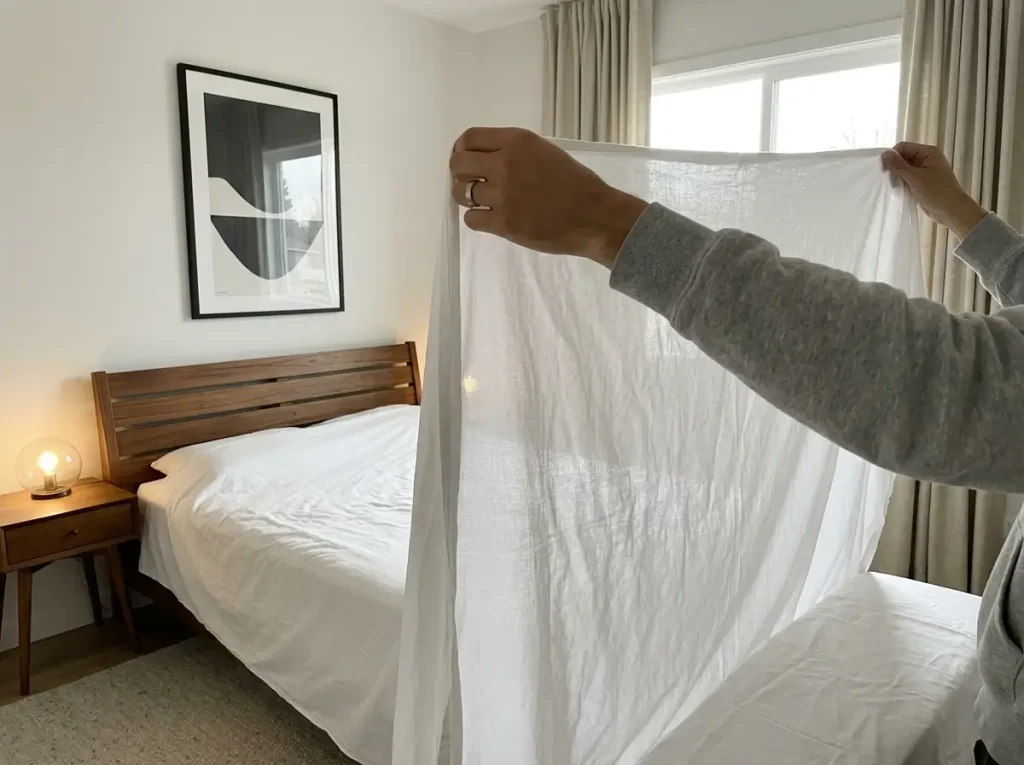
Pilling resistance is graded against ASTM D4970, the Martindale test the industry uses to rate a fabric’s resistance to pilling on a five-to-one scale, which counts cycles, not calendars. Percale and sateen are both constructions rather than fibers, and if you want the full picture of what each weave actually is, thread by thread, the pillar lays out the thread paths.
That unit matters because it exposes the sleight of hand in most durability advice. Rub cycles are contact, and contact is what a sleeper generates: turning over, a heel dragging, a jaw moving against a pillowcase for eight hours. A sheet does not age on a shelf. It ages in proportion to how much you move on it, which is why two identical sets on two different beds retire years apart.
And once you have a unit, the word “worn out” splits cleanly into two failures that have nothing to do with each other. Structural failure is the fabric thinning until it gives: a translucent patch, a seam letting go, the fitted sheet’s elastic finally slack enough that the corner will not stay. It is the end of the fabric’s tensile strength and its tear strength, the two numbers a mill actually tests for. That is a sheet ending.
Cosmetic wear is the other one: pilling, dullness, the loss of whatever hand it had when it was new. Nothing is broken. You simply stop wanting to sleep on it, which turns out to be just as final and arrives years earlier.
Everybody has retired a set that had no holes in it. You did not throw it out because it broke; you threw it out because it went fuzzy and gray and stopped feeling like anything. The competitors in this search all use “shorter lifespan” to mean both failures at once, and that conflation is exactly what makes the claim sound like a preference.
It is not a preference. The two weaves fail in different modes, not by different amounts of the same mode.
A sheet does not wear evenly, so stop treating it as one object. The top third of the flat sheet and the pillowcases take almost all of the abrasion; the tucked-in foot end is nearly untouched. Turn a tired set end-for-end and the good half becomes obvious immediately. On a percale that buys you another year for free.
The Float Is the Whole Answer
Once durability is measured in rubs rather than years, the gap between these two weaves stops being a matter of taste and becomes a matter of geometry.
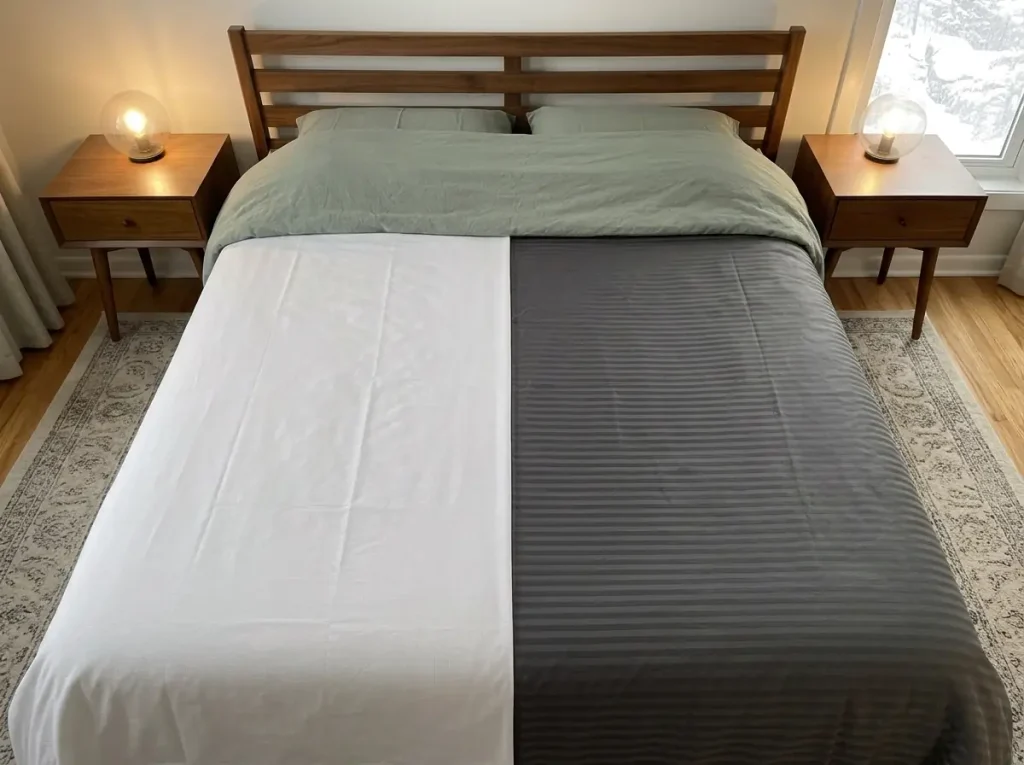
Run a hand across each one. The percale catches very slightly and sounds a little papery; the sateen glides. That glide is not quality. It is thread lying loose across the surface, and loose is exactly what a drum grabs.
Percale is a plain weave: one thread over, one thread under, every crossing, in both directions. No thread travels more than a single step without being pinned by a neighbor. There is nowhere on the surface for abrasion to concentrate, because there is nothing standing proud of it.
Sateen is a satin-family weave, and it works the opposite way. A thread skips over three or four others before it locks under one, in the three-over-one-under and four-over-one-under patterns that give the family its name. That skipped stretch is the float, and it is unsupported cloth: nothing holds it down until the next crossing, three or four threads later.
The sheen and the slip that sell a sateen set are that float. So is the failure.
Abrasion attacks whatever is exposed. A float snags, a fiber end works its way out of the yarn, and that is stage one of pilling, which is a four-stage process rather than an event: fuzz forms, the loose fibers entangle, the tangle grows into a ball, and eventually the ball wears off and takes fabric with it. Under the two abrasion tests the textile industry actually grades fabric durability against, plain weaves consistently outlast satin weaves for one reason: more interlacing points per inch means each fiber is anchored more often, and an anchored fiber cannot migrate out to start a pill. Long floats abrade faster and take the yarn with them.
Which leads to the part the packaging works hardest to hide. The same cotton, spun the same way, put into two different weaves, gives you two different lifespans. The weave is the variable, not the cotton — and certainly not the number on the box. That is worth sitting with if you have ever paid up for a count, because what the thread count on the package is actually counting is threads per square inch, which describes density and says nothing whatsoever about how those threads are locked together.
The clearest illustration is a genuinely good sateen. The SOHO 100% Egyptian Cotton Sateen Stripe Sheet Set is a 500-thread-count Egyptian cotton in a true sateen weave, which is about as favorable as the construction gets: good fiber, honest weave, real sheen, and it drapes the way people buy sateen to drape. And its flaw is structural rather than a matter of quality: the three-to-four-thread float sits exposed with nothing holding it down until the next crossing, so pilling starts earlier than the thread count implies, and the maker’s own care instruction is no fabric softener, which most buyers ignore. Five hundred threads per inch cannot anchor a float that is designed to skip.
Here is the level-3 tell, and it is the one that proves the mechanism rather than repeating it: the pills do not appear evenly across a sateen sheet. They show up in a rough oval where a shoulder and a hip rest, and on the pillowcases. Abrasion concentrates where a sleeper moves, so the map of the pills is a map of how you sleep.
Shaving the pills off a sateen with a fabric shaver is treating the symptom. The floats underneath are still exposed and still generating fuzz, which is why the pills tend to come back soon after they are removed. Shave it if you want the bed to look right for guests, but change the wash routine if you want the date to move.
What Each One Looks Like When It Goes
Knowing percale wins on rub cycles still leaves the practical question open, because the two weaves do not fail on the same schedule or in the same way. The question people actually ask is not which is more durable. It is how long before mine looks bad — and those have different answers, only one of which is on the box.
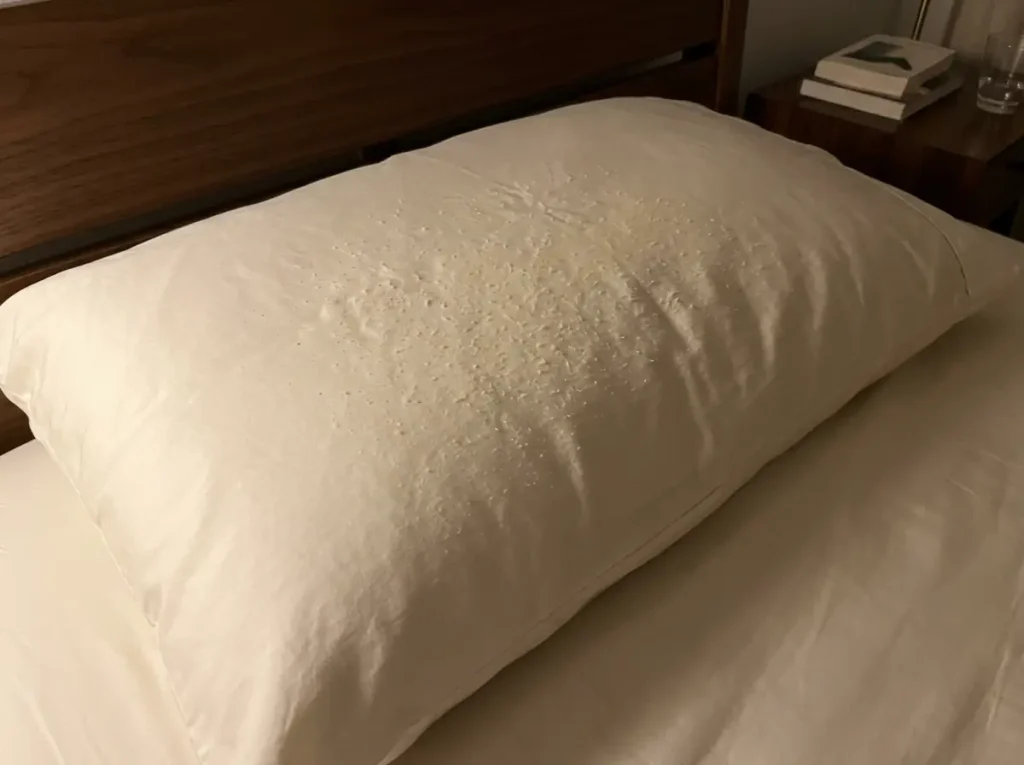
Sateen’s clock is cosmetic and it starts early. A fairly nice combed cotton set can start pilling on the fitted sheet within weeks. A lint remover clears it, but the pills tend to come back, and pillowcases can start too.
On weaker sets the first fuzz shows up somewhere in the first dozen or so washes, always on the sleeping side and the pillowcases first, never on the tucked edges of the flat sheet that barely get touched. And note what did not save that set: six hundred threads per inch.
Percale’s clock is structural and much later. It does not pill meaningfully, because there are no floats to snag. It thins.
The give arrives first as a change in hand, a softness that reads as pleasant rather than as warning, then as a genuinely worn patch in the top third, then as a tear. A quality long-staple percale is described industry-wide as lasting well beyond five years of regular use, and that estimate is describing structural life, because there is no cosmetic clock running alongside it to end the set sooner.
Which is why the two get retired for opposite reasons. A sateen gets thrown out while it is structurally fine. A percale gets used until it fails. If you have ever wondered why hotels made their decision decades ago and never revisited it, this is it, and there is more on why the industrial laundries settled on percale if the daily-washing case interests you.
Percale’s trade is real and worth stating plainly: it will never look ironed, and it starts crisp rather than smooth. That is not a manufacturing shortcoming. It is the price of the anchoring.
Every crossing that holds a thread down is also a place the fabric refuses to lie perfectly flat. Decide now whether you can live with a bed that looks slightly rumpled, because no amount of washing changes it.
When longevity is the deciding factor, the construction to buy is the one that tells you what it is. The Feather & Stitch 100% Cotton Percale Sheet Set is a single-ply 300-thread-count percale with a 16-inch pocket, and the reason it earns the mention is that its own listing states the weave, the count and the ply without hiding behind a single number, which is precisely what the durability argument asks a buyer to look for. Its flaw is the whole percale flaw: it will never look ironed or carry a sateen’s sheen, and the hand is crisp rather than silky, so anyone shopping for glide is going to be disappointed at first touch.
There is a second lever, and it is weave-independent, which is why it deserves separating rather than blending in. Long fibers pill less than short ones: fewer loose ends to work free, and a harder escape from the yarn even when one does. So a long-staple sateen genuinely resists the fiber-escape half of pilling better than a short-staple percale, even though the float-exposure half still runs against it. If you want the detail on how long the fibers in the yarn actually are and what the certification labels do and do not promise, that is its own argument.
And a percale that has thinned does not announce it in the hand. It announces it against a window. Hold the top third up to daylight and the worn panel reads lighter, weeks or months before anything gives.
The Habits That Move the Date (Free First)
Before replacing anything, a good share of the difference between these two weaves is decided after the purchase, in a machine. The set you already own probably has more life in it than the pilling suggests, and the thing shortening it is likely the bottle you have been adding on purpose.

Fabric softener coats fibers in a waxy residue and lubricates them, which works them loose from the yarn, and it accelerates exactly the surface breakdown a sateen is already prone to. Take it out of the rotation. Honestly, that single change is the highest-value free move available here, and it is the one that gets skipped before writing off the whole set. Beyond that, the routine that actually moves the number is short:
- Skip the softener entirely on sateen, and on percale you lose nothing by skipping it either
- Wash cold, inside out where the set allows it, so the float-exposed face is not taking the drum’s abrasion directly
- Don’t overload the machine — abrasion is contact, and a packed drum is more contact per cycle
- Rotate two sets on the bed, which halves the cycles on each
- Use the gentle cycle and a mild detergent. The agitation setting is a rub-cycle dial, and a heavy detergent needs a longer, harder rinse to clear
- Pull the load out early. A tumble dry on low to just-dry, or an air dry on a line, beats running a hot cycle until the drum is bone dry
The dryer is worth a sentence of its own, because it is where the wash count does most of its damage and almost nobody counts it. A drum full of hot, dry cotton tumbling against itself is an abrasion machine, and that is the same mechanical action the test standards simulate, just with heat added. Taking the set out slightly damp and letting it finish on a line or over a rail removes the harshest stretch of every single cycle, and on a sateen it delays the snagging that starts the first pill.
That last one deserves more than a bullet, because it is the only habit that acts directly on the unit durability is measured in. Everything else reduces the severity of a cycle; rotation reduces the count.
And two sets in rotation do not just last twice as long apiece. They last more than twice as long, because a set that gets a week off dries out completely between uses and the fibers recover their loft instead of being packed flat wash after wash.
Now the honest exception, because the anti-sell gets the last word here. The usual line is that percale wins and that settles it. After enough pilling reports where the variable was clearly the cotton rather than the weave, a narrower claim holds up better: a well-made long-staple sateen, washed without softener and rotated with a second set, will outlast a cheap short-staple percale.
The weave is the strongest single variable in this comparison. It is not the only one.
Which is what makes the cheapest option in this article the one that proves the argument. The Linen Home 100% Cotton Percale Sheet Set is a 200-thread-count percale with a 15-inch pocket and OEKO-TEX certification, and it will outlive a 500-thread-count sateen on the same bed with the same care, because construction decides and the count does not. Its flaw is exactly what you would expect at that spec: with 200 threads and a single ply it feels coarser in the hand than a freshly bought sateen, so it wins on durability and loses the first impression outright. That trade is the article in one product.
Buy the second set in the same weave and the same color as the first. Rotation only works if you actually rotate, and the reason people stop is that one set feels better than the other and quietly becomes the favorite. Identical sets remove the decision, and both age at the same rate instead of one carrying all the cycles.
None of this is unique to weave, incidentally. The same question asked of a different fiber lands on a different number entirely — with flax, the figure that decides how long linen sheets last is GSM rather than the weave at all, which is a useful reminder that “what wears out” always has a specific mechanism behind it and it is never the marketing adjective.
The Verdict, and What to Check at Wash Twenty
Percale outlasts sateen at the same fiber and the same care, and the reason is geometric rather than a matter of quality: every thread anchored at every crossing, nothing floating loose for the drum to catch. That is the answer, and it holds regardless of what either package charges for.
The two weaves also fail differently, which is the part worth deciding on personally. A sateen is retired for how it looks while it is still perfectly sound. A percale is used until it thins.
Pick the failure you mind less, because you are going to meet one of them. And thread count predicts none of this — weave, staple length and what goes into the wash do.
At twenty washes, take the flat sheet and the pillowcases under a lamp and look at the top third only. A sateen will be showing its first pills there and nowhere else. A percale should show nothing at all except a hand that has gone softer, which is the weave losing its starch rather than the fabric losing anything.
Take the softener out of the cupboard tonight and wash the set you already own without it. Give it a month. That costs nothing, and it moves the date further than most upgrades will.
Frequently Asked Questions
01How many washes before sateen sheets start to pill?
On weaker sets the first pills appear within roughly ten to fifteen washes, on the sleeping side and the pillowcases before anywhere else. Long-staple cotton pushes that date later; fabric softener pulls it much earlier.
02Does a higher thread count make sheets last longer?
No. Thread count measures how many threads sit in a square inch, not how they are locked together. Weave and staple length decide lifespan, which is why a 200-count percale routinely outlives a 500-count sateen.
03Can you stop sateen sheets from pilling?
You can delay it, not prevent it, because the exposed floats are structural to the weave. Skip fabric softener, wash cold and inside out, rotate two sets, and stop overloading the drum.
04Do percale sheets get softer over time?
Yes, and without pilling, because every thread is anchored rather than floating loose on the surface. The trade is that percale stays matte and never looks ironed no matter how many times it goes through the wash.
05Which weave is better for a guest room used twice a year?
Sateen. Abrasion is the enemy and a guest bed barely generates any, so the weave that looks and drapes best wins outright. The logic reverses completely on a bed slept in every night.





Tried it on your own bed?
No comments yet. Tell us what you changed, and what the sheet did after a few washes.