

What’s in here9 sections
- What Linen Actually Is, and Why It Behaves Like That
- The Number That Actually Predicts Whether It Lasts
- What the Hangtag Promises, and What It Doesn’t
- Softness: What You’re Actually Buying, and What It Costs
- Where It Fails First, and What People Do About It
- Hot Sleeper, Cold Sleeper, Shared Bed
- So: Is It Worth It, and What to Buy
- Conclusion
- Frequently Asked Questions
The hangtag says European Flax, and you read it the way it was designed to be read: pure, European, expensive for a reason. What that trademark actually requires is a composition of at least 50 percent linen and a certified paper trail from the field to the last business sale. It says nothing about where the cloth was spun, woven or sewn.
Meanwhile the number that decides whether the set is still on your bed in four years is not printed anywhere on that tag, and often not on the listing either. Flax is a bast fiber, pulled from the stalk instead of the seed head, so the individual fibers are long, thick and stiff. That is why a genuinely good linen sheet counts 80 to 150 threads while a good percale counts 300, and why holding the two numbers next to each other tells you nothing. Below is what linen actually is, what the label hides, the one figure that predicts whether the set survives, who it is worth the money for, and what it looks like at year four.
Quick Answer
Linen sheets are worth the money above roughly 180 GSM, for someone who keeps bedding for years and can live with creases. Under 165 GSM you are buying a light summer set that thins out early. Ignore thread count here, and treat a missing GSM figure as an answer in itself.
What Linen Actually Is, and Why It Behaves Like That
The question of whether linen is worth it cannot be answered before the fabric is, because almost every complaint people have about it (the creases, the roughness at first, the price) traces back to one property of the plant it comes from. Cotton comes from the seed head: short, soft fibers that get twisted into a fine, even yarn. Flax comes from the stalk. It is a bast fiber, harvested from the structural part of the plant, and the fibers are long, thick and stiff because holding a plant upright was their original job.
That single structural difference drives everything else on this page. Thick yarn cannot be packed as densely as thin yarn, so linen is woven open. The stiff fiber does not spring back from a fold.
And the fiber is hollow down the middle, which is the mechanism behind linen’s contradictory reputation. It holds a layer of still air against you, the same way any insulating fiber does, while the open weave lets moisture leave fast: that gap-and-evaporation combination is the whole of linen’s breathability, and it is why the same cloth sleeps cool in August and does not chill you in February. Cool in July and not cold in January is not marketing, it is the cross-section of the fiber. What decides January is the weight of the set and what goes over it, not the flax.
Which brings us to the number linen listings still love to print. Thread count is the wrong instrument here, and using it is the single fastest way to buy badly. Linen yarn is thicker than cotton yarn by nature, so 80 to 150 threads per inch is normal for a good set where a percale would need 270 to 300.
A linen listing bragging about 600 thread count has borrowed a metric from a different market and is hoping you do not notice the units changed underneath it. It is a bit like quoting a truck’s fuel economy in the same breath as a motorcycle’s and calling the truck worse. The instrument that does work on this fabric is grammage, which is the next section.
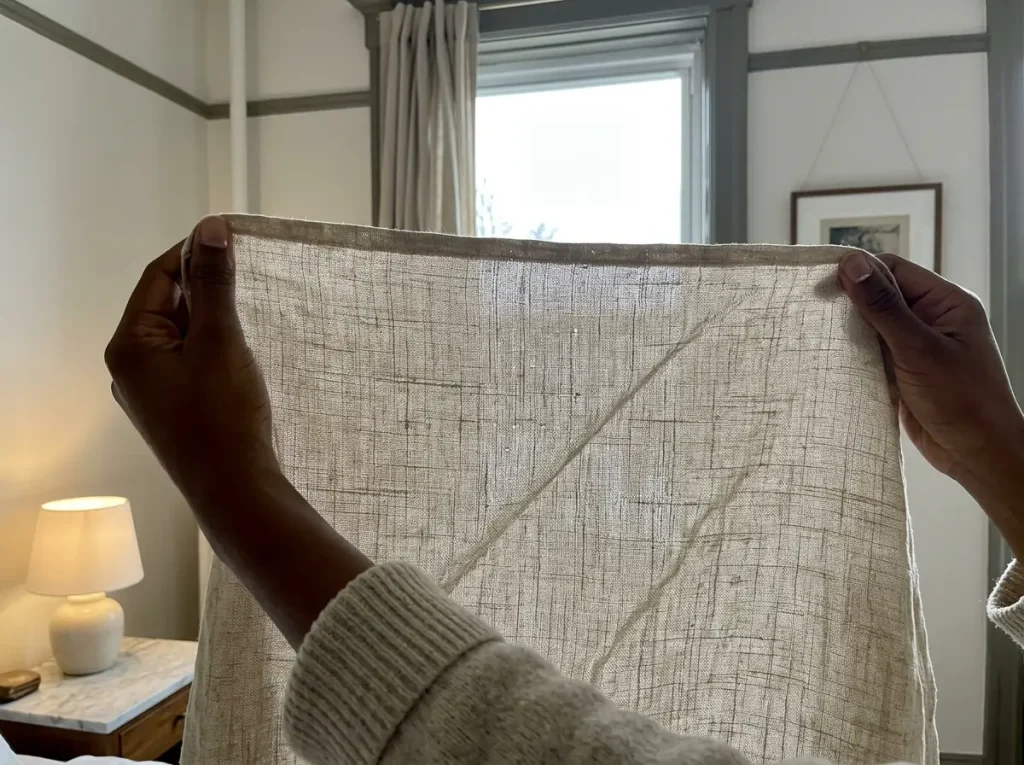
Hold a new linen sheet up to a window before you decide it feels thin. You will see light between the yarns: actual gaps a percale does not show at the same brightness. That translucency is the low thread density doing the breathing, not a defect. Judge thinness at the hips of a sheet you have owned for two years instead, where translucency means something completely different.
Then there are the creases, which are not a flaw in the sheet but the fiber doing exactly what a stiff fiber does. Cotton’s twisted staple has some spring in it and recovers from a fold. Flax holds the fold. No finish removes that without coating the fabric in something that changes how it breathes, and the ones that try wash out within a season anyway.
So linen will look unpressed on your bed, and it will look unpressed forever. The whole aesthetic the fabric is sold on depends on you agreeing to that. There is a full routine for keeping it on the right side of rumpled rather than crumpled, and living with the wrinkles is its own conversation.
So decide that part now, before anything else. If a bed that never looks pressed is a dealbreaker, the honest answer is not a lighter linen or a better linen. It is a different fabric, and it is percale: the same one-over-one plain weave with gaps in it, in a fiber that recovers from a fold.
The Brooklinen Percale 4-Pc Sheet Set for Hot Sleepers is a 270 thread count cotton percale carrying OEKO-TEX Standard 100 certification on the listing, which is the standard version of that trade: similar airflow, no permanent crease. At 270 threads it is a solid percale rather than a top-tier one, and someone chasing the crispest, coolest hand in that category will still have to move up a tier to get it. If you want to see how linen sits next to percale and sateen, side by side, that comparison is worth ten minutes before you spend anything.
One last piece of vocabulary, because you will meet it in every thread you read next. Cotton sheets announce their age by pilling, little balls of broken fiber on the side you sleep on, sometimes after a phase of shedding loose fiber into the wash. Linen does not usually do either.
Linen goes threadbare: thinned to translucency, still intact, no holes yet. Different fabric, different failure, different word.
The Number That Actually Predicts Whether It Lasts
If the fiber explains how linen behaves, GSM explains whether the set you are looking at will still be on the bed in four years. It is the one figure marketing copy is happy to leave off, and it is the only one I would refuse to buy without.
GSM is grams per square meter, sometimes called grammage on European listings: how much flax is actually in the cloth. Not how finely it was spun, not where it was grown, not how many threads crossed each other. Mass.
The linen industry’s own quality guides converge on 150 to 200 GSM as the midweight linen range for bedding, with 160 to 180 named again and again as the sweet spot for most climates. Anything meaningfully below that is lightweight linen and is sold as a summer sheet whether or not the listing says so. That range is real, but a range is not a decision, and the decision is what you came here for.
So here is the line worth writing down. Under about 165 GSM is a lighter, breezier set that will thin out faster, and it is a perfectly reasonable thing to buy if that is what you meant to buy. 175 and up is the class more likely to survive years of weekly washing. A practical threshold for linen is 180, and below it, pilling and tearing risk climbs.
Now the awkward part. DAPU’s 100% French Linen sheet set states 170 GSM on its own listing: a real, currently purchasable set inside the premium-sounding French linen category, sitting under the line, with nothing anywhere in the copy framing that as a trade-off. I am naming it because the number is admirably there at all; most listings in this category simply omit it, which is worse.
It is the clearest example of the gap between category and class you can point at right now: French flax, honest spec, under the durability line. Its flaw is the entire reason it appears on this page: at 170 GSM it sits below the 180 the community treats as the durability threshold, and the listing does not mention it.
Bought as a summer sheet, that is fine. Bought as an heirloom because the words 100% French linen sounded like one, it is going to disappoint you somewhere around year two.
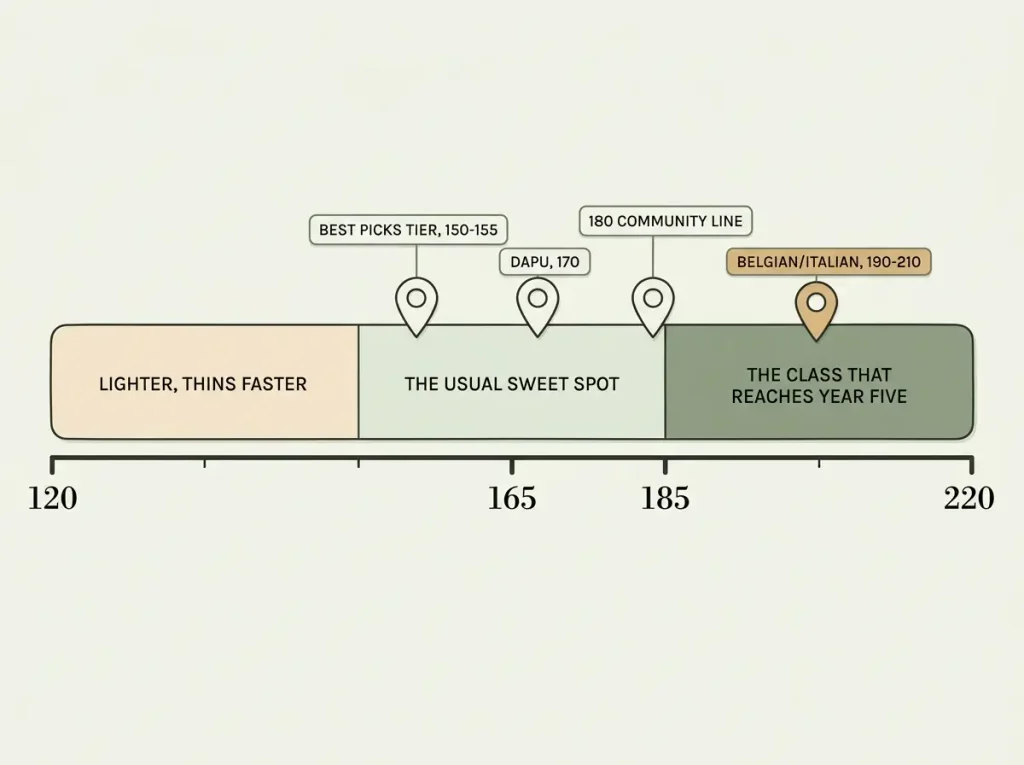
The other end of the range is where the long-lived sets live. Linen that lasts five or more years tends to fall in the 190 to 210 GSM Belgian or Italian linen weight class. Belgian flax and French flax are the same plant grown two hundred miles apart; what separates those sets from the ones that fail is the mass per square meter, not the border.
Same plant, same weave, same certifications available on both. Different mass, different outcome. Answers split by weight class rather than by brand name, and that is the finding that matters more than any roundup.
You can read the weight class before you wash anything. Throw the flat sheet across the bed once. A 200 GSM sheet has enough mass to fall off the mattress edge in a heavy vertical drape and stay there; a 150 GSM one floats, lifts on the air the duvet pushes when you sit down, and settles slowly. If a set arrives with no GSM on the listing, this is how you find out what you bought.
And the certificate will not rescue you here. The Alliance for European Flax-Linen & Hemp runs the European Flax and Masters of Linen schemes, and the certifying body’s own FAQ on what European Flax™ actually requires never mentions GSM at all. Not once.
A fully certified set carries exactly zero durability promise from that certificate, because durability was never what it was measuring. Provenance and weight are two different axes and the tag only reports one of them.
The durability spread the community reported lines up with that reading almost embarrassingly well: a West Elm fitted sheet worn through in a little under two years, a BedThreads one with small holes at the hip after four, a heavyweight Linoto set at five years with no thin spots at all. Brand prestige did not predict those outcomes. Weight did. The full lifespan question, year by year, deserves more room than this section can give it, but the pattern is the part you needed before buying.
What the Hangtag Promises, and What It Doesn’t
GSM tells you what is in the cloth. The label tells you where the plant grew, and shoppers routinely read the second as if it answered the first. The two certifications on most premium linen tags are not interchangeable, and only one of them is about the fabric at all.
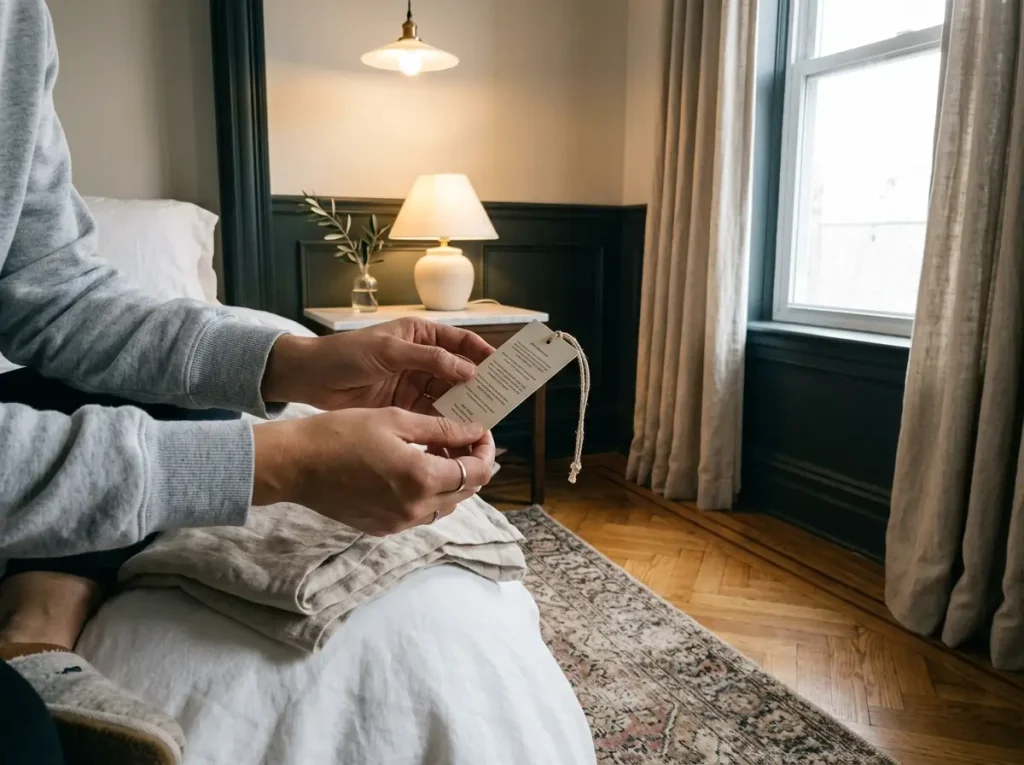
European Flax™ requires a composition of at least 50 percent linen, plus a certified chain of custody running from the grower to the final business-to-business sale, with no blending across linen types allowed. Read that first clause again: at least 50 percent. It is a provenance and traceability claim, not a purity claim, and a certified product can legitimately be half something else. That is not a scandal and nobody is cheating. It is simply what the certificate promises, and it is not what most shoppers think they are reading.
The second thing it does not promise is manufacture. European Flax certifies that the flax was grown and scutched in France, Belgium or the Netherlands, audited yearly by independent inspectors. It requires nothing about where the fabric is spun, woven or sewn. A set can carry fully certified European fiber and be woven and sewn on the other side of the world without breaking a single rule. European flax and made in Europe are two different sentences, and only one of them is on the tag.
Masters of Linen™ is the stricter sibling. On top of the fiber requirement, it demands that the spinning and weaving happen on European soil, and traders cannot hold the certification themselves. If the tag says Masters of Linen, the cloth was made in Europe, not just the plant grown there. That is a materially stronger claim, it is the standard that requires the weaving itself to happen in Europe, and it appears on a fraction of the sets that wave the European Flax phrase around.
GOTS sits on a different axis entirely, organic farming plus an audited processing chain, and it is orthogonal to both of the above. A set can be GOTS certified and not European Flax, or the reverse, and neither fact contradicts the other. The mechanics of that audit are the certification pillar’s job rather than this page’s, so if you want what OEKO-TEX and GOTS certify, and what they don’t, it is laid out there in full. It is the same confusion pattern that turns a chemical-safety certificate into an organic claim in people’s heads, and that exact mix-up has its own page because it comes up constantly.
European Flax™ is a licensed trademark with a license number, and the sets that actually hold the license print it on a sewn or hung tag you can see in the product photos. The ones borrowing the phrase put it in the listing bullets and nowhere else. Zoom into the photos before you believe the copy: if the words appear only in the description and never on a physical tag, it is a description, not a certification.
So read a hangtag in this order, and it is not the order the marketing suggests. GSM first, because it is the one that decides whether the set lasts. Then Masters of Linen or GOTS, because those are audited claims about the cloth or the chain, in the way a Fair Trade Certified mark is an audited claim about the people rather than the fabric.
European Flax comes last, because it is nice to have, it is honest as far as it goes, and it is the weakest of the three. Provenance is the thing shoppers pay the most attention to and the thing that predicts the least.
Softness: What You’re Actually Buying, and What It Costs
Every linen listing promises the set gets softer with washing, and that promise is true, which is exactly why the shortcut sold alongside it deserves a harder look than any retailer page gives it.
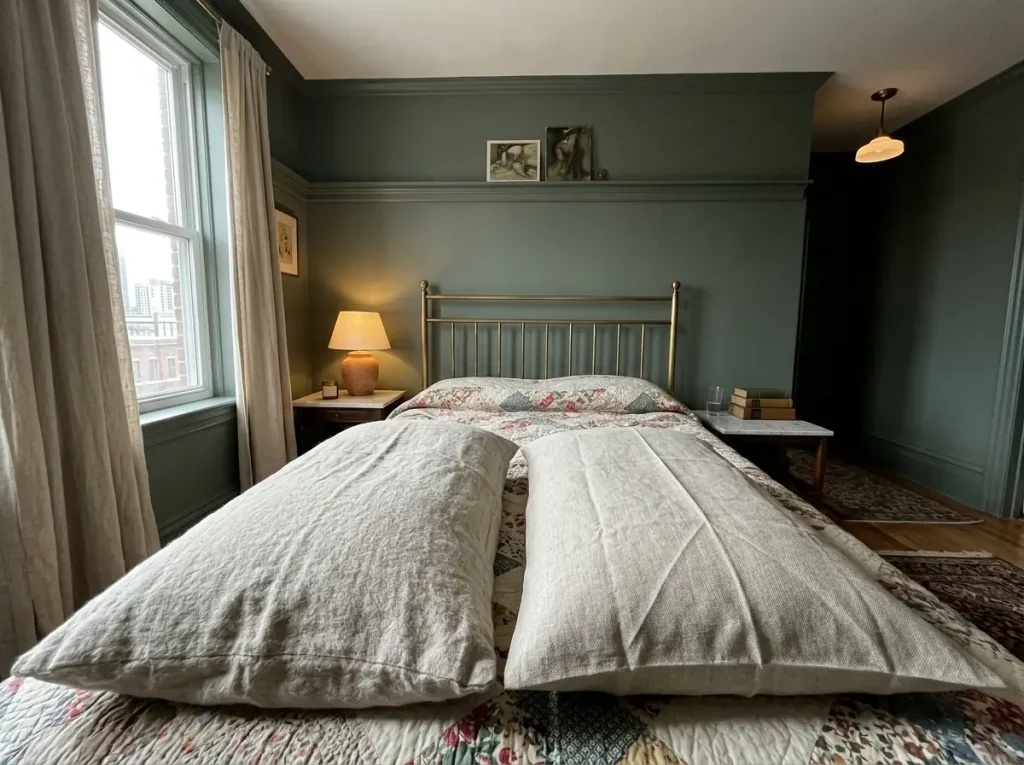
Untreated linen softens for a mechanical reason. The stiffness in new linen is largely pectin, the plant gum binding the fiber bundles together, and every wash cycle works some of it loose and separates the bundles a little further. That is not a metaphor for softening, it is the softening. It happens over roughly the first month of regular washing, and it is why the sheet you bring home and the sheet you own in October are genuinely different objects.
Stonewashing, sold as garment-washing, pre-washed, or relaxed depending on the brand, does that same work at the factory. Industrial drums, abrasion, sometimes enzymes, and the softness arrives before the set does. The softness on night one is completely real. So is what paid for it: some of the wear the set would otherwise have taken slowly across its first years has already happened, in a machine, to fabric you had not bought yet.
No retailer page in the results says this. Across every listing I opened for this article, garment-washing is presented as a pure upgrade with no other side to it, filed under softens with washing as though the two were the same event.
And I want to be careful here, because the obvious next move is to call it a scam, and it isn’t one. It is a trade-off. For someone who genuinely will not tolerate a two-month break-in period (and plenty of returns happen for exactly that reason), buying the softness up front is a legitimate purchase as long as they know what it cost. The job of this page is to price it, not to forbid it.
The deeper question of why linen costs what it costs in the first place sits underneath all of this: flax yield, yarn breakage on the loom, the small number of mills that can weave it well.
The break-in on untreated linen, stated honestly: it is stiff. Not charmingly rustic, actually stiff, for the first several washes, and the first month is the price of admission. If you buy untreated and put it on the bed expecting the fabric from the photographs, you will spend two weeks thinking you made a mistake and then stop noticing exactly when the pectin gives.
If you are buying untreated linen, check the returns window before you check anything else. A 30-day policy expires roughly one week before the fabric becomes the thing you paid for, which means you are deciding at the stiffest point in the set’s whole life. Sixty days or more is the difference between judging linen and judging pectin.
Here is the part that only shows up once a set has been on a bed for a while, and it is the reason the trade-off matters. Stonewashed and broken-in linen do not fail the same way. A stonewashed set arrives with its surface already slightly fuzzed, so it looks much the same at wash five and wash fifty, and then it thins somewhere all at once.
An untreated set visibly changes character every few washes for two months, stiffer, then softer, then softer again, and then holds that character for years. The one that stays boring is the one aging faster, and it is quietly reassuring you the whole time. What you can control across all of it is the wash temperature and the drying: a warm rather than hot wash, tumble dry on low and pulled out while still faintly damp, or line dry and folded before it goes bone stiff. The care label on the set is the authority on the specifics, and it is worth reading once rather than guessed at forever.
Which is also why the usual maintenance move exists at all. People turn their sheets: rotating them so the wear spreads across both faces and both roles rather than concentrating in one place. That habit only makes sense in a fabric where surface wear is the failure mode, and nobody talks about turning a polyester sheet.
Where It Fails First, and What People Do About It
Sets do not wear out evenly, and knowing which piece goes first changes what is worth buying, because on a linen set the failure is almost always in the same place, and it is not the piece that costs the most to replace.
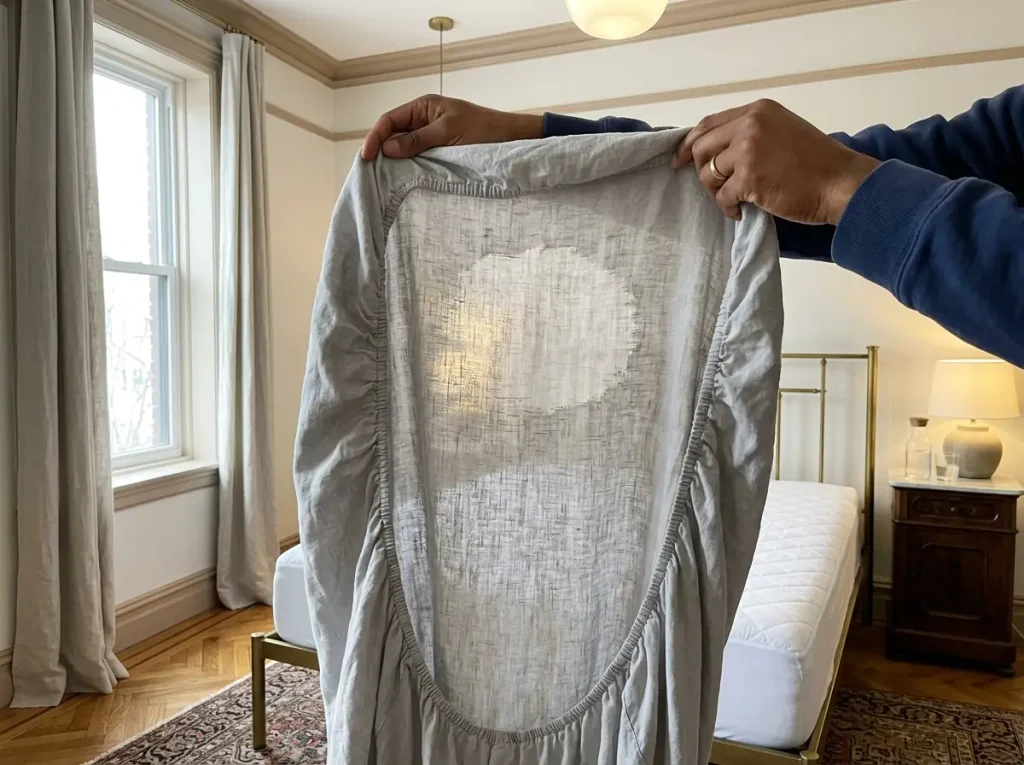
The fitted sheet fails first, every time. No fitted bottom sheet is going to last much past two years, whatever the brand. The corners are where the fabric is held under permanent tension, stretched over the mattress and pulled back under it, and tension plus abrasion is the whole recipe for thinning. The flat sheet on the same bed, doing gentler work, routinely outlives it by years.
Individual experiences are worth reading as a group, because grouped they show a pattern. A West Elm fitted sheet worn through in a little under two years, and the person reporting it said plainly that was not long enough for what it cost. A BedThreads fitted sheet with tiny holes around the hips at four years. A heavyweight linen set can stay free of thin spots and holes when it gets just a couple of deep soaks to get oil and grime out.
Under two years, four years, five years, and the variable that tracks that spread is weight rather than the name on the tag. That is the argument of the GSM section arriving with evidence attached, and it is what longevity in this fabric actually rests on. The same logic runs through the cotton weaves too, where construction decides which sheet outlives which far more reliably than price does. And if you want it counted properly, the full lifespan picture, wash by wash, is the page that does the counting.
Before you buy anything, though, the fix that costs nothing. If the fitted sheet is the piece that fails, stop using one. Buy an oversized flat sheet and put it on the bottom, tucked a foot deep on each side with hospital corners at the foot. It skips the elastic corner entirely, the exact part that thins and tears, and it sidesteps the deep pocket problem as well: a flat sheet does not care whether your mattress is nine inches or seventeen with a topper on it.
It also lets you rotate the same pieces between the top sheet and bottom positions, so no single face takes all the wear. Heavier flat sheets chosen on that advice can work beautifully. That is a stronger endorsement than any product page in this category has earned.
The second free move is to stop thinking in sets. Replace by the piece. A mixed-age set (new fitted sheet, four-year-old flat, pillowcases somewhere in between) is completely ordinary practice among people who keep linen for years, and the only thing that makes it work visually is keeping the palette to neutrals so old and new pieces sit together. The set was a merchandising decision. Your bed does not have to honor it.
The two thin patches arrive where the sleeper is heaviest and the cloth is stretched tightest at the same time: the hips and the heels. They show on the fitted sheet’s top face long before the corners give, so checking the corners tells you nothing useful. Turn the sheet end for end every few months and the hip load lands on cloth that has been resting under your heels. That is why the usual word is turn them rather than replace them.
Know what thinning looks like before it becomes a hole, because there is a window where action still pays. That is threadbare: translucent at the hips and the heels, still fully intact, no tear yet. Hold it to the window and the weave has opened where it was loaded. That is the moment to turn the sheet or plan a replacement piece.
The alternative is finding out the hard way, when a fitted sheet tears under a foot in the middle of the night and wakes you up. Ripping is how linen ends, not fraying. Failures in this fabric announce themselves at three in the morning, and by then the decision has been made for you.
Hot Sleeper, Cold Sleeper, Shared Bed
Linen’s reputation as a summer fabric is half of a longer sentence, and the half that gets left off is the one that decides whether it works for the person on the other side of the bed.

For the sleeper who runs hot, the mechanism is real and it is worth understanding rather than trusting. Low thread density means physical gaps between thick yarns, so air moves and moisture evaporates fast instead of sitting against you. That is what moisture-wicking means once you take the word off the box, and it is a fundamentally different kind of cool from a slick, smooth-feeling fabric that pulls heat off your skin on contact and then holds it.
One is airflow, the other is conduction, and they feel different at four in the morning. Neither is temperature-regulating in any certified sense: nobody audits that phrase. That comparison has its own page, and how linen compares with bamboo for somebody who runs hot works through both mechanisms properly, so there is no sense re-arguing it here.
For the cold sleeper, the usual advice is to avoid linen entirely, and after enough winter reports that reasoning does not hold up. The fiber is not the problem. The hollow core holds still air and linen does not chill you the way a thin, dense, smooth fabric does.
What decides January is the weight of the set and what goes over the top of it. A 200 GSM linen sheet under the right duvet and a heavier duvet cover is a perfectly warm winter bed, which is what makes linen closer to year-round bedding than to summer bedding in practice. Whether that holds in a genuinely cold room is its own question, and whether linen holds up in winter has the space to answer it properly.
Now the case almost nobody separates, and it is the one that actually breaks. Two people, one bed, one sheet. The weight class that suits the hot sleeper is the lighter one, around 160 GSM, and that is precisely the class that thins out fastest.
The heavier set that survives to year five is the one the hot sleeper will find warm. The sheet is shared and cannot be split. You cannot buy half a fitted sheet at 160 and half at 200, and no amount of shopping will change that.
But the duvet can be split, and that is where the compromise actually lives. So the honest recommendation for a shared bed is this: buy the sheet for the sleeper who runs hot, then solve the cold sleeper above the sheet line. A heavier sheet cannot be made cooler by anything you add to it, while a light duvet can always be doubled, layered or replaced on one side of the bed.
Fix the constraint you can move. The rest of the bed for somebody who sleeps hot goes through that layer by layer, and it is the better place to work out the duvet half of the problem.
There is a wear pattern on a shared bed the durability reports never mention, and it only exists when two people sleep on the same sheet. The fitted sheet goes threadbare on one side, at one set of hips, while the other half of the same piece of cloth is essentially untouched, because the loads are asymmetric and neither sleeper moves into the other’s territory. Rotating the sheet a half turn once a season is what evens it out, and if you sleep alone it does not matter at all.
And the honest exclusion, because a verdict that fits everyone is not a verdict. If what you want is a smooth, cool-to-the-touch surface on a bed that looks pressed and you iron nothing, linen is the wrong answer no matter what weight you buy. That reader wants percale, and saying so plainly is more useful than selling them a fabric they will resent in a fortnight.
So: Is It Worth It, and What to Buy
Everything above turns into one decision at the shelf, and it is narrower than the roundups make it look. For most people the question is not which brand — it is which weight class, and whether the tag backs up what the listing says.

The verdict, stated plainly. Worth it above roughly 180 GSM, for somebody who will keep the set for years and does not mind creases. Not worth it below 165 GSM unless the point is a light summer set you already accept replacing sooner.
And never worth it for somebody who wants a smooth, pressed-looking bed, at any weight, from any mill. That last one is not a compromise you grow into.
The checklist, in the order it should be worked through:
- Find the GSM on the listing. If it is absent, treat that absence as an answer rather than a gap.
- Check that the tag is audited. Masters of Linen or GOTS, not a bare “European Flax” phrase in the bullets.
- Confirm the flat sheet is sold separately, because that is what you will be replacing pieces with.
- Read the return policy, and make sure the window is long enough to survive a break-in.
- Order sample swatches if the mill offers them. Several of the heavier European weavers do, and a square of the actual cloth in your hand settles the hand-feel question that no photograph can.
Before any of that, the free move. If you already own linen, take the fitted sheet off, turn it end for end, and run it through a wash before you decide it is finished. A sheet that feels tired at the hips often has another year in it once the load moves somewhere else, and you will know within one night whether that was the problem.
The premium tier is worth being precise about, because it is where the most money changes hands on the least evidence. Organic certification and documented origin are audited claims and they are worth something real, because a GOTS certificate means the farming and the processing chain were both inspected, not just the fiber content asserted.
What they are not is a durability promise. Weight is still the durability promise, and a certificate has never added a gram of flax to a square meter of cloth. The same argument applies straight across to cotton, where the tag is not the whole quality picture either.
That said, when a set documents both axes at once, audited organic fiber and a named origin, it is doing the thing this article has been asking readers to look for.
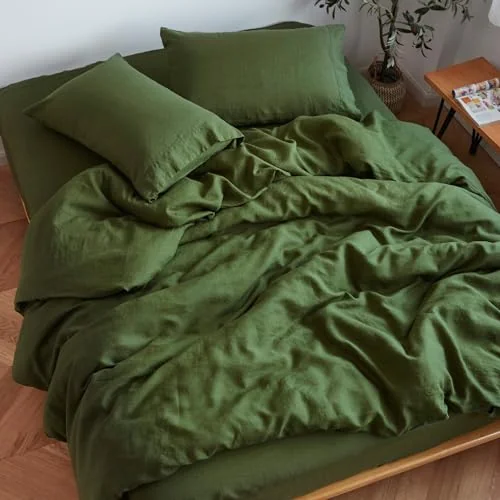
And to be fair to the other end of the shelf, budget linen is not a bad fabric. A 170 GSM French linen set is a perfectly good summer sheet: light, open, fast to dry, and honest about its weight if you look. The problem is never the cloth. It is that the same cloth gets photographed and described as an heirloom, and the number that would have told you otherwise sits four scrolls down the listing where nobody reads it.
One caution at that end of the shelf, though. A linen cotton blend is a different purchase from either fiber on its own: it creases less than linen and breathes less than linen, and it is often priced as though you were getting the linen. Check the composition line before you decide the splurge was avoidable, because a set that is 55 percent cotton is not a cheaper version of the heavier stuff. It is a different cloth wearing the same word.
Conclusion
Three things to carry to the shelf. Find the GSM before you look at the brand. Under 165 is a summer sheet, 180 and up is the one still on the bed in year four, and a listing that will not print the number has already told you something about what it is selling. Read the tag in the right order, audited claims first, Masters of Linen or GOTS, and provenance last, because “European Flax” is a 50 percent floor and a paper trail rather than a promise about the sheet in your hands. Buy the flat sheet oversized and let it do the bottom layer’s job, since the fitted sheet is the piece that fails and it is also the piece you can skip entirely.
After a season of washing, do one check. Hold the fitted sheet up to the window at the hips and at the heels. If the weave has gone translucent in those two places while the rest of the sheet is still opaque, turn it end for end now — not after the tear — and you will get another year out of it.
Before you buy anything at all, pull the sheet you already own off the bed and hold it up to the light. If you can see the window through the hips, that is your answer, and it costs nothing to check.
Frequently Asked Questions
01What are the disadvantages of linen sheets?
Linen creases permanently, costs several times what cotton does, and feels genuinely stiff for the first month of washes. The fitted sheet is also the first piece to thin, usually at the hips, and it rarely lasts much past two years whatever the brand.
02Can linen sheets go in the dryer?
Yes, on low, and pulling them out slightly damp is what keeps the creases from setting hard. High heat is what shortens a linen set’s life fastest, so the care label’s temperature is the authority here and worth following literally.
03How many GSM should linen sheets be?
Linen sheets sit between 150 and 200 GSM, and 180 and up is the class that survives years of weekly washing. Under 165 GSM is a lighter summer set that breathes beautifully and thins out sooner.
04Do linen sheets get softer over time?
Yes, over roughly the first month of washes, as the pectin binding the fiber bundles works loose. Stonewashed sets arrive soft because that same mechanical wear already happened at the factory, which brings some of the aging forward.
05Is European Flax the same as 100% linen?
No. The European Flax certification requires a minimum of 50 percent linen plus a certified chain of custody, so a certified product can be part something else. It also says nothing about where the fabric was spun, woven or sewn.




Tried it on your own bed?
No comments yet. Tell us what you changed, and what the sheet did after a few washes.