







What’s in here10 sections
- What “Bamboo” Actually Covers
- What Silk Is, and What “Silk” on a Label Is
- Which One Sleeps Cooler (the Answer Is Not the Fiber)
- The Hair and Skin Claims, Examined
- What Twenty Washes Do to Each
- Two People, One Bed, Two Different Answers
- What Each One Costs the World, and What It Costs You a Year
- Which One to Buy, by Sleeper
- Conclusion
- Frequently Asked Questions
Two sets of bamboo sheets can sit on the same bed in the same week and sleep completely differently, and the tag on both of them says the same word. That word is doing almost no work. Bamboo is not a fiber the way linen is a fiber; it is a plant that gets dissolved into pulp and re-spun, and the process that dissolves it decides how the finished sheet handles a humid night.
Silk has the opposite problem: a real fiber with a real mechanism, sold under a name that anybody can print on a package for twelve dollars. What follows is what “bamboo” actually covers, what silk actually is, how each one handles heat across seven hours rather than seven seconds, what twenty washes do to both, and which one belongs on which side of a shared bed.
Quick Answer
Bamboo and silk solve different problems. Bamboo is the better bet for a hot, sweaty sleeper who wants to machine-wash weekly; silk is the better bet for hair and skin friction, and only if you can live with hand-washing. Neither stays soft past a few washes without the right care.
What “Bamboo” Actually Covers
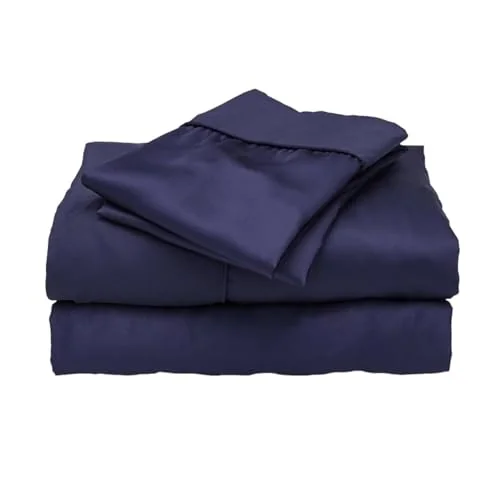
The word on the tag is the plant, not the fabric, and between the plant and the sheet there are five different roads. Only one of them tends to get named on the label. Bamboo reaches a bed as viscose or rayon, as modal, as lyocell (often branded TENCEL), as bamboo linen, or as a cotton blend, and those are not five marketing tiers of the same thing. They are different fibers made by different processes with different behavior at three in the morning.
Here is the part that settles most arguments before they start.
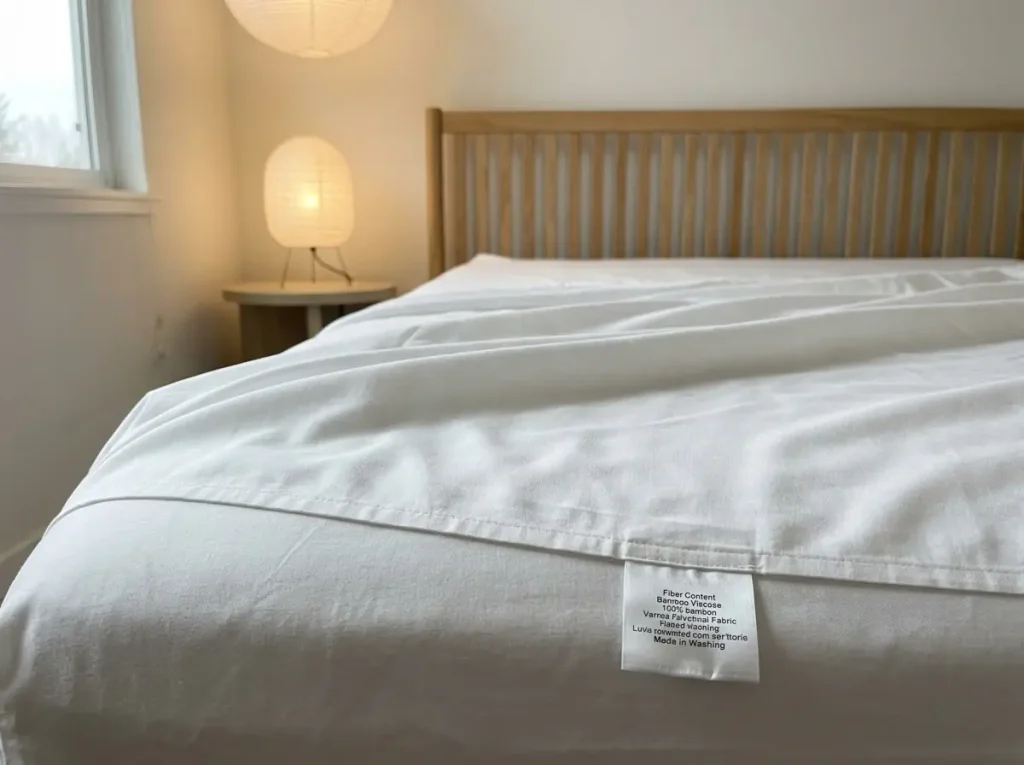
Under the FTC’s own bamboo-textile labeling rule, fabric made from bamboo pulp that has been dissolved and re-spun has to be labeled “rayon (or viscose) made from bamboo.” Plain “bamboo” or “100% bamboo” on a sheet set is non-compliant, because mechanically processed bamboo fiber is stiff, rare, and essentially never used for sheets. So if the tag says only bamboo, you own rayon. That is not a technicality nobody enforces: Macy’s, Sears, Bed Bath & Beyond and Leon Max paid a combined $1.26 million in 2009 over exactly this, and 78 more retailers got warning letters between 2013 and 2015.
The claim is still printed on packaging today, and bamboo rayon is what the great majority of it actually is. If you want what the viscose process actually involves, that is its own subject and it has its own page.
The distinction that matters for sleep is viscose against lyocell. Bamboo lyocell is made with a closed-loop solvent process, and it lets moisture go faster; bamboo viscose holds onto it longer, which is what turns a set clingy toward morning on a humid night. Both can come off the same loom in the same sateen weave. Folded on a shelf they look identical, they feel nearly identical under a hand, and the difference does not show up until the third humid night, when one has released what you gave it and the other is still carrying it.
Go and read the care tag sewn into the set you already own, not the listing you bought it from. Listings get edited; the sewn-in tag has to carry the legal fiber content. If it says rayon or viscose from bamboo, you have your answer, and every claim on the box now has to be read in that light.
The community shorthand for all of this is “sleeps hot,” and that phrase is quietly doing two jobs at once. It describes how a fabric feels in the first thirty seconds against skin, and it describes what the fabric does with moisture over seven hours. Those are separate properties, they are frequently opposite, and almost every disagreement online about bamboo and silk comes down to two people using one word for two different measurements.
What Silk Is, and What “Silk” on a Label Is
Silk has the reverse problem. The fiber is exactly what it claims to be, and the word on the package is the part that lies.
Real silk is graded two ways, and both numbers are printed by anyone selling the genuine article. Momme is the weight, and 19 to 25 is the working range for sheets, with 22 sitting at the durability sweet spot. The letter grade runs to 6A at the top, which describes long unbroken mulberry filaments free of impurities. Momme does for silk the same job thread count is supposed to do on cotton, except that momme actually does it: it is a weight, so it predicts how a set wears, where thread count is a count and predicts almost nothing once mills start twisting two thin threads together and counting both.
The mechanism underneath all of it is simple. Raw silk is coated in a protein called sericin, which gets stripped during degumming, and what is left is a smooth continuous filament. That smoothness is the entire reason silk does what it does for hair and skin, and it is also exactly why it will not survive an ordinary wash cycle.
Now the part the roundups skip.
There is a real, current, documented problem with fake silk at scale. One r/Bedding thread shows photographs of a set of silk pillowcases with visible thread and weave damage after three washes; the seller conceded a defective batch and then would not supply a return address. A separate poster reported a mulberry silk sheet set “greatly deteriorated” inside a single month and came back to the forum asking which brand to trust instead.
Two unrelated brands, same failure, same speed. And the community’s own filter is now the price itself: they treat a sub-fifteen-dollar “silk” pillowcase as answered before the label is read.
There is a hand test worth knowing, though it is not decisive on its own. Real silk squeaks faintly when you rub it between finger and thumb. That is the scroop.
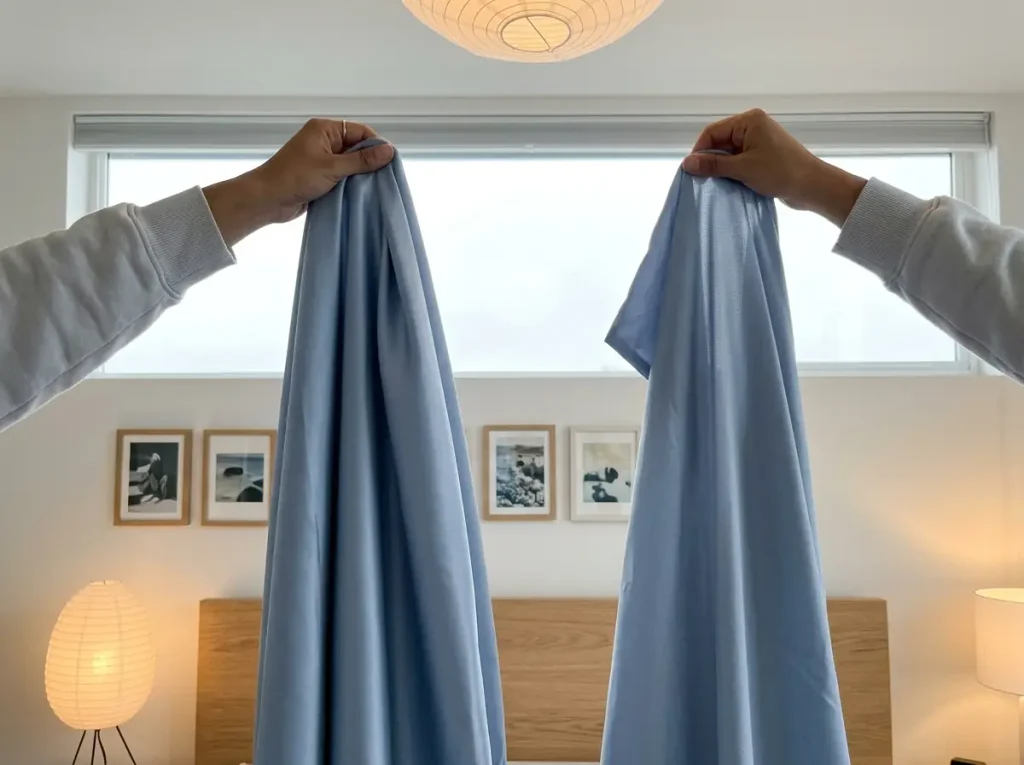
Polyester satin sold as silk is silent, and it feels slightly cool in a way that fades as it warms against you. The other tell is drape: real silk of any weight falls in deep rounded folds and holds a soft luster that shifts as it moves, where the fake hangs flat and shines in one hard band. Softness on first touch tells you nothing, and neither does slip on its own; a silicone finish buys both for about six washes. A set that fails both tests, carries no momme figure, and costs pocket change has told you what it is three times over.
The counterexample is easy to state.
The Mulberry Park Silks 22 Momme 4-Piece Bed Sheet Set is 100 percent mulberry silk at 22 momme, grade 6A, with a 16-inch pocket and OEKO-TEX certification. The numbers are all there, which is the whole point of naming it. Its flaw, stated plainly: it needs hand-washing or a dedicated delicate cycle with no bleach and no fabric softener, because softener coats the filament and shuts down the low-friction slide that is the only reason to buy silk in the first place. Run it through a normal household wash and it will fail early, and the failure will look like a manufacturing fault.
Which One Sleeps Cooler (the Answer Is Not the Fiber)
This is where the two camps online stop agreeing, and both of them are describing something real. They are describing different hours of the same night.
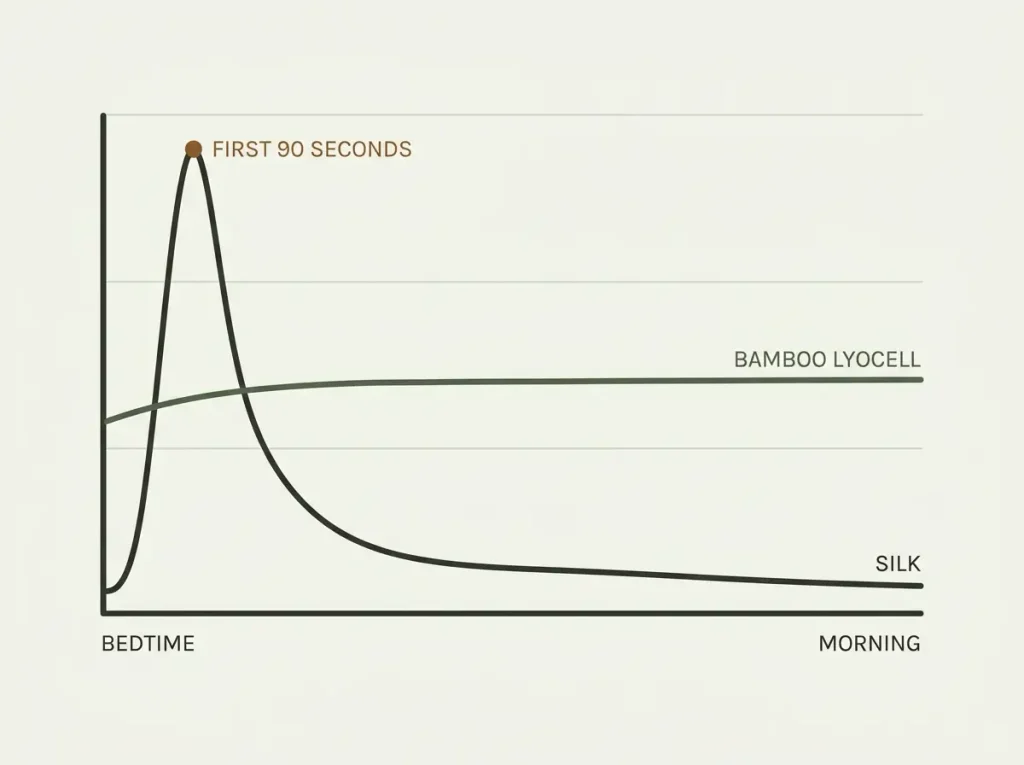
Silk conducts heat away from skin quickly on contact.
That is why it feels cold the moment you get in, and it is a genuine, measurable effect.
What it is not is moisture-wicking in any sustained sense, and moisture is what thermoregulation actually runs on once you are under a duvet.
If night sweats are the reason you are reading this, breathability across the whole night is the property that matters and contact coolness is the one being sold to you. What silk does not have is much capacity to keep moving moisture once that first transfer is done. Bamboo lyocell is the mirror image: far less dramatic on first touch, and better across seven hours, because it keeps releasing moisture instead of holding it. So the person who swears silk sleeps cool and the person who swears it traps heat by two in the morning are both correct, and both are reporting honestly.
One is describing minute one and the other is describing hour four.
The cool of silk is real for roughly the first ninety seconds and then it is over. That is exactly long enough to sell a set in a shop, and nowhere near long enough to matter at three a.m. If you want why silk goes cool and then stops argued out in full, that is a whole page on its own.
Two things decide more than the fiber name does, and both get skipped. The first is weave and weight: a heavy bamboo sateen sleeps warmer than a light bamboo percale, and the fiber on the tag is identical on both. The second is what is over the sheet.
The comforter or duvet is doing most of the thermal work in that bed, and no sheet on earth compensates for the wrong fill weight above it. The usual advice is to fix the sheet first. After enough complaints from people who bought three sheet sets and were still too hot, I would fix the top layer first and the sheet second.
One bedding forum thread makes the practical case better than any spec sheet. A shopper went looking for the look and feel of silk, and chose bamboo or Tencel instead, because of budget, because of a climate that swings, and because of cats in the house. An accidental snag is a real risk with silk and no risk at all with a washable bamboo set. Three constraints, none of which appears in a single roundup.
Test the fabric at the hour that matters, not the minute you get in. Make the bed, sleep on it, and check with your hand at the small of your back when you wake — not at bedtime. First-touch coolness sells sheets in shops; what your hand finds at five in the morning is the property you were actually shopping for.
The Hair and Skin Claims, Examined
This is the one claim in the whole category with a real mechanism behind it, which is exactly why it gets stretched so far past what it can hold.
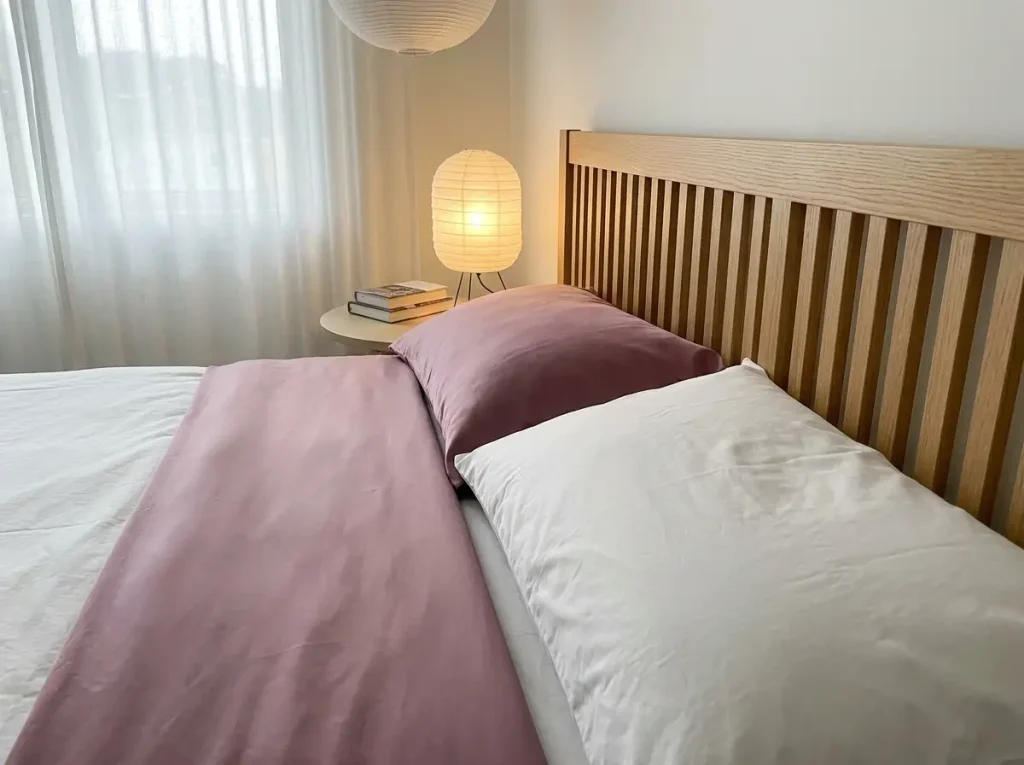
The mechanism is friction, and nothing else. A degummed silk filament presents a smoother surface than a spun cotton yarn, so hair moves across it instead of catching on it, and skin spends the night pressed against something that creases it less. That is the entire claim, and it is also enough.
A real, narrow, physical effect does not need help, and it does explain the reports that keep coming back: curly hair that arrives at morning with less frizz, and a cheek that is not printed with the creases of a cotton weave. What it is not is an anti-aging treatment, a thing that feeds skin, or anything a doctor would write down. If dry skin, acne-prone skin or genuine skin sensitivity is the actual complaint, a pillowcase is a reasonable thing to try and a poor thing to rely on, and that is a conversation for a doctor rather than a bedding article.
The same scrutiny belongs on the bamboo side, where the claims are “hypoallergenic,” “antibacterial” and “antimicrobial.” Both are usually a chemical finish applied to the fabric rather than a property of the fiber, and a finish washes out, typically well before the sheet itself wears out. That is the part nobody says out loud: the antibacterial claim on a bamboo set is generally true on the day the batch was tested and untrue by the twentieth wash, and nobody re-tests at wash twenty because no certificate requires it.
Which brings up OEKO-TEX, since both fabrics wear that badge. Standard 100 tests a finished batch for more than a thousand regulated and unregulated substances, and that is a genuinely useful thing to have. It is a chemical-safety certificate for that lot. It says nothing about construction, nothing about durability, and nothing about whether the sheet is any good — worth reading what Standard 100 does and does not certify before letting the logo do more work than it can.
If a bamboo listing claims antibacterial performance, look for whether it says the effect comes from the fiber or from a treatment. If it does not say, assume treatment, and assume it leaves on roughly the schedule that any other finish leaves. You are buying the sheet underneath the claim, so judge the sheet.
And there is a cheap way to test the friction claim without committing to anything. Your head is what touches fabric all night; your back mostly touches a fitted sheet you never think about. A pillowcase gets you almost all of the benefit for a fraction of the commitment, which is why the Cuddledown Mulberry Silk Pillowcase at 22 momme and grade 6A is the sensible entry point rather than a full set. Its flaw, in writing: it still wants a delicate wash and no softener, and unlike a cotton case, a snag from a pet, a ring or a zip shows immediately and permanently.
What Twenty Washes Do to Each
Everything in this category feels good in week one, which is precisely why week one is worthless as evidence. The honest comparison starts somewhere around the twentieth wash.
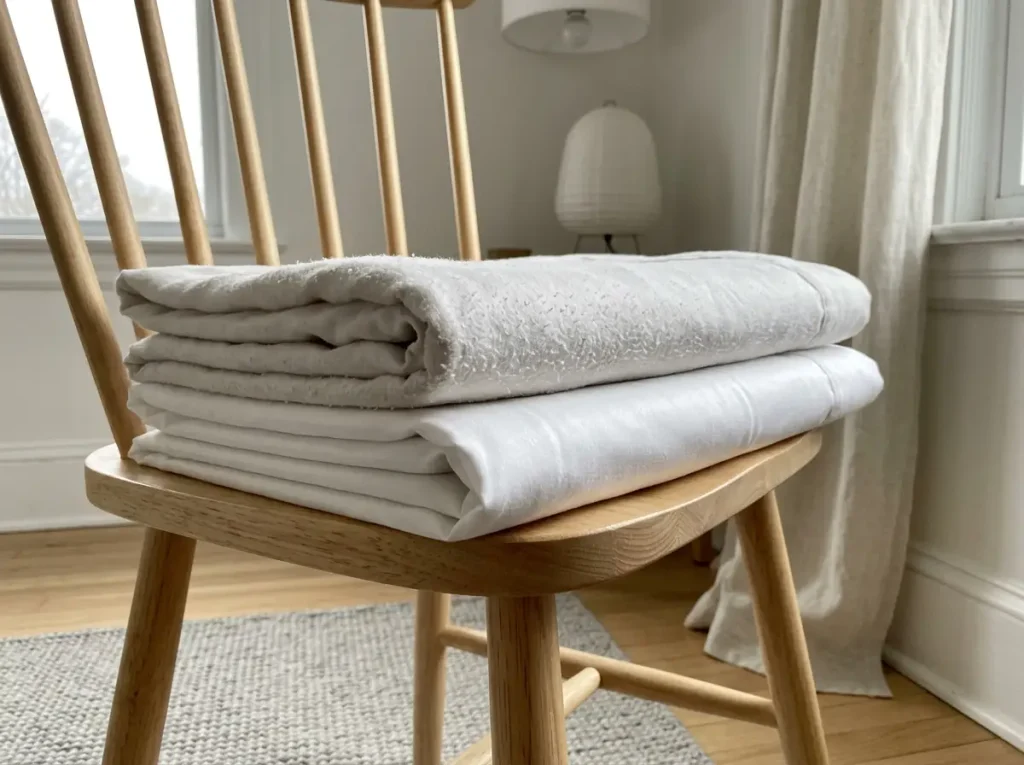
Community wash reports on bamboo split cleanly, and they split on fiber purity rather than on price. Sets that are genuinely 100 percent bamboo, viscose or lyocell, commonly reach 30 to 50 washes and beyond with their texture intact. Bamboo-polyester blends start pilling visibly somewhere around wash 15 to 20, near enough every time.
If a listing does not state a pre-wash or fiber-smoothing step, the risk goes up. That is the whole durability story, and it fits in a paragraph.
What does not exist is an agreed lifespan figure. One competitor publishes 5 to 8 years for bamboo and another publishes 5 to 10, both stated with total confidence and neither with a method behind it. When two pages disagree by two years and neither shows its work, both numbers are marketing. Silk is usually cited at 2 to 5 years, and that range quietly assumes correct care.
An ordinary hot cycle with softener in it compresses that dramatically. Silk wants a cold water wash by hand, or a gentle cycle in a mesh bag at worst, and it wants to air dry rather than see a dryer at all; bamboo will forgive a tumble dry low but not much beyond it. It is also worth saying that the silk failures reported at three washes and at one month are not silk failing at all. That is polyester satin failing on schedule, wearing a silk label.
Softener is the specific enemy of both, and this is the free fix.
On silk it coats the filament and removes the slide you paid for. On bamboo it clogs the fiber and removes exactly the moisture handling that was the reason for the purchase. Stop using it. That costs nothing.
Bamboo viscose also does not pill evenly, and knowing where to look is worth more than any lifespan claim. It goes first at the two spots where a forearm rests and where the fitted sheet stretches over the mattress edge, months before the middle of the sheet shows anything at all. Look at those two places.
Not the middle. For the longer view on this, how bamboo holds up against a fiber that improves with washing makes the contrast sharper than any bamboo-only account can.
| Construction | What the tag should say | First touch vs. all night | Wash routine | Where it fails first |
|---|---|---|---|---|
| Bamboo viscose | Rayon (or viscose) made from bamboo — never plain “bamboo” | Smooth and cool at first, holds moisture by morning | Cold machine wash, gentle, low tumble or air dry | Pilling where a forearm rests and at the fitted-sheet edge |
| Bamboo lyocell | Lyocell from bamboo, or TENCEL lyocell — stated explicitly | Less dramatic at first, steadier across seven hours | Cold machine wash, gentle, no softener | Sheen loss on the sateen face before any structural wear |
| Mulberry silk | 100% mulberry silk with a momme figure (19–25) and a grade | Cold for about ninety seconds, then flat | Hand wash or dedicated delicate cycle, no bleach, no softener | Thinning at the pillow end, and snags from rings, zips and pets |
| Silk pillowcase only | Same as above — momme and grade, on a single case | Friction benefit where hair and skin actually sit | Delicate wash, no softener, easy to do by hand | Visible snag damage, immediate and permanent |
Two People, One Bed, Two Different Answers
Every comparison in this category quietly assumes one sleeper. A great many of these beds have two, with opposite complaints and a single set of sheets between them.
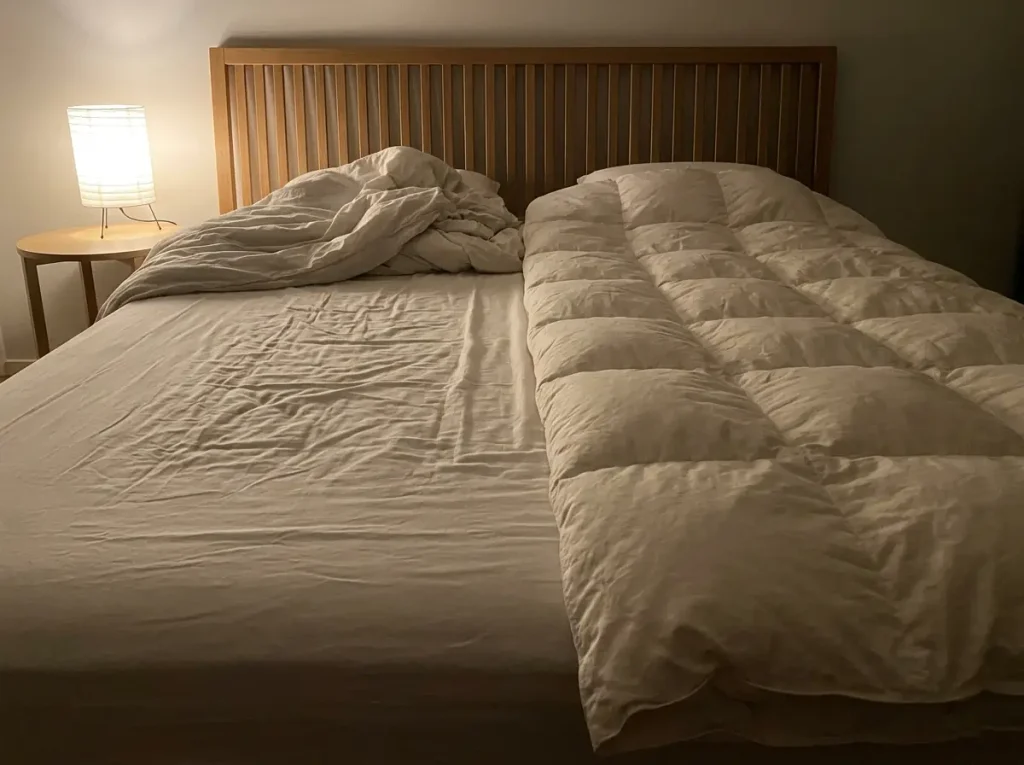
Start with what cannot be split.
The fitted sheet is shared, it is not negotiable, and it should be chosen for the hotter sleeper, because the cooler one can add a layer and the hotter one cannot subtract from a sheet. That single rule resolves most of the argument. The layers above are where the two of you actually diverge, and the arrangement that works is two duvets at different weights, each in its own duvet cover, sitting on one fitted sheet. Half of Europe has been doing this for years and it is still treated as an eccentricity here.
Free first, though, and this is the part worth trying before anything gets bought. Take the flat sheet off entirely for a week, or move the heavier layer to one side of the bed only. Most of the nightly argument is about the top layer, not the sheet underneath it, and you can find that out on Tuesday for nothing.
Then buy. The full layer-by-layer version of this is how the layers stack for a hot sleeper, and it goes deeper than a section can.
When the split does need buying into, the concrete lighter half of the pair is something like the Hotel Grand Tencel Lyocell Summer Cooling Comforter, with a 300-thread-count shell and a summer fill weight, over a bamboo lyocell sheet on the hot sleeper’s side. Its flaw, in writing: it is a Tencel and polyester blend rather than pure Tencel, so part of the lyocell moisture advantage is diluted, and stock on it is thin.
The other asymmetry is cheap and nobody thinks of it. Pillowcases are the one layer that is genuinely per-person — silk on one side and cotton on the other is a completely legitimate arrangement, and it costs a fraction of committing the whole bed to either. One forum poster was shopping for silk specifically because her husband “runs a little hot,” which is the community’s instinct running backwards: silk’s advantage is friction, not temperature, and it will not do the job she was buying it for.
There is a small piece of bed logic hiding in all of this. The fitted sheet is the layer nobody argues about and nobody can adjust; the duvet is renegotiated nightly, sometimes hourly. So choose the sheet for the sleeper who has no way to adjust, and let the adjustable layer do the adjusting. That is the whole method.
What Each One Costs the World, and What It Costs You a Year
Neither of these fabrics is the clean choice the marketing implies, and the reasons are completely different for each. This is worth two minutes because it is where most of the sustainability copy in this category falls apart.
Bamboo grows fast and needs little, which is true and is where most bamboo marketing stops. The problem is not the plant, it is the conversion. Turning a hard stalk into a soft yarn means dissolving it chemically, and conventional viscose does that with a solvent bath that is genuinely harsh on the workers and the water around the plant that runs it.
Lyocell runs the same idea through a closed-loop process that recaptures most of the solvent instead of discharging it, which is the real reason a lyocell set costs more than a viscose one. A GOTS mark, unlike OEKO-TEX, does speak to how the fiber was grown and processed rather than only to what is left in the finished cloth. Very little bamboo carries it, and the reason it does not is the chemistry.
Silk has no chemistry problem and an ethics one instead. Conventional sericulture harvests the silkworm cocoon before the moth emerges, which is why silk is not vegan bedding and why cruelty-free peace silk exists as a smaller, coarser, more expensive alternative. Whether that matters is yours to decide. It is simply worth deciding on purpose rather than discovering it later.
Then there is the cost per year, which is the only price comparison this site will make. A bamboo lyocell set that survives forty washes and a silk set that needs replacing in three years are not competing on the shelf price at all, and the shelf price is the only number either of them advertises.
Divide what you paid by the seasons you actually got, and the expensive set is frequently the cheaper one. That arithmetic is also the fastest way to see why a twelve-dollar “silk” pillowcase is not a bargain: cheap silk is a purchase you make four times. And if the care tag says dry clean only, add that to the arithmetic too, because it is a running cost and not a one-off.
Which One to Buy, by Sleeper
With the constructions separated and the wash accounted for, the question stops being bamboo-or-silk and becomes a short list of situations.
- Hot and sweaty, machine-wash non-negotiable → bamboo lyocell, and check that the tag says lyocell rather than just bamboo. If the brand name on the package is TENCEL and you are wondering whether Tencel and eucalyptus are the same thing, that distinction has its own page, and it is worth five minutes before you buy.
- Hair breakage or facial creasing is the actual complaint → a silk pillowcase, not a silk set. It is the cheapest real answer in the entire category and the only one that targets the mechanism precisely.
- Cold sleeper who wants something that feels expensive → silk works, and the care routine is the price of admission. Whether that trade is worth making is the subject of who silk sheets are genuinely worth it for, which goes through momme, care and cost of ownership properly.
- Budget, pets, or a household that will not hand-wash anything → bamboo, every time. A silk set in that house is a set of expensive rags by spring. If the budget is the binding constraint, the real comparison is how bamboo compares against microfiber rather than against silk.
- Shared bed → a bamboo lyocell fitted sheet chosen for the hotter sleeper, split layers above it, and a silk pillowcase on one side if the friction complaint is a real one.
Here is the thing that took the longest to see. Almost everybody who arrives at this question wants a pillowcase and a better comforter, and believes they want a sheet set. The sheet is the least of it.
Conclusion
Read the construction, not the fiber name. “Bamboo” standing alone on a tag is rayon by federal rule, and lyocell and viscose are two different sheets that will behave differently on the same bed. Silk buys you friction, not temperature, and momme is the figure that predicts whether the set survives the year. And neither fabric stays soft on its own terms past a season if it goes through the wash with softener in the drawer.
Around the twentieth wash, look at the two places bamboo goes first: where a forearm rests, and where the fitted sheet stretches over the mattress edge. On silk, hold the pillow end up to a window and look for thinning where your head has been.
Before you replace anything, take the softener out of the cupboard tonight and wash the set you already own without it. Give it three cycles. A good number of people find the sheets they were about to throw out come back.
Frequently Asked Questions
01What is the downside to bamboo sheets?
Most bamboo sold is viscose, which holds moisture longer than lyocell does and can feel clingy by morning on a humid night. Bamboo-polyester blends also pill around wash 15 to 20, and a tag reading only bamboo means rayon by federal rule.
02What are the downsides of silk sheets?
Silk needs hand-washing or a dedicated delicate cycle with no bleach and no fabric softener, and it feels cool only for the first minute or two. Below 19 momme it wears fast, and fakes sold as silk are common.
03Do bamboo sheets feel like silk?
A bamboo sateen can feel close to silk on first touch, because the weave floats threads across the surface, not because the fiber resembles silk. The difference shows up overnight in how each handles moisture, and again after washing.
04How can you tell if silk sheets are real?
Look for a stated momme weight between 19 and 25 and a letter grade such as 6A; real silk also squeaks faintly when rubbed between finger and thumb. No momme figure plus a very low price has answered the question.
05Which is better for hair, bamboo or silk?
Silk, and the reason is friction rather than any property of the fiber beyond its smooth degummed surface. A single pillowcase gets you nearly all of that benefit for a fraction of the cost and the care commitment.





Tried it on your own bed?
No comments yet. Tell us what you changed, and what the sheet did after a few washes.