

What’s in here7 sections
Two sheet sets sit on the same shelf. One says 300, one says 1,000, and the second one costs three times as much. Reaching for the bigger number is not a mistake on your part; it is the only comparison the packaging offers you, and it was designed that way.
Thread count is warp threads plus weft threads in one square inch of cloth, and there is nothing anywhere in that sum that tells you whether a single “thread” was one yarn or three thin ones twisted together and counted separately. A loom running single-ply cotton runs out of physical room somewhere around 400 to 600 threads per square inch, so a number well past that came from arithmetic, not from more yarn.
Below: what the number counts, how it gets doubled, the narrow range where it still means something, why the weave and the fiber decide the feel instead, and the one spec that works on the fabrics thread count cannot even be printed on.
Quick Answer
Thread count is a real signal only on single-ply, 100% woven cotton, and only up to roughly 400 to 500. Above that it is almost always multi-ply counting, which buys a denser and warmer sheet rather than a finer one. On linen, microfiber, rayon-family fabrics and knits it measures nothing useful at all.
What Thread Count Actually Counts
The definition is the part everybody skips on the way to the verdict, and it is exactly where the trick is hiding. The count is a sum. Simple sums are easy to game, and this one has been gamed at the shelf for twenty years.
Warp, Weft, One Square Inch
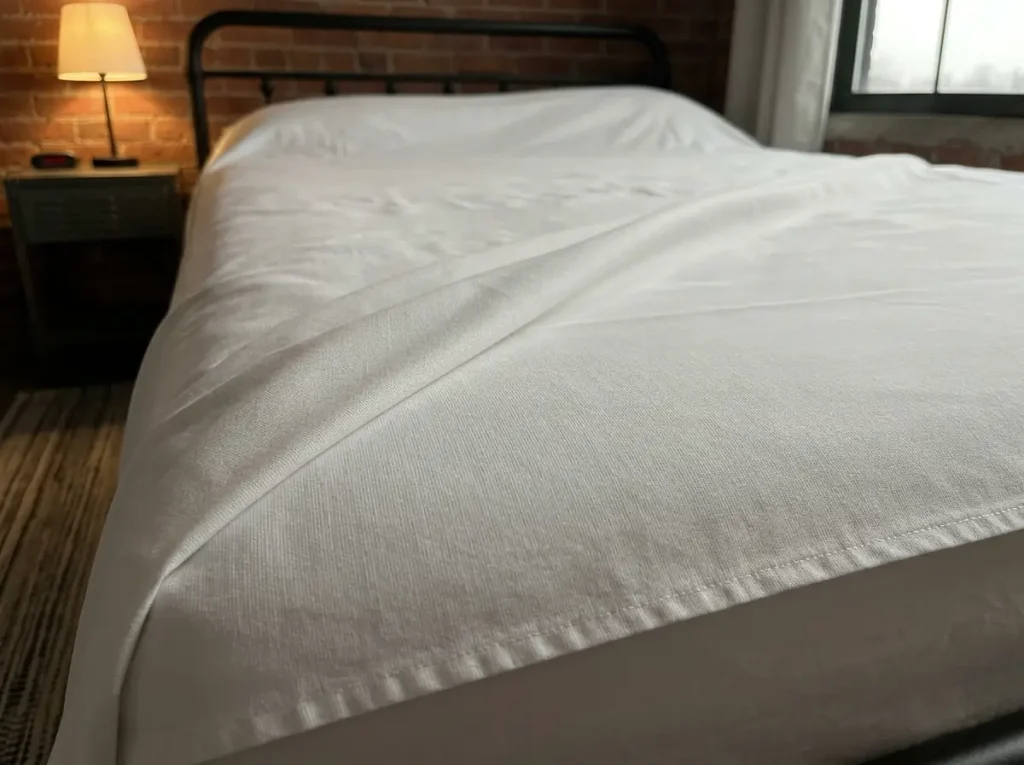
Warp threads run the length of the cloth, held under tension on the loom. Weft threads run across, over and under the warp. Count how many of each cross a single square inch, add the two numbers, and that is your thread count. That is the entire definition, and it is worth reading twice, because of what it leaves out.
It carries no information about fiber. None about staple length, which decides whether the cotton pills. None about ply, none about weave, none about finish, none about weight. Five things decide how a sheet feels in your hand and how it behaves in July, and the number on the front of the package holds none of them.
What thread count measures is density: how tightly packed the cloth is. Density is a real property and it is worth knowing. But density is not quality, and the whole sales apparatus of the last two decades has depended on you not separating the two.
A Mill Spec That Escaped Onto the Box
Thread count did not start life as a marketing claim. Inside a mill it is a construction spec, the shorthand a buyer uses to describe what a loom is set up to produce, sitting alongside a dozen other numbers that never made it to a package. It got out. On the front of a box, with the other dozen numbers stripped away, it stopped describing a construction and became a price ladder.
The community worked this out on its own a long time ago. A recurring shorthand is that the thread count is basically meaningless above 400, and the advice keeps landing on plainly labeled sets rather than headline figures. That is not a study. It is a lot of people who have washed a lot of sheets arriving at roughly where the standards bodies already were.
Why the Number Survives and the Description Dies
A percale and a sateen can carry the identical thread count and feel nothing alike. The count says how many threads are in there; the weave says what those threads are doing, one over one or four over one.
The number survives because it is a number, and numbers rank. The description dies because what the thread is actually doing in the cloth will not fit on a shelf tag.
How 300 Becomes 600 on the Package
Section one left the definition sitting there looking harmless. Now watch what a marketing department can do with a sum. This is arithmetic you can run yourself, standing in the aisle, without trusting anybody.

The Multiplication, Spelled Out
Take a real fabric: 150 warp threads and 150 weft threads per square inch. True thread count, 300.
Now weave that same cloth with two-ply yarn, meaning each yarn is two thinner strands twisted together, and count each strand on its own. Same cloth, same loom, same square inch, and the label now reads 600. Do it with 3-ply and the label reads 900.
The cloth never changed. Not one yarn was added.
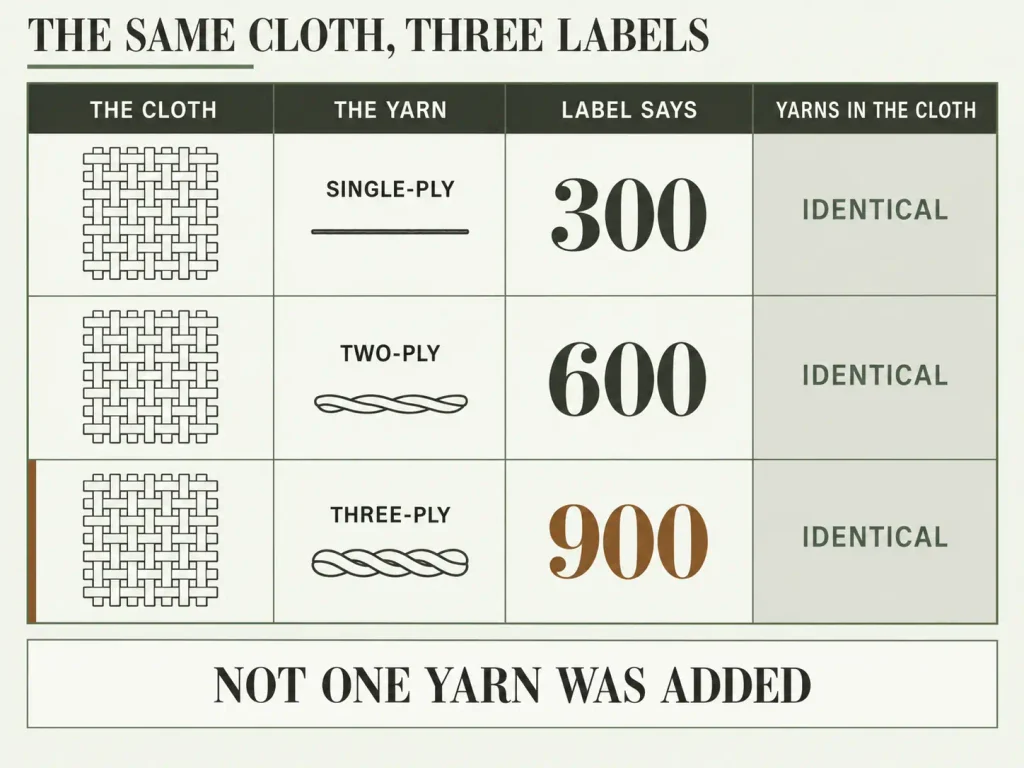
That worked example is not something anyone had to invent. It comes straight out of the ASTM subcommittee’s own 2005 proposal for a non-deceptive thread-count label, which held that warp and filling should be counted as single units regardless of whether a yarn is single or plied, and proposed the honest phrasing outright: a fabric like that should be sold as 300 thread count, 2-ply yarn, not as 600 thread count.
The Regulator Already Said So, in 2005
The same year, the Federal Trade Commission took the identical position in a letter to the National Textile Association: plied yarns should be counted as one thread each, and counting each ply separately could deceive or mislead the person buying the sheet. That was twenty years ago.
Nothing happened at the shelf. Which is why you can still stand in front of a package saying 1,000 today, with a regulator’s opinion letter and a standards subcommittee’s proposal both sitting in a filing cabinet, neither of them printed anywhere near the cloth.
Before you buy anything at all, turn the package over and look for the word ply. That is the whole test, it costs nothing, and it does more work than any amount of number-comparing. A brand weaving single-ply usually says single-ply, because single-ply is the harder and more expensive thing to do well. Silence is the signal. The ELINEN 100% Supima Cotton Sheets 600 Thread Count set is a clean place to run that test on a real listing rather than a hypothetical: 600 threads per square inch on 100% Supima, sitting right at the edge of what a single-ply loom can physically do, with no ply stated anywhere. And above roughly 500 threads per square inch without a stated ply there is less open area between the yarns for air to move through, so the higher number is buying you a denser, warmer sheet, not a better one.
Run the division before you run the comparison. Halve any count over 500 that does not state its ply, and thirds it if the listing mentions three-ply anywhere. A “1,000 thread count” set becomes a 500 or a 333, and suddenly it is sitting next to the plain 400 you were about to walk past, at which point the decision is between two comparable fabrics instead of between two labels.
The Quieter Second Inflation
There is a smaller trick stacked on top of the ply math. In some constructions, picks, the individual weft insertions the loom makes, get counted as threads in their own right, so a fabric with multiple picks in the same shed reports a count that no yarn count would support. It is less common than ply inflation and it compounds with it, which is how packages reach four figures.
And here is where this article parts company with the ones that just shout marketing lie: plying is not a scam. Twisting two thin strands together is a legitimate technique with real uses, and a good 2-ply fabric is a good fabric. What is dishonest is the counting, not the yarn.
A brand that says 300 thread count, 2-ply is telling you the truth about a decent sheet. A brand that says 600 about that same cloth is not. The tell is never the number itself; it is whether the listing states its construction at all, or stays quiet about everything except staple length, which is the spec the count is standing in front of.
The Range Where the Number Still Means Something
Two sections of taking a number apart earns the number a concession. Thread count is not useless. It is narrow. Inside its window it tells you something real, and the window has a top and a bottom you can memorize.
Roughly 300 to 500, and What Has To Be True
For single-ply 100% cotton, the useful band is about 300 to 400, stretching to 500 before the returns flatten out. Below roughly 200 the cloth starts feeling thin and sheer under a hand. Above 500 on an unstated ply, assume arithmetic and move on. That band is also, not coincidentally, the count hotels actually buy when they are choosing linen that has to survive an industrial laundry twice a week.
Four things have to be true before that band means anything at all, and you can run them as a checklist in about ten seconds:
- 100% cotton. A blend or a rayon-family fabric changes what a thread even is.
- Single-ply, or a stated ply you can do the division on.
- Woven, not knit. A jersey sheet has no warp-and-weft square inch to count.
- The ply is actually stated somewhere. Not implied, not guessed. Stated.
Miss one of the four and the number on the front is decoration. Miss two and it is closer to a costume.
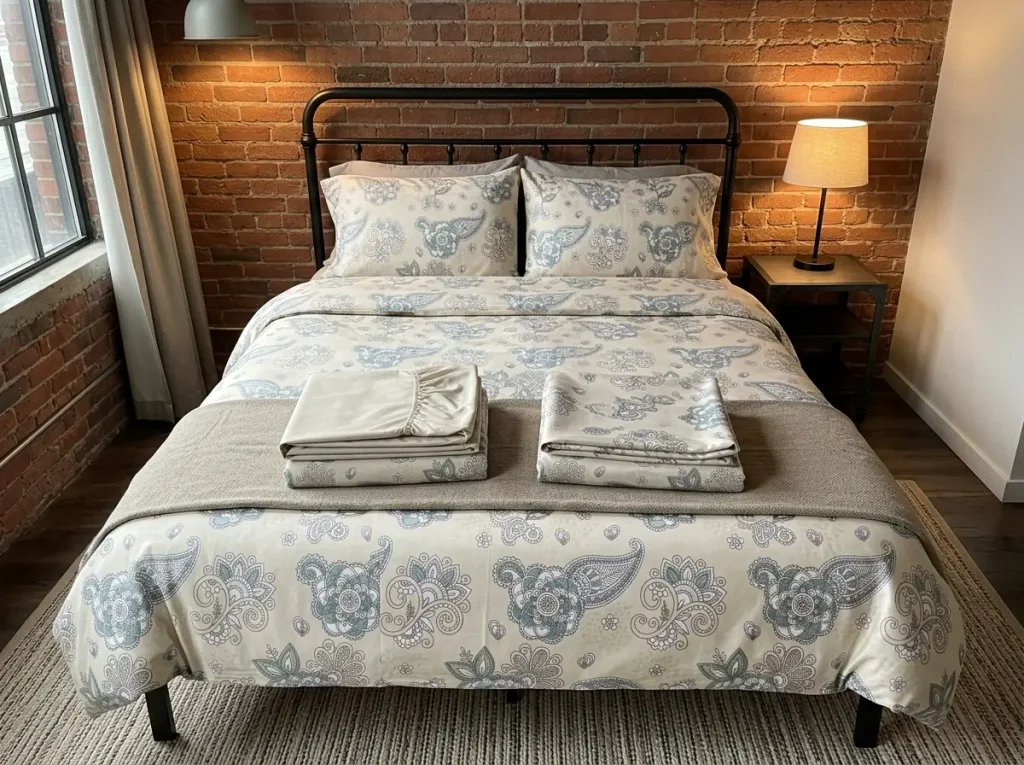
The Feather & Stitch 100% Cotton Percale Sheet Set is what all four conditions look like when a brand bothers: 100% cotton, percale weave, single-ply construction, a plain 300 on the label and a 16-inch pocket stated instead of a vague “deep”. Its flaw is the whole reason it needs defending: 300 and single-ply does not read as premium on a shelf, so the shopper comparing numbers alone walks straight past it toward something with a bigger figure and a worse cloth. That bias is the one this article exists to correct.
Why More Starts Meaning Hotter
This is the part that turns a debunk into a decision rule. As Cotton Incorporated’s woven product development manager put it, the fewer yarns you have in an area, the more open area you have for air to move through. That is the cotton industry’s own research arm stating the mechanism, and it runs in the opposite direction to the label.
So past roughly 400, packing more yarn into the same square inch does not make the cloth finer. It makes it denser, and denser cloth holds more warm air against you. If you sleep hot and you are choosing between a 300 and an 800 in the same fiber and the same weave, the higher number is not neutral. It is the wrong direction, and you will find that out in July rather than in the store.
Hold the packaged set up against a window or a lamp before you buy it. A single-ply percale in the 300 range lets a soft, even glow through, and you can see the grid of the weave. A padded multi-ply set at the same apparent count blocks noticeably more light, because the extra density is real even though the number describing it is not. It is the fastest read you get through cellophane.
The Lower Number That Outlasted the Higher One
There is a durability result worth carrying around. Consumer Reports’ own wash-cycle testing found the opposite of what the shelf implies: a 300-count long-staple cotton outlasted an 800-count short-staple cotton across 50 washes. The worse-sounding number survived. The better-sounding one did not, because the number was never measuring what wears a sheet out.
The community arrived at the same place from a different direction. The answer that keeps recurring is not a prestige brand at all; it is the plain percale that states its construction, and the sets that last are usually the plainly labeled ones. A modest number stated honestly beats a padded one, every time, and the Belem Luxury Hotel Sheets, Flat Twill Weave set makes that point at the bottom of the range, a 200 count in a twill weave, stated flatly, with no inflation claim anywhere on it. It is a 70/30 cotton-polyester blend rather than pure cotton, so it will not breathe or feel the way a 100% cotton percale does, and the saving there is paid in hand, not in lifespan.
Why the Weave and the Fiber Decide the Feel
If the number is only narrowly useful, the fair question is what you should be reading instead. Two specs do most of the work the count is pretending to do, and both of them are settled at length elsewhere on this site rather than re-argued here.
Weave, Staple and the Finish That Leaves
Weave decides the hand. One thread over, one under, and you get a matte, crisp cloth with gaps in it; that structure is a plain weave, and percale is its name in the bedding aisle. Four floating over one, and you get a smooth surface with a low sheen and fewer gaps; that is a satin weave, sold as sateen when it is spun from cotton. Same fiber, same count, two entirely different sheets, and how percale, sateen and linen actually differ is a full comparison rather than a footnote in this one.
The gaps are not incidental, either. Fewer floats and more open area between the yarns is what breathability actually consists of, which is why a plain weave at a modest count moves air that a dense satin weave at a high one does not, and why a hot sleeper who buys by the number tends to buy the wrong sheet twice.
Fiber and staple length decide the durability and the pilling. Staple is simply how long the individual cotton fibers are before they are spun. Extra-long-staple cotton spins into a yarn with fewer loose ends sticking out of it, so it resists pilling in a way a short-staple cotton at twice the thread count never will, and combed cotton, where the short fibers are mechanically removed before spinning, gets to a similar place by subtraction. That is what the Consumer Reports result was actually measuring: not 300 against 800, but long staple against short. Which of those constructions holds up better over years is settled in the article on which of the two weaves lasts longer.
And there is a third, invisible one. Finish is what makes week one lie. A softening treatment on a cotton lends a borrowed smoothness that has nothing to do with how the cloth was built; it makes a mediocre fabric feel remarkable in the store and for the first few washes, then leaves down the drain and takes the impression with it.
This is the reason the three words people actually shop by come apart under examination. Softness is mostly the finish and washes out. Smoothness is the weave, and it stays. Crispness is the fiber and the weave together, and it is the one a percale keeps for years.
None of the three is in a thread count, which is why what a flat sheet feels like after a season matters more than what it felt like on night one.
A sateen and a percale at the identical count will not even weigh the same in your hand, because the float length changes how much yarn sits on the surface. It also changes the drape: the same weight of cloth falls in soft folds off the side of a mattress in one weave and stands up in crisper planes in the other. That weight difference is the practical reason the next section’s metric tracks feel better than the count ever did.
The Two Checks That Beat Reading the Number
Everything so far has been about what the number cannot tell you. This is what to do instead, and both checks are free. One you run on the listing before you have touched anything; the other you run on the spec sheet.
The No-Label Test
The listing itself is the tell, and you do not need the fabric in hand to read it. Does the brand state its ply anywhere? Does it name the staple length, or at least the cotton? Does it give you a weave and a pocket depth in inches?
A brand confident about its construction talks about the construction. A brand relying on a number is loud about the number and quiet about everything else, which is the same instinct behind reading a sheet by staple and ply rather than by the tag.
Run it on a live example. The SOHO 100% Egyptian Cotton Sateen Stripe Sheet Set states 500 threads per square inch on a sateen weave in 100% Egyptian cotton, and that is a genuinely appealing spec on paper. But the listing does not say ply anywhere, and with no ply stated there is no way to know whether those 500 threads are 500 yarns or 250 counted twice, which means at that exact point you are buying blind.
It is not a condemnation of the sheet. It is the test working: you now know precisely which question the page refuses to answer.
GSM, the Metric That Should Have Replaced It
The second check is a single number that works everywhere thread count does not. GSM, grams per square meter, is the weight of the cloth itself. Not an inference about the cloth from counting yarns, but the actual mass of a square meter of it, which is a thing you can put on a scale.
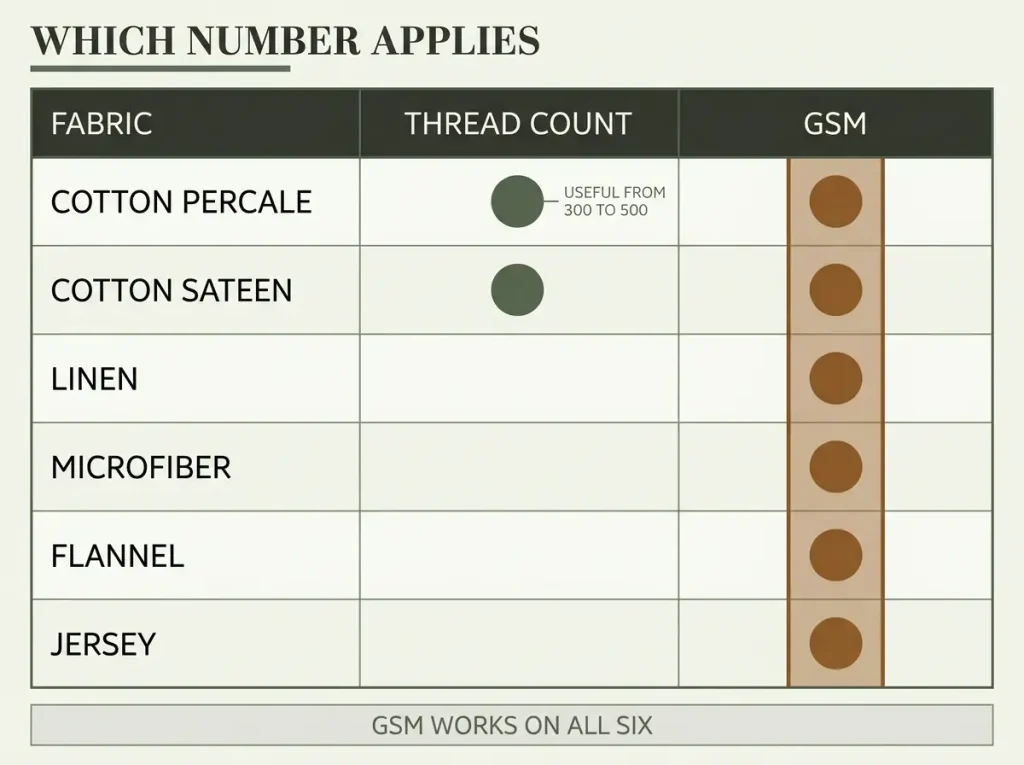
It applies to linen, microfiber, jersey, flannel and every knit, every fabric where a thread count either cannot be printed or means nothing when it is.
It is worth being specific about which fabrics those are, because the list is longer than most people expect. Linen is woven from flax, whose yarns are thick and irregular by nature, so a count of them describes almost nothing about the cloth. Viscose and lyocell, the rayon family that most bamboo sheets actually belong to, are extruded rather than spun from a staple, which makes a yarn count a poor proxy for anything you can feel.
Knit sheets, jersey chief among them, are looped rather than woven, so there is no grid of warp yarn and weft yarn to count in the first place. Brushed cotton and flannel are defined by the nap raised on the surface after weaving, which a count taken at the loom cannot see. In every one of those cases the fabric is specified by weight, and a thread count printed on the package is borrowed vocabulary measuring nothing.
Cotton percale typically runs about 140 to 160 GSM at 300 to 400 threads; sateen runs closer to 150 to 180. The two specs move together only loosely, which is exactly why two sheets can share a thread-count label and feel different the moment you pick them up. This is old news over in linen, where the useful number is GSM and always was, and it should have been the sheet aisle’s number decades ago.
What the Inflated Set Does at Wash Twenty
Now follow the number past the register, which is where the whole argument gets paid off and where no shopping guide goes. Multi-ply construction has more twist points in it, and twist points are friction points. Under repeated agitation those plies begin working loose, and the pattern across sources is consistent: pilling starts showing at around a dozen washes and the surface roughens faster than it does on a modest single-ply set.
The wash cycle is where that happens, and how you run it changes the pace. Agitation is the mechanism, so a long heavy cycle works the plies loose faster than a short gentle one. Fabric softener makes it harder to see coming rather than slower to arrive: it coats the fibers and masks the roughening by hand for a while, which is why a set can feel fine and look pilled. Heat is the other lever, so tumble dry low rather than high, or line dry when the weather allows it, and the twist points get worked less on every pass.
So the inflated sheet does not just fail to be better. It wears out sooner, having cost more, on the strength of a number that was describing a fabric it was not woven from.
What fails first is not the middle of the sheet, which is what people expect. It is the twist points, spread across the whole surface, which is why an inflated set starts feeling worse long before anything about it looks worn, and why you can be vaguely dissatisfied with a sheet for months without being able to say what changed. Nothing tore. The yarn just stopped holding itself together.
A useful benchmark for the opposite outcome is a fitted sheet that finally ripped only after a long run of use, because it was a plainly labeled set with a modest number. That kind of sheet is the standard everything else gets measured against, and nothing about it was remarkable except that the brand said what it was.
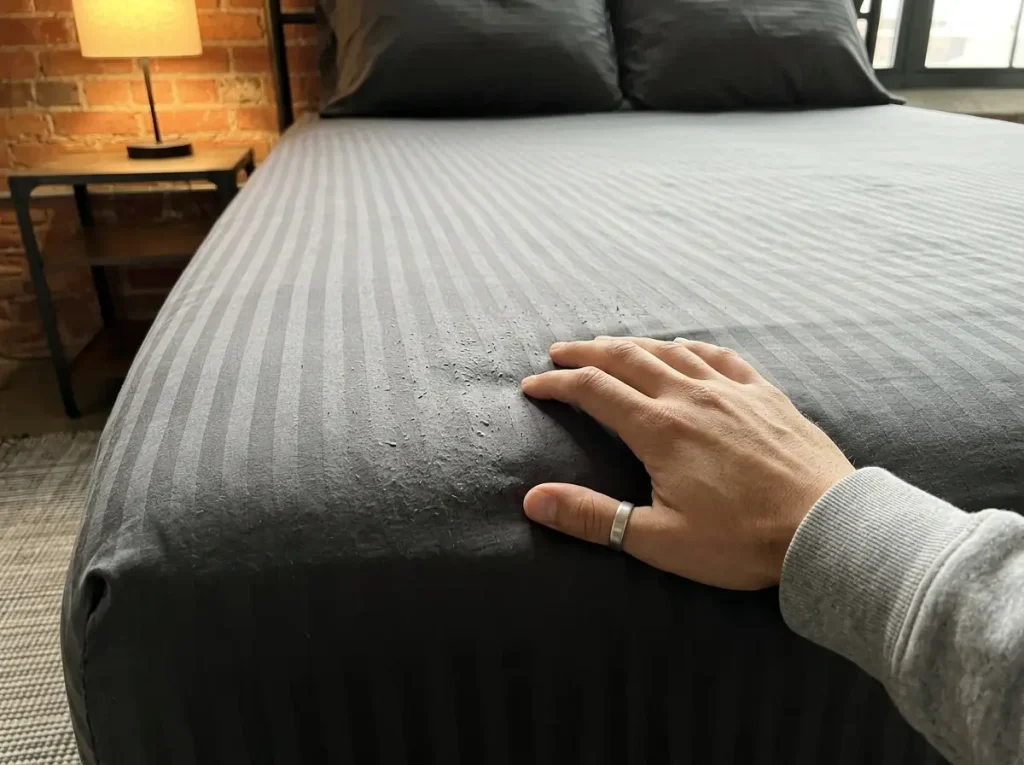
Find the pilling before it finds you. After a dozen washes, run an open palm slowly across the middle third of the fitted sheet, where a sleeper’s shoulders and hips do the most rubbing, and compare it to the strip that tucks under the mattress and never gets slept on. On a single-ply set the two feel the same. On an inflated multi-ply set the slept-on band has already gone slightly grainy, and that gap is the ply arithmetic finally showing itself.
Read the construction, weigh the cloth, ignore the headline. That is the section in nine words.
Conclusion
Thread count is warp plus weft in a square inch, and nothing prevents a brand from counting one twisted yarn as two or as three. A big number with no stated ply is arithmetic rather than cloth, and you can do the division yourself in about four seconds.
The number is a genuine signal inside a narrow window: single-ply, 100% cotton, woven, roughly 300 to 500. Outside those four conditions it is decoration, and above the window it is buying you density, which sleeps warmer.
Read the construction instead. Does the listing state its ply and its staple, and what does the cloth actually weigh. GSM works on every fabric in the aisle; thread count works on two of them.
The wash-twenty check: after a season of washing, run a hand across the areas that take the most friction. Where the plies have worked loose, the surface roughens and pills before anything looks worn, and that is the inflated number finally telling the truth.
Go and look at the set on your bed right now. If the packaging is long gone, pull up the listing and see whether it states its ply. Whichever way that goes, you will know more about that sheet in thirty seconds than the number on the box ever told you.
Frequently Asked Questions
01What thread count do hotels use?
Most commercial hotel linen sits between 250 and 400, single-ply cotton percale, chosen because it survives industrial laundering rather than because the number impresses anyone. The reasoning behind that band is worked through in what hotels actually put on the bed.
02Is 800 thread count better than 600?
No. At that level both figures almost certainly come from counting plied yarns separately, so you are comparing two labels rather than two fabrics. Compare the ply statement, the staple length and the weight of the cloth instead.
03Is a 1500 thread count good?
A single-ply cotton loom cannot physically reach 1,500 threads per square inch, so the figure is ply arithmetic applied to a much lower real count. Expect a dense, warm sheet that sleeps hotter than a plain 300-count percale.
04What is better, 400 or 600 thread count sheets?
400 in single-ply cotton, if the ply is stated. A 600 with no ply disclosure is likely 300 counted twice, which makes it the denser sheet, not the finer one. The deciding question is construction, not the gap between the numbers.
05Does thread count matter for linen or microfiber sheets?
No. Linen and microfiber are specified by GSM, and a thread count printed on either is borrowed vocabulary measuring nothing useful. Look for roughly 180 GSM or more on linen, and treat any thread count on a knit as decoration.





Tried it on your own bed?
No comments yet. Tell us what you changed, and what the sheet did after a few washes.