







What’s in here10 sections
- Why Linen Creases When Cotton Only Rumples
- The Crease That Sets and the Crease That Shakes Out
- The Free Fix Nobody Names — Make the Bed Damp and Tight
- In a Shared Bed, Only One Side Comes Out Smooth
- What the Dryer Does, and the Routine That Keeps It Honest
- Steaming, Ironing, and the Finish That Trades Away the Linen
- What “Pre-Washed” and “Stonewashed” Actually Buy You
- What Twenty Washes Actually Change
- Conclusion
- Frequently Asked Questions
“Pre-washed” on a linen band is not a promise that the sheet stops wrinkling. It is a promise that somebody already did the first few washes for you. That distinction matters more than anything else on the package, because the wrinkling itself is not a defect you can wash out of the set.
Flax cellulose is 60 to 80 percent crystalline against cotton’s 35 to 50, packed tight enough that the fiber physically has nowhere to spring back to. In one r/quince thread somebody described reaching for a hot, damp washcloth mid-emergency and pressing a line out by hand rather than digging out an iron, which tells you roughly how much this comes up. Here is what actually moves a linen crease, what does not, and what the twentieth wash really changes.
Quick Answer
Linen wrinkles because flax fibers have almost no elastic recovery: a fold made while the fiber is damp sets hard once it dries. Pre-washed or stonewashed linen, a tight tuck while the sheet is still damp, and repeated washing all reduce it. Ironing does not hold, and anti-wrinkle resin finishes trade away the breathability you bought linen for.
Why Linen Creases When Cotton Only Rumples
The intro said the fiber cannot spring back. What that means in a thread you can hold is this: flax has an elongation at break of only 2 to 3 percent. There is almost no stretch in it to give back, so when you bend it, the bend does not get absorbed and released the way it does in a stretchier fiber. It gets kept.
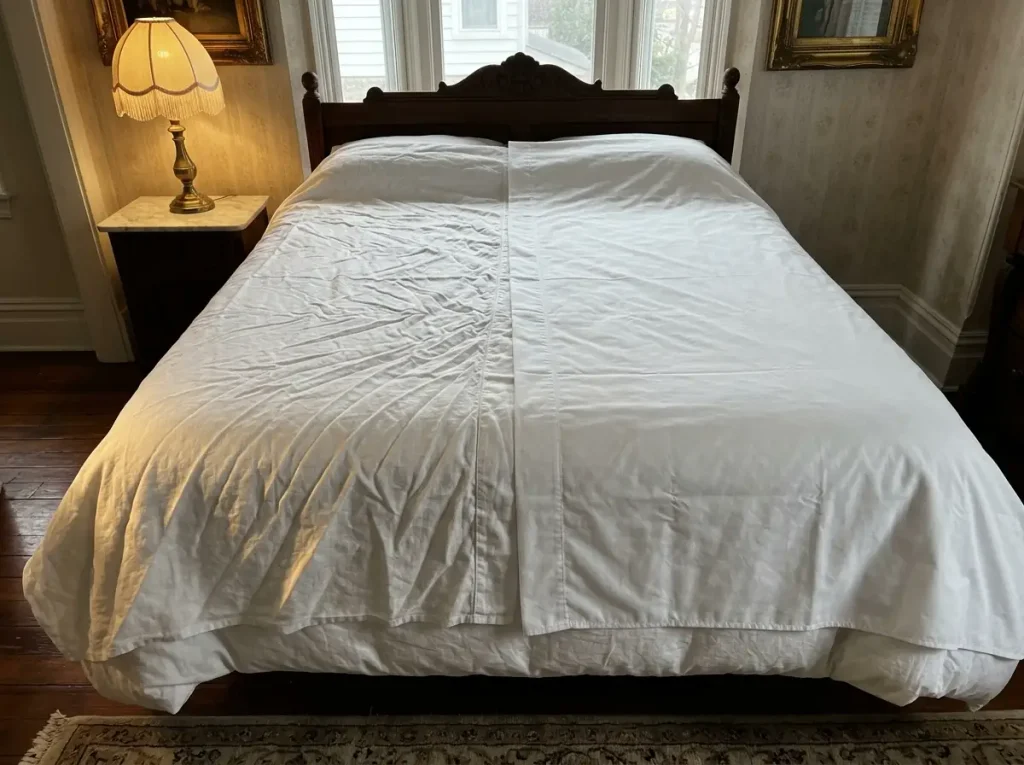
Bending recovery in flax can drop by as much as 40 percent after a single fold, which is a strange thing to sit with: the first fold does measurable damage, not the hundredth.
And the mechanism underneath that is the part nobody prints on a care label. Cellulose holds its shape through hydrogen bonds. When you bend the fiber hard enough, those bonds break and reform across the new folded interface rather than along the original axis.
The crease is not the fabric remembering a fold. It is new chemistry, formed in the folded position, and that is why it behaves like a structural feature instead of a temporary displacement.
Which gives you the honest contrast with the sheet you probably owned before this one. The same night on a cotton percale leaves a rumple, fabric pushed out of place, and it shakes out because nothing about the fiber changed. The same night on linen leaves a line. Those are not different amounts of the same thing: they are different events, one fabric displaced and the other fabric re-bonded.
If you have just bought a linen set and the bed looks unmade an hour after you made it, nothing is wrong with the set. That is the fiber doing exactly what flax does, and it is worth knowing before you decide whether a linen set is worth the money at all.
The Crease That Sets and the Crease That Shakes Out
Not every line on a linen sheet is the same line. The ones a night’s sleeping puts in and the ones that come out of the dryer are made differently, and only one of them is worth spending effort on. Most advice treats “wrinkles” as one undifferentiated thing, which is why so much of it fails.
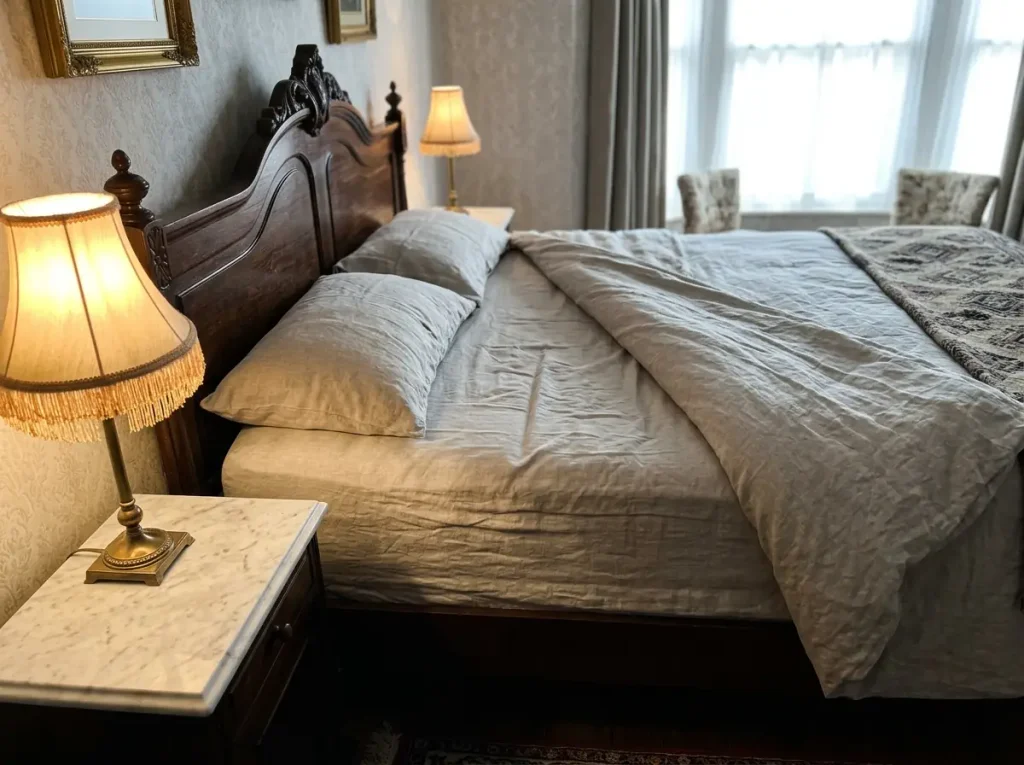
Start with the moisture, because moisture is the whole variable. Linen absorbs water up to roughly 20 percent of its own weight before it feels damp to a hand. So a sheet can feel dry and be nothing of the sort.
When cellulose is wet it swells about 12 percent radially but only around 1.5 percent along its length: the fiber gets fatter without getting longer. The microfibrils inside it have nowhere to go, so they slide and kink against each other.
That asymmetry is the answer to the whole article. A fold made while the fiber is swollen, and then dried in that position, locks. A fold made in a dry sheet at three in the morning does not.
So overnight moisture plus a fold under your hip gives you a set crease. A dryer finishing a load that was still damp and tangled gives you set creases everywhere, all at once, which is why the sheet that comes out of the machine often looks worse than the one you slept on.
If moisture in the fiber is the thing that decides the outcome, then a wash order built around getting moisture out of the fiber is doing more work than the detergent is.
The practical read: the creases that survive the morning are almost never where you expect them. They run under the hip and along whatever fold line the dryer put in, not across the middle of the bed, which is where the sheet looks worst from the doorway and where most people start ironing.
In the r/quince “Linen wrinkles??” thread, nobody reported a wash-and-forget trick that removes an already-set crease without heat. Eighteen comments, and not one.
Before you fight a crease, press it flat with your palm and hold it for ten seconds. If it relaxes, it is a dry rumple and the bed will finish the job on its own tonight. If it springs back sharp, it set while damp and only heat and water will move it. That test saves you most of the ironing you were about to do.
The Free Fix Nobody Names — Make the Bed Damp and Tight
Everything in this section costs nothing, and it works on the mechanism the last one described. If the fiber locks into whatever position it dries in, then the position it dries in is the only variable you actually control. Everything else is damage limitation after the fact.
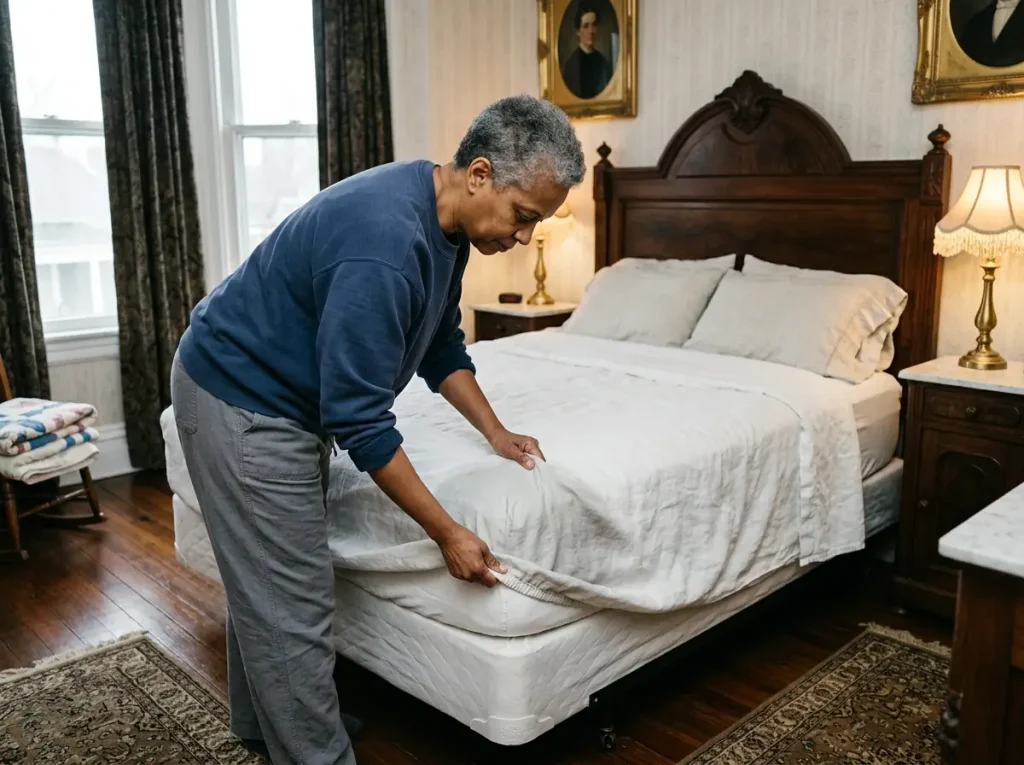
So take the sheet out of the dryer while it is still slightly damp. Not “almost dry”: genuinely a little cool and heavy in the hand. The fiber has not finished setting yet, which means it is still negotiable.
Put it straight on the bed and pull it taut. The mattress becomes the drying frame, and the sheet sets into the shape of the mattress instead of the shape of a heap.
Tuck the corners properly while you are there. Hospital corners are not a tidiness flourish on linen: a folded, tucked corner holds the fabric under tension while it finishes drying, which is exactly the condition you want. Smooth the flat sheet with a flat palm rather than shaking it out; shaking snaps new folds into a damp weave and sets those instead.
The corners are the part that has to be genuinely tight, and this is where people get lazy because the corners are the least visible thing in the room. A slack corner dries into a bunch that no amount of steaming afterward takes out, because you have essentially ironed a permanent pleat into it using nothing but time. A sheet put on damp will dry into the shape of the mattress within about an hour, so that hour is doing all the work whether you set it up properly or not.
For a single stubborn line when there is no time for anything proper, the r/quince fix is a hot, wet washcloth pressed and stretched directly against the crease, and then not putting the piece back in the dryer. It works for the same reason the steamer works: you are re-wetting the bonds locally and letting them reform flat.
What does not work, and gets suggested constantly, is leaving the sheet folded in the closet to “settle.” A folded sheet in a closet is a sheet setting a fold. That is the opposite of settling.
The Spare Set in the Closet Is Setting Its Own Creases
The set on the bed gets all the attention, and the spare set on the shelf quietly acquires the sharpest creases in the house. It has been folded along the same four lines for a month, under the weight of everything stacked on it, and those lines are the ones that will still be visible two washes after it comes back into use.
Roll the spare set instead of folding it. A rolled sheet has no straight edges pressed into it, so it comes out of the closet with soft curves rather than printed lines, and it takes up less shelf than a squared stack does. If rolling feels like too much, at least fold it loosely and refold it along different lines the next time, so no single crease gets a month of pressure to work with. Deep drawer storage is worse than an open shelf here, because a drawer packs from above and a shelf does not.
Pillowcases are the exception worth making: hang them. A padded hanger in the closet keeps the one piece anybody looks at closely completely line-free, and it costs nothing but the hanger.
Do the deep corners first, while the sheet is at its dampest and most cooperative, then work up to the head of the bed. If you start at the top you will be stretching a half-dry sheet into the corners at the end, which is exactly when it has stopped negotiating.
In a Shared Bed, Only One Side Comes Out Smooth
The damp-and-tight routine has one failure mode nobody writes about, and it shows up the morning after in a bed with two people in it. One of you tucks your side back in properly. The other sleeps with the sheet loose and leaves it that way. Two months later you have what looks like two different sheets stitched together at the middle.
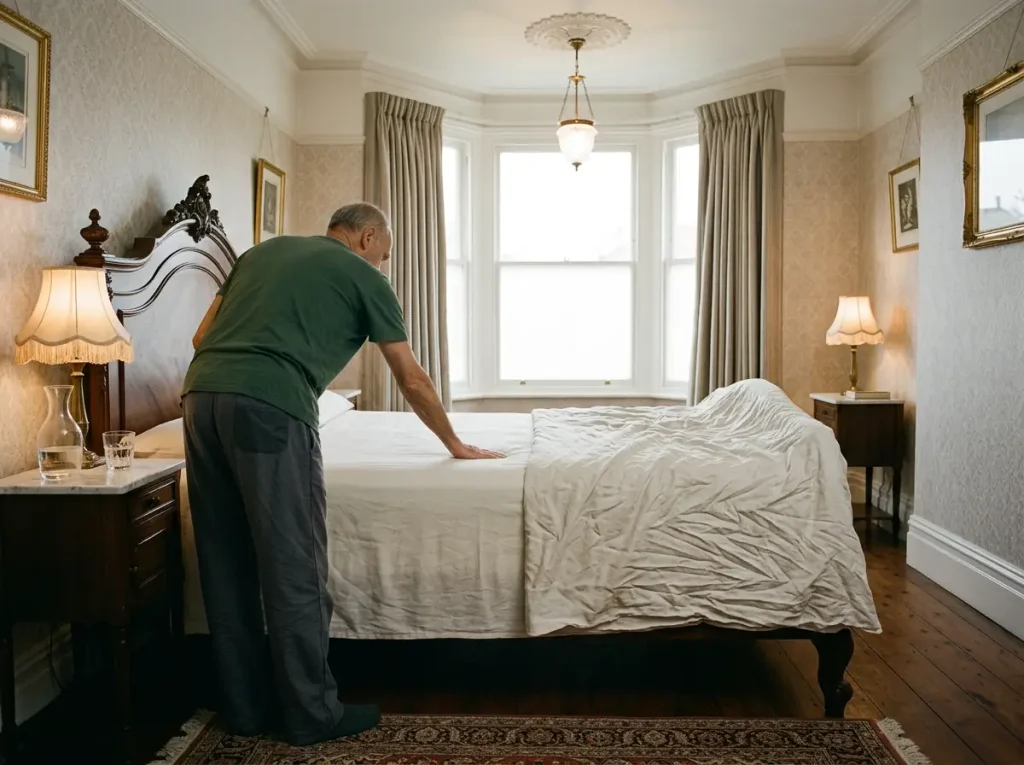
The mechanism is the same one as everywhere else in this article, just applied to half a bed at a time. The side that gets pulled taut dries flat and stays flat. The side left loose dries in whatever shape it was in when the person left the room.
So the crease pattern on a shared bed is not random at all. It maps onto who makes their half of the bed and who does not, and once you know that you cannot stop seeing it.
I should be straight about where this one comes from. It rests on a single Reddit thread read for this article, the r/Bedding thread about edge-creasing, and not on a second independent source. It is an observation that thread supports and that the fiber mechanics make sense of, not an established finding, and you should hold it that loosely.
The fix, if it is real, is free and takes about ten seconds: whoever gets up second pulls their own corner taut before leaving the room. Not the whole bed. Their corner.
And it is almost always the deep corner at the foot on the untucked side, the one nobody can reach without walking all the way around, which is why the bed looks noticeably worse from one side of the room than the other. A set of sheets gets judged by its worst-looking half, and the worst half usually has a person attached to it. This is the sort of thing that comes up constantly once you start thinking about two people who need two different things out of the same bed.
What the Dryer Does, and the Routine That Keeps It Honest
The dryer is where most of a linen sheet’s permanent creases are actually made. It is also the one step where a small change in habit shows up on the bed the same evening, which makes it the best return on effort in the article.
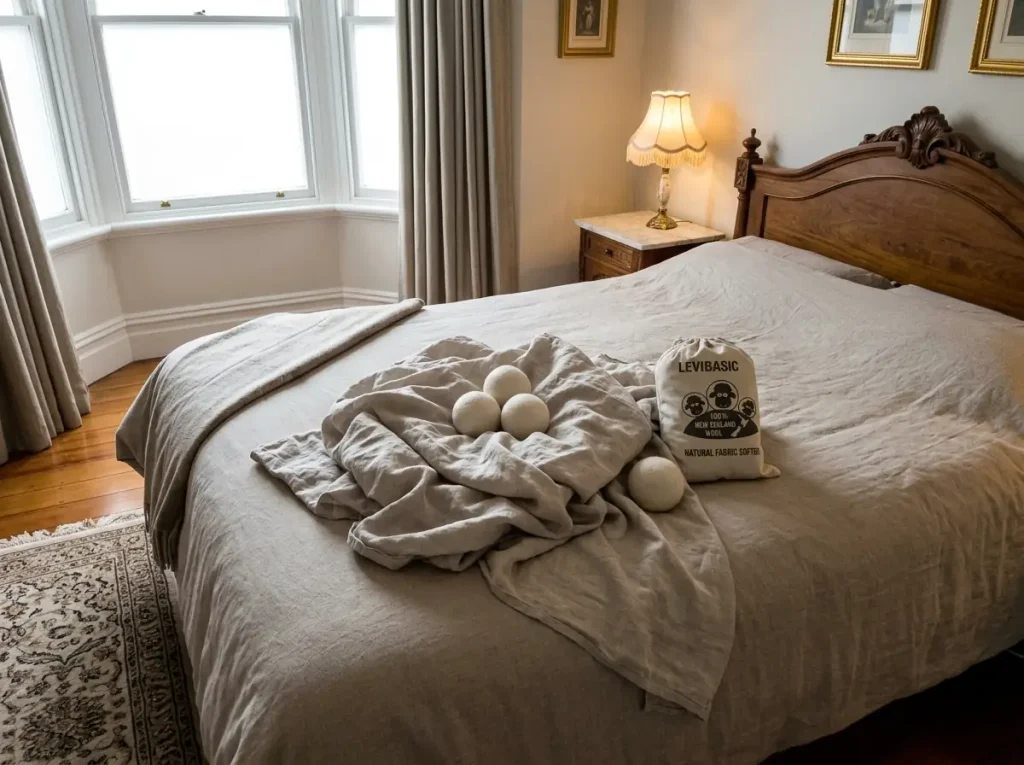
Here is the failure. An overloaded drum means the sheet dries folded against itself, still damp, under the weight of everything else in the load. Read that back against the mechanism from earlier and you will notice it is every condition for a set crease occurring at once: swollen fiber, held in a fold, drying under pressure. The load that comes out as one hot tangled rope is the load that gets ironed for the next two years.
So take it out early, deliberately. Slightly damp is the target and bone dry is the failure, which is the reverse of how most people judge a dryer cycle. Running the drum with room to move helps too, and this is where wool dryer balls do their small honest job: they lift and separate the load so air actually circulates through it instead of around a knot.
The LEVIBASIC Wool Dryer Balls are solid New Zealand wool through the core rather than a wool shell over filler, which is what stops them going soft and useless after a season. And their limit needs saying plainly: they are a passive assist during drying, not a solution. They will not undo a fold that is already set. All they do is stop the load coming out matted.
If you can line dry, that changes the arithmetic entirely. A sheet hung on a line dries under its own weight, stretched straight by gravity instead of folded against a drum wall, and it comes in with far fewer set creases than any dryer cycle produces. The catch is that it comes in stiff, because nothing has tumbled the fibers loose. The usual answer is both: hang dry most of the way, then ten minutes on low heat at the end to take the board out of it.
Cold wash, low dry is what the long-haul owners in the r/quince threads report running for two years and more, and it is worth pairing with the durability question rather than the wrinkle one, because they are separate axes: how long a linen set actually lasts under that routine has more to do with friction points than with heat.
The honest limit on all of this: none of it removes a crease that is already set. This section is prevention only.
Dry the sheets on their own, not with the towels. A towel load holds water long after the sheet is ready, so the sheet stays in the drum for the extra twenty minutes it takes the towels to finish: folded, hot, and setting the whole time. Splitting the load costs you a cycle and saves the ironing.
The sheet out of an overloaded dryer has its worst creases along one edge: the edge that spent forty minutes pressed against the drum wall. That band is the one that survives every later attempt to steam it out, and once you have seen it you can identify an overloaded dryer from across a room.
Steaming, Ironing, and the Finish That Trades Away the Linen
Once a crease is set, the only things that move it involve heat and water. There are three ways to apply them, and they are not equally good ideas, especially the one that comes built into the sheet.
Ironing works. That is not in dispute, and if you want a genuinely pressed sheet, an iron on a damp linen is how you get one. The problem is that it does not hold. The next night puts the creases straight back, because nothing about the fiber has changed and the fold is a fresh event every time.
So ironing linen sheets is not a fix, it is a subscription. You are signing up for it weekly, forever, in exchange for a look that lasts until bedtime. Most people quit around month three.
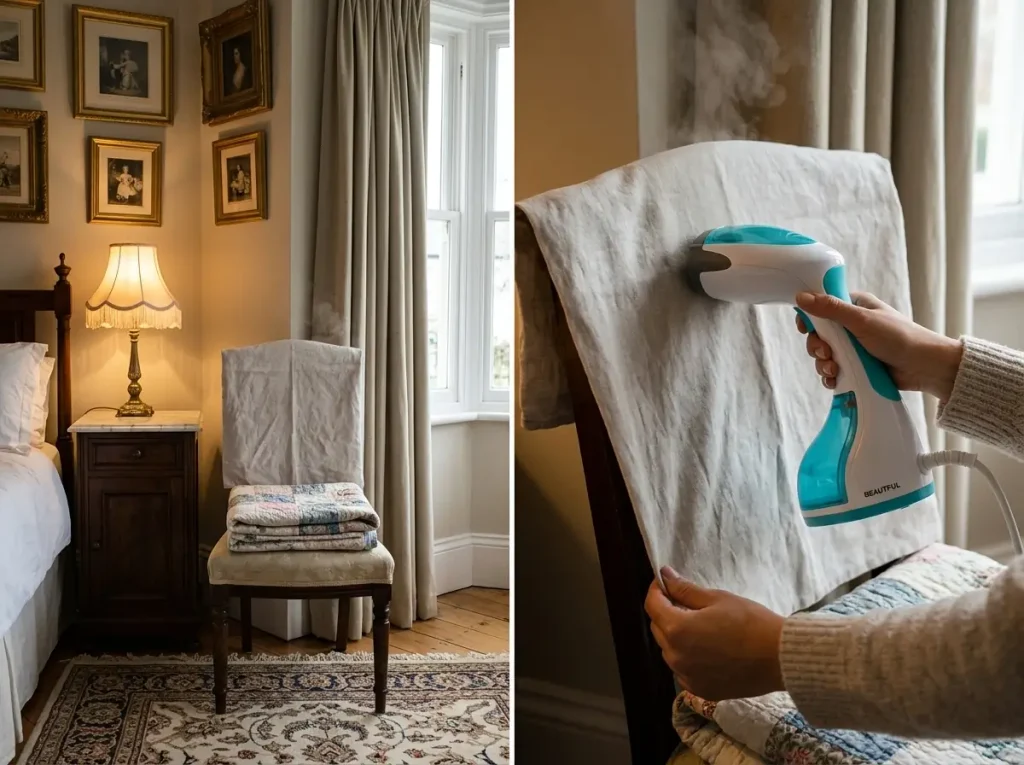
A garment steamer is the honest middle. Moist heat relaxes the hydrogen bonds without the direct pressure and friction of an iron, so it resets the fold instead of pressing sharp new lines in alongside it, and there is no board to set up and no scorch risk on a damp weave. The r/quince thread converges on it: faster than ironing, easier, and the tool people actually keep using.
The BEAUTURAL Steamer for Clothes runs 1200W through a ceramic plate and is hot in about thirty seconds, which matters more than it sounds, because a tool with a five-minute warm-up gets used twice. Its flaw is the flaw of the whole category: it will not leave the pressed look an iron leaves. It relaxes a fold, it does not print a line. If what you want is a flat, sharp-edged bed, this is not the tool and no steamer will be.
Which brings us to the finish, and this is the one to refuse. An anti-wrinkle resin finish works by cross-linking the cellulose so the fiber cannot move. Sit with that for a second, because moving is also how the fiber breathes and how it takes moisture in and lets it out. You are buying out the exact property you paid extra for linen to get.
A no-iron linen sheet is a stiffer, warmer, less absorbent sheet that happens not to crease, and if that is the trade you want, cotton already does it cheaper and better.
And “wrinkle-resistant” on a label is not the fog it looks like. There is the industry’s own wrinkle-recovery test, AATCC TM128, in which a specimen is creased under a fixed load, reconditioned, then graded against reference photos by trained graders. It produces a number. So a set that claims wrinkle resistance can be asked what it scored, and the answer to that question is usually a silence that tells you everything.
The steamer earns its place, but not where you would think. Not on the bed. On the pillowcases. They are the one piece that sits under a face every night and the only part of the set anybody ever looks at from six inches away.
What “Pre-Washed” and “Stonewashed” Actually Buy You
Every fix so far is something you do after the sheet arrives. This one happens at the mill, before it is folded into the bag, and it is the single biggest lever in the article.

Stonewashing originally meant exactly what it says: traditional stone washing, the pumice-and-drum process enzymes have mostly replaced, softening the cloth by abrading its surface. It worked, and it also wore the fiber down, because rocks do not distinguish between the stiffness you want gone and the strength you want kept. Since 1989 in Europe, most of that job has been done by enzyme washing, the process behind most “stonewashed” linen today: cellulase enzymes plus mechanical tumbling, which relaxes the fiber surface and does it without the stones’ wear on tensile strength. Same relaxed hand, less damage.
What that buys you as a buyer is position on a curve. The stiffness that would otherwise crease into sharp lines has already been broken down before the sheet reaches your bed, so you are starting several washes along instead of at the beginning. That is the whole reason two linen sheets at the same GSM can behave completely differently out of the bag. The weight is identical and the fiber has been through entirely different histories.
A stiff, unwashed linen set is not defective either. It is just at the start. It will get there, it will take a couple of months of your washing to do it, and the first month will be the worst it ever looks. The buying rule follows from that: if the label does not say washed, pre-washed or stonewashed, assume it is not, and price the first month in, which is part of what you are paying for in a linen set whether the listing separates it out or not.
If you want the mill to have already done that work, the Sijo Stone Washed Organic French Linen Bed Sheet Set is GOTS-certified French flax that names the treatment on the label rather than implying it, though stock on it runs thin and a set you cannot buy is not a recommendation, so keep the DAPU 100% French Linen Sheets in the same breath as the fallback: 170 GSM declared, washed finish, a 16-inch pocket, and consistently in stock, with the caveat that 170 GSM is a mid-weight and anyone chasing the heavy, dense drape of the premium end will want to go above it.
The giveaway on any set, before you look at a single label claim, is the fold line in the packaging. An un-pre-washed set comes out of the bag with the bag’s own creases printed into it hard: sharp, geometric, obviously factory. Those are usually the last creases to leave.
What Twenty Washes Actually Change
This is the section the title promised, and it has to open with the part every other article skips: nobody, in any source read for this piece, will give you the number.

Two independent community threads and a textile-science piece, and not one of them puts a wash count on when the creasing eases. Every one of them says linen “softens with time” and none of them anchors it to anything. So if you find an article that tells you it happens at wash fifteen, that number was invented, because the data to support it does not exist in the public record.
What is consistent across all three sources is only the shape of the curve: the change is front-loaded. The early washes move the fabric most, and it flattens out from there.
What twenty washes do change is real enough without a precise count. The hand softens. The fiber relaxes. And the creases go from sharp lines to soft folds, which sounds like a small distinction and is actually the whole thing.
The sheet stops looking creased and starts looking rumpled. Creased reads as neglected. Rumpled reads as lived in. Same fabric, same folds, completely different bed to walk into, and it is worth seeing this against how percale and sateen look after the same twenty washes, because they do not travel the same road.
What twenty washes do not change: linen still wrinkles. A set that has been washed a hundred times still comes off the line with lines in it. If you are waiting for the wrinkling to stop, you are waiting for the fiber to become a different fiber.
Durability is a separate axis and gets conflated with this constantly. One r/quince owner’s sheet thinned and tore mid-back at about a year and a half on weekly rotation, with no snag and no obvious cause: “just woke up one day and voila.”
Several others in the same thread reported two to two and a half years on identical cold-wash, low-dry routines with nothing wrong at all. Another commenter joked that the wear always lands exactly where their heels rest, with any sheet. Routine and friction points move that number far more than a wash count does, and none of it has anything to do with how the sheet creases.
Judge the softening by the pillowcases, not the flat sheet. They get the most friction and the most washing, so they run months ahead of the rest of the set on the same curve. If the pillowcases have not gone soft yet, nothing else has either.
That gap between the pieces is also why a two-year-old linen set feels like two different fabrics depending on which part you touch. The flat sheet is always the laggard. Nobody warns you about that, and it is the single most common reason people think their set is uneven when it is simply doing arithmetic.
Conclusion
Three things worth keeping from all of this.
The crease sets when the fiber dries damp, so the only step that genuinely moves the needle is what shape the sheet is in when it finishes drying. Everything else, the iron and the steamer and the hack with the washcloth, is repair work on a decision that was already made in the dryer.
Buy it pre-washed if you can, take it out of the dryer early, and put it on the bed taut. That sequence is free and it beats every tool you can buy afterward. And a steamer earns its place on the pillowcases, while an anti-wrinkle resin finish does not earn its place anywhere on linen.
The wash-twenty check: after a season of washing, do not look for the creases to be gone. Look at whether the lines have gone from sharp to soft. That shift, not their disappearance, is what “it gets better” actually means on this fabric. And if it has not happened by then, check whether you have been drying the set to bone dry.
Take the next load out of the dryer while it is still a little damp and put it straight on the bed, pulled tight. Sleep on it a week. That is the whole experiment, and it costs nothing.
Frequently Asked Questions
01Do linen sheets stop wrinkling after enough washes?
No. They soften, and the creases go from sharp lines to soft folds, but linen wrinkles for its whole life. Repeated washing changes how the creases look, not whether they happen.
02How do you get wrinkles out of linen sheets without ironing?
Use a handheld garment steamer, or use the bed itself. Take the sheet out of the dryer slightly damp, put it straight on the mattress and pull it taut so it dries in that shape.
03Does stonewashed linen wrinkle less?
It creases less sharply. The mill has already relaxed the fiber with enzymes or tumbling, so the sheet starts several washes along the softening curve instead of at the beginning.
04Should I buy wrinkle-resistant linen sheets?
Usually not. The resin finish cross-links the cellulose so it cannot move, which is the same property that lets linen breathe and absorb moisture. You trade away what you paid extra for.
05Why is one side of my bed more wrinkled than the other?
Because only one side is being pulled taut. The half left loose dries in whatever shape it was abandoned in, and after a few weeks the two halves stop matching each other.




Tried it on your own bed?
No comments yet. Tell us what you changed, and what the sheet did after a few washes.