







What’s in here7 sections
You go to bed cold. Actually cold, the kind where you pull the duvet up on purpose. Then it is three in the morning and the fitted sheet is stuck to your shoulder blades and you are deciding whether you can get away with sleeping on the dry half. A thread on r/Bedding with 338 comments opens on exactly that mismatch, the poster describing waking up soaked “like I’ve been in the mouth of the kraken himself” after going to bed freezing.
Most bedding for night sweats gets sold against the wrong problem, and the advice written for night sweats men search for is usually just the generic version with nothing changed. “Cooling” on a package is not a measurement and nobody certifies it. What actually decides the night is fiber, weave, grammage and finish, in that order, and the fourth one washes out. Here is what changes when the volume is higher, which two levers do the real work, what to fix for free before you spend anything, and what the whole set looks like by wash twenty.
Quick Answer
For a heavier sweater, buy for saturation and dry time, not softness or a cooling label: a plain-weave percale or linen sheet over a vapor-permeable protector, washed cooler and more often. Heavy sweating that happens nightly is a conversation for a doctor, not a bedding decision.
What Changes When the Volume Is Higher
The generic night-sweats article is written for a flash: a sharp, short spike of heat that passes. That advice is real, and the hormonal-flash version of this problem is a different shape than the one most men bring to the bed. What changes here is not the kind of sweat. It is the quantity, and quantity turns a warm bed into a wet one, which is a completely different failure with a completely different fix.
Hold one number in your head before you shop anything. A commonly cited baseline for one sleeper is around 500 mL of sweat over an average night, and that figure is before you account for a hot room or a heavy sweater. That is not warmth. That is liquid landing on the bed, every night, and it has to go somewhere.
Once a fabric takes on enough of it, it hits what the apparel side calls wet weight: the cloth gains measurable weight, collapses flat against skin, clings, and takes noticeably longer to release what it is holding. The community describes it as the sheet turning slick, and slick is the tell. What has failed there is capillary action: the fabric has no dry structure left to pull moisture along, so it stops moving it anywhere. That is a moisture-load event, not a temperature one.
Which is exactly why a “cooling” claim keeps missing on this bed. Cooling addresses heat transfer, and heat transfer is only half of thermoregulation once there is standing liquid in the cloth. Volume is a saturation-and-drying problem, so a lightweight fabric that empties fast can beat a cool-to-the-touch one that holds. No amount of cool-to-the-touch does anything once the fabric is already full.
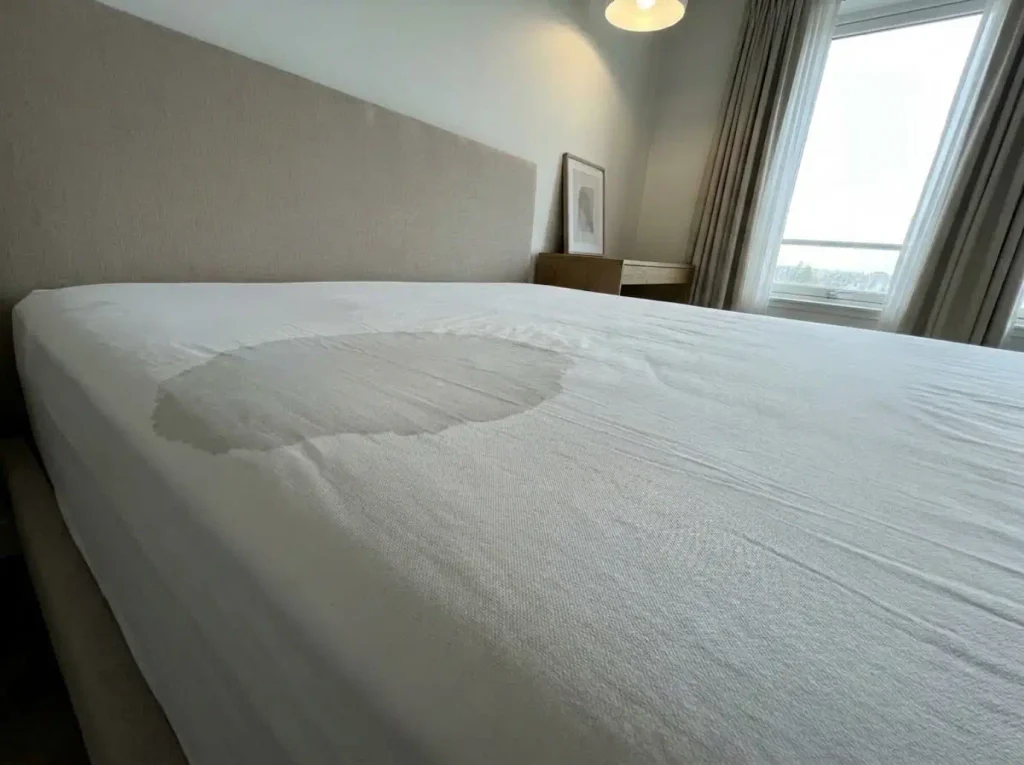
There is a simple way to tell which of the two you have, and it costs nothing. Look at where the damp patch is in the morning. A heat problem leaves the whole sheet warm and faintly humid, evenly, with no edges to it. A volume problem leaves a defined patch, usually high on the fitted sheet where the shoulder blades sit, and it is still readable hours after you have got up.
That difference is the whole reason sweat volume and heat output are worth separating rather than treating as one complaint. That patch is your diagnostic, and it is the one thing that tells you which of the next three sections you actually need: what the fabric can hold and how fast it lets go, what sits underneath it acting as a ceiling, and what twice the laundry does to all of it. All three sit on top of the four layers of the bed, ranked bottom up.
Photograph the damp patch before you make the bed, three mornings running. You will not remember its shape by evening, and shape is the whole signal: a hard-edged patch high on the sheet is saturation, a soft even haze across the middle is heat. Two different problems, and you are about to spend money on one of them.
Fiber, Weave and Grammage — the Three That Actually Decide
Two sheets can print the same number on the box and behave completely differently on a wet night, because the number on the box is almost never the number that matters. What decides it is fiber, weave, grammage and finish, in that order, and reading them in that order is most of the skill.
Weave first: percale over sateen, and why
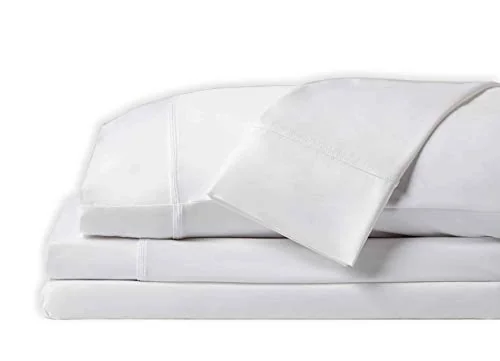
Percale is a plain 1/1 interlace. One thread over, one under, all the way across. Sateen floats a yarn over three or four before it goes under, and those long floats are where the sheen comes from, which is also why it feels smoother.
They also sit flatter against skin and close the gaps that air moves through, which is where weave density stops being a number and starts being breathability you can feel. That is what a 1/1 interlace does that a four-float sateen cannot: the interlace leaves a structure with space in it, and space is what lets a saturated sheet start drying while you are still lying on it.
For volume specifically, that tighter, more even interlace does two jobs at once. It moves air, and it dries faster once it has been loaded. It is also the weave less likely to pill first, which matters more than it sounds when you are running the set through the machine twice a week. An airy hand is not a marketing word here, it is just what an open interlace feels like when it has nothing trapped in it.
Now the trade, because it is real and you should hear it before you buy. Percale never feels silky. If you came here wanting a smooth hand, percale is going to read as stiff, even a little papery on the first few nights, and it is still the right answer for this bed. I would take the stiffness every time on a set that has to dry between three and seven.
Grammage: what GSM does and where it stops
Grammage is grams per square meter, and it is the lever nobody in this category talks about. What it sets is a fabric’s baseline capacity: how much moisture it can take on before it starts reading as wet weight against your skin. Heavier fabrics hold more before they saturate. Lighter ones hold less but clear it faster.
That gives you two strategies, and both are legitimate. On a heavy night, a low-GSM performance knit clears moisture faster than the night can overwhelm it, so it never really gets to the clinging stage. A mid-weight percale takes the opposite route: it has more reserve, so it takes longer to reach saturation in the first place. One strategy buys drying speed, the other buys capacity.
Pick the one that matches how your patch behaves. If it is soaked by two and you are lying in it for four more hours, you want the fast-clearing route. If it builds slowly toward morning, reserve wins.
Here is where grammage stops being enough on its own. The same GSM reads differently depending on the fiber carrying it: flax releases heat and moisture faster than cotton at an equivalent weight, because of what the fiber itself does, not just how it is woven. So GSM is necessary information and not sufficient information, which is an annoying thing to be true, but it is true.
Linen is the rare case where the number is actually printed for you. The DAPU 100% French Linen Sheets declare 170 GSM on the label and back it with flax that sheds heat and moisture faster than cotton at that same weight, which makes them the pick for a heavy sweater in a hot, dry room who cannot get on with percale’s crispness, and they will never look ironed, not once, not the morning after a wash, so decide now whether you can live with that.
For the reader who specifically wants neither cotton nor flax, the ettitude 100% Lyocell from Organic Bamboo Sheet Set is the one bamboo-derived option worth naming, because lyocell is a closed-loop fiber and not the bamboo viscose that most “bamboo” bedding actually is, the same distinction that separates a true lyocell from the eucalyptus sheets sold beside it, most of which are Tencel, a brand name for lyocell rather than a separate fiber, though it is woven as a sateen, so it traps a little more against skin than a plain weave does. That caveat is the whole reason the weave decides more than the fiber does is worth reading before you let a fiber name make the decision for you.
The finish, and why it is the one that leaves
Here is the part the packaging will not tell you. A moisture-wicking finish works by pulling moisture to the fabric’s outer face where it can evaporate, and that is a surface treatment applied to the cloth. It is not a property of the fiber underneath it. So when a cotton or cotton-blend sheet is sold as performance or moisture-wicking, what you are very often buying is a finish sitting on top of an ordinary fabric.
Which is exactly why it can wash out. The fiber is permanent. The treatment is not. Hold that thought, because the wash section is where it turns into money.
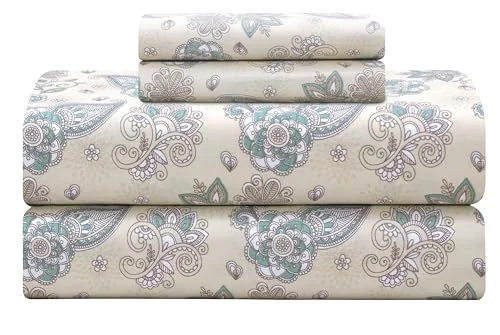
If you want the finish route at a lower outlay than a spandex knit, the PeachSkinSheets Cooling Bed Sheets for Hot Sleepers use a brushed microfiber with the same wicking treatment and an OEKO-TEX certification, which is the budget end of the moisture-wicking fabric category. They do dry fast, and fast drying is most of what passes for odor resistance in a synthetic, since what smells is what stays damp. But microfiber does not breathe the way a natural fiber does, and on a genuinely hot night it can read faintly plastic against skin.
There is one way to tell a finish from a fiber without a lab, and it is free. A fiber’s behavior does not change between wash one and wash two. A finish’s often does. The second night on a treated set frequently feels slightly less dry than the first, and that is not your imagination, that is the finish settling in.
The Layer Under the Sheet Sets the Ceiling
People replace the sheets three times before they think to look at what is underneath them. It is the wrong order, because one wrong layer undoes three good ones, and the membrane closest to your skin decides what the rest of the bed is even allowed to do.
Why a vinyl protector cancels a good sheet
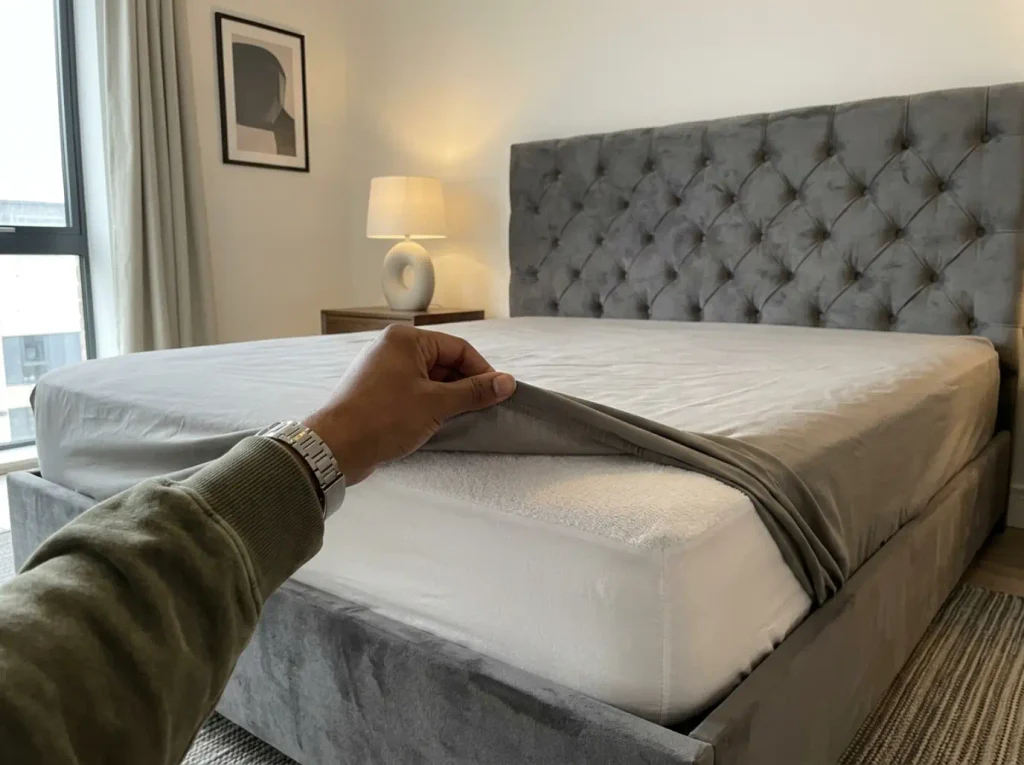
If the waterproof layer under your sheet does not pass vapor, then the best percale on earth is sitting on a plastic bag. Everything the sheet releases downward has nowhere to go, so it comes back up, and you spend the night in a closed system with 500 mL of your own output in it. That number is what makes this a ceiling rather than a detail.
The distinction that matters is on the box, and it is easy to miss because both versions use the same word. A breathable TPU membrane passes water vapor while blocking liquid. A vinyl or PVC backing blocks both.
They both say waterproof, so the word on the front tells you nothing: what you are choosing between is a breathable membrane and a sealed waterproof membrane that happen to share a label. They are not the same product, and the price difference between them is often nothing. The same split applies to a mattress pad, which adds loft on top of the protector and can quietly become a second layer holding what the first one passed. Worth reading the fine print on which protectors actually pass vapor before you replace a single sheet.
The free fix, first
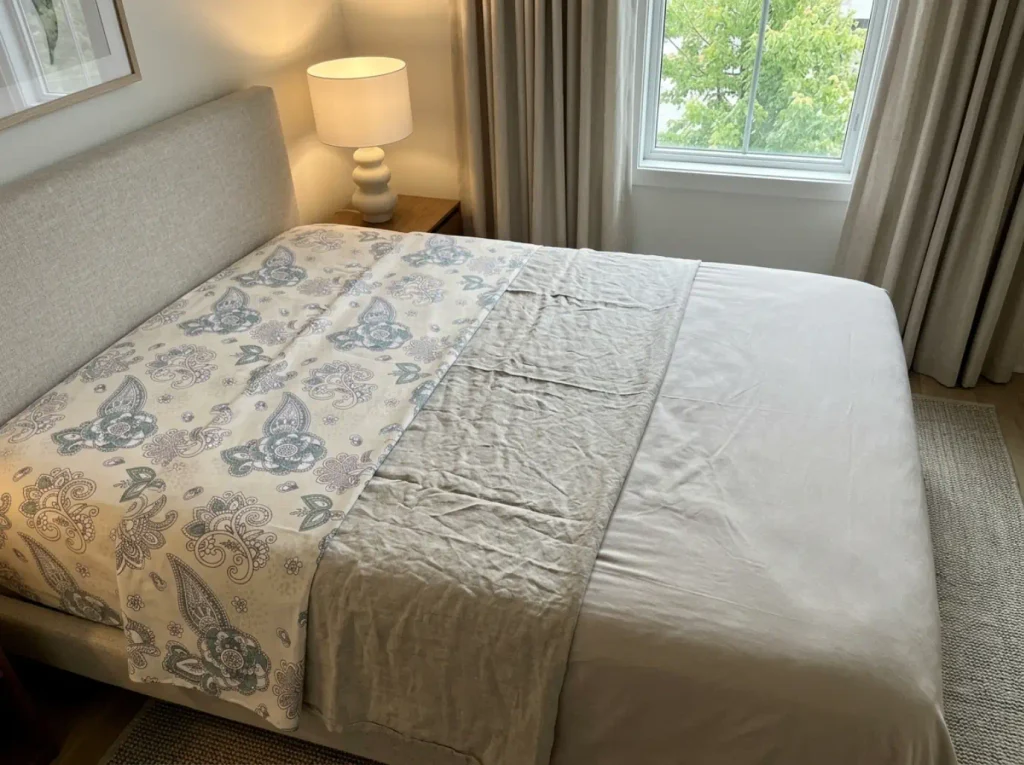
Before buying anything at all: take the top sheet off entirely and sleep under the duvet alone for a week. The same goes for anything else stacked on top of it, because layering is what most beds get wrong here: a blanket or a decorative coverlet left folded across the foot ends up over your legs by three, and neither was chosen for how fast it dries. One fewer layer between skin and air is the cheapest change available to you, it costs nothing, and it works far more often than it has any right to. The top sheet is also the layer that ends up on the floor by two anyway, so you are mostly formalizing what was going to happen.
The other free lever is the air around the bed rather than the cloth on it. A bedroom temperature above the high sixties fights every layer you put on it, and no fabric wins that argument, so a fan moving air across the bed does more for ventilation than a sheet swap usually does. In a shared bed this is also the one change that does not force a compromise: moving air helps the heavier sweater without stripping layers off the person next to him, which taking the top sheet off does not manage.
While the bed is stripped, change the pillowcase too, and if you sleep under a quilted comforter rather than a duvet in a cover, note that you cannot wash it on the same clock as the sheets, which is its own argument for the duvet-and-cover setup on a bed like this.
The second free move takes three nights. Strip the mattress protector entirely and see whether the damp patch changes shape. If it does, the ceiling was your problem and no sheet purchase was ever going to solve it. If it does not move at all, keep the protector on and keep reading.
The seam tape fails long before the membrane does. Turn the protector inside out around wash ten and look at the corners at the foot of the bed, not the head. Those are the two the fitted sheet drags across every single time you make the bed, and the tape lifts there first. A lifted corner means the waterproofing is already gone in that spot, whatever the rest of it still does.
Once both free moves have run and the answer is that the ceiling is the problem, the replacement worth having is a natural fiber face over a vapor-permeable membrane, which is a shorter list than the category suggests.
Wash Twenty — What Twice the Laundry Does to a Set
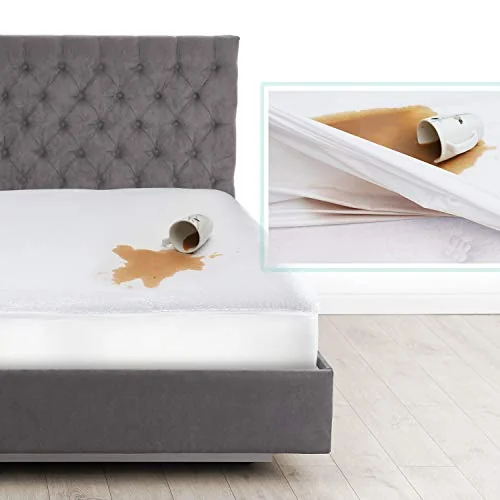
The set that wins in week one is not the set that wins in month six. Everybody knows this in principle and nobody prices it in, and a heavy sweater reaches month six roughly twice as fast as everyone else, because he is running twice the cycles to get there.
The frequency the generic advice gets wrong
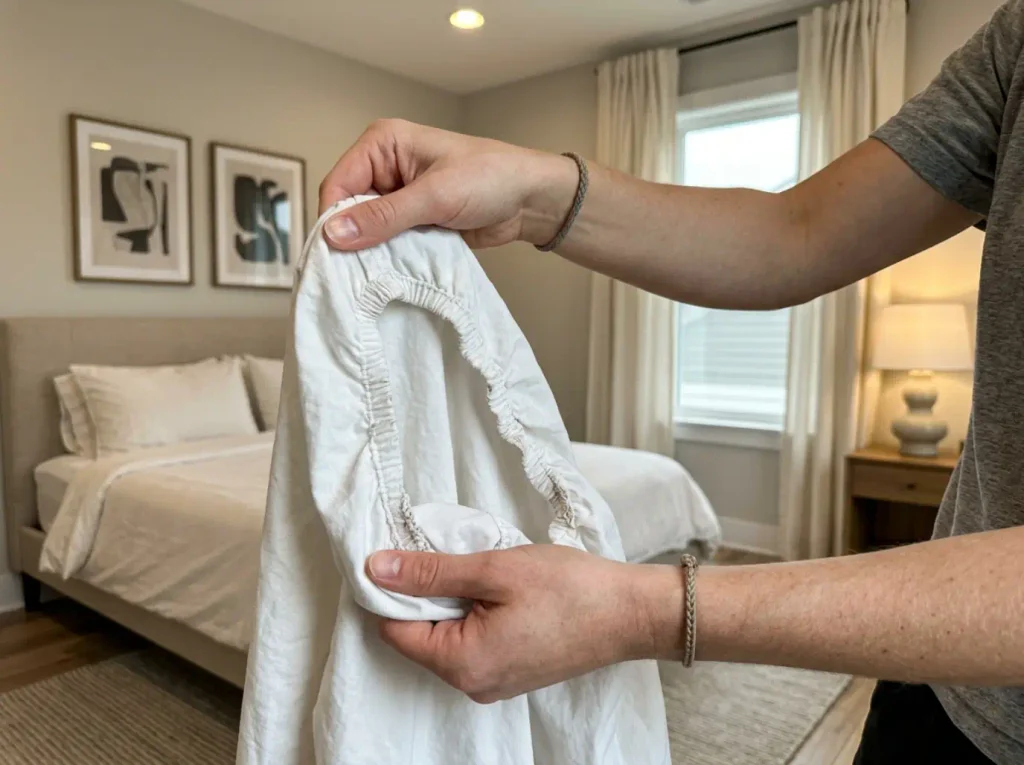
Sheets that are soaked through belong on a much shorter clock than the standard weekly one. Cleveland Clinic’s guidance on wash frequency for heavy sweating puts a soaked set on a 2-to-3-day clock, not a weekly one, and for a regular heavy sweater that lands somewhere around twice a week in practice.
Now do the arithmetic, because this is the part that reframes the entire buying decision. At twice a week, wash twenty arrives in ten weeks. The set you bought in March is a season old by the middle of May. Every durability claim written for a weekly washer is describing a timeline you will hit in less than half the time.
Fabric softener is what removes the finish
This is the most expensive mistake in the category and almost nobody says it out loud. Aminofunctional silicone and most cationic fabric softeners are hydrophobic, and that is exactly what Cotton Incorporated’s durability data flags: repeated use measurably reduces a fabric’s wicking and absorbency.
Read that against the previous section and the arithmetic is brutal. If you buy the performance set for its finish and then soften it every wash, you have paid extra for a treatment and are systematically removing it, twice a week, in your own machine. This is documented technical durability data rather than one person’s story, which is worth saying because most durability claims in this niche are somebody’s first week.
Cooler wash, lower heat, and what survives
Thirty to forty degrees Celsius is enough for a clean wash on bedding, and a cold rinse at the end of the cycle costs nothing and takes the last of the gentle detergent out rather than leaving it in the fibers. Check the care label before you set anything, because a performance knit and a linen want opposite treatment and only one of them will tell you so.
High dryer heat is the other quiet destroyer: it shrinks fibers over repeated cycles and it weakens fitted-sheet elastic faster than the fabric itself ever wears. At twice the normal frequency, both effects compound at twice the rate, which is why wash count rather than months on the calendar is the honest way to measure a set on this bed. That is also where getting the smell out before it sets gets complicated, because the instinct is to wash hotter, and hotter is the thing shortening the set’s life.
Which brings the buying decision to a single line: on a high-frequency bed, a fiber beats a finish, because a fiber cannot wash out. Percale and linen soften with age, which is the one direction you want a set to move. A treated knit only gets worse. And this is also why a higher thread count is not a better sheet on a bed like this one, because a big number reached by twisting two thin yarns together gives you a denser, warmer, slower-drying fabric and a bigger figure on the packaging.
Buy two fitted sheets and one flat, not two full sets. On a two-washes-a-week bed the fitted sheet is doing all the work and dies first, always at the two corners by the headboard, and you end up with a drawer of surviving flat sheets you never put on the bed. Splitting the purchase that way costs less and matches what actually wears out.
When It Is Not the Bed at All
Before spending anything else, it is worth finding out whether the bed is even part of the argument. Three nights, one change each, and the answer is usually unambiguous.
The three-night test, one variable at a time
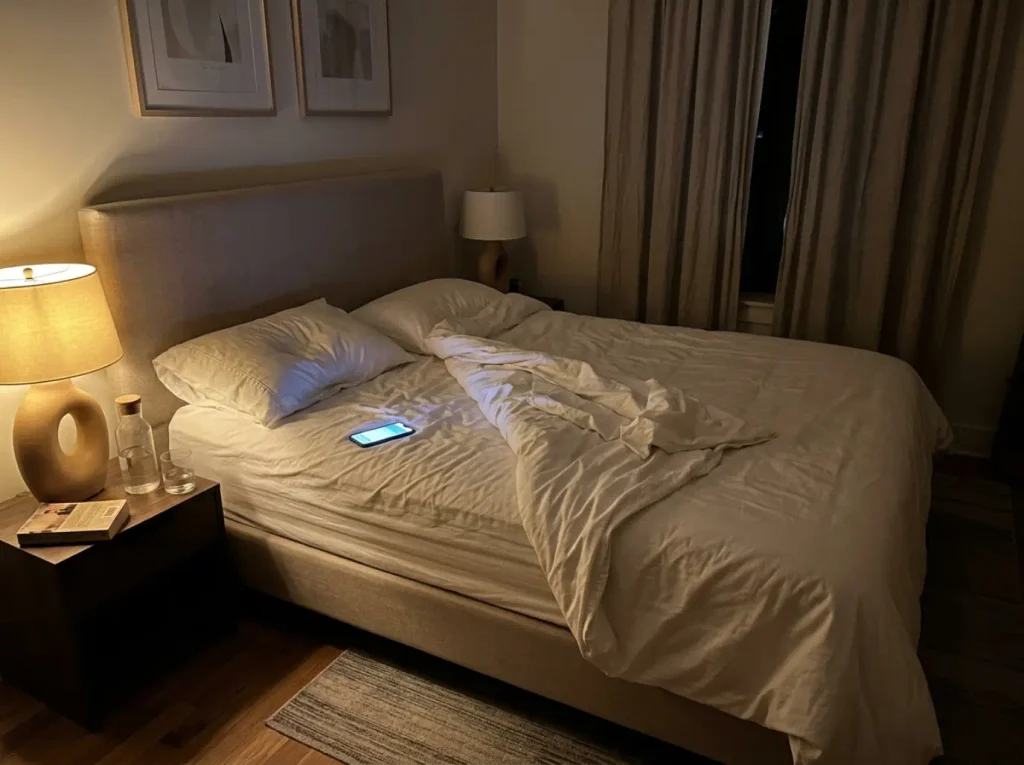
Run the three-night test in full like this:
- Night one: the current set, nothing changed. This is your baseline, and the thing to record is where the damp patch lands and how hard its edges are.
- Night two: strip the mattress protector. Everything else stays identical, including the room.
- Night three: take the top sheet off. Everything else identical again.
If nothing moves across all three, the bed was never the variable, and that is a genuinely useful answer that has just saved you a purchase. If the patch shifts on night two, your ceiling is the protector. If it shifts on night three, you were sleeping under one layer too many. And if it turns out to be heat rather than volume, the fix moves to a different set of levers entirely.
One thing about running it: keep the three nights consecutive and in the same week. A test spread across a fortnight gets confounded by the weather, and in a bedroom the weather is a bigger variable than the protector ever was.
There is an honest footnote to all of this, and it comes from the same r/Bedding thread that opens this article. The poster later edited it to say the sweats had turned out to be a side effect of medication he was taking, and he still wanted the bedding sorted out. That is exactly the right position.
Bedding does not address a cause. It manages the recovery, and the recovery is where you spend seven hours a night.
Where This Stops Being a Bedding Question
Heavy sweating that happens nightly, or that turns up alongside anything else that was not there before, is a conversation for a doctor rather than a bedding decision. Nothing on this page reads a symptom or stands in for that conversation, and the threshold question has its own answer elsewhere. What is on this page is the bed, and the bed is worth getting right either way. If you want to keep going on materials from here, whether bamboo is worth it at all is the next thing to settle.
The Short Version
Buy for saturation and dry time rather than for the word cooling: read the weave first, then the grammage, and treat any finish as temporary from the day you bring it home.
Check the layer under the sheet before you replace the sheet. A vinyl-backed protector caps the entire bed, and no fabric above it can outperform the membrane below it.
Wash cooler, skip the softener entirely, and plan for wash twenty to arrive in ten weeks rather than five months, because that is what twice-weekly laundry actually means.
After a season on this schedule, check two places: the two fitted-sheet corners at the head of the bed, and the seam tape on the protector’s foot corners. Both go long before the fabric does, and both are cheap to replace on their own if you catch them early.
Take the top sheet off tonight and look at where the damp patch is in the morning. Do that three nights running before you buy anything at all.
Frequently Asked Questions
01What kind of bedding helps with night sweats?
A plain-weave percale or a linen sheet over a protector with a vapor-permeable TPU membrane. The weave and the grammage decide how fast the bed dries once it is loaded; a cooling label on its own decides nothing at all.
02Do cooling sheets actually work for heavy sweating?
Only where the cooling comes from the weave or the fiber itself. A wicking finish works well at first and fades with washing, and fabric softener strips it noticeably faster than time alone does.
03How often should you wash sheets if you sweat through them?
Every two to three days rather than weekly, and closer to twice a week if it happens most nights. Cooler water and lower dryer heat are what keep a set alive at that frequency.
04Is linen or percale better for night sweats?
Percale is the safer default: crisper, faster-drying and less likely to pill under frequent washing. Linen releases heat and moisture faster at the same weight, but it will never look ironed.
05Does a mattress protector make night sweats worse?
A vinyl or PVC one can, because it traps everything the sheet releases downward. A cotton-faced TPU protector passes vapor through and does not cap the rest of the bed.




Tried it on your own bed?
No comments yet. Tell us what you changed, and what the sheet did after a few washes.