
What’s in here8 sections
It is three in the morning, the sheet is stuck to your back, the duvet went on the floor around one, and you have already decided the sheets are the problem. Hot sleepers describe the same night: waking up drenched, as if someone had thrown a bucket of water on the bed, on a stack of layers that traps heat. Percale is one thread over, one under, and the gaps that leaves are the entire reason it moves air; sateen floats four threads over one, which is smoother and closed. That difference is not on the front of either package.
This article names the four things that actually decide how hot a bed sleeps, takes the word “cooling” apart, maps the fabric families without crowning one, and then walks up and down the stack: the protector under the sheet, the duvet over it, the room around all of it, and the second person in the bed.
Quick Answer
Four things decide how hot a bed sleeps: the fiber, the weave, the weight in grams per square meter, and the finish. Only the first three survive the wash. The word “cooling” on the package is none of them, because nobody certifies it.
Four Things Decide How Hot a Bed Sleeps
You have been shopping by adjective, because the adjective is what the package gives you. There are only four variables that matter. Two of them are printed on most boxes, one is printed by almost nobody, and the fourth is the one that leaves in the wash and takes the good reviews with it.
The fiber: what it does with your sweat
Cotton fibers are hydrophilic, which means they take moisture in rather than shoving it off. They are also shaped like twisted ribbons rather than smooth rods, and the twisted-ribbon shape of a cotton fiber is the reason they cannot pack tightly when they are spun and woven. Irregular shapes leave air spaces between them. Those spaces are where the moisture goes and where the evaporation happens.
That is the whole mechanism, and it explains something that looks backwards on a shelf. A plain cotton percale with no claim on the box can outperform a synthetic sold specifically as cooling, because the fiber shape is doing the work and nothing was sprayed on to fake it. Polyester is a smooth extruded filament. It does not take moisture in; whatever moisture-wicking it does happens along the surface, or it does not, and either way it has no internal capacity to hold what your skin gives it.
Wool is the odd one that hot sleepers dismiss too fast, because it can absorb a significant fraction of its own weight in moisture without feeling wet to the touch. That absorb-and-release behavior is what people mean when they call a fiber thermoregulating, and it is a property of the fiber rather than anything sprayed onto it. Silk is a protein fiber and behaves differently again. But the cotton and flax families are where most of this niche lives, and the mechanism above is why.
The weave: gaps or no gaps
Percale is a plain weave. One thread over, one under, in a strict grid, with many small interlacing points. That geometry has no choice but to leave gaps, and gaps move air. It also makes the fabric matte and crisp rather than slick, which is the trade you are making.
Sateen floats roughly four threads over one before the crossing point. Longer floats lie flatter against each other and against you. The surface ends up smoother because it is less interrupted, and less interrupted means fewer gaps. Same cotton, same thread count, opposite behavior on a July night.
This is the single biggest lever in the whole category, and it is the one competitors gesture at without explaining. When somebody buys a set labeled “cotton, 300 thread count” and wakes up soaked, they did not buy bad cotton. They bought a sateen.
The weight nobody prints
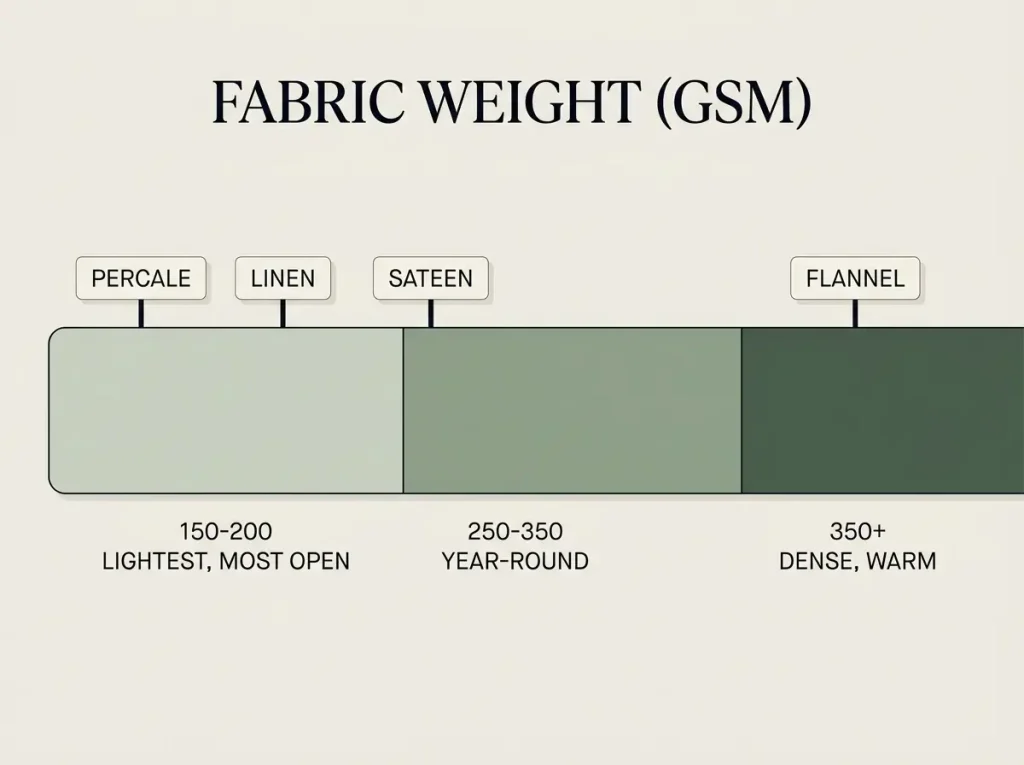
Grams per square meter. GSM. It is the number that predicts heat better than thread count does, and almost nobody prints it on a package.
Roughly 150 to 200 GSM is the lightest and most open end of the scale. Roughly 250 to 350 is the year-round middle. Above 350 is dense and oriented toward warmth, which is a fine thing to buy in January and the wrong thing to buy in the situation that brought you here.
Because it is rarely printed, you judge it the way anybody who handles fabric does: you lift the set. A queen percale that feels like nothing in the hand and a queen sateen that has real heft to it are telling you their GSM without either box saying a word about it. If a listing does print the number, that listing is being more honest than its competitors, and it is worth noticing which ones bother. If you want that argument in full rather than in outline, the case for reading weave and weight rather than thread count is argued out on its own.
The finish, and why it leaves
A finish is a treatment applied to the surface of a finished fabric. Some of them are resin, some are a cool-touch chemical hand, and what they have in common is that they sit on top of the cloth rather than being part of it. That is what feels remarkable in the store aisle and for the first two weeks at home.
Then it washes off. Not dramatically, and not on a particular day, but gradually and completely, which is the mechanical explanation for why a cooling finish seems to wear off. What is left after that is the fiber and the weave, which were the only permanent things in the set from the beginning.
So the four rank themselves. Weave and fiber are structural and they are there for the life of the sheet. Weight follows from those two.
The finish is temporary. Two of the four survive the wash, and any purchase decision that rests on the other two is renting a sensation.
Hold the fabric up to a lamp before you decide anything. A percale shows you an actual grid of pinpoints where the light comes through the gaps. A sateen gives you a sheen instead, because there are no gaps to see through. That is the mechanism, visible in four seconds, and it is the photograph no listing will ever show you.
You find out which of the four you actually bought on the third Sunday, not the first. A set that felt cool in the aisle, felt cool for two weeks, and then stopped feeling like anything in particular was a finish, and the finish left with the detergent. Here is what the opposite looks like: a package that tells you the structure instead of the mood.
What “Cooling” Means on a Label (Nothing)
You are standing in an aisle, or in two browser tabs, with two packages. One says “cooling” and costs more. Neither one tells you why. Here is what somebody who reads spec panels looks at instead of that word.
The word nobody certifies
There is no standard behind “cooling.” No test method, no threshold, no certifying body, no number anybody has to hit. Any fabric can carry the word, and plenty of fabrics that sleep hot do carry it.
That is not an accusation of fraud. It is simply what an unregulated adjective is worth, which is nothing you can check. The word is doing exactly the job it was chosen for: selling without committing to anything a returns department could be held to.
Thread count, and the two threads counted twice
Thread count is threads per square inch, and above roughly 400 it stops meaning what shoppers think it means. The usual way to reach a high number is to twist two thin threads together into one yarn and then count both of them. The sheet has the same number of yarns in it; the label has double the number on it.
The result is denser, not finer. And because dense is the direction that closes a fabric up, an 800-count sateen built that way can be a heavier, hotter sheet than a 250-count percale sitting next to it for a third of the money. The single-ply detail on a spec panel is worth more than the headline number, which is why it appears on good listings and never on the front of a box.
The certifications that are not about temperature
OEKO-TEX Standard 100 is a real, rigorous certification, and it is routinely misread on these packages. It tests every component of a textile, including the fabric, the thread, the buttons and any coatings, against up to 350 potentially harmful substances. That is what OEKO-TEX Standard 100 actually certifies: chemical safety.
It says nothing whatsoever about breathability, weave structure, grammage or how the sheet behaves at two in the morning. GOTS certified is the other mark that gets read the same wrong way: it governs organic fiber content and processing, not how a sheet behaves at two in the morning. Both marks are worth having and neither is a temperature claim.
Reading a certification mark as proof of temperature is the most common label mistake in this category, and it is an easy one to make, because the mark looks technical and technical looks like it must be measuring the thing you care about.
“Hotel quality” belongs in the same bin, and it is repeated as a selling point across the big roundups without anybody examining it. What most hotels actually buy is a mid-count cotton percale, chosen because it survives industrial laundering several hundred times without falling apart. That is a durability spec. It happens to sleep cool, which is a nice accident of the choice, but nobody in procurement was thinking about your night.
Then there is “bamboo,” which names a plant rather than a fabric. What is in the sheet is almost always viscose or rayon, a manufactured fiber produced by dissolving cellulose and extruding it. Bamboo viscose is not nearly as natural a fabric as its marketing suggests. That is a whole argument of its own, and how bamboo viscose actually compares with cotton is settled elsewhere rather than here.
Four lines worth reading on the back of the package
Read these, in this order, and ignore the front entirely.
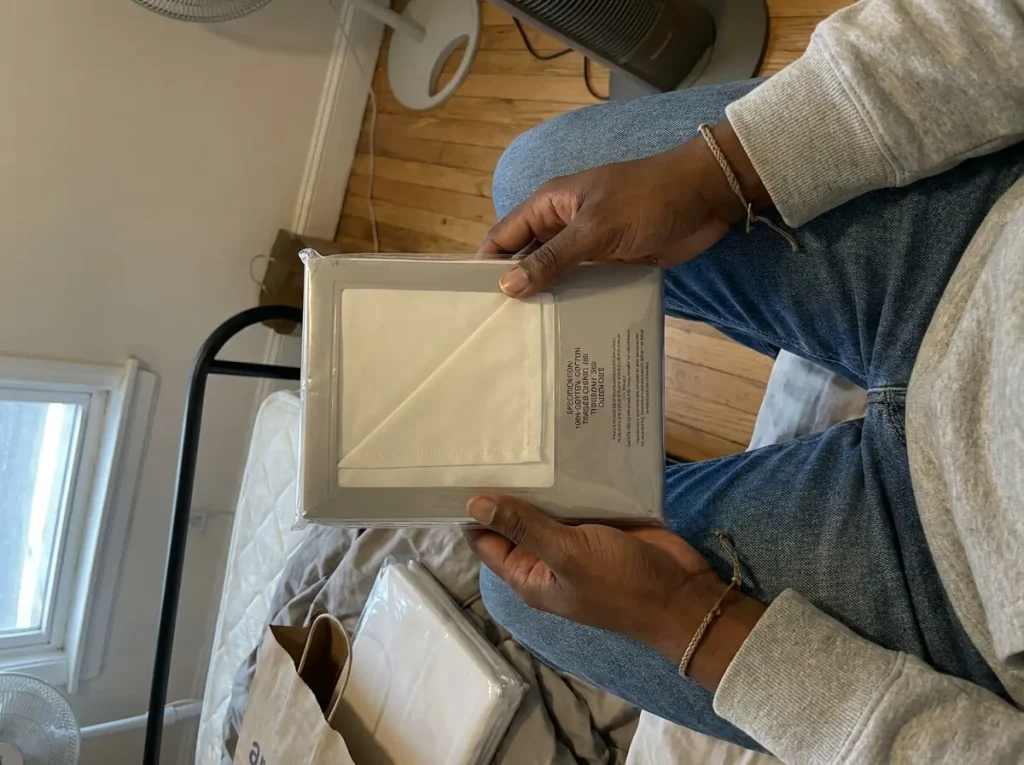
Fiber content. Weave name. GSM, if it is printed. Pocket depth against your mattress plus whatever you have on top of it.
Four lines. If a package will not give you the weave, it is selling you the adjective instead, and the adjective is the part that washes off. The tell is on the back panel rather than the front: a set that names its weave in the spec block and never uses the word “cooling” anywhere is usually the cooler set, because a maker who has a structural argument does not need to reach for a mood.
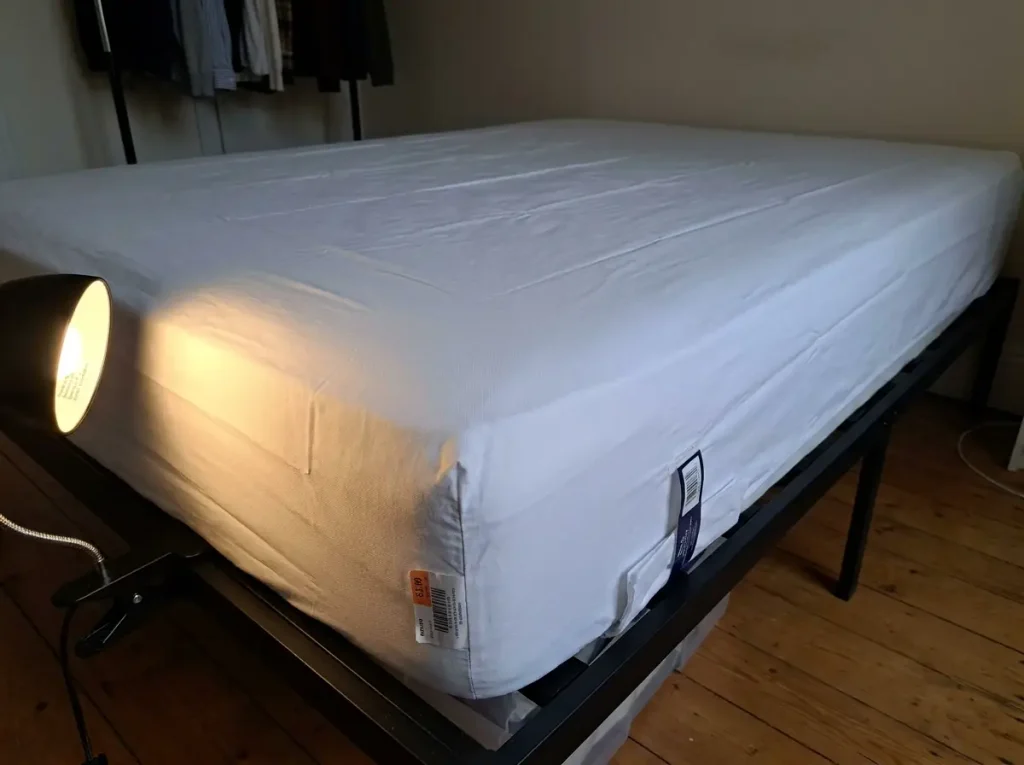
Measure the mattress with the topper already on it, then add two inches, and buy to that number. A deep pocket number is a stretch limit, not a promise: “fits up to 18 inches” means the elastic will reach 18, and your real mattress thickness is the mattress plus the topper plus the protector. It does not mean it will stay there. You find out it was two inches short the first morning you wake with the corner bunched under your shoulder, and no amount of extra-strong elastic fixes missing depth.
The Fabric Families, Briefly, and Where Each One Is Argued Out
You want a name. The honest answer is that there is no winner here, only four different trades, and which one is yours depends on whether you genuinely sweat, whether you can live with wrinkles, and what you are willing to spend. What follows is the map. The head-to-head fights live in their own articles, because each of them deserves more than a paragraph.
Cotton, which is two different sheets depending on the weave
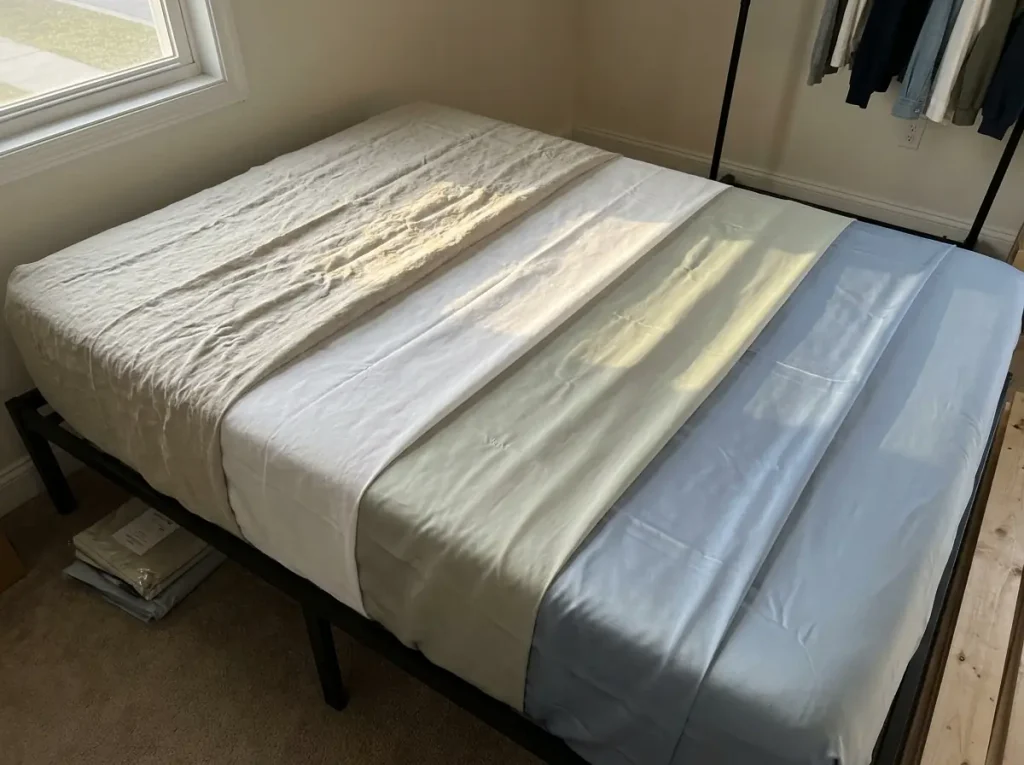
Cotton is not one thing. The same fiber woven as percale and as sateen produces two sheets that behave differently enough that treating them as one category is the root of most bad purchases in this niche. Percale’s plain weave leaves gaps; sateen’s floats close them.
Anybody who bought “cotton, 300 thread count” and woke up soaked bought a sateen without being told. A cotton sateen set can still leave a hot sleeper waking drenched, as if someone had thrown a bucket of water on them. The label was accurate in every particular and useless in the only way that mattered.
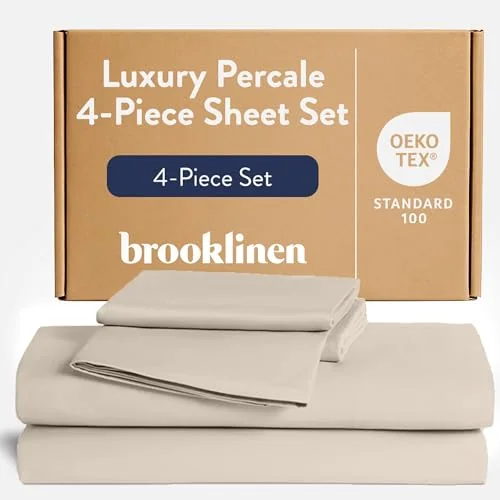
Whether the whole cotton family is the right bet for somebody who runs hot, and which weave to land on inside it, is the question of its own article: whether cotton sheets are a good bet for a hot sleeper.
Linen, the open one that never looks ironed
Linen is the most open weave in common domestic use. Flax fibers are thicker and stiffer than cotton, they do not pack down, and the resulting cloth has visible space in it that you can see against a window without any effort. It also gets better with washing rather than worse, which is the opposite of almost everything else in a linen closet.
It is also the family where checking GSM pays off most, because linen spans a genuinely wide weight range. A heavy linen is a winter fabric. A light one is the coolest thing you can put on a bed short of nothing.
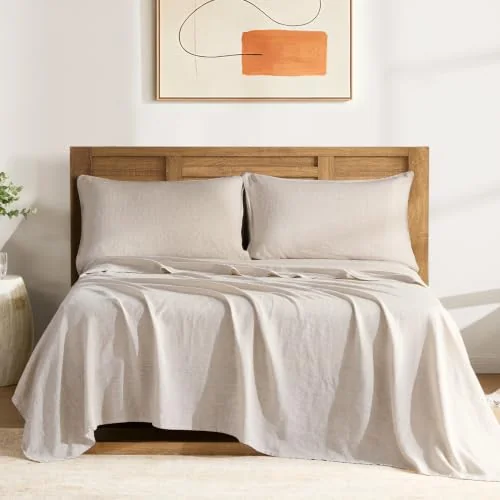
Linen costs several times what an equivalent percale costs, and whether that gap is justified is a separate question with a real answer: whether linen sheets are worth what they cost.
Bamboo, and the one version that is not viscose
Most of what is sold as bamboo is viscose or rayon, and in practice it measures no cooler than cotton. The plant is real; the fabric is a manufactured cellulose fiber that happens to have started as that plant, and the process is what determines how the finished cloth behaves.
Genuine lyocell made in a closed-loop process is a different fiber with different behavior, and it is worth separating from the category around it. Here the fabric itself points the same way as the usual experience: cotton percale and linen hold up well, while bamboo viscose feels cool at first and does not hold up.
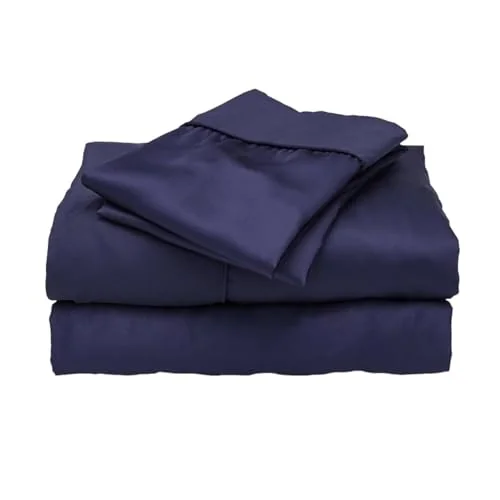
Both of the obvious comparisons get argued out properly elsewhere: bamboo against a plain percale is one article, and bamboo against linen is the other.
Silk, cool to the hand and something else by morning
Silk is a protein fiber and it reads cool the moment you touch it, which is most of its reputation. Over a full night the behavior is different: cool on contact, then warming and clinging by morning.
So this is the anti-sell of the section, and it goes in plainly rather than buried in a caveat. Silk is a good buy for somebody who sleeps temperate or cold and wants softness. It is not the pick for somebody who genuinely sweats through the night, and no amount of momme weight changes that.
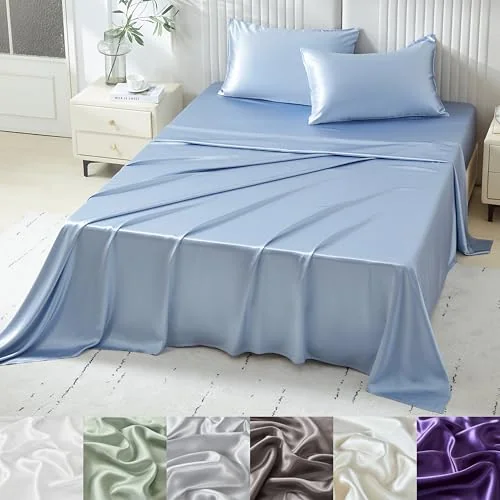
If that caveat is the thing you came to check, it gets tested properly in its own piece: whether silk sheets are actually good for a hot sleeper.
Two families get a sentence rather than a section. Wool is the outlier that regulates by absorbing moisture without ever feeling wet, which makes it far better for a hot sleeper than its reputation suggests, particularly as a duvet fill. Synthetics are the family where the word “cooling” almost always means a finish on polyester, and the finish is the part that leaves.
The family you picked shows itself at wash five rather than on night one. The percale loses its starch and reveals what the weave alone feels like.
The linen stops being scratchy. The sateen goes slippery before it goes shiny. And the viscose starts pilling, on the side that gets slept on.
Two other things show up on the same schedule and nobody warns you about either. Shrinkage arrives on the first hot wash and it is why a fitted sheet that fit in week one fights you in week four. Colorfastness shows up slightly later, as the deep shade you chose going chalky in the middle third where you sleep.
The Sheet Is One Layer of Four
You have replaced the sheets once, maybe twice, and you are about to do it a third time. Before you do: lift the fitted sheet and look at what is under it. Half the damp mornings in these threads trace back to a layer nobody had counted as a layer.
The four layers, from the mattress up
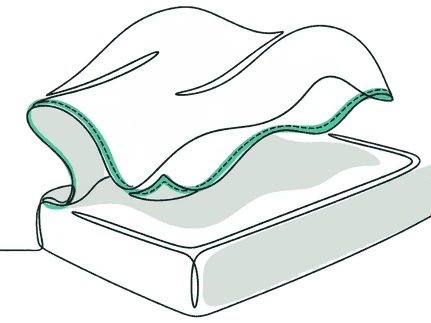
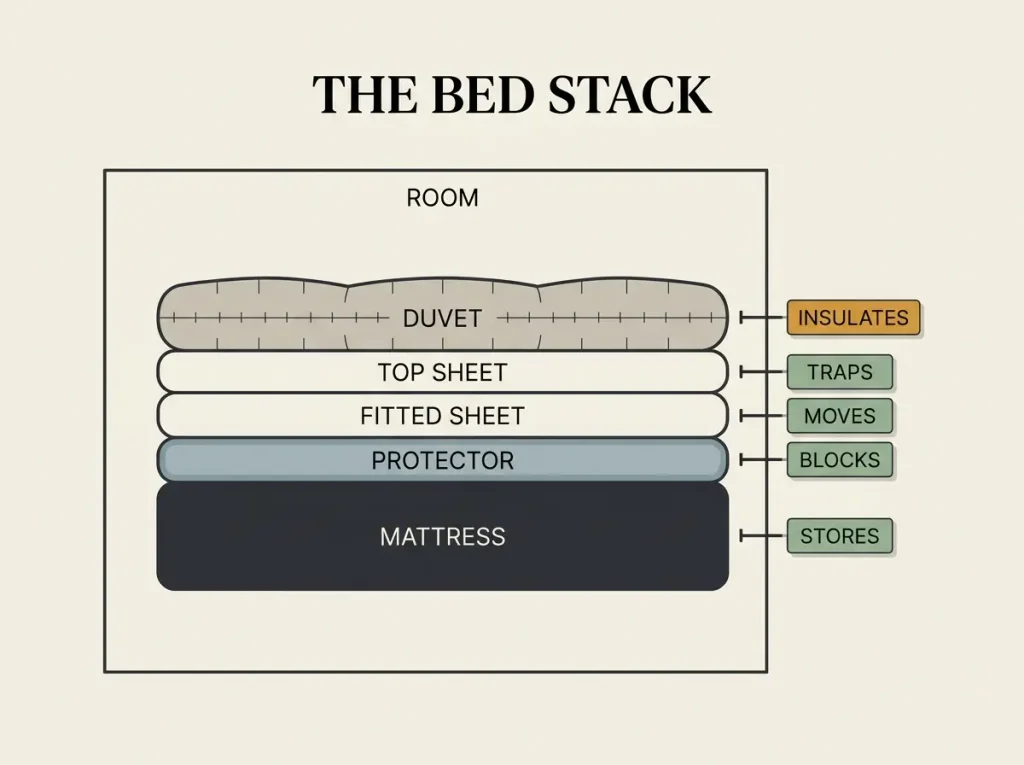
There are four things between you and the room, and only one of them is the sheet. Under it, the mattress protector, and under that, whatever mattress topper you added and stopped thinking about. Then the sheet, and with it the flat sheet and the pillowcase, which are the same cloth and obey the same rules.
Over it, the duvet or comforter. Around all of it, the room.
A hot bed is whichever of those four is the worst one, and replacing a different one changes nothing at all except your balance.
That is the sentence the rest of this section exists to prove. If the protector is a sealed plastic sheet, the finest percale in the world is lying on top of a raincoat, and the percale gets blamed. If the room sits warm, every layer in it is fighting a losing argument.
The stack has an order, and so does the diagnosis. Layered bedding is the term for treating those four as one adjustable system rather than four separate purchases, and it is the only frame in which the diagnosis makes sense.
If what you actually want is the finished stack rather than the diagnosis, building the whole set layer by layer is the article that assembles it.
The protector: the raincoat nobody remembers is there
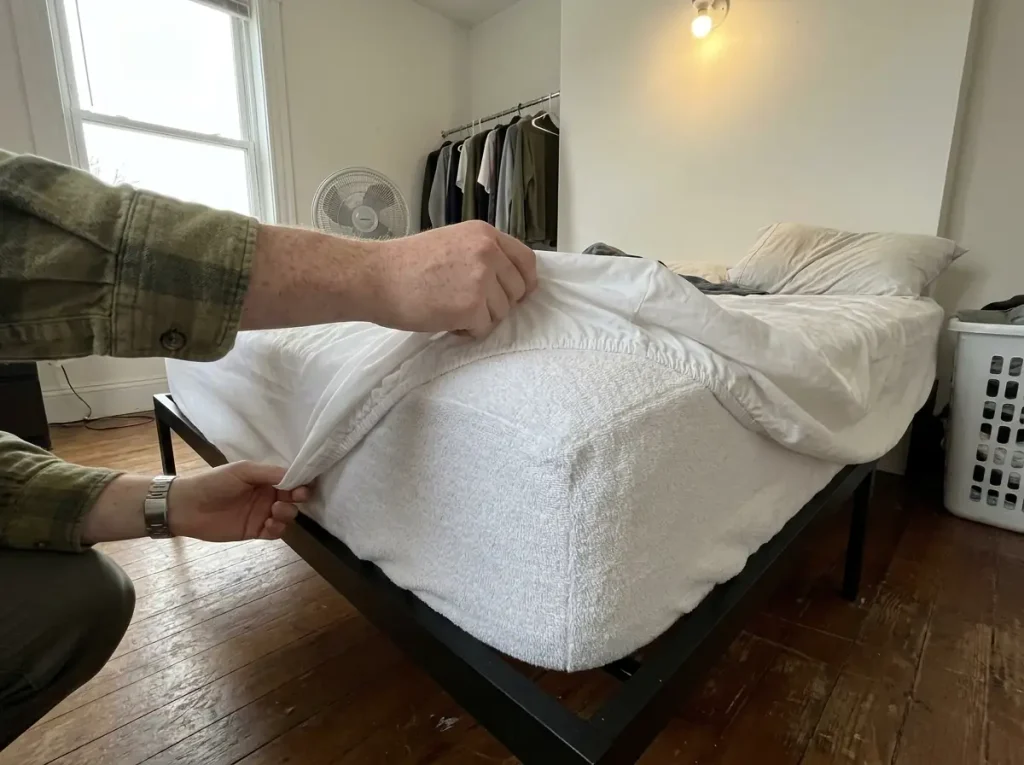
This is the layer most people never look at, and it is one of the most common misdiagnoses there is. A cheap plastic or fully synthetic waterproof protector is a raincoat between you and the mattress. Whatever moisture the sheet moves away from your skin arrives at that barrier and stops, and then it sits there, warm, an inch below you.
Many people spend weeks troubleshooting sheets before finding that the culprit is a plastic protector under a down-alternative insert, and the sheets were never the problem. That is the pattern, not the exception.
The free move comes first, and it is genuinely free. Take the protector off. Sleep a week without it. If the bed is noticeably drier and cooler, you have your answer and you have spent nothing. Only if you need waterproofing for a real reason should you replace rather than remove it.
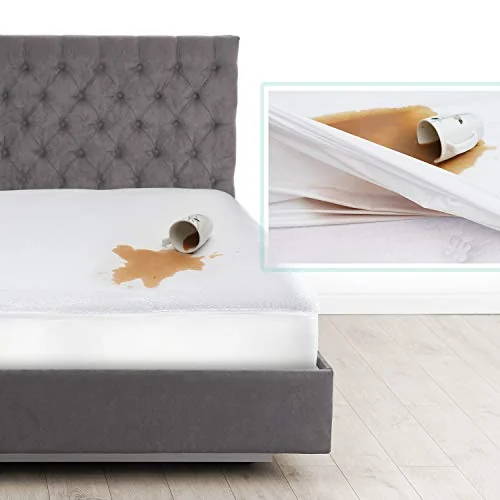
The protector is a category with real differences inside it, and which mattress protectors actually breathe is worked through in full elsewhere.
The protector is the only layer on the bed that never gets stripped on laundry day. The sheets come off every week; the protector stays on the mattress for a year or three, quietly, while you replace everything above it. That is precisely why nobody suspects it. Put a note in your phone for the same week each season and wash it, and you will also notice what it is made of.
The duvet: the same lesson, one layer up
Everything in the first section applies here too, and almost nobody applies it here. A comforter has a shell, and a shell is a fabric with a fiber and a weave. A percale-shelled comforter and a microfiber-shelled one behave differently for exactly the reasons the weave section gave, before you get anywhere near the fill inside them.
The fill matters too, of course. But the shell is the part that touches the cover that touches you, and a sealed synthetic shell around a good fill is the duvet equivalent of a plastic protector. Whether the layer over you or the layer under you deserves the money first is a genuinely arguable question, and whether the comforter or the sheets matter more is where that gets settled.
The room, which is free and beats all of them
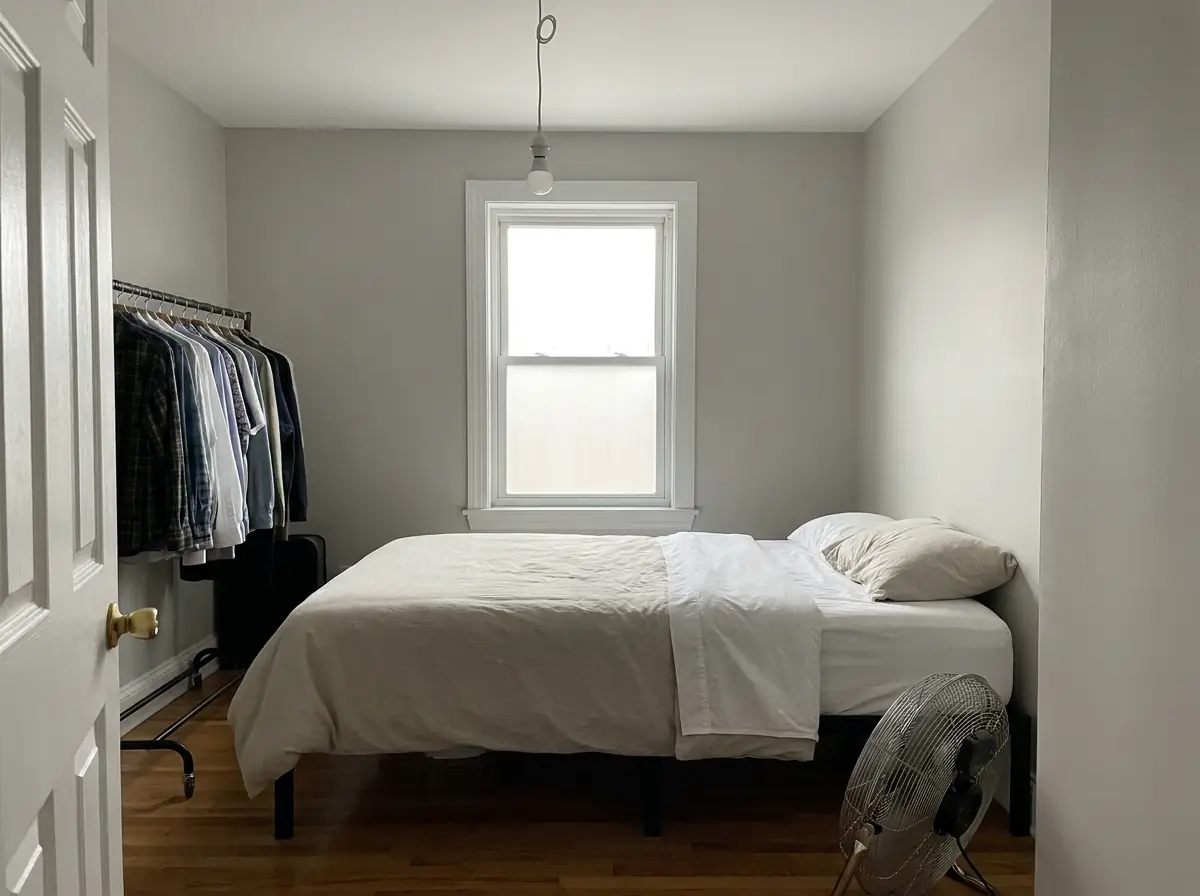
The fourth layer is the room, it costs nothing, and it does more than any of the other three. A room that sits warm fights every textile in it. Airflow across the bed does more than any adjective on any package, and a fan pointed at the bed is not a defeat, it is the cheapest variable in the system.
Room temperature is the one variable in this whole article you can change tonight for nothing. I am deliberately not giving you a number for it here, because your climate, your building and your insulation make any single figure a lie somewhere. The instruction is to change it and watch what happens, one change at a time, rather than to hit a target somebody wrote down in a different country.
And there is a layer below all four that fabric cannot fix. A foam mattress stores heat, and it will go on storing heat under the best percale ever woven. Saying so is more useful than selling you a sheet as the answer to it.
The order to test in is the cheap-first order, and most people run it exactly backwards: room, protector, duvet, sheets. Start with the free one and stop as soon as the bed is fixed.
One Bed, Two Temperatures
One of you throws the duvet off at two and the other pulls it back at three. Or the thermostat is a nightly negotiation. Or one of you needs the fan and the other resents it.
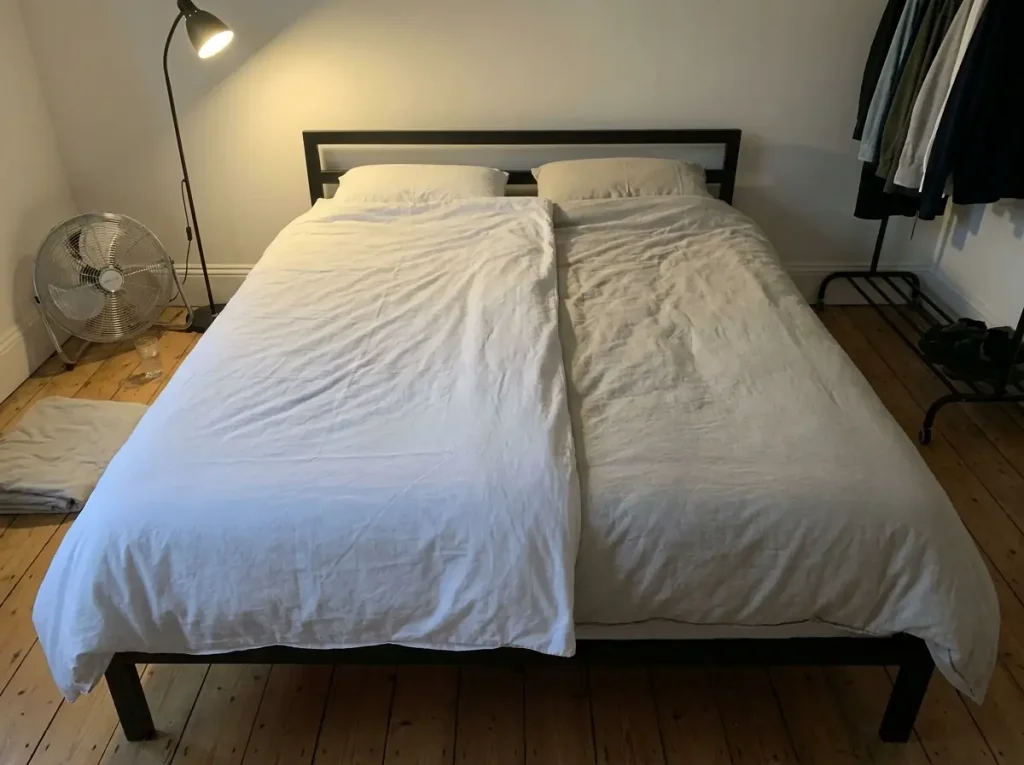
This is not a bedding problem being solved badly. It is a bedding problem that nobody has ever named as one: a shared bed with two sleepers at two different temperatures, treated as one bed with one answer.
Why one duvet cannot be right for two people
If one of you sleeps hot and the other sleeps cold, there is no single duvet that is right. There is only a duvet that is wrong for both of you in opposite directions, which is what a compromise weight actually is.
That is the whole finding, and it is worth sitting with for a second, because it reframes years of shopping. Every time you went looking for the correct tog, you were looking for something that does not exist. The variable you needed to change was the number of duvets.
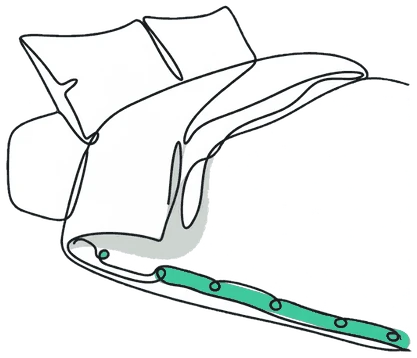
The fix has a name and a documented history: the Scandinavian Sleep Method. Two separate duvets on one bed, each matched to that sleeper’s own preferred weight, overlapped slightly down the middle and tucked at the foot so they stay where you put them. It is established Nordic domestic practice rather than a hack invented for a blog post, and half of Europe has been doing it for generations while the rest of us argued.
Two duvets, one bed: the method and how to test it free
Here is the part that costs nothing. Most couples already own a spare duvet or a spare comforter, sitting in a closet for guests. Put both on the bed, one per side, with two covers, and sleep a week like that. That test is free, it takes seven nights, and it settles the question permanently in one direction or the other.
Only if it works does buying anything make sense, and then the purchase is asymmetric, which is the part people get wrong. A lighter one for the sleeper who runs hot, a heavier one for the one who runs cold. Two different weights. Buying two identical duvets recreates the original problem with better bedspreads.
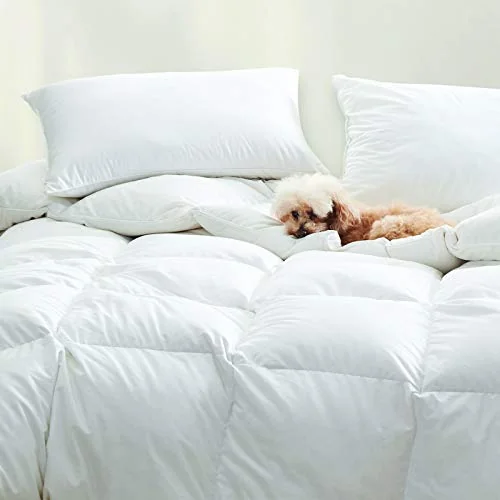
The partial fixes people invent on their own are worth naming honestly, because they do work a little: a fan aimed at one side of the bed only, or a lighter blanket over one half. People arrive at the isolation instinct without ever hearing the method has a name. A twin-size duvet for each side of the bed is the Scandinavian method, and it is what people land on when they just want to sleep.
The shared layer belongs to whoever runs hot
The duvets can be split. The sheet cannot. It touches both of you, all night, and there is exactly one of it.
So the sheet gets specified for the sleeper who runs hot, and the reasoning is asymmetric on purpose. A cold sleeper can add weight on top of a cool sheet, with a heavier duvet, a blanket, or socks. A hot sleeper cannot subtract heat from a warm one. Buy the percale for the hot one, and let the cold one solve their half above the sheet where solutions still exist.
Two duvets look wrong when the bed is made. There is a visible seam down the middle and no amount of smoothing hides it. The couples who adopt this stop caring in about a week, which is roughly how long it takes to notice that nobody is being woken at two anymore. If your half of the bed is the sweating half, bedding that actually keeps you dry is the next thing to read.
Change Nothing, Spend Nothing, Sleep a Week
You arrived here ready to spend. The most useful thing anybody can tell you is the list of moves that cost nothing, in the order to try them, plus an honest warning that whatever you eventually buy will feel wonderful for two weeks regardless of whether it is any good.
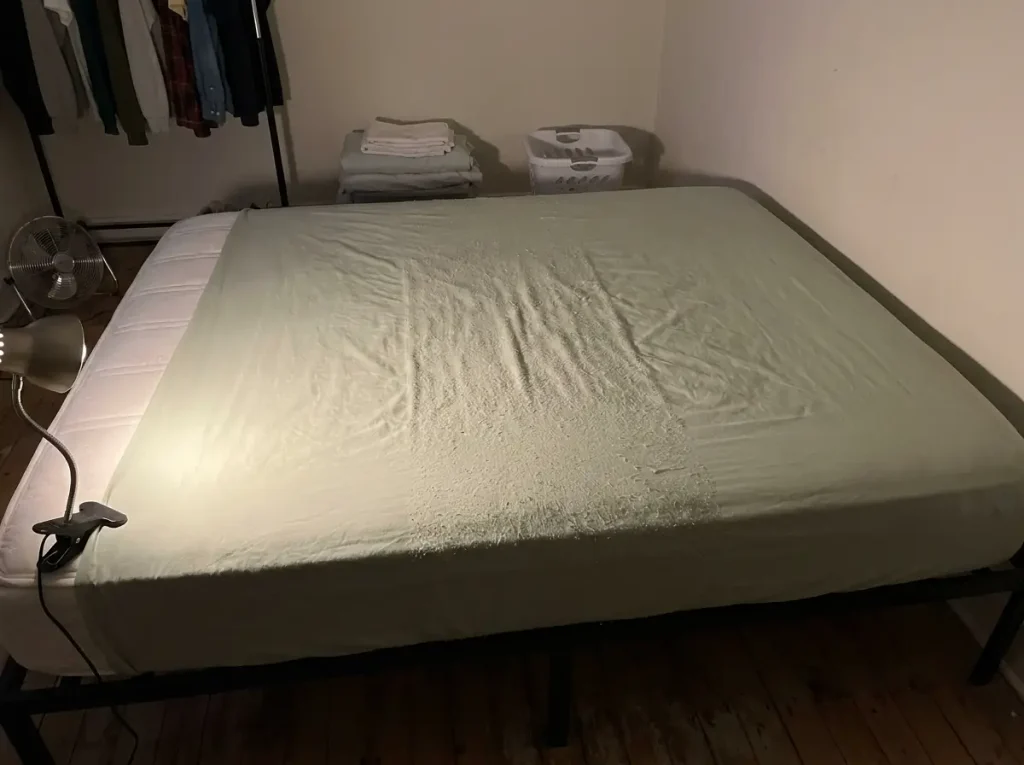
The moves that cost nothing, in order
Run these one at a time, a week each, starting from the top:
- Take the top sheet off and sleep under the duvet cover alone.
- Take the mattress protector off entirely.
- Open the room up and get air moving across the bed.
- Swap in whichever spare sheet set you already own, whatever it is.
- If there are two of you, split the duvets.
Every one of those is free, and none of them is a trick. Swapping or removing the protector is often the first and cheapest move, before buying sheets at all. If the removal itself is the answer, what to take off the bed and what to add goes further into subtraction as a strategy.
And change one thing at a time. Change three and you learn nothing except that something helped. A week each is enough to know, and five weeks is a shorter education than the two years most people spend buying sheets at random. If you get to the bottom of the list and still need to buy something, what to buy when the free moves are not enough picks up exactly there.
Week one lies: what you are actually feeling
Almost everything feels good after the first wash. That is the trap under every review on the internet, including the enthusiastic ones written in good faith.
What you are feeling in week one is starch on a percale and finish on everything else. Both of those are temporary by design, and both of them are at their strongest the day the package arrives, which is also the day most people sit down and write their review. Percale is a clean example of this: the disappointment out of the package is separate from the satisfaction after the first wash, and the set can only be judged once it has been laundered.
The usual advice is to judge a set on the first night, because that is when you have the strongest opinion about it. After enough of these threads, I would invert it completely: the first night is the least informative night the set will ever give you.
Spending more does not guarantee a fix. An expensive wool mattress topper, for example, can disappoint a hot sleeper, and the layer that changed the picture was elsewhere. A percale sheet, by contrast, tends to earn its keep, but its verdict only arrives after laundering, not before.
That is the same set of facts from two directions. The topper was judged against a review consensus written by people at week one, and it lost. The sheet was judged after a wash, by somebody who had learned not to trust the first night, and it won. Neither result is about the money spent.
And the failure mode goes the other way just as reliably. The bamboo viscose sets in these threads collect the warmest first impressions of anything on the page, praised for feeling cool and soft straight out of the package, and then get flagged in the same breath for not lasting. That is a finish and a fresh surface being reviewed, and both of them are on a clock.
Wash twenty, and the temperature to wash at
Count the wash cycles rather than the nights. By wash twenty the finish is gone, the starch is gone, and what remains is the fiber and the weave, which was the only thing that was ever going to be there on night twelve hundred. That is the verdict, and it is the only one worth anything.
So judge a sateen once it has lost its shine. Judge a percale once the starch is out.
Judge a linen once it has stopped being scratchy. Judge a viscose once you can see whether it is pilling on the side you actually sleep on. All four of those verdicts arrive at roughly the same point, months after the review window closed.
Wash it properly while you get there, and there is a real number for that. The wash temperature the Asthma and Allergy Foundation recommends is 130°F or above to remove dust mites, or, for fabrics that cannot take that, a tumble dry above 130°F for at least fifteen minutes. A controlled laundry study backs the temperature rather than the folklore.
Drying is where sets get quietly ruined, and the fix is dull. Tumble dry low, pull it out slightly damp, and let the last of it go on the bed.
High heat is what bakes a percale stiff and what sets a permanent crease into linen. Wool dryer balls are worth the small money because they keep the cloth moving and shorten the cycle, which means less heat for less time rather than any softening magic. This matters more for a hot sleeper than for anybody else, because a bed that gets damp nightly loads faster.
Pilling always shows up on one side first, the side that gets slept on, and it appears as a band across the middle third of the fitted sheet. That band stays completely invisible on a made bed. Once a season, strip the sheet, spread it flat under a lamp, and run a hand across the middle. A set that still lies matte and even there was structurally cool rather than finished cool.
When it is not the bedding at all
Sometimes you run the whole stack and nothing moves. That is information, not failure.
A foam mattress that stores heat will beat every layer above it. A room that runs warm will beat all of them together. A building with no cross-ventilation is a variable no textile addresses. If you have worked down through room, protector, duvet and sheets and the nights are the same, the variable is not on the bed, and continuing to buy sheets is the expensive way to keep learning that.
Conclusion
Read the weave, not the adjective. Fiber, weave, weight and finish are the four things that decide heat, and only the first three survive the wash. A package that names its weave is telling you more in four words than one that says “cooling” tells you on the whole front panel.
Fix the layer that is actually hot. The protector under the sheet and the room around the bed are free to test and are the two usual culprits. Replacing sheets you already like is the expensive way to find that out.
If there are two of you, stop looking for one right duvet. There isn’t one. Two duvets, two different weights, and the shared sheet specified for whoever runs hot.
After a season of washes, strip the bed, spread the fitted sheet flat under a lamp, and look hard at the middle third. Pilling shows up first on the side that gets slept on, and a set that still lies matte and even there is a set that was structurally cool rather than finished cool.
Tonight: take the top sheet off and sleep under the duvet cover alone for a week. Then lift the fitted sheet and see what the protector is made of. Both are free, and for most hot sleepers the two of them settle more than the next purchase would.
Frequently Asked Questions
01What type of bedding material is best for hot sleepers?
Cotton percale and linen are the two families that stay cool structurally rather than by finish, because both leave gaps in the weave for air to move through. The weave matters more than the fiber name, which is why the family comparisons are argued out in their own articles.
02What type of comforter should I get if I’m a hot sleeper?
A lighter fill inside a cotton percale shell, because the shell is a fabric and obeys the same weave rules a sheet does. If you share the bed, two lighter duvets beat one medium one, since a compromise weight is wrong for both sleepers.
03What is the best bedding for hot sleepers in the summer?
The same percale or linen you use the rest of the year, with layers removed rather than fabrics swapped. The free summer move is subtraction: take the top sheet off, and swap the duvet for its cover alone before buying anything seasonal.
04Do cooling sheets actually work?
Some do, but not because of the word. A set that cools by weave and fiber keeps working for its whole life; a set that cools by a surface finish stops after roughly ten washes. Read the weave on the back panel, not the claim on the front.
05Does a mattress protector make you sleep hotter?
A fully synthetic or plastic-backed protector traps the moisture the sheet moves away, which makes it the most commonly missed cause of a damp bed. Take it off for a week to test, then replace it with a cotton-faced one only if you genuinely need waterproofing.




Tried it on your own bed?
No comments yet. Tell us what you changed, and what the sheet did after a few washes.