







What’s in here6 sections
You are holding two sheet sets, and one of them has the little tag. The other does not, and costs less. The tag feels like it settles something, so you buy the certified one and stop thinking about it.
Here is the part nobody prints on the package: OEKO-TEX STANDARD 100 is a chemical screen run on the finished cloth, around a hundred parameters deep, and there is no line anywhere on that certificate for how long the cotton fiber was before it got spun. So when people ask whether OEKO-TEX sheets are better quality, they are asking a question the certificate was never built to answer — and this is where the tag stops and the fabric starts.
Quick Answer
No. OEKO-TEX certifies the absence of harmful substances in the finished fabric, not fiber quality, weave or weight. A short-staple, thin, certified percale can pill fast, and a well-made sheet can carry the identical tag. The certificate answers whether it is safe, not whether it is good.
What the OEKO-TEX Tag Actually Tests
The tag is not vague. It is one of the most specific things on the whole package, and its specificity is exactly what shoppers miss: it names a list of chemicals and then it stops. People turn the package over expecting a grade and find a lab result instead.
The Hundred Parameters, and What They Are Looking For
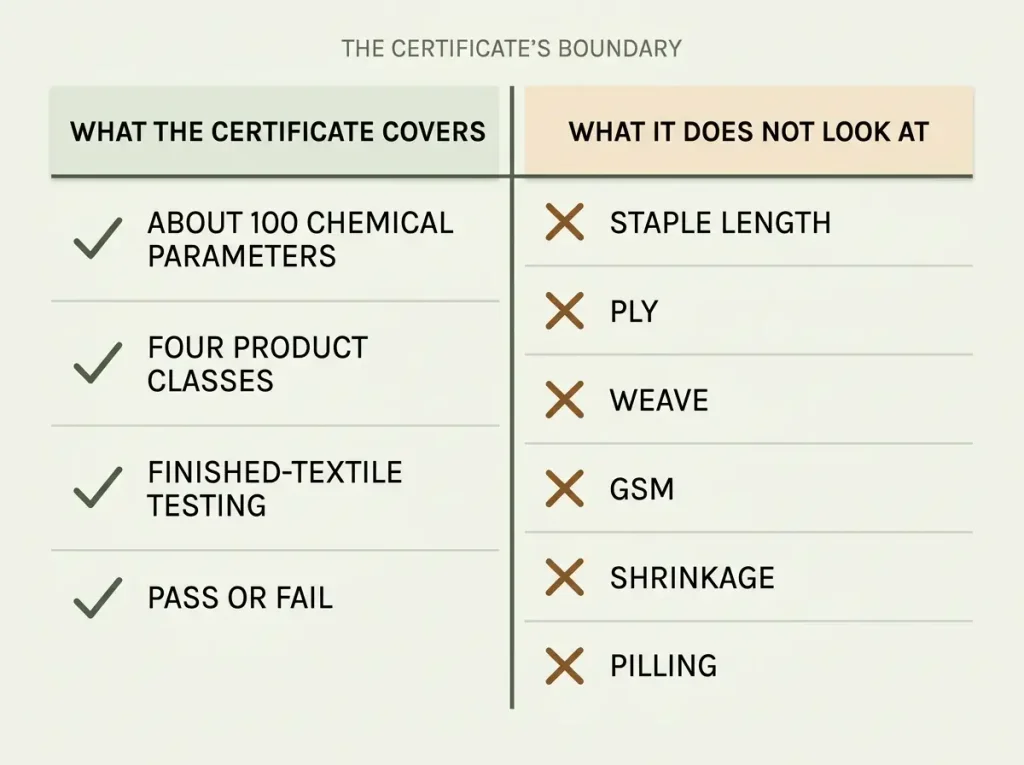
STANDARD 100 tests around 100 chemical parameters on the finished textile: banned azo colorants, cadmium, lead, PAHs, organotin compounds, chlorinated phenols, phthalates, PFOS and PFOA, APEO surfactant residues. Every one of those is a substance that could still be sitting on the cloth after it left the finishing plant. That is the whole scope: what got left behind, measured on the thing you will sleep against.
Read that list again and notice what kind of list it is. Azo dyes, heavy metals, formaldehyde and its relatives: every entry is chemical residue, and every one of them is measured on the finished product rather than on anything that happened upstream of it.
Now notice what is missing. Not how long the fiber was. Not how many threads got twisted together to make the yarn. Not whether the weave is one over one or four over one.
By the time the lab sees the cloth it has already been spun, woven and finished, and every decision that determines how the sheet feels was made before that.
The other thing worth knowing is that the number printed beside the logo is checkable. It resolves to a specific certificate, held by a specific supplier, for a specific product range, with an expiry date on it. The thing most people treat as a quality badge is closer to an inspection sticker on an elevator. For the tag mechanics themselves, what Standard 100 tests, certificate by certificate is a separate piece; this one is about what the tag cannot see.
Class II Is Where Your Sheets Live, and Why That Is Not a Downgrade
STANDARD 100 sorts products into four classes by how much skin they touch. Class I is babies and toddlers, with the strictest limits of the four. Bed linens fall under Product Class II, the direct-skin-contact tier, one notch below the baby bar. Class III is no skin contact, Class IV is furnishing fabric.
So your flat sheet, your fitted sheet and your pillowcases are all tested to the Class II threshold, and Class II is a chemistry bar, not a quality bar. A duvet cover you sleep under sits in the same tier as the sheet you lie on, judged against the same limits and against nothing else.
Some manufacturers certify adult bedding to Class I anyway, which is what makes the ladder legible rather than boilerplate. The ettitude 100% Lyocell from Organic Bamboo Sheet Set is a sateen-woven lyocell made in a closed-loop solvent process, carrying OEKO-TEX Standard 100 Class 1 voluntarily on a product no toddler is going to sleep on, with a 17-inch pocket. And the stricter class is not a free upgrade, because lyocell takes on more moisture than a cotton percale does and in a genuinely humid climate it holds it longer. A stricter chemical class and a fabric that suits your room are two separate purchases that happen to arrive in the same box.
Run a certification lookup before you assume the logo is current: type the number from the tag into the OEKO-TEX label check. A certificate belongs to a supplier and a product range and it expires. A printed logo with no readable number beside it is a graphic, not a certification.
Pass or Fail, With No Grades in Between
There is no Class II Gold. No premium tier, no top-rated version, no variant of the label that also means better made. The official factsheet frames the certificate the way a lab frames any screen: the article passed, or it did not. Everything a marketing team wants you to read into that binary, softness and longevity and thread quality, got added on the way from the lab to the package.
That leaves a second label doing a different job, and it is worth putting the two side by side while the boundary is fresh. GOTS audits the growing and the processing chain: a minimum 70% organic fiber content for the made with organic label, 95% for organic, plus a supply chain audit covering the factory conditions behind it.
The Whisper Organics 100% Organic Cotton Sheet Set is GOTS certified at the 95 grade and audited by Control Union, which tells you the cotton was farmed and processed to that standard, and tells you nothing whatsoever about how the yarn was spun or how the cloth was built, which is the same boundary this whole article is about. Safe, organic and well made are three separate claims. Two of them have labels. The third one does not.
The community already knows something is off here, even if it cannot name it. The top OEKO-TEX-adjacent thread on r/Bedding is titled “There’s too much conflicting information.” People are not asking which certified set is best. They are asking what the labels mean at all.
Why a Certified Sheet Can Still Be a Bad Sheet
Nothing in that chemical screen looks at the cotton before it was spun, and that is where a sheet is actually won or lost.
Think of the set that came with the tag, felt fine for a month, and had a fuzzy patch where a hip rests by wash six. Nothing went wrong with the certification. The certification was never watching that.
Staple Length, the Number Nobody Prints
Staple length is how long the individual cotton fibers are, and it is the single number that best predicts whether a sheet will pill. Cotton Incorporated sorts it into three bands: short staple up to 1 inch, medium staple between 1 1/32 and 1 3/32, and long staple above 1 1/8. It is the fiber measurement that actually predicts pilling, measured by high volume instrument as the upper-half-mean length.
The mechanism is not mysterious. Longer fibers overlap each other more times along the length of a spun yarn, so they grip better and fewer ends stick out. Short fibers have more loose ends per inch, those ends work their way to the surface under friction, and a pill is just a loose end that has rolled up and taken its neighbors with it.
So longer staple gives a stronger, smoother, less pill-prone yarn at the same thread count, and it is most of what people are describing when they talk about hand feel. Two certified 300-count percales can age at completely different rates for that reason alone, and the certificate has no opinion on the difference because it never measured the fiber.
The pilling also does not arrive evenly, which is the part that catches people out. It shows up first where a hip or a shoulder rests, and at the corners where the fitted sheet stretches over the mattress, the two places where friction and tension are highest. A set can look perfectly fine from the doorway and be finished exactly where you lie on it.
Ply, and How Thread Count Gets Inflated
Thread count is a count of threads per square inch, and above roughly 400 to 500 it is usually reached the cheap way: by twisting two or three thin yarns together and counting each one. A 2-ply yarn woven at 300 gets sold as 600.
The printed number goes up, the cloth gets denser and less breathable because you have crammed more material into the same square inch, and the fiber that went into it is exactly as short as it was before. Nothing improved. The number improved.
The OEKO-TEX tag never states ply. It has no field for it. So a package can carry a genuine certification and a four-digit thread count at the same time and still be built from short-staple, multi-ply yarn. Every claim on it true, and the sheet mediocre.
The honest version of this looks like the Linen Home 100% Cotton Percale Sheet Set: genuinely OEKO-TEX certified, and genuinely a 200-count single-ply percale with a 15-inch pocket, which is a modest cloth that feels correct rather than fine, and the certificate does not compensate for that in either direction. Safe and unremarkable at once, with no contradiction anywhere in it. That set is this entire argument standing up in one product. For the full mechanics of what thread count is actually counting, the weave pillar takes it apart properly.
What GSM Tells You, and What It Does Not
GSM is grams per square meter, the grammage of the cloth: how much fabric there is per unit of area. It is a genuinely useful number and almost nobody prints it, which is why lifting a set in a shop tells you something a spec sheet will not. But GSM on its own is ambiguous. A heavy sateen and a heavy short-staple percale can post the same figure and behave nothing alike, because weight measures how much material is there and says nothing about the quality of the material or how it was interlaced.
Read GSM beside the weave name and the staple length, never alone. And the tell that this is all one question rather than three: the three-star reviews on a certified set almost never complain about chemicals. They complain about the fabric. Two different questions, and only one of them has a certificate.
Sort the reviews to three stars and read twenty of them. The top-rated reviews are written in week one, and the one-star reviews are usually about shipping. Three stars is where someone who has had the set for a season tells you which corner went fuzzy first.
The Checklist to Read Beside the Certificate
Once the tag stops being the answer, the question becomes what to read instead, and the honest version of that list is short, free to apply and mostly printed on the package already.
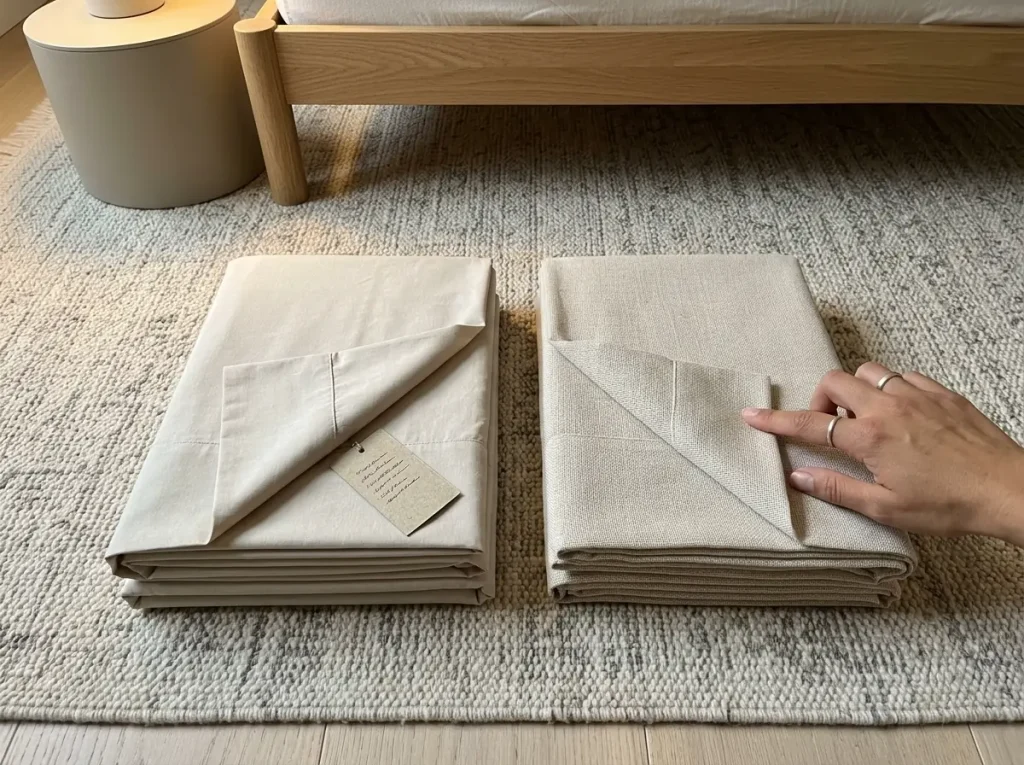
You are not going to run a fiber test. You are going to read a listing on a phone. So the real question is what can be verified from there.
What a Good Listing Tells You Without Being Asked
Four signals, in descending order of usefulness: long staple, single ply, a named weave, and a sensible thread count. All four predict the sheet better than any third-party certification does.
And the free move comes before any of them: read the listing for what it refuses to say. A set that names its weave and its ply is telling you it has nothing to hide. A set leading with a certification logo and a four-digit thread count is choosing which number to show you, and the choice is the information. It is also how cheap sheets get sold at a premium price.
Here is the part that takes practice. The listings that do name staple length almost never put it in the specification block: it turns up in the description paragraph, three lines down, and often only as the country the cotton came from.
Read the paragraph, not the spec table. That is the whole trick, and it costs nothing.
Reading the Weave Name Instead of the Thread Count
A weave name is a fact about construction, which is what makes it more useful than a number that can be inflated.
Percale is one thread over, one under: gaps between the intersections, air moves through, it feels dry and crisp and it sounds slightly papery when you shake it out. Sateen floats four threads over one, a smoother closed surface with fewer interruptions, which is why it looks better in a photograph and sleeps warmer.
Percale also creases more, so if wrinkle resistance matters to you that is the trade you are making. Same cotton, same count, two entirely different beds. Percale against sateen, one over one against four over one is the comparison worth understanding before any tag enters the decision.
A listing that will not name its weave is telling you something too.
When the Certificate Does Earn Its Place
None of this makes the certificate worthless. A certificate plus a named weave plus single-ply construction is a genuinely good signal: three independent things confirmed, rather than one confirmed and two hidden. The tag is simply the wrong tool for the quality question, and it stacks perfectly well with the right ones.
If sensitive skin or chemical safety is the real worry rather than durability, that is exactly the job the certificate was built for, and label verification takes about a minute. To pin down which label covers what, what OEKO-TEX and GOTS each actually certify is the piece that settles which label you want.
Put two certified sets next to each other and the point makes itself. The Brooklinen Percale 4-Pc Sheet Set for Hot Sleepers is a 270-count cotton percale carrying the identical OEKO-TEX tag as the Linen Home set from the last section, and it sits a clear step above it in construction. But 270 threads still does not tell you whether the yarn is single-ply, so a reader checking only the count is buying partly blind even here.
The tag cannot separate those two sets. The checklist can, in about ninety seconds.
And the counterpoint, because certification does not correlate with quality in either direction: the Feather & Stitch 100% Cotton Percale Sheet Set is a 300-count percale with a 16-inch pocket and no certification claim of any kind on its listing, which is a perfectly reasonable sheet and a real thing to give up if you want the chemical-safety assurance in writing. Plenty of well-built cloth never bothered to get certified, and plenty of certified cloth is ordinary. Those two facts sit together comfortably once you stop asking one label to do both jobs.
When the labels stop being useful, people ask for brand names instead, and the budget threads on r/Bedding are mostly that. It is a workaround for an unreadable label, not a strategy, and the checklist is what replaces it.
What Wash Twenty Says That the Tag Never Will
Every claim so far can be checked in a shop. This one can only be checked by waiting, which is why almost nobody publishes it.
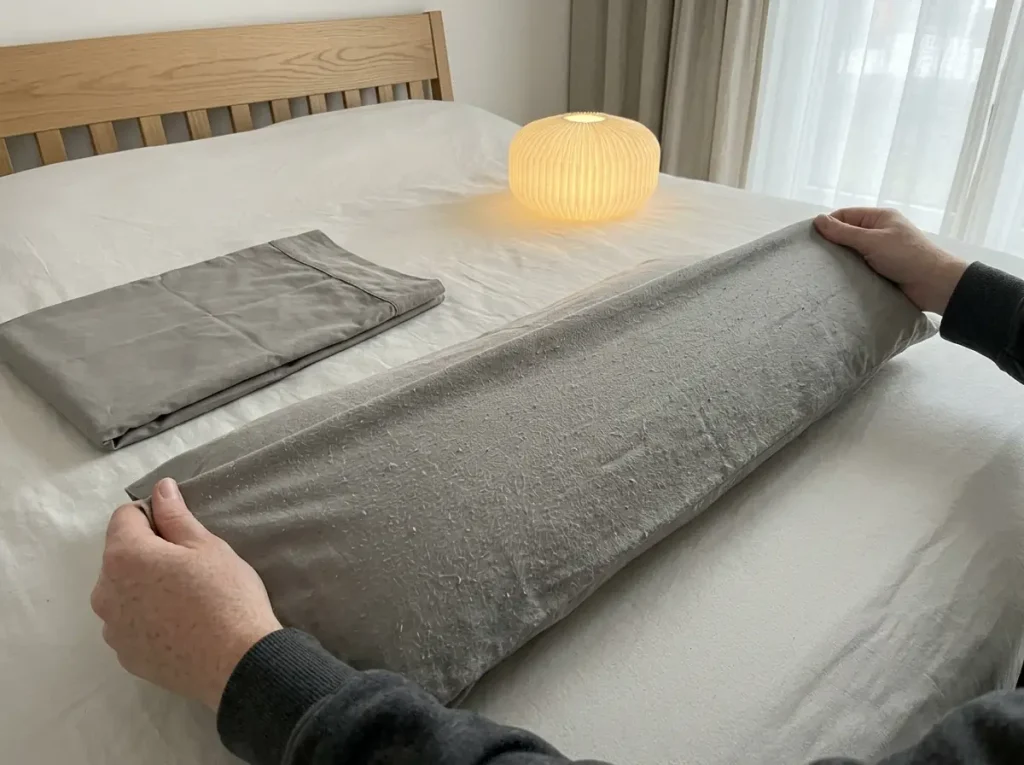
And the limit is worth stating plainly: no first-person account of a certified set at wash twenty turned up anywhere in the sources for this piece. So what follows runs on the mechanism rather than on somebody else’s laundry diary, and an invented wash report would be worth less than the honest gap.
What Actually Changes Between Wash One and Wash Twenty
The certificate tests the textile as finished. It is a point-in-time chemical result, not a durability prediction, and it has nothing to say about the cloth after twenty wash cycles because it was never a test about time.
Three things do change, and they are all construction. Short-staple yarns shed and pill, worst where friction is highest. Multi-ply constructions can stiffen and lose drape as the plies set. And resin and softener finishes wash out, which is the one that fools people most: a set that felt smooth in week one can feel ordinary by month two with nothing wrong except that the finish has left.
Week one lies. Almost everything feels good after the first wash, certified or not, and colorfastness is usually the only thing anybody checks.
The finish does not fade gradually, either. It goes on a schedule: the cloth is noticeably different after the particular wash where the finish finally leaves, and people almost always blame the detergent they happened to switch to that month. For the durability comparison in full, which weave holds up longer over a season of washes is where the weave node carries it.
Do not judge a new set until it has been through five washes. The starch and the softener finish are still on it before that, and they are the two things guaranteed not to last. What is left at wash five is the actual cloth you bought.
Where to Look on a Season-Old Set
Strip the bed and check three places. The contact zones where a hip and a shoulder rest, which is where the fuzz starts. The fitted-sheet corners, where tension is constant and the pilling is a stretch failure as much as a friction one. And the hand of the cloth itself: run it through your fingers and ask whether it feels like the same fabric it was, because if it went from crisp to soft-and-slightly-limp, the finish is what left, not the cotton.
The three-star reviews on certified sets say some version of still safe, just not soft. That is the certificate doing exactly what it was designed to do, and the buyer’s expectation failing. If the organic side of the question is what you are really weighing, whether organic bedding is worth paying more for is a different calculation and gets its own answer.
Conclusion
The OEKO-TEX tag answers one question well — is there harmful chemistry left on this cloth — and it does not answer the question most shoppers are actually using it for. That is not the certificate failing. It is a screen being asked to be a grade.
Staple length, ply and the weave name predict how a sheet will feel and how long it will last. All three are readable before you buy, and none of them is on the certificate. A certificate stacked on top of a well-specified cloth is a good sign; a certificate standing alone next to a four-digit thread count is a choice about which number to show you.
After a season, look at the two places a hip rests and at the fitted-sheet corners. If the fuzz is there and the rest is smooth, the fiber was short, and no certificate was ever going to tell you that in advance.
Tonight, open the listing for the set you already own and see whether it names its weave and its ply. If it does not, you have learned something about it for free.
Frequently Asked Questions
01Is OEKO-TEX good quality?
OEKO-TEX is a chemical-safety certification, not a quality grade, so it confirms the finished cloth carries no harmful substances without saying anything about the fiber, the yarn or the weave. Read staple length, ply and the weave name instead.
02What should you avoid when buying bed sheets?
Avoid any set with a thread count above roughly 400 that does not state its ply, name its weave, or say where the cotton came from. A listing that leads with a logo and a big number instead of a fabric description is choosing what you get to see.
03Do OEKO-TEX certified sheets pill?
Yes, they can. Pilling comes from short-staple fiber and yarn construction, and the certification tests neither of those. It shows up first where a hip or shoulder rests and at the fitted-sheet corners, where friction and tension are highest.
04Are Costco sheets OEKO-TEX certified?
Some are and some are not, and the certificate number printed on the package is the only way to tell, since it resolves to a specific certificate with an expiry date. The same checklist applies regardless of which retailer the set came from.
05Is OEKO-TEX or GOTS better for bed sheets?
Neither is better, because they test different things: OEKO-TEX is a chemical screen on the finished cloth, GOTS is an organic-farming and processing audit, and one product can carry both. Neither one grades construction, which is where the organic-versus-safety confusion starts.




Tried it on your own bed?
No comments yet. Tell us what you changed, and what the sheet did after a few washes.