






What’s in here7 sections
Someone on r/Bedding ordered two sheet sets side by side from the same retailer: one sold as a 700-thread-count Egyptian cotton sateen, one as a 400-thread-count Supima cotton sateen. Both showed up thin and slippery, and the care label sewn into the side seam of each read the same three words: 100% Cotton. Two countries on the marketing, one label on the fabric.
The thing nobody tells you at the shelf is that American cotton and Egyptian cotton, at the top of each range, are the same plant species, Gossypium barbadense, and what actually separates a good set from a thin one is how long each individual fiber is before it gets spun into yarn. So here is what the two names really name, what staple length does, why the label is the weakest link in the whole chain, which one sleeps better on an August Tuesday, and when the Egyptian premium buys something real.
Quick Answer
Egyptian cotton names a place, not a grade. Staple length is what you feel, and genuine American Supima at extra-long staple matches or beats most retail Egyptian cotton, which is frequently not the top Giza grade the name implies. Buy the verified staple and the weave, not the flag.
What “American” and “Egyptian” Cotton Actually Name
Both words on the package describe geography, and geography is the one thing about a sheet you will never feel. So the first job is working out what each name is claiming before deciding which claim is worth more money. The honest answer to is Egyptian just better is: sometimes, by a fraction, and only when it is the grade you think it is.
The two premium cottons are botanical cousins. Egyptian Giza grades and American Pima both come from Gossypium barbadense, not two different categories of plant, but two national crops of the same species selected in different valleys. What the marketing sets up as a rivalry between countries is, at the fiber level, a rivalry between growing regions of one plant.
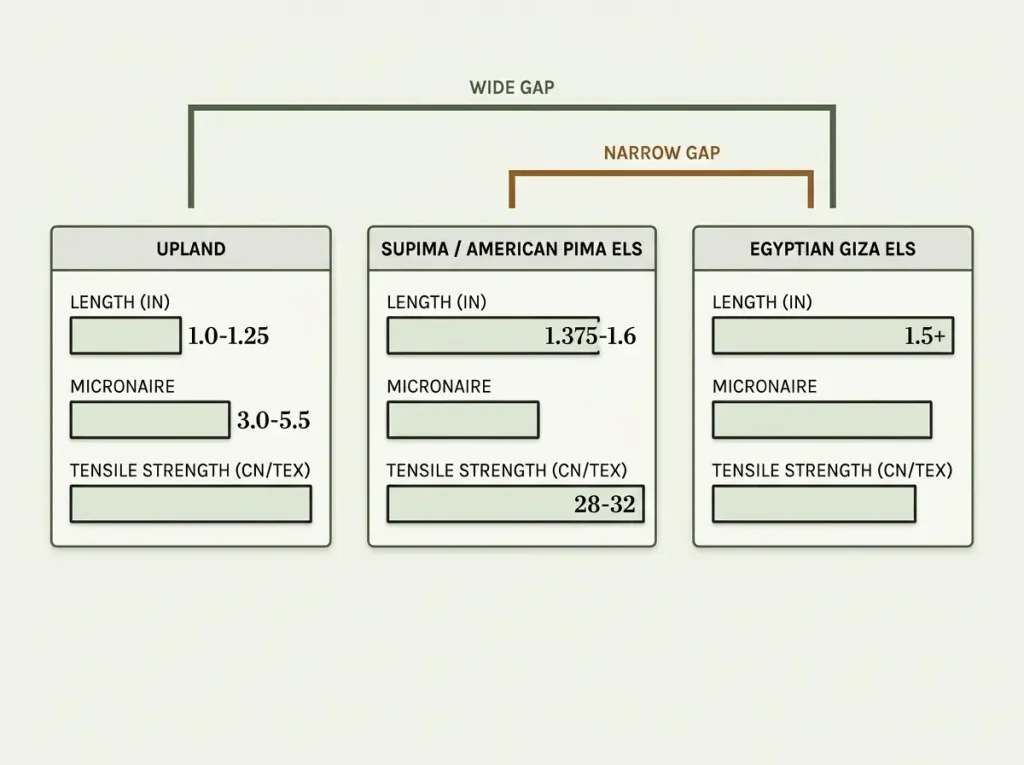
“American cotton” is not one thing, and this is where most comparisons go wrong before they start. Upland cotton, the short-staple cotton that makes up the commodity crop, Gossypium hirsutum, is the overwhelming majority of the U.S. harvest, with fiber running roughly 1.0 to 1.25 inches. American Pima is a different, far smaller crop, running up to about 1.6 inches.
So comparing “American” to “Egyptian” without saying which American you mean is comparing a category to a grade. That is why the pillar on why staple length beats thread count treats staple as the master variable and the country as a footnote.
Supima is a trademark, not a fabric. It is the licensed name for American-grown Pima, and the organization behind it says the crop is less than 1% of the cotton grown in the world, traced back to its growing region by forensic isotope analysis, with 93% of it coming out of California’s San Joaquin Valley and the rest from Arizona, New Mexico and Texas. A tag that says “American Pima” without saying Supima has been through no such check. That distinction is small on the page and large in the bag.
And on the other side, “Egyptian cotton” describes where a plant grew, historically the Nile river valley, whose long growing season and river silt are the actual reason Nile valley cotton earned the name. But the name carries no grade, no staple minimum and no automatic tier. The Giza numbering does that work, and Giza numbers almost never appear on retail packaging.
Which brings us to the tell. The community shorthand for a disappointing set is “feels like polyester”, and it gets used identically for Egyptian- and Supima-labeled sheets. When the same complaint lands on both flags, the flag is not the variable.
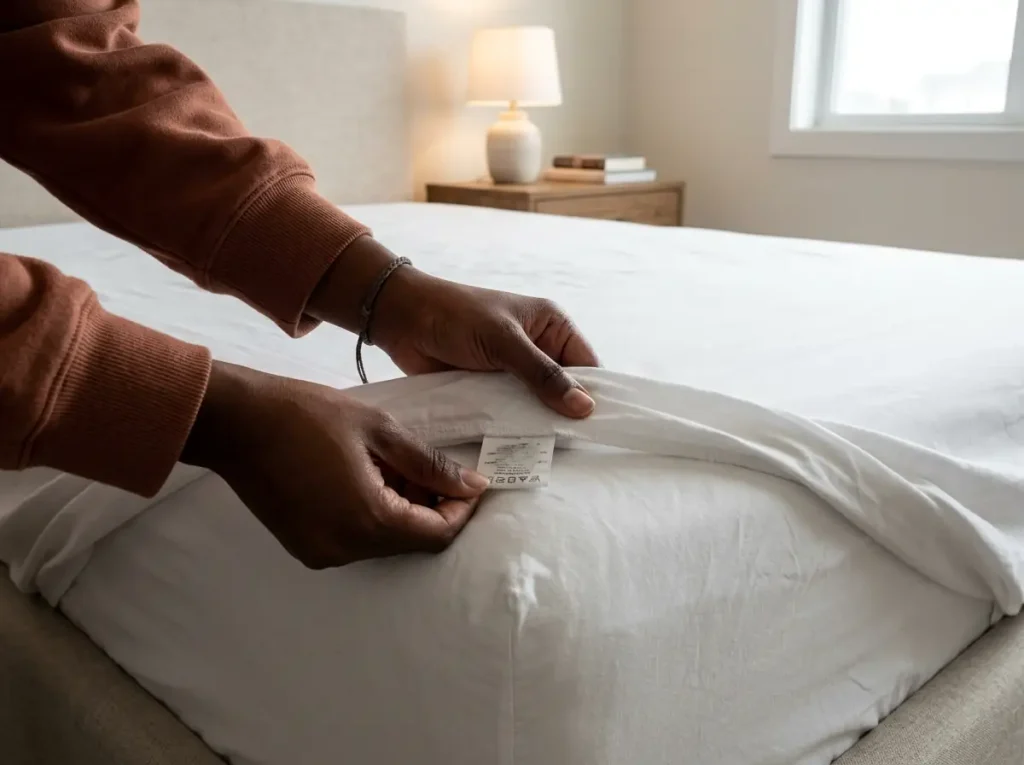
The care label sewn into the side seam is a regulated garment label. The words on the cardboard band around the package are marketing copy. When the two disagree, and in that Lands’ End thread they disagreed twice on two different sets, the sewn-in one is the one that had to be true.
Why Staple Length, Not the Flag, Decides the Yarn
If the country names are a poor guide, something has to be a good one. The fiber going into the yarn is measurable, graded on every American bale since 1991, and the reason a good sheet feels the way it does. It is also why the same “100% cotton” can come out feeling like a hotel percale or like a windbreaker.
Start with the mechanism, because every claim later in this article gets tested against it. A longer fiber needs fewer overlaps to make a continuous yarn, and that is the whole of yarn construction in one sentence.
Fewer overlaps mean fewer fiber ends standing out of the surface. Fewer ends mean a smoother hand, less fuzz raised by washing, and less pilling six months in. That is the argument for long staple, and it has nothing to do with a country.
Now the numbers. Supima extra long staple cotton is defined at 1 3/8 inches and up, and genuine Egyptian Giza runs roughly 1.5 inches and up, so Egyptian does hold a slight edge at the very top grade: fractions of an inch, not a different class of material.
Set both against Upland’s 1.0 to 1.25 inches and the picture reorganizes itself. The gap between the two premium cottons is narrow; the gap between either of them and the commodity crop is wide. That is the comparison worth having, and what the Supima and Pima names each mean goes deeper into why one of those words is audited and the other is just botany.
Fineness and fabric strength follow the same pattern. Upland runs roughly 3.0 to 5.5 micronaire; Pima runs lower, meaning finer and more mature fiber, with tensile strength cited around 28 to 32 cN/tex.
These are not brand assertions. They come out of the HVI fiber-classing system Cotton Incorporated uses to grade the entire U.S. crop, the same lab process every American bale passes through.
Then there is ply, the confound nobody controls for, and it is completely origin-agnostic. Above roughly 400, a genuinely single-ply weave in long-staple cotton is very hard to reach.
A 1000TC “Egyptian” set and a 1200TC “Supima” set are both, almost certainly, multi-ply: twisted plies counted as threads. Thread count inflation does not care which country is on the band, so comparing origins while ignoring ply means comparing two inflated numbers and thinking you learned something. What thread count actually tells you unpacks that arithmetic in full.
And the weave decides more than either of them. Percale is one thread over, one under, which leaves gaps, and gaps move air, which is where breathability and moisture-wicking actually come from rather than from the fiber’s passport. Sateen floats three or four threads over one for sheen and a softer first touch, and gives up airflow and snag resistance at the same fiber grade.
Whatever the flag says, the weave decides how the set sleeps. For a concrete case of the mechanism this section just described, the Tuft & Needle Supima Cotton Percale Sheet Set names Supima specifically rather than a vague “Pima blend”, in percale, with a 16-inch pocket and an OEKO-TEX certification. That is genuine extra-long staple in the weave this section just argued for, with no country doing the persuading. Its flaw is availability: stock on it is thin right now, and if it is gone by the time you look, the Supima argument does not depend on this one listing.
One more thing that only shows up on a bed. The fuzz that appears on a long-staple sheet around wash ten is not pilling yet: it is the short fibers that were always in the blend working their way to the surface.
On a genuine extra-long-staple set there are fewer of them, so the surface settles instead of getting worse. Longevity is that difference, and it is the one you are actually buying.
The Label Problem — When “Egyptian Cotton” Isn’t
All of that assumes the label is telling the truth about which cotton is in the bag. That assumption has failed at national retail scale within living memory, which is why the verification mechanism, not the country name, is the thing actually worth knowing. If you already own “Egyptian cotton” sheets and you are now squinting at them, the fault is not yours. It is the label’s, and the label was built to be squinted at.
The precedent is documented. In 2016, Target cut ties with Welspun after finding roughly 750,000 sheets and pillowcases labeled 100% Egyptian cotton were not. Bed Bath & Beyond and Walmart both pulled Welspun’s Egyptian-labeled products after an independent audit could not confirm the fiber’s origin. National retailers, major brands, years after “Egyptian cotton” had become a premium-priced word.
So what does a real certification require? DNA testing cotton is the core of it. The Cotton Egypt Association tests fiber against a genomic fingerprint of cotton grown in Egypt, audits the full chain of spinning, weaving, dyeing and sewing, and only then licenses its Accredited Gold Seal, which is printed and couriered per accredited product line. That is the DNA-testing accreditation the Cotton Egypt Association actually runs before a mill can use the Egyptian Cotton logo, and it is a serious process.
It is also opt-in and paid. A set that does not name the Cotton Egypt Association or carry its seal has not been through that check, no matter how confidently the box states the country, and confidence on packaging costs nothing to print.
If you want the full treatment of whether a 100% Egyptian cotton label is always true, that question has its own article. This one stays on which origin wins and why.
Who checks the checker? An independent auditor, Bureau Veritas, verifying the claim at the mill level, a third party with no stake in the Egyptian trade, running testing and auditing at any stage of the supply chain under a partnership with the association. Every competitor writing about this mentions that “DNA testing exists” and then stops, without ever naming who runs it. Naming it matters, because a certification with no external auditor behind it is a logo.
The Gold Seal is issued per accredited product line, not per brand. A mill can hold accreditation for one range and sell an uncertified range beside it under the same company name. Which is why the seal has to be on the set in your hands, not on the company’s About page.
Here is the symmetry, and here is the part that costs nothing: the American side has the same kind of mechanism in Supima’s licensing and forensic origin testing. Both origins have a genuine verification story, and neither of them is the country name on the front of the package.
So before buying anything at all, strip the bed and read the sewn-in label on the set you already own. Free, five minutes, and it settles most of the question.
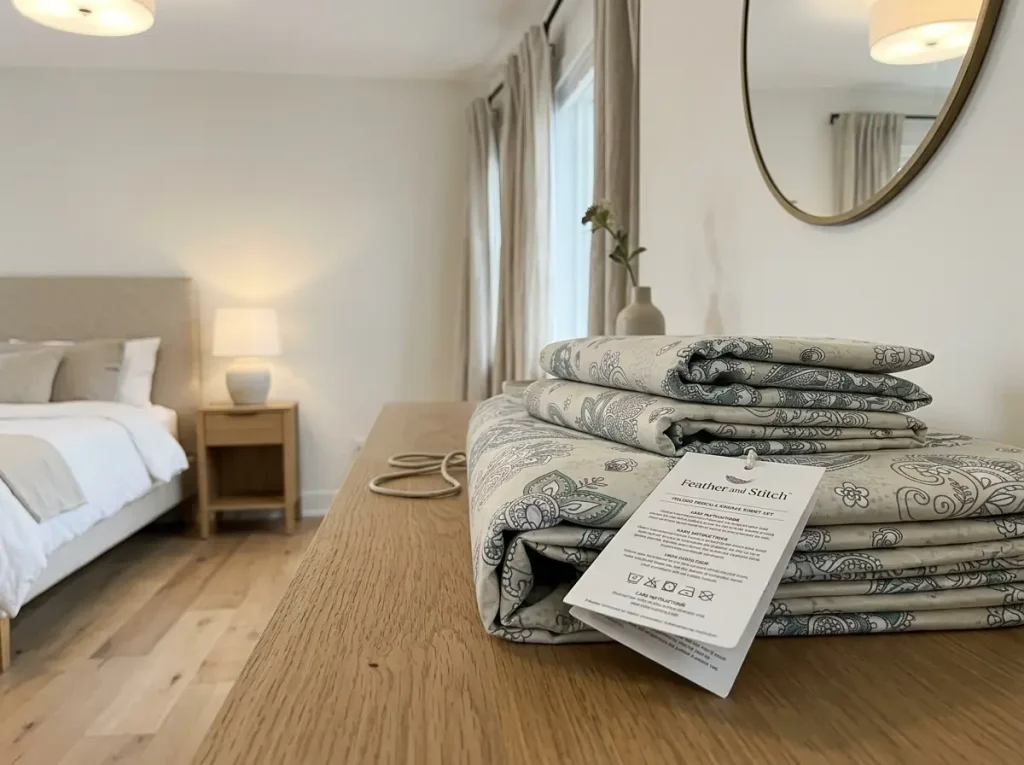
Once you have done that, the useful exercise is reading a listing that makes no origin claim at all. The Feather & Stitch 100% Cotton Percale Sheet Set is exactly that control case: 300 thread count, percale, a 16-inch pocket, and not one word about Egypt or Pima anywhere on it, so the only things left to read are the ones that were always the real signal.
Its flaw is the flip side of the same coin: with no origin or staple claim on the listing, you cannot verify fiber quality from the page itself and have to lean on what reviewers report about hand and durability after a few months.
Which One Actually Sleeps Better
Verification settles what is in the bag. It still leaves the question you came with, whether the Egyptian set will feel better on a Tuesday in August, and the honest answer runs through the weave long before it reaches the country.
The order of importance, stated plainly: weave decides breathability, staple decides smoothness and how long it stays smooth, and origin decides neither directly. Origin only correlates with staple, and only when the grade has been verified. Two variables you can check, one you mostly cannot.
At equal fiber, percale sleeps cooler and wears crisper because of those one-over-one gaps; sateen feels smoother in week one and is likelier to snag and pill later at the same grade. Most retail “Egyptian cotton” is sold as sateen, which explains a great deal about why it feels so convincing in the shop and so disappointing in August. The sheen you are touching is a weave decision, not a fiber one, and why cotton sheets sleep hot when the weave is wrong is the same mechanism seen from the temperature side.
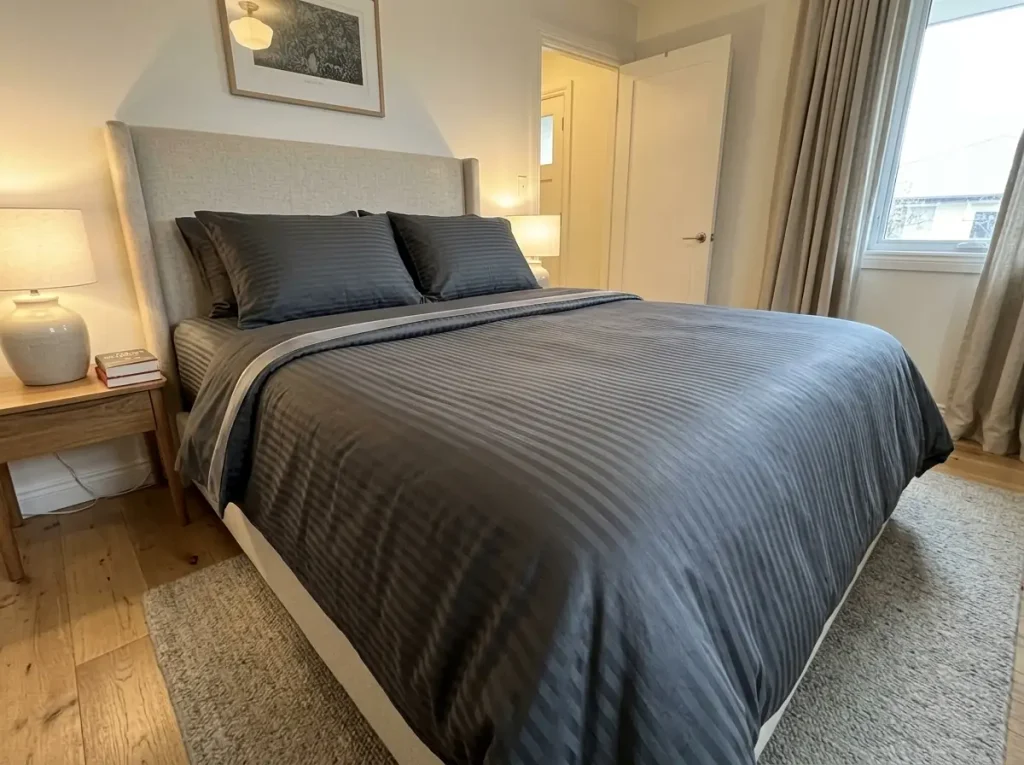
If you do want an Egyptian sateen, the SOHO 100% Egyptian Cotton Sateen Stripe Sheet Set is honest about its numbers: 500 thread count is a believable figure for a single-ply weave rather than the inflated four-digit count this article has been teaching you to distrust. Its flaw is the weave itself — sateen carries more sheen and a softer hand, and raises more pilling with use than a percale at the same fiber grade. That is the trade, stated up front.
The community keeps confirming the same thing from the other direction. One poster bought Tempur-branded Egyptian cotton sheets that “slide all over and feel slippery”, then discovered their old, well-worn, non-Tempur Egyptian sheets did precisely the same. The origin claim had told them nothing about grip, finish or weave.
It never does. “Slides all over” shows up in threads about American-labeled sets just as often.
The wash-twenty view is where the money either shows up or does not. The difference between a genuine extra-long-staple set and a commodity one appears not on night one but somewhere around wash ten to twenty, when the short fibers in the cheaper blend raise a fuzz along the fold and the extra-long-staple surface settles instead. Week one lies. Almost everything feels good after the first wash.
Which means how you wash it matters more to the outcome than which flag you bought. Wash temperature is the lever that matters: a cold wash or a warm wash both work, and a hot one does not, because heat is what shrinks the weave and sets the creases that later become the fold line where fuzz starts. Tumble dry low, or air dry if you have the space and the patience — high heat is the single fastest way to age a good sheet, and it does not care what the fiber cost.
And avoid fabric softener entirely. It works by depositing a waxy film on the fibers, which is exactly the thing you did not pay for on an extra-long-staple set: the softness was supposed to come from the fiber length, not from a coating. That film also blocks moisture-wicking, so a sheet that breathed when it arrived slowly stops.
On a commodity set, softener hides the short-fiber fuzz for a while. On a good one, it just covers what you bought.
An honest gap, though, named rather than papered over: no community source found reports a specific pilling or fading outcome tied to country of origin at wash twenty. What gets reported, repeatedly, is disappointment on both sides of the flag. That is itself the finding.
Check the fold line down the middle of the flat sheet, where it sat creased in the package and where it gets folded every single wash. That is the first place fuzz appears, months before you would notice it anywhere else. It is also why running your hand over a display set in a shop tells you nearly nothing.
Is the Egyptian Premium Worth Paying
Which leaves the money. The answer is not a number, it is a condition: the premium is worth paying exactly when it is buying a verified grade, and it is worth nothing at all in the case that describes most of the shelf.

Start with when it buys nothing. An “Egyptian cotton” set at 800 to 1200 thread count, priced well below what genuine extra-long-staple fiber and proper finishing cost to produce, is telling you what it is. That is ply-inflated commodity cotton wearing a premium word, and the number on the front is doing the lying for the country on the front. This is the common case, not the exception.
The same logic runs underneath what the money actually buys in a cheap percale — you are paying for staple and finish durability, never for the marketing name.
When does it buy something real? A verified Giza grade carrying the Cotton Egypt Association seal, in a weave that suits how you sleep, at a thread count in the range a single-ply weave can genuinely reach. All three conditions, not one out of three.
So the rule fits in one line: buy the staple and the weave, not the flag. A genuine American Supima percale and a genuine Egyptian Giza percale are close enough at the fiber that whichever one you can actually verify is the better buy. It is the same structural lesson as a certification tells you one narrow thing, and staple and ply tell you the rest, applied to a different mark.
If you want the verified-staple argument at a more attainable point, the ELINEN 100% Supima Cotton Sheets 600 Thread Count names Supima outright rather than hiding behind a vague “American cotton”, in sateen, fitting mattresses up to 18 inches. Its flaw sits in that thread count: 600 on single-fiber cotton is already at the edge of what a single-ply weave reaches, so it is worth confirming in the reviews that it really is single-ply before buying blind.
Before any of that, though, the free move. Strip the bed and read the sewn-in label on the set you own right now. If it says nothing but 100% Cotton, then the origin claim on the box you threw away was never on the fabric, and knowing that may settle the question without spending anything at all.
The usual advice is to buy the trusted origin and stop worrying. After enough threads where posters got burned on both flags, the better advice is the one the community itself keeps converging on: any honest 100% cotton percale, forget the country name.
One shopper asking for a cheap twin set was told outright to stop filtering by origin and read the material percentage and weave in the listing bullets instead. That is not cynicism. It is what is left after the words are removed.
The listing bullets and the sewn-in label are written by two different departments. The bullets are marketing copy the seller controls; the label follows textile labeling rules. When a listing says Egyptian and a customer photo in the reviews shows a label reading 100% Cotton, the reviews are showing you the regulated one.
The Short Version
Egyptian and American name places, not grades. The same species grows in both valleys, and the fiber length, never the flag, is the part you can actually feel with your hand.
Both origins have a real verification mechanism behind them: the Cotton Egypt Association’s Gold Seal on one side, Supima’s licensing and origin testing on the other. Neither of them is the word printed on the front of the package, and a set carrying neither has been checked by nobody at all.
Weave decides how it sleeps. Staple decides how long it stays good. Origin decides neither one on its own, and it costs the most.
After a season of washes, look along the fold line down the middle of the flat sheet. A genuine extra-long-staple set settles smooth there; a commodity one raises a fuzz that turns into pilling by the following summer.
Tonight, strip the bed and read the label sewn into the side seam of the fitted sheet. If it says nothing but 100% Cotton, you have just learned exactly what the box was worth. Then decide.
Frequently Asked Questions
01What is better, 100% cotton or Egyptian cotton?
Egyptian cotton is 100% cotton, with a country added to the label. What decides quality is staple length, ply and weave, not the origin word. A verified long-staple set beats an unverified Egyptian one every time.
02What thread count do 5 star hotels use?
Most run between 250 and 400 in percale, far below the numbers sold to shoppers as premium. Hotels buy for survival through industrial laundering, and that favors honest single-ply weaves over inflated counts.
03What is considered the best cotton in the world?
Extra-long-staple cotton. Egyptian Giza grades and American Pima under the Supima license are the two, and both are the same species. The best of either beats the ordinary of the other, comfortably.
04Is American cotton better quality?
American Upland cotton is ordinary commodity fiber; American Pima, sold as Supima, is extra-long staple and competes directly with genuine Egyptian Giza. The word American alone never tells you which of the two you have.
05How can you tell if Egyptian cotton is real?
Look for the Cotton Egypt Association’s Accredited Gold Seal, which requires a DNA test against Egyptian-grown cotton plus a full supply-chain audit. Without that seal, the country claim on the box has been verified by nobody.




Tried it on your own bed?
No comments yet. Tell us what you changed, and what the sheet did after a few washes.