







What’s in here6 sections
Two sheet sets sit on the same shelf, in the same price bracket, in the same plastic. One package says Pima cotton. The other says Supima cotton. Through the wrapper they feel identical, because at that point they are: one word is the difference, and the word is not a description of the cloth.
Pima is a plant. Supima is a license somebody paid for and gets audited to keep. Here is what that audit covers, exactly where it stops, and whether the difference is worth paying for in a sheet you are going to wash a hundred times.
Quick Answer
Pima is the extra-long-staple cotton variety. Supima is the trademarked, licensed, US-grown, third-party-verified version of that same Pima. Every Supima is Pima; not every Pima is Supima. The trademark is what turns the claim from an adjective into something somebody actually checked.
What Pima Cotton Actually Is
The word on the more expensive package is not a brand at all. It is a plant, and the plant is the reason any of this costs more in the first place.
The Fiber Is Longer, and That Is the Whole Argument
Pima is Gossypium barbadense, an extra-long-staple cotton. Cotton Incorporated defines Pima as an extra-long-staple variety of *Gossypium barbadense* with fibers running roughly 1¼ to 1⁹⁄₁₆ inches, against the much shorter staple of the upland cotton that fills most of the world’s sheets. That is the entire physical difference, and everything printed on the front of the package is a consequence of it.
Longer fibers matter for a mechanical reason nobody bothers to explain. A yarn is a bundle of fibers twisted together, and every fiber has two ends. Short fibers mean more ends per inch of yarn, and those ends work their way to the surface with friction: a shoulder rubbing, a heel dragging, a tumble dryer. That is what pilling is, fiber ends escaping and balling up. Fewer ends means fewer escapes.
The same length buys tensile strength: a yarn spun from long fibers needs less twist to hold together, and less twist is what a fine yarn count and a soft hand feel are actually made of. Long-staple cotton also takes dye more evenly across a smoother yarn surface, which is why the colorfastness holds instead of the folds going chalky. It is not that Pima is “higher quality” in some abstract sense. It is that there is less loose end in it.
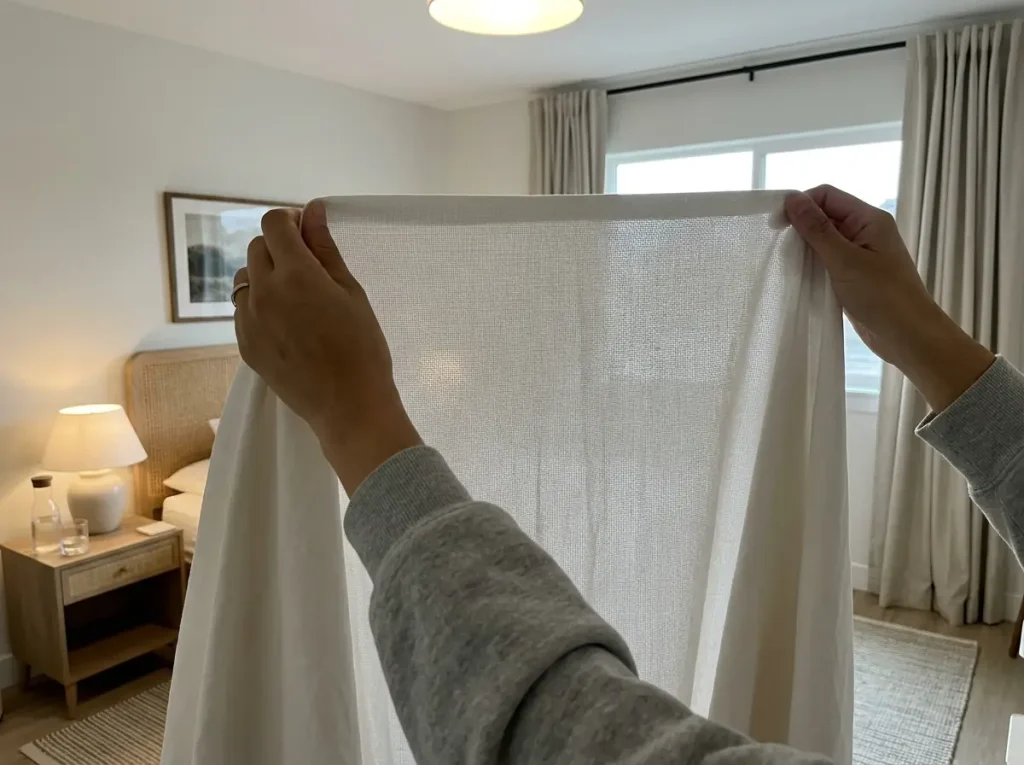
You can see this without a lab, and it is the reason staple length is what actually decides a cotton sheet. Take a set you have owned a season and hold it up between you and a lamp.
A short-staple sheet has a faint haze across the surface, a fuzz of raised ends, thickest where a shoulder or a seat sits. A long-staple one still reads even. That haze is pilling that has not finished happening yet.
Do the lamp test on the sheets already on your bed before you shop for new ones. Hold the fitted sheet up against a bare bulb and look across the surface at a shallow angle, not straight through it. The haze shows up at an angle and disappears head-on, which is why most people never notice their sheets are pilling until the pills are big enough to feel.
Rare Before Anybody Marks It Up
Cotton staple length is graded, and ELS — extra-long-staple, the fiber grade above long-staple, which is itself above the upland cotton in most sheets — is about 7% of world production, and American Pima on its own is somewhere between 3% and 5% of the US crop. The scarcity is real and it predates every marketing decision made about it. When a Pima sheet costs more than an unnamed cotton one, part of that gap is a supply curve, not a story.
It grows commercially in California, Arizona, far west Texas and New Mexico, and also in Peru and in Australia. Which means “Pima” on a tag does not even promise the cotton was grown in the United States. It promises a species. That is a smaller promise than most shoppers assume they are reading, and it is the gap the trademark exists to fill.
There is a thread on Styleforum where a poster describes years on the same Brooks Brothers Supima cotton oxford shirts: “profoundly durable,” with “a real heft to it,” and then the line that does the work, “the cloth goes on and on.” His measure of the end of a shirt’s life is the collar and cuffs fraying, not the fabric giving out. Another poster in the same thread reports throwing his through the washer and dryer, heat and all, dozens of times, with “little to no sign of wear.”
That is apparel, not bedding, and the distinction matters: oxford cloth is a different weave from a percale or a sateen and will not behave like one. What transfers is the fiber claim underneath, which is the same claim a Supima sheet tag makes.
What the Supima Trademark Actually Guarantees
Pima is the plant; Supima is the paperwork. And the paperwork turns out to be far more forensic than a word printed on a tag has any right to be.

A License, Not a Description
Supima is a trademark owned by the Supima Association, the nonprofit that has licensed the SUPIMA trademark since 1954. The name is a contraction of “Superior Pima.” Roughly 600 mills, manufacturers and brands hold a license to print it.
Two things follow from that. First, the mark requires US-grown Pima, which is precisely the origin claim the bare word “Pima” does not make. Second, a license can be lost, and something that can be lost has to be checked.
The checking is where this stops looking like marketing. Nobody on earth can tell a genuine Supima sheet from a well-made imitation by touch, and the trade knows it, which is why staple length verification here runs on DNA rather than on judgment. Supima uses FibreTyping, a DNA-based fiber testing method that identifies the cotton itself, alongside isotopic origin testing through Oritain that makes the crop traceable to where it grew, sampled at the yarn stage, the fabric stage and the finished good, to a stated 99.5% confidence.
A tag on a Supima pillowcase is downstream of a chain of physical tests on the cotton in it. Licensed cotton, in this system, means traceable cotton.
The mark is a licensed logo, not a word anyone can type. On a legitimate package it appears as the Supima trademark in the brand’s own product copy and on the sewn-in tag, and the brand can usually be found in the Association’s licensee listings. Written in lowercase in a bullet point, with no mark anywhere on the packaging, is how “supima-quality cotton” tries to ride along on a claim it does not hold.
Where the Audit Stops
Here is the part every page ranking for this question leaves out, and it is the part that decides whether you are happy with the sheet.
The trademark audits the fiber and where it grew. It certifies nothing else. Not the weave. Not the finish. Not the GSM, the grammage that tells you how heavy the cloth actually is. Not the thread count. Not the pocket depth. A licensed Supima sheet can be a genuinely bad sheet — badly woven, over-finished, cut too shallow for your mattress — and still be one hundred percent honestly labeled. It does not make the cotton organic either, which is a separate certification with a separate auditor (GOTS) covering a separate question. This is the same shape of argument as OEKO-TEX, where a certification covers exactly what it says it covers and stops there: the cloth gets tested, the cotton behind it does not, and reading the seal as a blanket verdict on the product is a category error people make with every certifying organization.
The proof this is real rather than theoretical is sitting in stores right now. Supima is sold in percale and in sateen, two fabrics that behave in opposite ways in a warm bed, one open and matte and one closed and smooth, under the identical fiber claim, with the identical mark. The label cannot tell them apart because the label was never about that.
The Tuft & Needle Supima Cotton Percale Sheet Set is a useful example of what a complete label looks like, because it declares the things the trademark does not cover: 100% Supima cotton, percale weave stated plainly, OEKO-TEX certified, 16-inch pocket. Fiber claim, construction facts, fit number, all on one listing, which is rarer than it should be. Its flaw is stock: this listing runs thin, and the only warning you get is the “only a few left” line that appears and then quietly does not.
The pocket depth is the clearest evidence that this is a fiber mark and nothing more. Supima-labeled sets ship at 14 inches and at 18 inches, and the tag reads “Supima” identically on both. The trademark buys you no information about whether the sheet fits your bed. You still measure the mattress with the topper on, like any other sheet, with a tape.
How the Label Lies Anyway
A trademark audited to 99.5% confidence still leaves two doors open on a store shelf, and both of them are perfectly legal.

Door One: “Supima Blend”
Under a 1997 FTC ruling, a product can be 100% cotton and contain some quantity of Pima or Supima fiber. But the moment the label or the marketing names “Pima” or “Supima,” the exact fiber-content percentages have to be disclosed. So “Supima blend” is not a vague flourish somebody added for warmth. It is a legal admission that the answer is less than one hundred percent, and the number is required to be printed somewhere on the package.
Find it. It is almost never on the front.
It lives on the back panel or the sewn-in care tag, in the fiber-content line, in the smallest type the printer could get away with, the same place the pocket depth hides. Turn the package over. That is the whole trick, and it takes about four seconds.
Door Two: Unlicensed “Pima”
Plain “Pima cotton,” with no Supima mark anywhere, has passed through zero audits. Any manufacturer can print the word if Pima fiber is present, with no percentage required, no origin verification, and nobody checking the yarn.
It is legal. It is also unverifiable by you, standing in an aisle. And it is not unique to this fiber, because the same trick runs on Egyptian cotton labels: one word, no auditor, and a price bracket built on top.
Unaudited is not the same as bad, and this is where most articles on this topic get lazy. The RT Designers Collection Modern Living 100% Pima Cotton Sheet Set is in this article precisely because it is a real, currently-sold, honest-looking example of exactly what door two looks like: 100% Pima on the box, no Supima mark, no third-party verification of any kind. It may well be perfectly good cotton. The point is that its flaw is an information flaw, not a quality one. “100% Pima” is literally the only thing a buyer can confirm about it, and nobody outside the manufacturer has checked even that. Whether that trade is fine depends on what you are paying and what you were told you were buying.
The Four Checks, in Order
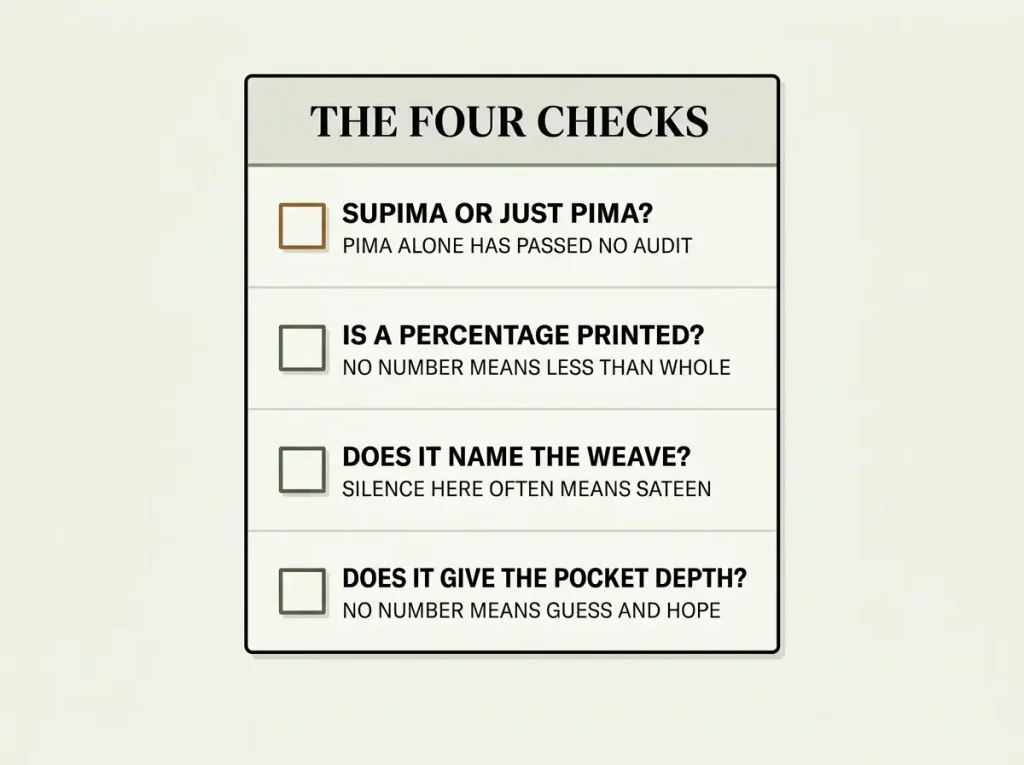
You do not need to memorize any of the above to use it. In a store, on a package, in order: does it say Supima or just Pima; is a percentage printed anywhere; does it name the weave, percale or sateen; does it give the pocket depth. Four things, ten seconds, and they answer different questions. The first two are about the fiber, the last two are about whether you will actually like sleeping on it.
One more thing that stacks on a Supima label without auditing it: the thread count. A big number printed next to the trademark is a completely separate claim, made by a different party, checked by nobody. The two do not validate each other, and thread count inflation above roughly 400 is usually reached by twisting thinner plies together and counting each one, so a single-ply 300 can be the better cloth.
If a package names a fiber and refuses to name a weave, treat the omission as the specification. A mill proud of its percale prints the word percale; a set that says only “premium Supima cotton, 800 thread count, silky soft” is describing a closed, heavy sateen without using the word, because the word would tell hot sleepers to put it down.
Whether the Premium Is Worth It on a Sheet
Everything above is about a fiber. A sheet is not a fiber. It is a fiber that has been spun, woven, finished, and washed twenty times before you have any honest opinion of it.
What the Money Actually Buys
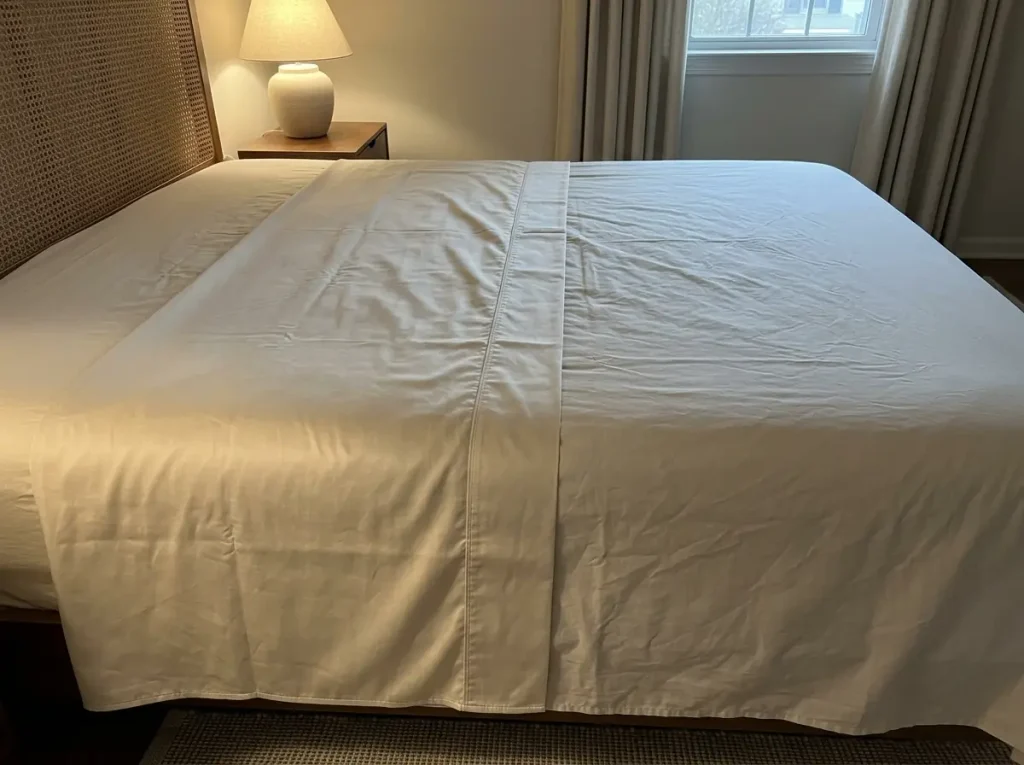
What the premium genuinely buys is a scarce fiber with a verified origin, plus the pilling resistance and color retention that come with staple length over years rather than weeks. That is not nothing. Independent lab testing puts a good cotton set at five to ten years, and attributes that durability to staple length rather than to any trademark, which is worth reading twice, because it means the physical benefit is available in unlicensed Pima too. What the mark adds is that somebody checked.
What the premium does not buy is how the sheet feels or how it sleeps. Breathability comes from the weave and the weight, not from the fiber’s pedigree, and a heavy resin finish can flatten good cotton into something papery until the finish washes out.
That is the weave, and the weave is what decides how a sheet sleeps: percale is one thread over, one under, which leaves gaps and reads matte and crisp; sateen floats four over one, which closes the surface and gives you the low sheen and the warmer hand. Same cotton. Opposite nights.
The ELINEN 100% Supima Cotton Sheets, 600 Thread Count makes that concrete better than any diagram: identical trademark to the percale set above, sateen weave, fits a mattress up to 18 inches. Two licensed Supima sets that feel nothing alike is the cleanest proof available that the fiber name is not the sleeping experience. Its flaw is stated on the tin — sateen has more sheen and more slip than percale, and if what you want is that dry, matte, cool hand, this weave will not give it to you no matter how good the cotton behind it is.
The Free Move First
Before any of this becomes a purchase: go read the tags on the two sheet sets already in your closet. Find the fiber-content line, the weave if it is named, and the pocket depth on each. Most people have never looked, and the comparison between the set you reach for and the set you avoid will tell you more about what you actually like than any label will. It costs nothing and it takes five minutes.
I would push back on one piece of standard advice here. The usual line is that you buy the best fiber you can afford and the rest sorts itself out. After enough sets where the fiber was the only honest thing on the package, I think it is backwards: get the weave right first, then buy the best fiber available in that weave. A wrong-weave Supima sheet is a wrong sheet with a good story.
And the fiber premium is often not the biggest line on the page. A licensed Supima set from a serious mill can land in the same bracket as a “regular” cotton set carrying a 1000-thread-count claim that is worse in every way that matters, because a thread count over 400 is counting plies, not threads. You can be paying a premium either way. Only one of the two premiums is attached to something a laboratory verified.
The Cotton Physics Still Apply
The trademark does not exempt the sheet from being cotton. It shrinks in the wash like any 100% cotton, which is why pocket-depth leeway matters more on an expensive set than a cheap one. You cannot re-buy the fit, and a set that fits at purchase and not at wash five is a set you resent. Measure the mattress with the topper on, add two inches, and buy to that number.
The care itself is unglamorous and it is the same for both tags. Wash temperature stays cool to warm, on a gentle cycle. Skip the chlorine bleach, which attacks the fiber directly and takes the colorfastness with it.
Tumble dry low, or line dry if you have the room. High heat damage is the one thing that undoes an extra-long-staple set faster than time does: it shrinks the weave unevenly and it makes the yarn brittle, and no amount of staple length or origin verification protects against a hot dryer run twice a week.
Two more, and they are the ones people skip. Fabric softener coats the fiber with a waxy film, which is why a set can feel wonderful for three washes and then feel like nothing at all — the softness you paid for in the staple length is sitting under a layer of something else. And a mild detergent beats a strong one here: the long fibers do not need help, and enzyme-heavy formulas work on the cotton as readily as on whatever you spilled.
None of that is special treatment. It is what any good cotton sheet wants, and the premium tag does not change a line of it.
Conclusion
Supima vs Pima comes down to one thing: every Supima is Pima, and not every Pima is Supima. The difference is an audit, not a different plant, and not a different grade of cotton quality in any measurable sense. DNA and isotope testing at the yarn, the fabric and the finished good is a genuinely serious chain of custody for a word on a tag.
The mark certifies the fiber and its origin, and it certifies nothing about the weave, the finish, the thread count or the fit. Those four you check yourself, on the back of the package, in the small type. And “Supima blend” means less than 100% by law, with the percentage required to be printed somewhere. Turn the box over and find the number.
The wash-twenty check, because week one lies: after a season of washes, hold the sheet up against a lamp at a shallow angle. A long-staple set still reads flat. A short-staple one carries a faint haze of raised fiber ends across the shoulders and the seat, and that haze is pilling beginning. It is the one thing the fiber premium is actually buying you, and it is invisible in week one, which is exactly why week one is a bad time to form an opinion.
Go read the tags on the two sets already in your closet tonight: fiber content, weave, pocket depth. Then work out whether you have a fiber problem or a weave problem. They are not the same problem, and only one of them gets fixed by paying more for cotton.
Frequently Asked Questions
01Is Pima better than Supima?
No, because Supima is Pima: the same extra-long-staple species, grown in the United States and verified by DNA and origin testing. Pima without the mark is the same plant with nobody checking it. The fiber can be just as good; the claim is not checkable.
02What are the disadvantages of Supima cotton?
It costs more, it wrinkles like any cotton, and the name tells you nothing about the weave, the finish or the pocket depth. A Supima sheet can still be the wrong sheet for you: too warm, too shiny, or two inches too shallow for your mattress.
03Will 100% Supima cotton shrink?
Yes, like any 100% cotton. The trademark audits the fiber, not the physics. Buy a couple of inches of pocket-depth leeway over your measured mattress, wash cool to warm on gentle, skip chlorine bleach and tumble on low.
04Is Pima cotton better than 100% cotton?
“100% cotton” says nothing about which cotton, and unnamed cotton is almost always short-staple upland. Pima is a specific extra-long-staple variety, so it usually outlasts and out-wears an unnamed 100% cotton set of the same construction.
05Does a “Supima blend” sheet still count as Supima?
Only partly, and the package has to say how much. Once the word Supima appears in the labeling or marketing, the FTC requires the exact fiber percentage to be disclosed. If you cannot find a number on the back panel or the care tag, keep looking.





Tried it on your own bed?
No comments yet. Tell us what you changed, and what the sheet did after a few washes.