







What’s in here7 sections
- The Honest Range, and the Number It Depends On
- Why Linen Outlasts Cotton (It Gets Stronger Wet)
- What Actually Fails First (and the Blend That Fails Fastest)
- The Four Habits That Decide Which End of the Range You Get
- Wearing In or Wearing Out — How to Tell at Wash Twenty
- The Bottom Line
- Frequently Asked Questions
On r/BuyItForLife, a community whose entire premise is buying things once, somebody had to ask whether anyone’s linen sheets had actually lasted more than five years. It was a real question, not a rhetorical one, and one of the most upvoted replies was a flat rejection: linen is “more expensive, less soft, and much less durable than high quality long staple cotton sheets.” Meanwhile every brand page selling linen says decades, heirloom, generations.
Both sides are describing something true, because flax is a stronger thread than cotton before either one gets wet, and it is one of the only fibers that gets stronger wet instead of weaker. The disagreement is really about the break-in period, and about a weight nobody checked.
So how long linen sheets last is not one number. It depends on a spec printed on maybe half the boxes in the category, and this article gives you the real range by weight, why the fiber outlives cotton, what tears first, what quietly shortens it, and how to tell wearing in from wearing out.
Quick Answer
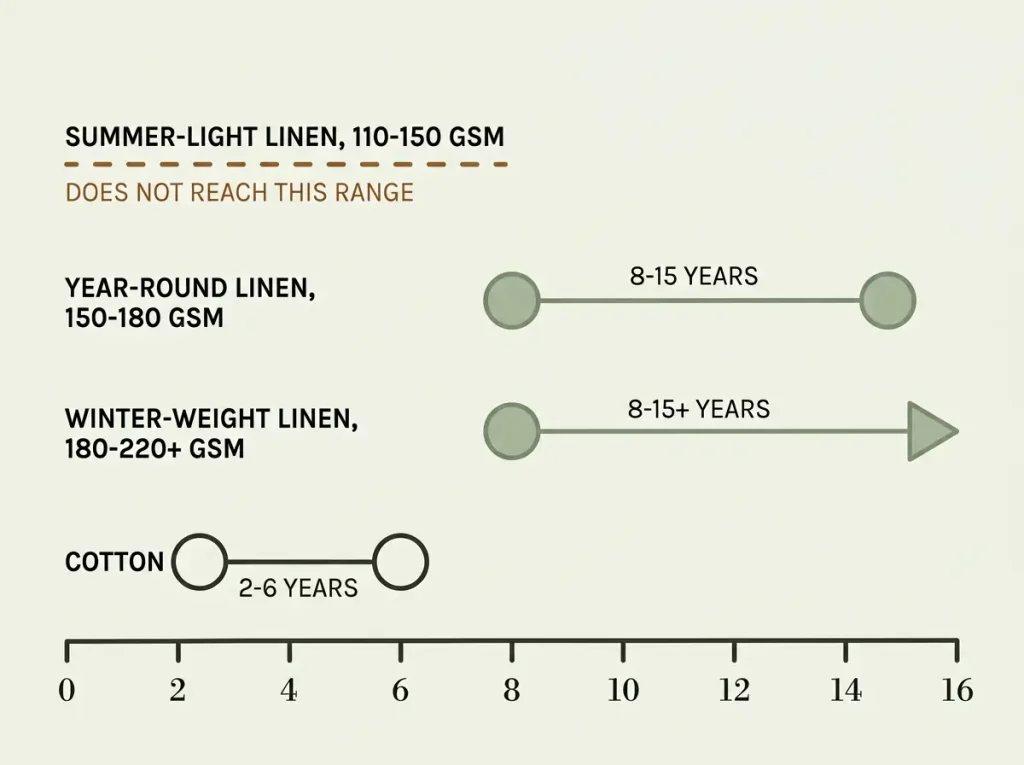
At 150 GSM and above, with cool washes and no dryer heat, linen sheets last roughly 8 to 15 years against cotton’s 2 to 6. Below 150 GSM, none of that applies: a thin set behaves like the cheap cotton it is priced above, and no care routine rescues it.
The Honest Range, and the Number It Depends On
The decades claim is not invented. It is just quoted without its condition, and the condition is a number most linen brands never print on the box. Grammage, written GSM, is grams per square meter of cloth. It is the closest thing this category has to an honest spec, and it predicts lifespan better than the country the flax grew in, the brand’s founding story, or the price.
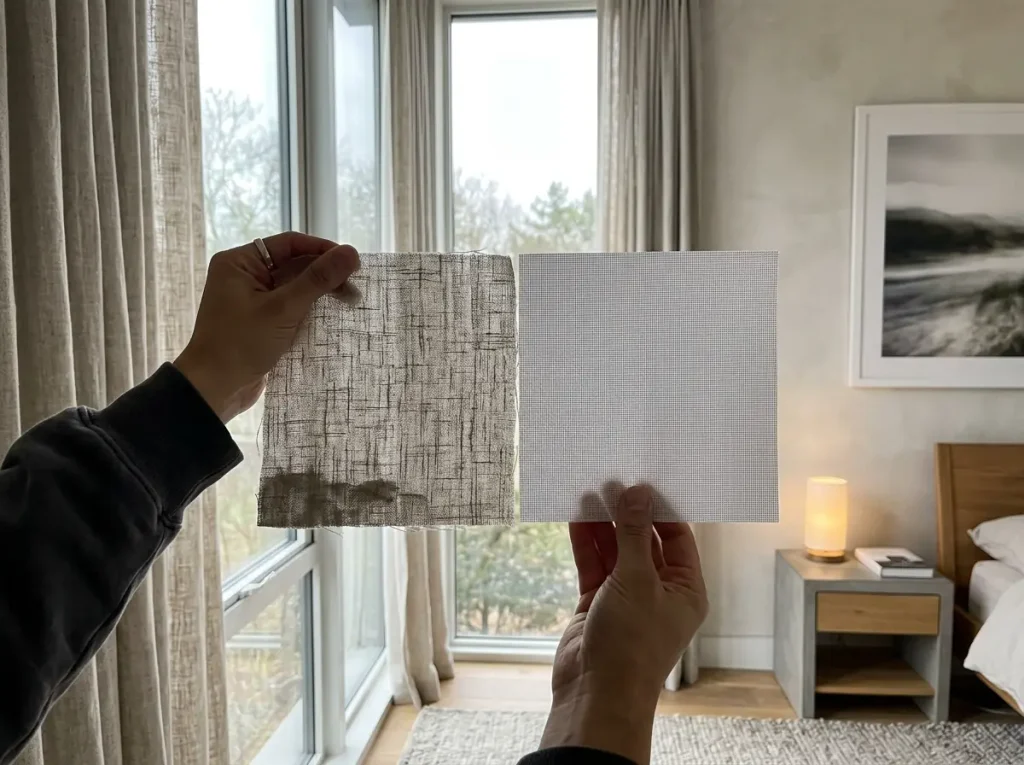
The bands are simple enough to memorize. Between 110 and 150 GSM you have summer-light linen, thin enough to see the weave against a lamp. From 150 to 180 is the year-round weight, and the Linen pillar makes the case that a set is only above 180 GSM really worth the premium for nightly, all-season use. Above 180 and into the 220s you are into winter weight, heavy in the hand and slow off the line.
Those bands are really a statement about years of use rather than about season. A 120 GSM set was never built for ten years of nightly use, and it will not deliver them no matter how carefully it is washed.
Here is the part the marketing pages skip. One maker of 165 to 175 GSM pure-flax stonewashed sets puts its own honest figure at five to ten-plus years of regular use, with plenty of owners going longer. That is a seller volunteering a number well below the twenty years its own category advertises. The r/BuyItForLife figure for carefully treated Eastern European linen lands in the same territory: five-plus years of daily use, and the people reporting it treat that as hard-won rather than automatic.
Set that against cotton’s usual 2 to 6 year band and the gap is real, even at linen’s low end. But it is a gap of years, not of generations.
So the floor matters more than the ceiling. Below roughly 150 GSM, stop expecting the 8 to 15 year figure regardless of what the fiber content says. And most linen boxes do not print GSM at all, which is its own tell: a maker who has a 175 on the label puts it on the label. A set that omits the number is usually omitting it because the number is low.
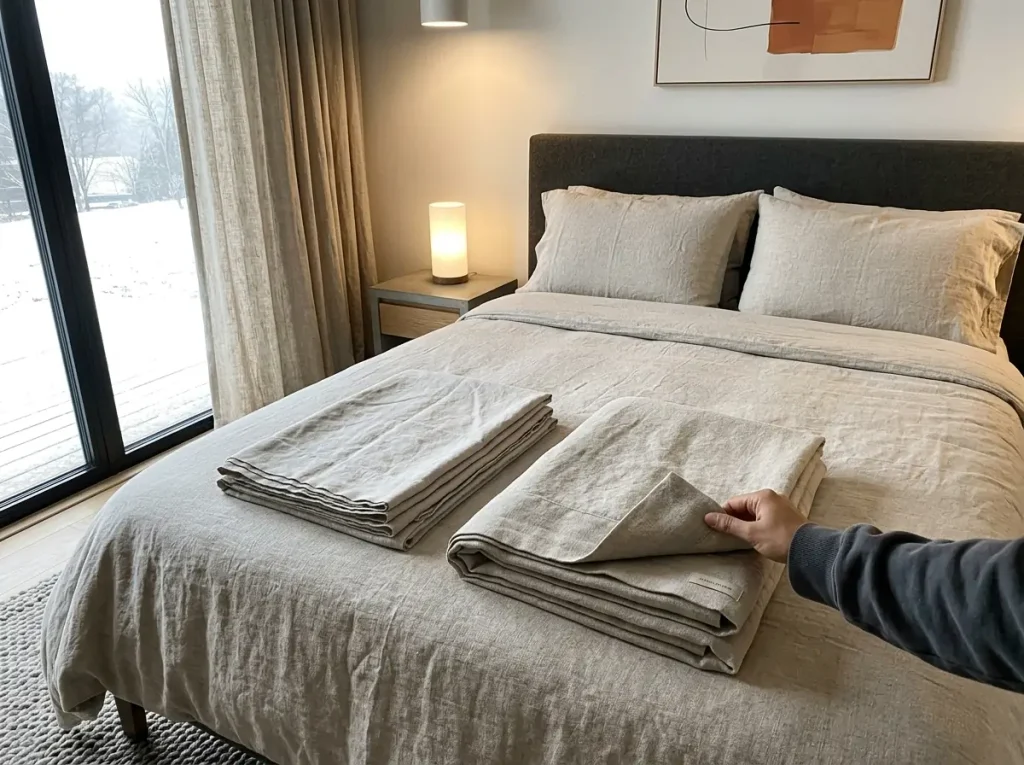
The cruder version of the same test works in a shop with your hands. Lift the folded set. Heavy is the answer. A pre-washed or stonewashed set will feel softer than its weight suggests, so judge it by the heft and not by the hand.
The DAPU 100% French Linen Sheets are the checkable example of that band on a real box, because they declare 170 GSM in the listing, which is exactly inside the 165 to 175 range the sources tie to the five-to-ten-plus year figure, and they are 100% French flax rather than a mix. At 170 GSM it is still linen, though, which means the first several washes feel like sleeping on canvas before the hand relaxes, and the 16-inch pocket is tight on a tall mattress with a thick protector on it. Weight is also the reason linen costs what it does, and what you are paying for at that weight is more flax per square meter, not more brand.
If the listing does not print GSM, search the page for the shipping weight instead. A queen flat sheet plus fitted plus two pillowcases in the 150 to 180 band lands near five to six pounds; a set that ships at three is thin, whatever the copy says.
Why Linen Outlasts Cotton (It Gets Stronger Wet)
Bands are only worth trusting if the mechanism behind them holds up, and this one is strange enough that it explains both the durability and the reason a new linen sheet feels wrong for the first month. It starts with the thread itself. Dry flax runs roughly five to six times the tensile strength of dry cotton, around 1,500 MPa against cotton’s 300 in one comparison, and a peer-reviewed comparison of flax fiber’s tensile strength gives a range of 264 to 2,000 MPa depending on how the flax was retted and processed. Wide range, but the floor of it is still cotton’s ceiling.
Then comes the reversal that actually decides the lifespan. Wet flax gains roughly 20% strength. Wet cotton loses roughly 20%. Read that again with a washing machine in mind: every wash cycle is the moment your cotton sheet is at its weakest and your linen sheet is at its strongest, tumbling against a drum for forty minutes.
Multiply that by a wash count in the hundreds and the two fibers are not on the same curve at all.
That is also why cotton’s own lifespan runs on staple length more than on anything you do in the laundry room: a good long-staple set reaches six years and a short-staple one gives up at two, and no wash routine moves either very far.
Two more fiber properties finish the picture, both from the Alliance for European Flax-Linen & Hemp’s own fiber-performance research. Flax cellulose is more crystalline than cotton’s, which gives it very low elongation, 2.7 to 3.5%. That is why linen does not stretch out of shape the way a tired cotton fitted sheet does, where the elastic still grips but the cloth itself has gone baggy across the top panel. And flax carries high moisture regain, 10 to 12%, so it moves moisture through the weave rather than holding it against you.
None of this is a slogan invented by a seller either. AATCC test methods TM 196 and TM 220 exist specifically to measure the force needed to rupture a fabric, so “stronger” here is a number a textile lab reproduces on a machine. Worth knowing what that does and does not cover: an OEKO-TEX tag on the same set certifies what the cloth was treated with, not how long it will last.
This is also why the two fibers behave in opposite ways in the first month, and why so many people give up on linen before it has started. Cotton is at its most flattering on night one and declines from there. Linen is at its most awkward on night one and improves for the next two or three years.
The community shorthand for it is that linen wears in while cotton wears out. Week one flatters cotton and punishes linen, and week one is exactly when most people form their opinion of a set they will own for a decade.
What Actually Fails First (and the Blend That Fails Fastest)
Everything above assumes the set is what the label says it is. And the loudest failures in the community threads are not slow, honorable wear at all. They are sets that tore inside a year, from people who had paid linen money for them.
Start with the trap that catches the most people: the word linen on a label can legally describe a blend. A cotton-linen mix is sold as linen, priced somewhere near linen, and then behaves like the weaker fiber in it, which is always the cotton. The Reddit set that thinned to holes in roughly eighteen months and became a cautionary tale about linen was a cotton-linen blend. It did what a mid-grade cotton sheet does on schedule.
None of the four brand blogs ranking for this question names the blend problem at all, which is understandable, since three of them sell linen and the fourth sells bedding generally. But it is the single most useful thing to check before you check anything else.
A good name is not a substitute for the fiber content either. Community reports include a mid-market DTC brand’s fitted sheet tearing after about a year of normal use, and another poster’s sheets from a maker that community generally rates well tearing in under a year. The pattern in the three-star reviews is consistent: people who expected the marketing lifespan and got twelve to eighteen months, almost always on a blend or on a set under 140 GSM. Two variables, both printed on the label, both routinely unread.
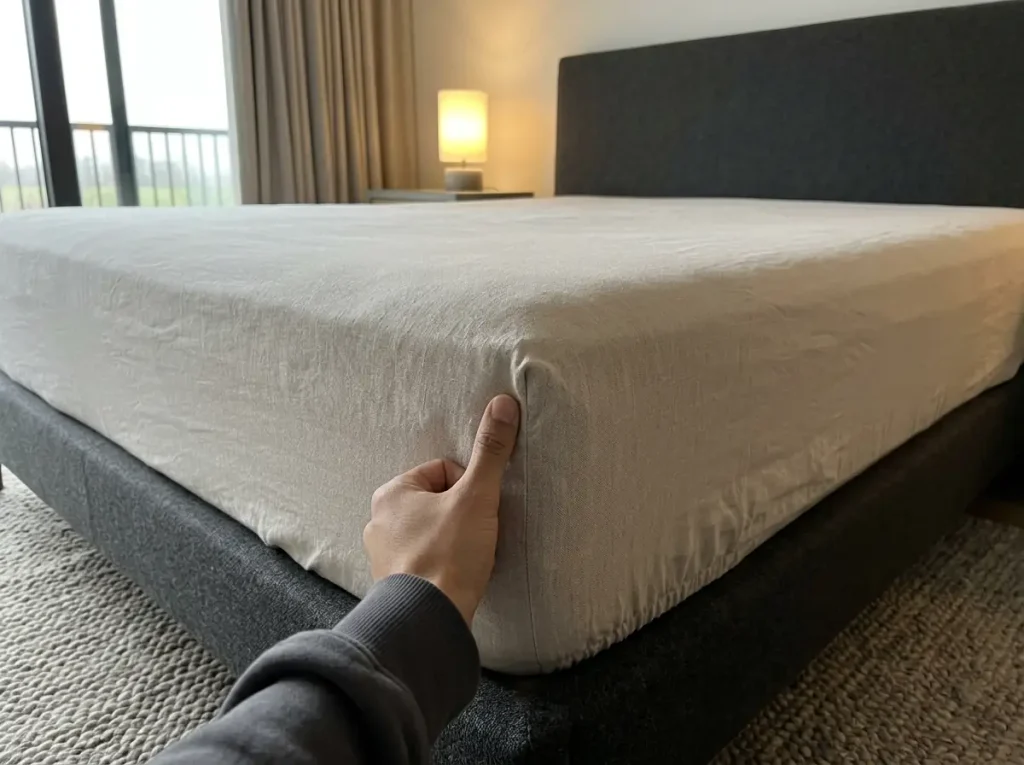
When a genuine 100% linen set does eventually go, it goes in a predictable order, and the fitted sheet goes first. It is the piece under permanent tension, stretched over a mattress and re-stretched every time the bed is made, and it fails at the corners rather than in the middle. Corners are where the whole force of that stretch concentrates on a seam.
This is where a deep pocket and a full-perimeter elastic stop being a comfort feature and start being a durability one: a sheet that actually reaches around the mattress is not being yanked at four points every morning, which is why the DAPU set’s 360-degree elastic and 16-inch pocket matter more here than they do in a comfort review, with the same caveat as before about a tall mattress plus a thick protector. Second to fail is the panel at the foot of the bed, from friction against feet and from being the stretch a top sheet stops protecting once it gets kicked off at two in the morning. Fraying along that hem, and at the corner seams, is the earliest visible warning either place gives you, which is why seam reinforcement on a fitted sheet is worth more than another twenty grams of cloth.
The duvet cover, for what it is worth, outlives both by years: it carries no tension and no feet. Compare two weaves instead of two fibers and you get the same argument by construction rather than by fiber, landing in the same corners.
Rotate the fitted sheet 180 degrees every few months so the head-end corners take a turn at the foot. The corners that carry your shoulder and the corners you sit on to put shoes on are not the same two, and swapping them buys the piece that fails first another season or two.
So the two failures that get blamed on linen are almost never the fiber. They are the fiber content and the weight, and both are printed on the label next to the number everyone reads instead. Thread count is the one that gets the attention, and on a plain-weave linen it tells you close to nothing about how long the set will live, which is the whole case for treating GSM as the number that actually predicts anything.
The Four Habits That Decide Which End of the Range You Get
Fiber content and weight set the ceiling. What happens in the machine every week decides how close a set actually gets to it, and every one of the four habits that matter is free.
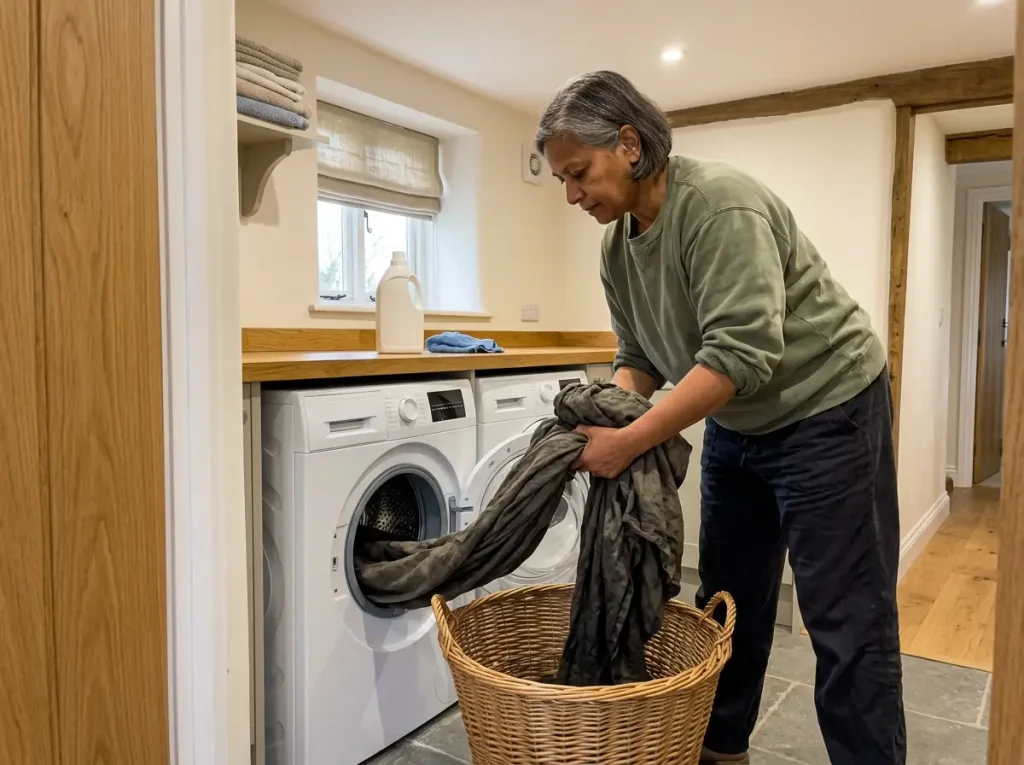
- Wash cool or warm, never hot. A cold wash or anything up to about 40°C, 104°F, and no higher. Hot water is the single most common self-inflicted cost to a set’s lifespan, and it buys nothing on bedding that gets washed weekly anyway.
- No bleach and no fabric softener. Bleach attacks the fiber directly. Softener does something more insidious: it coats the flax, and the coating defeats the moisture regain that makes linen work as bedding in the first place.
- Line dry, or tumble dry low and take it out slightly damp. A hot dryer is what turns ordinary creases into set creases and cooks the fiber over hundreds of cycles. Pulling it out damp is also what twenty washes change about the creasing, which is a different article’s argument reaching the same drying rack.
- Rotate two sets. Halving the wash frequency on each set roughly doubles the calendar life of both. That is arithmetic, not a trick, and it is the cheapest extension available to anyone.
The softener rule is the one people break with the best intentions, so it deserves the extra sentence. Linen feels rough early, softener makes it feel better immediately, and it does that by coating the exact fiber that was going to soften on its own by wash twenty. You pay for a temporary improvement with the permanent one.
If you want to replace bleach and softener with something rather than just removing them, a Seventh Generation Concentrated Laundry Detergent, Free & Clear does the job because of what it leaves out rather than anything it adds: no bleach, no fragrance, no softening agents. Be clear about what that is, though. It is a plain gentle detergent, not a linen formula, and there is no flax-specific chemistry in the bottle. The merit is the absence.
One more variable is bought rather than done, and it happens before the set ever reaches you. Genuine stonewashing or enzyme-washing softens linen without weakening the fiber, which is why a good stonewashed set skips the canvas phase without paying for it later. Harsh versions of the same process are described by community posters as stripping five years of life out of a set before the first night. The word stonewashed on a label does not tell you which one you got.
Certification is the only outside check available: the Sijo Stone Washed Organic French Linen Bed Sheet Set is GOTS certified, which audits how the fiber and the finish were processed, not just what the fiber is. Honestly, a certification tells you the process was inspected, not that the set will feel softer than an uncertified one, and genuine stonewashing still is not something you can read off the word alone.
Wash linen alone, or with other linen. A zipper or a bra hook running loose in the same drum for forty minutes does more visible damage to a flax weave in one cycle than a year of correct washing undoes, and the snag it leaves at a fitted-sheet corner is where the first run starts.
Wearing In or Wearing Out — How to Tell at Wash Twenty
Both curves feel like change in the hand, which is the whole problem. One of them means the set is finally arriving. The other means it is leaving. And they arrive at roughly the same point on the calendar, somewhere around the twentieth wash, which is when people start guessing.
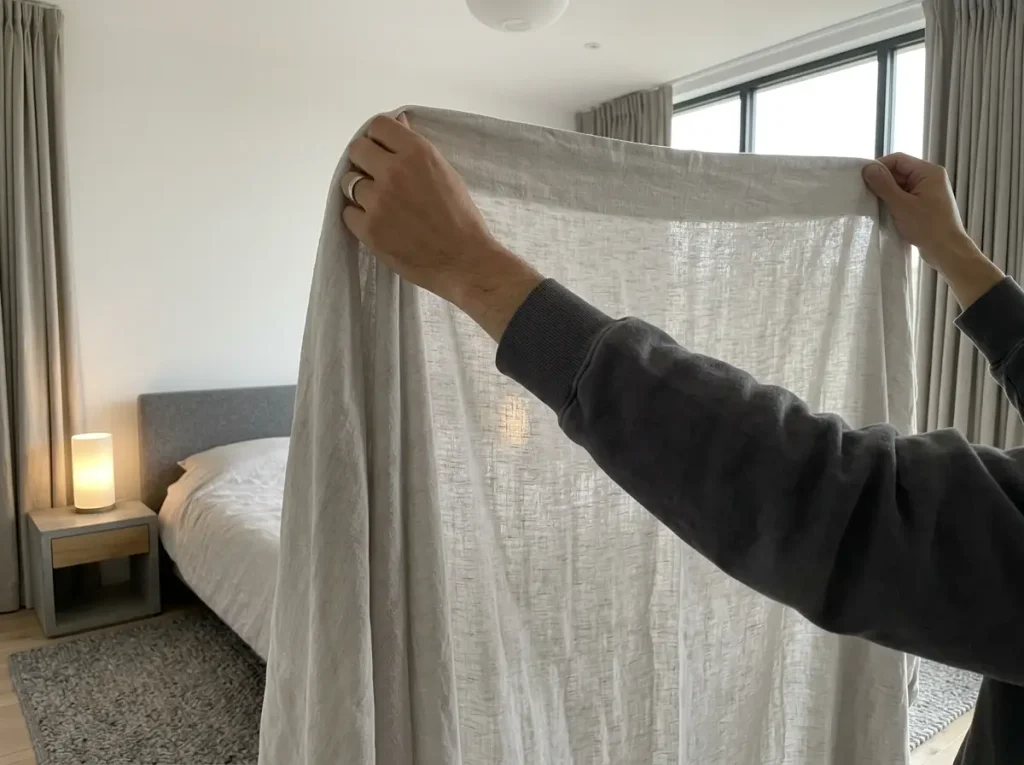
Wearing in has a specific signature. The hand softens while the cloth stays opaque. The drape improves, so the flat sheet starts falling into folds instead of standing in them, and the creases go from stiff to soft without going away, because they never go away. Elastic recovery holds too, so the fitted sheet still snaps back over the corners instead of sagging.
Most usefully, the weight in the hand is unchanged. That softened drape is also the reason an aged set does something a new one cannot in cold weather: a broken-in linen follows the sleeper instead of tenting over them.
Wearing out looks different in every one of those places. The cloth goes translucent held up to a window, first at the foot panel and the fitted-sheet corners. The weave opens rather than the fiber softening, so small pulls turn into runs instead of staying as snags. And the set feels lighter than it used to, because it genuinely is.
The window test is the honest one and takes ten seconds: hold the flat sheet up to daylight. A set that still reads solid at wash twenty is a set at the start of its life, not near the end of it.
People retire linen far too early, and always for the same reason: they judge it against week one’s stiffness, decide the softness means it is going, and replace something that had just finished becoming what they paid for. The extreme version of that curve is heirloom linen, the vintage household sets that survived generations by being mended and repurposed as they thinned rather than thrown out. That is what wears in actually means, taken to its limit, and it is why linen has a replacement cycle measured against cotton’s rather than against a warranty.
One failure has nothing to do with wear at all: damp storage. A set folded away before it is fully dry will grow mildew in a closet. Mildew stains the fiber permanently, long before the weave gives out.
When a modern set genuinely is done, the fix is usually partial: if the corner is the only failure, mend the fitted sheet or replace that one piece, since it is the part that dies first and the flat sheet and pillowcases are typically years behind it. Retire the whole set when the panels go translucent.
Ten to fifteen years across a set also reads as a very different annual cost than a cotton set replaced three times in the same window, which is how that lifespan reads as cost per year against another fiber once you do the division.
The Bottom Line
The honest range for linen sheets is 8 to 15+ years at 150 GSM and above, against cotton’s 2 to 6, and under 150 GSM none of it applies no matter how the set is treated. Check the fiber content before you look at anything else, because a linen label can cover a blend and a blend fails like its weakest fiber, usually inside two years. Then wash cool, skip the bleach and the softener, dry low or on a line, and rotate two sets if you can, because those four free habits are what decide which end of the band you actually land on.
After a season of washes, hold the flat sheet up to a window. If it still reads opaque and the weave is closed at the fitted-sheet corners, the softness you are feeling is the set arriving, not leaving, and you have most of a decade in front of you.
Go and find the fiber content on the set you already own, usually on a tag at the corner of the fitted sheet. If it says 100% linen and the cloth still blocks the window, stop worrying about the lifespan and start washing it cooler.
Frequently Asked Questions
01How often should I replace linen sheets?
Replace them when the panels read translucent against a window or the weave opens at the fitted-sheet corners, typically 8 to 15 years at 150 GSM and above. Softening on its own is never a reason to replace anything.
02What are the disadvantages of linen bedding?
It costs more up front, it never looks pressed, and it feels stiff for the first several washes. The stiffness is temporary and the wrinkling is permanent, which is the honest trade for the lifespan.
03Are 100% linen sheets worth it?
At 150 GSM and above the cost per year usually beats cotton, because the set lasts two to three times as long. Below that weight the premium buys you the wrinkles without buying the lifespan.
04How long do linen sheets last compared to cotton?
Roughly 8 to 15+ years against cotton’s 2 to 6. Flax gains about 20% strength when wet while cotton loses about 20%, so every wash cycle treats the two fibers in opposite directions.
05Do linen sheets get softer or thinner with washing?
Softer, and that is the difference from cotton. The hand relaxes while the cloth stays opaque. If it is getting thinner rather than softer, check the label, because it is likely a blend.




Tried it on your own bed?
No comments yet. Tell us what you changed, and what the sheet did after a few washes.