







What’s in here6 sections
You are standing in the aisle with a tag between your fingers. A leaf icon, the word organic printed in green, an OEKO-TEX logo on the corner of the package, and eight dollars between this set and the plain cotton one beside it. Nowhere on that tag is a number.
One of those two labels tests what is left in the cloth right now, on the finished item, against a published list of substances. The other certifies how the fiber was grown and every hand it passed through afterward. They are not two grades of the same check, and a sheet can carry either, both, or neither while printing the same reassuring green adjective on the front. Here is what each one actually measures, why a set can pass one and fail the other with no contradiction at all, and the thirty-second check that separates a real certificate from a word.
Quick Answer
No. OEKO-TEX tests the finished fabric for harmful substances; organic is a farming and processing claim, certified by GOTS at 95% organic fiber for “Organic” or 70% for “Made with Organic materials.” A sheet can carry either, both, or neither. A bare “organic” tag with no certificate number is an unverifiable adjective.
What OEKO-TEX Standard 100 Actually Tests
The label is doing something real and specific, and it is worth knowing exactly what, because what it does is also the reason it cannot answer the organic question. Standard 100 is a laboratory result on a finished object. A sample of the actual product goes to a lab, and OEKO-TEX Standard 100 tests the finished fabric against more than 1,000 substances: regulated azo dyes, formaldehyde, heavy metals like cadmium and lead, pentachlorophenol, phthalates, and the substances listed under REACH Annex XVII and XIV.
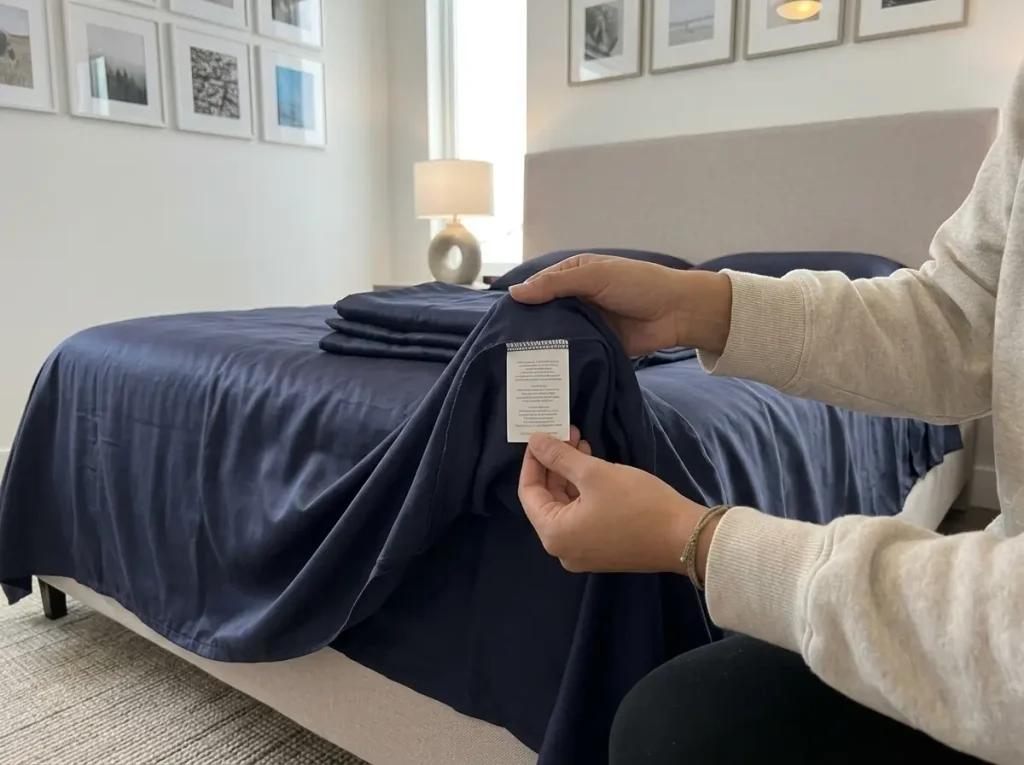
The scope is what catches people out: it is not a swatch of the face cloth. It covers every thread, every button, every zipper, the label sewn into the seam and the elastic in the hem of the fitted sheet. If a component is part of the item, it is part of the test.
That word finished is doing more work than it looks. The certificate describes the chemistry of the object in your hands at the moment it was tested. It has no opinion about the field the cotton grew in, whether anything was sprayed on that field, or what happened in the spinning mill.
A fully synthetic sheet, farmed conventionally in the sense that nothing about its raw material was ever audited, processed with entirely ordinary chemistry, will pass Standard 100 without difficulty as long as the chemical residue in the finished cloth sits under the limits. That is not a loophole. It is the standard doing precisely the job it was written to do.
Bedding sits in Product Class 2, which OEKO-TEX defines as products with direct skin contact. Product Class II, in the standard’s own numbering, is a stricter tier than Class 3, where jackets and outerwear live, and much stricter than Class 4, which covers curtains and upholstery.
It is not the strictest: Class 1, or Product Class I, covers items for babies under three years old, and its limits are tighter again on the assumption that the item will end up in a mouth. A sheet is against your skin for seven or eight hours a night, which is why Class 2 exists as its own tier, and it is worth knowing which one a seller is claiming before you accept the claim. If you want the full breakdown of what each tier permits, that is a topic of its own and there is a whole article on the classes and what each one covers.
The class number is the part nobody prints. A seller who has genuinely certified a set will put the product class and the certificate number in the listing, because it costs them nothing and it is the strongest thing they can say. A seller who is repeating a supplier’s claim prints the logo alone. “OEKO-TEX tested” with no class is an incomplete sentence, and incomplete sentences on a listing are usually incomplete on purpose.
The clearest way to see the split is a product whose own name argues with its own certificate. The ettitude 100% Lyocell from Organic Bamboo Sheet Set is 100 percent CleanBamboo lyocell in a sateen weave, made in a closed-loop solvent process, with a 17-inch pocket, and it carries OEKO-TEX Standard 100 Class 1, the baby tier, stricter than the Class 2 a sheet needs to clear.
Its flaw is printed on its own box: the name carries “Organic Bamboo” while the certification behind it is OEKO-TEX, not GOTS, so the word organic there is describing the plant the cellulose came from, not an audited farming chain anybody signed. That is not dishonest and it is not unusual. It is exactly the confusion this article exists to take apart, sitting on a set that is genuinely well certified for what it is certified for.
There is a thread on r/Bedding asking this same question, and what stands out is that the shoppers in it use OEKO-TEX, GOTS and organic interchangeably, as three brands of the same vague reassurance. One reply flattens all of it into a single verdict: organic is “simply a buzzword at this point.” That is a fair reaction to a shelf full of unverifiable adjectives, and it is also the exact moment the useful distinction gets thrown out with the marketing. Two of those three words point at real, auditable, publicly searchable processes. The third one, on its own, points at nothing.
So the practical read on OEKO-TEX is narrow and genuinely useful. It rules out the chemical-residue worry, which is the part most people are actually anxious about when they think about a fabric being against their skin all night. And it says nothing whatsoever about a farm.
What “Organic” Means, and Who Says So
The other tag is not a chemistry result at all. It is a claim about farming, and about every factory the fiber passed through afterward, and it only means something when a body has audited that chain and issued a number for it. Most people read organic on bedding the way they read it on a carton of eggs, as a regulated word with a government behind it. On textiles, the word by itself is regulated by nobody.

What does the work is GOTS, the Global Organic Textile Standard, and its labelling rules are unusually blunt about what may and may not be printed. There are two grades, and the difference between them is the number of fibers. The grade “Organic” requires a minimum of 95% certified organic fibers. The grade “Made with Organic materials” requires 70 to 94%.
Those are two different promises, and on a printed tag they occupy roughly the same amount of space in roughly the same typeface. GOTS’s own labelling rules spell out exactly which claims are allowed and which are not, including the exact wording each grade is permitted to use.
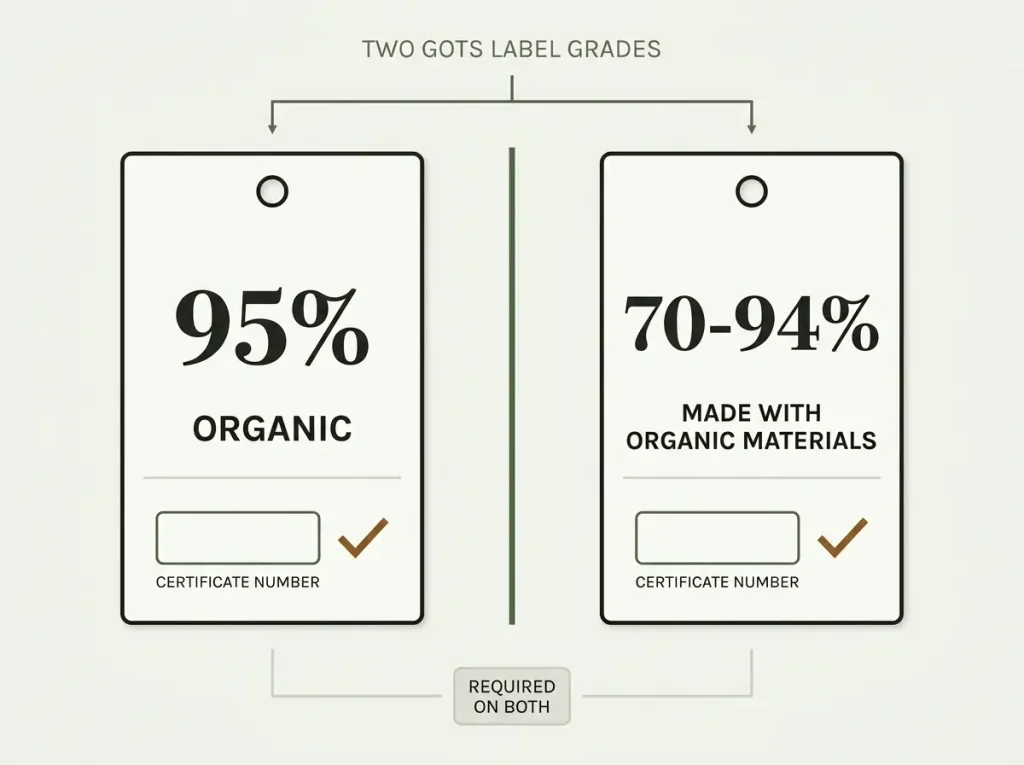
The 70% grade is the one that gets used, and the reason is arithmetic. Seventy percent is reachable with a blend; ninety-five is not.
So when a product page says made with organic cotton and never once says organic cotton on its own, that phrasing was chosen by somebody who knew the difference. It is not a stumble. It is the accurate description of a blend, written in the most flattering accurate way available.
And here is the part that undercuts nearly every bedding page on the subject, including the ones ranking above this one. GOTS lists “GOTS cotton” and “GOTS-certified organic cotton” as incorrect claims. Not sloppy, not informal, but explicitly not allowed.
The standard’s own rule reads: “GOTS is not an organic cotton standard. GOTS certification covers the processing of textile goods made with organic fibres, not raw cotton itself.” The certified fiber has to be certified organic first, by a separate accepted certifier, its farming audited for pesticides and GMO seed, before it can enter the GOTS chain at all.
GOTS then audits everything that happens to it afterward: the spinning, the dyeing, the finishing, the wastewater, the labor conditions. It is a chain-of-custody standard sitting on top of an organic-fiber certificate, not a replacement for one. Most writing on the subject treats the two as the same act, and it is the single most repeated error in the category.
There is a practical consequence to that layering, and it is the part that actually changes what you are buying. Because GOTS audits the processing and not just the field, it bans things at the mill stage that an organic-farming claim on its own never touches: APEOs, perfluorinated compounds (PFCs), chlorine bleach, formaldehyde, synthetic sizing agents, GMO enzymes.
So a set described as organic cotton with no GOTS chain behind it can be perfectly honest about the field and still have been bleached, sized and finished with chemistry nobody looked at. And the mirror image is the one that catches OEKO-TEX shoppers: a conventional cotton set with a valid Standard 100 certificate has been checked for what survived into the finished cloth, which is a genuinely different and genuinely useful question.
Neither one covers the other’s ground. That is the entire reason both certificates exist.
The traceability underneath is stronger than the paperwork phrase suggests. GOTS uses physical segregation and volume reconciliation rather than a mass-balance approximation, which in plain terms means the certified cotton is kept physically apart and the quantities are made to add up, instead of a percentage being averaged across an invoice. That is backed by satellite-based cotton monitoring developed with the European Space Agency, and the standard is referenced by the EU, the OECD, the UN and the USDA in their own procurement frameworks. This is not a seal a marketing department invented.
Read the exact phrase, not the vibe. “Organic” and “Made with Organic materials” are the only two wordings GOTS permits, and they mean 95% and 70% respectively. Anything else, whether that is “organic-based,” “natural organic cotton” or “made with GOTS-certified fabric,” is a sentence somebody wrote freehand, and freehand sentences are not audited by anyone.
One more correction, because it circulates constantly and it is wrong. GOTS is not cotton-only. The standard covers cotton, hemp, linen and flax, and jute among vegetable fibers, and wool, cashmere, mohair, alpaca and silk among animal ones.
A reader shopping for certified linen sheets is not hitting a wall built into the standard: the linen certification scope is there. They are hitting a market where most linen sellers have not bothered to certify, which is a completely different problem with a completely different meaning — more on that at the end.
For the shape of a tag that carries the strong grade, the Whisper Organics 100% Organic Cotton Sheet Set is the useful reference: 100 percent organic cotton, GOTS grade 95, with the certification body named on the listing as Control Union. That last detail is the whole point of naming it here, because a named certifying body is a thing you can go and check.
Its flaw is worth saying plainly: the premium is paid for the traceability, not for a different feel against the skin. It is a percale like any other percale, and it will sleep the way its weave and its weight say it will, not the way its certificate does. If you want both certifications set out side by side across the whole category rather than for this one question, that is what each of the two certifications covers across the whole category.
Both, One, or Neither — and How to Tell in Thirty Seconds
Because the two standards measure different things, all four combinations are real, all four are common, and the only way to know which one you are holding is to stop reading adjectives and start looking for a number.
| What the tag carries | What has been checked | What it still does not tell you |
|---|---|---|
| OEKO-TEX only | Residues in the finished item, every component, against the Class 2 limits | Nothing about farming, fiber origin or the processing chain |
| GOTS only | Organic fiber content at 95% or 70%, plus every mill in the chain, audited annually | Overlaps heavily on chemistry, but it is not an OEKO-TEX certificate |
| Both, with two numbers | Farming, the full chain, and the finished item’s chemistry. The strongest a bedding tag gets | Still nothing about hand, weight, drape or wash twenty |
| “Organic,” no number | Nothing. No body has signed anything | Read it as an uncertified set and judge it on fiber, weave and spec |
The free fix comes before any purchase, and it costs nothing but the thirty seconds in the title of this section. OEKO-TEX runs a public verification tool: you can check any OEKO-TEX certificate number directly in the official Label Check by typing in the label or certificate number, which is case-sensitive, or by scanning the QR code printed next to it.

It returns the certification status, the product scope it covers, and the expiry date. If the number returns nothing at all, OEKO-TEX’s own instruction is to contact them directly, which tells you how they expect that result to be read. GOTS runs the equivalent for its side: a public database of certified entities, searchable by the certified company’s own number.
Now the trick that no logo will ever warn you about, and it is not a conspiracy. It is written in the standard’s own rulebook. GOTS lists “Made with GOTS-certified fabric/yarn/other components” as an incorrect claim, and explains exactly why: if GOTS-certified fabric is sewn in an uncertified facility, the chain of custody is broken and the final product is not considered certified.
Read that again with a brand’s About page in mind. A company can say something completely true, along the lines of our fabric supplier is GOTS-certified, here is a photograph of the mill’s certificate, while the finished, cut, sewn, packaged set you are about to buy carries no valid certification of its own. Every company in the chain has to be certified independently, with annual on-site third-party audits and transaction certificates following the goods from one to the next. That is what supply chain traceability means when somebody has actually done it.
Which turns the question you should be asking into something very specific. Do not ask whether a brand is GOTS certified, because the honest answer to that can be shaped in several directions.
Ask for the Certification Number of the Certified Entity. The seller’s own number, the one that returns the seller’s own name in the certified entity database.
Label verification is the whole job, and it is a lookup, not a judgment call. A supplier’s certificate photographed and posted is evidence about the supplier. It is not evidence about the thing in the box.
It helps to know what a real lookup actually gives back, because the shape of the answer is what tells you the claim is genuine. A valid OEKO-TEX result returns the certified company’s name, the certificate number itself, the product scope the certificate covers, the product class, and the expiry date.
Note the scope field in particular: a certificate is issued against specific articles, so a company can hold a real, live certificate covering one product line while the item in your basket sits outside it. The GOTS side works the same way, with the certified entity’s name and the scope of what they are certified to produce. Neither lookup asks you to create an account, and neither takes longer than typing the number.
Certificates expire, and Label Check returns the expiry date along with the status. A listing photograph taken two years ago showing a logo on the packaging is evidence that a certificate existed once, not that it is live today. The date field is the one nobody looks at, and it is the one that quietly turns a real claim into a stale one.
The community rule that falls out of all this is the blunt one, and it is right: if a set is marketed as eco or sustainable and shows a logo with no certificate number anywhere on the listing, treat it as uncertified and buy it on its fiber, weave and spec merits instead. Not because the seller is necessarily lying, but because an unverifiable claim and no claim are worth exactly the same when you are standing there deciding. A reader working through this for a bamboo viscose set has a second layer to think about, since the processing chemistry is the whole question there, and that is covered in what an OEKO-TEX certificate proves for a viscose or bamboo product specifically.
Chemistry certification is also not a premium feature, and it is worth proving that with the cheapest thing on the shelf. The Linen Home 100% Cotton Percale Sheet Set is a 200-thread-count cotton percale with a 15-inch pocket, OEKO-TEX certified, and not marketed as organic at all. Its flaw, stated plainly: 200 threads of percale is a sound, plain sheet and not a lush one, and the certificate does not change the hand of the cloth by a single gram. What it does prove is that when a budget set carries no certification, that was a decision somebody made, not a price constraint they were trapped by.
And the same logic travels out of the sheet drawer, which is the part most people never think to apply. The Cuddledown Dreamstead Down Alternative Comforter has a 235-thread-count cotton percale shell over a synthetic fill at roughly 500 fill power equivalent, carrying OEKO-TEX Standard 100 on the finished item.
Its flaw is in the name: the fill is synthetic, not down, and the certificate confirms that the shell and the fill are clear of the listed substances. Not that the fill is down, and not that a single thing about it is organic. Ask the duvet covers, the protector and the pillow the same question you asked the sheets. Same tag, same number, same lookup.
There are other seals in the same aisle, and knowing which question each one answers stops you paying twice for the same reassurance. The Organic Content Standard (OCS) verifies how much certified organic fiber is in a product and tracks it through the chain, but it stops there: it says nothing about the dyeing, the wastewater treatment or the labor standards, which is precisely the ground GOTS adds on top. GREENGUARD and MADE SAFE are chemical-emissions and ingredient screens, closer in spirit to Standard 100 than to anything about farming. Fair Trade certification is about the people, not the fiber or the chemistry: prices paid to growers, working conditions, and the ILO conventions on child labor and forced labor that GOTS also folds into its own social criteria.
None of them is a substitute for another, and a package carrying three of them is not three times safer. It has answered three separate questions, and the useful move is to work out which question you were actually asking.
Where does that leave somebody buying for sensitive skin or for a household with allergies or asthma? On the chemistry side, and that means Standard 100 rather than an organic claim. Finished product testing is what tells you the residues in the cloth against your face are under a published limit. Organic farming is a claim about a field, and a field is a long way from the hem of a pillowcase.
That is also the shape of most greenwashing in this category, and it is rarely an outright lie. It is a true statement about the farm, or about a mill certification held by a supplier, presented where a reader will naturally read it as a claim about the finished set. The brand vs mill gap and the farm to fabric gap are the two seams it lives in, and the certificate number of the certified entity closes both of them in about thirty seconds.
What Neither Label Tells You
Both certificates are worth having, and both of them stop at the same place. Neither one has a word to say about whether the sheet will still be worth sleeping on next summer.
Neither standard measures hand, drape, how the cloth moves air, or how long it lasts. A certificate is a chemistry result or a chain-of-custody audit. It is not a quality grade, and reading it as one is exactly how a shopper ends up with a fully verified set they do not enjoy sleeping on.
This is the same misreading that happens to every label in the category. Egyptian on a cotton package gets treated as a quality tier when it is a geography claim, the same way a certificate gets treated as a quality tier when it is a compliance claim. If you want the full version of that particular unpicking, it is what “Egyptian” on a cotton label is actually claiming, and the whole question of whether a certified sheet is a better sheet has an article of its own.
Neither one predicts anything about a season of washes either. Certification does not degrade in the machine, which sounds like a feature and is actually the limitation: the certificate will be just as valid on the day the sheet starts pilling along the side you sleep on, the day the fitted sheet stops gripping the corner you sit on to put your shoes on, the day the softening finish finally rinses out and the cloth underneath turns out to be what you actually bought. None of that is in scope for either standard, and neither standard ever claimed it was.
What actually decides how a sheet sleeps is the same four things it always is. The weave: percale is one thread over, one under, which leaves gaps, and gaps move air; sateen floats four over one, which is smoother, heavier and closed.
The fiber: whether it takes moisture in or pushes it around. The weight, in grams per square meter, which almost nobody prints, so you learn it by lifting the set. And the finish, which is often what you are feeling in the store and is frequently gone by wash ten.
Two sets can both be OEKO-TEX Class 2, one a percale and one a sateen, and sleep completely differently. That is the whole argument in one sentence: the certificate was never the variable.
So the honest ranking of where to spend your attention goes like this. Get the fiber and the weave right for the way you actually sleep, because that is the decision that determines whether you like the bed.
Then use certification as a filter within that choice: among the percales that suit you, prefer the one with a number you can look up. Not as the choice itself. Whether the organic premium earns its keep once you have sorted the weave out is its own separate question, and there is a full answer on whether the organic premium is worth paying.
Which brings the linen point back around, because it changes what an absence means. GOTS covers flax explicitly. So when you find a linen listing with no certification number on it, that is not the standard declining to cover linen and it is not evidence of anything about the cloth. It is a market where sellers mostly have not bothered, and the fair response is to shrug and judge the linen on its weight, its weave and how it is finished, the way you would have anyway, which is most of linen sheets and what you get for the money.
The Short Version
OEKO-TEX tests what is left in the finished cloth, on every component, against a published substance list. GOTS certifies how the fiber was grown and every hand it passed through afterward, on top of a separate organic-fiber certificate that had to exist first. Neither implies the other, and a product can carry both, one, or neither.
The word organic with no certificate number and no “95%” or “70 to 94%” grade beside it is an adjective, not a claim. When you want to check one, ask for the certified entity’s own number, the seller’s own, searchable in the public database — and not a photograph of a supplier’s certificate, because a certified fabric sewn in an uncertified facility produces an uncertified product and the standard says so itself.
A certificate is a filter, not a verdict. Get the weave and the fiber right first, then use the number to choose between the sets that already suit the way you sleep.
After a season of washes, look at the corners of the fitted sheet and at the patch where your forearms rest. The certificate will still be perfectly valid, and it will not have prevented a single pill, which is the clearest evidence there is that the label was answering a different question all along.
Pull the tag on the set you already own tonight and look for a number. If there is one, spend the thirty seconds checking it. If there isn’t, you have just learned something about the last thing you bought, and rather more about what to ask before the next one.
Frequently Asked Questions
01Does OEKO-TEX mean no chemicals?
No. It means no residues above the published limits on a list of more than 1,000 harmful substances, tested on the finished item. Dyes and finishes are still used to make the cloth. The certificate is about what remains in the fabric against your skin, not about what was never used.
02Is OEKO-TEX or organic better?
Neither, because they answer different questions: one tests the finished fabric’s chemistry, the other certifies farming and the processing chain. A set carrying both is the strongest claim available. Which single one matters more depends on whether your concern is residues in the cloth or how the fiber was grown.
03Does organic mean OEKO-TEX certified?
No. Organic certification says nothing about whether the finished item was tested against OEKO-TEX limits, and the two are awarded by different bodies. GOTS does impose its own chemical requirements, so the overlap is real and substantial, but overlapping is not the same as holding the certificate.
04Is OEKO-TEX polyester bad?
Certified polyester has passed the same substance testing as certified cotton, because the label is about residues, not fiber type. How it sleeps is a separate question entirely, decided by fiber and weave. Polyester holds heat and moves moisture differently than cotton, and no certificate changes that.
05Can bedding be OEKO-TEX and GOTS certified at the same time?
Yes, and both numbers should be printed and checkable. It is the strongest combination a bedding tag can carry. It means the fiber’s farming and chain of custody have been audited and the finished item’s chemistry has been tested, by two separate bodies with two separate lookups.





Tried it on your own bed?
No comments yet. Tell us what you changed, and what the sheet did after a few washes.