







What’s in here7 sections
Someone in r/textiles posted about a blanket that had two labels on it. One said 100% recycled polyester. The other said the thing had been certified for harmful substances, and the poster’s reaction was the one most people have in that aisle: “seems shady.” It isn’t.
The tag was never contradicting the polyester, because it was never asked about the polyester in the first place. It was asked what came out of the dye bath and the finishing line on the finished blanket, and the answer was recorded on a certificate with a number.
OEKO-TEX Standard 100 is a chemistry result, and reading it as a verdict on the fiber is where every argument about it starts. Here is what it tests, which of its four tiers your bedding actually sits in, what it flatly refuses to promise, and the thirty seconds that tell you whether the number on the tag is real.
Quick Answer
OEKO-TEX Standard 100 certifies that a finished textile — every thread, dye, seam and button — tested clean of a list of more than 1,000 substances that could harm human health. It says nothing about the fiber’s quality, origin, or whether it is organic. Bedding sits in Product Class 2, direct and prolonged skin contact, the second-strictest of four.
What Standard 100 Actually Tests
The phrase printed on the box is “tested for harmful substances,” which is the vaguest possible way to say something quite specific. It is the whole of what textile safety means under this scheme: certified textiles are ones whose chemical residue was measured and came in under a threshold.
So start with the substances. The restricted substance list covers more than a thousand entries and gets reviewed and updated at least once a year. It opened in 1992 at roughly a hundred.
That growth matters more than the headline number, because a set certified this year was measured against a longer list than one certified five years ago, and the bar only moves in one direction.
What is on the list is not abstract. Formaldehyde, which is the chemistry behind most wrinkle-resistant and no-iron finishes. Heavy metals: lead, cadmium, mercury, arsenic, chromium VI, nickel.
Azo dyes, listed as azo colourants, which are fine sitting in a fabric and less fine when they break down into arylamines linked to cancer. PFAS, the compounds that make a stain-resistant coating work.
According to OEKO-TEX’s own product-class breakdown, those checks run across every component of the article, and the certifier means that literally: every thread, button and accessory. Component testing is the mechanism, and the finished object is the unit. The polyester thread that sewed the hem was tested. So was the elastic in the fitted corner.
The heavy metals get measured twice, and the second measurement is the one that gives the whole standard away. First, total content: how much is in the fabric. Then extraction: how much of it comes out into artificial sweat. A curtain never has to answer the second question.
A fitted sheet under a warm, slightly damp sleeper for eight hours does, and that difference is the reason bedding is graded on a different tier than the drapes hanging two feet away.
“Tested for” and “free of” are two different promises, and OEKO-TEX is the one that says so. Certifying to Standard 100 means the product was tested for PFAS against the threshold written into the standard. The certifier explicitly does not certify anything as PFAS-free. If a listing turns a Standard 100 tag into a “free of forever chemicals” claim, that wording came from the seller, not from the lab.
Then there is the rule that decides the title of this article. Hohenstein, one of the institutes that does the testing, states it without hedging: claims of certification on ingredients, such as “the fabric in this product is certified”, are not allowed. The unit is the finished article or it is nothing. A brand cannot certify the cotton and sew it into whatever it likes; the sewn, dyed, finished, buttoned thing is what goes to the lab, and a hangtag that tries to certify one ingredient of it is not a valid label.
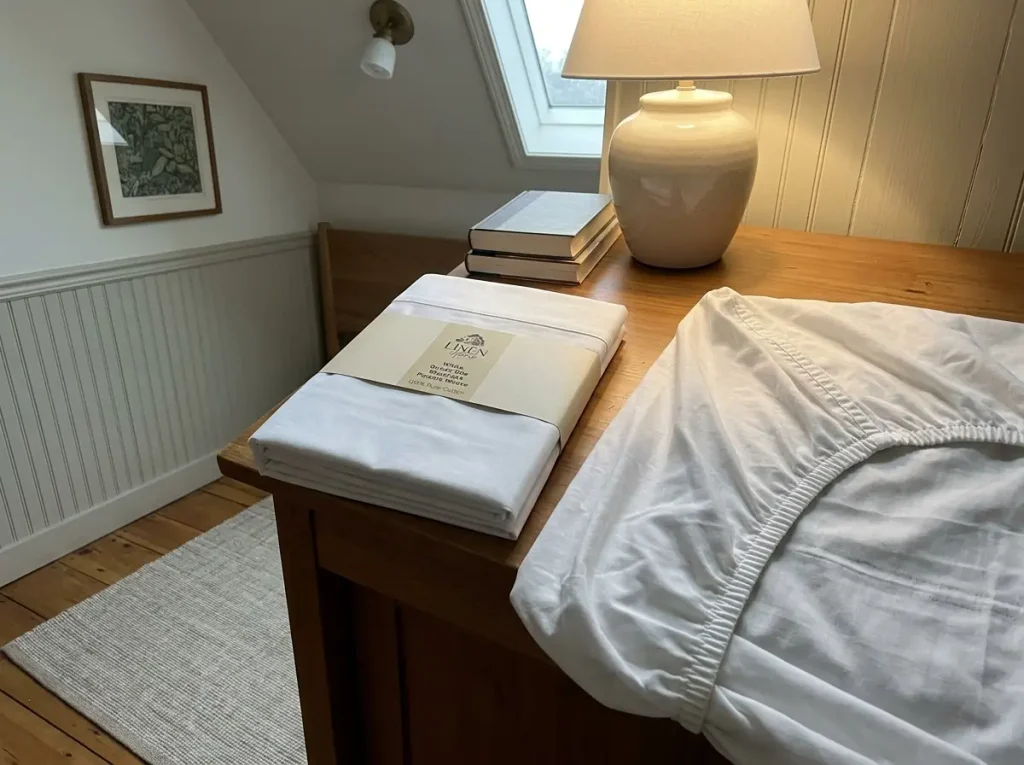
Which is also why the tag turns up at every price level, and it should. The Linen Home 100% Cotton Percale Sheet Set is a 200-thread-count single-ply cotton percale with a 15-inch pocket, sitting near the bottom of the ladder, and it carries the same Standard 100 claim as anything above it. Read that correctly: it is evidence the certificate is cheap to earn honestly, not evidence the sheet is good.
A 200-count single-ply percale is a basic percale, and it will not compete on hand or on durability with a long-staple set. The certificate is talking about chemistry, not about how the thing feels on a Tuesday.
The Four Classes, and Where Your Bed Sits
Not everything with a Standard 100 tag cleared the same bar, and the difference is nowhere on the package. It is decided by one thing: how much of the day the article spends against skin.

The tiers, in one pass
There are four, and they read as a ladder of exposure rather than a ladder of quality.
- Product class 1, articles for babies and toddlers up to three years. The strictest of the four.
- Product class 2, direct skin contact, prolonged. OEKO-TEX names bed linens here by name.
- Product class 3, little or no skin contact, like a jacket shell.
- Product class 4, decoration. Curtains, upholstery, tablecloths.
The skin contact tier is the only thing separating them.
Why the tier your sheets sit in is the second-strictest one
Here is the sentence nobody in the search results bothers to write: your sheets were held to a harder bar than the curtains hanging in the same room, and the only tier stricter than theirs exists for infants. That is not a marketing hierarchy. It is a description of the exposure.
A curtain is touched by a hand a few times a week. A fitted sheet spends seven or eight hours a night in contact with a warm, faintly damp sleeper, and that is a harder condition for a dye or a finish to survive without giving anything up. The extraction test from the last section is exactly where that difference gets paid.
And the class is about contact, never about the fiber. That is the first half of the answer to the recycled-polyester question, and it is worth holding onto for a few paragraphs: the tier a product is tested at is set by where it ends up on a person, not by what it is made of.
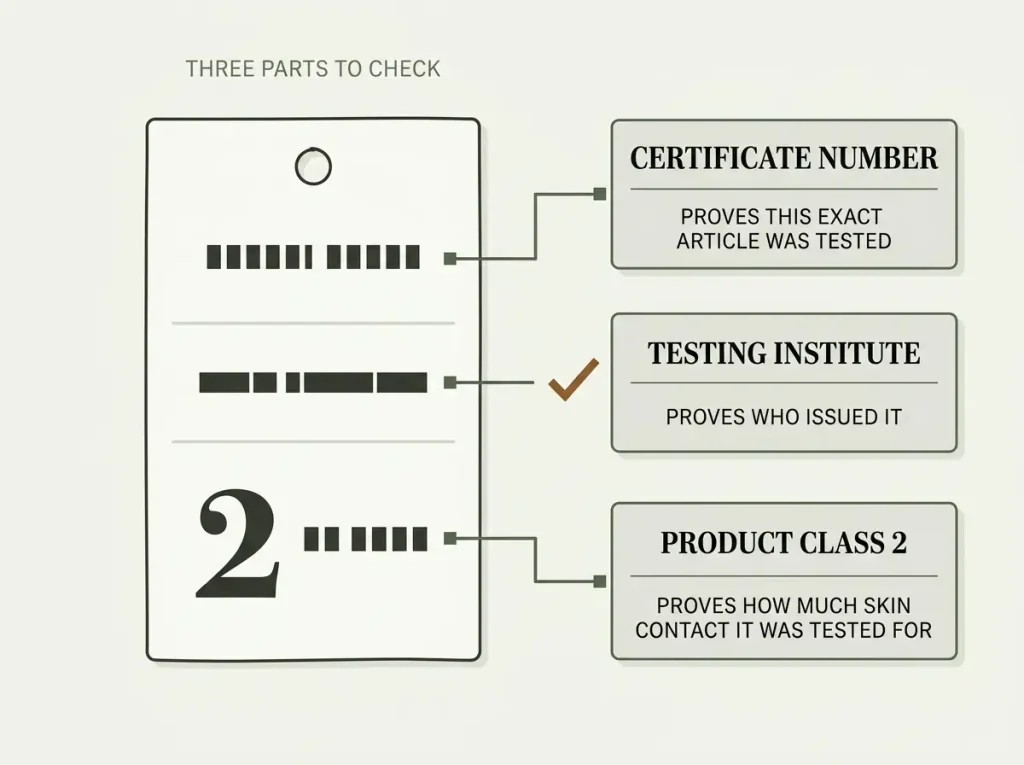
The class number is findable far more often than shoppers expect, and it is almost never in the headline. Look one line under the certificate number in the bullet list, or in the product-details table below the fold. It is the only part of the tag that is comparative: two sets can both be certified, and one of them can have cleared the tier above.
A set certified one tier higher than it needed to be
Some manufacturers certify to Class 1 even though bedding only has to clear Class 2, and when they do, they usually print it. The ettitude 100% Lyocell from Organic Bamboo Sheet Set is 100% CleanBamboo lyocell in a sateen weave with a 17-inch pocket, made through a closed-loop solvent process, and its listing names Class 1: the infant tier, on an adult sheet set. That is what “certified higher than required” looks like when it stops being a diagram and turns into a line on a listing you can read. One honest caveat: stock on this one runs thin and the listing has been sitting on a handful of units, so it can be gone between reading about it and deciding.
None of this tells you which certificate is the right one to care about for your own reasons, which is a different question with a longer answer, and the pillar on what OEKO-TEX and GOTS actually certify lays the whole map out.
What the Tag Refuses to Tell You
Everything so far is what the standard does, and it does it properly. The reason people misread the tag is that it looks like a quality mark. It grades nothing about the fabric at all.
Not a quality grade
Staple length, thread count, weave, GSM, how the set will feel in week one or week thirty: none of it is in the standard. Not measured, not scored, not mentioned. A Standard 100 tag on a scratchy short-staple blend is not a contradiction and not a scandal, because the label was never grading the cloth, it was screening it. Safety standard versus quality standard is the whole distinction, and the tag only ever claimed the first one.
This is the same trick thread count plays, a printed figure that means something real and narrow while shoppers read it as a general score. If what you actually want to know is whether an OEKO-TEX set is better made, that is its own question and the certificate does not answer it.
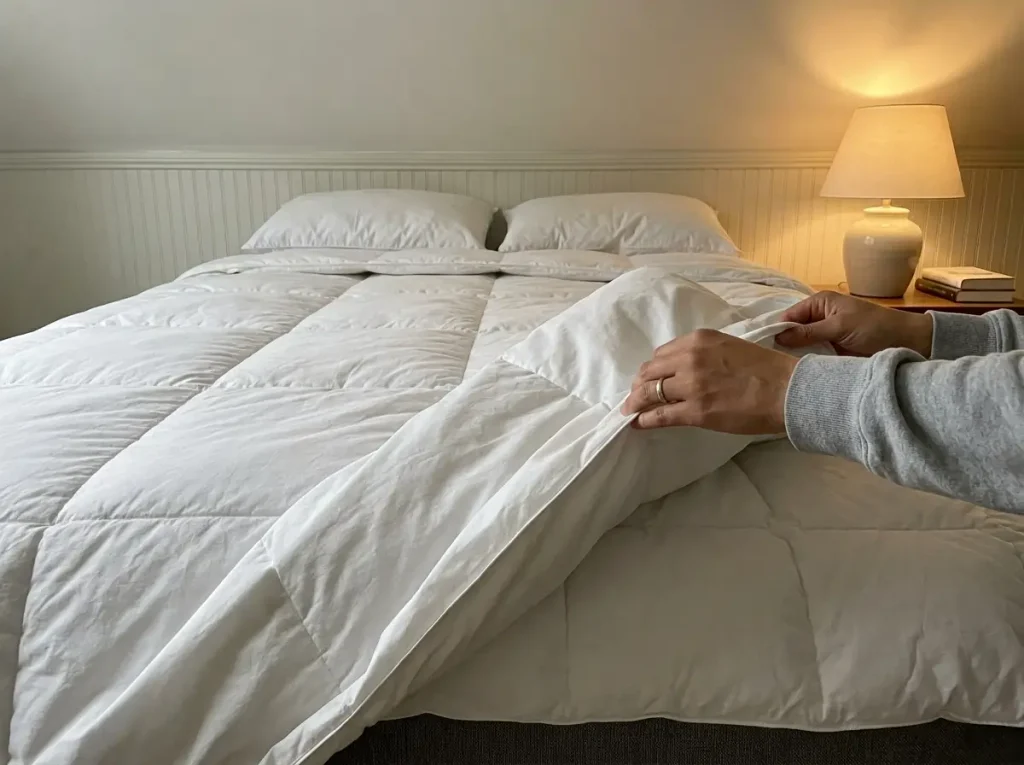
The tag also travels with whatever the finished article happens to be, sheets or not. The Cuddledown Dreamstead Down Alternative Comforter is a shell plus a fill, 235-thread-count cotton percale over a synthetic fill rated around 500 fill power, and both halves went through the same certification as one object, which is the finished-product rule doing its job on something that is not a single piece of woven cloth. What the certificate has no opinion about is warmth. The fill power decides that, and a certified comforter is not a warmer comforter; do not read the seal as a temperature rating.
Not a sustainability claim, and the certifier says so
Hohenstein, one of OEKO-TEX’s own testing institutes, spells this out directly: “Although a product that is safer for humans could also be better for the planet, STANDARD 100 is not an eco/sustainability claim.” Sustainability gets verified through a different program, MADE IN GREEN, with a different scope. The organic question runs on the same fault line and belongs to its own article, so one sentence is all it gets here: Standard 100 has no organic-content requirement whatsoever, so organic cotton and virgin polyester clear it on identical terms, and a label that would rule out a synthetic fiber is a different label.
Not a durability claim either
There is no wash count anywhere in the standard. Nothing about pilling at wash ten, nothing about a resin finish leaving and taking the crispness with it, nothing about what the hem looks like after a season. It is a manufacturing-chemistry result, measured once on a new product, and the tag would read identically on a set that goes limp by spring. That is worth sitting with, because it is the gap between what the tag proves and what people buy on the strength of it.
The two things live on the same piece of card, which is most of the problem. Certificate number on one side, marketing adjectives on the other. The certificate is doing honest, narrow, verifiable work; the adjectives beside it are doing none, and the certificate’s authority quietly rubs off on them.
The original poster in that r/textiles thread got as far as reading a retailer’s own explainer, which said OEKO-TEX does not mean organic and only tests the finished product, and still wrote “I still need answers though.” Fair. The official line is completely true and it still stops one step short of anything you can do.
Checking the Number Takes Thirty Seconds
All of the above assumes the tag is telling the truth, and that is the one part you can settle yourself without trusting anybody, because the certifier publishes the check. This is also the only thing in this article that asks you to do something, and it costs nothing.

What a valid label has to show
Two details, and both have to be there: the test number and the responsible testing institute. Those have to match the company’s actual certificate. A hangtag carrying the logo and nothing else is not a certified product. It is a logo, and printing a logo requires a printer.
The check itself
Scan the QR code on the tag, or type the certificate number into OEKO-TEX’s Label Check tool. The number comes in three parts, something like 123456.01.12345, and the record that comes back names what was certified and which institute issued it.
Then do the step nearly everybody skips: check that the institute on the record is the institute printed on the tag. That match is the entire point of the exercise. Confirming a number exists proves a number exists.
The failure mode here is almost never a forged number, which is why “is it real” is the wrong question. It is a real number belonging to a different article from the same manufacturer, quietly reused. So read what the record says was certified, not just whether it returns something.
Match the institute name, not just the number. A certificate number that returns a valid record has told you one thing: that number exists somewhere. A record whose issuing institute matches the name printed on the tag, for a product description that matches the thing in your hands, has told you the label belongs to this article. That second check is thirty seconds and it is the one that catches the reused number.
What happens after the certificate is issued
It is not one lab test followed by silence. At least a quarter of already-certified products get control-tested again each year, samples are bought at random out of shops for re-testing, and independent auditors run unannounced on-site inspections.
That is the part of the system that makes the tag worth checking at all. Without the spot checks, a certificate would only ever describe the sample that was sent in. It is the same instinct you would apply to the same question asked of an Egyptian cotton label: a claim is only as good as whoever is willing to re-open it.
A Certificate Is a Snapshot, and Polyester Can Pass
Two loose ends are left, and they turn out to be the same knot. People expect the tag to mean more than it does across time, and more than it does across materials. It was never built to do either.
Twelve months, then it is re-tested or it lapses
A Standard 100 certificate is valid for one year. Certification renewal means annual retesting: to stay valid it has to be re-tested and re-issued every year, against that year’s criteria catalogue, which as we said gets longer most years, so renewal is not a rubber stamp, it is passing a slightly harder exam than last time. Manufacturers are told to start the process around three months before expiry.
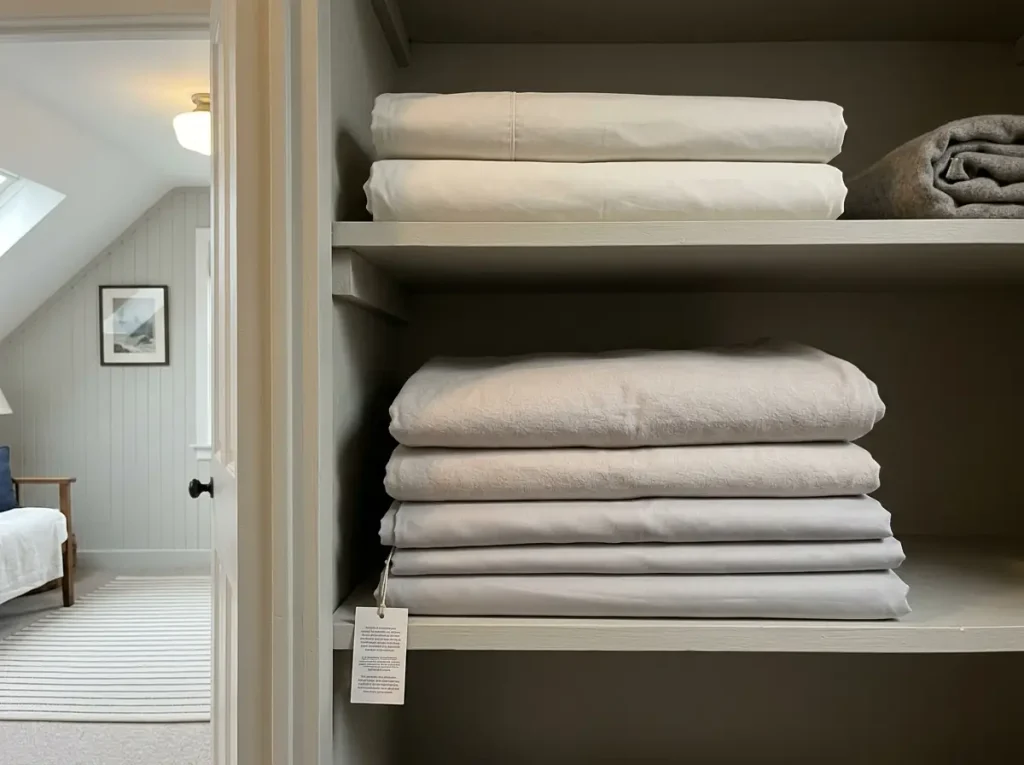
The practical reading is quieter than that sounds. A hangtag on a set that has been in the back of a closet for five years was true the year it was made, and nobody has re-checked that specific product since. It is not a lie; it is a photograph.
And the expiry is invisible to you and always will be, because the tag is printed once and sewn in and carries no date on it. The only thing carrying a date is the record behind the number, which is the second reason the Label Check is worth thirty seconds.
An undated hangtag proves nothing about the current year, and every hangtag is undated. On a new set from a live listing that is a non-issue. On a deadstock set, a clearance bin, a resale listing or something that has been sitting in a warehouse, the tag is telling you about the year it was sewn, and only the record behind the number can tell you whether anyone has re-tested that article since.
Why polyester passing is not a loophole
Back to the blanket in the aisle. Standard 100 asks one question: are these textiles safe against skin. It has no organic-content requirement and no fiber-origin requirement at all. None, not a weak one.
So a recycled polyester blanket clearing it means precisely what it says on the tag, which is that the finished blanket tested clean of the substance list. Somebody in that thread answered the original poster in five words: “polyester meets consumer safety standards.” That is correct, and the reason it satisfied nobody is that it answers a different question than the one being asked.
The question underneath “seems shady” is usually about farming, water, labor and what the fiber is made of, and there is a label for that. It is not this one. Whether OEKO-TEX means organic is the sibling question with its own long answer, and the short version is no, by design. The same reasoning is worth carrying over when the same certificate number is applied to bamboo, where the anxiety is about the process rather than the plant and the certificate is again answering only the residue half of it.
Read this way, the tag stops being either a scam or a guarantee. It becomes a narrow, well-audited claim about chemistry that you can check in half a minute, sitting next to a lot of other claims that nobody checked at all.
Conclusion
Standard 100 tested the finished article, every thread, every dye, the seam and the elastic, against a list of more than a thousand substances that gets longer most years. That is real work and it is worth having on a thing you sleep on for eight hours a night.
Your bedding cleared Class 2, the direct-skin-contact tier, which is stricter than everything else in the room except an infant’s cot. And none of it graded the weave, the staple length or how the set is going to feel, because that was never the question the lab was asked.
After a season of washes, look at the set and not the tag. The pilling on the side you sleep on, the way the hem sits, whether the crispness left when the finish did. The certificate will read exactly the same on a set that has gone soft in all the wrong ways, because it was never measuring that.
Find the hangtag on a set you already own tonight and type its number into the Label Check. See what comes back, and check whether the institute matches. Whatever it says, you will read the next package differently.
Frequently Asked Questions
01Is OEKO-TEX Standard 100 good?
Yes, for what it is: an independently tested chemical-safety certification on a finished textile, backed by annual re-testing and random spot checks. It is worth trusting for exactly that. It is not a quality grade and not a sustainability claim, and the certifier says so itself.
02Which brands are OEKO-TEX certified?
Thousands of them, at every price level, which is why the brand name is the wrong thing to check. Certification is granted per article, not company-wide, so a brand can sell one certified set and one that is not. Check the certificate number on the specific product.
03Does OEKO-TEX have microplastics?
Standard 100 tests a finished textile for harmful substances; it does not test for or restrict microplastic shedding. A polyester or blended sheet can be fully certified and still shed fibers in every wash. The two things are simply not on the same list.
04What product class is bedding under OEKO-TEX Standard 100?
Class 2, direct and prolonged skin contact, the second-strictest of the four classes. OEKO-TEX names bed linens in that tier explicitly. Only Class 1, for babies and toddlers up to three years, is tested harder, and some sets are certified to it voluntarily.
05How long is an OEKO-TEX Standard 100 certificate valid?
Twelve months, after which the product must be re-tested and re-issued against that year’s updated criteria. The hangtag itself carries no date, so an old tag is not proof of a current certificate. The record behind the number is the only thing that is dated.





Tried it on your own bed?
No comments yet. Tell us what you changed, and what the sheet did after a few washes.