


What’s in here8 sections
Shoppers often say it better than any brand page does: the terms oeko tex, GOTS and organic on linen sheets are easy to mix up, and what each one actually means is rarely explained. Picture the object that confusion lives on: a hangtag with a tiny printed number under a logo you don’t recognize, on a set that is about to go on the bed while the tag goes in the trash. That number matters more than the logo does, because a certificate is issued against a list of substances that gets revised every year, which makes the word on the box a dated test result rather than a permanent property of the cloth.
The two labels answer two different questions: is this safe to touch tonight, and how was this fiber grown and who made it. Neither one answers the third question you actually have, which is whether you will like sleeping on it.
| The question | OEKO-TEX Standard 100 | GOTS |
|---|---|---|
| What it tests | The finished fabric, dyed and sewn, against a list of over 1,000 harmful substances | That the fiber was grown organically and every processing stage was audited |
| What it covers | Any fiber at all, natural or synthetic, at the moment of testing | Farm to finished product, including wastewater and labor standards |
| What it does not tell you | How the fiber was grown, or how the set behaves after twenty washes | Whether the finished item passed a residue test, or how it feels |
| How you verify it | Certificate number into the OEKO-TEX Label Check, which returns valid, expired or withdrawn | Certification number plus the certifier’s name, looked up in the GOTS database |
Neither mark certifies better quality, and neither certifies a softer hand. They are floors, and this article is about where each floor sits.
What OEKO-TEX Standard 100 Actually Tests
The intro said the two labels answer different questions. Here is the first one taken apart, and the surprise is how narrow the OEKO-TEX promise is, and how precisely dated.
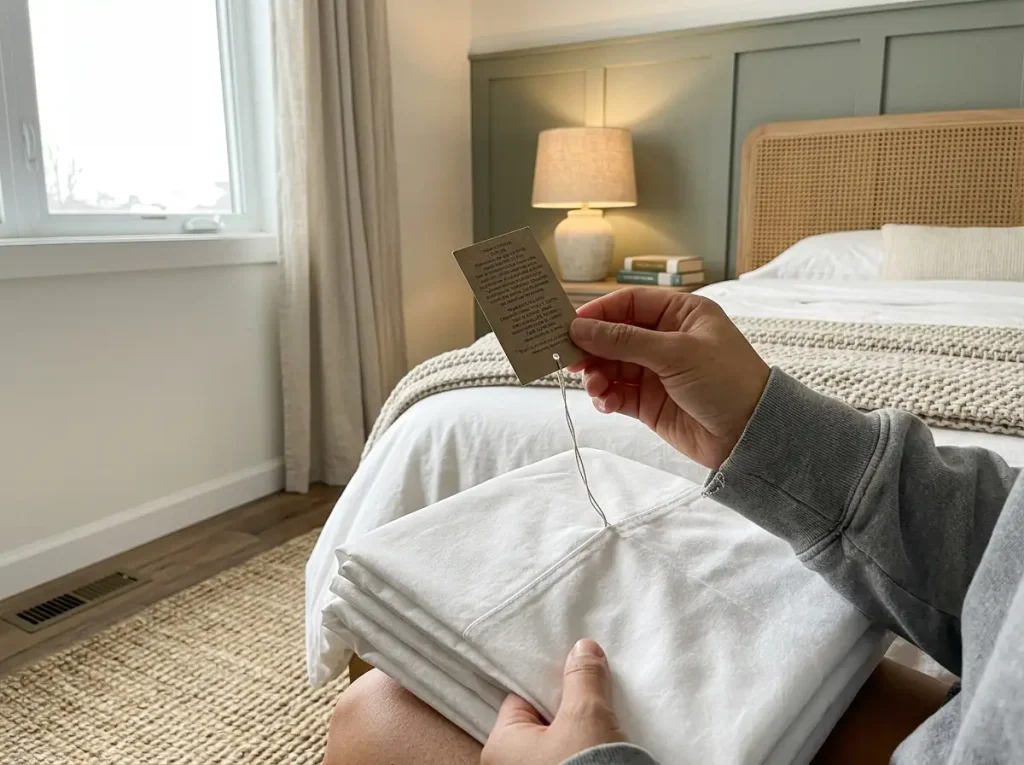
STANDARD 100 tests the finished textile. Not the cotton in the field, not the yarn on the cone: the sheet as it exists after dyeing, treating and sewing, which is exactly the object that ends up against skin. That is the whole logic of the mark. It is checking what is on the fabric now, not the story of how the fabric got here, and those two things come apart more often than the packaging suggests.
The List of Substances, and Why It Changes Every Year
The test screens the fabric against a list of over 1,000 individual harmful substances: azo dyes, formaldehyde, phthalates, heavy metals, chlorinated compounds, the whole catalogue of things that can survive a finishing line and still be sitting on the cloth. The number sounds impressive and it is, but the part almost nobody mentions is what happens to that list afterward. OEKO-TEX reviews the limit values at least once a year, which means the list is a moving target by design.
Read that carefully, because it changes what a certificate means. A certificate is a test against that year’s list, not a permanent property of the fabric. A set certified four years ago passed a version of the standard that has since been revised, possibly several times. The regulated families move as the science does, which is how PFAS and the tighter limits on chlorine bleach residues found their way onto the list.
That is not a scandal. It is how a chemical safety standard is supposed to work when the chemistry keeps changing. But it does mean the word “certified” on a package is closer to a dated receipt than to a permanent grade, and the date is the part that gets thrown away with the tag.
Photograph the hangtag before you cut it off. The certificate number, the class and the certifier’s name are all on that piece of cardboard and nowhere else: not on the fitted sheet’s sewn-in care label, not on the box. Ten seconds with a phone camera is the difference between being able to check a claim in six months and having to take the listing’s word for it.
The Four Classes, and Which One Your Sheets Are
STANDARD 100 is not one test with one pass mark. It is four product classes, sorted by how much skin the product touches, and the more contact there is the stricter the limits get.
Product class I covers baby textiles — babies and children up to three years old — and is the strictest of the four. Product class II covers items with direct skin contact, and OEKO-TEX’s own STANDARD 100 page lists the four product classes and confirms bed linens fall under Class 2. Class 3 is for things that don’t sit against skin, a jacket shell say, and Class 4 is décor: curtains, upholstery, the fabric on a headboard.
So your sheets are tested to Class 2, not the baby-grade Class 1. Both are real certifications and both are worth having. They are not the same test, and the difference matters the moment somebody buys a set for a crib on the strength of an “OEKO-TEX certified” line in a listing.
And here is the level of detail nobody prints: the class number is the part that goes missing. A package that says only “OEKO-TEX certified” has told you it passed something. Which class it passed decides whether it was held to the babies-and-children limits or the bed-linen ones, and a listing that names the class is telling you more than one that just shows the logo. If you want the whole standard broken down, that is the four classes, walked through one at a time. For here, the class number is the thing to look for and the thing most listings leave out.
What the Test Does Not Look At
A residue test is a residue test. STANDARD 100 does not ask where the cotton grew, whether the field carried pesticide residue, who worked in the mill, or what the factory did with its wastewater. It also is not a fiber-type screen: polyester passes, bamboo viscose passes, a synthetic fiber blend passes, as long as what is left on the finished cloth stays under the limits.
That surprises people who read the mark as an environmental one. It is a chemistry test on an object, and it does that one job well.
The clearest illustration of the gap is simple: OEKO-TEX certified does not include finishings. A set marketed as organic can still give off a strong VOC- and formaldehyde-type smell straight out of the package. That conclusion is the right one. A claim about how the fiber was farmed never covered the chemicals applied at the finishing line, and the test that would have caught it is a different test entirely. Two labels, two questions, and a set can be honest about one while saying nothing about the other.
What GOTS Certifies, and Why It Is a Longer Chain
OEKO-TEX asks one question about one object at one moment. GOTS asks a different one, and it asks it of every company that touched the product, which is what makes the label so much easier to break.

The Two Grades: 95% and 70%
GOTS is not a single binary mark, and this is the first thing every competing explainer flattens. The Global Organic Textile Standard has two label grades with two different guarantees, and both come down to organic fiber content. “Organic” requires a minimum of 95% certified organic fibers. “Made with Organic Materials” requires a minimum of 70%.
GOTS spells out the 70% and 95% organic-fiber thresholds on its own key-features page, so this is not a reading between the lines. It is the standard describing itself.
Those are not marketing synonyms for the same idea. A set at 72% organic content and a set at 98% both carry a GOTS label, legitimately, and one of them contains nearly a third of something else — usually conventional cotton or a synthetic fiber blended in for durability or price. Neither is a fraud. They are two different promises with two different printed names, and the grade is supposed to appear on the label right next to the logo.
Which means the difference is something you can read in the aisle, standing there with the package in your hands. Almost nobody does, because the logo is what the eye lands on and the grade is set in small type beside it.
For a worked example of a listing that does print all of it, the Whisper Organics 100% Organic Cotton Sheet Set is 100 percent organic cotton in a 500-thread sateen, and its listing names both the 95–100% organic-content grade and Control Union as the certifying body, which is the exact checklist the next section teaches, printed by the seller instead of hidden. Its flaw is a real one and worth saying plainly: stock on it is thin, single digits at the time of writing, and there is no other GOTS-certified sheet set in our shortlist to send you to if it sells out. A set this thinly stocked may simply be gone by the time you go looking.
When a listing shows the GOTS logo but never names a grade, treat the missing grade as the answer. A brand at 95% has every reason to print the word Organic; a brand at 71% has a reason to show only the logo. It is not proof of anything, but it tells you which question to ask before the set goes on the bed.
Every Factory in the Chain, Not Just the Field
Here is the half of GOTS that surprises people. The reader who hears “organic” pictures a cotton field, and roughly half of what GOTS does happens after the field: spinning, weaving, knitting, dyeing, sewing, packaging.
Every company in that chain has to be certified itself for the finished item to carry the label. Not compliant, not supplied by someone certified. Audited and certified in its own right. That is also where the social half of the standard lives — GOTS carries a set of labor criteria drawn from the core ILO standards, covering fair wages, working hours, and the prohibition of child labor and forced labor at every processing site in the chain. A residue test has nothing to say about any of that, which is one more reason the two marks are not substitutes.
Which produces a result that sounds wrong the first time you hear it. A cotton field can be genuinely organic, the yarn can be genuinely organic, and the finished sheet on your bed can still fail to be GOTS-certified, because one factory somewhere in the middle skipped its audit. The organic content did not change. The chain did.
The audits behind that are annual, on-site and third-party, and they combine physical segregation of the certified goods with volume reconciliation, recently strengthened by satellite-based cotton monitoring done with the European Space Agency. The point of that machinery is supply chain traceability: the claim gets checked against bales physically moving through real facilities rather than against a paper total that balances on volume.
It is slow, expensive and unglamorous, which is most of what you are paying for when a certified set costs more than a conventional one.
The Fibers Beyond Cotton
GOTS is not a cotton-only mark, and the assumption that it is quietly narrows what people look for. Hemp, linen and flax, jute, wool, cashmere, mohair, alpaca and silk all fall under the same standard. A GOTS-certified linen set is running on the same audit chain as a GOTS-certified organic cotton set: same processing rules, same labor standards, same annual inspection, different fiber going in the top.
That is useful mostly because it stops you dismissing a label you were not expecting. A wool comforter with a GOTS mark is not a brand borrowing a cotton certification. It is the same standard, doing the same job, on a different animal.
“GOTS Certified Brand” Is Not “GOTS Certified Sheet”
Everything above assumes the label on the package is telling the truth about the object inside the package. There is one gap where a brand can be entirely honest and the sheet on your bed still uncertified, and GOTS wrote the rule about it themselves.
The Claim GOTS Says a Brand May Not Make
GOTS’s labelling guidance bans a specific family of phrases outright: “GOTS cotton,” “GOTS-certified organic cotton,” and “made with GOTS-certified fabric/yarn” are all listed as incorrect claims when they are used to describe a finished product that is not itself certified. GOTS’s own labelling rules explicitly ban brands from saying ‘GOTS-certified fabric’ as a stand-in for a certified finished product, which is worth knowing precisely because those phrases sound so reasonable on a brand page.
The mechanism, in GOTS’s own framing, is chain of custody, and the shorthand worth carrying out of this section is brand-certified versus fabric-certified. If certified fabric is sewn in an uncertified facility, the chain breaks and the final product is not certified. Not “less certified.” Not certified.
The fabric was fine; the last step was never audited, and the standard covers the product rather than the roll of cloth it came from.
The same mechanic is easy to explain in plain language, and it is sharper than the standard itself: brands can be misled or confused by their suppliers, and a product stops being GOTS as soon as there is an uncertified link in the supply chain.
That is not a cynical reading, and it is worth separating from greenwashing proper. Some of these brands genuinely believe their product is certified because their fabric supplier’s certificate is real.
The certificate is real. It just belongs to somebody else. Which is the practical difference between a deliberate eco-friendly claim with nothing behind it and an honest brand quoting a document it misread. Which is why shopping for organic cotton bedding on brand copy alone is a coin flip either way.
The Four Things a Correct Label Carries
GOTS also wrote down what a legitimate claim looks like, which hands you a template to hold any brand page up against. The permitted form runs “We are GOTS certified” followed by the certification body’s name and the license number, which is a sentence with two blanks in it that a brand either can fill or cannot.
On the product itself, a correct label carries four things together:
- The GOTS logo
- The label grade: “Organic,” or “Made with x% organic materials”
- The certification body’s name: Control Union, ECOCERT, OneCert and the rest
- The certified entity’s certification number
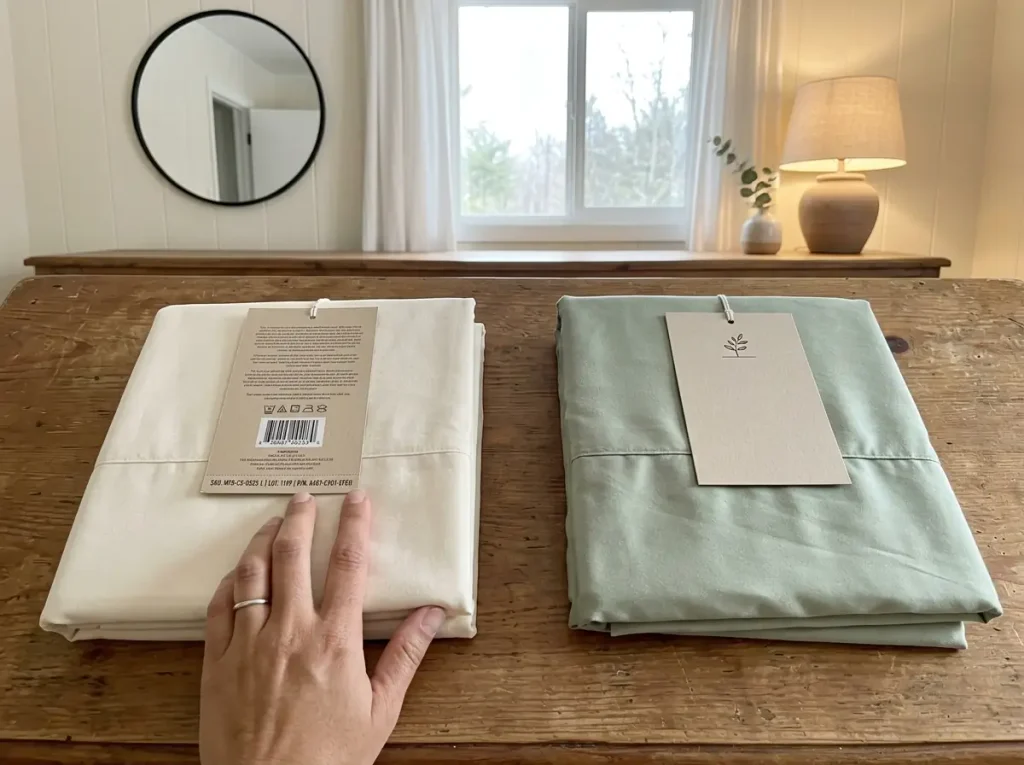
The tell is not a missing logo. Logos are artwork and artwork is easy. The tell is a logo standing alone. A real certification always arrives with a number beside it, because the number is the thing the certifier issued and the logo is the thing the designer placed. When the two get separated, it is the number that went missing, never the logo, and that asymmetry is the whole check.
What the Tag Looks Like When It Is Real
In practice this is a two-second scan, done with the package still in your hand. Logo present, grade named, certifier named, number printed. Four things, one glance. A listing missing the last two is not proof of anything dishonest, since a lot of Amazon copy is written by somebody who has never seen the physical tag, but it is a reason to look at the tag itself before you believe the copy.
And the usual advice is to trust the brand’s sustainability page, because that is where the detailed claims live. After reading enough of those pages against GOTS’s own rules, I’d trust the physical tag instead. The sustainability page is written by marketing; the tag is printed under a certifier’s license, and it is the one surface where the missing number actually shows.
Checking It Yourself, Free, in Under a Minute
Every distinction above collapses into one habit, and it costs nothing. The number on the tag is a lookup key, and both certifiers run a public database that answers it.

The OEKO-TEX Label Check, and the Expired-Certificate Trap
A STANDARD 100 certificate is issued for one year and must be renewed. That is the fact that makes the whole lookup worth doing, and it is why OEKO-TEX runs the Label Check tool that turns a certificate number into a valid, expired or withdrawn answer. You type in the number printed on the tag. It comes back with one of three verdicts, and none of them are ambiguous.
Which sets up a consequence none of the competing explainers mention: a certificate can come back expired on sheets that are brand new in the package. Nothing dishonest has to have happened. A set manufactured and certified two years ago, sitting in a warehouse since, carries the certificate it was issued, and that certificate lapsed while the product sat there. The fabric is the same fabric. The test result is simply older than its own validity window, and the only way you would ever know is by typing the number in.
Three verdicts, three responses. Valid means the claim checks out as of now. Expired usually means old stock rather than a bad actor, and it is your call whether that bothers you. Withdrawn is the one worth taking seriously, and it is rare.
Looking Up a GOTS Number, and What It Traces To
For GOTS the lookup takes two pieces: the certification number and the certification body’s name. Both are supposed to be on the label, which is why the four-item check above matters. A listing that gives you a logo and nothing else has given you nothing to look up.
What comes back is the useful part. The number traces to the entity that was actually audited, and that is how you tell a certified processor from a seller quoting somebody else’s certificate. If the number resolves to a mill or a manufacturer and the brand on the package is a different company entirely, you have found exactly the brand-versus-fabric gap the section above described, in about ninety seconds, without having to email anyone.
The community got here first, by the way, and got here without a paid tool. The answer to whether a set is actually certified is never a service or a subscription. It was pull the number off the tag and punch it into the certifier’s own lookup, at checkout, before the box arrives. A transparent, OEKO-TEX-certified linen duvet cover can beat a pricier competitor branded as sustainable, because one of the two claims can be checked and the other can only be believed.
Here is where a genuinely cheap set makes the argument better than an expensive one does. The Linen Home 100% Cotton Percale Sheet Set is a 200-thread cotton percale with a 15-inch pocket, and it carries an OEKO-TEX certification at a tier well below where organic cotton starts, which is the clearest evidence that the chemical-safety mark is a floor rather than a badge of the premium shelf. Its flaw is exactly what the thread count says: at 200 threads this is a basic cloth, and it will not match a lyocell or a 500-thread sateen for hand-feel. The certificate does not change that, and it was never meant to.
Keep the Tag Until the First Wash
The routine has one failure point and it is not the lookup. It is that the whole thing has to happen before the tag comes off, and most people cut the tag off in the first ten minutes, somewhere between the packaging and the washing machine.
So: keep the hangtag until the set has been through its first wash. Not as a filing habit. As a return window.
That is the only stretch of time in which sending the set back is still simple, and it is exactly the stretch in which a number coming back expired or withdrawn would actually change your mind. Once the tag is in the trash and the sheets are on the bed, the claim on the package is the only claim you have left.
Do the lookup at checkout, not after delivery. Most listings show the certificate number in the images or the bullet copy, and typing it in while the set is still in the cart takes less time than reading the reviews. A number that fails then costs you nothing. A number that fails after the tag is gone costs you the return.
Which Label Answers Which Worry
With both labels taken apart and a way to check them, the question stops being which certification is better and becomes a matching problem. The two marks are not competing for the same job.

“Is It Safe Against Skin Tonight?” → The Residue Test
If the worry is what is physically on the cloth that will be against you in a few hours, the smell out of the package, the finishing chemicals, the dye chemistry, that is OEKO-TEX. It tests the finished item for residue, any fiber, and it answers the question in the tense you are asking it: right now, on this object.
This is also the mark most often reached for by readers with sensitive skin or allergies in the house, and it is worth being precise about what it does for them. A residue limit rules out a class of chemical irritant the cloth might otherwise have carried out of the factory. That is a real thing to have ruled out, and it is the whole of what the certificate claims.
A product can carry one mark, both, or be marketed with neither actually verified, and both is common enough to be worth looking for deliberately. The ettitude 100% Lyocell from Organic Bamboo Sheet Set is the illustration: 100 percent CleanBamboo lyocell in a sateen weave with a 17-inch pocket, made through a closed-loop solvent process, carrying an OEKO-TEX Standard 100 Class 1 mark, the babies-and-children grade, on an adult sheet set, which is a stricter test than the Class 2 sheets normally clear. Two answers in one listing: an organically sourced fiber and a residue test on the finished cloth. Its flaw is the same one the GOTS example has, and it is worth saying rather than burying: stock runs to single digits, so if you take your time deciding you may find it out of stock and be waiting on a restock.
“How Was It Grown, and by Whom?” → The Processing Audit
If the worry is the field, the dye house and the people in the factory, that is GOTS, and no residue test substitutes for it. Organic farming, wastewater treatment, labor standards audited annually on site. None of that appears anywhere in a chemistry result on a finished sheet.
Which is why a set marketed as organic can still arrive smelling of finish, and why the point about finishings earlier in this article is not a contradiction. Neither mark is a farming claim and a residue claim at once. If you want the equivalence question argued properly, that is its own piece: whether an OEKO-TEX mark tells you anything about organic at all. The short version here is that the two questions do not overlap, and a brand answering one loudly is not answering the other quietly.
Beyond Sheets: Fill, Covers, and the Crib
Certification is not a sheets-only affair, which matters if you are buying a bed rather than a set of sheets. A comforter’s fill and its cover can each carry the mark, and for the reader replacing the whole bed at once that is the difference between one certified layer and three.
The Cuddledown Dreamstead Down Alternative Comforter is the worked example: an all-season comforter with a 100 percent cotton percale cover at around 235 threads and an OEKO-TEX Standard 100 certification covering it. Its flaw is in the name if you read it carefully. The fill is synthetic, rated as equivalent to roughly 500 fill power rather than being down at all. If real down is what you came for, this is the wrong product and no certificate changes that.
And baby bedding is where the class number stops being trivia. Class 1 is the grade for babies and children up to three, and it is a genuinely different, stricter test from the Class 2 a normal sheet set passes. A crib set described only as “OEKO-TEX certified” has not told you which of the two it cleared. Ask for the class, or find a listing that names it.
What Neither Label Tells You
Both marks are worth having and both are worth checking. The honest close is what neither of them measures, which turns out to be most of what decides whether you actually like the sheets.

Weave, Grammage, and Everything the Certificate Skips
Neither mark measures weave, and weave is the single biggest thing deciding how a sheet sleeps. Percale is one thread over, one under, which leaves gaps and lets air move. Sateen floats four threads over one: smoother, heavier, closed. That difference is the whole reason one certified set sleeps crisp and another certified set sleeps warm, and no certificate anywhere mentions it.
Neither measures grammage, grams per square meter, the weight of the cloth, which almost nobody prints and which you end up judging by lifting the package. Neither measures hand-feel, staple length or how the surface behaves under a forearm. Two certified sets can feel nothing alike, and both labels will be entirely truthful about both of them.
This is the same trap that catches people reading fiber names on a package: a label predicts one specific thing and gets read as predicting everything. It happens with certifications and it happens with fibers, and what Tencel and eucalyptus actually mean on a label runs on exactly this pattern.
A certified set can still be the wrong set for your bed, and the certificate will not have lied to you once. It answered a question you were not asking. Whether that floor makes for a better set than an uncertified one is a separate argument, and a longer one.
Wash Twenty, and the Thing a Certificate Cannot Promise
Here is the gap that matters most on this site, and it is structural rather than a criticism of either standard. A certificate is a point-in-time result: a lab test on a sample, an audit of a facility on a given week. It describes what left the factory. Everything you actually care about happens afterward, in a washing machine, over months.
Nothing in either standard speaks to pilling at wash ten, or to a resin finish leaving by wash twenty and taking the crispness with it, or to a hem that stops lying flat, or to a fitted sheet whose elastic gives out at the corner you sit on to put shoes on. Look for a wash-count claim in a certification document and there is nothing to find, because certification is not a durability claim and was never sold as one. No competitor connects the two, for the good reason that there is no connection to make.
The certified sets do generally cost more, and the honest way to read that is as a signal about the audit chain rather than as a quality grade the certificate confers. You are paying for annual on-site inspections, physical segregation of goods, and a certifier’s license, not for a finer yarn. Sometimes the yarn is finer too. The certificate is not what tells you so, and whether the organic premium is worth paying deserves its own accounting.
When It Is Not the Bedding
One last boundary, because this niche blurs it constantly. A certification rules out a chemical irritant that a fabric might otherwise have carried. It does not diagnose, treat or relieve a skin condition, and a reaction that persists on certified bedding is a conversation with a doctor rather than another set of sheets.
Everything in this article is about cloth, chemistry and paperwork. That is where it stops.
The Short Version
Read the class and the grade, not the logo. OEKO-TEX Class 2 is the bed-linen grade and Class 1 is the babies-and-children one; GOTS “Organic” at 95% is a different promise from “Made with Organic Materials” at 70%. Those four words carry more information than the two logos do.
A logo standing alone is the tell. A real certification arrives with a number and a certifier’s name beside it, and that number is a lookup key on a free public database that answers in three words. If a brand page says GOTS and cannot name a certifier and a license, it may be describing its fabric supplier rather than its product.
A certificate is a floor, not a review. It says what left the factory, not how the set behaves on your bed — and a certified sateen and a certified percale will sleep as differently as any other sateen and percale.
After a season of washes, look at what no certificate ever covered: whether the hem still lies flat, whether the surface has pilled where a forearm rests, and whether the crispness that sold you the set is still in the cloth. That is the review the label could not give you, and it takes twenty washes to write.
Go find the hangtag on the set already on your bed. If the number is still on it, look it up tonight. That is the entire skill, and it costs nothing.
Frequently Asked Questions
01Is organic cotton better than OEKO-TEX cotton?
They are not ranked against each other, because they answer different questions. Organic describes how the fiber was grown and processed; OEKO-TEX describes whether the finished fabric passed a residue test. A single set can carry both marks, and the ones that do usually say so.
02Is OEKO-TEX safe for babies?
Class 1 is the OEKO-TEX grade for babies and children up to three, and it is stricter than the Class 2 that sheets are tested to. Check which class the listing names, because “OEKO-TEX certified” on its own does not say.
03Does OEKO-TEX have microplastics?
Standard 100 tests for harmful substances in the finished textile, and it is not a fiber-type screen, so a polyester or microfiber set can be certified. If you want to avoid synthetics, read the fiber content on the label, not the certification.
04What is the most non-toxic bedding?
There is no single answer, but the verifiable version is a set carrying a current Standard 100 certificate and a GOTS label with its number and certifier printed. Chemical residue tested, processing audited, and both claims checkable in a public database.
05How do I check if a certification is real?
Take the certificate number off the hangtag and put it into the certifier’s own public lookup, either OEKO-TEX Label Check or the GOTS database. It returns valid, expired or withdrawn, it is free, and it takes under a minute.





Tried it on your own bed?
No comments yet. Tell us what you changed, and what the sheet did after a few washes.