







What’s in here7 sections
You get into bed already wearing socks, and twenty minutes later the sheets are still taking heat off you instead of giving it back. A bed keeps you warm by holding still air against you, which means a cold bedroom is pulling that heat out in two directions at once: upward through the air above you, and downward through the mattress you are lying on. Almost every winter bedding list only ever fights the first one. What follows builds the bed in the order the heat actually leaves: under you first, then the sheet against your skin, then the insulator over you, and finally the case where two people in the same cold room need two different answers.
Quick Answer
A cold bedroom is fixed from the mattress up, not the duvet down: a topper for the layer you lie on, brushed cotton or flannel sheets, then a duvet at 13.5 tog or 600+ fill power as the main insulator, with a wool blanket over it only for the coldest nights. The room’s overnight temperature, not the season, decides how many of those four layers you need.
What “Genuinely Cold” Changes About the Bed
Most winter bedding advice is written for a room that gets a bit chilly in December and warms back up when the heating clicks on. A room that sits in the 50s all night is a different physical problem, and it needs its own starting number rather than a seasonal refresh. The mechanism is the same one the pillar article settles — warmth is trapped air, not fabric weight — but a room that never gets warm changes how much air you have to trap and where.
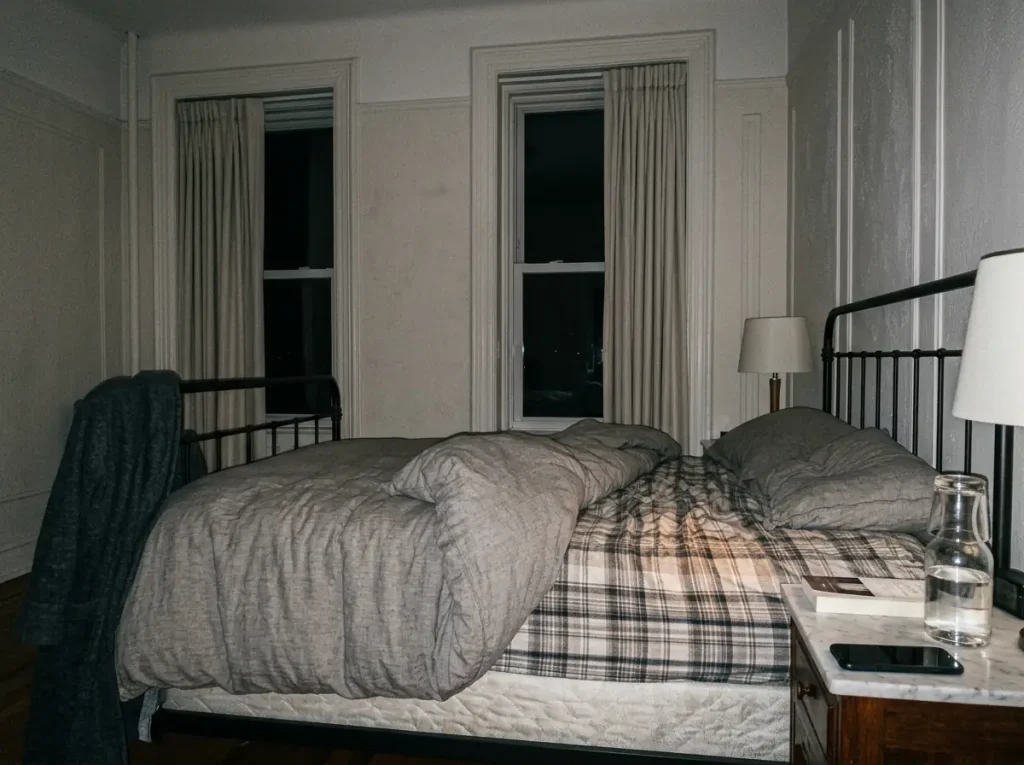
Start with the number, because it is the only thing that predicts whether tonight works. Sleep specialists put the range at 60 to 67°F, and below 60°F is where a room stops being cool and starts being cold. That is the line this entire article sits on the wrong side of.
Notice what the community does with that number, too: people in these threads do not say “my room is cold,” they say “55F” or “in the 50s.” The shorthand is a literal degree, because the degree is what decides the layer count.
A room under that threshold also does something to the sleeper that more blankets alone cannot undo. Circulation narrows at the surface, breathing gets shallower, and the system spends the night compensating instead of settling. That is a physical fact about a cold room rather than a reading of anybody’s symptoms, and it is the reason piling on weight can leave you both heavy and awake.
Why It Hits at Three in the Morning
Core body temperature drops roughly 2°F starting about two hours before sleep and keeps falling to a low point in the early morning. That fall is not a malfunction, it is the circadian rhythm doing what it does, and sleep depends on it happening.
So the cold-bedroom complaint is almost never “I could not get to sleep.” It is “I woke at three.” Your own thermostat is bottoming out at the same hour the room is at its coldest, and the two lows land on top of each other.
There is a second thing happening in that window. REM sleep suppresses shivering and sweating, which means the body’s own thermoregulation is partly offline in exactly the sleep stages that dominate the second half of the night. The bed has to do the work the body stops doing, and it has to do it unattended. That is the whole design brief for everything below.
The tell that separates a genuinely cold room from a cool one costs nothing to run: get into bed and time how long it takes to stop feeling cold. A cool room warms from you in a couple of minutes. A cold one is still taking heat off you at the twenty-minute mark, and that is the room this article is written for. It is also the honest reason the hot-water-bottle habit survives: it is not nostalgia, it is pre-loading a bed that starts the night below you.
The Room Does Things to the Bed, Not Only to You
A post on r/Mattress makes the point better than any spec sheet. A student in an uninsulated bedroom sitting in the 50s did not write in because they were cold. They wrote in because the cold had turned their memory foam “unimaginably hard.” Memory foam stiffens as its temperature drops, so a room like that changes the mattress underneath the sleeper as well as the air above them. A commenter in the same thread pointed out that latex or wool holds its feel far better across that kind of swing.
Which is worth sitting with for a second, because it reframes what a cold room actually is. It is not a colder version of a normal bedroom. It is a room in which the objects themselves have changed state, and the bed you built in October is not the bed you are lying on in January.
It also explains why these threads sound the way they do. The rooms in them are not simply cool: they are a drafty room over an unheated garage, an unheated bedroom at the end of a run of ducting, a corner room with two exterior walls and single glazing. The room temperature is not a setting anybody chose, which is why the answer has to be built into the bed rather than into the thermostat.
The Layer Under You Is the One Nobody Counts
Every list in this niche starts at the duvet and works down, and then stops at the sheet. Which means the entire lower half of the heat problem never gets named at all. A mattress is a large, cool object in direct contact with a sleeper for eight hours, and in a cold room that contact is not neutral. It is a route out.
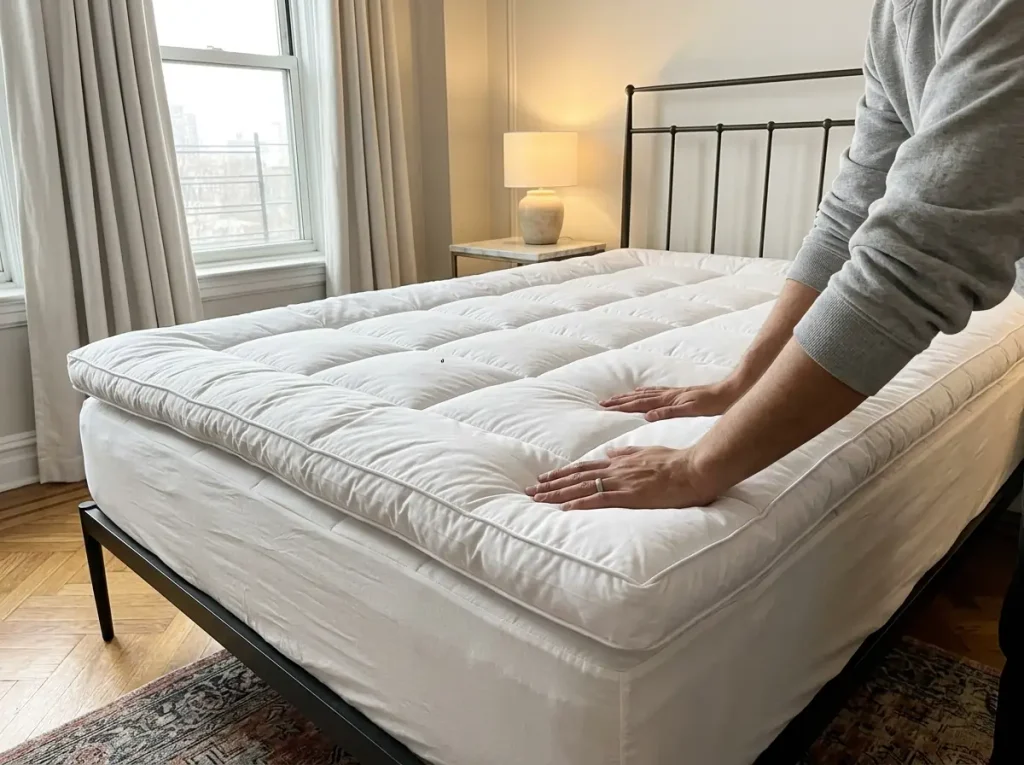
The mechanism has a name and a measurement behind it. A mattress with high heat capacity pulls heat away from your body by conduction, which is a completely different route from the convection and radiation your duvet is fighting.
And conduction does not care how many blankets are stacked over you. Every layer above the sleeper works by holding still air; the layer below is working against direct contact with a cold mass. Only something below can solve something below.
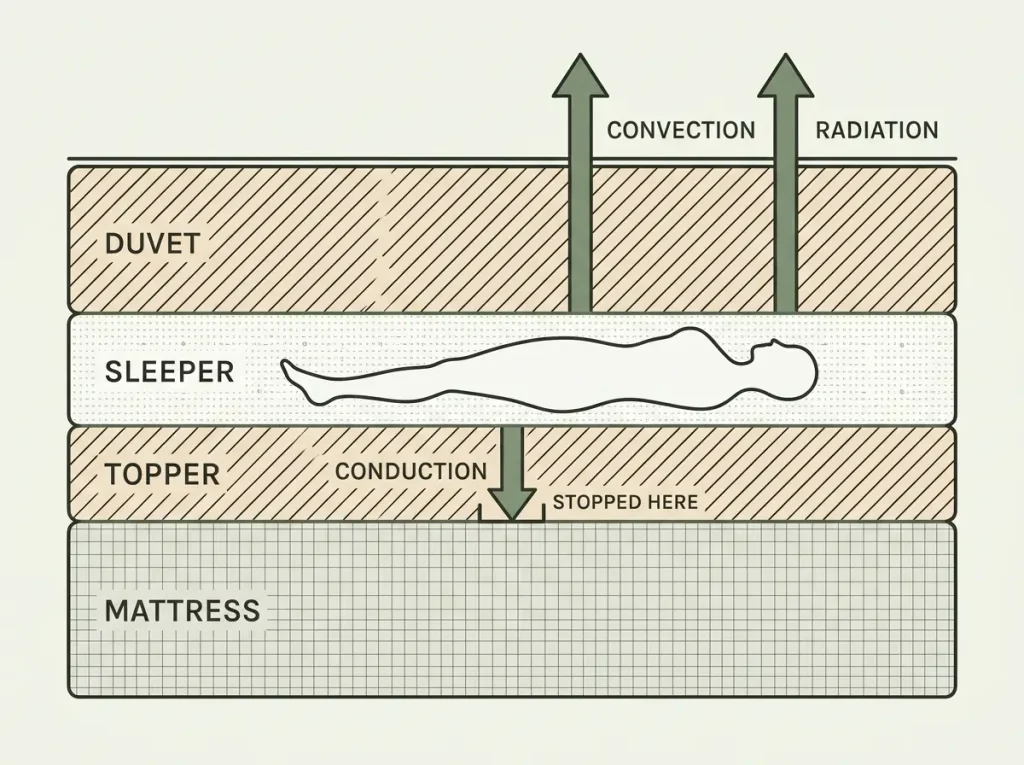
So what a topper actually does here is not “extra softness.” It puts a compressible, air-holding layer between the sleeper and the mattress, so the contact your back spends the night making is with something that has already been warmed by you rather than with a mattress core that never will be. That is the whole argument, and it is why a topper belongs in a cold-room article at all.
Which makes the layering order worth stating plainly, because a cold room reverses the one most people use. Mattress, then mattress protector if you run one, then the topper, then the fitted sheet, then the flat sheet, then the duvet inside its duvet cover, and a blanket over the top only on the nights the number below calls for it.
A mattress pad and a mattress protector are not the same object and neither one is a topper: a protector is a thin barrier, a pad is a light comfort layer, and a topper is thick enough to insulate. In a warm-room article the order barely matters. Here the first three positions are the whole difference.
Material Matters More Down Here Than It Does Up There
In a warm room, topper material is a comfort preference. In a cold one it is a warmth decision, because of the stiffening problem from the last section: memory foam gets harder as it cools, so you get a warmth failure and a comfort failure arriving together in the same week. Latex, wool and a lofted down-alternative fill all hold their feel across that temperature swing far better. If you are buying a topper specifically for a cold room, that is the fork, and it is not the one the product pages talk about.
Before spending anything, though, run the free version. Move the bed off the exterior or uninsulated wall if the room allows it. The poster in that first r/Bedding thread eventually named her own cause, and it was that her bedroom sat in an uninsulated corner of the house, not that her blanket was thin.
Then take whatever spare blanket is already in the house and put it under the fitted sheet for a week. If the difference is obvious, you have proven the topper is the right purchase before making it. If it changes nothing, the problem is above you and you just saved yourself a return.
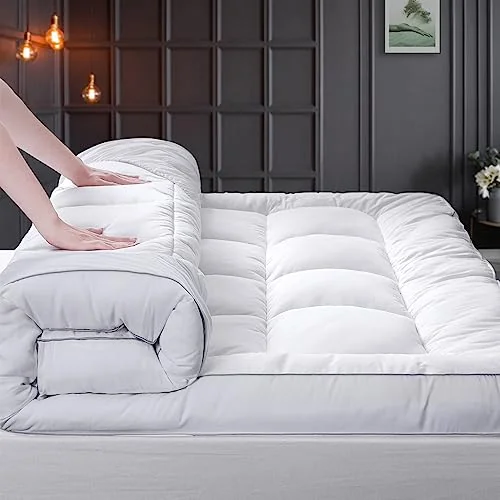
That pocket-depth warning is not a footnote, and it is the part people learn the expensive way. Adding a topper under an existing fitted sheet changes the arithmetic the same night: a sheet that fit the bare mattress starts letting go of a corner at three in the morning, and the reader blames the sheet. Measure the mattress, add the topper’s height, add two inches. That is your pocket depth, and “fits up to 18 inches” on a package means the elastic will reach 18, not that it will stay there.
The Sheet Layer Touches You First
The topper fixes what is under the sheet, which leaves the sheet itself. It is the only layer in the whole stack that spends the entire night against skin, and it is the one most likely to be quietly working against everything above it. This is where a lot of expensive winter beds fail for free reasons.
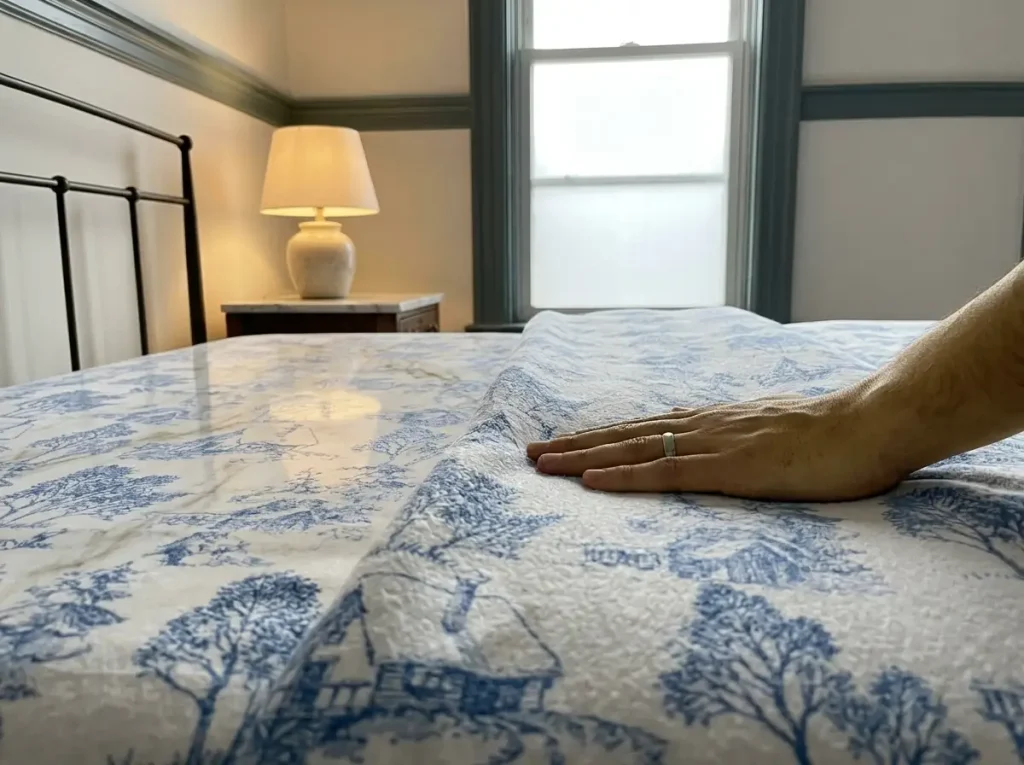
Straight from an r/Bedding thread, and it is the cleanest illustration of the problem in this article: somebody was cold under a heavyweight down duvet and could not work out why, until the sheets came up. Polyester. In her own words, “none of the heat gets trapped in the bed.” The duvet was never the problem, and no upgrade to the duvet would have found it.
Here is the mechanism. Brushed cotton and flannel are not warmer because they are thicker. The nap is raised fiber ends standing off the surface of the weave, and that raised surface holds a layer of still air directly against the skin. It is the same trapped-air principle the duvet is running on, just working at a scale of millimeters.
A smooth polyester surface has nothing standing off it to hold that air, so the layer never forms and every warm thing above it is starting from a deficit.
Flannel Is a Finish, Not a Weave
Worth being precise, because the packaging is not: flannel is a finish, not a weave. It is a brushing process applied to a woven cloth, which is why “flannel” on its own tells you almost nothing. Double-napped means both faces have been brushed, and that is the difference between a flannel sheet that holds warmth on the side facing you and one that just felt soft in the package.
Weight is the honest specification here, and it is the one the sibling piece settles in full: below a certain point there is simply not enough fiber in the cloth to raise a nap that survives being used. Rather than re-derive it, take the ounce weight a flannel sheet has to clear from there and treat it as the floor. As the entry-level example of that rule, the Pointehaven 180 GSM 100% Cotton Flannel Sheet Set is double-napped 100 percent cotton at the lightest weight worth having, and its flaw is baked into that same sentence, because at 180 GSM it will give up part of its brushing in the first few washes and there is not much margin underneath it.
That shedding is normal, by the way. A napped sheet loses some loft early as the loose surface fibers come away, and that is the fluff you find in the lint trap after the first two or three washes rather than a defect. What matters is what is left once the initial shed settles. A heavier flannel is not buying you the nap in the package; it is buying you the nap that is still there in February.
If there is a polyester or a thin percale set on the bed right now and a flannel or brushed-cotton set already in the closet, swap them tonight before you buy a single thing. It costs nothing, it takes four minutes, and it is the cheapest change in this entire article. It is also diagnostic: if that one swap makes a noticeable difference, the sheet layer was the leak, and you now know not to spend the money on a heavier duvet.
The Duvet Is the Main Insulator, and It Has a Number
With the layer under the sleeper sorted and the sheet no longer fighting it, the duvet finally gets to do the job it was always supposed to do. This is also the point where “all-season” quietly stops being enough, and where two duvets that look identical on a shelf turn out to be one winter apart.
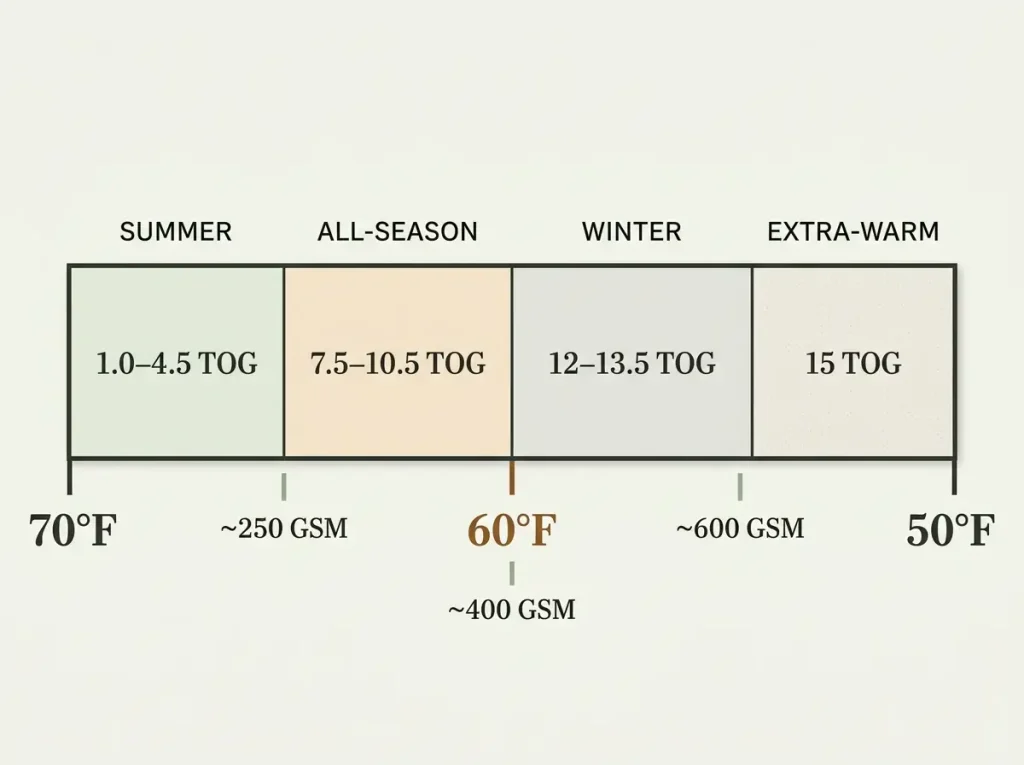
Two numbers decide a duvet, and which one you get depends on which side of the Atlantic wrote the label. The tog scale runs roughly 1.0 to 4.5 for summer, 7.5 to 10.5 for all-season, 12 to 13.5 for winter, and 15 for extra warm. A room below 60°F is a 13.5-and-up conversation. An all-season duvet is the wrong tool in that room regardless of how good the brand is, and no amount of brand quality changes a tog rating.
Fill power is the other number, and unlike most of what is printed on bedding it is a tested one. Around 650 is a standard warm comforter, 700 is mid-loft, and 800 and above is the top of the range. Fill power is measured under a defined steam-conditioning method with a stated tolerance, which is exactly why it survives contact with a label better than the word “warm” does.
Nobody certifies “warm.” Somebody does certify 650.
And when a listing gives you only one of the two, you can still cross-check: roughly 250 GSM of fill lands around 2 to 4 tog, 400 GSM around 7 to 9, and 600 GSM around 10 to 13. Rough, but enough to catch a product page that names GSM precisely because the tog would not flatter it.
There is a third thing on the label that decides whether the number holds, and it is the one most listings bury. A duvet is built either baffle box or sewn-through, and in a cold room the difference is not academic. Sewn-through stitches the top and bottom layers directly to each other, which is cheaper and holds the fill in place, but every seam is a spot where there is no loft at all: a grid of thin lines running across you all night.
Baffle box puts a strip of fabric between the two faces, so each chamber keeps its full height right up to its edges. That is the construction that lets a stated fill power actually behave like its number. On a duvet you are buying specifically because the room temperature is against you, sewn-through is a compromise you feel, and the label will happily give you the fill power without ever mentioning which of the two you are getting.
Polyester fill and down alternative are worth one line of the same honesty. They insulate by holding air the same way, they cost less, and they wash without ceremony. What they do not do is hold their loft as long, which is the trade the next section is about.
Add a Blanket Before You Buy a Second Duvet
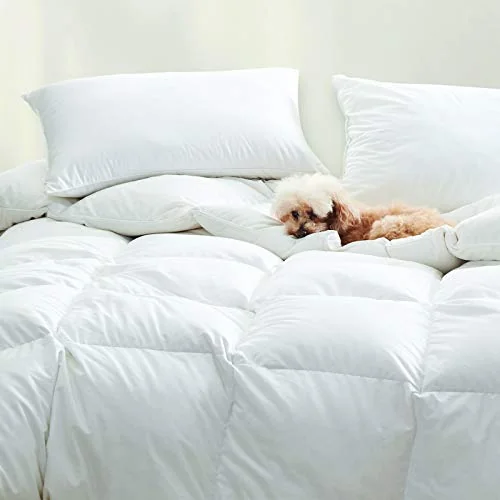
The usual advice at this point is to go back and buy the winter-rated insert. And that works. But after enough cold-room threads where somebody already owns a perfectly good all-season duvet, the cheaper move holds up better: put a wool blanket over the duvet that is already on the bed and you push an all-season insert into winter territory without replacing it. Wool is the regulator in that stack: it holds air the way the duvet does, and it also handles the moisture a heavier pile of layers inevitably traps, which is the difference between warm and warm-then-clammy.
Which wool matters less than the label suggests. Merino wool is finer and softer against skin, lambswool is the first shearing and sits somewhere near it, and a coarser blend is scratchier and often warmer for the money. Any of them beats a synthetic throw blanket in this position, because the synthetic holds the heat and none of the moisture.
The community version of this is a woman describing her own unheated cabin bedroom: flannelette sheets, then a wool blanket, then a down duvet, then a heavy cotton bedspread on top, with her own verdict that she can barely move under the weight. The order is the interesting part, not the total. If you want the named example of that middle layer, the Desert Breeze Alpaca & Sheep Wool Blanket is a 50/50 alpaca and Peruvian sheep wool weave, and its flaw is real: it is the most expensive item in this article, and genuine wool weight makes it awkward in a home washer, so it is not a blanket that goes in with the rest of the bedding. If you want the ranking rather than one pick, the sibling piece sorts which blankets actually hold air.
One fork this article deliberately does not settle: whether that main insulator should be down or a synthetic fill. It is a real decision with a real answer, and for a cold room the short version is that fill power and fill weight both have to be right, because excellent down that has been underfilled still sleeps cold. The full argument is down against down alternative for warmth, and it belongs there.
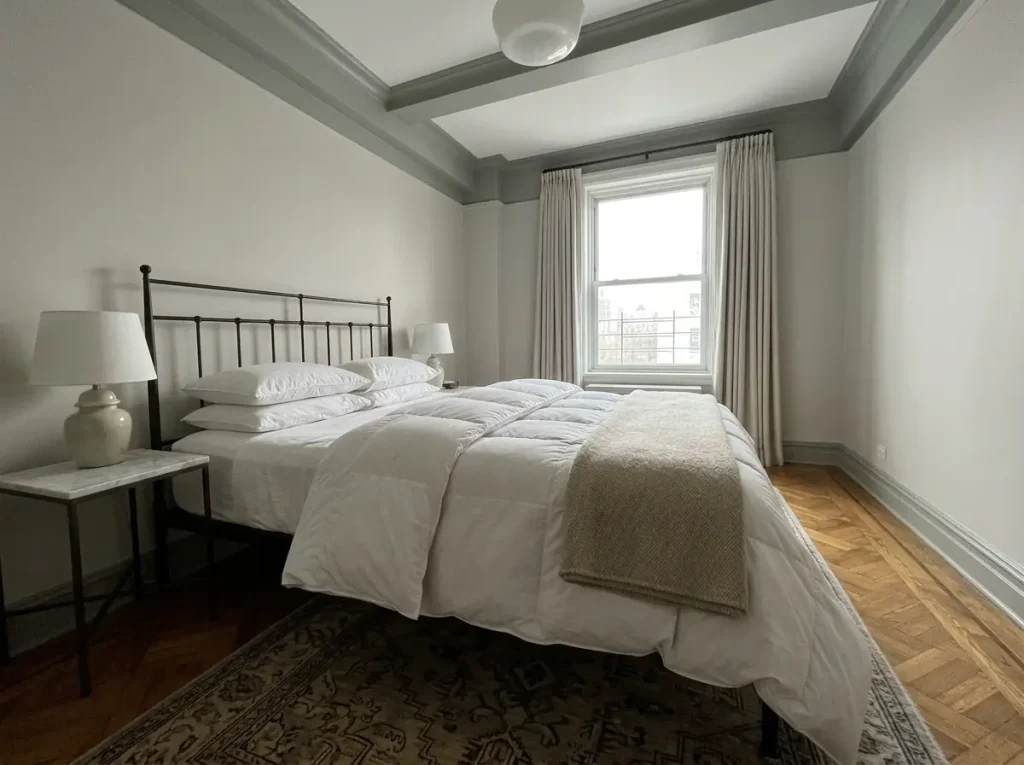
A duvet that has lost its loft fails unevenly, not uniformly, and that is why the symptom gets misread. The fill migrates inside its channels and the cold shows up as one specific band across the chest or the feet while the rest of the bed still feels fine. Somebody reports being cold in one spot and starts hunting for a draft from the window. It is the insert. Lay the duvet flat, press it down with your palm along its length, and look for the channels that stay flat instead of springing back.
That is also the honest answer to what a season of use does to all this. After a winter, the question is loft, not cleanliness. A synthetic fill compresses over time and eventually stops recovering its shape, and when it does, the bed does not feel thinner all over.
It develops cold bands along the baffles. A duvet that stopped working in February usually stopped because something in it stopped holding air.
When One of You Is Cold and the Other Is Not
Everything above assumes one person and one answer, which holds right up until two people with different thermostats get into the same bed under the same duvet. Then the stack has to be right twice, simultaneously, for two different sleepers, and only one of you is the cold sleeper this article has been written for. And in a cold room the asymmetry gets worse rather than better, because the one who runs cold needs a layer the other one is already too warm under. One duvet cannot be two tog ratings.
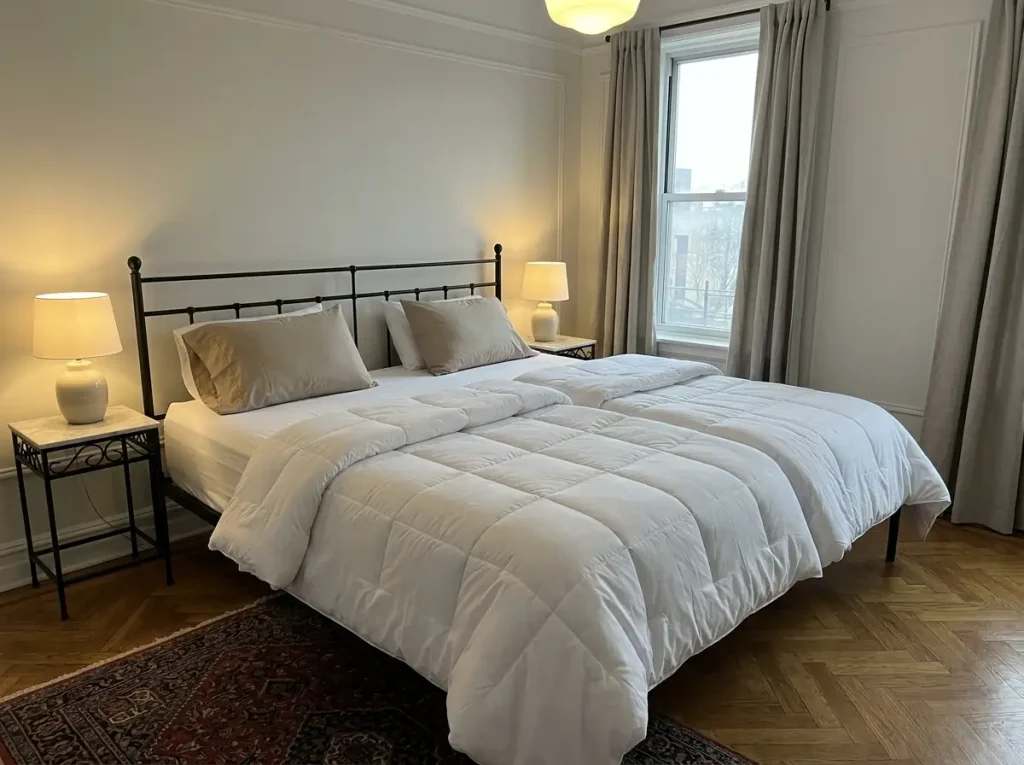
That is not a compatibility problem and it is not anybody being difficult; it is a two-people-one-bed problem with a one-duvet answer bolted onto it, and the mirror image of it turns up on the warm side of this cluster in the same split from the opposite direction. A shared bed is the case almost every warmest-bedding guide quietly writes around, because a single recommendation is easier to make than two.
The free fix comes first, and this one is genuinely free: stop sharing. Two separate duvets on one bed, the Scandinavian Sleep Method, costs nothing if there is a spare insert already in the house, and for most couples in this exact position it is not a step toward the solution, it is the whole solution.
It is also not a novelty. In the dedicated r/Bedding thread on the method, one commenter reports “2 twins is the way to go. Been doing this for 8 years strong,” and another puts it at “at least 12 years since my husband and I have shared a sheet or a blanket.” Those are households that settled on this and stayed, not people reporting on week one.
The Asymmetric Setup, and What It Costs You
The version that matches this article’s exact reader is described in that same thread by somebody living it: a thicker insert for the one who runs cold, a thin summer insert for the one who does not, on the same bed. Her verdict was that it is literally the best thing ever. Someone else describes the identical split, a very light duvet on the hot side, a wool duvet on the other that she personally would find far too heavy, solved with two twin XL inserts slightly overlapped under one shared cover, so it reads as a single king duvet from the outside.
Which is where the second insert comes in, because most people have one duvet and need two. A Utopia Bedding Twin Duvet Insert is a down-alternative all-season insert at 64 by 88 inches, and its job here is enabling the split without replacing the duvet the other sleeper is perfectly happy with. Its flaw is arithmetic: the method needs two inserts, one per sleeper, and without a shared cover pulled over both, the bed reads as two beds pushed together rather than as one.
Sizing is simple enough to say in a line. Two twin inserts on a queen, two twin XL on a king. The overlap in the middle is the part nobody warns about, and it is where this fails: two duvets laid edge to edge leave a seam that goes cold within an hour of the bed being made, and whoever sleeps nearest the middle finds it first.
The overlap is not cosmetic. It is the insulation.
Give the switch three weeks before you judge it, and know why in advance. Several people in these threads reported morning back pain or restless sleep in the first weeks after going to two duvets, and the theory that keeps coming up is that they were suddenly free to move without a shared duvet’s weight pinning them in place. That is an adjustment period rather than a fault in the method, but it is the sort of thing that sends people back to one duvet on night four if nobody told them it was coming.
And if two duvets is not the answer in your house — some couples simply do not want the bed to look like that, which is a legitimate reason — the other route is heating one side rather than insulating it. Running a heated layer on one side only solves the same asymmetry from the opposite direction, with its own trade-offs in running cost and in what it is like to sleep on. One person in these threads runs a heated mattress pad under the fitted sheet on a smart plug, warming the bed before bedtime and shutting off shortly after they fall asleep, a workaround built specifically by somebody who did not want an electric blanket running all night.
What This Adds Up To
Measure the room before buying anything. A number in the 50s and a number at 65 are two different articles, and the number decides the tog rating, not the calendar. Everything in this piece hangs off that one reading, and a cheap thermometer on the nightstand settles it in a night.
Build from the mattress up. The layer under the sleeper is the one nobody counts and the one conduction works on all night, and no quantity of blankets reaches it. Fix that first, then the sheet, then the insulator over you, in that order, because each one changes what the next one has to do.
So the warmest bedding is not the heaviest, and everything above the sleeper is the same mechanism doing the same job at different scales: still air, held. The tog on the duvet, the nap on the flannel and the wool blanket over the top are three ways of trapping it. Once you see the stack that way, the shopping decisions mostly make themselves.
After a season, check loft rather than cleanliness. Press the duvet flat with your palm and see whether it comes back, and look at the flannel’s nap where the shoulders and hips sit, alongside the pillowcase, because those are the three places it goes first. A stack that stopped working in February almost always stopped because something in it stopped holding air, not because it got dirty.
Which also settles how to put it away. Wash cold on a gentle cycle and air dry the wool rather than tumbling it, and treat seasonal storage as part of the job by keeping the winter layers somewhere dry and uncompressed until they are needed again, because a duvet that spends five months crushed into a vacuum bag comes out of it having lost the loft you were trying to preserve.
Tonight, put a spare blanket under the fitted sheet instead of on top of the duvet. Sleep on it for a week. If your back stops being the cold part, you know exactly which layer to spend money on, and it is not the one you were about to buy.
Frequently Asked Questions
01What is the best bedding to use in cold weather?
A brushed cotton or flannel sheet against the skin, a duvet at 13.5 tog or higher over it, and a topper underneath. The order matters more than any single item — a warm duvet over polyester sheets still sleeps cold, because the sheet never forms the still-air layer the rest depends on.
02What is the warmest comforter for cold weather?
One rated 13.5 tog or above, or 600+ fill power when the label gives fill power instead. Below those numbers you are in all-season territory whatever the packaging calls it. In a room under 60°F, adding a wool blanket over what you own beats buying twice.
03What goes first in a bed for a cold room?
The topper, directly on the mattress and under the fitted sheet. It is the layer that stops heat leaving downward by conduction, which is the direction blankets cannot help with and the one most cold-bedroom advice never mentions at all.
04Do two duvets work better than one in a cold bedroom?
For two sleepers with different tolerances, yes. Each person gets their own tog rating, which one shared duvet cannot do. Overlap them slightly in the middle so no cold seam opens down the center of the bed within an hour of it being made.
05Why am I still cold with a thick duvet on the bed?
Usually the sheet or the mattress, not the duvet. Polyester sheets do not hold a still-air layer against your skin, and an uncovered mattress keeps pulling heat downward all night no matter what is piled on top of you.



Tried it on your own bed?
No comments yet. Tell us what you changed, and what the sheet did after a few washes.