






What’s in here7 sections
You pull the quilt off the display bed at a home store, and it is recognizably the same object as the patchwork throw folded at the foot of a kid’s bed. Same word on the tag, same aisle, wildly different amounts of anything in the middle. A quilt is three layers held together, a top, a layer of batting, a backing, and the stitching that joins them is not decoration; it is the thing that decides how much air that middle layer is allowed to hold.
Which is why are quilts warm enough has no single answer: it depends on what the batting is and on how hard the sewing crushed it. Below is what a quilt actually is, why the stitch line is the cold part, the fix that costs nothing, when the quilt genuinely has to go, and what the whole thing looks like after a winter of washes.
Quick Answer
Conditionally. A quilt with wool or down batting and channel or baffle-box stitching can carry a normal bedroom on its own. A cotton or polyester quilt sewn straight through cannot once the room gets cold, and most quilts sold as bedspreads were never built to try.
What a Quilt Actually Has Inside It
The question cannot be answered until the word is pinned down, because those same four letters get printed on a decorative bedspread and on a batting-filled winter covering, and only one of the two was ever built to keep anybody warm. A quilt is a construction, not a warmth rating: top, batting, backing, joined by stitching that passes through all three. Nothing in that definition promises heat. It promises a sandwich.
What the batting does is hold still air. The fill does not make warmth. You make the warmth, and the fill’s only job is to stop the air you have warmed from moving away from you.
Loft, the fluffed-up thickness of that middle layer, is the measure of how much air it can hold, and it is the number that matters even though nobody prints it. That is loft and thermal resistance, in the fiber industry’s own terms, not a blogger’s metaphor: thermal insulation is a property of the structure, not of the fiber’s name.
Fill type moves the answer further than anything printed on the front of the package. Cotton batting is heavy and low-loft. Polyester batting is often warmer per unit of weight than the same weight of cotton, which is why so many quilts land on the same moderate warmth regardless of what the front says. Down gives the best warmth-to-weight ratio of all, as long as it stays dry and uncompressed, and wool holds its loft even when slightly damp, in exactly the conditions where cotton mats down and goes flat.
So when a listing says 100 percent cotton, it is telling you about the shell and the fill in one breath, and only one of those two facts is about warmth. The Bedsure PureWoven cotton quilt set is the clearest example of a listing that actually states it: cotton shell front and back, cotton fill, 90 by 96 inches. It is worth reading not as a winter recommendation but as a lesson in where that line lives on a page. Its own flaw is right there in the pattern: the stitch runs straight through all three layers, so every line of that embroidery is a strip with no fill in it, and the pattern on the surface is also the map of its cold spots.
The Secgo cotton quilt set is the same construction class at a lower price and is not the lesser object for it, though the reversible patchwork is still a through-stitch: the fill is pinned just as flat along every seam.
On r/BuyItForLife the people hunting for a natural-fill quilt keep hitting the same wall, and one of them put it plainly: “Unfortunately the quilts are stuffed with polyester though. Unless I missed one stuffed w/ natural batting.” Stuffed with polyester has become the shorthand there, and it names a real problem. The fill hides behind the word “quilt” until you open the specs, because quilts are merchandised by pattern first and fill somewhere near the bottom. It is why part of that community skips the quilt aisle for an insert and a duvet cover, where the fill type is the headline instead of the footnote.
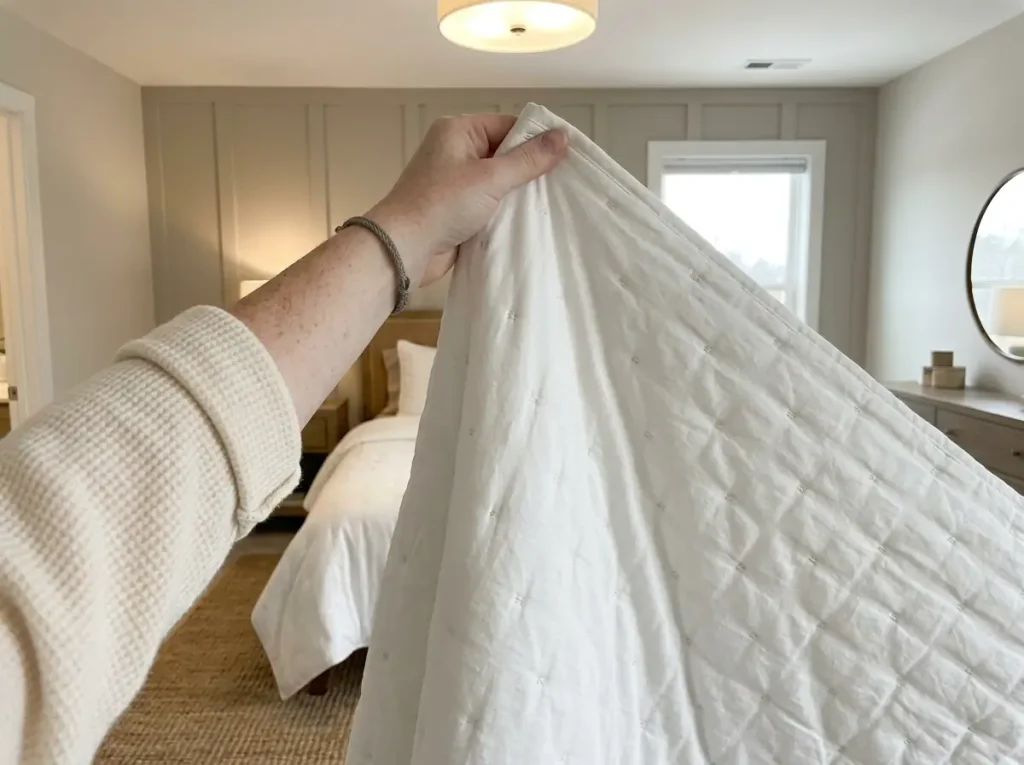
Pick the quilt up by one corner before you judge it. A real batting-filled quilt comes with you in a slab, the whole width lifting at once. A bedspread-weight one hangs from the corner and the rest of it follows late, because there is almost nothing in the middle to carry the pull.
And this is where the shopping instinct goes wrong: weight is not warmth. A cotton-batting quilt can be the heaviest thing on the bed and still lose to a lighter wool one, because warmth on a bed is trapped air, not weight. The heft you feel in the store is the fiber’s own mass, and mass is not the part that keeps you warm. The pockets between the fibers are.
Why the Stitch Line Is the Cold Part
So the fill is half the answer. The other half is a piece of sewing nobody thinks about while they are looking at the pattern, and it decides how much of that fill is doing any work at all.
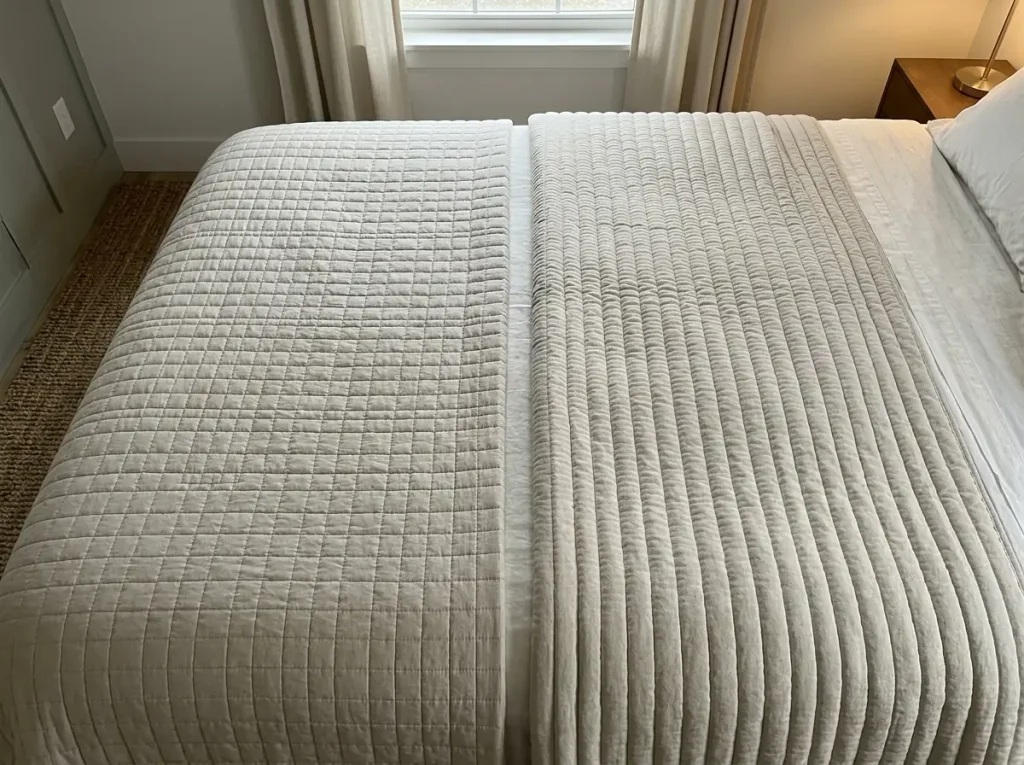
Sewn-through construction joins the top fabric directly to the backing. At the stitch line there is no fill, and where there is no fill there is no trapped air: a cold channel, repeating every few inches across the entire quilt. That is not a manufacturing defect. It is the quilt working exactly as designed, and it is the whole reason “quilts are moderately warm” keeps being repeated as if it were a property of the fabric rather than a consequence of the sewing.
Baffle box construction does the opposite. A thin fabric wall is sewn between the two shells, creating a three-dimensional chamber, and the fill reaches its full loft inside it instead of being pinched. The same fill puffs more, stays puffed longer through years of washing, and the stitch-line tension is eased, so the seams themselves last longer. “Warmer” stops being an adjective at this point and becomes a measurement: a batting’s thermal resistance is read off the ASTM hot-plate method textile labs use to measure a batting’s thermal resistance, under a still-air hood, with a number at the end of it.
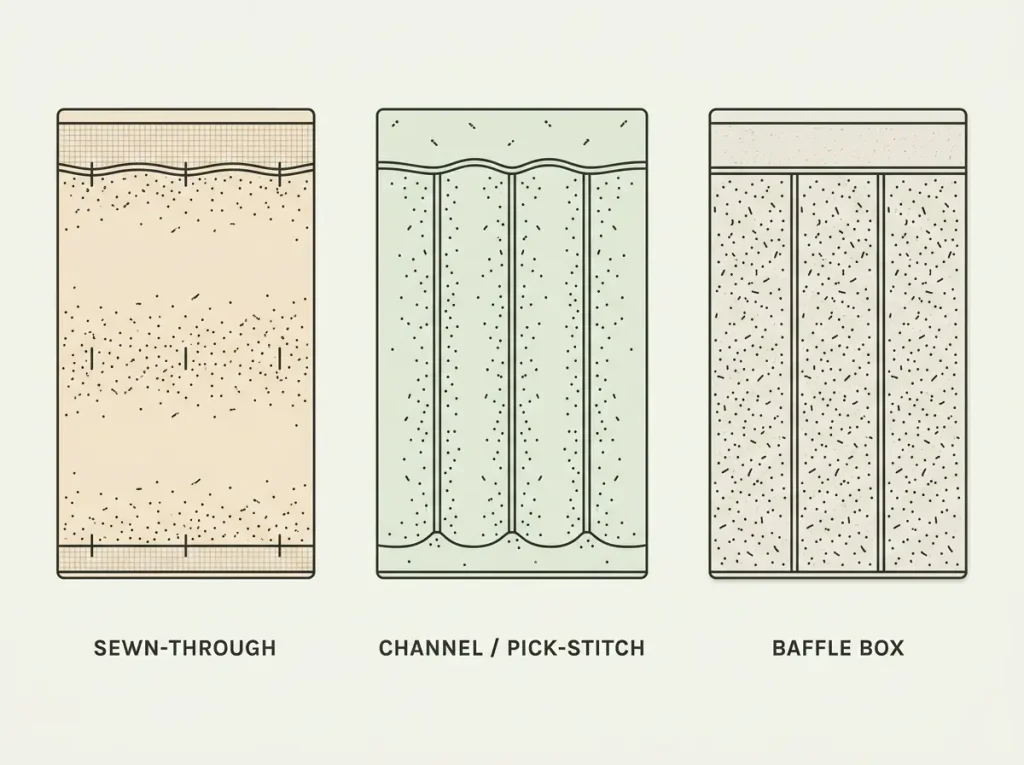
Between those two sits channel construction, sometimes sold as pick-stitch: tighter seam channels that keep the filling spread along a run rather than pinched to a single flat line. The palassio channel pick-stitch quilt set is a cotton-blend shell built that way, and it is the object this whole argument needed attached to it, proof that not every quilt compresses its fill the same way. The honest limit: channels spread the fill better than a flat grid, but they are still tight seams, and this is closer to a baffle box, not equal to one.
Older quilts are sometimes tufted instead, tied through at intervals with yarn, which pinches the fill at points rather than along lines and leaves more of it standing between them. Compressibility is the quiet trade in all of this: a fill that packs down small in a closet is a fill that packs down small under a seam.
Which is also why “comforters are warmer than quilts” is a construction fact rather than a marketing claim. A comforter is built pillowy on purpose. Most quilts are built thin and pinched flat on purpose.
The quilt is not a lesser fabric; it was sewn to lie smooth, and lying smooth and holding air are opposite goals. Worth knowing that the same construction argument runs the other way when you are trying to sleep cooler, where a flat stitch is suddenly the feature.
One more thing the shelf hides. Overstuffing, packing more fill into the same shell, raises warmth without raising the visible loft height, which is one way makers compensate for what compression takes away. Two quilts of identical apparent thickness can sleep very differently, and you cannot see it, which is the part that makes quilt shopping genuinely hard.
And if two of you share the bed, a quilt has less loft to steal than a loose-fill duvet does. When a partner pulls, a duvet leaves a gap you can feel the edge of; a quilt leaves an exposed seam line that was already the coldest strip on it.
On a cold morning, lay a hand flat on the quilt and slide it slowly sideways without lifting. The temperature steps: warm across the panel, cooler across the seam, warm again. Once you have felt it you cannot unfeel it, and that single gesture is this entire article.
The Fix That Costs Nothing: Put a Layer Underneath
Everything so far points at buying a different quilt, and that is the wrong first move. The air the stitching took out of the middle can be put back underneath instead, with something most people already have in a closet.
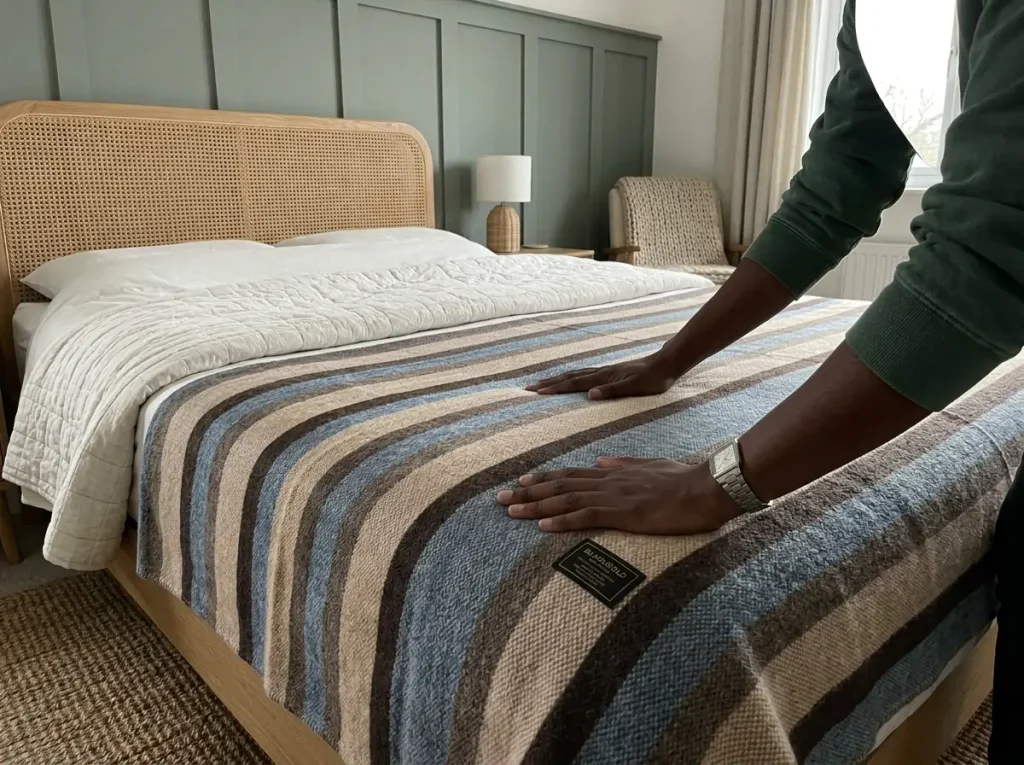
A blanket slid between the top sheet and the quilt creates a second air gap of still air, the same mechanism the batting was supposed to provide, rebuilt from outside the quilt rather than inside it. It is free if the blanket exists, it is reversible, and it takes about a minute.
It works because of where it goes, and this is the part that usually gets done backwards. Under the quilt, the blanket’s own loft is not being compressed by the quilt’s stitching, so the two air layers stack. On top of the quilt, the blanket’s weight presses the quilt’s remaining loft flatter, and a good part of what you added is cancelled by what you crushed. Same blanket, same bed, opposite results.
Fiber matters more for the layer underneath than for the quilt above it, because this is the one that ends up against the sheet and takes your moisture first. That matters most for a hot sleeper in a cold room, who is the person most likely to be damp and cold at the same time. Wool and alpaca keep their loft even slightly damp, and their breathability is what stops the added layer from turning the bed clammy. Cotton thermal weave is lighter, cheaper, and compresses faster with washing.
If there is no spare blanket in the house, that is the moment a purchase becomes reasonable. The Desert Breeze alpaca and sheep wool blanket is a 50/50 alpaca and Peruvian wool weave that does exactly what the under-layer is asked to do, though it is the most expensive thing named in this article and it is being bought to go underneath something else, so if the budget is tight, this is not where it goes.
The Utopia cotton thermal blanket is the same move at 350 GSM in a honeycomb weave for a fraction of it, with its own honest catch: cotton honeycomb compresses faster than wool with washing, so the air cushion you are adding thins out over a couple of seasons. Which blanket goes down there is really its own question, and which blanket to put down there, by fiber and weight settles it properly.
The stack, in order, is fitted sheet, flat sheet, the added blanket, then the quilt. There is one detail that decides whether it survives the week.
Tuck the added blanket at the foot along with the flat sheet, and leave the sides loose. Tuck it all round and it pulls the quilt tight against the mattress, flattening the loft you just added. Leave it entirely loose and it slides out by the second night and ends up on the floor.
There is one other honest route, and it is worth naming before this section moves on: the r/BuyItForLife answer to the same frustration is to skip the quilt aisle entirely and buy a duvet insert plus a cover, on the grounds that inserts are sold by fill type up front while quilts are sold by pattern first. Not wrong. Just a purchase rather than a rearrangement.
When the Quilt Genuinely Is Not Enough
The layer underneath buys a real amount of warmth, and there is a point past which it stops working. Worth saying plainly, because someone who keeps stacking layers onto a quilt that was never built for winter ends up with a heavy bed and a cold one. That is the trap winter bedding sets for a cold sleeper in particular, because more weight reads as more progress right up until it is not.
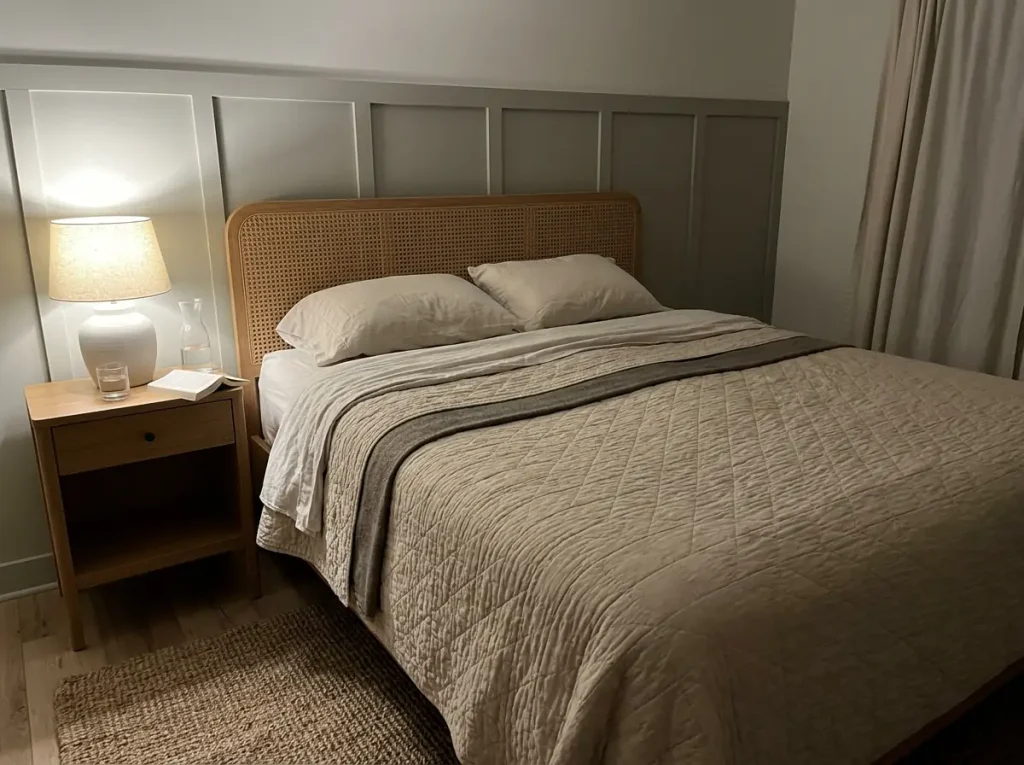
Three conditions mark the line. The room itself is cold, in which case the bedding is not the actual problem, and no bed covering fixes a room temperature. The quilt is cotton-batting and several winters old. Or it is bedspread-weight and never had meaningful batting to begin with, in which case no amount of layering will rescue what was never in there.
On that middle case, the aging is not an assumption: measured thermal-insulation loss in a bedding fill after laundering has been studied directly as its own question, which is what makes “it is finished” a verdict rather than a feeling.
When it is the room, layering the bed is treating a symptom of the house, and you can add covers all winter without ever fixing it, and when the room is the thing that is cold is a separate diagnosis with separate moves. Check that first. It is cheaper than everything else on this page.
If the quilt really is the problem, the replacement is a genuine loose-fill covering, not a thicker quilt: baffle-box or box-stitched construction, fill stated by type, and enough of it. This is the one place “comforter” earns its reputation, and it earns it on construction alone.
The Cuddledown Dreamstead down alternative comforter shows what that looks like: a 235-thread cotton percale shell over a synthetic fill rated around 500 fill power equivalent, with the trade-off stated as plainly as the spec. the fill is synthetic, not real down, so the warmth-to-weight does not reach a genuine down insert, even though the construction beats any sewn-through quilt on the shelf. For a smaller bed or a smaller outlay, the Utopia Bedding twin duvet insert is the entry point to real loose fill, with the obvious catch that it is a Twin at 64 by 88 inches and will not cover a Queen, so check the size against the bed before ordering. Whether that fill should be down or a down alternative is a decision of its own, and down against down alternative, decided properly is where it belongs.
Keep the quilt either way. In the coldest weeks it goes back on top of the comforter, where its weight is a virtue and its stitch lines stop mattering, and the rest of the year it lives on the guest bed.
Before replacing anything, feel the quilt’s border against its middle. A quilt washed through several winters has migrated batting — thin at the edges, bunched toward the center. That contrast is the tell, and it is far more reliable than how the quilt feels to lie under.
What a Quilt Looks Like After a Winter of Washes
Every judgment so far has been about a quilt as it arrives. The one that decides whether you were right is the quilt in its third January, because cotton batting does not stay where it was sewn.
Week one lies here in a particular way. A new all-cotton quilt is stiff, and the consensus on r/quilting is that it takes three to five washes with real use in between before it softens and the batting settles into whatever it is going to be. The quilt bought in October is not the quilt being slept under in January, and people judge the October one.
Softening and thinning are two different processes, and they do not happen at the same time. That is why the quilt that got nicer also, later, got colder without anyone noticing the handoff.
The first few washes settle the batting and improve the hand. The later ones compress and migrate it, and that is when the warmth actually leaves. That distinction matters more than the fabric touching your skin, because the layer above decides more than the fabric touching you in almost every winter bed.
The fill decides how fast this happens. Cotton batting mats down when it holds moisture; wool keeps its loft slightly damp and comes back. Across a run of winters that is a durability difference rather than a first-night one, which is exactly why it never shows up in a review.
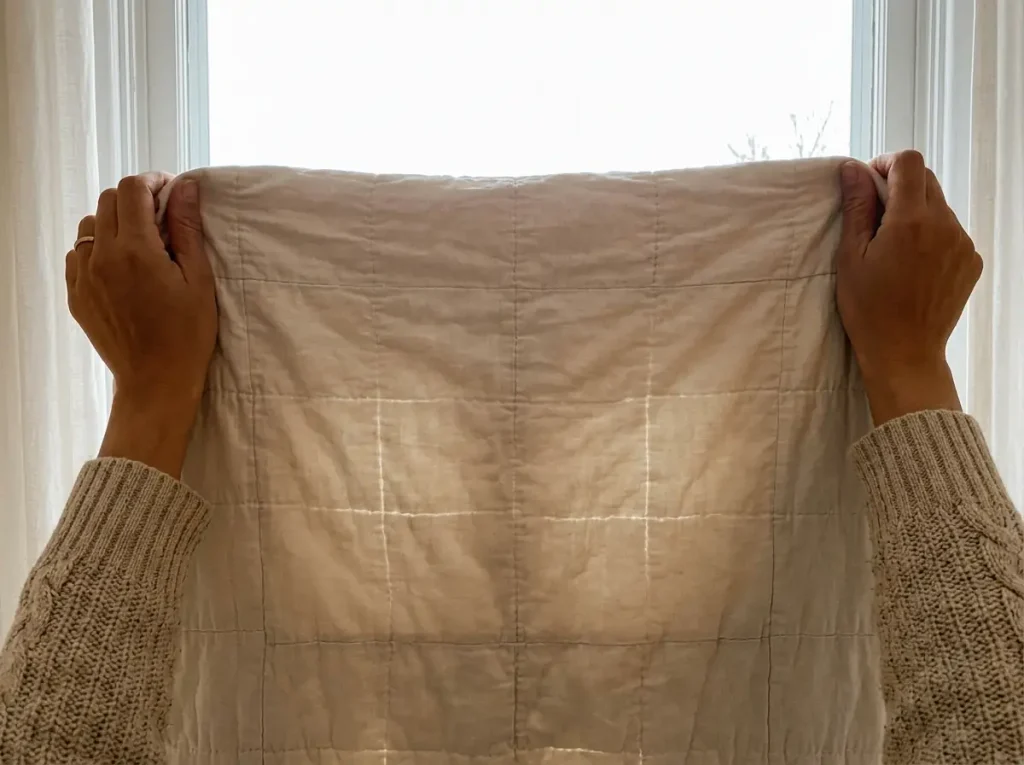
Inspect it concretely rather than by feel. Hold the quilt up against a bright window and look for thin patches, for batting bunched away from the seams, and for stitch lines that have started to pull.
What you do about it is mostly restraint: machine wash it less often than feels right, tumble dry low rather than hot, and store it uncompressed, because a season folded under something heavy removes loft exactly the way a stitch line does. Held to the light, an aged sewn-through quilt shows light through the stitch lines first, and then, a winter later, through the panels between them. The seams go before the panels do. The same construction fact showing up at the end of the quilt’s life as at the beginning.
What to do about it is unglamorous: wash it less often, dry it gently rather than hot, and store it uncompressed. Compression removes loft in a storage bag exactly the way it does on a bed, and a quilt vacuum-packed all summer comes out thinner than it went in.
Conclusion
Read the fill line before the pattern. “Quilt” describes a construction, three layers stitched through, and not an amount of warmth, so the word on the tag tells you almost nothing about the night ahead. A through-stitched quilt is cold along every seam by design; that is where its warmth goes, and it is why a comforter of the same weight sleeps warmer without being made of anything better. And before replacing anything, put a blanket underneath: it rebuilds the air layer the stitching removed, and it costs nothing if the blanket is already in the closet.
After a winter of washes, hold the quilt up against a bright window. If the light comes through along the stitch lines, the batting has started migrating away from the seams, and no amount of layering is going to put it back.
Slide a blanket under the quilt tonight. Tuck it at the foot with the flat sheet, leave the sides loose, and sleep on it for a week before deciding you need a new quilt at all.
Frequently Asked Questions
01What keeps you warmer, a quilt or a comforter?
A comforter, almost always, and not because of the fabric. Its fill sits in chambers instead of being stitched flat, so it holds more still air. A quilt’s warmth is limited by its own seams.
02What type of quilt is best for winter?
One with wool or down batting and channel or baffle-box stitching rather than a flat through-stitch grid. Wool holds its loft even slightly damp, where cotton batting mats down and goes flat.
03Can I use a quilt instead of a comforter?
Yes, with a blanket underneath it once the weather turns. On its own a quilt suits mild nights and warm sleepers; the added layer restores the trapped air its stitching removed.
04Are quilts warm enough on their own in a cold bedroom?
Rarely. In a genuinely cold room the problem is usually the room, and a low-loft quilt has the least margin of any bed covering to absorb it. Fix the room first.
05How can I tell if my quilt has real batting or is just a bedspread?
Lift it by one corner. A batting-filled quilt comes up as a slab, the whole width moving together. A bedspread hangs from the corner and the rest follows late, because there is little in the middle.


Tried it on your own bed?
No comments yet. Tell us what you changed, and what the sheet did after a few washes.