






What’s in here7 sections
- What a Heated Blanket Actually Does That a Duvet Cannot
- What Each One Costs to Run, and What Each One Costs to Own
- The Safety List Only One of Them Comes With
- What Fails, and How Long Each Side Lasts
- Two People, One Bed, Two Different Temperatures
- The Verdict, and What to Do Tonight
- Frequently Asked Questions
The search that brings people here looks like a shopping question, and it is not one. One of the two answers is already in the closet, folded on the shelf above the coats, and nobody selling the other one is going to mention it.
A heated blanket and more bedding do the same job by two completely different mechanisms: one manufactures heat out of the wall socket, the other traps the heat you are already making and hands it back. Almost everything that matters about staying warm falls out of that single difference. Here is what each one costs to run, what each one costs over a winter, the safety list that only one of them comes with, and what changes when there are two people in the bed running at two different temperatures.
Quick Answer
For most bedrooms, more bedding wins on comfort, safety and total cost across a winter. A heated blanket wins in one specific case: the room will not warm up fast enough any other way, or the bed has to be warm before anyone gets in. It also arrives with wiring, washing rules and a safety list plain bedding never has.
What a Heated Blanket Actually Does That a Duvet Cannot
The two things sit in the same aisle, on the same shelf, priced against each other, and they are not the same category of object at all. One makes heat. The other keeps the heat you are already making. Every trade-off below comes out of that sentence.
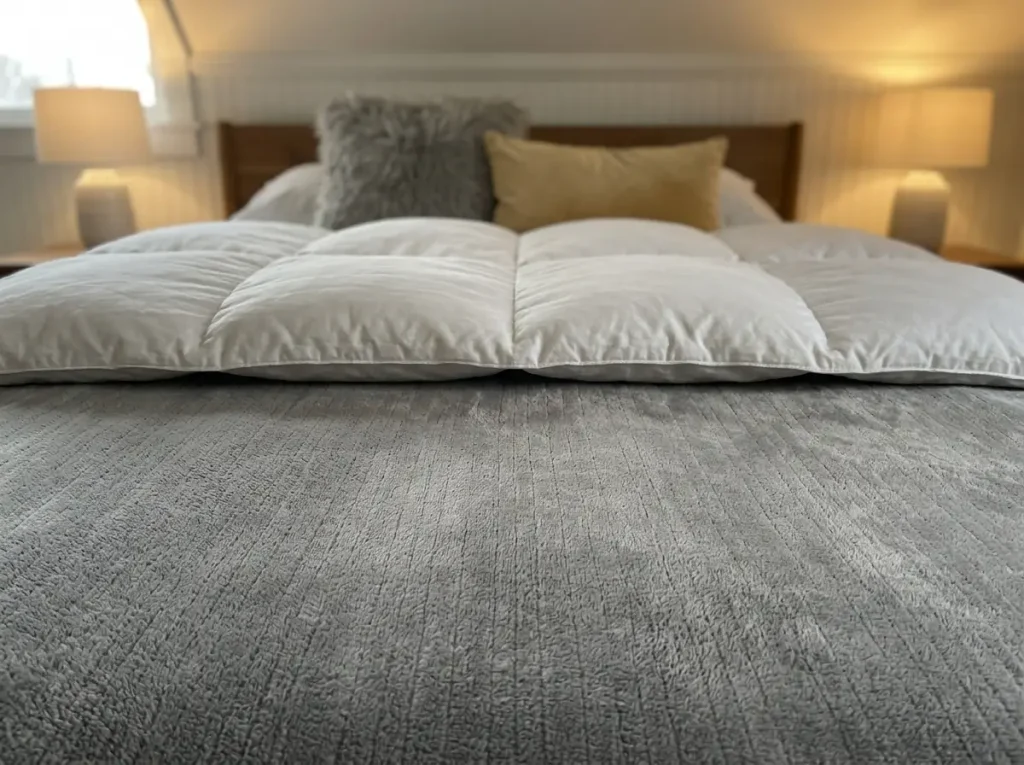
Passive bedding is an insulator and nothing else. Wool, down, down alternative, cotton batting: what they all do is hold still air in place, and still air is the actual insulation. That is why warmth in a bed is trapped air, not weight. The fill is only a scaffold for the air pockets.
So a down comforter cannot make you warmer than you are; it can only slow down how fast you leak. At a room temperature of 55°F it will still get you to comfortable, given time, because you are the furnace. What it cannot do is get there quickly, and warm up time is the whole reason the other option exists.
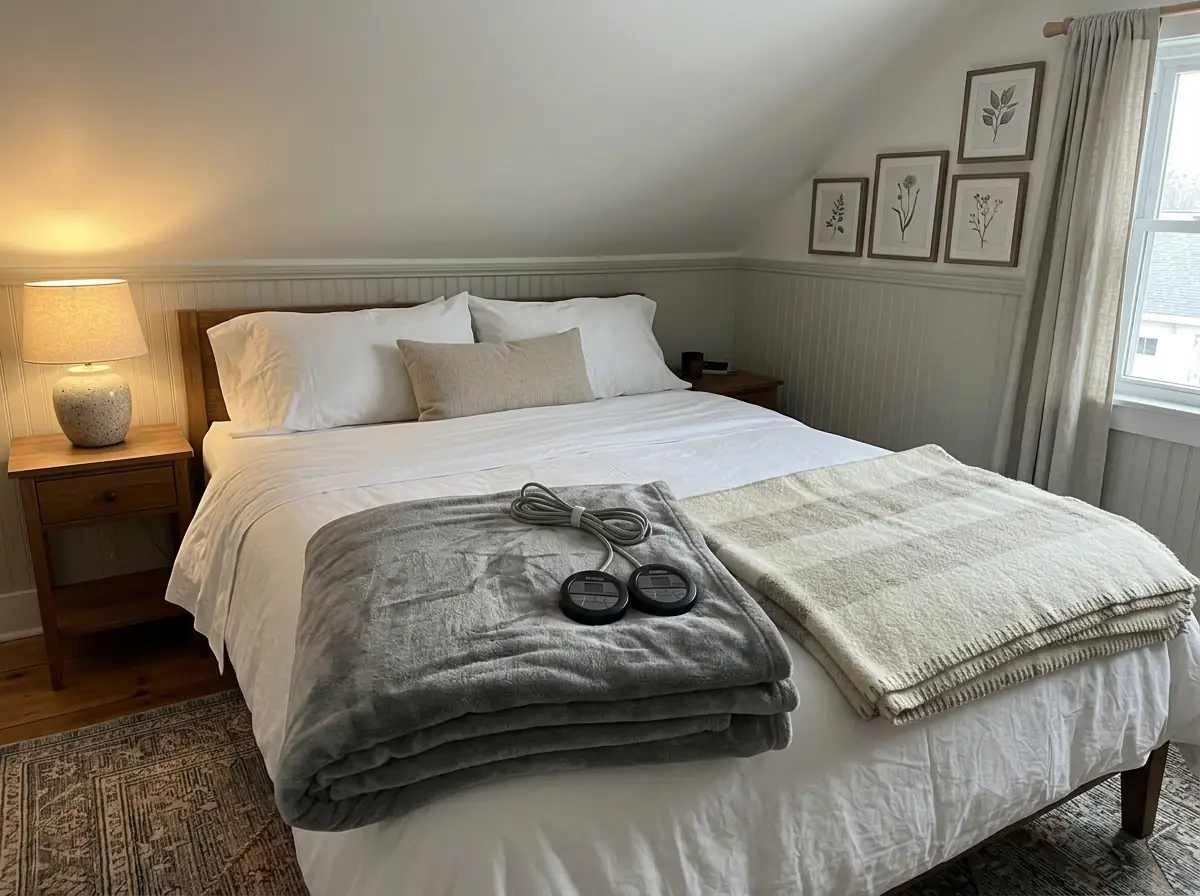
A heated blanket has no interest in whether you are in the bed. It is a grid of resistive wire sewn between two layers of fabric, converting wall electricity straight into heat, and it will warm an empty mattress at three in the afternoon just as happily as it warms a sleeper at midnight. That is the actual feature people are buying, and almost nobody names it plainly: a duvet does nothing for the first several minutes because there is no body heat yet to trap, while a heated blanket has already finished its work before anyone lies down.
Which brings up the number on the box that nobody explains. “Heats up fast” is not marketing enthusiasm, it is a written allowance. Under the UL 964 standard that caps a blanket’s surface at 149°F, a blanket is permitted to run up to 194°F during its first twenty minutes of warm-up before settling down to that 149°F steady-state ceiling. So the thing that feels impressively quick in the first minutes is the standard working exactly as designed: the blanket is allowed to be much hotter at the start than it is ever allowed to be at four in the morning.
Read the wattage too, because it is the one spec on the package that predicts something real. Most units draw between 50 and 200 watts, and that range tells you both the warm up time and what it costs to leave running. It applies to a heated throw and a heated mattress pad exactly the same way, which is worth knowing because the three get shelved together and compared as if they were interchangeable.
The wattage is printed on the controller or on the care tag, not on the front of the box, and it is the only number on a heated blanket that tells you anything. A 60-watt queen and a 180-watt queen behave completely differently: the low-wattage one is a bed pre-warmer, the high-wattage one is a room heater that happens to be lying on a mattress. Find it before you find the price.
Here is the one worth thinking about. A duvet feels cold to climb into and a heated blanket feels warm, and people read that first impression as “warmer overall.” It is not.
By hour three the duvet has caught up and gone past it, because holding heat in beats pushing heat in one direction against a cold bedroom. What you are actually paying the electricity for is the first ten minutes.
And heat direction is a variable neither side of this argument usually mentions. A poster in a badly insulated 1960s trailer, with the thermometer sitting in the 30s and 40s, gave up on the blanket on top and put a heated mattress pad underneath the sheet instead. He described the result as a dome of warm around the bed, which is a better description of the physics than most product pages manage.
Under you, the heat has nowhere to escape except through you. On top of you, half of it is heading for the ceiling.
What Each One Costs to Run, and What Each One Costs to Own
The running-cost objection is the first thing everyone raises about a heated blanket, and it is the weakest argument on the table. The electricity is genuinely cheap. The cost that actually decides this is a different number, and it only appears once you start counting in winters instead of in nights.
Do the arithmetic. At 50 to 200 watts, eight hours a night works out to roughly 12 to 24 cents for a full night at typical US electricity rates. Over a five-month heating season that is somewhere between a takeout coffee and two of them, total. That is the entire energy efficiency argument, settled, and it settles in the blanket’s favor.
Whoever told you an electric blanket is expensive to run was comparing it against nothing at all, and the comparison people actually need is against the thermostat. Turning the whole bedroom up is the expensive option by a wide margin, because you are paying a furnace or a heat pump to warm several thousand cubic feet of air so that one mattress-sized piece of it feels different. Both a heated blanket and an extra duvet beat that, and beat it by a lot.
So the electricity is a red herring on both sides. The number that matters is replacement (the cost per season, once you divide what you paid by how many winters you got), and this is where the honest answer moves the decision somewhere the reader was not expecting.
Several posters on one long-running trade forum each name multiple heated blankets that lost heat output within a few months. Not one bad unit: several different units, described independently by different people, in the same way.
Passive layers do not do this. They wear on a curve measured in years: pilling on the side that gets slept on, matting where a knee rests, loft slowly going flat. There is no moment where a wool blanket stops working, which is another way of saying the two things have lifespans that are not even measured in the same units.
The passive side also has no running cost whatsoever, no cord to fray, no controller to fail and no auto-off that has to work correctly for you to be safe. Whether wool, down or down alternative is the right layer for your bed is a separate argument, and this article is not going to hijack it. The sibling piece on which passive layer is worth the money ranks them properly. What matters here is the shape of the ownership cost, not which fiber wins.
Here is the level-three detail, and it explains a lot of confused reviews. A heated blanket does not usually announce that it has failed. It quietly stops getting as warm, so the owner nudges it up a setting. Then another.
Two winters later it is on 10 all night and the bed is still cold, and the owner is still using it. That is why the same person will report the failure as “a few months” and also admit to having kept the thing for another year. Nothing broke. It just faded, and human beings are very bad at noticing a slow fade.
Both options against each other, on the same rows:
| The question | Heated blanket | More bedding |
|---|---|---|
| What makes the heat | A resistive wire grid, powered from the wall | You do. The fill just holds the air that keeps it in |
| Warm before you get in | Yes, and this is the whole point of it | No. It needs a few minutes of you in it first |
| Cost to run per night | Roughly 12 to 24 cents at 50 to 200 watts | Nothing at all |
| What fails, and when | Heat output fades, often within a few winters | Pilling, matting and loft loss, over years |
| The safety list | Don’t fold, don’t stack, inspect the cord each season | There isn’t one |
| Two people, two temperatures | Dual controllers fix the heat gap only | Two separate covers fix heat, weight and tug-of-war |
The Safety List Only One of Them Comes With
Every roundup on this topic parks its safety paragraph near the bottom and writes it like a disclaimer, in the tone of something a lawyer asked for. It belongs up here instead. For a specific set of readers this is not a caution appended to a purchase. It is the thing that decides the purchase.
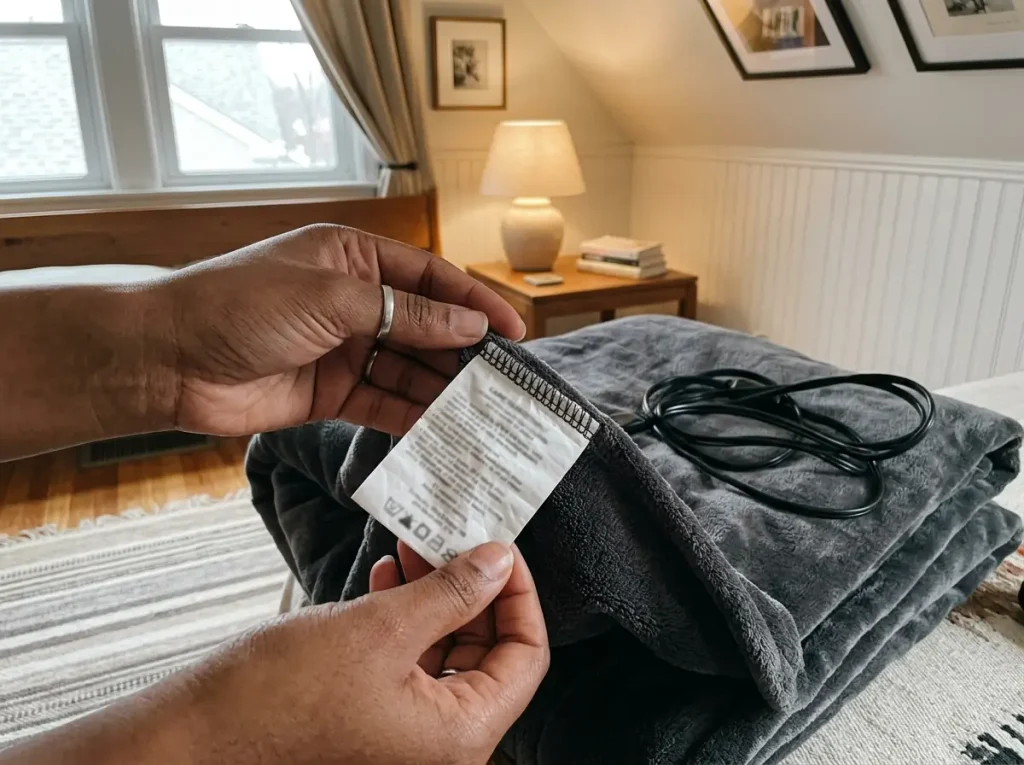
Read the care tag properly and the rules stop looking like generic legal caution. Each one maps to a specific way the wiring overheats, which is to say each one is really about wire damage arriving by a different route.
Don’t fold or bunch it while it is powered, because a fold concentrates heat in a spot where the wire cannot shed it. Don’t run it stacked under another heat source, for the same reason. Inspect the cord and the insulation at the start of each season, because the failure is usually in a wire that has been flexed a few thousand times. Pre-warm the bed and switch it off, rather than running it all night.
That is not a list of things that might theoretically go wrong. It is a list of things that have, and between them they cover both the fire risk and the burn risk that the category carries and passive bedding does not.
UL 964 exists because of exactly that scenario. It is the standard written for electric blankets, comforters, sheets and mattress pads, and what it tests is overheat protection and flame resistance under blocked airflow. In plain terms: somebody folded one onto itself while it was running and watched what happened, and the certification mark means the unit survived that.
It is a specific test of a specific failure, not a general quality sticker. An ETL mark on the tag means the same standard checked by a different accredited lab, so either one counts; what does not count is a box that says “safety tested” and names nothing.
And there is a named, current example rather than a hypothetical. In July 2026 the CPSC told consumers to stop using around 700 units of one brand of heated blanket after the internal heating wires overheated and melted through the polyester fabric — five reports of smoking, melting or burning, including one burn injury. Read the CPSC’s own 2026 warning about a heated blanket whose wiring melted through the fabric if you want the incident count in the regulator’s own words.
The blankets had been sold on a major platform from February through October of 2025. The storefront does not inspect the wiring inside the things it lists, which is why the certification mark on the tag is the thing to check and the size of the retailer is not.
Then there is the group for whom this stops being a shopping question. Anyone who is pregnant, has diabetes or neuropathy, has reduced heat sensitivity, or has an implanted cardiac device should ask their own doctor before sleeping under something that makes heat. That is the whole of it: a hand-off, not an assessment, and this article is not going to explain any of those conditions to you.
The same goes for an infant, for anyone who cannot move themselves off the blanket, and for a bed that pets nest on. In every one of those cases the passive layer is the answer that requires nobody’s permission, which is not a small advantage.
Passive bedding has no equivalent list. None. A wool blanket’s worst-case failure mode is that it pills, and that is the entire asymmetry of this comparison in one sentence.
Run the cord through your fingers along its whole length at the start of every heating season, and do the same along the blanket itself for stiff spots or lumps in the wire path. You are feeling for a hard kink where the wire has taken a permanent bend, usually within a foot of where the controller plugs in, because that is where it gets pulled every time the bed is made. A kink there is the end of that blanket, not a repair job.
The rule everybody breaks is the folding one, and it breaks itself. A made bed folds the blanket at the footboard by definition; a comforter goes over the top of it; the duvet gets tucked. Half of the “don’t do this” list is violated by making the bed normally. Which is quietly why “switch it off before you get in” solves most of the list at once, because an unpowered blanket can be folded, bunched, stacked and sat on with no consequence at all.
What Fails, and How Long Each Side Lasts
This is the question every ranking page structurally cannot answer, and not because the writers are lazy. A test window is a few weeks long. This failure takes a season or three to show up. You cannot review your way to it; you can only own your way to it, or read the people who have.
The first failure is the heat one. On a decade-spanning trade forum, several independent posters name different heated blankets that started out fine and then, after a few months, stopped heating up much, with one owner having gone through the warranty process more than once for the same fault on the same brand. The community word for it is that the blanket crapped out, and the term is precise: it does not mean dead on arrival, it means the heat quietly dropped to nearly nothing while the thing still switches on and still lights up its controller.
The second failure is a different animal, and it is the more interesting one. A poster who cut open a dead blanket found the safety microcontroller had read a false over-temperature signal and then permanently reprogrammed itself to stay cool — locked into barely-warm as a failsafe, inside about a month of ownership. His verdict was that the thing was programmed to fail.
There is no repair for that. The chip made a one-way decision and the only remaining option is the return window.
But it is not universal, and the exception is the useful part. The same thread has someone running a different brand for years without trouble, on its lowest setting, used to pre-warm the bed and then switched off, never left on overnight. The variable that predicted survival was the habit, not just the badge on the controller.
Which is worth pausing on, because it inverts the usual advice: the standard recommendation is to buy the better-reviewed blanket, and after enough of those threads, changing how you run the one you own looks like the better bet. So before replacing anything, try that. Run it low, warm the bed for an hour before you get in, switch it off. It costs nothing, it is the pattern the one long-lived unit in that thread had, and it is the cheapest lifespan extension available to anybody.
Write the month you bought a heated blanket on the care tag in laundry marker. The fade is slow enough that nobody can remember whether the bed used to be warmer, and the tag settles the argument in three seconds. It also tells you honestly whether you are on your second unit in three winters or your third, which is the actual number this decision turns on.
The passive side does not fail; it degrades. Wool mats slightly where weight sits on it, and pills on the side that gets slept on. Down alternative loses loft as the fibers break down and stop springing back. Neither has a moment where it stops.
A machine washable 100 percent virgin wool blanket like the Faribault Mill Pure & Simple is the concrete version of this, and that part matters more than it sounds, because “wool means dry cleaning” is the objection that rules wool out for most people before they get to the warmth argument. Its flaw is that it is still wool: heavier to move around wet, and slow to dry, so you line dry it rather than reaching for tumble dry low the way you would with cotton.
If that is more than you want to spend, the Desert Breeze alpaca and sheep wool blanket is a 50/50 alpaca and Peruvian sheep’s wool blend woven in Peru, and it names its fibers instead of describing how warm it feels. Its own flaw is shedding: it drops some lint through the first few washes, and an extra gentle cycle at the start sorts it out.
Loft loss is the slow one people mistake for a colder winter. A comforter that has flattened over four seasons looks identical made up on the bed, because the cover has not changed at all.
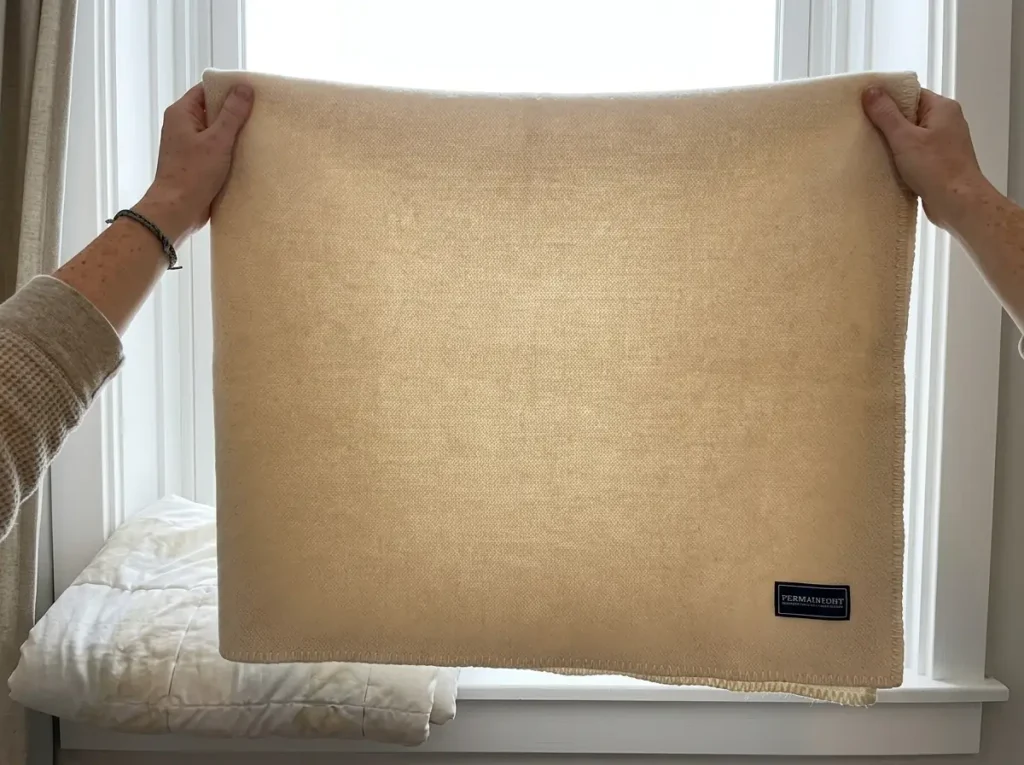
Hold it up against a window instead and look at the flat spots. Light comes through where the fill has migrated or compacted, and it is startling how obvious it is once you look. That same window test is how you check whether the stitch pattern is holding the fill where it should be, which is the real difference between a quilt that stays warm and one that goes cold in patches.
Two People, One Bed, Two Different Temperatures
Everything above assumes one sleeper. A lot of these beds have two, and this is the version of the question where the two answers stop being interchangeable at all.
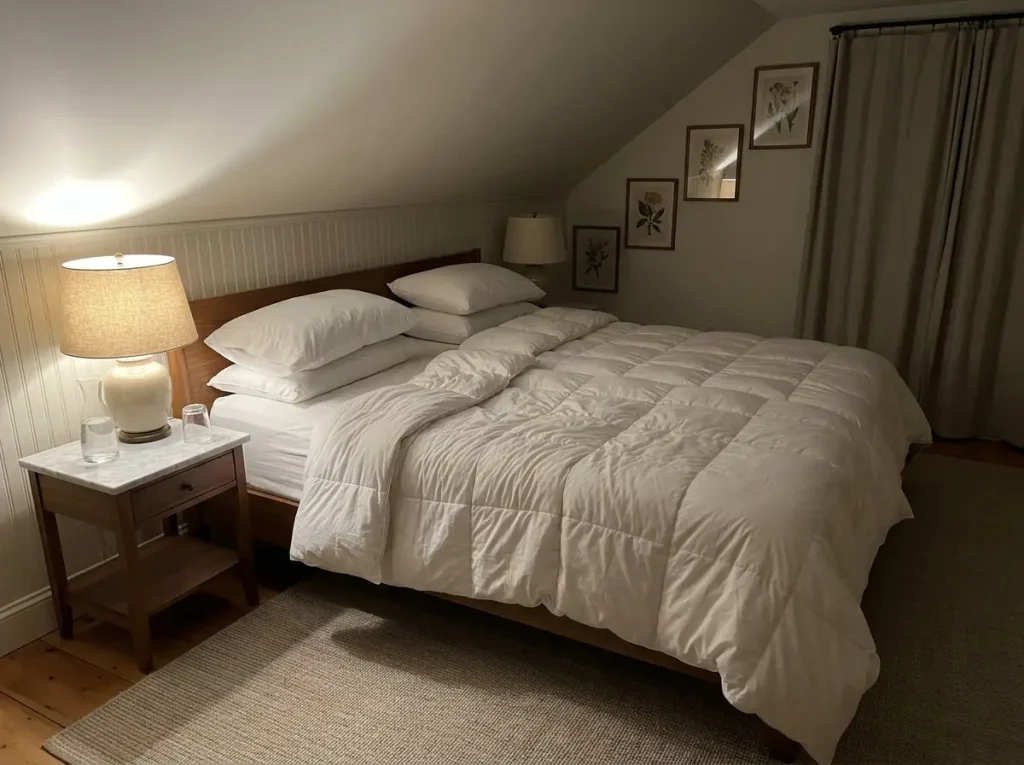
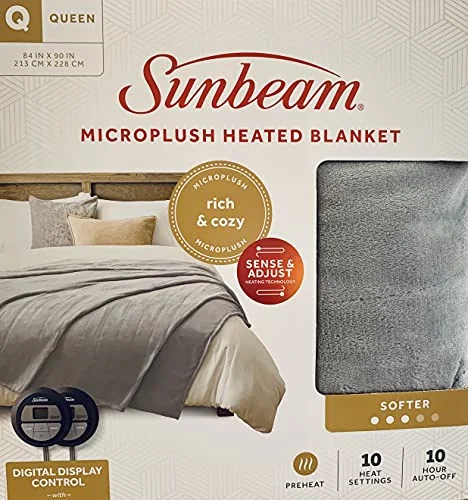
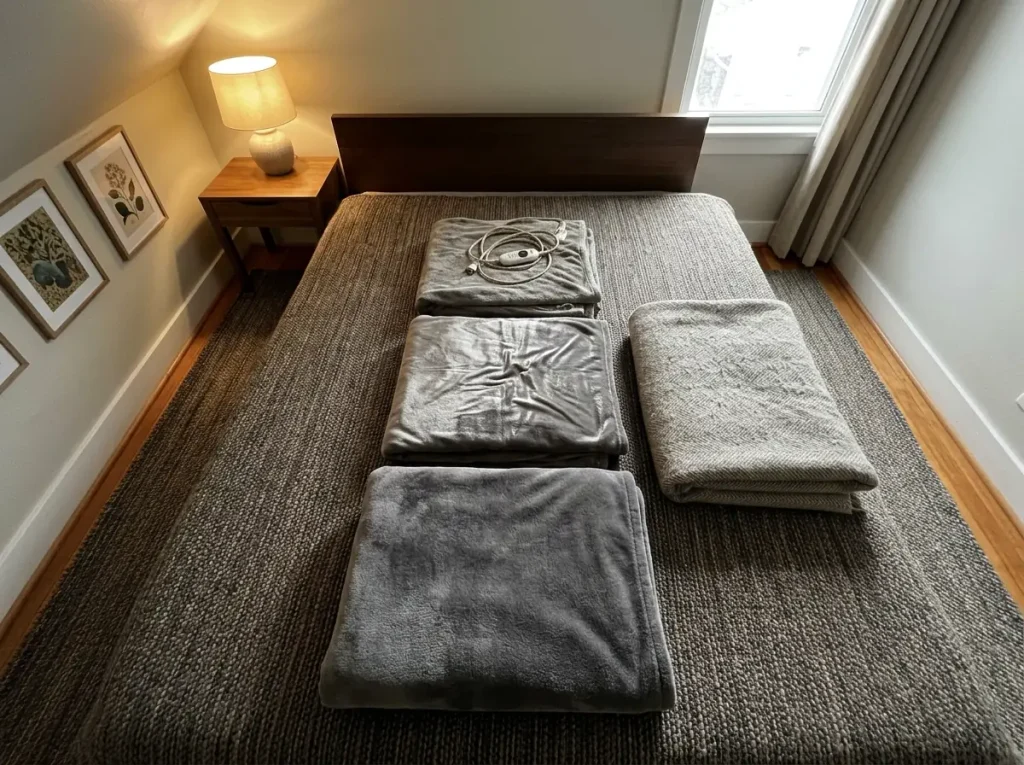
The electric answer is dual controllers, one per side, and this is genuinely what they are for rather than a feature invented to justify a price step. The reference unit above has two. In a shared bed the cold sleeper sets their own half and the hot sleeper sets theirs, and the disagreement disappears, at least the temperature part of it. Dual zone is the phrase to look for on the box, and it is one of the few features on these things that means exactly what it says.
The passive answer arrives from an unexpected direction. On that same forum, a Canadian poster with decades of cold-weather experience behind him, the kind who has slept outside below minus fifty, recommends two duvets rather than one shared blanket for a mismatched pair, naming the specific case of sleeping next to someone having hot flushes.
That is not a design trend or a European affectation imported by bedding marketers. It is what somebody landed on independently because it worked. If the mismatch is hormonal rather than a cold room, that changes which half of the pair needs the intervention, but the two-cover fix is the same fix.
Now compare what each one actually solves, because they are not solving the same problem. Dual controls fix a temperature gap on a shared surface — useful, real, and limited, because both sleepers are still under the same top layer, so the weight and the loft stay shared and non-negotiable.
Two separate covers fix the temperature gap, the weight gap, and the two-in-the-morning migration where one person rolls and takes the whole thing with them. With no wiring on either side.
For the two-covers version you need a duvet you can buy two of, and the Cuddledown Dreamstead down alternative comforter states a 235-thread-count cotton percale shell, a synthetic fill equivalent to roughly 500 fill power and OEKO-TEX Standard 100 certification, which is three real numbers where most listings offer adjectives. Its flaw is in the word all-season: in a genuinely cold room it is a layer to combine with something else, not the whole winter answer by itself.
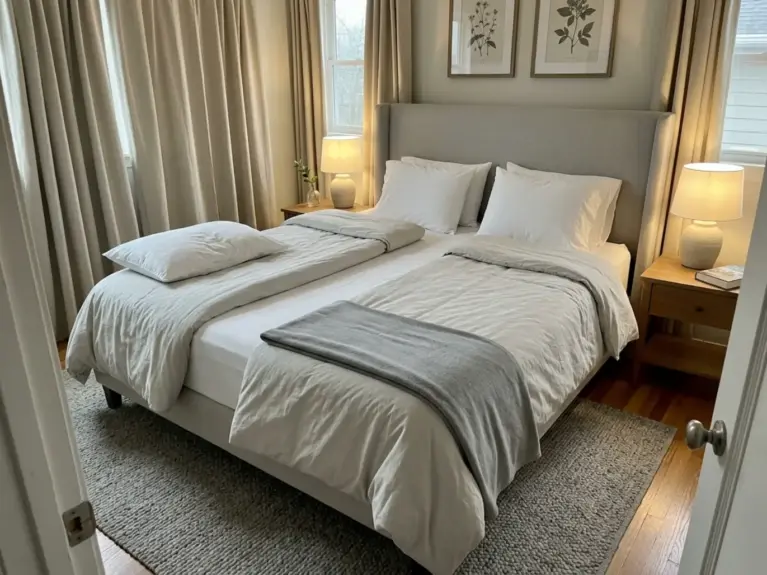
Buy two duvets one size down from the bed, not two of the same size. Two queen duvets on a queen mattress puts eight feet of loft on a five-foot bed and the overhang drags on the floor on both sides. Two twins on a queen, or two fulls on a king, meet in the middle with no gap and no puddle, and each one still tucks properly on its own side.
There is a separate case that is not about the pair at all. If the room itself is genuinely cold, rather than the two of you being mismatched, insulating from underneath beats covering from above — the passive version of that dome-of-warm post from the trailer.
A pillow-top mattress topper at 1300 GSM puts a thick layer of down alternative between you and the mattress, which is where a surprising amount of heat goes on a cold night, and it does it with no cord. Worth knowing before you order: stock on that one runs thin, so it may need substituting with an equivalent GSM.
And if the cold bedroom is the whole problem rather than one layer of it, building the whole stack for a cold room is a different question with its own order of operations. This article only answers plug it in or add a layer.
One honest warning about the two-duvet setup. It looks wrong the first night. The seam down the middle of the bed reads as a divide rather than a fix, and it photographs badly, and there is no arrangement of pillows that hides it.
Most people who try it stop noticing by the end of the first week. The ones who abandon it almost always abandon it within three nights, and over how it looked made up rather than how it slept.
The Verdict, and What to Do Tonight
The electricity was never the expensive part of a heated blanket. What it costs is the replacement cycle, so count in winters rather than in nights, and be honest about how many units you have already been through.
Passive layers wear out. Heated ones fail. Only one of the two arrives with a list of things that must never happen to it, and for a lot of households that list is the honest deciding factor rather than a footnote, especially where the answer needs to work for someone who cannot get themselves off a blanket that has gotten too warm.
A heated blanket earns its place in one situation, and it earns it properly there: a room that will not get warm fast enough any other way, or a bed that has to be warm before anybody gets into it. Outside that, the answer is already in the closet.
By the third winter, run two checks. Hold the comforter up against a window and look at the flat spots, because that is loft loss telling you it has thinned while the cover kept looking fine. And put a hand flat on the heated blanket after ten minutes on a middle setting, because that is the blanket telling you whether it still reaches the temperature it used to, before you spend another season nudging it up a number at a time.
Tonight, before ordering anything at all: put whatever spare blanket is in the closet on top of the duvet, and turn the bedroom thermostat down two degrees. Sleep on it a week. If that fixed it, the decision has already been made for you and it cost nothing.
Frequently Asked Questions
01Is it cheaper to turn up the heat or use an electric blanket?
The blanket, by a wide margin. Heating one bed at 50 to 200 watts costs pennies a night, while heating a whole room to the same felt warmth runs the furnace or heat pump for hours to warm air nobody is using.
02What are the downsides of using a heated blanket?
A replacement cycle measured in a few winters, a safety list plain bedding does not need, and no help at all during a power cut. Owners commonly report heat output fading months in, well before the blanket looks worn.
03Is it good to sleep with a heated blanket every night?
Most safety guidance points the other way: pre-warm the bed, then switch it off. The one long-lived unit in a decade-long owner thread was run exactly that way, while the ones that failed were left on overnight on high.
04What is better than an electric blanket?
For most bedrooms, a heavier duvet or a wool blanket over the one already there. Same warmth, no wiring, no wattage, and a wear curve measured in years. Electric wins when the bed must be warm before anyone gets in.
05Which is warmer, a comforter or a blanket?
The comforter, usually, because it traps air in loft rather than in fiber and loft is what holds heat. A dense wool blanket over a thin comforter can beat a thick comforter alone, since the two trap air at different scales.

Tried it on your own bed?
No comments yet. Tell us what you changed, and what the sheet did after a few washes.