







What’s in here6 sections
It is two in the morning, the sheet is stuck to your back, and you are changing a pillowcase in the dark for the second time this week. The word that frightens people about sweating at night is not sweats. It is every.
But a bed that has not been touched since February is doing exactly the same thing to you in September that it did then, at the same rate, with no variation at all, which is the one behavior that looks most like something coming from inside you. This article names the four things in a bedroom that never change, gives you a way to test them for free, and reads the two people one bed case where only one of them wakes up wrung out. What it will not do is tell you what the sweating means, or when to see a doctor about what it means. That part belongs to a doctor.
Quick Answer
Sweating every night is not by itself a bedding answer or a medical one, and there is a single line between them: does it happen no matter what you change about the bed and the room? Hold the room still, strip the bed to its lightest layers for three nights, change nothing else. If the pattern breaks, it was the bed. If it does not, the bed was never the variable, and that is a doctor’s question rather than a shopping one.
What “Every Night” Actually Describes
There is one distinction worth borrowing here, and only one: whether the sweating shows up only when the room or the bedding is warm, or whether it shows up no matter what you change. That is where clinical sources draw the line at whether it happens regardless of the room, and it is the hinge this whole article turns on. Everything below assumes you are trying to find out which side of it you are on.
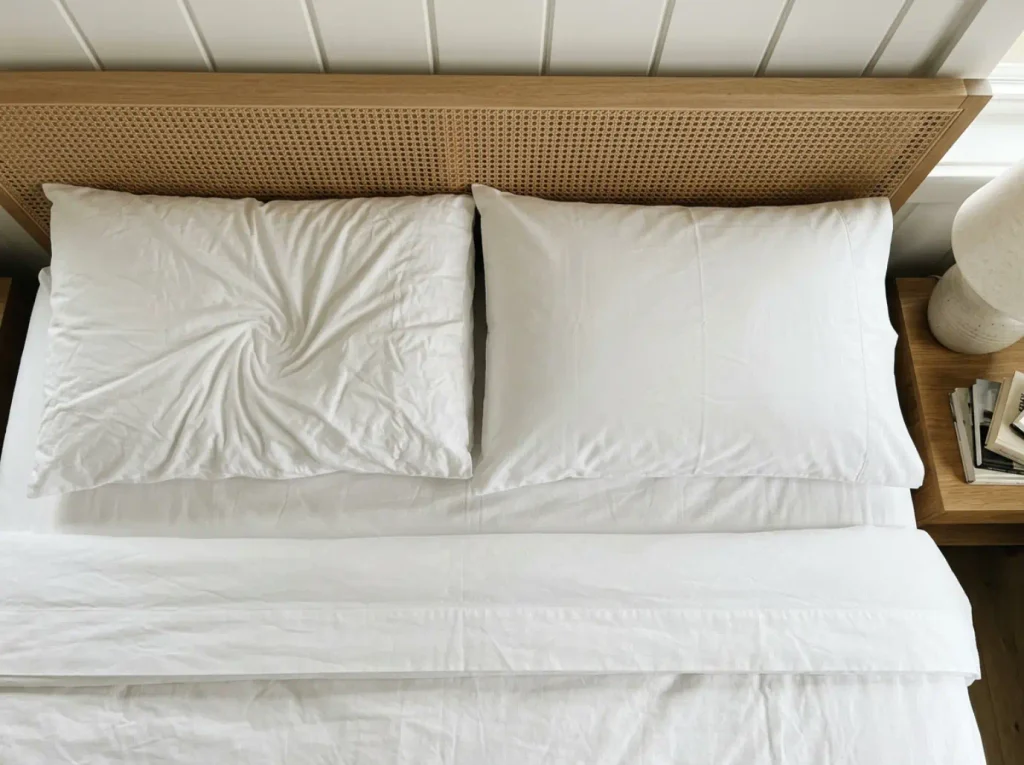
So look again at the word every. It is not a measure of how bad this is. It is a measure of how consistent it is, and consistency is a clue, because consistent results usually come from something that is also consistent.
A thing that varies produces nights that vary. A thing that never varies produces the same night, 365 times. Which is why the frequency of sweating tells you more here than the amount does.
And a bedroom is full of things that never vary. The mattress has been the same mattress for years. The protector went on once and has not been off since. The comforter has been on the bed since winter and nobody has thought about it since the weather turned.
The thermostat was set at some point and nobody has touched the dial in months. Four objects, all doing the same job at the same intensity tonight as they did in February.
On a forum thread about night sweats, someone described two straight weeks of soaking through the sheets, with the same thermostat setting, the same sheets and the same blankets, and “absolutely nothing” changed. That sentence almost always gets offered as proof the bed is innocent. It is the opposite. Nothing changing is precisely the condition under which a bed can hand you the identical result every night of the year.
None of which is meant to talk you out of what you are experiencing. The community’s own words for this are “soaking wet” and “totally drenched”, and if you have run out of clean pajamas at two in the morning, being told your room temperature might be a touch warm is not an answer. The point is narrower than that: before frequency gets read as severity, it is worth spending three free nights finding out whether the frequency belongs to the bed.
Here is one level-3 tell while you are deciding. A bed-driven pattern prints in the same place every time, the shoulder blades or the small of the back, because the same square of mattress is doing the same thing under you all night. Sweating that comes from elsewhere moves around, and takes the pillowcase and your hair with it. If you want the layer-by-layer version of this, the pillar article ranks the four layers from the mattress up.
The Four Things in a Bedroom That Never Change
Start with the mattress, because it is underneath everything else and nobody thinks of it as bedding. Memory foam has a closed-cell structure: it hugs you, which increases the amount of skin in contact with it and restricts airflow at the same time, and it does not wick, so the moisture has nowhere to go.
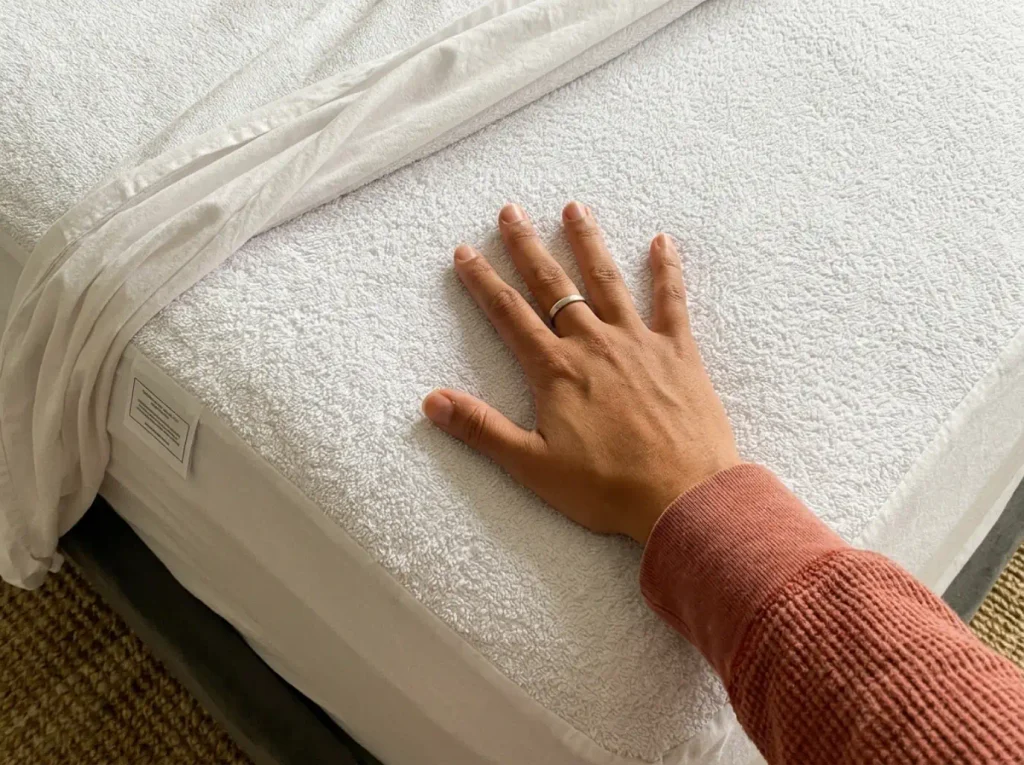
That is not something the mattress does on bad nights. Foam mattress heat retention is a fixed property, working at full strength every night of the year.
Latex is open-cell and breathes by its own construction; a hybrid with a coil layer has actual air moving through it. Either way, mattress breathability is a constant, and the only question is which kind of constant you are lying on. No amount of breathable bedding on top changes what the slab underneath is doing.
Then the thermostat, which is the cheapest one to check and the one people skip. Your core temperature has to fall for sleep to happen properly, and a room warmer than the 65 to 68 degree range sleep researchers recommend works against that drop with perfect consistency, because the dial has not moved since whenever you last thought about it. A room set wrong is wrong identically every night. That is what makes it read like something coming from the sleeper.
Now the layer nobody suspects, because it went on once, years ago, and has been invisible under a fitted sheet ever since. Mattress protectors come with two very different backings and the packaging rarely makes a fuss about which. A vinyl or PVC membrane blocks airflow almost completely — a sheet of plastic between you and the mattress, doing what a sheet of plastic does.
A TPU backing is a different animal: the membrane has microscopic pores, small enough to stop liquid and open enough to let water vapor through, so sweat can leave as vapor instead of pooling on top of a barrier. The Nestl Premium Cotton Terry Mattress Protector is the plain version of that second kind, cotton terry on the face and TPU underneath, though the terry adds a layer of real thickness under the fitted sheet and on a tall mattress it can put a deep pocket right at its limit.
And here is the free check that costs nothing: peel the fitted sheet off one corner and put your palm flat on what is under it. A terry or cotton face gives the warmth back slowly. A plastic membrane feels cool for about a second and then goes clammy under your hand. That is the same thing it has been doing under your back all night.
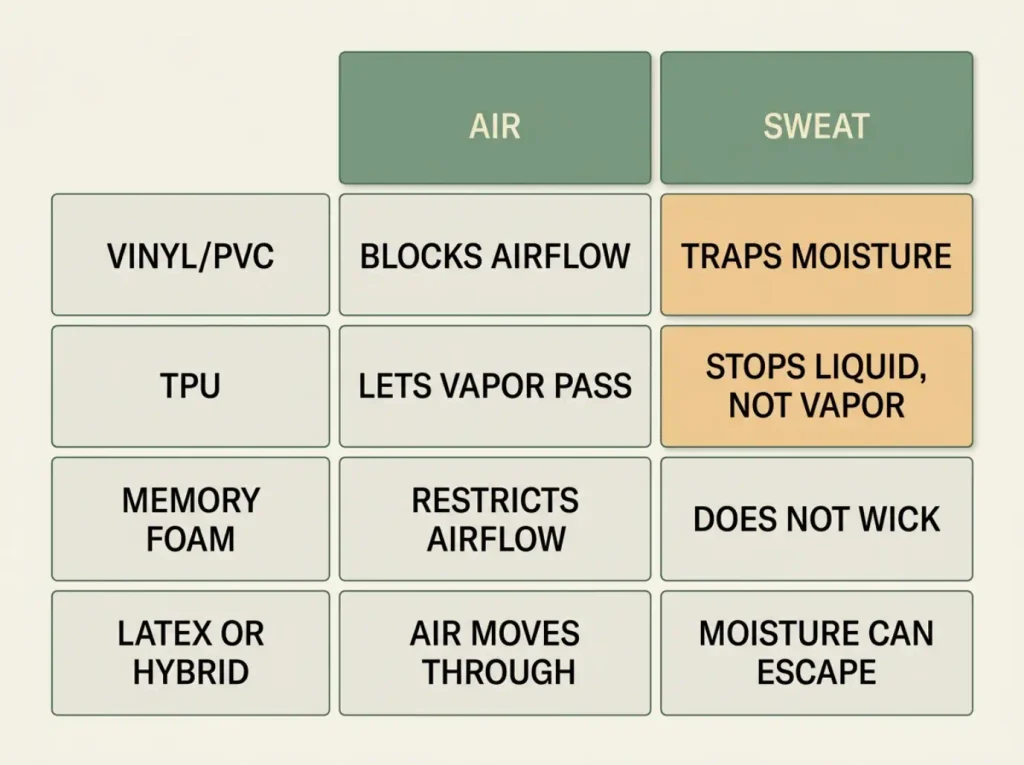
Sit down hard on the bare protector before you buy or blame anything. If it crinkles, the backing is plastic. TPU is silent and cloth-like under weight, and that one second of noise tells you more than any label on the package will.
The fourth constant is the comforter, and it is the easiest to prove. Same fill, same weight, on the bed since winter, because taking it off is a chore nobody schedules. A duvet that gets swapped with the seasons is a variable and behaves like one.
A synthetic comforter or a down comforter that never comes off is a constant running at full winter strength in September. It has no way of knowing the weather changed, and swapping in lightweight bedding for the warm months is the one seasonal move that turns it back into a variable.
Which brings up the fabric on top, where the same distinction applies and almost nobody makes it. A weave either has gaps in it or it does not. Percale is one thread over, one under, which leaves the gaps that let air move.
The Feather & Stitch 100% Cotton Percale Sheet Set is 300 threads in that plain one-over-one construction with a 16-inch pocket, and it is a breathable fabric because of how it is built, not because of a finish sprayed on it that leaves in the wash. It will also never have the smooth, cool slip of a sateen, and it will never look ironed. Decide now whether you can live with that, because it is permanent.
Sateen floats four threads over one: smoother, denser, closed. If you want why one weave moves air and another traps it in full, that is the cooling pillar’s whole subject.
The usual advice at this point is to buy better sheets, and honestly, sheets are the layer people reach for first because they are the layer they can see. On an r/sleep thread about one partner soaking the bed nightly, the most-repeated non-medical explanation from other commenters was not the sheets at all. It was the mattress: “Tempurpedic mattresses make me insanely hot when sleeping… Those mattresses don’t breathe well.”
The community’s own phrase there is “doesn’t breathe well”, which is a mechanism, not a diagnosis, and the same thread’s cheapest suggested fix was still the sheet fabric, because it is the one you can change in an afternoon. Both things are true. Start with the cheap change, but the layer order matters: the sheets sit on top of three constants that are bigger than they are.
How to Take the Bed Out of the Equation for Three Nights
Fifteen articles have already told you to try lighter bedding. None of them told you how to run it so the answer is worth anything, which is the difference between an isolation test and a shrug. Change four things at once and you learn nothing. Change one thing for one night and you learn nothing either.

Hold the room still first. Set the thermostat once, somewhere in that 65 to 68 range, and then leave it alone for the whole window. Same sleepwear, same bedtime, same everything. The room stops being a suspect and becomes a fixture. That is the entire point: you cannot measure a variable while three other things are moving.
Then strip to the lightest combination you own. Fitted sheet, one flat sheet, nothing else. The comforter goes over a chair, not folded across the foot of the bed, where it is still a warm slab against your feet all night and still in the experiment.
If you would rather test a different fabric than simply subtract layers, the PeachSkinSheets Cooling Bed Sheets for Hot Sleepers are brushed microfiber with a moisture-wicking finish and an OEKO-TEX certification, which makes them a reasonable single-variable swap. Being microfiber, though, they lack cotton’s cool first touch and feel warmer for the first minute even though they move moisture better after that.
Take the protector off, or at least check it. This is the step everyone skips, and it is the one that most often changes the result. If yours has the plastic backing, the fastest version of this test is running the three nights without it entirely. If you would rather sort out which protectors actually breathe before you decide, that comparison is a separate piece.
Give it three nights. One good night is weather, a cool front, a day you were tired enough to sleep through anything. A three-night test tells you whether the every actually broke, which is the whole difference between occasional sweating and the regular night sweats you came here about.
Then read the result honestly, which means accepting either answer. If the pattern breaks, the bed was carrying it, and the three-night version of this, in detail takes you the rest of the way. If the pattern does not break, you have learned something worth more than a new sheet set: the bed is not the variable, and no amount of new bedding is going to move it.
Do not start the window on laundry night. Fresh sheets are drier, cooler and stiffer than sheets that have been on the bed for five days, so night one comes back falsely good and you conclude it was the sheets. Run the three nights on bedding already slept in for a couple of days, or change the sheets on all three, so at least the error is even.
There is a version of this that never gets run, and it is worth naming because it is common. On an r/sleep thread, a memory foam mattress topper had been under the sheets for months before the sweating started, and it never came off long enough for anybody to find out whether it was the reason. A constant that never gets removed cannot be tested. And it will not volunteer.
When One of You Sweats and the Other Doesn’t
Two people, one bed, one mattress, one room, one thermostat, one night. If only one of you wakes up wrung out and the other has not stirred, every environmental variable in the room has already been controlled for by the bed itself.
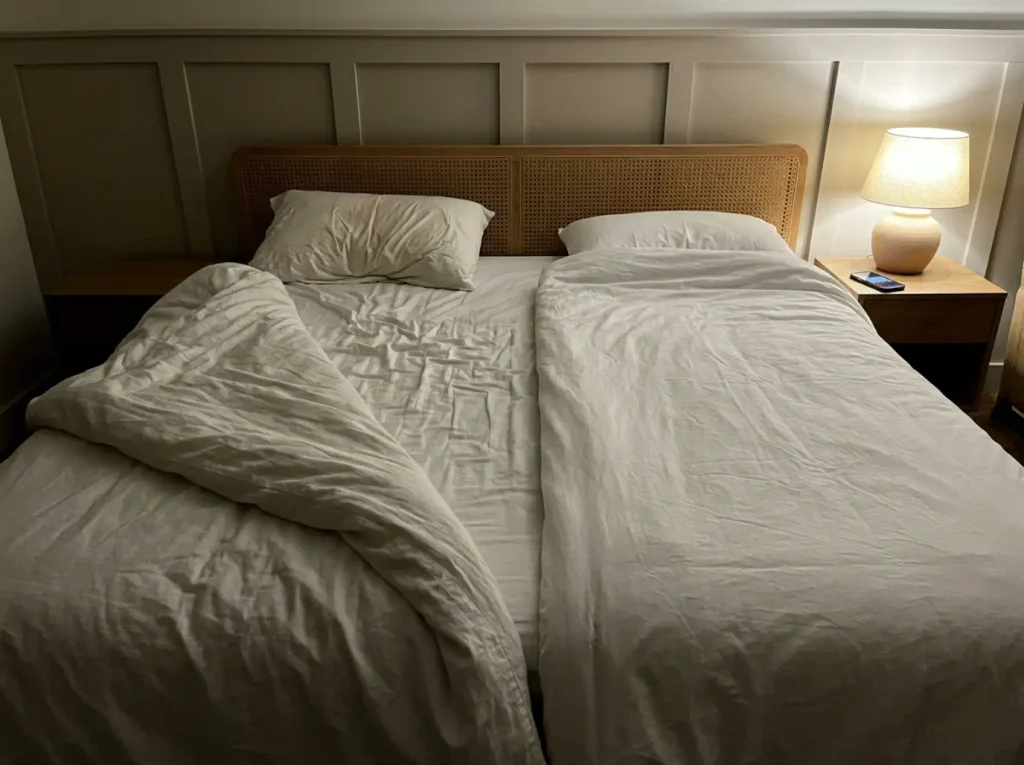
Same foam holding heat, same air, same dial nobody touched, same comforter. The constants are identical for both of you, so the constants are not what differs. That is a real experiment, it ran itself, and it cost nothing.
Be careful about what that licenses, though, because it is less than it sounds. It does not say what is different, and this article is not going to guess. It says the bed has been ruled out on the cheapest evidence available, which is a genuinely useful thing to know and also the end of what the evidence supports.
Something worth doing on a shared bed regardless of any of this: two separate duvets. One sleeper’s warmth stops being a compromise with the other’s, which is the arrangement half of Europe already uses and which one commenter on that thread named as the low-cost fix for two different needs in one bed. If one of you simply runs hot as a baseline rather than in a pattern, the four-layer framing there is the better starting point.
And the reason people abandon the two-duvet setup on night three, which nobody mentions: a gap of bare sheet opens down the middle where the two duvets meet, and whoever is on the draft side gets cold shoulders and blames the duvet. Overlap them by a hand’s width across the center. That’s it.
That r/sleep thread about a partner soaking the bed nightly ran for dozens of comments (the other sleeper “doesn’t sleep hot”, same bed, same room, same night), and the non-medical replies kept converging on the mattress and the sheets as the things to rule out first, before anything else was assumed.
And now the line where this article stops. If the pattern holds through the three-night window, or it holds while the other side of the bed stays dry, or it is new and regular and comes with anything else at all, that is worth a visit to your doctor this week, not a new sheet set.
That is the whole of it. Not a list of what it might mean, not a reassurance, not a ruling in or out of anything — a hand-off, from someone who can tell you what a fabric does with heat and moisture to someone who is allowed to tell you the rest. If you have already had that conversation and are back here for the bedding side of it, the layer-by-layer version for menopause night sweats starts at the mattress and works up.
On a shared bed, run the three-night window on one side only. Strip your half to the lightest layers and leave the other half exactly as it was. Same room, same mattress, same night, one variable, and a control sleeping eighteen inches away.
What to Do Tonight
Every night is a clue about consistency, not about severity, and the most consistent objects in the room are the mattress, the protector, the comforter and the thermostat nobody has touched. Three nights of the lightest layers, one thing changed, everything else held still, answers the question for free and tells you which of the two questions you are actually asking. And if the pattern survives that window, stop shopping — that is the point at which bedding has nothing left to offer you, and continuing to buy sheets is just an expensive way to avoid making a phone call.
One thing to look at after a season of hot washes: the protector you bought is not the protector you own any more. TPU membranes stiffen and can delaminate along the seams, and a protector that has started to crinkle when you sit down has quietly gone back to being the plastic version.
Take the comforter off tonight and put it over a chair. Give it three nights. Then you will know which question you are asking.
Frequently Asked Questions
01Is it normal to sweat every night in your sleep?
Sweating every night is common enough that the bed is worth checking before anything else, because the bed is the part of the equation that never varies. The line is simple: sweating only when the room or the layers are warm is one case, sweating regardless of what you change is a different one.
02Can a mattress make you sweat every night?
Yes. Closed-cell memory foam increases skin contact, restricts airflow and does not wick, so it holds heat against you at the same rate every night of the year. That sameness is exactly what makes it look like a pattern in you. Latex and coil hybrids breathe by construction.
03How do I know if my night sweats are from my bedding?
Hold the room still at one thermostat setting, strip the bed to a fitted sheet and one flat sheet, and change nothing else for three nights. If the every-night pattern breaks, the bed was carrying it. If it does not break, the bed was never the variable.
04Can a mattress protector cause night sweats?
A vinyl or PVC backing blocks airflow almost entirely and traps moisture against you. A TPU backing has microscopic pores that pass water vapor while still stopping liquid. The quickest test is weight, not reading: if it crinkles when you sit down on it, it is the first kind.
05Why does only one of us sweat at night in the same bed?
Same mattress, same room, same air, same night. A shared bed controls every environmental variable for you, so an asymmetry means the bed is not what differs between you. What it does mean is not something to guess at, and it is not what this article is for.





Tried it on your own bed?
No comments yet. Tell us what you changed, and what the sheet did after a few washes.