






What’s in here8 sections
- What Fill Power Actually Measures
- The Math Nobody Runs — 40% More Fill for the Same Warmth
- The Stitch Decides More Than the Fill
- When One of You Runs Hot and the Other Runs Cold
- What Each One Looks Like at Year Three
- What the Labels Certify, and What They Do Not
- Conclusion
- Frequently Asked Questions
“Warmer” is not a property of down. It is a property of a number printed on maybe one listing in five, and almost nobody makes you read it. Fill power is not a warmth score; it is cubic inches of loft that one ounce of down produces under a weighted piston in a lab cylinder, which means it measures how much air the stuff can hold, not how hot you will be. That distinction is the entire down vs down alternative argument, and it is why somebody on r/Bedding can follow the standard advice, buy the well-reviewed down comforter, and end up posting that they are roasting under it. Here is what the number actually says, what the stitching says on top of it, and what changes when two people share the bed.
Quick Answer
Down is warmer per ounce, not warmer outright. Fill power measures how much loft one ounce produces, and down produces more of it than synthetic fill does. So a down alternative comforter can match a down one for warmth. It just has to weigh noticeably more to get there.
What Fill Power Actually Measures
The comparison everybody runs is down warm, synthetic cheap, and it skips the only number that decides the thing. So before this article spends that number, it should say what the number counts. You have read “800 fill power” on twenty listings by now. Nobody has ever told you what the 800 is counting.
It counts volume.
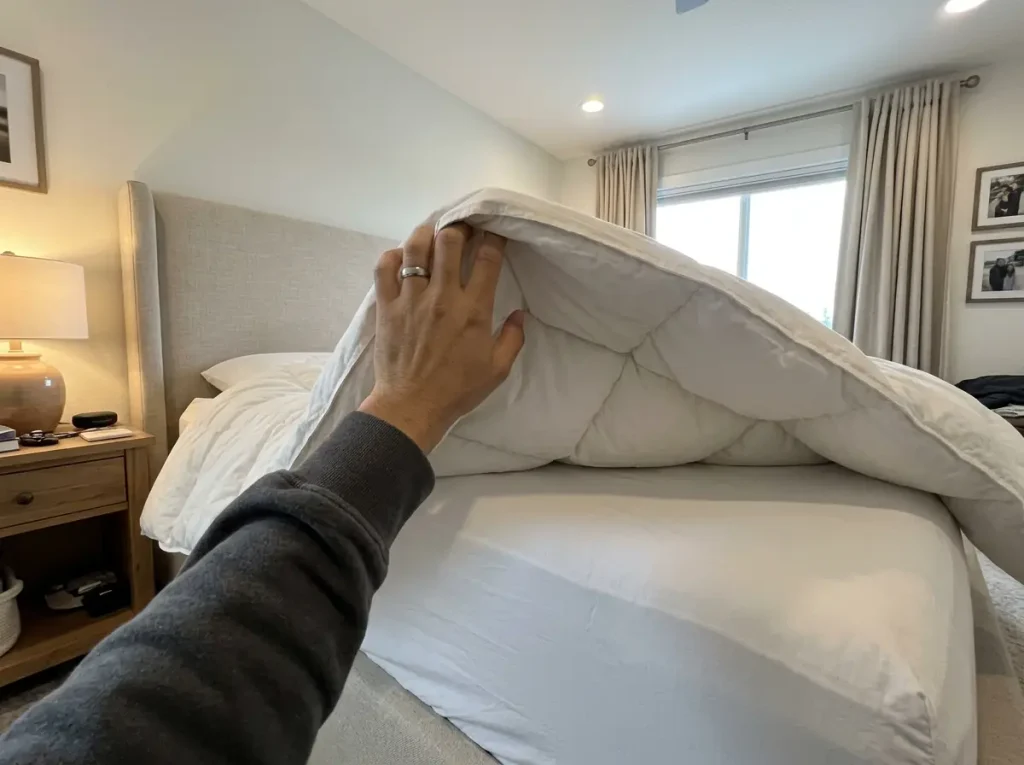
One ounce of down is dropped into a graduated cylinder, a weighted piston is set on top of it, and fill power measures cubic inches of loft per ounce, tested under a weighted piston once it settles. Eight hundred cubic inches per ounce is a lot of air held open by very little material. The bands run roughly like this: 300 to 450 is poor, 600 to 650 is good, 700 to 750 is very good, and 800 to 950 and up is where the expensive stuff lives. None of those numbers is a temperature. What fill power really describes is warmth to weight, meaning how much warmth arrives for every ounce sitting on top of you, and comforter weight is the other half of that sum that hardly any listing prints.
That matters because warmth is trapped air, not weight, and down is simply an unusually efficient way of holding air still. The fill is not what warms you. The pockets of motionless air between the clusters are what warms you, and the fill’s only job is to keep those pockets from collapsing when you roll over.
Which leads straight to the trap. Two comforters both labeled 800 fill power are not equally warm if one of them contains less down. Fill power tells you the quality of the material.
Fill weight tells you how much of it is in there. Warmth is the two multiplied together, and a listing that prints one without the other has told you half of a sum. Most listings print exactly half.
So when somebody says they are roasting under a down comforter, that is a heat complaint and not a verdict on down. They were sold the wrong quantity for their room, not the wrong material. Room temperature does a great deal of the work here, and a comforter sized for a cold bedroom is simply too much comforter in a warm one.
A comforter that feels thin in the shop and warm on the bed is not lying to you in either place. Down ships vacuum-packed, and the clusters need a full day out of the bag, shaken and laid flat, before the loft you paid for is actually there. Judging a new comforter the hour it arrives judges the packaging.
The Math Nobody Runs — 40% More Fill for the Same Warmth
With the unit defined, the comparison stops being a matter of taste and turns into arithmetic.
And the arithmetic is the reason a synthetic comforter that matches down on warmth does not match it on anything else. “Down is warmer” is a true sentence and a useless one. Warmer per what? Per ounce. That is the whole comparison, and it has a figure attached.
One thing to settle before the figure: “down alternative” is not a material, it is a category. Underneath the phrase sits polyester fill in some form, usually a microfiber fill spun fine enough to imitate the way down clusters tangle, and at the upper end a branded staple such as PrimaLoft that behaves closer to the real thing and is priced accordingly. They differ from each other more than the marketing suggests, and none of them holds air quite the way a down cluster does.
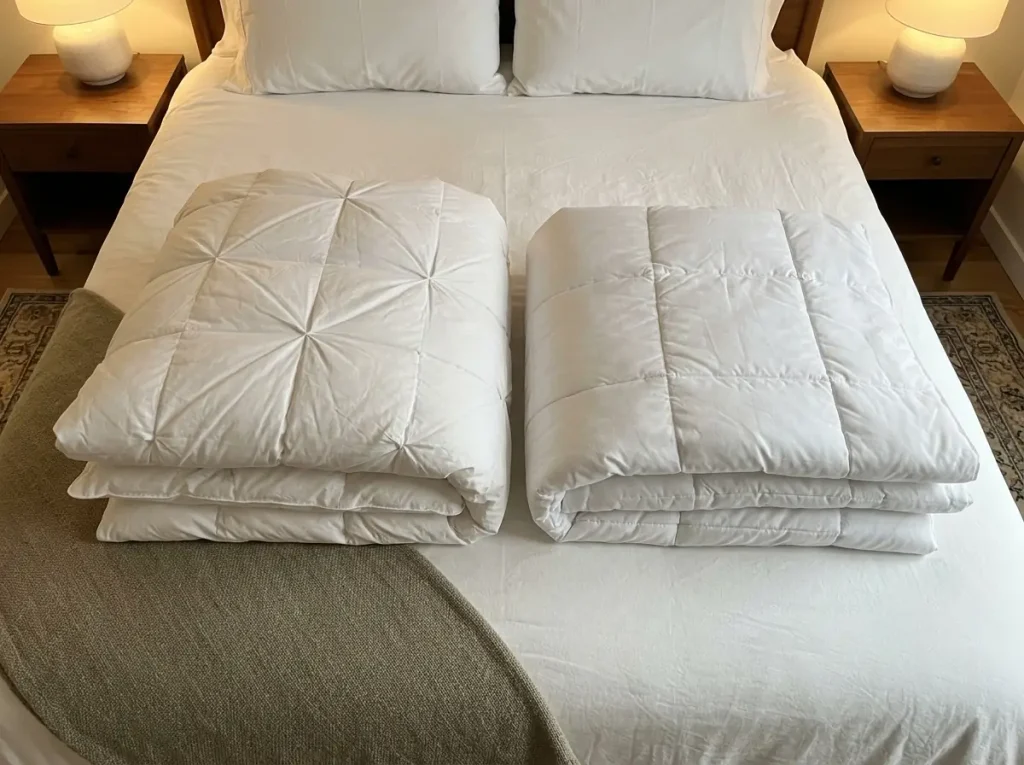
Here is the figure. A 550-fill-power comforter needs roughly 40 to 50 percent more down by weight than an 800-fill-power one to reach the same loft. That is down against down. Down alternative sits lower still on loft per ounce, because polyester fibers are thicker and springier than a down cluster and simply cannot hold as much air per gram of themselves.
So the honest sentence, the one that no retailer blog in this search will print, is this: down alternative can absolutely match down for warmth. It just has to weigh more. That is not a defeat. It is a trade, and the whole rest of the article turns on whether the trade suits you.
What the extra weight buys and what it costs you are the same thing. More material means more insulation and also more of it pressing down on you, more bulk fighting its way into a duvet cover, and more effort to shake it back into shape after a wash.
The part that catches hot sleepers out is breathability, and it is a consequence of the extra material rather than a defect in the fiber. Heat and moisture leave a comforter by moving through it, so an insert carrying forty percent more mass to reach the same warmth is putting forty percent more in the way of that exit. It runs warmer at the surface and damper underneath.
Against that, down alternative wins outright on three things: warmth per dollar, machine washability without ceremony, and no sourcing question to think about. The buyers on r/Bedding hunting for “the fluffiest, heaviest down alternative comforter insert” are describing this trade in their own words. They want down’s loft and they have already decided to carry the weight for it.
The one place you feel the difference is not in bed. It is in the laundry room. A synthetic insert that matches a down one for warmth comes out of the washer sodden and genuinely heavy in your arms, and that weight is exactly the extra material that was doing the trapping all night.
Laid out side by side, with the fill power split into its real bands and the construction kept in the picture, the trade reads like this.
| Fill | Loft per ounce | Weight for the same warmth | Washes like | What it does at year three |
|---|---|---|---|---|
| Goose down, high fill power (750 to 900) | Highest | The baseline, lightest for a given warmth | Wash mild, then a long full dry with dryer balls | Mats with oils and moisture, and re-lofts with a proper wash |
| Goose down, low fill power (550 to 650) | Moderate | Around 40 to 50 percent more down by weight | Same routine, longer to dry through | Same matting, same fix, heavier to handle wet |
| Down alternative, baffle box or box-stitched | Lower | Noticeably heavier again | Home machine, no ceremony | Holds its distribution, because the grid stops the fill traveling |
| Down alternative, loose fill | Lowest in practice, once it shifts | Heaviest, and uneven where it lands | Washes easily, comes out lumpy | Fill has migrated to the bottom third and stays there |
The Stitch Decides More Than the Fill
Two comforters with identical fill and identical fill power can perform differently, and the difference was sewn into the shell before either one was filled. The fill settles the argument on paper. The stitching settles it on the bed.
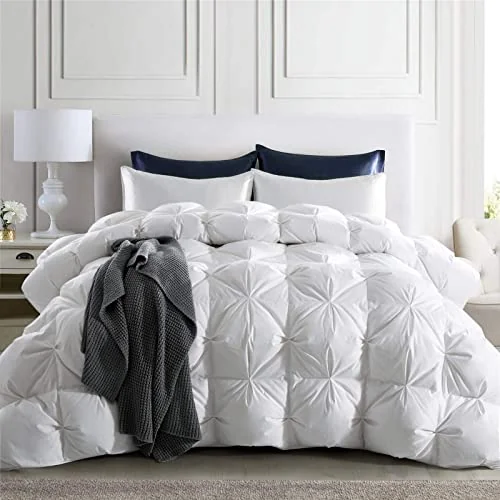
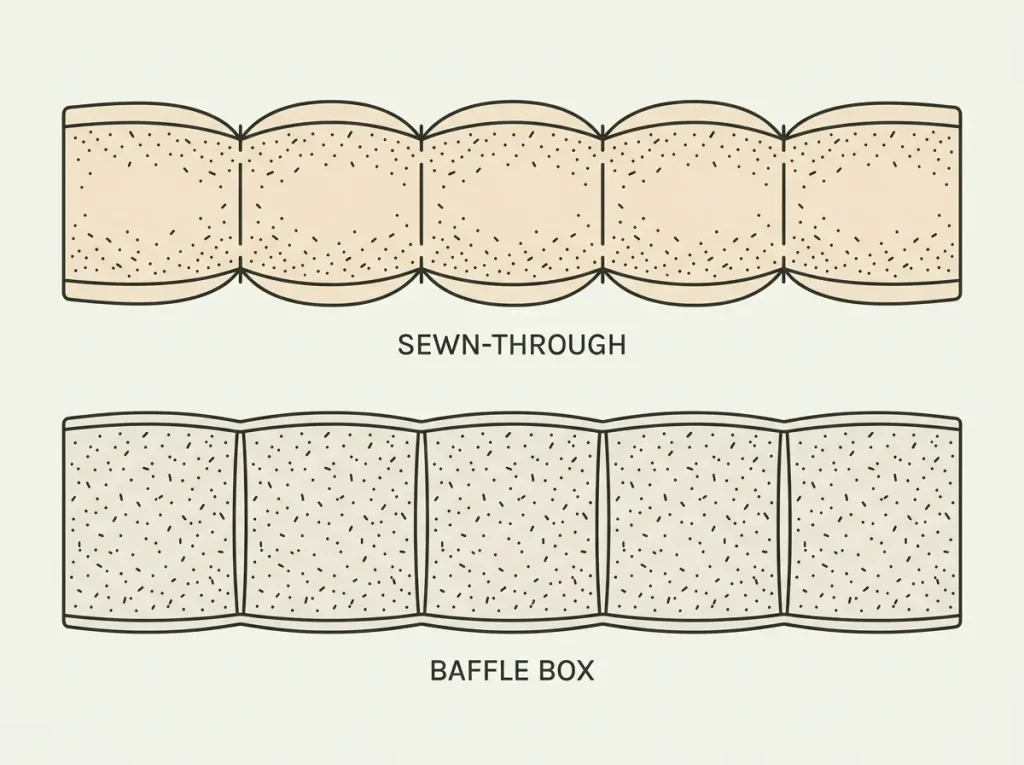
There are two ways to hold fill inside a cotton casing, and the difference between baffle-box and sewn-through construction is a mechanical one, not a decorative one. Sewn-through, sometimes sold as channel stitch, sews the top shell directly to the bottom shell. Wherever that stitch line runs, the two faces of the comforter are pinched together and the fill is squeezed to nothing.
There is no trapped air at that line at all, which means there is a cold stripe running through the comforter at every seam, in a regular grid, all night. Baffle box puts fabric walls between the two shells instead, making three-dimensional chambers. The fill lofts to its full height in every cell and the air layer stays continuous across the entire surface.
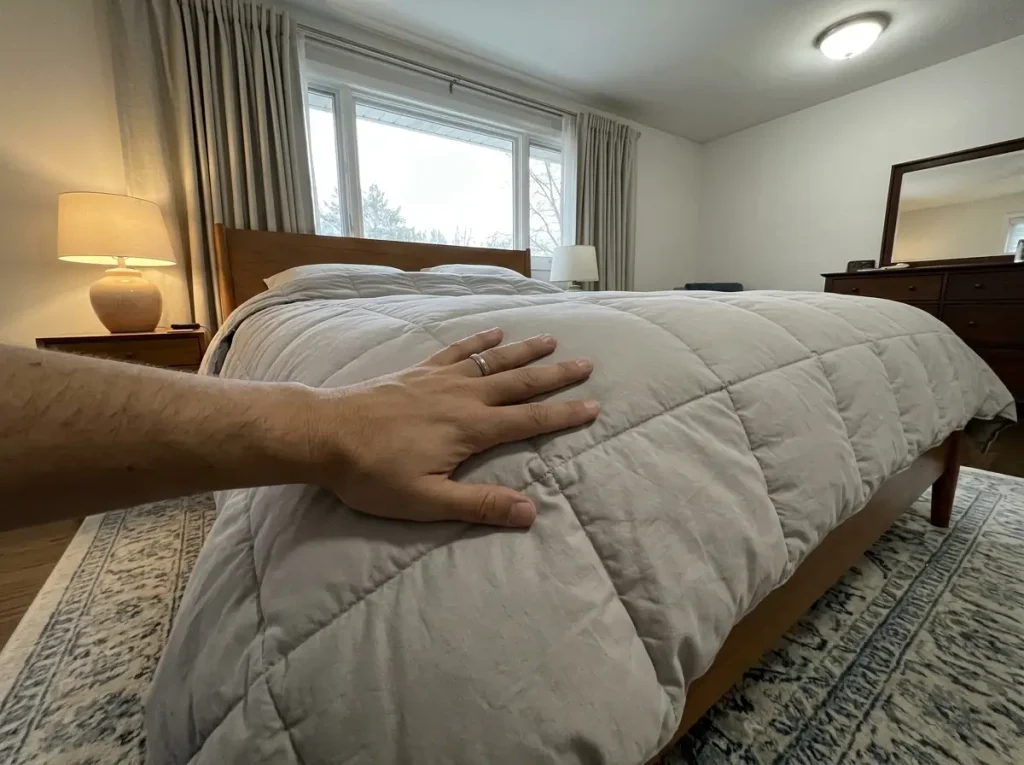
You find those cold seams with your hand long before you would find them with a thermometer. Run a flat palm across a sewn-through comforter in the morning, before you get out of bed, and the stitch lines read cooler than the panels between them. It is the same thing that decides whether a quilt is warm enough: every line of stitching is a place where the loft was crushed on purpose.
Baffle box costs more to make. More fabric, more labor, more time on the machine. Which means the cheap stitch on a budget comforter is not a styling decision made by a designer. It is the reason that comforter goes flat along its seams within a season, and it was chosen to hit a number on a shelf.
Read a listing accordingly: if it names no internal stitching at all beyond the outer shell, assume loose fill, and assume clumping. The failure the community reports over and over shows up at the stitching, not in the fill. A comforter with only a perimeter seam sags into its own bottom third within a season of washing, whatever it was stuffed with. Construction, not fiber, is what durability comes down to here.
Hold a comforter up to a window before you commit to it. Light through a baffle box shows an even glow with dark vertical lines where the walls stand; light through a sewn-through piece shows bright pinholes at every stitch, because there is nothing in there to block it. That is the cold seam, visible.
When One of You Runs Hot and the Other Runs Cold
Every comparison so far has assumed one sleeper. That is a convenient assumption and, in most beds, the wrong one. If you share the bed with somebody whose thermostat disagrees with yours, the previous two sections just solved a problem you do not have.
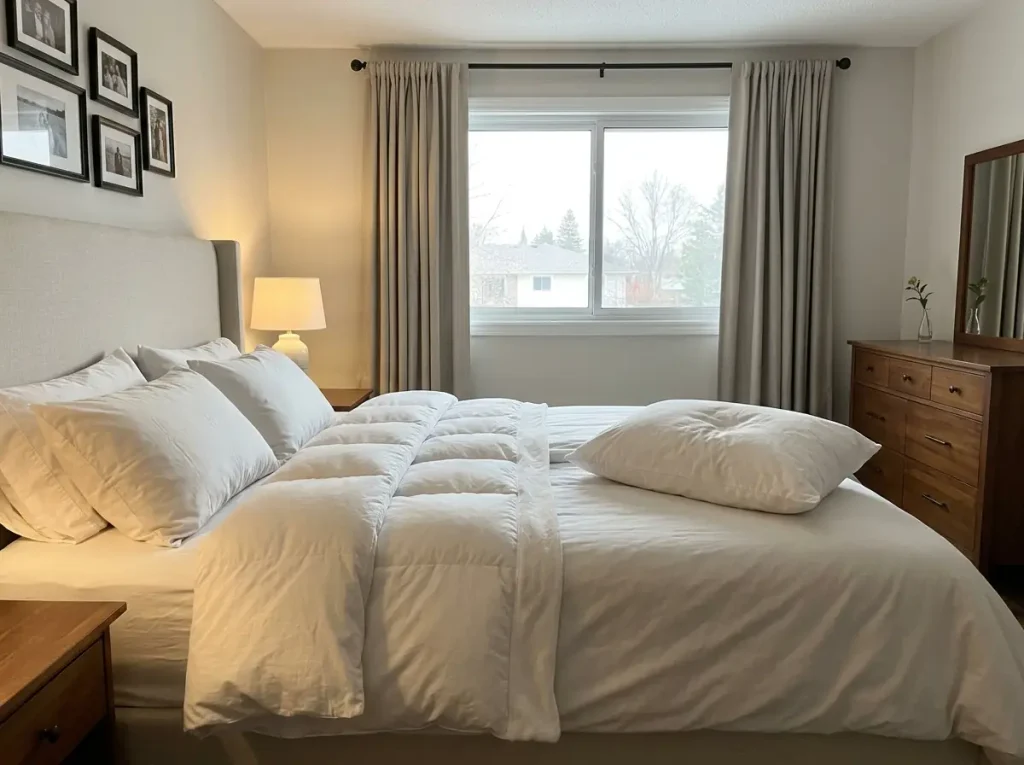
Here is why no fill choice fixes it. A single comforter picked halfway between two preferences is not neutral.
It is wrong for both people, in opposite directions, at the same time. The one who runs cold spends the night under something too thin. The one who runs hot spends it under something too thick. Splitting the difference on fill power splits the misery evenly; it does not remove any of it.
The free fix comes first, and it is not a purchase. Put two lighter duvets on the bed, one per sleeper, each chosen for that sleeper. Half of Europe already sleeps this way and thinks nothing of it, which is also why European inserts carry a tog rating on the label: when everybody buys their own, the warmth of the thing has to be stated rather than guessed.
You can test it tonight with bedding you already own: a spare twin duvet from a guest room, or a comforter and a blanket while you decide. Once the layer is split, the fills sort themselves out quickly. The cold sleeper takes the higher loft per ounce, the hot sleeper takes less fill and more airflow, and neither choice has to be a compromise with how the other one runs. A shared bed stops being a negotiation and goes back to being furniture.
And no, it does not wreck the bed. Two twin-size inserts inside two covers sit flat on a queen with a modest overlap down the middle, and the bed still gets made in the morning. For the cold half specifically, there is the other way to solve one cold sleeper without changing the whole bed, which is worth pricing against a second duvet before you buy either.
But the temperature was never the whole fight. A single duvet moves as one object, so the person who turns over at two in the morning takes the entire layer with them, and the other one wakes up in the draft they left behind. Two duvets end the pulling before they end the temperature argument, and honestly, for a lot of couples the pulling was the louder problem.
What Each One Looks Like at Year Three
Both fills feel excellent the week they arrive, which is precisely why the week they arrive is worthless as evidence. You wash the comforter on an ordinary Sunday, pull it out of the dryer, and find three fist-sized lumps along one edge. Whether that is a repair or a replacement depends entirely on which of two failures you are looking at, and they look identical from the outside.
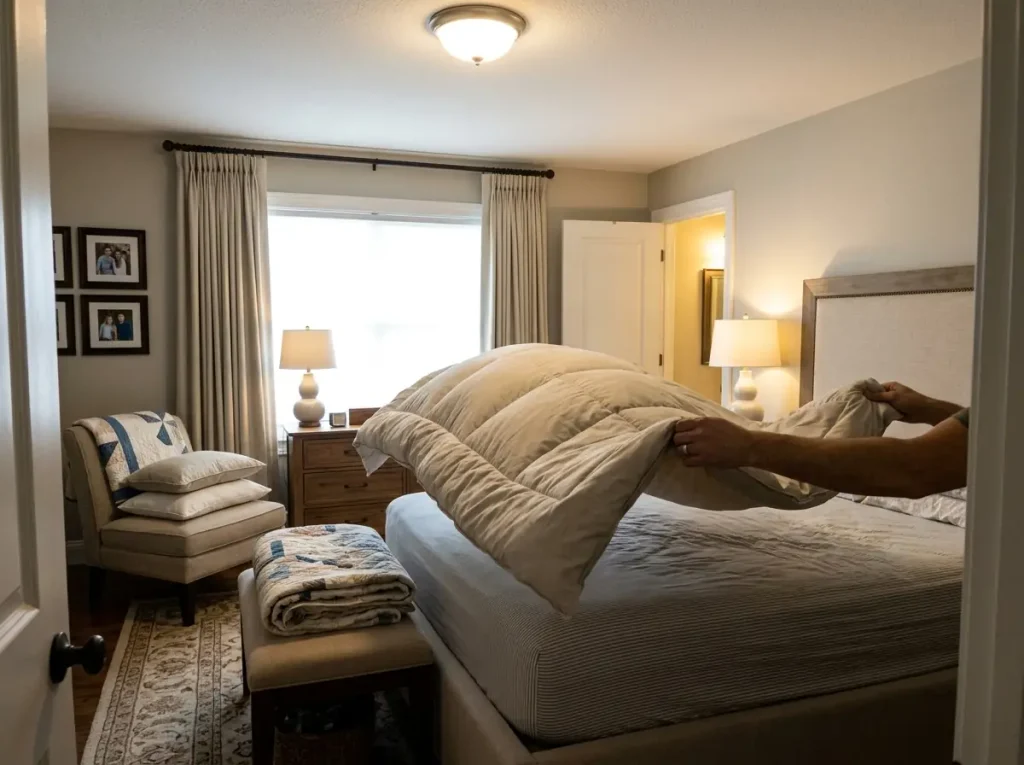
Down’s failure is matting, and it is reversible. Loft drops as the clusters take on body oils and moisture over a couple of years, and a matted cluster holds less air than an open one. A gentle wash cycle in mild detergent, followed by a full tumble dry with dryer balls, beats the clusters back open and the loft returns. A down comforter that feels flat at year two usually needs a wash, not a credit card.
Loose synthetic fill’s failure is migration, and it usually is not. Once the fill has balled up and traveled, the parts of the shell it left stay empty, because nothing inside is holding a position for it to return to. Box-stitched and baffle-box synthetic resists this well. Loose fill in a shell with only a perimeter seam does not resist it at all. The community’s own two words are a decent diagnosis: “flat” is usually washable, “lumpy” is usually construction.
So before you replace anything, try the machine. A large-capacity laundromat machine with room for the comforter to actually tumble, followed by a complete dry cycle in a drum big enough to let it move, has been reported to fully restore a down-alternative insert that had gone flat. It costs a handful of coins and it takes an afternoon.
It is the single cheapest thing in this article, and it fails at the drying step more often than the washing one, because a comforter pulled out damp and folded away goes back to flat within a week and picks up a faint mustiness on the way. Check the care label first, because a few shells still say dry clean only, and that instruction is almost always about the fabric rather than the fill.
Out of all of that comes one buying rule, split by material. For synthetic, the internal stitching matters more than any fill claim on the listing. For down, the wash routine matters more than the fill power.
And whichever you pick, an all-season comforter is a compromise weight rather than a season-proof one, so a lightweight comforter plus a separate blanket beats it in a room whose temperature actually swings. Which is worth holding in mind against the honest budget tier: the Utopia Bedding Twin Duvet Insert is the real entry point in this category and it is a fine thing to test the two-duvet setup with, but its listing states neither a fill-power equivalent nor a fill weight, so there is no honest way to compare how warm it runs against anything else here, and with no internal baffle declared it carries exactly the migration risk this section just described. Whether that is acceptable depends on what you are buying it for. As a second duvet to try splitting the bed, it is cheap and it answers the question. As the comforter you intend to keep, it is a bet on a spec nobody will tell you.
Dry it longer than you think, and check it by feel rather than by the timer. Pull the comforter out, grip a handful in the middle, and squeeze — if the core feels even slightly cool and dense, the inside is still wet and it goes back in. Most comforters that never recovered their loft were dried once, on the outside only.
Two of these hold their shape better than the other; the same trapped-air logic explains how the other warm layers age once the wool, the fleece and the down have all had a season of Sundays.
What the Labels Certify, and What They Do Not
Two acronyms show up on the good listings in this category, and both get quoted as if they were warmth claims. Neither one is. The article has spent five sections on specs; this one is about the things that look like specs and are not.
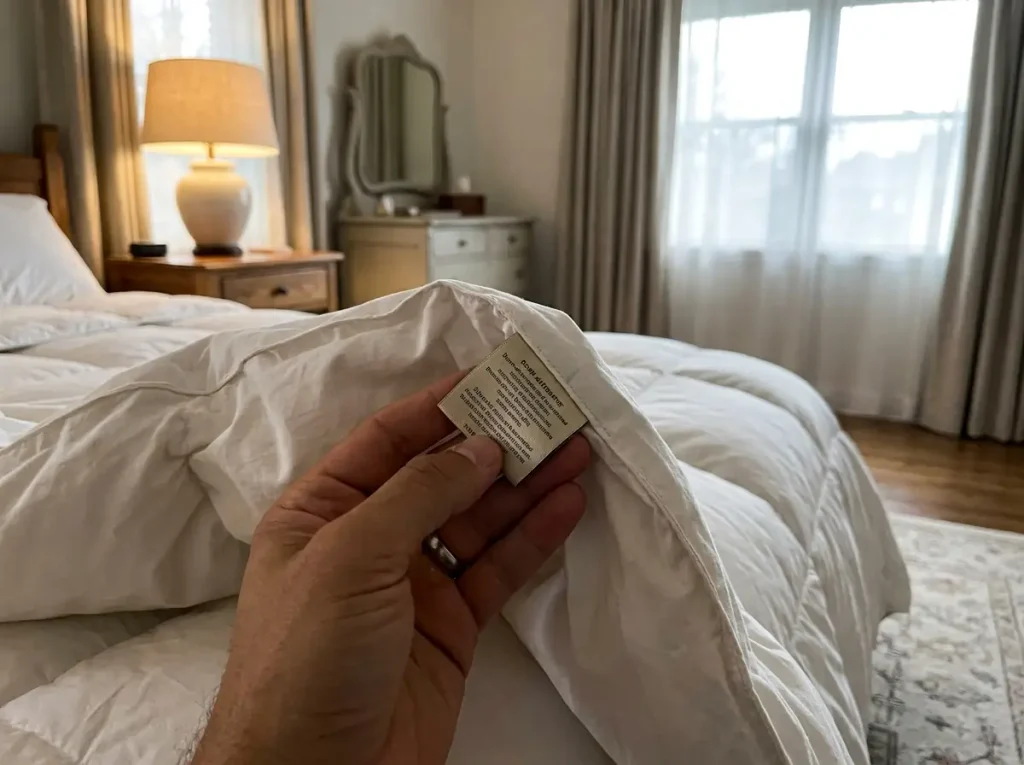
RDS, the Responsible Down Standard, certifies the animal-welfare chain of custody from the farm to the finished product. That is a real and useful thing to certify, and it says nothing whatsoever about fill power, construction, or warmth. It is a sourcing answer to a sourcing question. If ethically sourced down matters to you, that logo is the one to look for, and it belongs in a different column of your decision from the warmth one.
OEKO-TEX Standard 100 tests the finished textile, shell fabric and thread and any coating on either, for over a hundred regulated substances. It is a chemical-safety certification. When an OEKO-TEX Standard 100 label means the fabric was tested for harmful substances, it means the fabric, and it does not mean the down inside is any particular fill power, and it is not an organic claim either. Useful, correctly scoped, frequently misquoted.
The word doing the most work in this whole category, though, is “hypoallergenic,” and nobody certifies it. There is no standard behind it and no organization issuing it. It appears on a synthetic comforter because synthetic comforters are the ones that say it.
And swapping down for synthetic fill does nothing at all about the dust mites already living in the mattress and the pillows underneath the comforter, which is where the population actually is. What changes allergen load, per the Asthma and Allergy Foundation of America, is zippered allergen-barrier encasements on the mattress and pillows plus washing bedding hot, at 130°F and above, or fifteen minutes and more in a dryer running hotter than that. That is a laundry and encasement question. It is not a fill question, and buying a different comforter will not answer it.
And there is a line under all of this that a bedding article does not get to cross. A stuffed nose that will not clear, wheezing, or trouble sleeping because breathing is hard is a doctor’s appointment, not a shopping decision, and shortness of breath that is getting worse quickly is urgent care rather than an appointment. That threshold is the Asthma and Allergy Foundation of America’s guidance on when dust-mite symptoms need a doctor.
This article can change what is on the bed. It cannot tell you what a symptom means, and it is not going to try.
Back to the bed, then, and to what a correctly scoped certification looks like on an actual listing.
One last thing about those certifications, and it is the practical one. The logos live on the packaging insert, not on the comforter itself.
Six months later, when you want to remember what you actually bought and whether the shell was tested, the only surviving record is a listing you no longer have open. Photograph the insert before it goes in the recycling. It takes four seconds and it saves an argument with yourself, and it also tells you where the comforter sits in the rest of the winter bed when you come to replace a layer around it.
Conclusion
Down is warmer per ounce, not warmer full stop. A synthetic comforter matches it by weighing roughly 40 to 50 percent more, and whether that trade suits your bed and your laundry room is the actual decision in front of you. The material was never the question.
Read the stitch before you read the fill claim. Sewn-through puts a cold line at every seam and baffle box does not, and that single manufacturing choice does more for longevity than any fill claim, which is why two comforters with the same numbers on the label age into completely different objects.
And if you share the bed, stop comparing fills altogether and split the duvet. No single comforter is right for two people who disagree about temperature; it is just wrong for both of them at once.
After a season of washes, lay the comforter flat and look hard at the bottom third. If the fill has drifted down there and left the top thin, that is migration and the stitching lost. If it is evenly thin all over, that is matting, and a proper wash with a full dry cycle brings it back.
Before you buy anything at all: take whatever comforter you own right now and give it a full wash and a complete dry with dryer balls. Sleep under it for a week. A good share of “I need a warmer comforter” turns out to be a comforter that just needed its loft back.
Frequently Asked Questions
01Do hotels use down or down alternative comforters?
Mostly down alternative, and for laundry reasons rather than comfort ones. Synthetic inserts survive commercial hot-water washing on a schedule that would flatten down within months. It is an operations decision, not a verdict on which one sleeps better at home.
02What type of comforter is warmest?
The one holding the most trapped air, which takes high fill power and enough fill weight together. A high-fill-power down comforter gets there with the least weight on top of you; a synthetic one gets there by carrying more material.
03Which is better, a down alternative comforter or a down duvet?
Neither, in the abstract. Down wins on warmth per ounce and on being re-loftable by washing. Down alternative wins on warmth per dollar, on machine washability, and on having no sourcing question attached to it.
04Will a down comforter keep you warm?
Yes, provided the fill power and the fill weight are both adequate for your room. A low-fill-power down comforter with very little fill in it is a thin comforter, and the word down on the label does not change that.
05Why did my down alternative comforter go lumpy after one wash?
Almost always loose fill with no internal stitching. The fill migrates during the cycle and balls up wherever it lands. Baffle-box and box-stitched inserts hold their distribution; a comforter with only a perimeter seam does not.





Tried it on your own bed?
No comments yet. Tell us what you changed, and what the sheet did after a few washes.