



What’s in here5 sections
You lay the new topper over the bed, tuck the corners, and lie down in the middle. The surface feels softer, and then your hip finds the old hollow anyway, a few inches below the foam, exactly where it always was. A topper takes the shape of whatever it lies on, so the mattress dip travels up through it, and that is why the question of whether a mattress topper can fix a sagging mattress has a narrower answer than the word “fix” allows. Below: the three jobs a repair has to do, how long a cover keeps the top level, and the purchase that ends up costing twice.
Quick Answer
A topper can make a sag feel level for a while, but it cannot put back the height or the support the sag took. It levels the top and leaves the core as hollow as it was, so it is a stopgap with a clock on it, not a repair.
The Three Jobs a Repair Has to Do
If the base is what failed, no layer on top will change that, so check the base before you buy a layer. Once the base is ruled out, the word “fix” still hides three separate jobs. A repair would put the height back, hold the sleeper where the support gave, and level the top. A topper does the third and only the third, and the two it leaves undone are the two that made the bed sag in the first place.
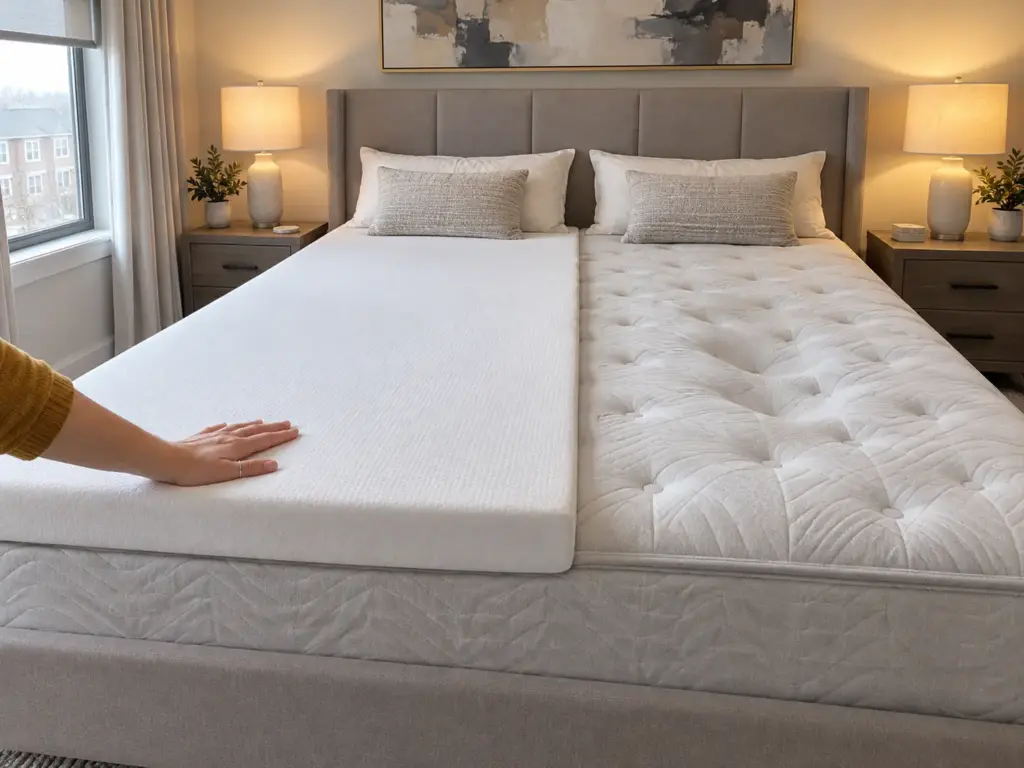
Putting the height back
Height is the first thing a sag takes. The comfort foam over the core compresses and stays compressed, so the surface that once sat level now sits lower at the hip than at the edges. Consumer Reports treats that height as a measure of its own: according to Consumer Reports’ durability test, the lab looks at “how well a mattress maintains its original shape, height, firmness, and side/back sleeping support after eight years of simulated use.” Height and support sit on that list as separate items, and both belong to the mattress itself.
A topper adds inches above the bed. The inches the bed lost are below it, and the hollow is still there, now under three more inches of foam. That arithmetic is why a thicker layer is not the answer to a deeper dip: more foam over the same hollow has more shape to take on, and takes it.
Holding the sleeper where the support gave
Support is the second job, and it is the one people mistake for softness. A mattress keeps a sleeper level by pushing back harder under the heavy parts, hips above all. When the support core is spent at that spot, the hips settle below the shoulders, and the only thing that can push them back up is whatever is under the foam. A topper has nothing under the foam except the mattress.
A topper is flexible and takes the shape of, and gets its support from, whatever it sits on. For the same reason, the way a layer takes that shape differs by material, and how gel foam and latex take a shape differently matters for feel without changing the job.
At 3 inches of thickness a layer is a comfort layer. It spreads the pressure points of a hip across more foam, and it bottoms out into the same hollow.
A topper can reduce a dip without erasing it: you still feel the hollow, only less of it. That can be enough to fall asleep, and a board under the slats can add to the effect, so the improvement is not the foam alone.
Greatly reduced and still felt is the honest ceiling of this job. Viscosoft’s own FAQ for sagging mattresses concedes the same thing, saying a topper “won’t rebuild broken internal support.”
Leveling the top
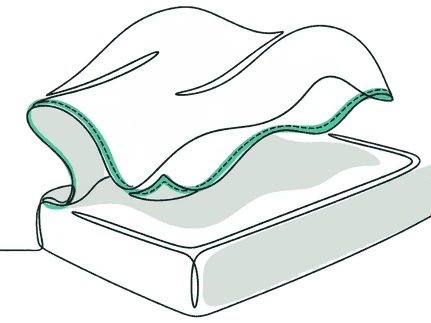
The third job is the one a topper does, and it does it by bridging. Three inches of foam lying over a shallow hollow evens out the surface dip: the height difference between shoulder and hip shrinks by whatever the foam can make up, and the edges of the hollow soften into a slope you stop registering.
The surface says level, and for a while it is a level surface. Underneath, nothing has changed. The core is as low at the hip as it was, and the foam is leaning on it.
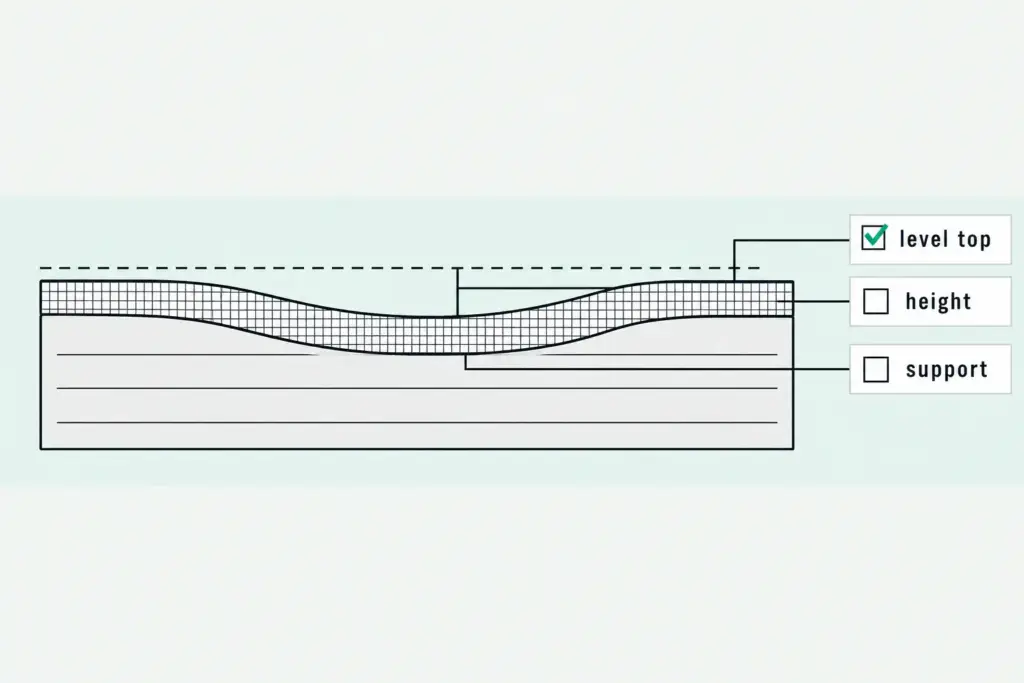
That is the case where a layer earns its place: a core that still holds, a dip that is shallow and lives in the comfort foam, and a sleeper who needs the surface to stop pulling toward the middle.
Viscosoft’s 3-inch memory foam topper is the straightforward example: one block of gel-infused memory foam, medium-firm on the listing, with a density printed as “over 3 lbs per cubic foot.” Read that as a floor, not a measurement, and read “Select High Density” as the seller’s name for the product rather than a spec. The listing sits at 4.4 stars across more than 15,000 ratings, which is a good sign for the one job it does.
The reviews on the same listing show what the job costs: one buyer says the pad “developed a mound in the center” after three months, another writes that “it didn’t last 5 months.” Whether a mound like that is the foam giving out or the core beneath it, a listing cannot say, and that uncertainty is the whole argument against calling any layer a fix.
If the Viscosoft is not the one you want, VALUXE’s 3-inch gel memory foam topper is the alternative, picked on ratings (4.3 stars from 2,880) and not on price. Its spec is the weaker of the two: no density is printed anywhere, only “Medium” firmness and a bamboo-blend cover. The listing reviews cut both ways for a dipped bed. One says “you sink into it and it does not rebound until you get out of the bed,” which is a layer mirroring the hollow rather than bridging it, and another says “It radiates heat,” the usual trade of gel-infused foam that holds the sleeper’s warmth instead of passing it through.
Lay a flat palm into the hollow with the topper on, press, and note how far your hand goes. Take the topper off and press the same spot again. The difference between the two presses is what the layer actually did, and it costs nothing to measure.
How Long the Cover Holds, Counted in Months
A topper that levels the top is a clock, not a repair, and the unit that fits is months. The numbers that exist come from buyers in their own words, and each is a reading of the cover, not of the hollow underneath it. Put them in order and a shape appears: relief at the start, a mound by the third month, a failure by the fifth, and a year at the optimistic end.

The first weeks: reduced, not gone
New foam is at its tallest and its most resilient, so the first weeks are when the layer does everything it can. A center dip is often described as sleeping in a bowl. A topper can soften that feeling, and the sense that it is working is real. But a feeling reported in week two is a reading of new foam on a hollow that has not had time to answer back.
Months three to five: the mound
This is where the listing reviewers speak. A buyer who “gave this pad 3 months to work” reported a mound in the center, and a second reviewer’s layer did not last five months. A mound is what a hollow looks like when it has been pressed into foam for ninety nights, one more of the impressions a sleeper leaves in a bed, and it arrives on schedule because the weight lands in the same place every night. (The same hollow tends to move the layer too: a deep dip can make a topper begin to slide, and the mechanics of when a topper slides or locks are worth reading before you rely on the corners staying put.)
The cover can also outlast the comfort. A layer that still looks new and still has all its inches can have stopped hiding anything, because the core under it keeps moving. What the buyer sees is the dip returning through foam that appears untouched.
A year, with the layer on a dip
The only counted span in the seller’s own material is a verified buyer’s: the topper bought “another year or so,” in a review that adds “Not a miracle fix.” A year is the optimistic end, and it is one person’s year. Sooner or later, a dip that comes from the core ends in a new mattress.
Two clocks are running here, and they are not the same one. The topper’s own life is measured in inches of compression, as in how long a topper itself lasts, in inches.
The dip’s clock is the core’s, and nothing printed on a listing measures it month by month. That leaves one honest rule: a topper delays the decision, it does not cancel it. The morning you notice you are rolling toward the middle again under a layer that still looks new is the morning the delay has run out.
Write down the date the topper goes on. On the first of each month for three months, press the same spot at your hip with the same flat palm and write the depth you feel in your own words, even if the words are “about the same.” That page holds the one number no listing carries.
When the Topper Becomes the First of Two Purchases
The last question is not whether a topper works but what it costs when it is bought as the fix. The people who have already paid that cost report it in the same order more than once, and the order is the useful part.

The topper that was a waste
Buying a topper first and a new mattress later is a common sequence, and it matters more than the amount spent: the topper came first, and the replacement followed anyway. A topper that works on the top does nothing for the core, so when the core is spent, the layer is money placed over a bed that has already failed.
Picture the delivery day: the new hybrid mattress carried in while the topper, still clean, leans against the wall. A topper in that scene needs no defect to be a waste. It did its one job, and the job was not the one that needed doing.
The one case where the height came back
Height can come back, and the method is instructive: take out the spent comfort foam and replace it with a fresh layer on a sound core. That is a rebuild of the comfort layer, and the spent material came out, which is the opposite of laying something over it.
It is also not a guarantee. A replacement from the same retailer can sag as well, so the product line is not a guarantee.
The lesson is not that rebuilds fail. It is that height only returns when the thing that lost it is dealt with, and that a same-build replacement can repeat the dip.
Deciding before you buy the layer
Three free steps come before a purchase. Rule out the base, since a slat, a bed frame rail or a center support that gave way is a base problem and no foam repairs it. Run the monthly press from the last section for a few weeks so you have your own depth. And take the topper off for a night and compare, which is the cheapest test of what the layer is covering.
Then the call itself, stated as a rule. If the base is sound and the dip is shallow and sits in the comfort foam, a 3-inch layer is a reasonable stopgap, and the thing to look for is choosing a layer by density rather than by the word firm. If the dip returns through a layer that still looks new, or the press you have been recording keeps getting deeper, the core is the problem, and a replacement topper only repeats the clock. A better layer on a spent core is a more expensive version of the same delay.
Take the topper off for one night before you decide. If the dip under your hip is the same depth with the layer off as it was before you bought it, the layer changed the feel and left the bed alone.
A Layer Buys Months, So Count Them Before You Pay Twice
A topper is a good answer to a small question and a poor answer to a large one. Three things are worth carrying away:
- A topper does the third of three jobs: it levels the top, and it leaves the height and the support where the sag left them.
- It buys months, not height, and the months are counted by the dip returning through a layer that still looks new.
- The cost shows up when a topper is bought as the fix and a new mattress follows anyway.
For later, once the layer has been on for a season, keep pressing the same spot at your hip once a month, and watch for the month the cover stops hiding what is under it, because that month is the real end of the topper’s job.
And for tonight, the free change: take the topper off, press the bare mattress at your hip with a flat palm, and sleep on it as it is once. If the hollow is shallow and the bed holds you level, you know a layer is the right size of answer. If your hip finds the bottom immediately, you have just learned what the layer was covering, and it cost nothing.
Frequently Asked Questions
01Can a mattress topper fix a sagging mattress?
No. A topper levels the top of the bed for a while, but it does not put back the height or the support the sag took. Of the three jobs a repair needs, it does one.
02How long will a topper keep a sagging mattress feeling level?
Months, not years. Buyers report relief in the first weeks, a mound in the center by about three months, and one verified buyer got another year or so at best. The core sets the clock, not the cover.
03What are the downsides of using a mattress topper on a sagging mattress?
The dip returns through the cover while the layer still looks new, and the cost shows when a new mattress follows anyway. Sliding and locking on a hollow are a separate problem, covered in the back pain article on toppers.
04Is a thicker topper better for a deeper sag?
No. A thicker topper is more foam over the same hollow, and a topper follows the shape it lies on, so a deeper dip travels up through it. Rule out the base before adding any layer.
05Should I replace the topper or the mattress when the dip comes back?
If the dip comes back through a layer that still looks new, the core is the problem, and a replacement topper only repeats the clock. Take the layer off for a night first to confirm.




Tried it on your own bed?
No comments yet. Tell us what you changed, and what the sheet did after a few washes.