


What’s in here8 sections
- Three Sags Hide Under One Word: Which One Is Yours?
- Check the Base Before You Buy Anything (The Free Fix)
- What a Topper’s Foam Does Over a Dip (and Why Soft Ones Sink Through It)
- Thickness and Density by Case, and What Your Sheets Can Take
- When Two People Share the Dip
- When the Bed Is the Answer, and When It Isn’t the Bed at All
- Measure the Gap, Check the Base, Then Pick the Density
- Frequently Asked Questions
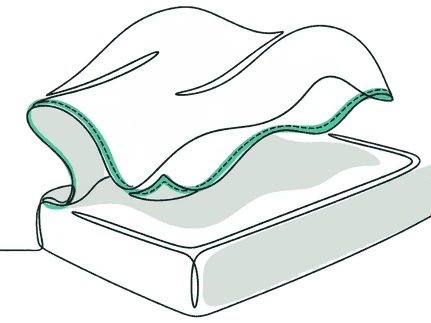
You smooth the fitted sheet in the morning and it lies tight along the edges, then slumps in the middle, right where you slept all week. The obvious move is a mattress topper for a sagging mattress, and for one kind of sag it is the right one. A topper covers only the top few inches of the bed, so whatever sits underneath keeps doing what it was doing: a slat gap, a bowed frame, a core that has given up. This guide sorts the sag into its three kinds, runs the free base check first, and then matches thickness and density to the dip you actually have.
Quick Answer
A topper only covers a dip in the surface. Lay a straight edge across the bed: a shallow hollow over a flat base is the case a dense 3-inch foam can take, while a dip that follows the slats, or runs deeper than about an inch and a half, is a base fix or a new mattress, not a topper.
Three Sags Hide Under One Word: Which One Is Yours?
A topper gets sold as the answer to all three kinds of sag, and it is the answer to one of them. Telling them apart takes a straight edge and ten minutes.
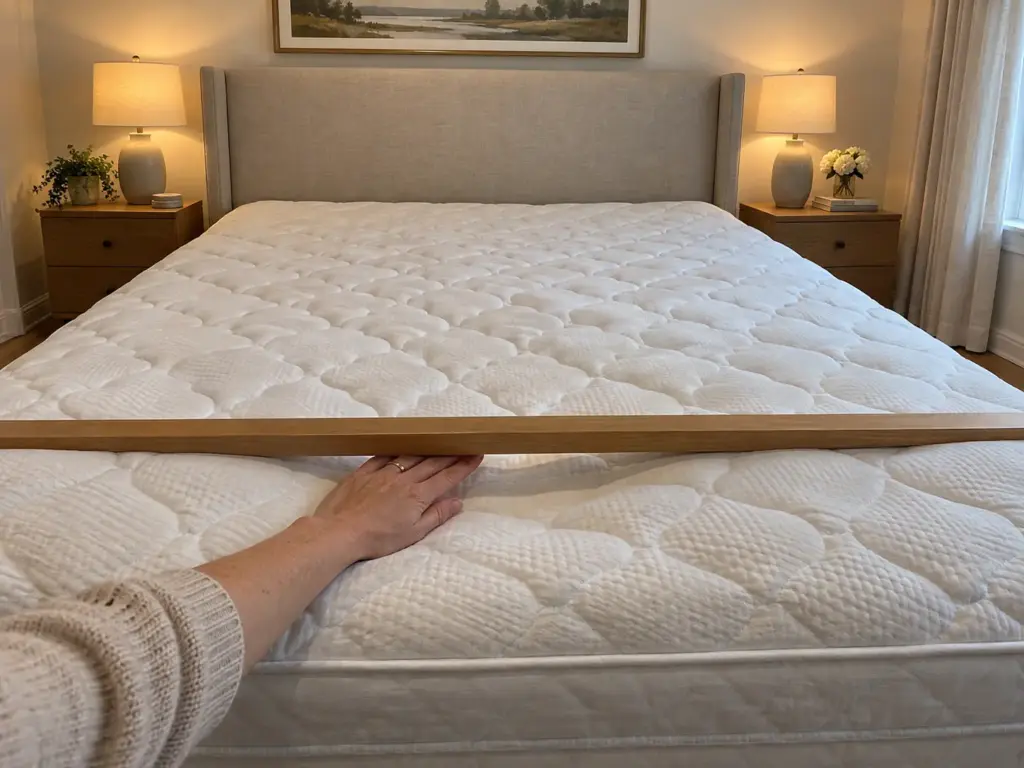
The dip in the surface
Here the top layer of the mattress has compressed under one spot, usually where the heavier sleeper lies, while everything below it is still flat. That worn-in hollow is a mattress dip in its plainest form, and it is often described as sleeping in a bowl.
To measure it, lay a yardstick or any straight board across the middle of the bed and slide your fingers under it. The gap you can feel is the depth, and it reads far more accurately than lying down and guessing. A shallow hollow with a flat base is the only case a topper can cover.
The base that stopped holding
In this case the dip follows the base instead of the foam. Slats set farther apart than the mattress can bridge, a missing center support, or a bed frame that has bowed all leave the mattress hanging over a gap. An old box spring gone soft, or a support board never meant for the weight, does the same thing.
The tell is where the hollow sits: it is deepest over the gaps and not under the sleeper’s weight. Lift a corner and look at what the mattress rests on before you read another product page, because a dip is often fixed underneath the mattress, with boards and 2x4s. A topper changes only the top few inches, which is why the Back Pain guide already says to check the base first.
The core that is spent
Now the mattress itself has lost its spring or its foam, and the hollow stays even on a base you know is good. Consumer Reports puts it flatly: toppers “won’t resuscitate a bed that’s past its prime or fix a sagging mattress.”
Sellers put the limit of a topper at about an inch and a half of sag, and they do not agree to the quarter inch. One retailer says 1.5 to 2 inches, and one mattress maker notes that warranties on premature sagging often start at a dip of 1 to 1.5 inches. No standard exists; treat the number as a zone, not a line.
| Where it shows | The test | What it takes |
|---|---|---|
| Surface dip: a shallow hollow under the heavier sleeper | A straight edge across the middle, the gap read with your fingers | A topper can take a dip this shallow |
| Base sag: the dip follows the frame, worst over the slats | Lift the mattress and look at what it rests on | Fix the base first |
| Spent core: a long, deep hollow that stays | The same straight edge, on a base you know is good | A mattress, not a topper |
Check the Base Before You Buy Anything (The Free Fix)
The base costs nothing to look at, and a topper laid over a bad base only hides it for a few weeks.
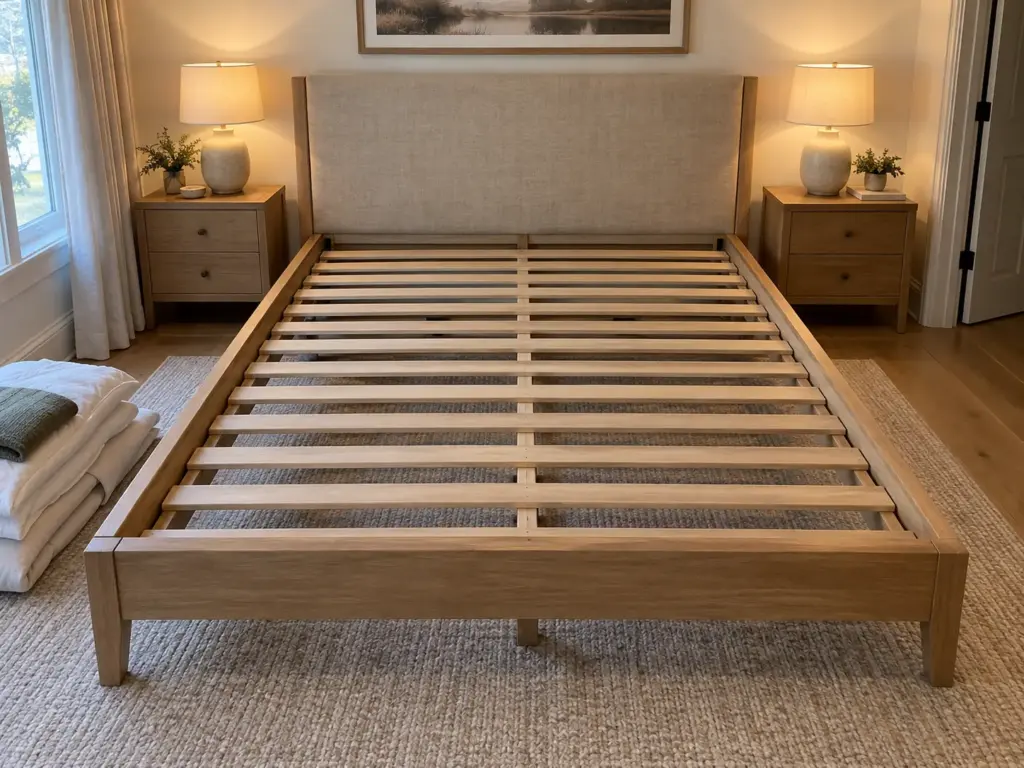
Slats, center support and the 3-inch rule
Slats should sit no more than 3 inches apart, and a queen or king frame needs a center support leg. Beloit lists slats wider than 3 inches and a missing center leg among the common causes of premature sagging. Measure the clear gap between two slats with a ruler, not the distance from center to center, and measure the widest one. Slats also wander sideways over the years, so a gap that was fine at assembly can be wider now.
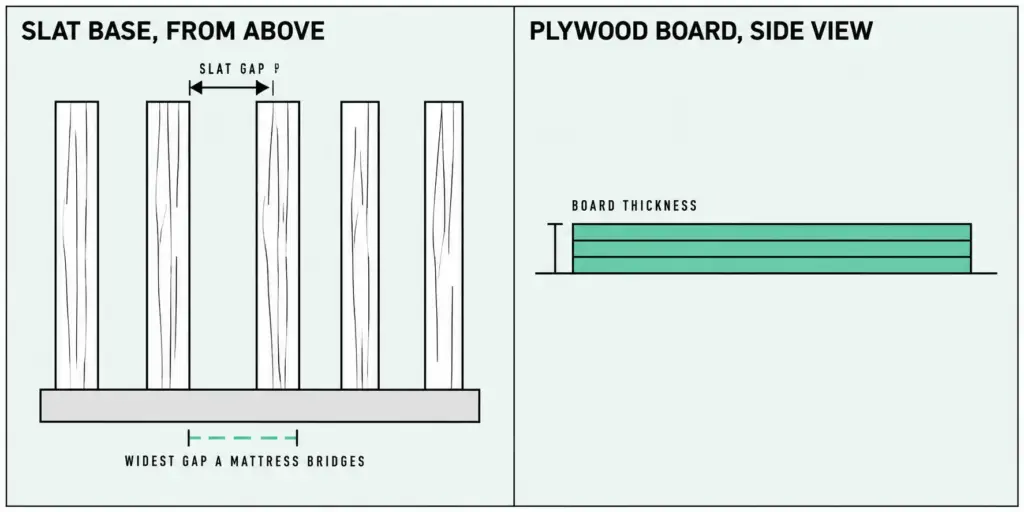
A drifted slat is easiest to spot with the mattress propped on its side against a wall: the gap that looks fine from above is the one that opens up when every slat is in view at once.
With the mattress off, push each slat back to an even gap and lay the ruler across the widest one before you decide anything. A bed that sagged because two slats drifted apart goes flat again for the price of five minutes.
Plywood, and what it does to your warranty
A board laid over the slats should be at least 3/4 inch thick; two guides agree on that number, and a thinner sheet bends under a queen mattress. A ready-made bunkie board has to clear the same line, and the two found for this guide did not.
Both outcomes are possible. Putting 2x4s under the low spots can fix a bed. Another put plywood in and found “the mattress tends to slide more now.” So the board solves the sag and hands you a sliding mattress, which a thin non-slip layer between the two, or a frame with a rim, usually stops.
The warranty is the trap. Better Slumber says to read your warranty terms before using plywood, since a board can risk the coverage, and sellers’ warranties often begin at a dip of 1 to 1.5 inches. Photograph the dip with the straight edge in the picture, and write the depth down, before you change anything. A board under a worn core also does little: Beloit notes it can create new pressure points under a soft mattress.
Before you add a layer: a base that is already fine
If the slats pass, the center leg is there and the straight edge still shows the dip on a known-good base, you are in case 1 or case 3, and the free move left is to rotate the mattress head to foot, if the maker allows it, so the heavier sleeper stops lying in the same hollow. Flip it only if it is built two-sided.
Check the dip again after a week. A hollow that shallows out was surface compression, and a layer will cover it. One that stays the same depth wherever you turn the bed is the core.
What a Topper’s Foam Does Over a Dip (and Why Soft Ones Sink Through It)
With the base sound, what is left is a dip in the surface, and now the material of the topper decides whether it covers the hollow or follows it down.
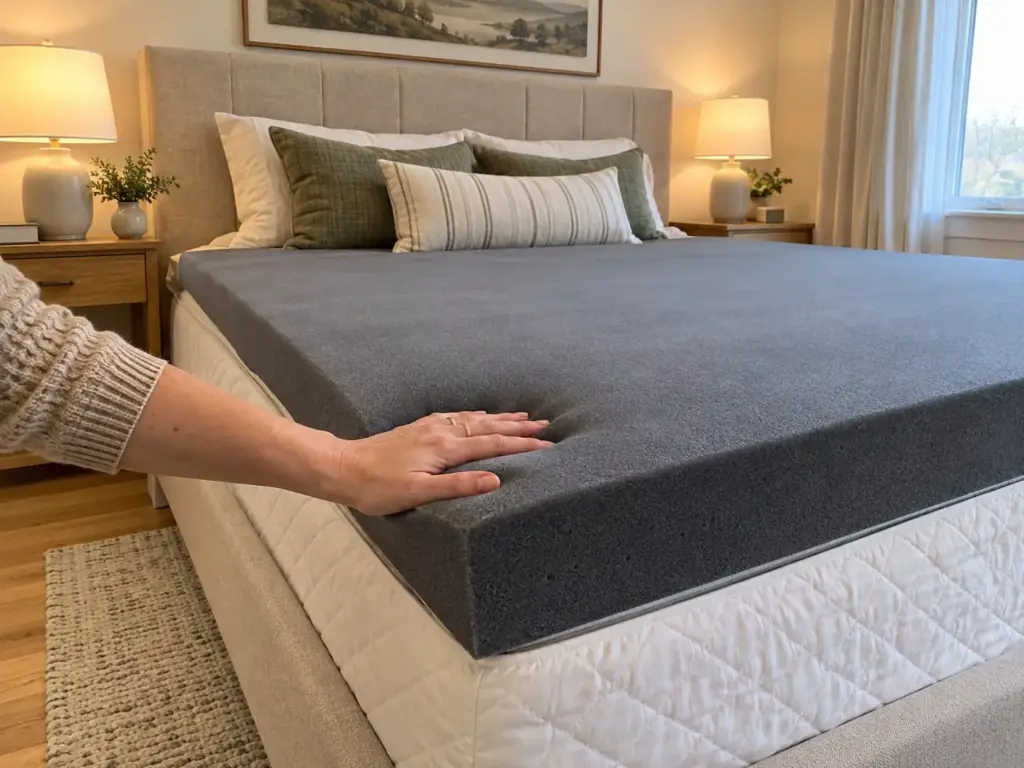
Dense foam holds the shape of the bed; soft foam copies the dip
A soft foam fills the hollow and then sinks into it with you, so the surface you feel is still a hollow. A dense foam bridges it. That is why sellers advise high-density foam at 3 to 4 inches for a sagging bed, and why one reviewer wrote that a topper “felt like I was sleeping in a hole.”
The words on the listing will not tell you which you are buying. A firm topper or an orthopedic topper is not a defined thing: “firm,” “orthopedic” and “high density” are not standards. Viscosoft notes that its “orthopedic” is not a medical claim, and a retail review site rates firmness on its own 1-to-10 scale. Read the density in pounds per cubic foot, and if the listing has no number, the word is all you have.
Latex pushes back, which is a different feel from foam
Latex springs back where foam sinks in. Beloit’s reasoning is that a firmer topper helps a dip more than an ultra-soft one, and that latex adds resilience to firmness. One candidate is the Queen 4-inch natural latex topper, 100 percent natural latex at four inches, and a 4-inch topper is the top of the range before heat and sheet fit become problems.
It has no customer reviews at all and comes from a generic maker, and the title says Firm while the listing copy says Medium-Firm, so it is a candidate to weigh, not a recommendation.
For the density, ILD and Dunlop vs Talalay numbers that would let you judge any latex layer, read density, ILD and Dunlop vs Talalay.
Feather and wool are the wrong tool for a dip
Feather and wool compress quickly and do not rebuild a shape, so they suit a bed that needs warmth or softness, not one that needs a level surface. Over a hollow they follow it. The guide to feather and wool toppers covers where those fills do belong, and what each topper is made of lays out the rest.
Thickness and Density by Case, and What Your Sheets Can Take
The fill is chosen; now the numbers that go with the sag, and one that is easy to forget: whether the sheets still fit.
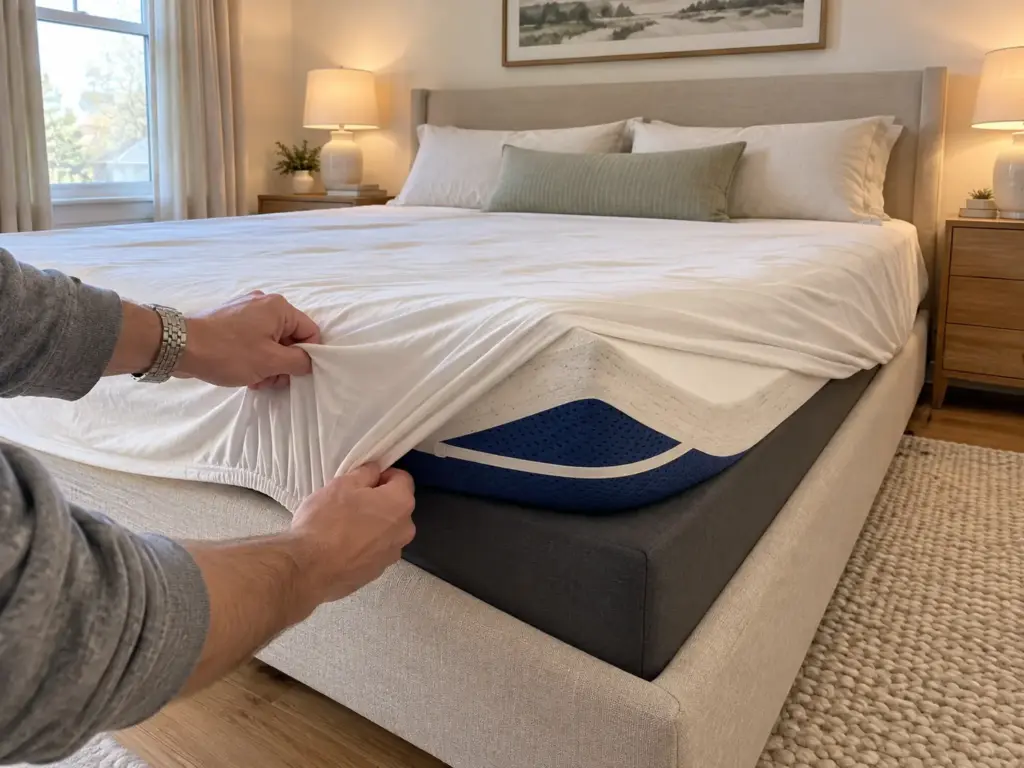
A shallow dip: 2 to 3 inches of dense foam
For a hollow of about an inch or less, 2 to 3 inches of dense foam is the range, and below 2 inches the layer sinks where the dip is. A seller’s line says a thin 1-to-2-inch topper will not make much difference and that noticeable change starts at 3 to 4 inches. Treat the weight line with suspicion too: one seller says to go to 3 inches instead of 2 over 230 pounds, yet a 200-pound reviewer found a 3-inch foam caved in the middle. Density has to be stated in pounds, and the thickness has to be matched to the hollow, not to the sleeper’s size alone.
A dip near the 1.5-inch line: 3 to 4 inches
Superior Brand puts the next step this way: a mattress sagging past 1.5 inches needs 3 to 4 inches of cushioning, not a 2-inch refresh. Beyond 2 inches, the same seller says to skip the topper, because you would be masking a structural problem. Other sellers draw the line elsewhere, so the honest reading is a zone between 1 and 2 inches where the base check and the warranty matter most. A deep hollow also makes a topper slide.
For a dip in the surface that sits near that line, the Viscosoft 3 Inch Memory Foam Topper is the pick for this case: its listing states a density over 3 pounds per cubic foot at three inches, which is the spec this case needs.
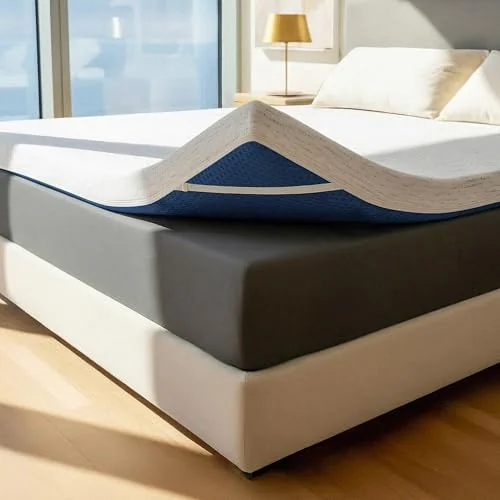
A new foam needs a day or two to expand fully, so the first night tells you little. Take the straight-edge reading the morning after the second night, with the sheets back on, and treat that as the real starting point.
The pocket of your fitted sheet
A topper adds height, and the sheets have to reach around it. Most standard fitted sheets fit mattresses up to 14 inches, and deep-pocket sets cover 15 to 17. A 10-inch mattress with a 3-inch topper is 13 inches, and the pocket should be mattress plus topper plus 2 inches, so that bed already wants a 15-inch pocket. Standard sheets will pop off the corners.
When Two People Share the Dip
The hollow belongs to one sleeper, and its edge belongs to the other, who ends up in it.

The heavier sleeper makes the hollow, the lighter one rolls into it
In a shared bed, the dip can pull the lighter sleeper toward the heavier one. The heavy sleeper compresses the middle, and the lighter one slides toward it. A lighter sleeper rolls toward the center of a soft bed even asleep, because the surface slopes toward the hollow and gravity does the rest.
A topper that is soft enough to feel kind on the lighter sleeper’s side copies that tilt. Density, not softness, is the spec, because a dense layer holds a flat plane and the roll stops before it starts. The Back Pain guide lists the ways a topper over a dip can go wrong as sink, lock, slide and dip, and the shared-bed version trips all four.
One topper cannot be firm for one and soft for the other
A single topper laid over the whole bed fills one hollow at the weight of one sleeper. Sort it by the heavier one: the density has to carry that person’s weight, and the 200-pound reviewer who watched a 3-inch foam cave in the middle is the proof.
The obvious pick is the softest topper, because the lighter sleeper is the one complaining. The better call is the opposite, since a soft layer follows the hollow and keeps the roll going. The lighter sleeper then gets a firmer surface than they might choose alone, and that trade is the cost of a flat bed. A thick quilted cover or mattress pad can read as softness without adding any give, so the dense layer still sets the feel.
Where the two sleepers are far apart in weight, firm vs soft by position and weight sorts what each person needs. A split-style fix, two halves for two sleepers, is not recommended here: nothing verified supports it. What can be said is that repairing the surface under the heavier one is what evens the whole bed.
Take the straight-edge reading twice, once on each half of the bed. The heavier side usually reads deeper, and that reading, not the average, is the one the topper’s density has to answer to.
When the Bed Is the Answer, and When It Isn’t the Bed at All
A topper is the right tool for the shallow case, and this section covers everything it is not.
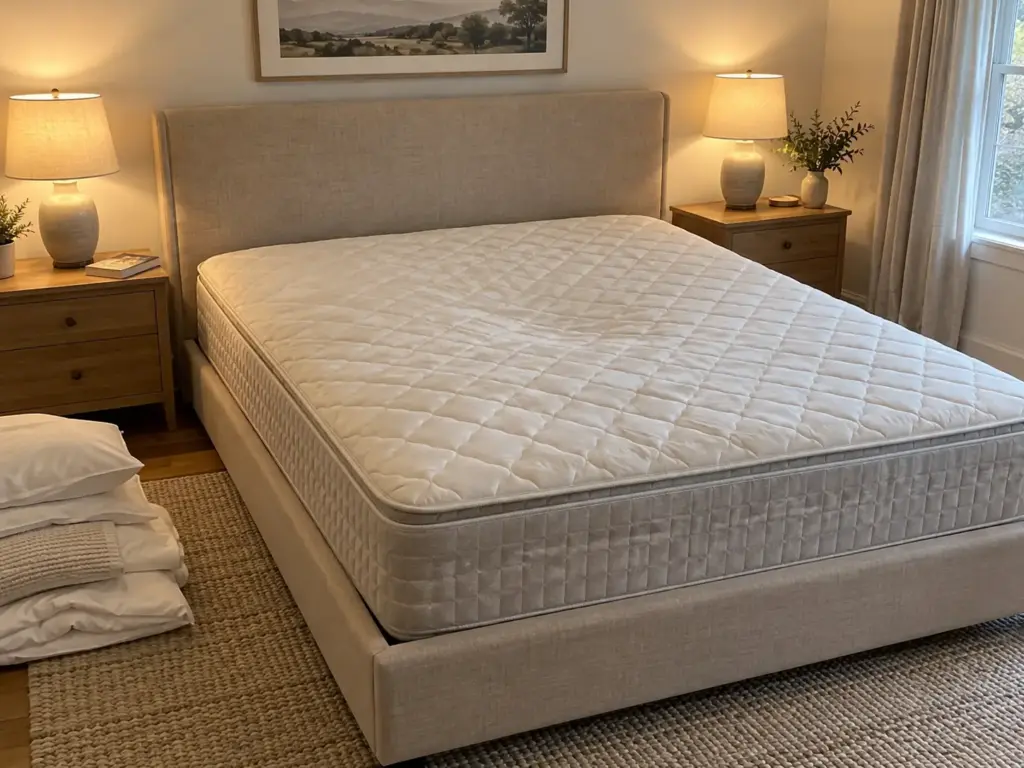
The signs that the mattress itself is finished
You need to replace the mattress when the hollow runs deeper than the line sellers give, when it stays after a good base, or when you can feel a spring through the top. Viscosoft says a topper will not repair broken springs, and Consumer Reports says the same of a bed past its prime.
One retailer puts the working life of a mattress at seven to ten years, a range that is unverified, so use it as a prompt to look and not as a verdict. The mattress lifespan is one question and the topper’s is another: how long a topper itself lasts measures it in inches, not years.
Whichever layer you pick, check the trial period before you open it; sellers’ trials run from 30 to 180 nights, long enough to take the straight-edge reading twice. Then take it again three weeks after the layer goes on: a gap that is back is the dip returning through the layer.
When the ache doesn’t move with the bed
If an ache stays the same whether you sleep on a flat, dense or brand-new surface, that is a clinic’s question, not a mattress’s. See Mayo Clinic’s guidance on when to call a doctor about back pain, which draws the line at back pain that “hasn’t improved after a week of home treatment.” Back to the bed: for the question of how much of a bad morning the surface owns, read when it’s the bed and when it isn’t.
Measure the Gap, Check the Base, Then Pick the Density
- Sort the sag first: a dip in the surface, a base that stopped holding, or a spent core.
- Check the base before the topper, because slats, a center leg and a board of at least 3/4 inch cost nothing to test.
- Pick density by case and by the heavier sleeper, in pounds per cubic foot, and ignore the word on the front of the listing.
Once the topper has been on for a few weeks, repeat the straight-edge reading and compare it with the one you took before. A topper earns its place by that gap, not by how it felt the first morning, and a hollow that is back through the layer says the problem was never the surface. This weekend, lift the mattress and look at what it rests on, then measure the widest slat gap. Notice whether the dip in the bed lines up with it.
Frequently Asked Questions
01Do mattress toppers help with a sagging mattress?
Mattress toppers help only with a shallow dip in the surface, not with a failing base or a worn core that has lost its spring. Lay a straight edge across the bed first: a small gap over a flat base is the case a dense topper can cover.
02What is the best type of support for a sagging mattress?
The best support for a sagging mattress is a sound base: slats no more than 3 inches apart with a center support, or a board at least 3/4 inch thick over them. Read your warranty before adding a board.
03Is there a mattress topper that makes your mattress firmer?
Choose a firmer topper by its density in pounds per cubic foot, not by the word firm, which has no standard behind it. Latex also pushes back where foam sinks in. The numbers for both are in density, ILD and Dunlop vs Talalay.
04Why is my mattress sagging after only 3 months?
A mattress sagging after three months points to the base first: slats more than 3 inches apart or a missing center leg are common causes of early sagging. Measure the dip and read the warranty before you change anything.
05Will a topper slide on a sagging mattress?
A topper can slide on a sagging mattress, and a deeper dip makes it likelier because the surface under it slopes toward the hollow. A deep dip makes that slide more likely. Fix the surface under it.




Tried it on your own bed?
No comments yet. Tell us what you changed, and what the sheet did after a few washes.