


What’s in here12 sections
- Check the Layer Already on the Bed First
- Memory Foam and Polyfoam, One Chemistry at Two Densities
- Gel, Copper and Graphite Are Additives, Not Layers
- Latex Comes in Two Processes, and the Label Rarely Says Which
- Feathers and Down Give Loft, Not Support
- Wool and Cotton Move Air but Feel Like Padding
- Polyester Fill, Down Alternative and Hybrids
- Motion and Two Sleepers on One Topper
- What Height Does to Your Sheet
- How Each Material Fails, and What the Label and Warranty Leave Out
- Pick the Failure You Can Live With
- Frequently Asked Questions
Three words turn up on topper boxes again and again: gel, egg crate and down alternative. Gel names an additive, egg crate names a shape, and down alternative names polyester, so none of them names the material you are about to sleep on. The real list of mattress topper materials is shorter than the shelf suggests: polyurethane foam, latex, feathers and down, wool and cotton, and polyester fill, each of them going flat, lumpy or tired in its own way. The table below sorts them by feel, heat and failure, and the sections after it take one family at a time, starting with the layer already on your bed.
Read the table by row. Each row is a family of material, not a product, and the last two columns are the ones a box never prints.
| Material | Feel, heat and height | How it fails | What it is for |
|---|---|---|---|
| Memory foam and polyfoam | Memory foam hugs and recovers slowly, and dense foam holds heat. Polyfoam is bouncier, and the perforated egg crate cut passes more air. | Foam loses its hold; polyfoam goes first. New foam smells until it is broken in. | A hold under the hips and shoulders (memory foam, at 1½ to 2 inches or more), or a plain softener (polyfoam). |
| Gel, copper and graphite | The same foam with an additive mixed in. The cover does part of the heat work. | The heat offset may fade over time, and it is unclear it works at all. | Nothing on its own. A label to read, not a layer. |
| Latex | Springy and pushes back. Dunlop is denser and firmer; Talalay is lighter and more ventilated. | The process is rarely printed, and it costs more up front than foam. | Support with lift, for a sleeper who wants to sit on top of the layer. |
| Feathers and down | Loft without support, and less heat-trapping than foam. | Compresses and migrates; shafts can poke through a cheap cover. | Softness on a bed that is already supportive, if you will shake it out weekly. |
| Wool and cotton | A padded feel that moves air. Wool is warm in winter and cool in summer. | Compresses over time; cotton needs frequent washing; wool smells mildly when new. | A natural layer of modest loft. |
| Polyester fill and down alternative | Fluffy and light, with the least support of the group. | Squashes down quickly and clumps into lumps. | The cheapest softness, and the shortest-lived. |
| Hybrid and split layers | Two materials stacked, or two firmnesses in one piece, with a firmer midsection in zoned designs. | The seam where two zones meet, and fit complaints on the cover. | Two sleepers, or one bed that needs both feels. |
Check the Layer Already on the Bed First
The table sorts the materials; this section sorts the bed they are going onto, because the cheapest layer is the one that is already there.
A Built-In Top May Already Do a Topper’s Job
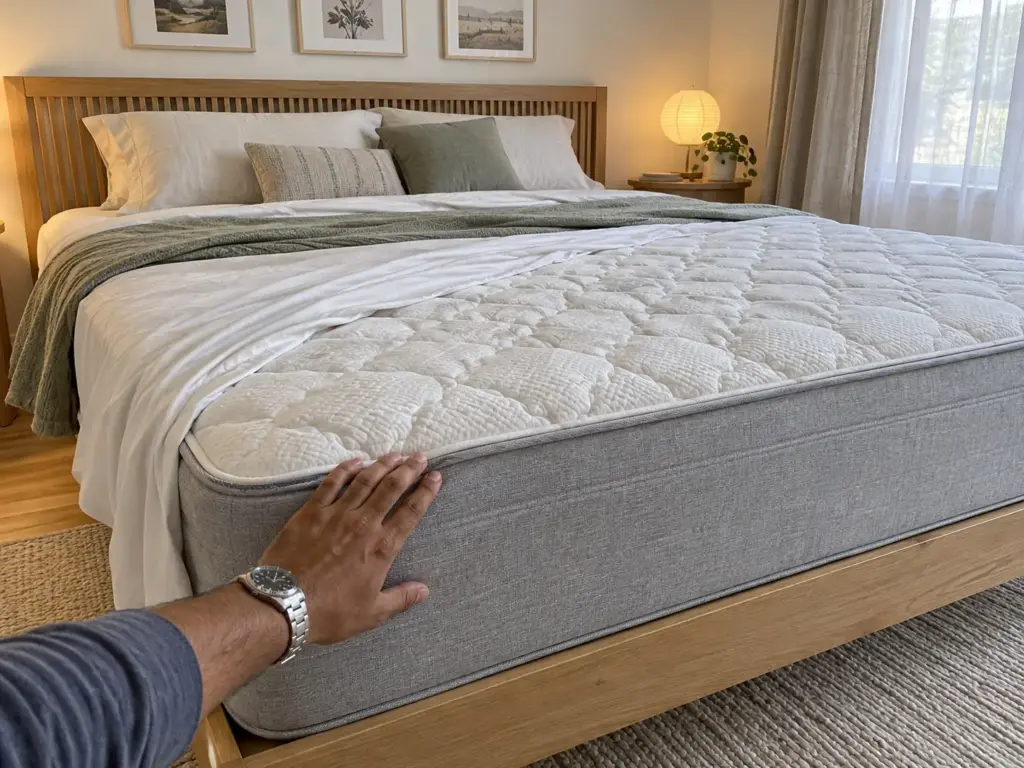
Sleep Foundation points out that new mattresses often ship with a built-in pillow-top or Euro-top, a padded panel stitched across the surface, so many beds need no separate topper at all. You can find out without reading a label. Run a hand down the side of the mattress near the top edge (a minute, no tools): a seam with a quilted panel above it means the bed already carries a layer of the kind this guide is about. But a second one stacks softness on softness, while the firm part underneath stays exactly as it was.
A Sagging Middle Belongs to the Base
A topper is the standard fix for a bed that has gone soft, and a sagging middle is the case where it fails. The Spruce is plain about it: a topper won’t help a mattress with a saggy middle. A topper changes the top few inches, and a trough in the base comes straight back up through whatever you lay over it.
What a layer can and cannot hide is laid out in the four ways a topper fails a bed. If the center of the bed has a dip you can see from the doorway, the base is the purchase, and no material below this point changes that.
The Protector and Sheet Sit Above Whatever You Add
Everything you stack goes under the mattress protector and the fitted sheet, and both need pockets deep enough for the new total height, as Sleep Foundation and The Spruce both warn. That makes the sheet the free half of this check, since the pocket depth is printed on its package and costs nothing to read. The height section further down turns it into a sum. For now, the point is that the bed you have is the first material in the stack.
Press a flat palm into the center of the bed, then into a corner, before you shop. If the center gives and the corner holds, that difference is the base, and a topper will drape over it instead of removing it.
Memory Foam and Polyfoam, One Chemistry at Two Densities
Two names on the shelf, one family underneath. This section is where they split, and why the split sets heat and wear.
Memory Foam Is Polyurethane Made Denser
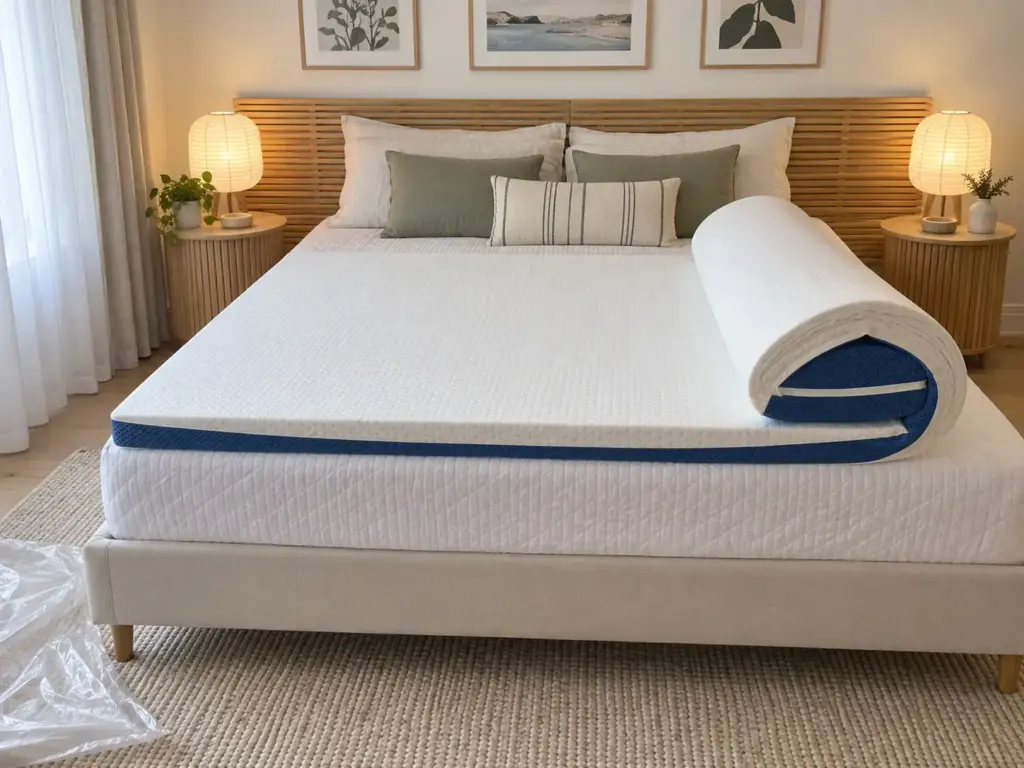
Memory foam is polyurethane made denser, and the extra density is its whole character: it conforms slowly, recovers slowly (the trade term is low-rebound) and holds the shape of whatever lay on it, which is where its pressure relief comes from. The same density that gives the hold also traps heat, which Sleep Foundation names as the trade. The pain question has its own guide, and this one borrows only its rule: density is the ruler, not the firmness label.
The Viscosoft 3 Inch Memory Foam Topper is a useful example because it is the one foam here whose listing prints a density figure at all, a single block of gel-infused foam rather than a cut one. The figure is the maker’s own, so it is left unquoted here. Amazon’s summary of its reviews gives the other side: some buyers say it is “too squishy and sinks too much,” some say it makes them hot, and a few report an awful smell.
Polyfoam and “Egg Crate” Are the Bouncier, Cheaper Cousin
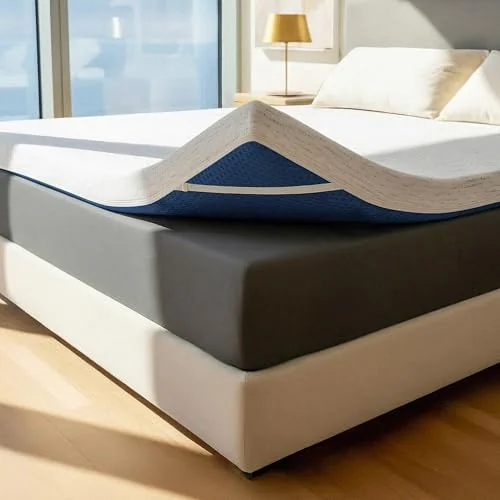
Polyfoam is the bouncier polyurethane: less dense, less constricting, quicker to push back. “Egg crate” is not a separate material but a shape of polyfoam, cut with perforations so air can pass, according to Sleep Foundation. The trade is life span. Polyfoam wears out faster than memory foam, as Turmerry puts it, so it sits at the budget end of the foam family and ages like it.
What a Thin Layer of Foam Cannot Do
Consumer Reports asks for at least 1½ to 2 inches of memory foam before the motion benefit shows; below that you own a softener, not a different bed. A new foam topper also smells until it is broken in and needs time to expand, as The Spruce and Sleep Foundation both note, so the topper that comes out of the bag is not the one that exists after a day or two flat on the mattress. For long-term foam, the evidence is thin: memory foam under a feather bed has been reported to hold up over time, with no month count behind it. The pillow version has its own ledger in the same foam in a pillow.
Gel, Copper and Graphite Are Additives, Not Layers
“Gel” is on more boxes than any other word in this guide, so it gets a section to say what it is before it decides a purchase.
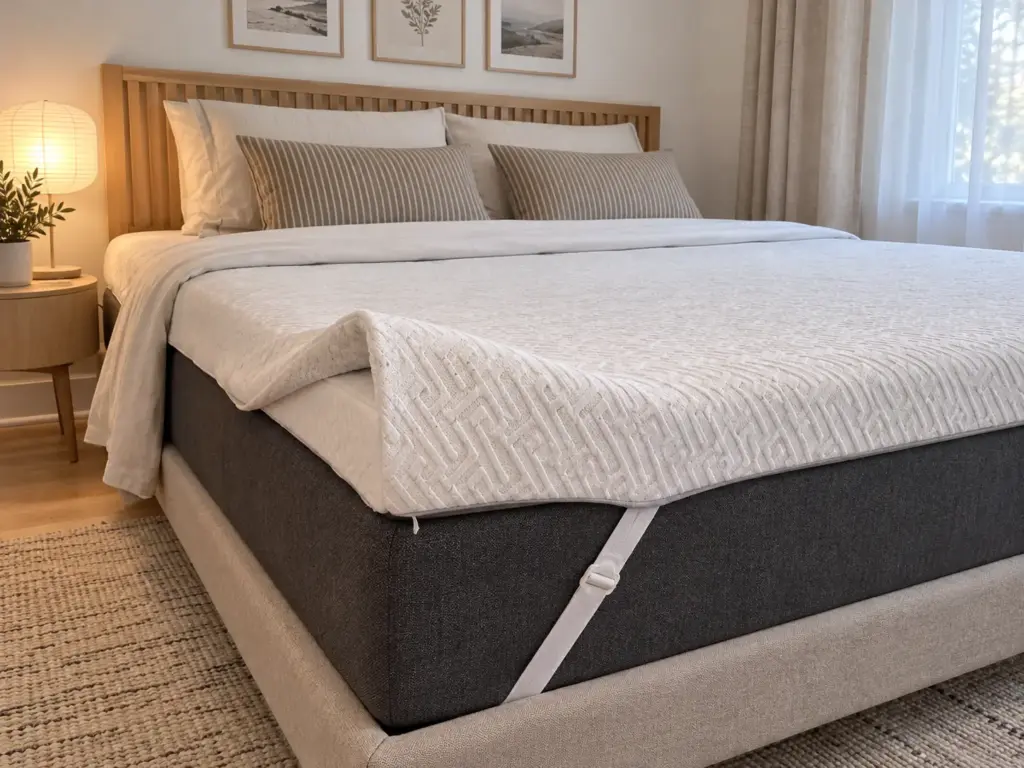
Gel, copper and graphite are additives mixed into a foam, not a different construction: underneath, gel-infused memory foam and its copper-infused and graphite-infused cousins are the same polyurethane from the last section. Consumer Reports’ expert is skeptical there is enough of any of them to make a difference, and the buying guide itself calls it unclear whether they work. Turmerry adds that the heat-shedding effect may fade over time, and a surface reading from a test that runs for minutes cannot say what the fiftieth night feels like. No listing states how the first night compares with the fiftieth.
That is why the price gap between two toppers sold on a cooling gel is not a gap in how the foam sheds heat. The VALUXE 3 Inch Gel Memory Foam Topper sits at the cheaper end of the same 3-inch gel-infused memory foam, with a bamboo cover and the same gel word, and its listing prints no density figure. That missing number is the flaw to weigh: with density hidden, the gel word is all the listing says about the foam, and the word describes an additive. No pattern of owner complaints is established for it here, so the missing number is the only flaw stated.
The cover does part of the work, too. A knit or open-weave cover has gaps for air to move through, and a tight one seals the core under the sheet, which adds to the heat retention. Where heat goes is a three-part question, and what actually moves heat in a topper is the core, the cover and the sheet, which that article takes apart.
Latex Comes in Two Processes, and the Label Rarely Says Which
After the additive that means little comes the material whose process means a lot, and the box usually names neither.

Dunlop Is Denser, Talalay Is Springier
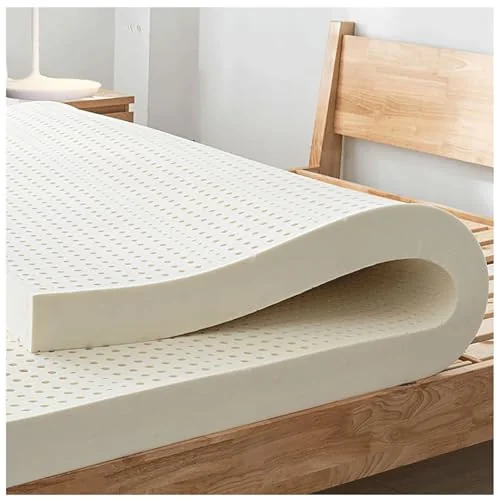
Latex is made by one of two processes. Dunlop latex is firmer and more durable; Talalay latex is springier (more responsive), lighter and more ventilated, and Sleep Foundation calls it often more cooling. The two behave differently enough that the process, not the word “latex,” tells you what the layer will feel like and how it will age, yet three listings that all say natural latex can hide three different ones. The same material in a pillow gets its own treatment in latex in a pillow.
Natural, Synthetic and What GOLS Covers
Check that the label says natural, as The Spruce advises, because synthetic latex is a different material that can carry the same word. GOLS is the certificate people reach for next.
Control Union, a certifier that issues it, says all the raw materials in a GOLS product must meet the organic-origin rules, and that such products may also contain other approved materials and accessories. So GOLS speaks about the raw-latex chain. It is not a comfort grade, and it says nothing about firmness or heat. If you have a latex allergy, that is a reason to choose another material, and the topic ends there.
“Latex Is Cool” Is Said Both Ways
Consumer Reports calls latex naturally cooling. The Spruce says it can be hot. One latex-topper review scored a specific product below its latex rivals on heat.
All three can be right, because the variable that is never set next to the claim is the process, and with it the density and the open-cell structure that decides how much air gets through. For a hot sleeper, a listing is worth reading for what it leaves out: no process, no certificate.
The Queen 4 Inch Firm Natural Latex Topper is an example of exactly that. Its listing says 100 percent natural latex, and it names neither Dunlop nor Talalay nor GOLS, so it cannot say which side of the cool argument it sits on. Owner complaints could not be read for it, so the flaw stated is the listing’s own: the process and the certificate are missing.
Feathers and Down Give Loft, Not Support
The oldest filling in this guide trades support for softness, and the trade has a weekly cost.
Loft Without Support
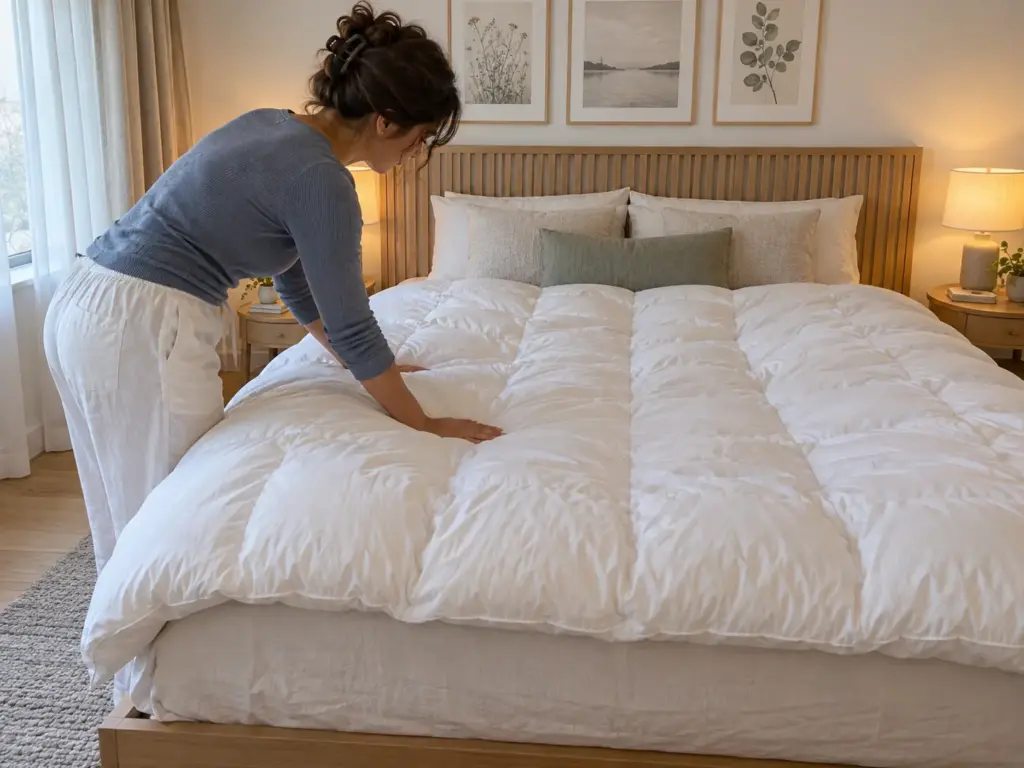
Feathers and down do not deliver the responsive support memory foam and latex can, but they are less heat-trapping, as Consumer Reports puts it. They also compress over time and need periodic shaking, and the shafts can poke through a cheap cover, The Spruce notes. A feather topper on a mattress that is already supportive makes a bed softer; on one that is not, it makes a soft bed with nothing under it. A feather allergy is a reason to choose another material, and that is as far as this guide goes with it.
The Upkeep Nobody Lists
The 2007 Straight Dope thread on a feather bed against foam is blunt about the maintenance. One owner said the feather bed has to be flipped and rotated every week. Another said the feathers “migrate to the places where you don’t put your weight,” which is the thin center and full edges you find when you stop turning it.
On a bed shared by two, a third described the feathers settling into “a mound of compacted feathers” between the sleepers, with the bedclothes ending up hanging off one side of the bed. It is one informal report, not a survey, but the mechanism is plain: a loose fill goes where the load is not.
Real Down and the Certificates
A real down topper brings its own labels. The Responsible Down Standard and the Global Traceable Down Standard are the ethical certificates for it, per Consumer Reports, and they speak about sourcing, not about loft or how long the layer holds up. The same fill in a duvet is laid out in down versus the polyester that stands in for it.
Wool and Cotton Move Air but Feel Like Padding
Natural fibers sit between the loft of feathers and the hold of foam; they give neither fully, and they say little about it.

Wool Is Warm in Winter and Cool in Summer
Consumer Reports says the fills in a wool topper or a cotton topper tend to be breathable and naturally regulate heat, because the fiber itself takes up moisture and the loft keeps air moving through the layer. The Spruce and Sleep Foundation both describe wool as warm in winter and cool in summer, and The Spruce adds a mild sheep odor when it is new. The odor is a first-nights detail, the kind a week-two report catches and an unboxing does not.
The padded feel is real, though: this is a layer that sits between you and the mattress, not one that reshapes the mattress. The layer order for a cold room is settled in what to put on a cold bed from the mattress up.
Cotton Needs the Wash Instructions Read First
Turmerry notes that cotton may need frequent washing, and the care label decides what can go in a machine. Almost no latex or foam topper can, and the fills in this section depend on the maker. A cotton-filled layer that goes back on the bed while still damp inside keeps its moisture long after the surface feels dry, so the drying is part of the care.
Read the label’s organic claim the same way. GOTS means 95 percent or more organic fibers, according to Consumer Reports, so check whether a label covers the shell, the fill or the whole layer before treating it as a statement about the fill.
Polyester Fill, Down Alternative and Hybrids
The cheapest fill and the most renamed one: here is what the soft words stand for, and what happens when two materials are stacked.
“Down Alternative” Is Polyester With a Good Name
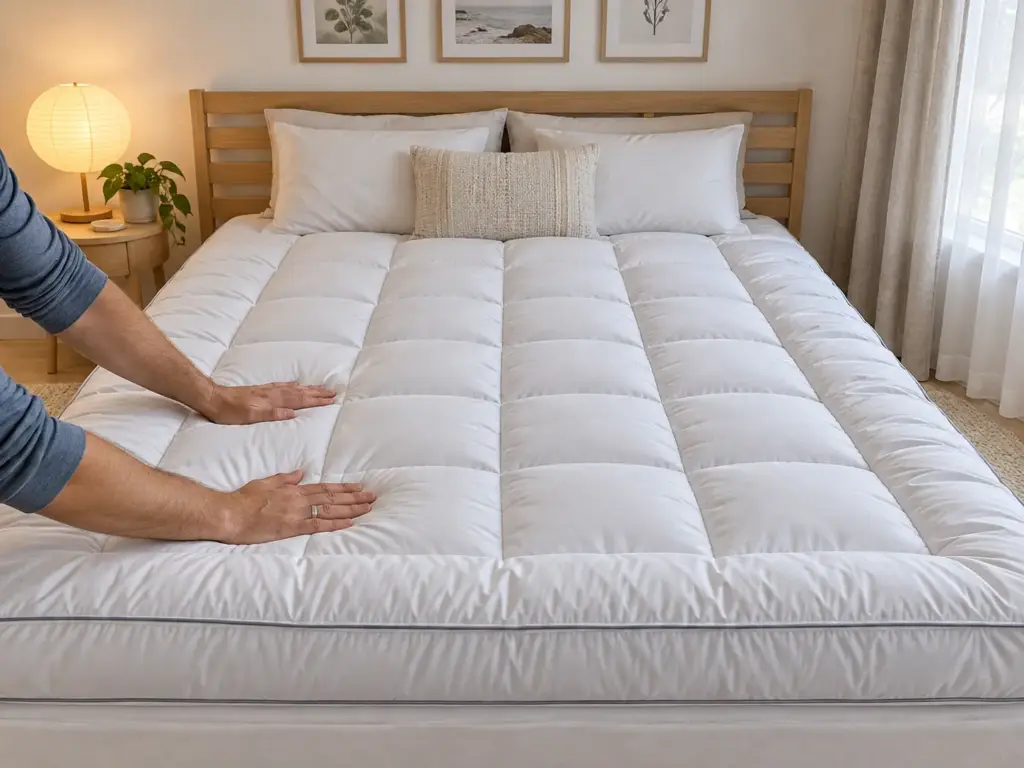
Polyester fiberfill is the least expensive and least supportive fill, and The Spruce says it squashes down quickly and can become lumpy. A down alternative is the same family: polyester clusters in a shell, per Sleep Foundation’s description. The soft name is a label for the fill, and it carries no construction detail. Same fiber, different denier covers what the polyester itself is.
The HYPREST Pillow Top Topper is the example here, a quilted pillow-top cover over a down-alternative fill. Amazon’s review summary reports mixed feedback on its thickness, and some buyers say it doesn’t fluff up as expected, which is the fiber-fill complaint in one line. Whether a fill fluffs back in the first week is the nearest thing to a preview of month six.
Hybrids and Zoned Layers Stack Two Materials
A hybrid topper puts microcoils or zoned foam under a cover, and a zoned layer has a firmer midsection. Two materials stacked means two sets of failure modes, one under the other. Sleep Foundation notes that many companies now offer built-in toppers in a pillow-top or Euro-top style, so as the first section said, you may already own the hybrid.
Why Fill Clumps
A loose fiber fill is a pile of crimped strands held in a shell by stitching, and the strands move where your weight sends them. That is why Turmerry says polyester fibers may clump over time, and why the lumps arrive where the load is heaviest. A layer that clumps unevenly is also the hardest to read at a glance, because the stitched shell hides the shift until you press it.
Motion and Two Sleepers on One Topper
Everything above judged one sleeper; a bed usually holds two, and the testers do not agree on what moves across it.
Motion Follows Thickness and Density
Sleep Foundation and Consumer Reports both say memory foam keeps movement from crossing the bed. A hands-on test of a memory foam topper felt more motion transfer than expected. The Spruce says latex doesn’t transmit motion, while another test scored a latex topper 3 out of 5 on motion isolation.
Each source is describing a real layer, and the material name does not settle it, because motion follows how thick and how dense the layer is. Consumer Reports puts memory foam at no less than 1½ to 2 inches before the motion benefit shows, so a thin foam sheet and a thick latex block can swap places in a motion test, whatever the family says on the box.
For couples and any two sleepers, the question is not which material is quiet but whether this particular layer is thick and dense enough to be quiet. Ask it of the specific topper, not of the family.
One Bed, Two Firmness Needs
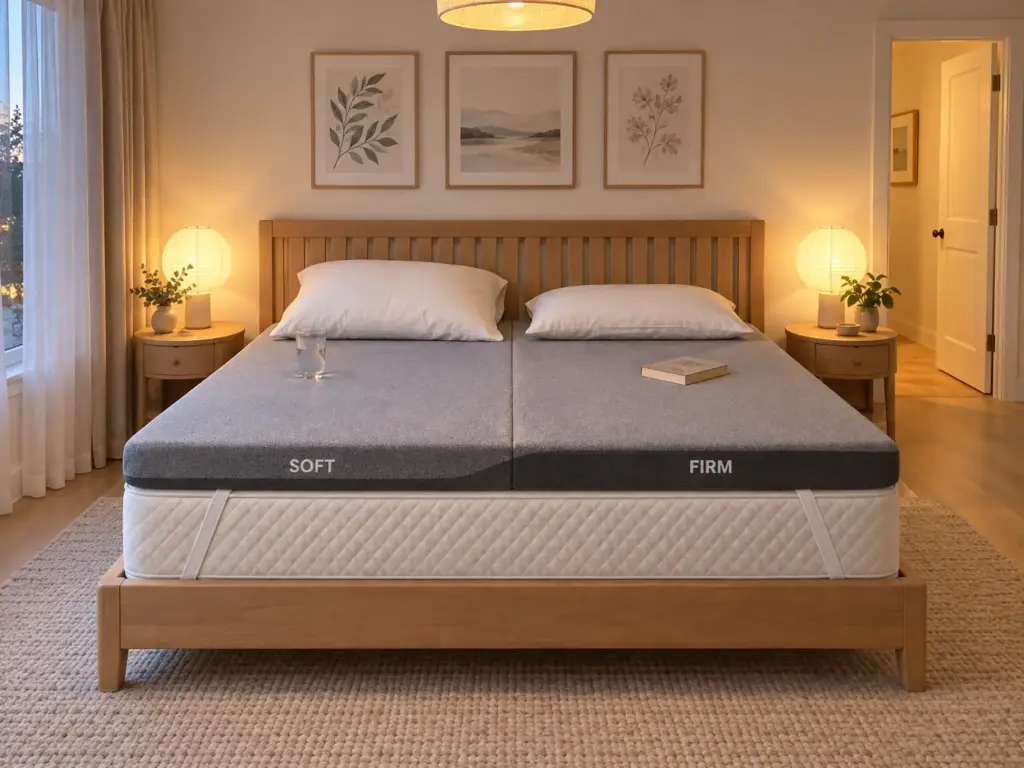
One sleeper wants soft and the other wants firm (on the 1 to 10 firmness scale many brands print, they may sit several points apart), and one compromise is wrong for both in opposite directions. The structure that avoids it is two firmnesses on one bed: either a split layer, or a topper that covers only one half, with the catch that the sheet then has to cross a step.
The PERLECARE Dual Firmness Topper is the split version, two firmnesses in one 3-inch piece, which is split firmness in its plainest form. The listing is Full, not Queen, so check the size before assuming it fits a queen bed. The review summary on Amazon carries two flaws: the fit runs too big for some buyers, and others report it tearing within days of use.
The seam down the middle is where the two firmness zones meet, and it is the first place you will feel the change. Which side of firm suits which position and weight has its own article: firm versus soft by position and weight.
What Height Does to Your Sheet
The last thing a topper changes is the thing that never gets measured: the bed got taller and the sheet did not.
Add the Numbers Before You Buy
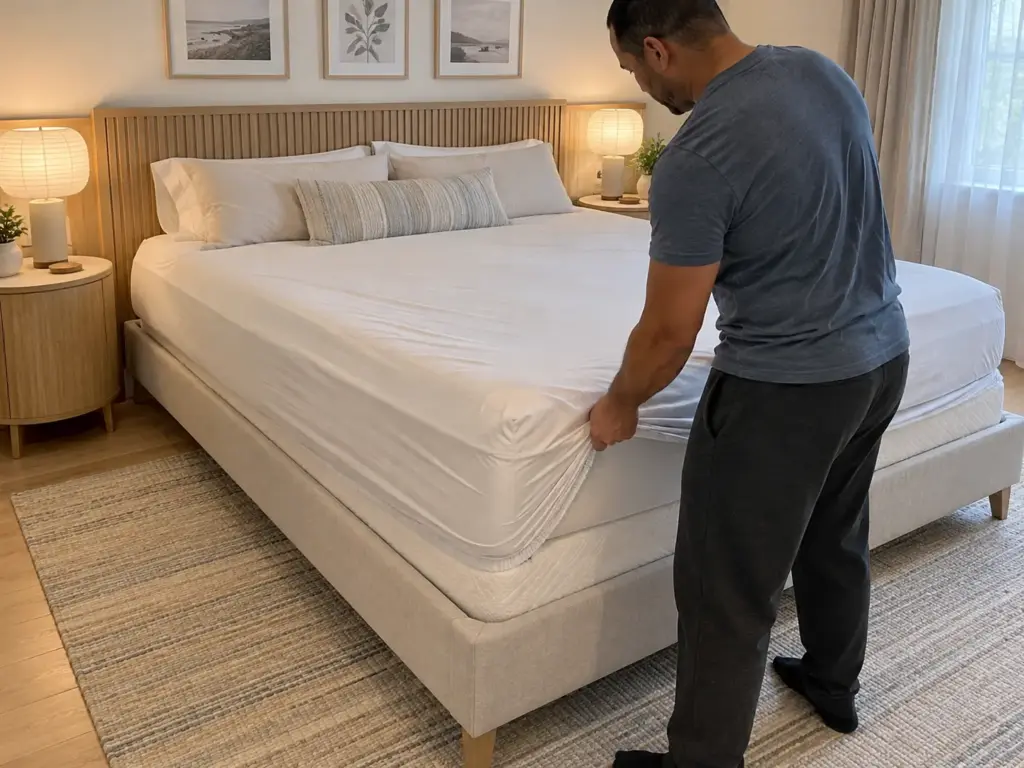
A topper adds 1 to 4 inches, according to Consumer Reports, and its own example is a 4-inch topper on a 15-inch mattress, which may leave you struggling to get the sheets to fit. Past that, the choice thins out fast: a limited number of Consumer Reports’ top-rated sheets will fit an 18-inch mattress.
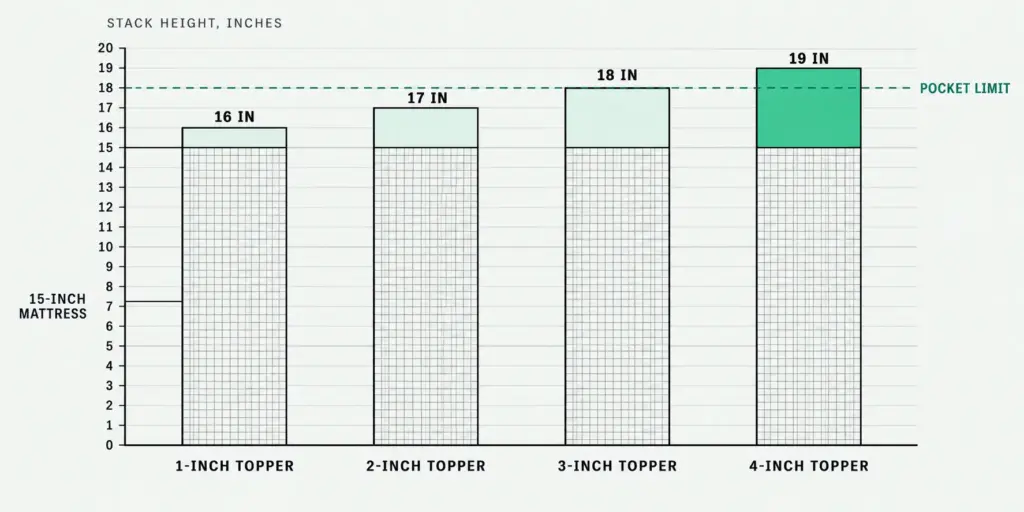
The arithmetic is the whole job: mattress depth plus topper thickness, set against the pocket depth printed on the package of a deep pocket sheet. The protector has to clear the same total, as Sleep Foundation and The Spruce both say. A sum that comes out above the pocket means the sheet is the wrong sheet, or the topper is the wrong thickness.
Write down the mattress depth and the topper thickness, add them, and compare the total with the pocket depth on the sheet’s package before the topper ships. The sum takes a minute and settles the question the return window would otherwise answer.
The Corner Pops Before the Topper Moves
When the sum is wrong, the corner is what shows it. The corner that lets go first is often one at the head of the bed, and the topper itself stays where it was put while the sheet crawls off its edge. The rule for a sheet that stays on is mattress plus topper plus two inches, and a sheet that stays on at mattress plus two inches works through it.
How Each Material Fails, and What the Label and Warranty Leave Out
Every family above has one named way to end. This section lines them up and then reads the paper that comes with the layer.
Each Family Ends in Its Own Way
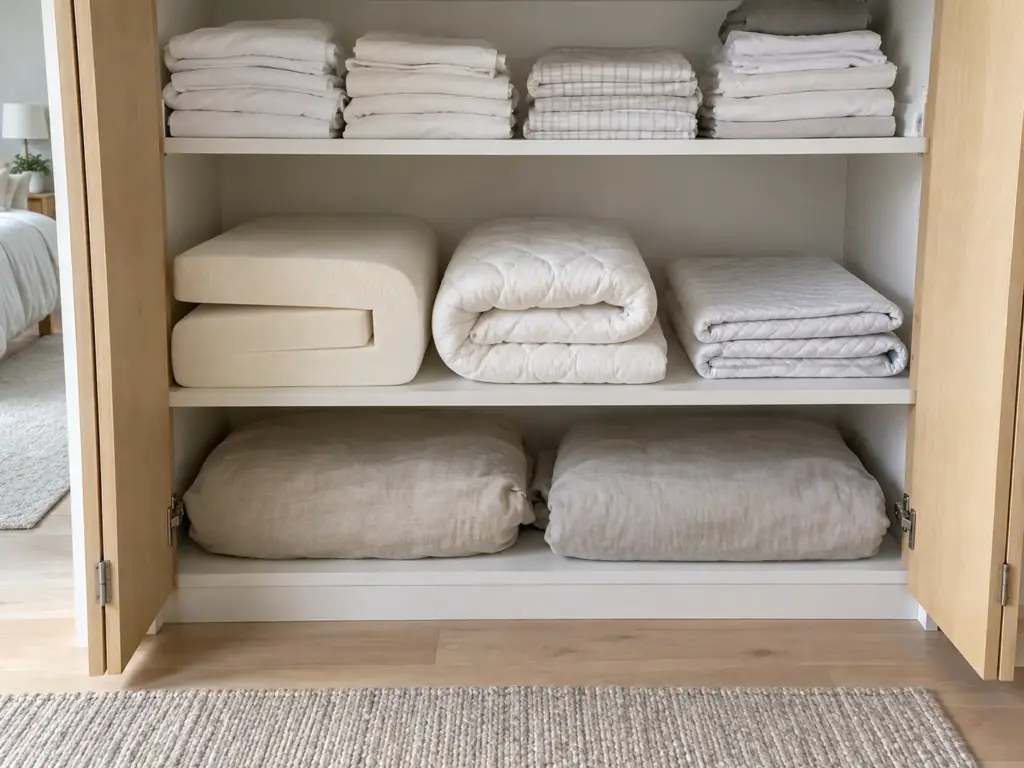
The endings, one per family:
- Memory foam loses its hold, and polyfoam goes sooner.
- Gel’s heat offset may fade over time.
- Latex lasts five years or more with proper care, per Turmerry.
- Feathers compress, migrate and need turning.
- Wool and cotton compress and need their care.
- Polyester fill squashes down and clumps.
No source names a month count. The only time figure comes from a testing publication: according to Consumer Reports’ buying guide on mattress toppers, “As for lifespan, a high-quality mattress topper typically lasts three to five years.” It is a range for a good topper, without a named test behind it, and it says nothing of what the layer looks like at month twelve. The same fills run on a different schedule in a comforter, and how long a comforter’s fill lasts gives that one.
The check that answers it at home is simple. Press the center of the layer, then a corner, and compare. A new corner laid next to the worn middle shows the loss in one touch, because the corner has carried no weight.
A Warranty Covers Defects, Not Height
Warranties are printed in years, from one to ten years on the toppers the testers cover, and they cover structural and workmanship defects. A ten-year warranty is a claim about a defect in the make, such as a split seam or a manufacturing flaw. It is not a promise that the layer will be as thick in year ten, and a warranty page rarely says what it promises about sag. Reading a ten-year warranty as a ten-year layer is the mistake the paper invites.
A sleep trial, which runs 30 to 180 nights on the listings the testers cover, is the closer check, but it ends long before month twelve.
Keep the receipt and the date, and press the center and a corner every few months. A flat middle is the failure no warranty names, so the dated receipt is the only record you will have when you need one.
What the Certificates Actually Certify
Each certificate answers one narrow question, and none of them is a comfort grade:
- GOTS: 95 percent or more organic fibers, as Consumer Reports states it.
- GOLS: the raw latex chain and its raw materials.
- OEKO-TEX Standard 100: tested for harmful substances, as Consumer Reports describes it.
- Greenguard: low chemical emissions.
- CertiPUR-US: a program for polyurethane foam.
Read the line of the label for what it covers, the shell, the fill or the whole layer, and then set it aside. None of them says how many months the height holds.
Spot-Clean the Core, Wash the Cover
Almost no latex or foam topper can be washed, only spot-cleaned, Consumer Reports says. Some toppers come with a removable, machine-washable cover, and some covers are spot-clean or dry-clean only, so the care label tells you which kind you have. Wash the cover and spot clean the core, and never soak a foam or latex block to freshen it: a layer that cannot dry through is a layer that stays wet.
Pick the Failure You Can Live With
Three things carry over from the sections above. The material sets the feel and most of the heat, and the family name on the box is a clue rather than a promise. Each family ends in its own way, and neither the label nor the warranty says how many months the height holds. And the first checks cost nothing: the layer already on the bed, and the pocket on the sheet.
For later, once the layer has been on the bed a few months, press its center and a corner and compare them. A middle that has gone flat against a corner that stayed thick is the failure of your particular material, and it is the one you accepted when you picked it.
Tonight, run a hand down the side of the mattress for a built-in top, then measure the mattress depth and read the pocket depth on your fitted sheet’s package. Afterward, notice whether you still want a second layer at all, or whether the corner you pressed was the whole answer.
Frequently Asked Questions
01What material is the best for a mattress topper?
No single material wins; the right one is the one whose failure you can live with. Foam loses its hold, fills compress or clump, and latex costs more up front. Choose by how the layer ends, then check its height against your sheet.
02What are mattress toppers made of?
Mattress toppers are made of memory foam, polyfoam, latex, feathers and down, wool, cotton or polyester fill, and sometimes two of these stacked. Gel is an additive mixed into foam, not a separate layer, and egg crate is a shape of polyfoam.
03What are the downsides of using a mattress topper?
A topper adds height that can stop your sheet fitting, cannot fix a sagging base, and carries heat-shedding claims that are mostly unproven. Almost none can be machine-washed. Consumer Reports puts a good one at three to five years.
04Do I need a topper if my mattress already has a pillow-top?
Often not. Many new mattresses ship with a built-in pillow-top or Euro-top, so check that layer first. A second layer adds height and softness without changing the base underneath.
05Can you wash a mattress topper?
Almost no foam or latex topper can be washed; they are spot-cleaned. Some covers come off and go in the machine, while others are spot-clean or dry-clean only, so read the care label before wetting anything.





Tried it on your own bed?
No comments yet. Tell us what you changed, and what the sheet did after a few washes.