

What’s in here7 sections
The box says gel, or it says latex, and neither word is a measurement: gel is an additive mixed into memory foam, and latex is a family of materials that do not all feel alike. What separates them in a gel vs latex mattress topper choice is cell structure. Latex is open-cell, so air passes through it and the layer pushes back against your weight, while gel-infused memory foam closes around you and keeps the dent after you move. This page is about the material, not about which side of firm suits your position and weight, which has its own page.
The order from here is the tag, a press test that costs nothing, heat in one comparison, stacking the two layers, and a bed shared by a hot sleeper and a cold one, with what each topper material is made of waiting if you want the wider family.
Read the table across first, then use the press test further down to settle the row that decides it for your bed.
| On the topper | Gel-infused memory foam | Latex |
|---|---|---|
| What it is | Memory foam with gel added: beads, a swirl through the foam, or a layer on top | A family of materials: natural, blended or synthetic, made by the Dunlop or Talalay process |
| Under your weight | Gives way slowly, closes around you and holds the dent | Gives way, then pushes back and returns fast |
| On a firm base | A slow, deep cushion that settles toward the base | A springy cushion that holds you up off the base |
| Heat | Cool at lie-down, a surface effect that fades within hours, unmeasured | Open cells let air through, so it tends to run cooler |
| What to read on the tag | Density as a number, not a grade word | Natural or blended, Dunlop or Talalay, and the firmness rating (ILD) |
| Where it falls short | Holds the dent, and the cool fades | Can feel bouncy to a restless sleeper, and the process is often left off the listing |
What each one is on the tag
On the box, gel and latex read as two single materials. On the tag they split into several, and that split is the part of this decision that costs nothing to settle before you press anything.
What gel can mean on a topper
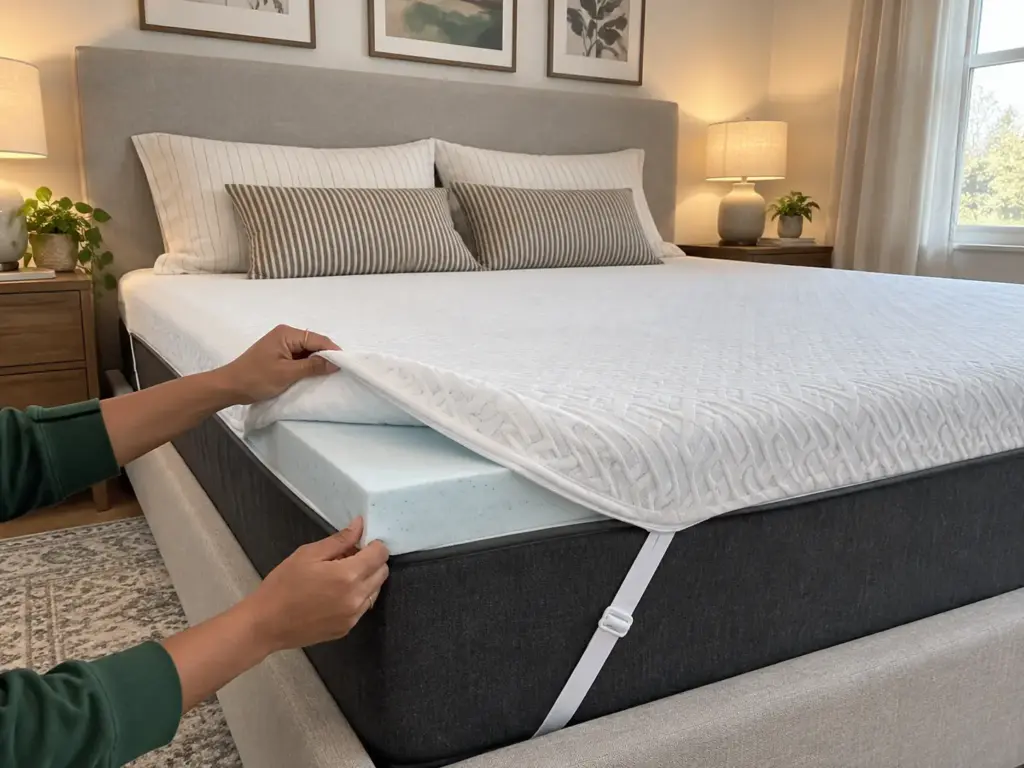
Gel on a topper is an addition to memory foam, never a different material. That foam is a viscoelastic polyurethane foam, and gel comes in three forms: microbeads mixed into the foam, gel swirled through the liquid foam before it sets, or a separate gel layer on top. All three sit on the same memory foam underneath, which is why a gel topper still sinks and holds the dent the way plain memory foam does.
The VALUXE 3 Inch Gel Memory Foam Mattress Topper is a clean example of what to read past. It is a 3-inch layer of gel memory foam, the title says High Density, and the listing prints no density figure anywhere. A grade word is not a number, and two grade words cannot be compared with each other.
Across retailer listings for 3-inch gel toppers, the printed densities cluster roughly between 2.5 and 3.2 pounds per cubic foot, and one reviewer wrote that the number on the listing did not match the foam in the box. A figure is at least something to hold a seller to. A grade word gives you nothing to hold.
What latex can mean
Latex is described on a different axis. It comes natural, blended or synthetic, and a blended one can be mostly synthetic with a little natural latex in it, so 100% natural on a listing is a statement about the source and says nothing about the process. The process is the second word to find. Vendors describe Talalay latex as vacuum-processed and flash-frozen, giving a more uniform open-cell structure and a softer, more buoyant feel, while Dunlop skips those steps and ends up denser toward the bottom of the layer. Sources disagree on whether the two feel alike at the same firmness number, and that disagreement is the reason to want the word on the tag at all.
One boundary belongs in this section and nowhere else in the piece. A skin, breathing or eye reaction after contact with latex, or a sleep pain that stays put whichever topper is on the bed, is a question for a doctor, not for a topper. According to Mayo Clinic’s guidance on latex allergy, “If you have less severe reactions after exposure to latex, talk to a healthcare professional.” Everything after this point is about how the layers behave, which is the part a topper can change.
The number to read next to the word
Two numbers do the work the adjectives pretend to do. On foam it is density, in pounds per cubic foot. On latex it is the firmness rating, ILD (indentation load deflection), because latex is sold by process and firmness rather than by density. Density is not an argument in this piece; it is the figure you check, and a listing without one has told you something about itself.
If a listing has a grade word where a number should be, ask in the product questions before buying. A seller who answers with a figure has given you something to compare, and one who answers with the grade word again has given you the answer to the whole question.
A seal is a different kind of printed word. OEKO-TEX or GOTS says what was tested, and what OEKO-TEX and GOTS actually certify sets out which tests, but a seal does not say what a sleeper is spared from.
Sink or push back
With the tag read, the question becomes what the layer does under your weight. Memory foam gives way and closes around you; latex gives way and pushes back. The whole difference fits in two sentences: you sleep on latex, and you sleep in memory foam.
The free press test
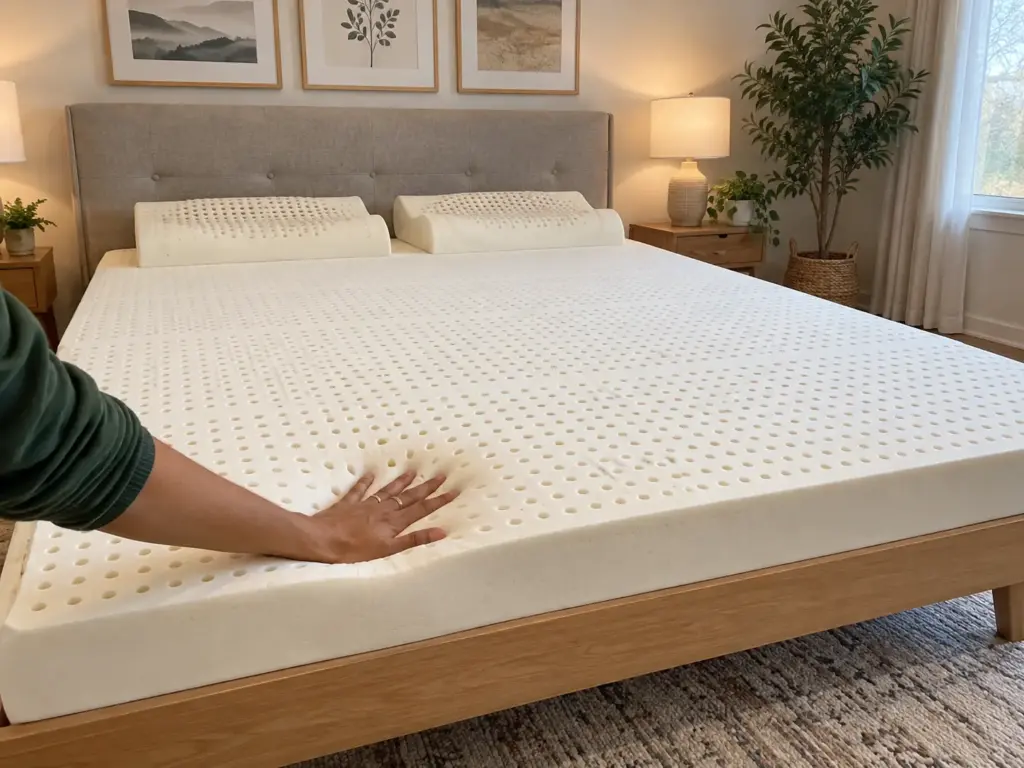
Before you open a product page, press a flat hand into the top of the mattress you already own and lift it. Watch the surface, not your wrist. A slow return, where the print of your hand fills back over a few seconds, means the bed already conforms. A quick return means it already pushes back, which is the rebound you are about to be choosing between.
A bed that already sinks wants a layer that returns; a firm bed that feels hard under shoulder and hip may want one that gives way first. It is a way of looking and nothing more, and it takes less time than reading one listing.
Press where your hip lands and again where your shoulder lands, not only in the middle of the bed. If the two spots return at different speeds, the layer you want is the one that evens them out.
On the memory-foam side of that test, the Viscosoft 3 Inch Memory Foam Mattress Topper is the gel example you can buy today: one piece, 3 inches, gel-infused, Queen. Its listing says Select High Density and prints no density figure, so the press test on your own bed is the only evidence you have until it arrives. Memory foam’s habit of holding the dent has a limit, and when a topper sinks too far shows what that limit looks like.
In the morning the sheet tells the difference. On foam the hollow stays where you were, and on latex it fills back before you have stripped the bed.
On a firm base
On a firm hybrid mattress or an innerspring, both layers add give and some pressure relief at shoulder and hip, and the difference is what the give does next. Gel foam keeps giving, so shoulder and hip settle in slowly and the layer holds that shape. Latex gives and then holds you up, so the cushion stays above the base instead of settling toward it. The case for choosing by density, not firmness is made on the back-pain page; here it stays a number to read.
On the push-back side, the ARyako 100% Natural Latex Topper is firm, 4 inches and natural latex. The listing does not say whether it is Dunlop or Talalay, so the feel at that firmness is not pinned down until you lie on it. At 4 inches and firm it changes a bed rather than covering one.
The Queen 4 inch Firm Natural Latex Mattress Topper matches that spec, though its listing carries no brand name, so there is nobody to look up if you want to know how it was made.
Motion and the bounce
Memory foam isolates motion better: a partner’s turn mostly stays on their side. Latex is more responsive, and some people find it a little too bouncy.
A hot side sleeper who tosses and turns can move to latex, find it a little bouncy, and get used to it. Bounce is the common reason a restless sleeper gives latex up. So the layer everyone points a hot sleeper toward can be the wrong match when the other person feels every turn.
Heat, in one comparison
Heat is the reason most people open this comparison, and it is the part that gets over-promised: cool at lie-down and cool in the second half of the night are different measurements, and only the first one is on the box.

Open cells against a gel that takes up heat
Latex’s open-cell structure lets air move through the layer, which is its breathability in plain terms. Memory foam is slower to let go of warmth, because it wraps close to you and the heat sits in the foam you sink into; that heat retention is the cost of the wrap.
The gel in gel-infused foam feels cool at lie-down because it takes up heat from your skin at first, then warms to match. Some hot sleepers find latex much cooler than memory foam, and that points the way the structure does.
The cool window is an anecdote
How long the gel keeps feeling cool has no measurement behind it. The cool feeling of a memory-foam surface is said to fade after a while, and no test has measured how long.
What it means for the night is plain: if the cool lasts for the first stretch, it has finished before the second half, which is when a layer that holds warmth matters most. Gel is the usual advice for a hot sleeper, and that is the point where it stops helping.
Where the rest of the fix lives
Neither material is the whole answer. The core, the cover and the sheets set the ceiling, and core, cover and sheets is where that fix is worked through. The topper cover and the mattress protector sitting above the core are covered in the layer above the topper.
Stacking the two
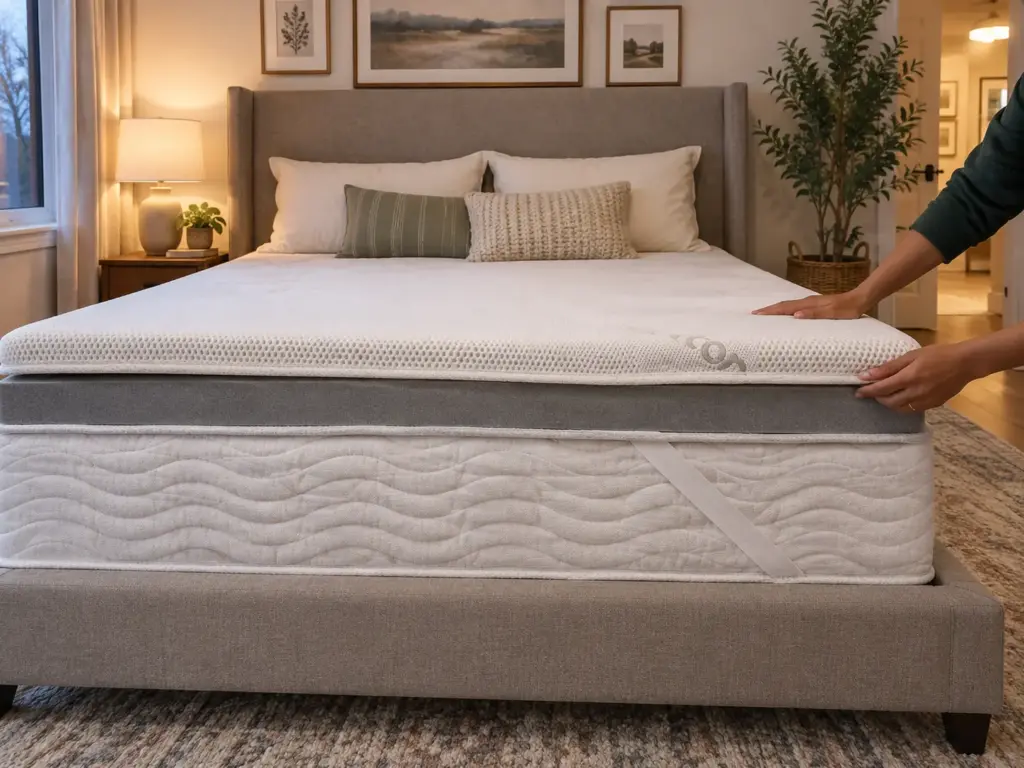
The choice is not always one or the other. A latex layer over a thin memory layer, or the reverse, is a common stack, and the order decides what the first minute feels like and what holds you through the night.
What the top layer sets
Whatever is on top is what your skin and your hips meet first. A memory layer on top gives the instant cushion. A latex layer on top gives the lively, springy first feel. That first feel is a poor judge of the whole stack, which is how a sleeper who loved the cushion on the first night finds, by the third, a hollow: a thin soft top sitting over nothing firm gives an instant cushion without much support.
What the lower layer does
The lower layer does the holding. It decides whether you settle into the stack or sink through it to the base. Latex underneath supplies the push, and a thin memory layer on top takes the edge off it. Foam underneath with latex on top reverses the job: the foam is the layer that holds the dent, and the latex rides on it.
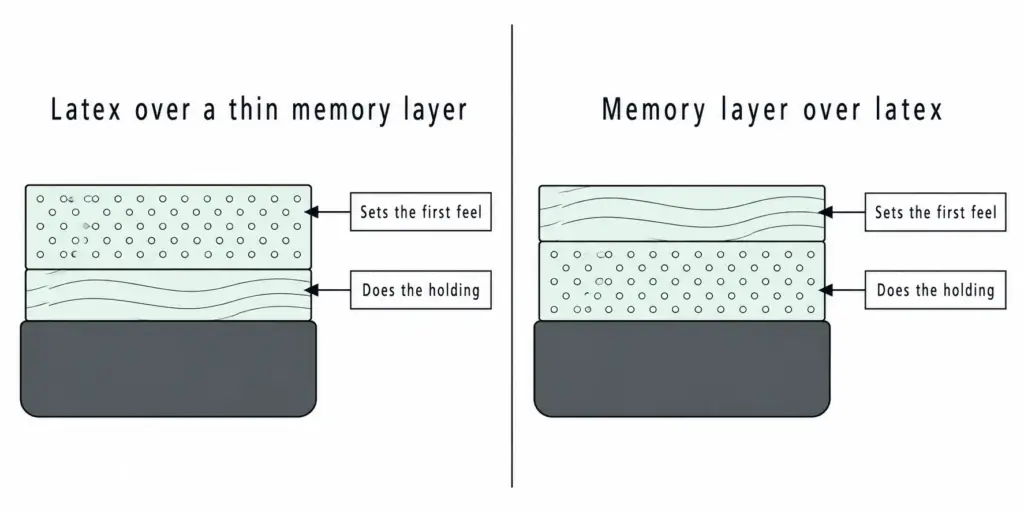
A latex topper over a thin layer of memory foam can help cut the bouncy feeling. The first feel is springy, the foam beneath takes the sharpness off the bounce, and the hold is the latex’s.
The second case runs the other way, memory foam over latex support: the first feel is the slow wrap, and the latex underneath stops that wrap from becoming a descent to the base. That stack is reported to keep some sleepers from running hot, though this is not a measured result. Nothing here is measured. The order is a decision, and the check is the press test again with both layers on the bed.
For the thin latex layer in a stack like this, the Saatva Natural Latex Premium Mattress Topper is the only one checked: natural latex, Queen, 1.5 inches, with anchor bands. At 1.5 inches it cannot change a bed on its own, so treat it as one layer in a stack, never as the fix for a bed that is wrong.
Judge a stack on the second night, not the first. The top layer sets the feel of the first night, and the second night is when you find out whether the lower layer is actually holding.
When two layers are one too many
Every layer adds inches. A 3-inch memory layer and a 1.5-inch latex layer put 4.5 inches of height on a bed whose fitted sheet was cut for the mattress alone. Measure the mattress plus the whole stack, then check the pocket depth on the fitted sheet’s label against that total. The cover and the fitted sheet are the first things to pop when the total runs past the pocket.
One hot sleeper and one cold one
A shared bed turns the choice into a trade. The layer that runs cooler for one sleeper holds less warmth for the other, and the answer is a structure, not a compromise on one material.
Which sleeper loses more
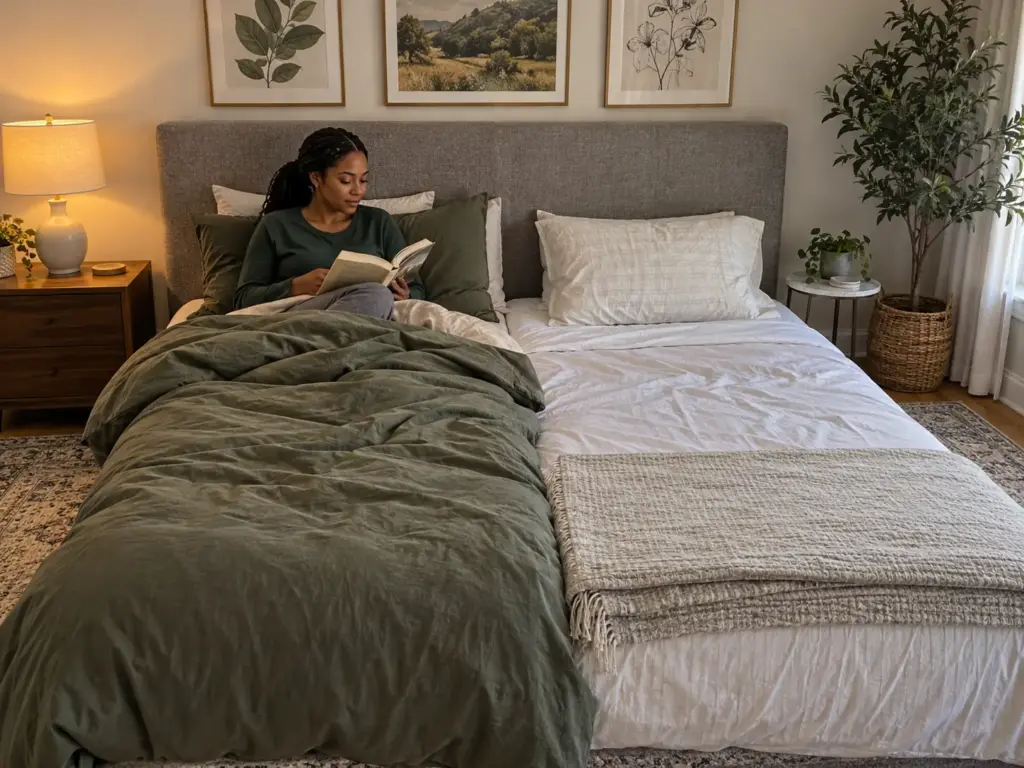
Decide which of the two has the free fix. The cold sleeper can add a layer above the topper, a heavier blanket on their side. The hot sleeper cannot subtract past the sheet: once the topper itself holds warmth, changing the sheets alone does not undo it. So the layer that runs cooler goes under both, and the cold half is warmed from above.
Two layers instead of one compromise
Toppers made in two halves exist, and the firm-vs-soft page already covers a topper with two zones, so that content is not repeated here. If you go that route, read the listing for how the halves are split before you buy, because the split is the whole point and a size on the box does not tell you where it falls. This piece does not claim a shared-bed result for either material: a shared bed is a trade, not a test that someone has settled.
The covers on each side
The topper stays; the sheet and the blanket change per side, two blankets rather than one. The hot half can follow bedding for hot sleepers, layer by layer, and the cold half warm bedding for a cold bedroom. The middle line of the bed is where one half’s choice leaks into the other, and a heavy blanket dragged across it is felt on the hot side, which is why two separate blankets beat one shared one.
Make the bed with two blankets, one per side, before you think about a second topper. The hot sleeper pushes theirs back without waking the other, and the topper stays one purchase instead of two.
Press first, read the tag second, stack last
Three things carry over. Read the tag for the number next to the word, because the word alone names an additive or a family and never a feel. Let the press test on the bed you own decide whether you need give or push-back before any product page does. And if you stack, the top layer sets the first feel while the lower one holds, so judge a stack on the second night.
A month in, press the same spot with the same flat hand and see whether the surface still returns the way it did on the first night. Tonight, before you open a product page, do the press test on the current mattress and write down which way it went: slow return or quick. That one line is the brief you carry to the tag.
Frequently Asked Questions
01Are gel-infused mattress toppers good?
They are good for a sleeper who wants to sink into a slow, wrapping layer that holds its shape. The cool is a surface effect at lie-down, not a thermostat, and it fades within hours, unmeasured. Look for a density figure on the listing, not a grade word.
02What are the disadvantages of a latex mattress topper?
Latex pushes back, so a restless sleeper may find it bouncy, and the word natural on a listing does not tell you whether it is Dunlop or Talalay. The process changes the feel at the same firmness number, so two latex toppers with the same rating can still feel different.
03What are the disadvantages of a gel memory foam mattress?
The topper layer holds the dent, so the heaviest part of the sleeper sinks deepest, and the gel’s cool is short-lived. A listing may also leave out the density, which leaves you no way to compare one gel topper with another.
04What kind of mattress topper is the most comfortable?
Comfort here means the material that matches how you lie on it, and the press test on your own bed decides between give and push-back. A bed that returns slowly already conforms and may want latex; a bed that returns fast may want foam’s slow give. After that, firm or soft is a question of position and weight.
05Does the order matter when you stack gel foam and latex?
Yes, the top layer sets the first feel and the lower one does the holding, so reversing them changes both. Repeat the press test with both layers on the bed, and judge the stack on the second night.




Tried it on your own bed?
No comments yet. Tell us what you changed, and what the sheet did after a few washes.