


What’s in here7 sections
- The Sink and the Lock: Where the Foam Puts You
- The Slide: A Topper That Moves a Little Every Night
- The Dip: The Middle Gives Way Before the Edges Do
- The Three-Night Test: Settling In or the Topper?
- When Taking It Off Changes Nothing
- Take It Off, Write One Line, Then Decide
- Frequently Asked Questions
The topper that felt right for years keeps a record of every night in one place: the middle, where you lie. If you now wake sore and nothing else in the bed has changed, a topper can make back pain worse, and the middle is the first place to look. It is only one of four.
A topper does not fail by a single road. It sinks, it holds, it walks and it thins, and each one leaves its own sign in the morning on its own clock. This guide sorts the four, gives you a free test to run before you buy or return anything, and marks the point where the answer stops being the bed.
Quick Answer
Yes. A topper can make back pain worse in four ways: it sinks under the hips, locks you in the shape you sank into, slides out of place, or goes thin in the middle with age. Each leaves its own morning sign on its own clock, and a topper cannot repair a base that has already sagged.
The Sink and the Lock: Where the Foam Puts You
“Too soft” and “too firm” are the two verdicts people post, and they are one mechanism read from opposite sides. The foam decides where your hips end up, and then it decides how easily you leave. Those are two failures with two signs, and the fix for one can feed the other.
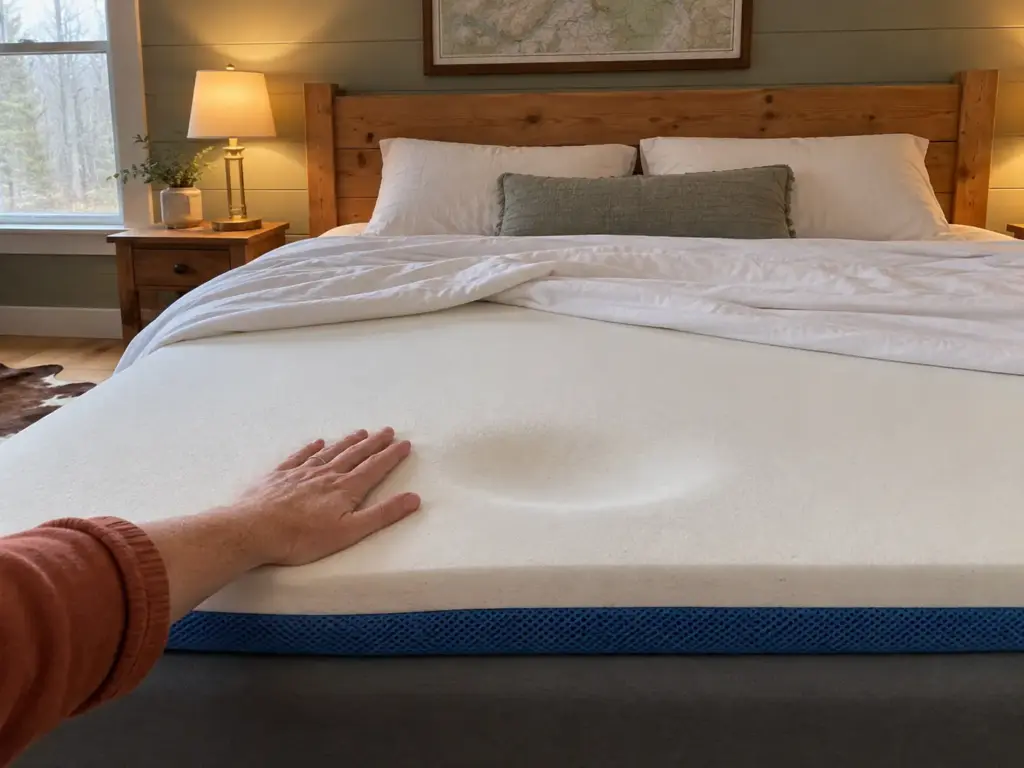
The sink: hips lower than the upper back
On your back, a topper that gives too much lets the pelvis settle below the shoulders and the upper back. On a back, a soft topper can let the hips dip lower than the upper back. That is the shape of the bed, nothing more, and you can check it without any theory. How deep it goes depends on your sleeping position and your body weight: a heavier sleeper pushes the same foam further down, and a side sleeper loads the hip and shoulder rather than the whole back.
Lie on the topper on your back, have someone look from the side, and see where the hips sit against the upper back. Then do the same on the bare mattress. The difference between the two views is the sink.
Position changes how much it matters. Stomach sleeping is often where a too-soft topper hurts most: on those nights the pain can be far worse, and the topper itself may simply be too soft.
A foam like the Viscosoft 3 Inch Memory Foam Mattress Topper shows how the mechanism works. It is three inches of select high density memory foam with gel, in one piece, and that much thickness of slow foam on a mattress that is already soft gives the hips more room to go down. Amazon’s summary of its reviews lists the complaint you would predict: some buyers say it is too squishy and sinks too much, and others say it makes them hot. Read that as a description of the sink, not as a verdict on the product.
Press a flat hand into the middle of the topper for five seconds, then lift it and watch the hollow. Foam that fills back in at once lets you turn in the night. Foam that keeps the print for a long moment is the foam that will hold you where you sank.
The lock: still where the foam let you down
The second failure does not show as a dip. It shows as effort. A firmer topper can feel like it locks you into a position you have difficulty moving out of. Turning over in the middle of the night takes a push, because the foam keeps the shape of the last position.
The sink and the lock are easy to confuse because both end with a sore morning, but they answer different questions.
The sink is how far you go down. The lock is how long you stay. With the sink, the sign is the hips sitting low, worst after stomach nights. With the lock, the sign is the turn itself.
Why a firmer topper does not undo the lock
The reflex after a sore morning is to go firmer. The reader above did exactly that, and the lock arrived with the firmer topper, so the firmness on the label cannot be the whole story. What holds a sleeper is how much the surface lets you settle into and how slowly it lets you out.
Memory foam recovers its shape slowly after the weight leaves it, and that slowness is the comfort in the first week and the problem later. A firmer version of the same slow foam is still slow.
If you want a contrast to compare against, the Queen 4 Inch Firm Natural Latex Mattress Topper is 100 percent natural latex, four inches thick and firm, with no memory foam in it. Nothing says latex escapes the lock, and its page shows no pattern of complaints to weigh, so it is a surface to try against the other one, not a repair. Four inches is also a lot of new height for a fitted sheet to clear, which the next section gets to.
The side of firm is its own question, and which side of firm suits your position and weight has its own guide. This piece comes before it and asks only whether the topper is the cause.
The Slide: A Topper That Moves a Little Every Night
The first two failures belong to the foam. This one does not: a topper can be perfectly good and still be somewhere other than where you put it.
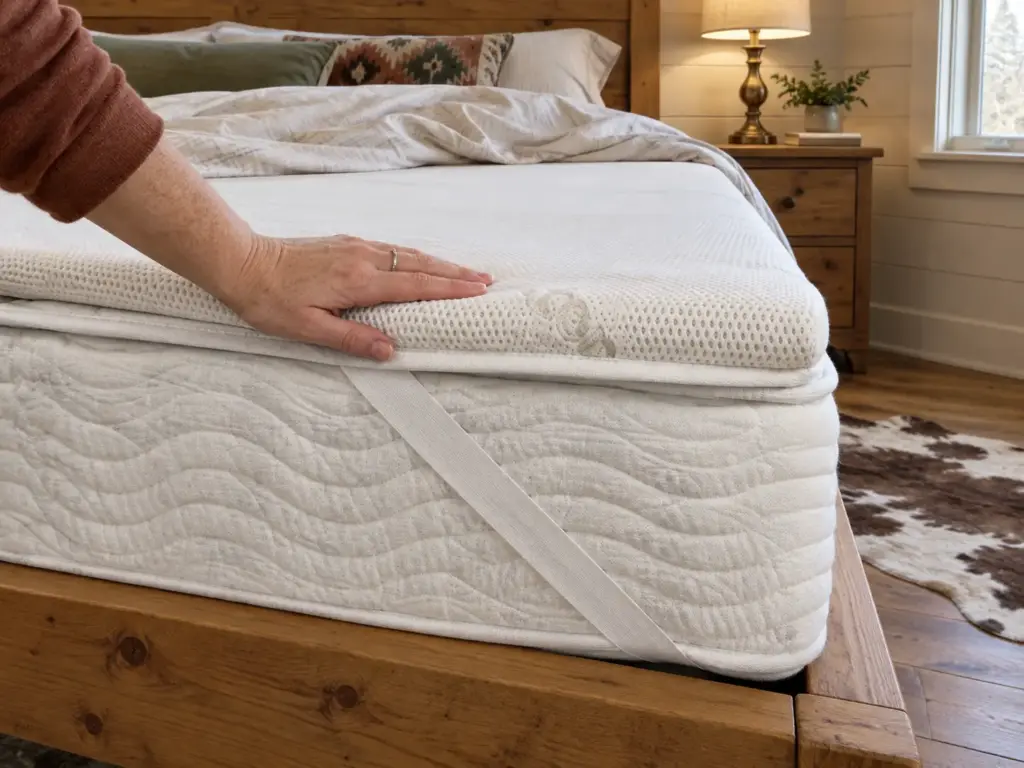
What makes a topper walk
The Sleep Foundation lists the usual causes as an improper size, a smooth surface, no headboard or footboard to stop it, and a lot of movement in the bed.
A topper larger than the mattress is worse, because the extra fabric gives your weight something to drag. A topper sized for a smaller bed does the opposite and bunches into lumps. Either way the movement is small. It is a little each night, until the edge has folded under a hip and the surface that used to be flat has a ridge under the shoulder or the hip.
You can catch it early at the corners. A corner that sits an inch inside the mattress corner by the third morning is the early sign, long before the ridge.
Measure the gap between the topper corner and the mattress corner at the foot of the bed each morning for three mornings, and write the numbers down. A gap that grows is a topper that is walking. A gap that holds is a topper that fits, and the ache has another source.
The check before any strap: size, cover, sheet
Straps are the reflex, and they come second. A strap on a topper larger than the bed ties the extra fabric down and does not remove it. So the free checks go first: match the size to the bed, look at the cover (a smooth cover on a smooth mattress, or on a slick mattress protector, slides most), and then look at the fitted sheet.
The sheet is the layer that holds a topper in place, and it holds nothing if its pocket cannot reach under both layers. Sheets that stay on are a measurement problem, and the guide to cooling sheets that stay on shows how to find a fitted sheet pocket that clears mattress plus topper.
Only after that does a strap make sense, because corner straps stop bunching on a topper that already fits. The Saatva Natural Latex Premium Mattress Topper is a 1.5-inch Queen latex topper, natural latex, whose listing names anchor bands at the corners, which makes it a fair example of what the fix looks like: bands that hold a topper that already fits. Amazon’s summary of its reviews carries a warning, though: “others mention it causes mid back pain.” Straps fix position, not feel, and that line is a reminder to run the removal test below no matter how well anchored a topper is.
The Dip: The Middle Gives Way Before the Edges Do
The slide shows up in days. This failure takes years, and that clock is why people rarely suspect the topper: it is the oldest piece of the bed and the last one blamed.
A topper that was fine for years and sore in two weeks
A thick foam topper that has been in use for years can seem fine, and then the nights turn bad over a couple of weeks. The reader described the topper as slightly sunken in and thinner toward the center, and less squishy in that area.
The wear had been building for years. The soreness arrived within two weeks, and the reader only noticed the flattened middle after the pain started.
Age is the first thing to check, and a free test comes with it: sleep without the topper for a while, or rotate the mattress. A thick foam topper of that age is often close to worn out.
The pattern in both is the same. The soreness arrives long after the topper stopped being new, and it arrives faster than the wear did. The clock here is years, not washes, and years are not counted the way washes are, so the topper draws no suspicion until the ache starts.
Foam compresses where the weight lands, night after night, and compression that never fully recovers is the dip. The middle is where you have lain every night, so it is the first place to flatten and the last place you look. The topper is one layer on a clock of its own, and the clocks a bedding set runs on are laid out in one place.
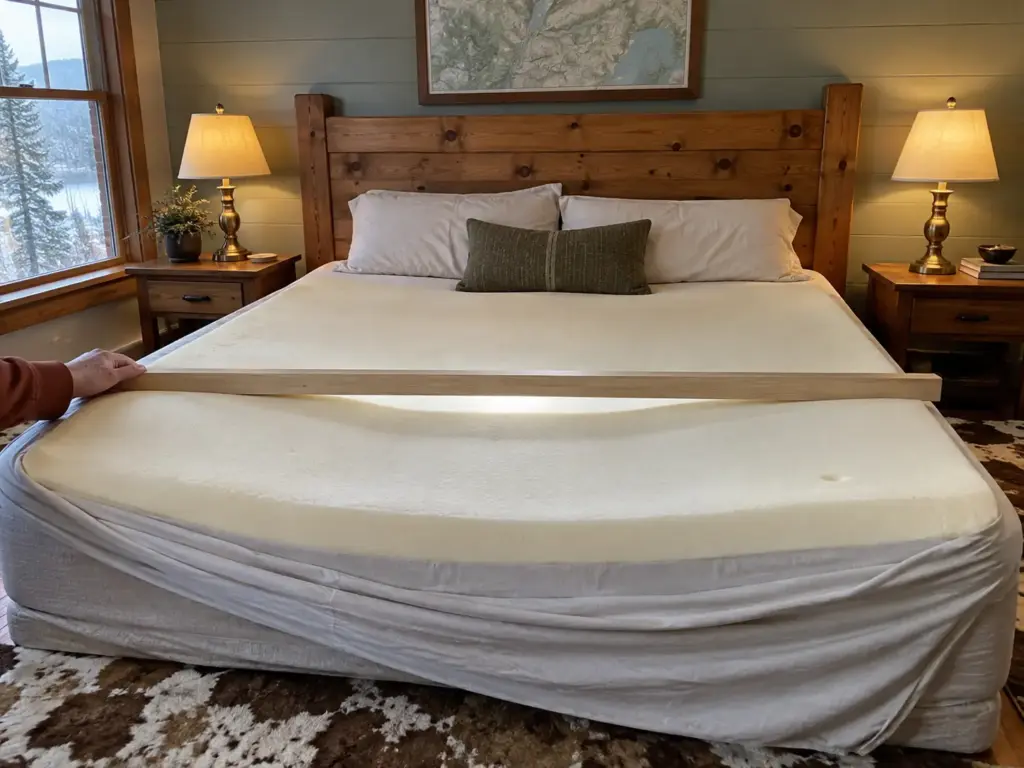
How to find the dip with a straight edge
Lay a long straight edge across the topper from side to side: a yardstick, a level, a straight length of board. The edges stand, and if the center has gone, you will see light, or at least a gap, under the middle of the straight edge. Do it twice, once across the width where your shoulders lie and once along the length where your hips lie, because the dip is wherever you lay most.
Do the straight-edge check with the topper lying on the floor, not on the bed. On the bed it takes on the shape of whatever is under it, so a dip in the mattress will read as a dip in the topper, or hide one.
The Three-Night Test: Settling In or the Topper?
All four failures can feel like “just getting used to it”, and a day count cannot tell a topper that is settling from one that is failing, because both ache through the break-in period. The direction of the ache can.
Take it off for three nights and change nothing else
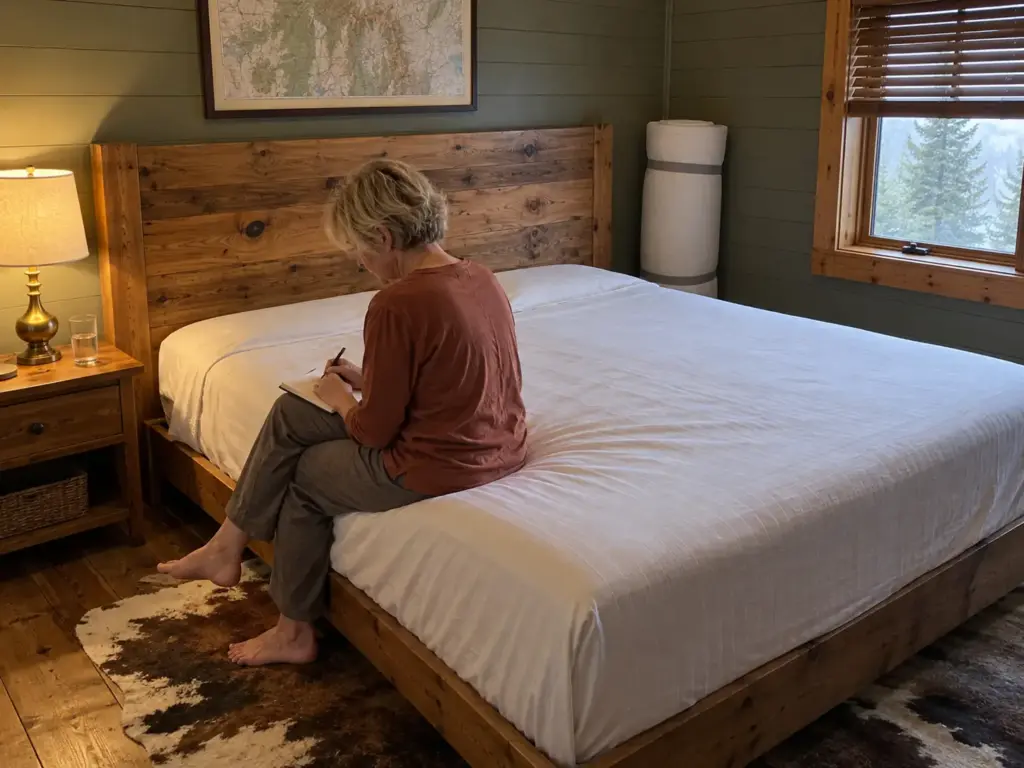
Take the topper off for three nights. Keep the same pillow, the same sheets and the same bedtime, and write one line each morning about how the back feels and where. That is the whole test. Three nights is a design choice, not a measurement: long enough for a pattern to show on a plain surface, short enough to keep the rest of the bed from changing underneath you.
The right first move is the free one: take off the topper and see whether it gets better. It sits before any return or purchase. The one-night lie-down in the firm-versus-soft guide picks a firmness. This test asks whether the topper is the cause at all.
Read the third morning, not the first. The first morning with it off can feel worse for a moment, because you are used to the old surface, and a surface you have slept on for years has a shape the bare mattress does not copy.
Write where it aches and whether it is morning stiffness or soreness (low, mid, hip, shoulder), not a score out of ten. A score drifts with the week you had. A location does not, and a location that repeats across mornings is the line that tells you something.
Read the direction, not the number of days
An ache that eases a little each week while you keep sleeping on the topper is settling in. The same ache at the same spot every morning is the topper. That is reasoning, not a measured result, and the reasoning is simple: settling changes with time, and a failing topper gives you the same answer every day.
Put the topper back after the three nights and read the same line again. If the ache comes back at the same spot, you have your cause.
If it is the topper, which of the four it is
The signs sort the four. Hips low on the back and the worst nights on the stomach point to the sink. A turn that takes effort points to the lock.
A corner inside the mattress corner, or a ridge under the hip, points to the slide. And an older topper with light showing under the middle of the straight edge points to the dip.
| The failure | The sign in the morning | The clock | The first free check |
|---|---|---|---|
| Sink | Hips lower than the upper back, worst after stomach nights | From the first nights | Side view on the topper, then on the bare mattress |
| Lock | Turning over takes a push | From the first nights, at the turn | Press a hand in and watch the hollow |
| Slide | A corner inside the mattress corner, a ridge under the hip | Builds over the first mornings | Measure corner gaps, then check size and sheet |
| Dip | The same ache at the same spot, on an older topper | Years, then a few weeks at the end | A straight edge across the middle, topper on the floor |
Check the bed under it
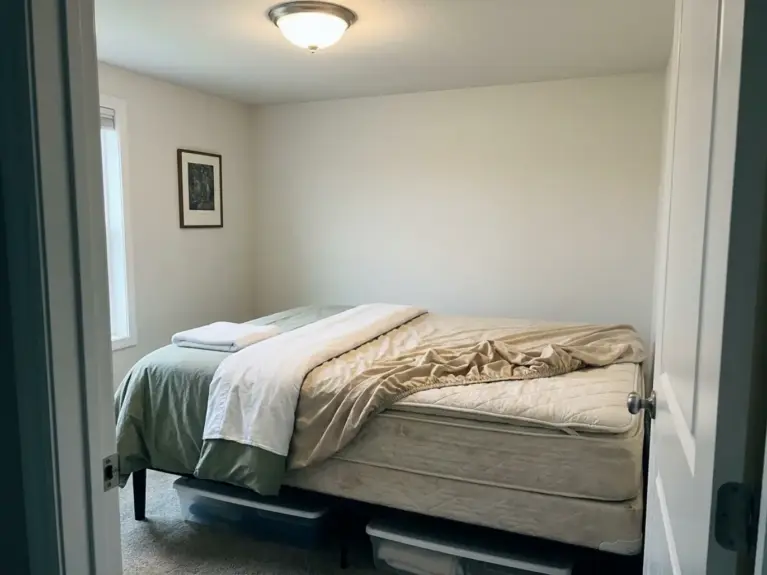
If the ache is the same with the topper off, the next suspect is the bed under it. Check that the frame is level and has almost no sag in the middle, which means looking at the bed frame and the slats, not only the mattress. And ask the question that costs nothing: have you tried sleeping without the topper, or rotating the mattress?
Another reader suggested putting the topper straight on the box spring and sleeping on it without the mattress, which is a reader’s trial and not a result, but it does separate the layers. A topper cannot repair a mattress base that has already sagged, so a sagging base under a good topper gives the same morning. The longer version of that order, check the base first and judge density over firmness, lives in the main guide to toppers for back pain.
When Taking It Off Changes Nothing
If the ache is the same with the topper off, the topper was never the story, and this is the one place this guide says so. Pain that does not change when the topper comes off, pain that causes night waking, pain after a fall, and weakness or loss of feeling in the legs are not bedding questions. According to the South Australian government’s guide to when low back pain needs a doctor, “If you have low back pain and it’s not getting better or you’re worried about what’s causing it, visit your General Practitioner (GP).”

It names the same thresholds: a large weakness or loss of feeling in the legs, a fall or trauma behind the pain, or no improvement after four to six weeks of treatment. Past any of those, a doctor decides, and no layer of foam does.
Back to the bed. The pillow is the other bedding suspect: whether the pillow or the mattress is the culprit is sorted by where the ache sits, and the same question from the morning side starts at the wake-up.
Take It Off, Write One Line, Then Decide
Three things to carry out of this. A topper can make back pain worse in four ways, the sink, the lock, the slide and the dip, and each has its own sign and its own clock. Three nights without the topper tells you whether it is the cause, and the direction of the ache tells you settling from failing. And if the ache does not move when the topper comes off, the answer is not the bed.
The check for later is the dip, because it is the failure that arrives after the topper has stopped being new. Before the next winter, lay a straight edge across an older topper and look for light under the middle.
The one free change to make tonight: take the topper off, and write one line each morning for three mornings. Then notice which morning looks different.
Frequently Asked Questions
01Why is my mattress topper hurting my back?
A topper can sink under the hips, hold you in the shape you sank into, slide out of place, or go thin in the middle. Take it off for three nights and see which morning changes; if nothing does, it is not the topper.
02What are the downsides of using a mattress topper?
A topper can sink under the hips, hold you where you sank, shift out of place and thin out with age. It also cannot repair a bed that has already sagged, and it adds a layer your fitted sheet has to clear.
03Do mattress toppers cause hip and back pain?
They can leave a sleeper sore when they are too soft, too thick, loose or worn through in the middle. The fix starts with taking the topper off for three nights and reading which sign appears.
04How do I know if my topper is worn out?
Lay a straight edge across the topper while it lies on the floor. If light shows under the middle while the edges stand, the center has given way and the topper is the likely cause.
05Should I rotate or remove a topper that hurts my back?
Remove it first, for three nights, with the same pillow and sheets. A topper that goes back on and brings the same ache at the same spot is the cause. Rotating the mattress is the next free test.




Tried it on your own bed?
No comments yet. Tell us what you changed, and what the sheet did after a few washes.