



What’s in here7 sections
How long do mattress toppers last? Depending on the page, anywhere from two years to fifteen, and that spread is the first thing worth taking apart. A topper is a layer of foam, latex or fill that carries the same hip and the same shoulder every night, so it does not expire on a date: each morning its cells spring back a little less completely, until a hollow stays. Below, you will see why the printed years disagree, what actually wears a topper, which popular claims have nothing behind them, which habits matter, and the measurement in inches that tells you yours is finished.
Quick Answer
A topper lasts as long as its foam or fill still springs back under your hip and shoulder. Density and the load it carries each night set that, and the years printed on sellers’ pages are ranges that never say which failure they counted. Measure your own topper’s height in inches instead.
Why the Years a Topper Lasts Never Agree
The ranges printed for toppers do not fit each other, which is the first sign they are counting different things. The years for each fill and foam live in the guide to what each material is made of, so this section stays on a narrower question: what a number would have to say before you could use it.

Three guides, three answers for the same foam
For memory foam, one review site’s table gives 2 to 5 years, one retailer’s guide gives 3 to 4, and another retailer’s guide gives 3 to 6. Latex spreads wider: 5 to 7 years in one guide, and 5 to 15 in the table of a review site whose own text says 5 to 10. Same material, same kind of bed, and a spread that runs from two years to fifteen.
None of those ranges is a lie exactly. They answer different questions, and the pages never say which: a topper in daily use or one on a guest bed with occasional use, a hollow or a torn cover.
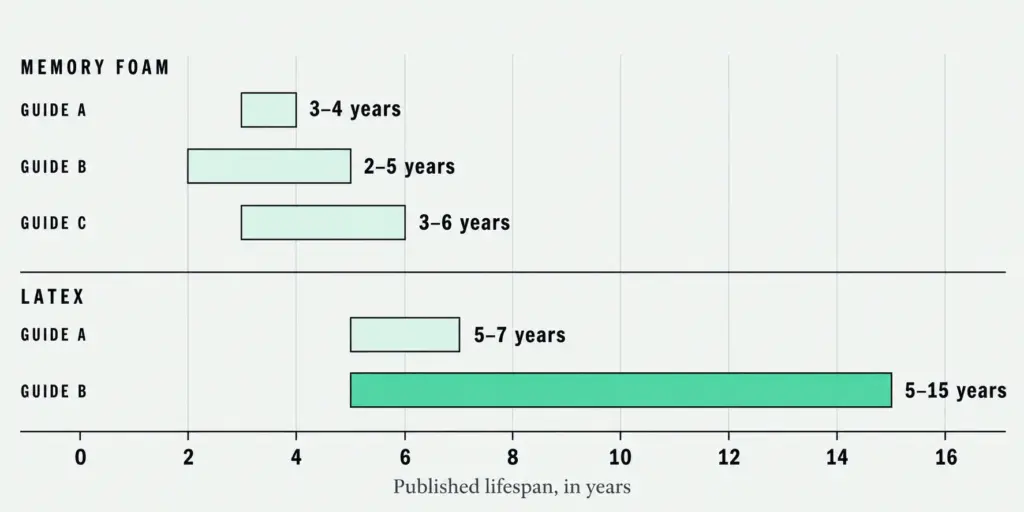
What the test behind a number would have to count
A number of years becomes a measurement only when it names the failure it counted: a hollow at the hip, a torn cover, a smell that airing does not move, an inch of lost height. Without one of those, it is a seller’s habit.
Consumer Reports gets closest to naming one. Its durability test for toppers “simulates eight years of use,” and it says a good topper “shouldn’t sag, soften, tear, rip, or provide less support after just a few years.” Two details stand out. The test is built around years of nightly load rather than a calendar guess, and every failure it lists is something you can see or feel in a bed.
The people who live with toppers describe the same thing from the other side. A topper is not expected to last long, so you will be replacing it often. Many people would rather replace a topper regularly than the mattress under it, which treats the topper as the layer that is meant to be spent.
So the only failure you can check is the one in your own bed. A number on a page was earned on a topper nobody slept on (or slept on at a weight and in a position nobody records). Yours is measured by the hollow it keeps in the morning, and the last section turns that hollow into inches.
What Wears a Topper Out, Night After Night
A failure has to be something that physically happens, and in a topper three things decide how fast it happens: what the topper is made of, how much of it there is between you and the mattress, and which spot carries the load.
Foam: the cells that stop springing back
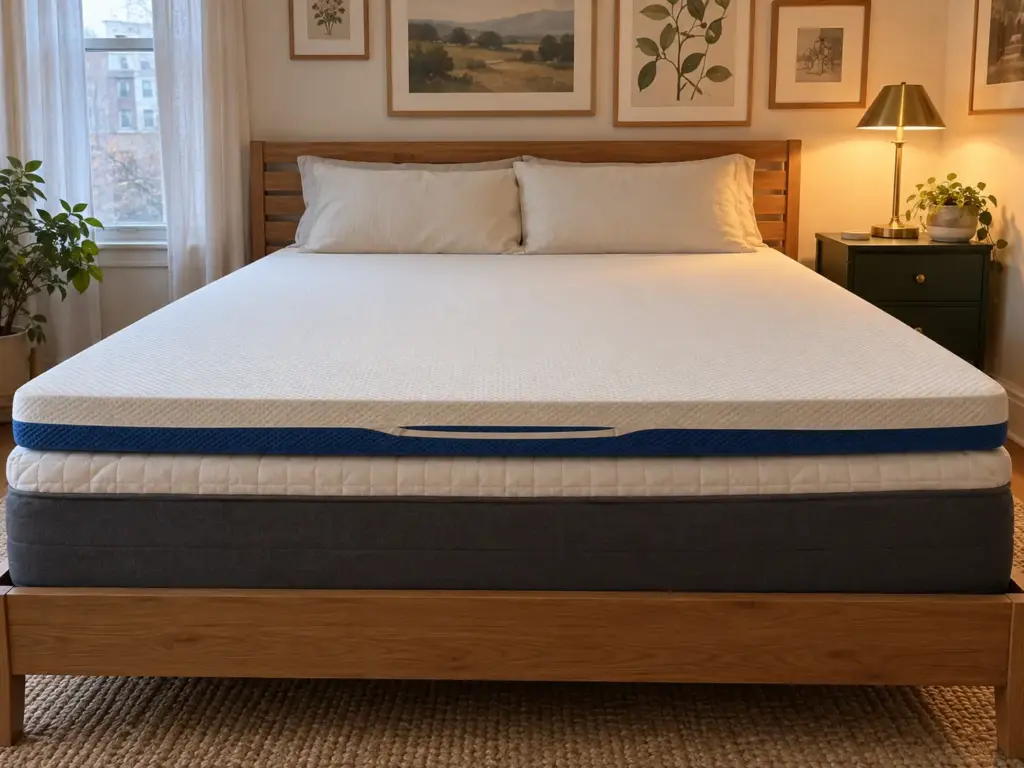
Memory foam is a lattice of tiny cells. Lie on it and they compress; get up and they recover, slowly, and a little less fully each time. A side sleeper’s body weight goes mostly through the hip and the shoulder, so those two spots lose their recovery first, and the first failure is a hollow rather than a tear. The cover can look perfect over a topper that is spent.
There is a quick way to see it. Press a thumb into the middle and watch the print. On a new foam it fills back in quickly; on a tired one it fills slowly, and a hollow that is deep enough may not fill at all.
Fill and latex: loft goes first, rebound lasts longer
Fill toppers fail differently. Feather, down and polyester fiber fill clump and lose loft before the cover shows anything, so you lie on a flat layer under a cover that still looks full.
Latex is a springy cellular rubber, and of the four materials in those ranges it is the one credited with the most resilience. The sources disagree on how much: 5 to 7 years in one, 5 to 15 in another. Resilience is a direction, not a date.
Density and thickness, the two numbers on a listing
Density is the figure that gets quoted, in pounds per cubic foot: how much foam is packed into the same space. More foam per cubic foot means more material to compress before it gives out, which is why density, not firmness is the ruler the back-pain guide uses. Here the same ruler measures wear.
What each source has behind its density claim differs, so it helps to say which is which. Denser foam generally lasts longer, which is the usual rule of thumb. Density figures on a listing are the first thing to compare.
One retailer’s guide says a 4 pound foam outlasts a 2 pound one by one to two years and names no test. Neither is nothing. A listing, though, is something you can read before you pay.
The Viscosoft 3 Inch Memory Foam Mattress Topper is a useful example because its listing prints a density: “over 3 lbs (per cubic foot),” in a single block of gel-infused foam at 3 inches. That is the maker’s figure and nobody has verified it. The catch sits in the reviews. Amazon’s summary of them says some buyers find it too squishy and that it sinks too much, others that it sleeps hot, and a few report an awful smell.
The sinking matters most for the question here, because a foam that gives way easily on day one has less travel left to lose later. The budget VALUXE 3 Inch Gel Memory Foam Mattress Topper sits at the same height in the same foam family, and its listing prints no density at all, which is the point of this paragraph.
And density alone can mislead. Three pounds of foam at an inch and a half has far less to give than the same foam at four inches. Thickness is the second lever: a thin topper puts less foam between you and the mattress, so the same nightly load uses up more of its travel, and a dense foam that is thin runs out of room sooner than its figure suggests.
The free fix comes before any purchase: read the listing for a density figure. One that prints none is not telling you which lever it pulled.
Screenshot the density, block and thickness lines of a listing before you buy. Listings get edited, and those three figures are the only thing you can hold the topper to later.
The Claims With Nothing Behind Them
The sellers’ pages do hand over the right levers, and then they attach numbers to those levers that have nothing behind them. Three come up often enough to take apart, and a fourth question, rotation, gets four different answers.
The 30 percent and the 25 years
One retailer’s guide says heavier sleepers lose “up to 30 percent” of a topper’s life. It gives no source and names no test. The mechanism is plausible, since more load means more compression, but a plausible mechanism is not a percentage, and the guide shows nothing that produces 30.
At the other end, some claims put a properly made polymer foam at about 25 years, but the tests behind such figures are often not shown. Twenty-five years sits far outside every range above, and a claim with its test missing cannot be checked against a bed.
A third rule says the cheapest toppers wear out soonest. That one holds, for a reason that needs no price: low density is the cheap part of a foam topper, and density is the lever from the section above.
Four rotation intervals, one job
Three guides give four intervals between them. One says every two to three months, with a flip every six where the topper flips; another says every three months; a third says every six months. None names a test.
What rotation does is spread the load, so one spot does not carry every night. What it cannot do is bring back a foam that has lost its recovery everywhere. Turn a topper 180 degrees when its hollow sits under your hip, and the hollow moves to a different part of the bed while fresher foam takes your hip. The hollow is still there.
Even with regular rotation and a pad cover, divots can form over time.
So rotation earns its keep on a topper that still recovers, and the best schedule is the one you will keep, because no test ranks the four.
A listing that says “for years to come”
The obvious answer to all of this is latex, and the obvious answer needs one condition: that the listing says what kind. The Queen 4 Inch Firm Natural Latex Mattress Topper is four inches of latex, and its listing names neither Dunlop nor Talalay, prints no density, and carries no GOLS certification. Its only line about longevity is “for years to come,” which is the seller’s phrase, not a measurement. Four inches of natural latex may well hold its height; nothing on that page lets you check.
The ARyako 100 % Natural Latex Topper, Firm, 4 inch is the same material at the same thickness, so the same questions apply to its listing. For how latex and gel behave against foam, our guide takes the full comparison. What belongs here is only the spec a listing leaves out.
Habits That Slow the Wear
Setting the claims aside, some habits cost nothing, a couple have a care label behind them, and one mistake can ruin a topper in a single cycle.

Air it, don’t fold it
One retailer’s guide says to air the topper out every few weeks and never to fold or bend it. It shows no test, so do not expect a number out of it, but the habit is free and does no harm. A topper kept flat and aired smells of nothing in the morning; one folded away for a season tends to carry its storage smell back into the bed.
Store a topper flat or rolled loosely, never folded sharply, and let it air for a few hours before it goes back on the bed.
A wash can leave it the wrong size
Spot cleaning is what the guides say; machine washing is not. The care label is the authority here, and this article draws no wash as steps for that reason. The cost of ignoring it is real: a topper run through a bulky bedding cycle can shrink until it no longer fits the mattress. The failure cannot be undone, so a wrong cycle can leave it the wrong size.
The protector between you and the foam
A protector between the sleeper and the foam is the one habit the guides recommend and none tests. Try it in the same three-night spirit as the other topper articles on this site, as a layer you judge by what changes, not as a promise of extra years.
The Nestl Premium Cotton Terry Mattress Protector has a cotton terry face over a waterproof TPU back and a deep pocket. Its catch is in the reviews: Amazon’s summary says some buyers find it only accommodates up to 14 inches, despite a title that says up to 24, and others report it sliding off the mattress. So measure the mattress and the topper together before you order, the same sum the last section uses. Which backing is the problem is its own question, covered in the guide on which backing traps heat, and keeping a topper from sleeping hot has a guide of its own.
The Inches That Say It’s Finished
If a year count cannot tell you, a measurement taken twice can, and the equipment is a tape measure, a straight edge and a notebook. This section turns your own bed into the test.

Take the number on day two
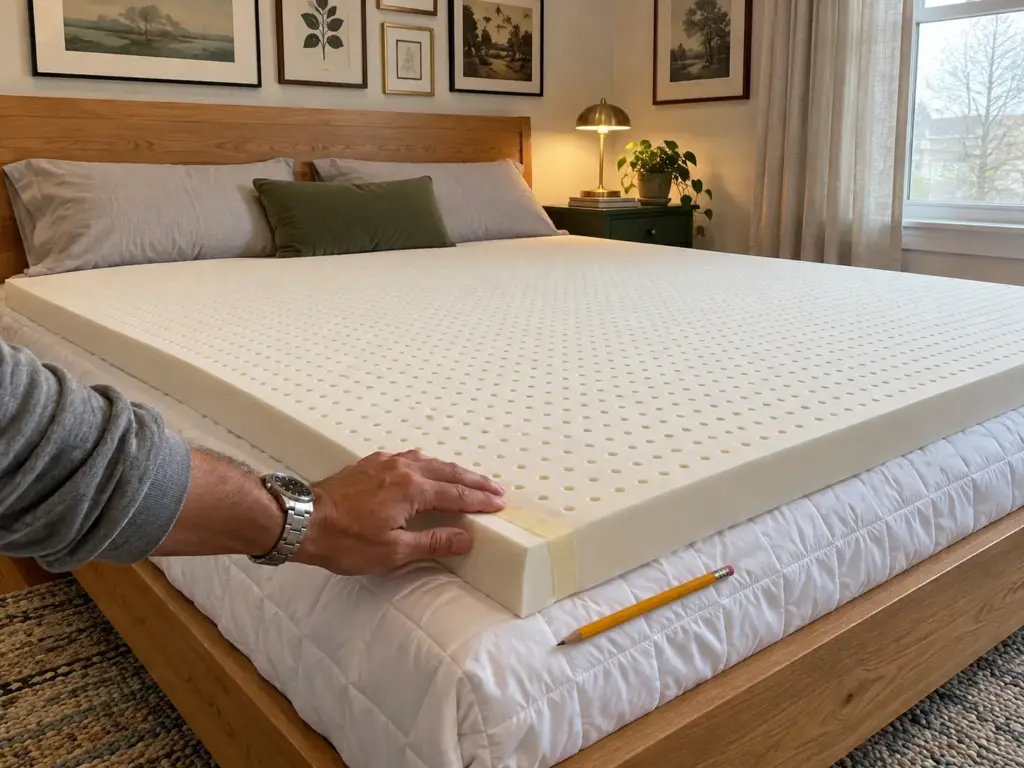
Give a new foam time first: it needs time to expand out of the box, so the first reading belongs on day two, not the night it arrives. Then write down the date and two heights. The first is the topper’s thickness at its edge, where nobody lies and the foam is hardly used; that is your reference.
The second is the dip. Lay a straight edge across the bed at the hip line, the way the straight-edge check across the hip does, and slide a ruler under it to read the gap at the lowest spot. On day two the gap is close to zero, and that is your zero.
The edge tells you what the topper started as. The gap tells you what it has lost.
Keep the day-two numbers on the nightstand, with the date. The second reading means nothing without the first, and nobody remembers a quarter inch.
Measure it again the same way
At each change of season, repeat both readings on the same spot with the same fitted sheet on, since a different sheet pulls the surface differently. The loss in inches is the replacement point you can see.
No source gives a threshold for finished in inches, and this article will not invent one. The rule is a loss that is still there after a night nobody has lain on it. A number without that rule is only a reading.
While the tape is out, measure the stack. The mattress, the topper and two more inches have to fit inside the pocket depth printed on the fitted sheet’s package, the same mattress plus two inches arithmetic that keeps a sheet on. A topper that has lost height loosens that sum a little; a new one that has expanded fully tightens it.
When a night off doesn’t bring it back
Take the topper off the bed for a night and lay it flat where no one lies on it. If you are already taking it off for the three-night removal test, read the dip at the end of the first night off. If the gap has closed, the foam was only compressed and needed rest, and a rotation may be all it wants. If the gap is the same, you have found the spot that will not come back, and the topper is finished.
A topper that still measures what it did on day two is not the cause of an ache. If aches are the reason you started measuring, a full-height topper does not explain them, and an ache that persists is a question for a doctor, not for another layer. Back to the foam: the edge reading stays the one fixed point in all of this, because it barely moves.
The Number to Write Down Tonight
Three things to take from the foam, the fill and the claims:
- Read any printed year count as a seller’s guess until it names the failure it counted.
- Use the levers you hold: density and thickness when you buy, and rotation, airing and no sharp folds once it is on the bed.
- Call the topper finished when a measured loss is still there after a night nobody lies on it.
For later, at the next change of season, take the same two heights on the same spot against the same sheet and set them beside tonight’s numbers. The difference between the two sets is your topper’s real age.
The one free change to make: put a date and two heights (edge thickness and hip gap) on a card under the lamp tonight. The next time the bed feels tired, you will have something to compare it to, and the decision gets easier than arguing with a year count.
Frequently Asked Questions
01When should you throw away a memory foam topper?
Throw it away when the measured dip is still there after a night nobody has lain on it, the cover tears, a musty odor stays after airing, or mold shows. Each one is something you can see, measure or smell, which a year count is not.
02Does a mattress topper make a mattress last longer?
No source tests whether a topper makes a mattress last longer, and the topper takes the nightly load first, which is why it wears out before the mattress under it. Rotating a topper and keeping a pad cover on it helps, but divots can still appear.
03Can you wash a mattress topper?
The care label decides whether you can wash a mattress topper, and the guides say to spot clean it rather than put it in the machine. A topper run through a bulky bedding cycle can end up too small for the bed.
04How long does a new topper take to expand?
A new topper needs time out of the box to expand before its real height shows, so take your first measurement on day two instead of the first night. The guide to what each material is made of covers the wait.
05Do heavier sleepers wear out a topper faster?
More body weight means more compression, so a heavier sleeper plausibly wears a topper faster. The 30 percent figure on one retailer’s page has no source behind it, so no number is safe to give.




Tried it on your own bed?
No comments yet. Tell us what you changed, and what the sheet did after a few washes.