


What’s in here12 sections
- What a Topper Changes and What It Leaves Alone
- What the Layer Is Made Of: Foam, Latex and the Rest
- What the Surface Does Under Your Hips
- The Firmness Number Is the Seller’s, and Density Is the Ruler
- Heat: Why Foam Holds It and Latex Lets It Go
- Thickness: What the Layer Adds to the Bed
- Fit: Keeping the Topper and the Sheet Where You Put Them
- Two Sleepers, Two Surfaces
- Durability and the Trial Window
- Judge It at Month Three, Not on Night One
- The Base, the Number and the Clock: What to Check Tonight
- Frequently Asked Questions
You bought a mattress topper for back pain because the bed felt wrong at the hips, and for a week the mornings were better. Then the ache came back, or it never really left, and you started to wonder whether you bought the wrong layer. A topper is a few inches of foam or latex on a mattress that is eight or ten inches deep, so the surface under your hips changes while everything beneath it stays exactly as it was. This guide works from the base outward: what the layer is made of, what its labels hide, how much height it adds, how two sleepers share it, and why a topper needs months, not a night, before you can judge it.
Quick Answer
A topper helps when the surface under your hips is the problem and the mattress beneath it is sound. It changes the top few inches of the bed, not the spine, and it cannot prop up a sagging base. Pain that stays put whatever you change on the bed is a doctor’s question.
What a Topper Changes and What It Leaves Alone
Everything a topper does happens in the top few inches of the bed, so the question that comes before any purchase is what sits under them.
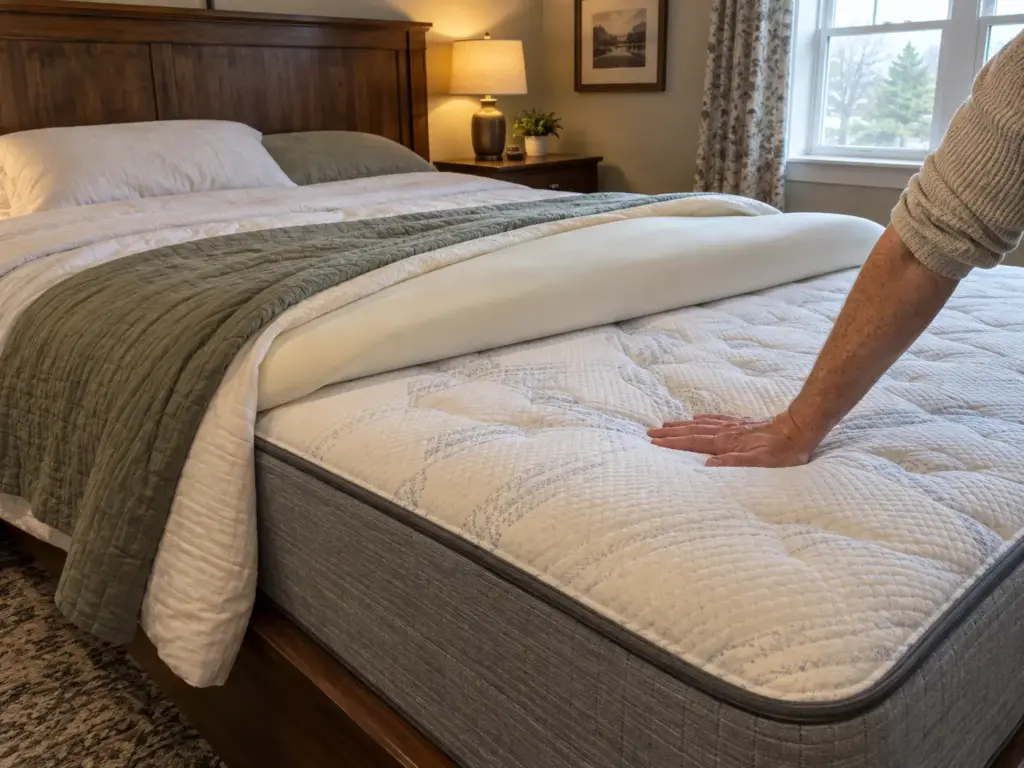
The few inches you are buying
Toppers are sold from about an inch and a half to five inches thick. Under one is a mattress several times deeper, and your hips press through the topper into every layer below it. What you are buying is the surface: how fast it gives, how far it gives, and what pushes back. What the mattress does under the hip stays as it was, however good the layer on top.
The proportions are worth seeing once. A 3-inch topper on a 10-inch mattress is less than a third of the stack, and the part of the stack that moves most under a sleeper is the hip, which presses the deepest into whatever is beneath it. Whatever the topper cannot reach, the hip still reaches. That is why two people can put the same topper on two different beds and report opposite results: the layer was identical and the stack under it was not.
Thicker is the common reach when a bed feels wrong, and it fails on a soft base, where it only puts a deeper soft layer over the same dip. This guide stays on the mattress side of the bed; the head pillow is its own change, with its own loft and gap to get right.
A base check before you spend anything
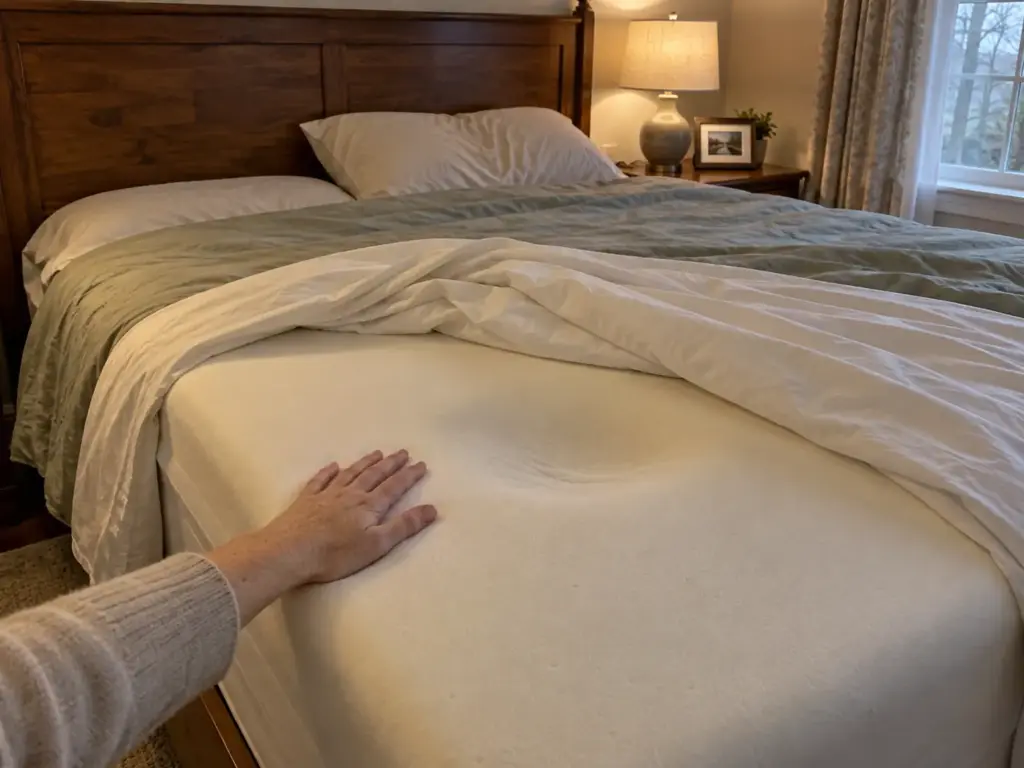
Start with the free part. Strip the bed and press a flat hand into the mattress where your hips rest, then press the same way at the foot of the bed. If the hip spot gives further, or the made bed shows a shallow hollow in the sheet at that spot, the dip belongs to the base, and a topper will hide it for a while rather than remove it.
If the mattress underneath is too soft, a topper will not help much. The age of the mattress goes into the same check, because a worn mattress, the kind that has started to read as a sagging mattress at the hip, is the one a topper most often gets bought to cover.
Read the result both ways. If the mattress presses back evenly from hip to foot and the trouble is the feel of the top surface, too firm under the hip or too soft, then a topper is the right kind of purchase, because the surface is the thing that needs changing. If the hip spot gives noticeably further than the rest, you are looking at a problem of the stack, and a layer on top changes how the dip feels without changing the dip. Pull the bottom sheet tight and look along the bed from the side at a low angle, and the same answer shows without touching anything.
Cheaper fixes come before a purchase, such as a flat board or a sheet of 1.5-inch foam slid under the mattress. Telling a pillow problem from a mattress one by where it aches is worked through in sorting the pillow from the mattress by where it aches, so it is not repeated here. A dip that shows every morning belongs to the mattress, not the topper, and a deep sag is a separate subject from this one.
Lay a yardstick or a broom handle lengthwise across the bare mattress at hip height and look for daylight under it. A gap you can slide a flat hand into is the base’s, and a topper will cover it for a few weeks without closing it.
The line that sends you to a doctor first
A topper is a layer on a bed, and some back pain is not a bed question at all. A few signs mean a doctor before anything on the bed changes. According to IQWiG’s guide to when low back pain needs a doctor, “If you have one or more of the following symptoms, you should have them checked out by a doctor:”
- pain below the knee or into the foot, with numbness, tingling or muscle weakness
- paralysis of a leg
- new problems with the bladder or bowel
- numbness around the genitals or anus
- pain after an accident
Time counts as well. The NHS guidance on when to see a GP for back pain says to get it checked if “it does not improve after treating it at home for a few weeks”, and it treats pain, tingling, weakness or numbness in both legs as an emergency, not a question for the bedroom.
Everything from here on is about the bed: what the layer is made of, what its labels hide, how much height it adds and how to judge it.
What the Layer Is Made Of: Foam, Latex and the Rest
Every topper listing promises pressure relief, and the phrase means nothing until you know whether the layer underneath it is foam, latex or a stuffed pad. They behave differently under the same hip.
Memory foam: it slows down under weight
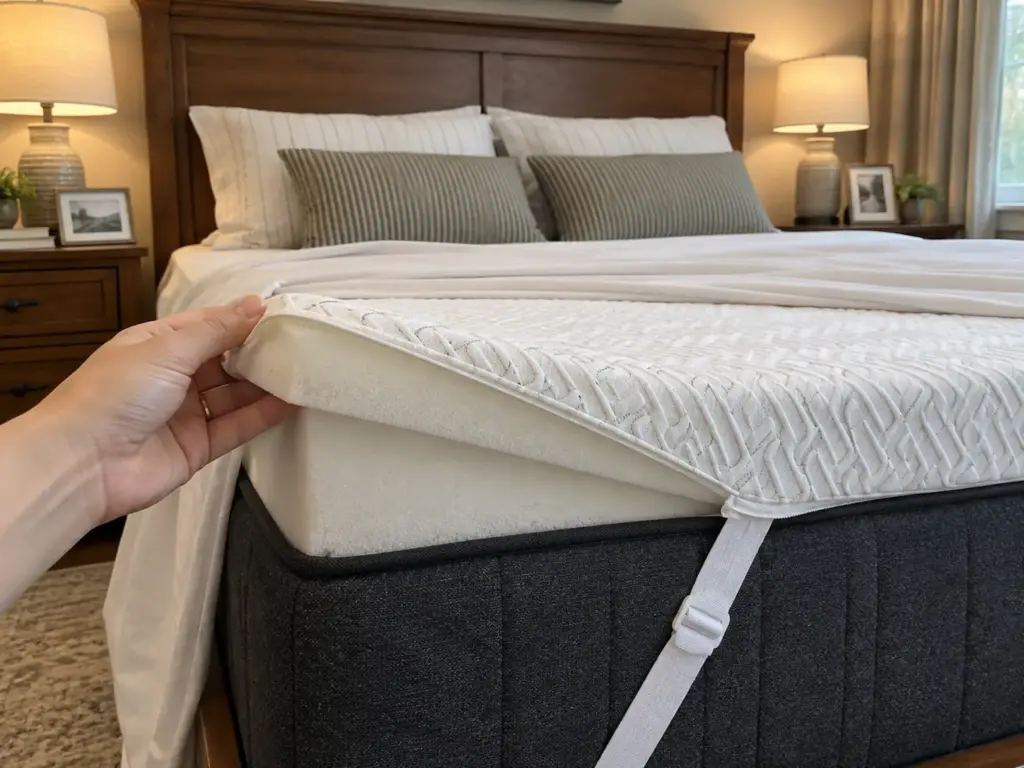
Memory foam is viscoelastic polyurethane: it gives slowly under load and recovers slowly when the load leaves. That slow give is what people mean by sinking in, and it is why the hip spot ends up cupped. Polyfoam, the plainer foam under many cheaper toppers, gives and returns faster. Gel-infused, copper-infused and graphite-infused foams are additives mixed into a foam, not a different construction, so the word on the front says little about what the layer does under you.
A new foam asks for patience before it can be judged. It can carry a packaging odor, and it needs time to reach full height; the seller of the gel foam below asks for 24 to 48 hours laid flat. Judging it on night one is judging it before it has finished expanding. A stacked build can do better than foam alone, with a layer of polyfoam under the memory foam adding support.
The VALUXE below shows what a High Density title looks like when no number stands behind it.
Latex: it pushes back
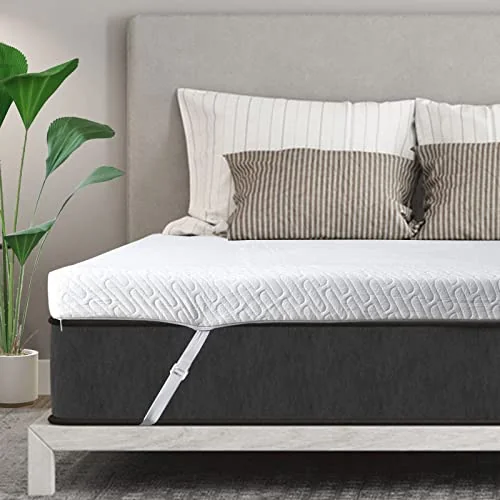
Latex sits at the other end of the feel. Foam sinks and slows; latex rebounds, and that responsiveness returns the push instead of holding the shape of the hip. It is made by two processes, Dunlop and Talalay, and a listing that does not name its process leaves a question open. The memory foam is the obvious pick, because the cupped feel is what most people picture when they read pressure relief. But a layer that cups the hip also holds you in the hollow it made, and for someone who turns through the night, the rebound of latex can be the one that works.
On the long clock, a latex topper can last without a deep indentation at the sleeping spot, and flipping the mattress and replacing the topper can put things right. A foam topper can die inside a year; the heat section below covers that.
Microcoil and stuffed pads: the constructions with no listing worth recommending
Two more constructions exist. A microcoil layer is a bed of small, individually wrapped steel coils sitting in or under a foam layer. A stuffed baffle-box pad is fiber-filled pockets quilted into a pad. No Amazon-sold example of either was verified for this guide, so neither is named or recommended, and the table below says what each does so that the next listing you meet can be placed.
| Construction | What it does under a hip | What it adds to the bed | What to watch |
|---|---|---|---|
| Memory foam | Gives slowly, cups the hip, recovers slowly | Its stated thickness and a conforming surface | 24 to 48 hours to expand; holds its own heat |
| Latex | Pushes back; rebounds instead of cupping | Its stated thickness and a heavier layer to lift and turn | Firmness labels vary; ask which process made it |
| Microcoil hybrid | Wrapped coils push back under or inside a foam layer | A springier layer with air between the coils | No Amazon-sold example verified here |
| Stuffed baffle or fiber | Fiber pockets compress under load, with no foam recovery | Loft that settles with use | Fill can shift; no Amazon-sold example verified here |
What the Surface Does Under Your Hips
The same three inches of foam behave differently under a hip that carries the sleeper from the side and a hip that carries them from the back. This section describes what the surface does in each position and does not tell anyone how to sleep.

Back and stomach: the hips sink first
The heaviest part of the frame sinks farthest into any layer, and for a back sleeper or a stomach sleeper that is the hip, the pressure point that decides how the layer feels. A layer that is too soft lets the hips travel below the shoulders and ribs. One that is too firm holds them up and leaves a gap at the waist. Those are descriptions of a surface, and which shape suits your back is not something a bedding guide can say.
Side: the hip and the shoulder carry it
For a side sleeper the load moves to the hip and the shoulder, two narrow pressure points instead of one broad one. The layer has to give enough at both that neither takes the weight on a small patch, and a thin or very firm layer does the opposite. A topper can make things worse rather than better when it does not match the mattress under it. A topper that does not fit the position it is used in can add to the problem instead of removing it.
Combination: the bed has to work in every position it is used in
Most people are combination sleepers, so a surface has to work in every position the bed is used in. A bed that feels right on the back when the light goes off can feel different once you have turned onto your side. The long hollow along one side of a made bed in the morning is the position showing through the sheet, and it tells you which position the bed has been doing most of its work for.
The words on the box are no help here. “Medium-firm” and “pressure relief” turn up on opposite surfaces, because each seller draws the scale for itself, and the next section takes that number apart.
The Firmness Number Is the Seller’s, and Density Is the Ruler
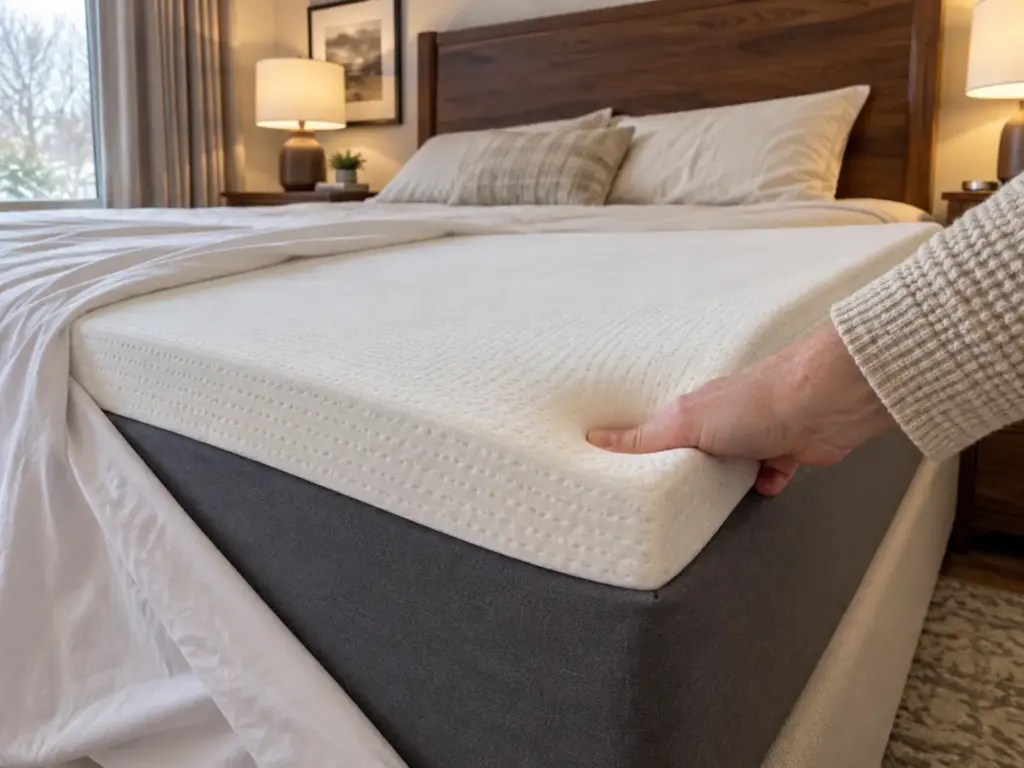
A topper’s firmness is a number on the seller’s own scale, so the 6 on one box and the 6 on another are not the same surface. That turns the shopper’s question into what the foam weighs and how hard it pushes back.
A 1-to-10 scale with no owner
The scale on most listings runs from 1 to 10, or names a step such as medium (5) or firm (7), and each seller draws its own. No listing read for this guide converts its number to a standard, so one 6 cannot be set beside another. The mattress underneath moves the number too: the same topper reads firmer on a soft bed and softer on a hard one, so even a perfectly honest 6 describes a topper on someone else’s mattress.
That is why two listings can both say medium-firm and feel nothing alike once they have been slept on. The word was never a measurement. It is the seller’s guess at how a layer will feel on an average bed, and your bed is not the average one.
Density is mass per volume, firmness is a force
The ASTM D3574 test methods for urethane foam are the standard way polyurethane foam is specified, and they give a common method for research, quality control and acceptance under a specification. They treat density and firmness as separate measurements: density is the mass of a given volume of foam, and firmness is the force needed to press into it. Two foams can match on one and differ on the other, which is why a firmness word cannot stand in for a density.
In practice that means two different tests. Density is found by weighing a known volume of foam. Firmness is found by pressing a flat plate into the foam to a set fraction of its thickness and recording the load it takes. A heavier foam is not automatically a harder one, and a lighter foam is not automatically soft, so a seller who prints one number has told you about one property only.
Density is the better ruler, not the whole one. Two foams of equal density can still feel different, because firmness is its own reading. I would still ask for the density first, because it is the figure a seller can print and a buyer can compare.
What the boxes actually print
The Viscosoft listing states “a density of over 3 lbs (per cubic foot)”, which is a floor the seller chose, not a measurement. “Over 3” cannot be set against another listing that says 3.5. The VALUXE listing prints High Density in the title and no figure at all. Both are the makers’ claims, and neither listing carries a measured density or an indentation load, so the comparison between them stays open.
Four checks make a listing readable:
- Is there a density in pounds per cubic foot, or in kilograms per cubic meter?
- Is that a figure, or a floor such as “over 3”?
- Does the listing name a test method, so the number can be compared with another one?
- Does the thickness it states match the thickness in the title?
A listing that passes none of the four is describing a feeling.
What can be done is a rule: put a number to the claim before you trust the word. A listing with no density has not given you the thing that decides the foam, and the phrase high-density foam without a figure behind it is only a phrase. Which side of firm suits which sleeper is a question of its own, and this guide does not argue it. The foam that springs back slowly after a thumb press is viscoelastic, and the foam that springs back at once is not, but neither tells you the density.
When a listing shows no density, send the seller one message asking for it in pounds per cubic foot before you order. A seller who cannot answer has told you what the box left out.
Heat: Why Foam Holds It and Latex Lets It Go
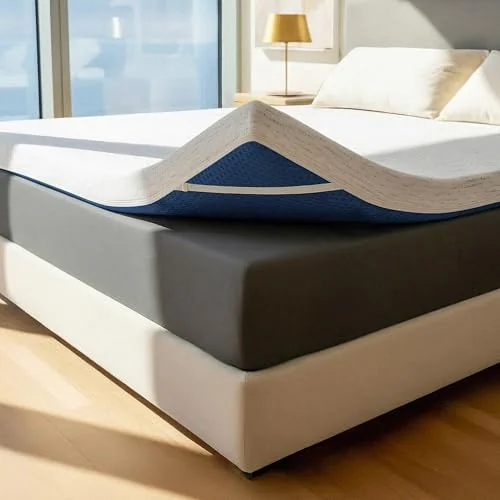
Heat is the most common reason a topper comes off the bed, and the reasons are mechanical. A solid foam sits against the sleeper and keeps its own heat in, which is the heat buildup a hot sleeper notices first. Open-cell foam and latex pass more air through the layer, so less of it stays. A cooling cover adds a few minutes of cool feel when you lie down, which is a different thing from a night of it, and what decides the night is the layer under the cover.

A topper that wears out within a year can also make the bed a lot warmer. How to keep a topper comfortable through a whole warm night is a subject of its own, and this guide does not try to settle it.
Thickness: What the Layer Adds to the Bed
Advice on thickness contradicts itself. Thinner is firmer in one place, thicker is better in another, and at least two inches in a third, because the advice starts from the topper and not from the bed under it. This section starts from the bed.
Start from the bed you have
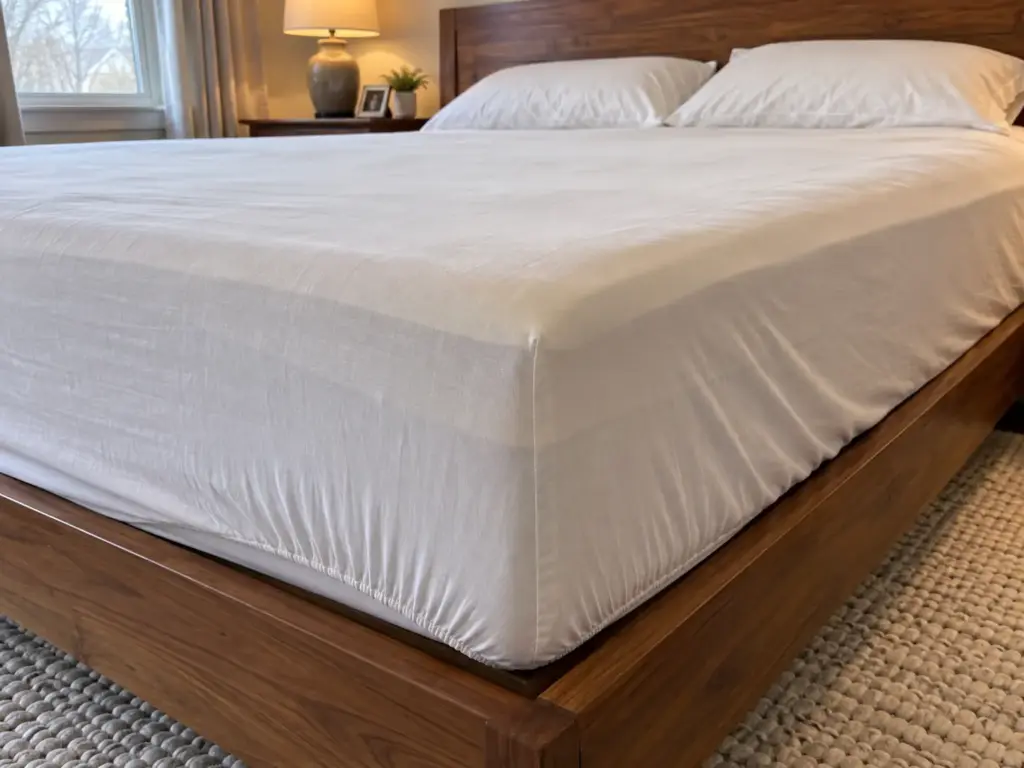
A topper adds its thickness to the height of the bed and to the pocket your fitted sheet has to span. An inch and a half barely moves either, and four or five inches changes both, enough that a sheet that fitted the mattress now hangs by its corners. Working out the pocket you need is done in the pocket formula for a fitted sheet over a topper, so it is not repeated here. A rule such as “at least two inches” is right only for the bed it was first said about.
You feel the height in how you get in. A thick topper changes where the mattress edge meets your knees when you sit down, and where the bedside lamp now sits against the pillow.
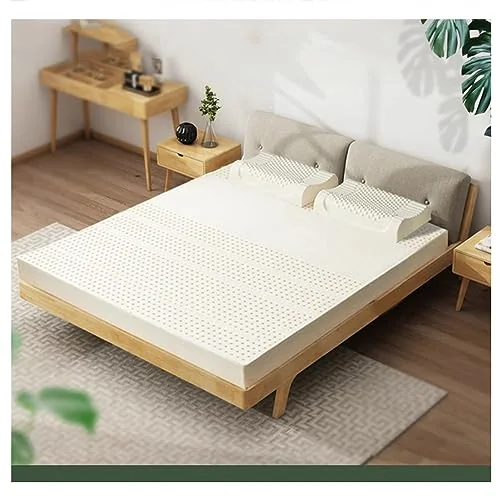
Four inches of firm latex
Two listings share one construction: four inches of firm natural latex. Four inches of latex is a heavy layer to lift and adds more height than any other topper below, so read the pair as the example of a thick topper.
The Queen 4 inch Firm Natural Latex Mattress Topper words its own firmness two ways, Firm in the title and Medium-Firm in the description, and the brand shows as Generic, so settle which one arrives before you rely on it.
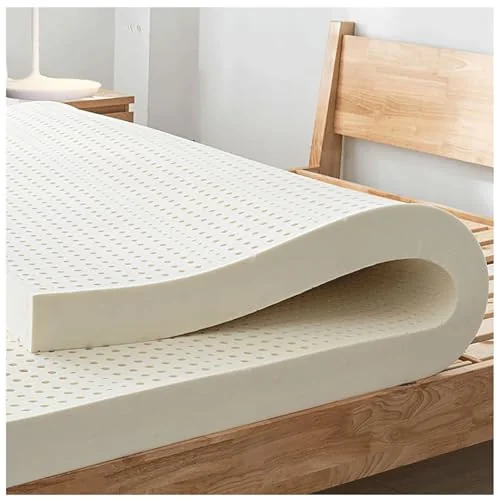
The ARyako 100% Natural Latex Topper is the same four inches, firm. Its listing points it at sleepers over 250 lb or anyone who wants a very solid surface, and it measures 150 by 200 cm (59 by 79 inches), about an inch short each way of a standard queen at 60 by 80. The ratings behind it are few, so the rating base is thin.
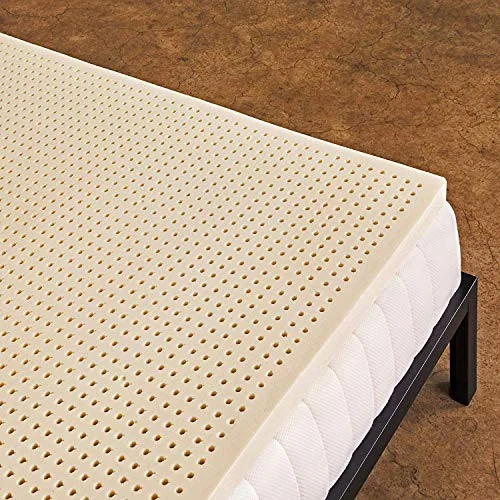
One inch and an inch and a half
At the other end, one inch of latex adds almost nothing to the bed height and changes the surface very little. The Pure Green Natural Latex Mattress Topper is that case: medium firmness, GOLS-certified, sold without a cover.
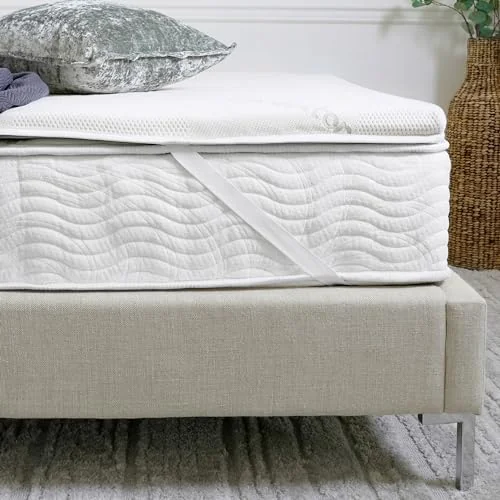
The Saatva Natural Latex Premium Mattress Topper adds half an inch more, with an organic cotton cover and four elastic anchor bands that hold it to the mattress corners. Its listing also sells a foam version, so check that the Natural Latex queen is the one in the basket.
Fit: Keeping the Topper and the Sheet Where You Put Them
A topper that slides in the night gets blamed on the topper, and most of the time the cause is the fit: the corners, the elastic and whatever sits on top.
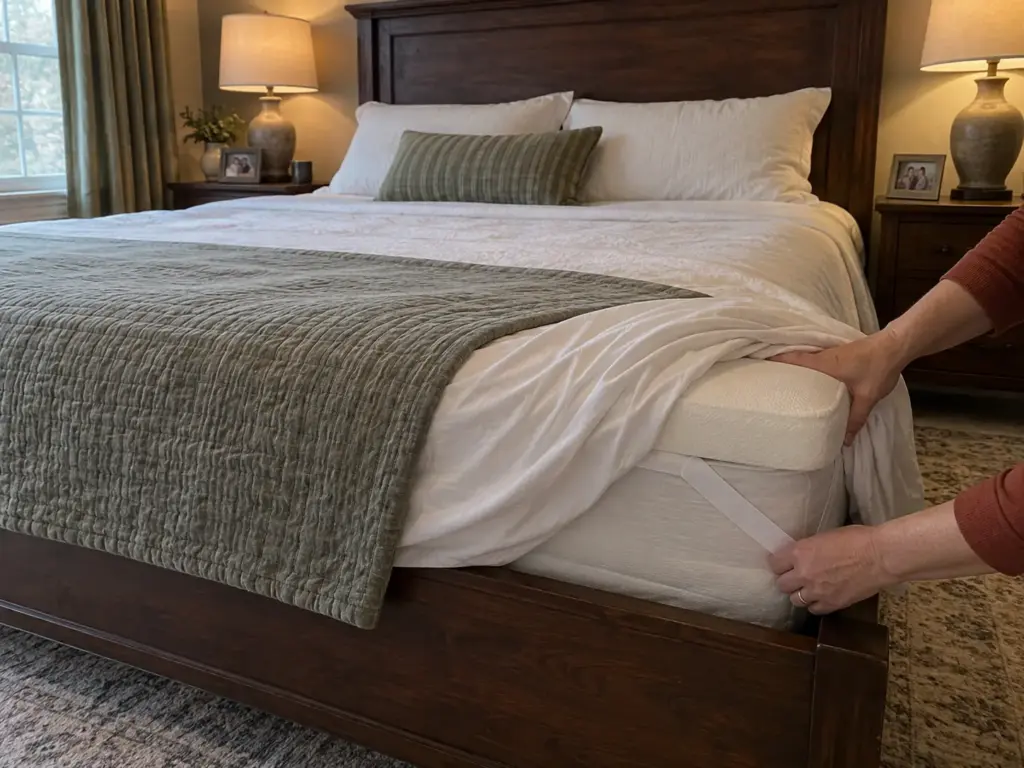
Straps, skirts and the sheet over the top
Three things keep a topper in place. Corner straps are elastic bands that hook under the mattress corners. An elastic skirt wraps the edge of the topper itself, the way a fitted sheet wraps a mattress. And a fitted sheet over the top pins the whole layer with its own elastic.
A cover with a slick surface works against all three, because a slick cover against a slick sheet lets the two layers travel on each other.
The sheet goes over the topper, not under it. A sheet under a topper leaves the topper loose on a smooth surface, with nothing holding it but its own weight. Before buying a new sheet, check the pocket depth you already own against the mattress and the topper together, because that is the free fix, and a deep pocket sheet is only needed when the stack outgrows the one you have. The order of the stack, topper first, then sheet, duvet and blanket, is set out in topper first, then sheet, duvet and blanket.
Measure the mattress and the topper stacked, with the tape pressed flat across both, and buy a sheet whose pocket is deeper than that total. A pocket that only just fits will lift at the first corner you pull on in the night.
When the sheet pops off with the topper under it
If the corners lift, the pocket is too shallow: it has to span the mattress and the topper together, and the elastic has to stretch around both. A sheet that comes off at the corners in the night is a pocket problem, not a sign the sheet is poor. A topper that creeps sideways night after night usually starts at the one corner that is not strapped, which tells you which corner to fix first.
Two Sleepers, Two Surfaces
A topper that settles one person’s ache can be the thing that wakes the other, and a shared bed changes the answer. This section says what two different surfaces on one bed look like and what the options are, without a product claim that cannot be backed.
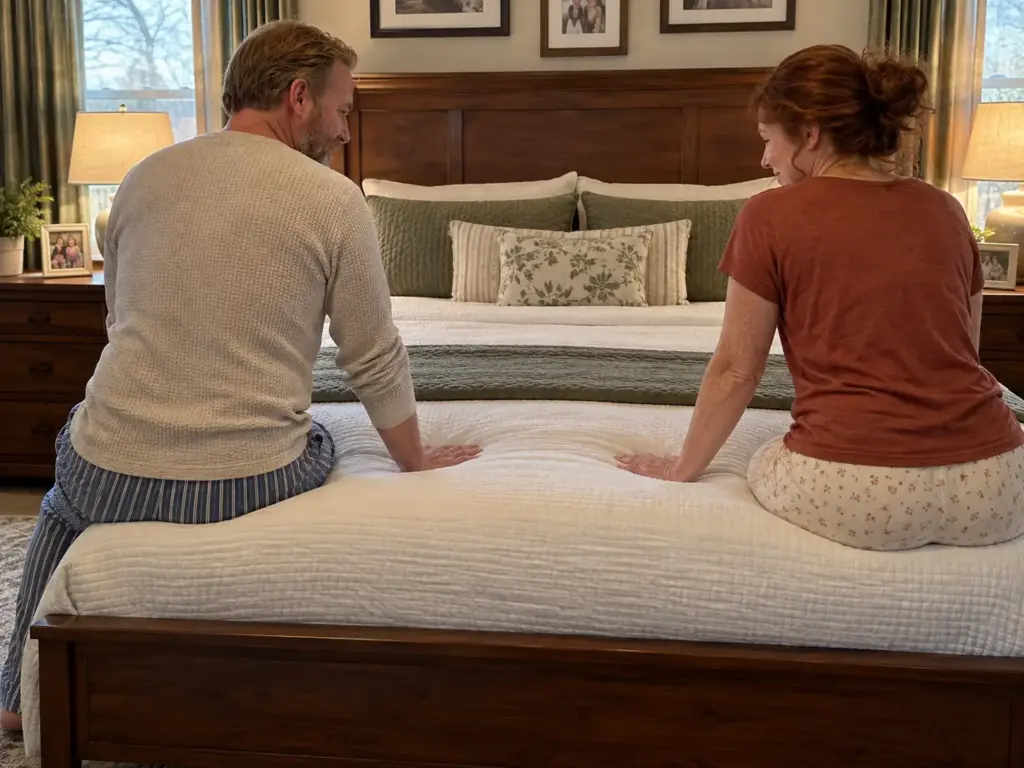
One bed, two needs
The partner who sleeps fine on the bed as it was has no reason to want it firmer or softer, and neither sleeper is wrong. The same surface can be too firm for one frame and right for another. Where a bed has been shared for years, the mattress under it is two different bases, because it wears where each person sleeps. Press each hip spot separately before deciding anything, and judge the two sides apart.
Free first applies here as well. If the mattress is made to be rotated head to foot, and its care label will say whether it is, turning it moves each sleeper onto the part of the mattress the other has been wearing. That costs nothing and can narrow the gap between the two halves before any layer is bought. A topper bought for one half of a bed that has simply worn unevenly is a purchase made to solve a rotation problem.
The easiest mistake is a compromise: a layer of middling firmness that suits neither sleeper. It rarely works in both directions at once, and the usual fix for opposite needs is two of something instead of one thing set in the middle. Motion transfer across the bed, the other thing couples ask of a layer, is a separate matter from firmness and does not settle this one.
What “two of something” looks like
There are two structures. One is a split topper: a layer that covers one half of the bed, so that one sleeper has it and the other keeps the bare mattress. The other is a dual-surface layer built with two firmnesses on one piece. Dual-surface toppers exist, but no Amazon-sold example was verified for this guide, so none is named or recommended here.
A topper laid over half the bed leaves a step at the center line, equal to the thickness of the layer. A 3-inch layer means a 3-inch step the sheet has to bridge. A sleeper who rolls toward the middle changes height under the hip as they cross it, and that step is where a half-bed topper is most likely to wake the person on the other side. A dual-surface layer has no step, but it has a center seam, and the center seam of a two-sided layer is where one sleeper’s side starts to roll the other toward it.
A half-width topper also has less holding it down. With no elastic around the whole bed, it relies on the sheet and on friction, so it creeps toward the center line more readily than a full topper does. The side that gets the layer is the side that has the ache, and the other sleeper’s side keeps the bed as it was; what you owe the second sleeper is a week of honest notes on how their half feels afterward, written in the same four lines as the first.
Whatever the structure, the test in the last section applies to both sleepers, one change at a time, with the second person’s verdict counted as much as the first’s. If the first sleeper’s ache improves and the second sleeper’s nights get worse, the topper has not worked, it has moved the problem to the other half of the bed.
Durability and the Trial Window
A return window is sold as the test, and for a layer that has to be judged over weeks the trial period closes early. This section sets the sellers’ own numbers beside what a person needs to find out.
Windows and warranties, as the sellers state them
Three terms turn up in the listings, and each is the seller’s own word, not a measurement of performance. Viscosoft states a 60-Day No Hassle Guarantee. Amazon’s page text gives a baseline 30-day right of return “for many products”. VALUXE states a 10-year warranty and two years of free replacement for damage that is not human.
Each protects something specific, and none says how long the foam will hold its shape.
Lay the clocks end to end and the problem shows. A new foam is asked to lie flat for 24 to 48 hours, one seller’s care instructions put the first turn at about two months, and a 60-day guarantee from another seller closes at that same point. A buyer who follows the instructions to the letter has had the topper through a single turn when such a window ends. The window sold as the test closes at about the moment a topper has completed its first scheduled care.
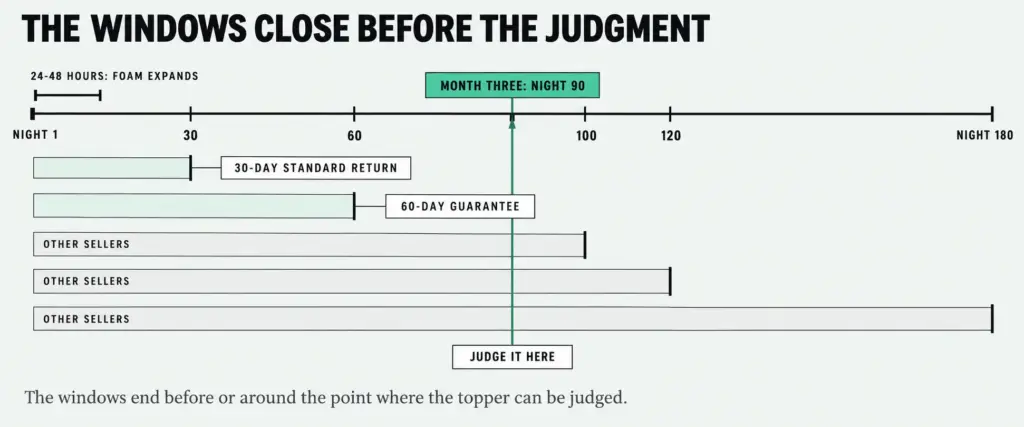
Trial windows on other sellers’ pages run from 30 to 180 nights, and at least one name-brand topper cannot be returned once it has been slept on. A store with a generous return policy is the cheapest trial there is, and a Costco topper that can go back if it does not help is a good example. The wording of a warranty matters as much as its length. VALUXE’s separates damage caused by people from damage that is not, and a shallow hollow at the sleeping spot is the kind of wear a buyer would have to ask the seller about before counting on it.
What the long clocks say
Judging a topper over time takes months, not a single night. One says “one or two nights won’t tell you either”, on the question of when a topper can be judged. Another reports a topper that died within a year. A third describes a latex layer that held to a mild indentation at about twelve years.
These are reports, not a lifespan.
What the reports share is where the wear shows. The sleeping spot is where a topper fails first, and it shows as a shallow permanent hollow rather than a tear. It is also gradual, which is why the check has to be deliberate: the hollow arrives a little each week and the sleeper never sees it. The check is to look at the layer with the sheet off, from the side, in daylight.
One practical consequence follows from the clocks. Write the delivery date and the closing date of the return window on the first line of the note on the day the topper arrives, and set a reminder for five days before it closes. That reminder is the real decision point: either the topper is clearly working by then, or it is clearly not, and anything in between is a reason to keep the receipt and the packaging in case a return is needed.
Judge It at Month Three, Not on Night One
The honest test for a topper is slow and boring and changes one thing at a time. This section turns everything above into a test you can run on your own bed and read when the foam has stopped being new.

One change at a time, in this order
Changing the pillow, the topper and the sheets in one weekend leaves you unable to tell which of them did anything. The order that keeps the answer readable runs from the head down: pillow first, then the mattress, one change at a time.
- Check the base, using the press test from the first section, and write down how far the hip spot gives.
- Make the free changes: the board or foam sheet under the mattress, and the pillow.
- Lay the topper flat for 24 to 48 hours before the first night, then make the bed and change nothing else.
- Judge at one week, one month, two months and about three months.
Free first, always: the base check and the turning care for a foam topper come before any second purchase.
The reason for the discipline is what each change can tell you. A pillow change that helps in the first week and a topper laid on top of it in the second leave you with a result you cannot assign. If the mornings are better, you cannot say whether the pillow did it, whether the topper did, or whether the foam was simply new.
One change at a time makes each result belong to something. It is slower, and slower is the point: the test is built to be readable, not fast.
Start a note on your phone the day the topper goes on, with the date and one line about how it feels getting in. Changing the pillow in the same week turns the note into guesswork.
What to write down and when to look at it
What goes in the note is the bed, never the sleeper: how the surface feels as you get in, whether the topper moved in the night, whether it held heat, whether a corner crept. Four lines a week is plenty. At about three months, read the whole note in one sitting; the pattern across weeks is the result, and no single night is.
Look for three patterns in it. A steady line, the same few words every week, means the layer has settled and what you feel is what you have. A line that improves and then slides back means the foam is aging faster than a topper should, and the notes will show the week it started. A line that never moves means the layer is not the lever, which is itself a result worth having, because it stops the next purchase.
Week one still lies, because nearly anything feels different when it is new. A topper that was great in week one and ordinary in week eight is usually the foam finishing its break-in, not a verdict on the layer.
When month three says the answer is not the topper
Month three can say the topper was not the lever. If the sleeping-spot hollow is deeper than it was when you checked the base, the base is moving and the next change belongs to the mattress, which is a different purchase and a different guide. Some people also find that a topper makes things worse on a given base, and the test is how you find that out before the trial has closed. If a corner keeps creeping even though the pocket measured right, the cover is sliding against the sheet, and the answer is a different cover or strap, not a different habit.
There is also a result that is easy to miss: a topper that is fine in every way except that it has made the bed shorter on one side or higher at the edge, so that getting in changes. Those are fit problems found only by living with the layer, and they are exactly what a three-month note catches and a three-night trial does not. Treat each as a reason to adjust the fit or return the layer while the window is open, not as a reason to put up with it.
The Base, the Number and the Clock: What to Check Tonight
Three things carry this guide.
- The base decides how long any topper helps, so it gets checked before anything is bought.
- The firmness number belongs to the seller; density is the ruler foam is actually specified by, and a listing without one has left out the deciding figure.
- A return window closes before the judgment does, so give a topper about three months and change one thing at a time.
When the topper has been on the bed for a season, strip the sheet and look at the sleeping spot from the side: a shallow hollow where your hips rest tells you which gave first, the layer or the base.
Tonight, take everything off the bed, press the hip spot and the foot of the bed, and write down what you find before you order or turn anything. A few weeks from now, press the same two places and see whether either has moved.
Frequently Asked Questions
01Do mattress toppers help with back pain?
A topper changes only the top few inches of the bed, so it helps when the surface is the problem and the base underneath is sound. It is a surface to test, not a treatment, and a worn base will outlast any layer placed on it.
02What is the best mattress topper for lower back pain?
No single topper is best, because the right one matches your base and your sleeping position and is judged at month three, not on night one. Read the printed density and the real thickness before the firmness word on the box.
03What type of mattress topper is best for sore backs?
Foam and latex sit differently under the hips: memory foam gives and recovers slowly, while latex pushes back. Neither type is right for everyone, so choose by what each does, then check the density a listing prints.
04How long should I try a mattress topper before deciding?
Give a topper about three months, because a new foam needs a day or two to expand and the first week flatters almost anything. A 30-day or 60-day return window closes before that.
05Can I put a mattress topper under a fitted sheet?
No, the fitted sheet goes over the topper, and its pocket has to be deep enough to cover the mattress and the topper together. A sheet under the topper leaves it free to slide across a smooth surface.




Tried it on your own bed?
No comments yet. Tell us what you changed, and what the sheet did after a few washes.