







What’s in here7 sections
You pull a set out of the closet, or out of the cart, and the band across the front says 100% Egyptian Cotton. The honest answer to what that phrase guarantees is: on the evidence, not much. The Cotton Egypt Association runs a DNA-testing program on its own trademark, and roughly nine samples in ten pulled off shelves around the world came back as something else.
The reason the number can be that high is that “Egyptian” names a place, and the property that actually makes a sheet good is a length: extra-long-staple, at least 1⅜ inches of fiber. A place is easy to print on a box. A length is not. Two different failures hide behind that one phrase, and this sorts them, then hands you the checks you can run without a lab.
Quick Answer
No. “100% Egyptian cotton” can be legally accurate and still meaningless, because Egypt grows ordinary short-staple cotton too, and in DNA testing, most samples pulled from shelves worldwide had no traceable Egyptian fiber at all. Staple length and verifiable sourcing decide the sheet, not the country on the tag.
What the DNA Tests Actually Found
Nine in ten is the kind of figure that deserves a says who, so here it is before anything else rests on it. The number does not come from a rival mill, a consumer group with a campaign to run, or a bedding brand with a competing story to sell. It comes from the organization that owns the trademark and stands to lose the most by publishing it.
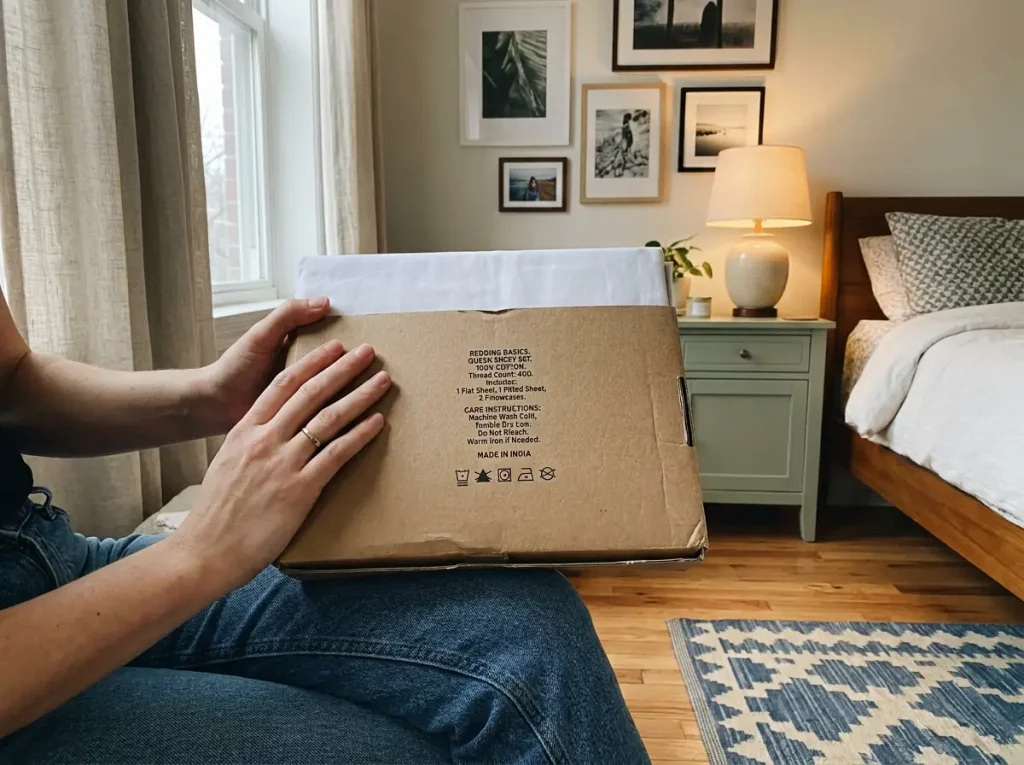
The Cotton Egypt Association operates the certification and the DNA testing behind the Egyptian cotton name, and its own program found that around 90% of random global samples carrying that label were blended with cotton from Sudan, Burkina Faso and Pakistan. That is the trademark holder saying its own mark has been overrun. The Cotton Egypt Association, the organization that runs the DNA-testing program in the first place, has publicly admitted the scale of the counterfeiting problem, which is not a thing a trade association does for fun.
Then there is the case that made the whole thing concrete, and the scene is not a laboratory. It is a Target aisle.
Target sold 750,000 sheets and pillowcases branded Egyptian cotton, made by the Indian supplier Welspun, at up to $75 a set. Its own supply-chain investigation put the product under a microscope and found no Egyptian cotton in it at all. The retailer pulled the line.
That is the Target investigation that broke the story, reported at the time by Bloomberg — a named national retailer proving a named supplier’s label false, not an accusation from the sidelines.
And here is the detail that changes how you read every certification logo for the rest of your life. Welspun held the Cotton Egypt Association’s own gold seal when the fake product was found. It was the first gold-seal recipient. The mark that exists specifically to tell you the cotton is real was on the packaging of the sheets that contained none.
That fact matters more than the fraud rate does, because it closes the door your instinct reaches for first. Standing in a shop, the natural move is to hunt for a logo and let it decide. The logo has already failed this exact test on a national scale, which is why everything below is about the fiber and the arithmetic instead.
The story has not stayed inside the trade press either. On r/Bedding, someone who works in home textiles and deals with factories says testing has turned up product carrying a certification logo that was “just standard cotton”. The same failure, from inside the supply chain, years after the news cycle moved on.
In the same thread, ordinary buyers quote the 90% figure from memory, unprompted. When a statistic escapes the industry and becomes something shoppers repeat to each other, the industry has lost the argument.
Two Different Failures Wearing One Label
A fake and a disappointment are not the same thing, and once you have been handed a 90% failure rate the temptation is to file every underwhelming set under fraud. Some of the sets that let people down were labeled entirely legally. Separating the two matters because they have different fixes, and only one of them is anybody’s fault.
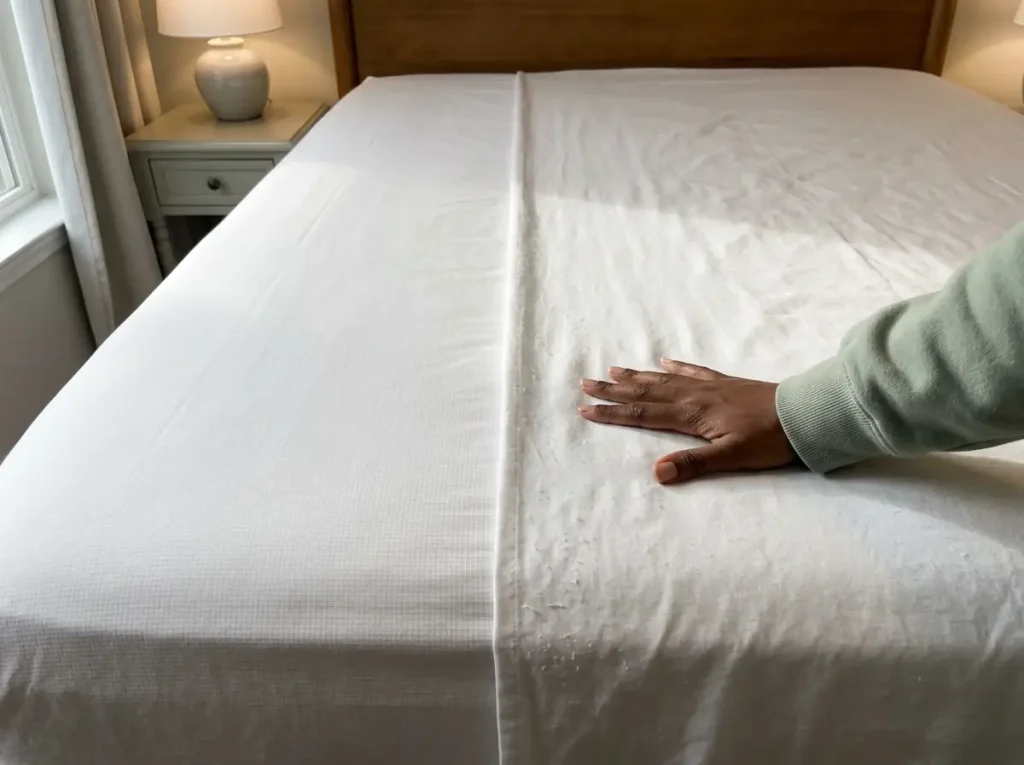
The first failure is the false claim, and there is a bright line under it. The FTC’s own textile labeling rules spell out exactly when a “100% Egyptian Cotton” claim breaks the rule: a product may only be labeled 100% of one cotton type if it contains only that cotton by weight. A 50/50 blend of Egyptian and upland cotton sold as 100% Egyptian is the regulator’s own worked example of an unacceptable label.
Not a gray area, not marketing latitude. A named rule with a named violation.
Worth being precise about what is actually banned, because it is narrower than people assume. Blending is legal. A label reading 65% Pima Cotton, 35% Other Cotton is a lawful label and an honest one. The offense is the word “100%” sitting on top of a blend, not the blend itself.
A disclosed mix is a product decision you can accept or reject; an undisclosed one is a lie about weight.
The second failure is stranger and, for most people, more common: the claim that is completely true and buys you nothing. Egypt grows ordinary upland cotton alongside the famous stuff. A sheet can be genuinely, verifiably, DNA-provably 100% Egyptian and still be short-staple, and it will go limp and pill on the same schedule as any other short-staple sheet.
Your friend who says “mine is definitely real, I bought it in Egypt” is probably telling the truth and may still have a mediocre sheet. Origin and quality are two separate claims, and only one of them is printed on the tag.
One number is worth memorizing on this whole subject: 1⅜ inches, or 34.925 mm. That is the minimum fiber length for extra-long-staple cotton. Ordinary upland runs 20 to 26 mm and makes up around 85% of world production. If a seller can tell you the staple length, they know what they bought. If they can only tell you the country, they are repeating what was on the bale.
That threshold is the whole mechanism. Extra-long-staple means fibers of at least 1⅜ inches, long enough to be spun into a strong single strand with few loose ends inside the yarn. Ordinary upland cotton is a third of that.
When you pay for Egyptian cotton, the thing you believe you are buying is the length; the thing the label promises is the latitude and longitude. The two overlap often enough to keep the myth alive and not nearly often enough to bet on.
It helps to know what the premium is actually naming. The extra-long-staple cottons are a different species from the commodity crop: Gossypium barbadense, not the Gossypium hirsutum that most of the world grows.
Giza cotton, grown in the Nile delta, belongs to it, and so does Pima, and so does Supima cotton, which is Pima grown in the United States under a licensed name. All of them are ELS cotton first and a place second. That ordering is the entire point: the species is what performs, and the country is what gets printed.
Which leads somewhere uncomfortable for the premium: a long-staple cotton with no romantic origin story beats a short-staple Egyptian one, and usually costs less, because it is not selling a word. If you want that comparison run properly, it is the subject of American cotton and Egyptian cotton, where the staple decides it: same fiber science, different flag on the bale.
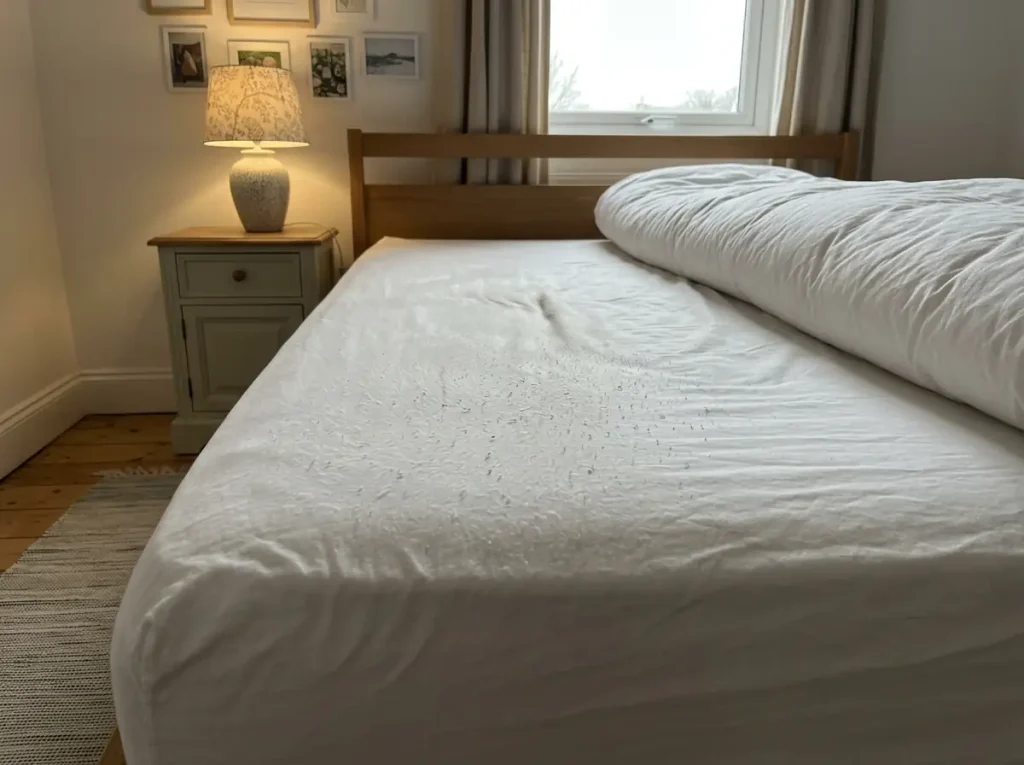
Short-staple gives itself away at the surface, and it takes a few months. The fiber ends are too short to stay buried in the twist of the yarn, so they work loose and stand up, and the sheet goes from smooth to faintly fuzzy under your hand. That is the length showing through. No origin claim on earth prevents it.
The Checks You Can Run Without a Lab
None of this is worth much standing in a shop unless it converts into something you can do with the package in your hands. It can. Once you stop reading the front of the box, the rest of the label starts being useful, and so does a little arithmetic that most listings are not expecting you to do.
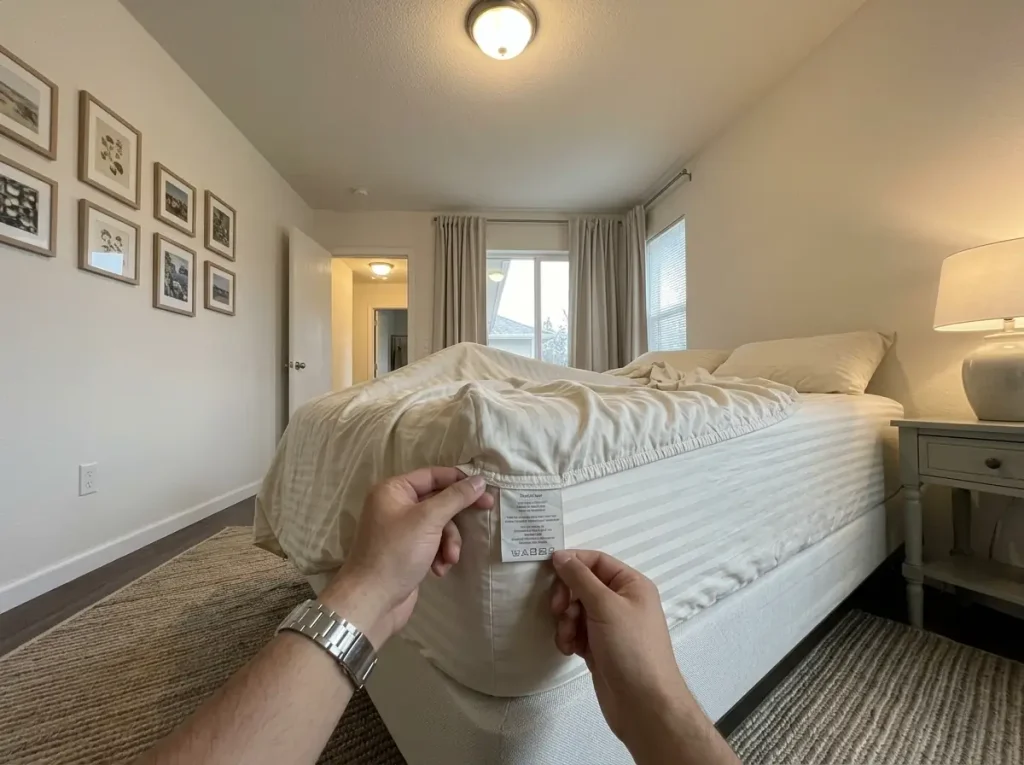
Start with the ply, not the thread count. A genuinely single-ply weave tops out around 500 threads per square inch, because that is roughly how many single strands physically fit in that space at a usable density. Everything above it is reached by twisting thin strands together and counting each one: 2-ply doubles the printed figure, 3-ply triples it. This is the same arithmetic behind what a thread count actually tells you, and it is why a 1000-count sheet is often a 250-count sheet wearing makeup.
So the credible band is 300 to 600, single-ply. A label that shouts a thread count and stays silent on ply is hiding the half of the spec that decides the sheet.
Take the SOHO 100% Egyptian Cotton Sateen Stripe Sheet Set as the worked example rather than the accusation: 500 thread count, sateen weave, Egyptian origin claimed, and nothing anywhere about ply. That number sits right on the physical ceiling, which means it is either an honest single-ply weave at the top of what is possible or a doubled 250. Its flaw is exactly that silence — from the listing alone you cannot tell which, and that is what “go check” looks like on a real product rather than in theory.
GSM is the number that is hard to fake, and almost nobody prints it. Grams per square meter is a weight. A weight does not inflate because a copywriter wants a bigger figure on the front; it is either on the scale or it is not. When a listing bothers to state it, that single number tells you more about what you are getting than the thread count printed next to it in a larger font.
| The number | What it claims | Can it be inflated? | Where to find it |
|---|---|---|---|
| Thread count | How finely the fabric is woven | Yes, ply multiplies it | Front of the package, in the biggest type |
| Ply | Strands twisted into each thread | No, but it is usually left out | Spec sheet, if at all; ask the seller |
| GSM | Fabric weight per square meter | No, it is a weight on a scale | Detailed specs, rarely on the box |
| Staple length | Fiber length: ELS is 1⅜ in and up | Not directly, but “Egyptian” implies it | Almost never printed; only good sellers state it |
Send the seller one question and read the shape of the answer, not just the words: “Is this single-ply, and what is the GSM?” A brand that knows its own supply chain answers with two numbers. A reseller answers with adjectives, or explains why thread count is what really matters. That reply is worth more than the entire product description above it.
Then run the price arithmetic, which is the check the community reaches for first. The r/Bedding rule of thumb puts genuinely top-grade extra-long-staple around $500 and up for a King. So a $60 set advertising 100% Egyptian cotton at 1000 thread count is implausible twice over in the same breath: the fiber alone costs more than the asking price, and that count is almost certainly ply-inflated.
It is not a lucky sale. It is the listing telling you what it is made of, and it is the most reliable tell that fake Egyptian cotton is what is on offer. Cotton fraud at this end of the market is rarely subtle: the arithmetic gives it away before the fabric does.
Finally, know what the care label cannot do for you. It carries fiber content and washing instructions, and that is the end of its jurisdiction. It does not carry staple length, it does not carry ply, and it certainly does not carry origin verification.
Cotton labeling and fiber traceability are separate systems, and only the first one reaches your bed. DNA testing cotton is how blended cotton gets caught, but it happens in a lab, on a sample, long before or long after the set you are holding was packed. If a certificate number is printed on the box, treat it as a thing to look up rather than a thing to trust, because label verification means checking that the number resolves to your product, not just that a number exists. Quality verification, in the sense a shopper can actually perform, stops at the numbers on the box.
A set can pass every honest reading of its own care label and still bear no resemblance to what the front of the box claimed, because the front of the box and the care label are answering different questions.
The counter-example is worth seeing, because “more checkable” is a real category even when “proven” is not available. The California Design Den Certified 100% Egyptian Cotton Percale Sheet Set stacks a named third-party seal, Good Housekeeping, on top of the origin claim, and adds OEKO-TEX Standard 100 and a stated 16-inch pocket depth, three checkable statements instead of one adjective.
Its flaw is the one this article opened with: a third-party seal raises the odds and is not a DNA test, and Welspun carried the Cotton Egypt Association’s own gold seal when its product was found to contain no Egyptian cotton. More things to check is better than fewer. It is not proof.
One thing worth noticing in the hand while you are there. A set with an inflated multi-ply count feels heavier and denser, not finer. That is the opposite of what the number implies, and the reason those sheets sleep warm. Thickness got sold as refinement.
What Twenty Washes Tell You That the Tag Cannot
Every check above happens before money changes hands, and the honest limit of all of them is that the fiber only really answers at the far end of a laundry cycle. The checklist is what you can do in the shop. This is what the bed tells you afterwards, and it tends to disagree with the packaging.
Most of the first-night softness on a cheap Egyptian set is a chemical finish sitting on top of the yarn rather than anything the cotton is doing. It feels remarkable out of the package because it was engineered to feel remarkable out of the package, at the point of sale, before any washing machine has had an opinion. Then it washes out, and what is left is whatever the fiber actually was the whole time.
The mechanism is worth naming, because it explains the disappointment better than any story about fraud does. A softening treatment, usually a resin finish, coats the yarn and flattens it slightly. That is chemical finishing, and it buys a lovely hand feel and a heavier drape for as long as it survives detergent.
It also masks the one thing you were trying to judge. Shrinkage in the first wash tells you a little about how the cloth was set; the finish coming off over the next few tells you what you actually bought.
From there the two grades go in opposite directions under identical treatment, which is the cleanest evidence you will ever get. Long-staple cotton gets softer with washing, because there are fewer fiber ends inside the yarn to work loose in the first place. That is staple over origin in one sentence, and it is the only rule here that survives a laundry room.
Short-staple goes fuzzy, then pills. Same detergent, same machine, same months, opposite outcomes, and that divergence is the staple length finally speaking. It is the same sorting logic behind cotton sheets sorted by staple length rather than thread count, which is the only order that predicts anything.
Now the report that complicates the story, because leaving it out would be dishonest. A r/Bedding commenter who owns four sets at claimed counts of 500, 800, 1000 and 1200 says the two higher-count sets are softer and holding up better in real use. Ply inflation is a labeling problem, not automatically a fabric problem.
A well-made multi-ply yarn sheet from decent cotton can outlast a badly made single-ply one. The count being arithmetically dishonest and the sheet being bad are two claims, and only the first one is guaranteed.
The other honest admission: nobody in the sources gives a specific wash count at which a fake’s chemical finish gives out. I would rather say that plainly than invent a tidy number, because a number like that is exactly the sort of thing that gets repeated for a decade after somebody made it up. What can be said is the direction of travel, and where to look.
Look at the middle third of the fitted sheet, in raking light, after a season of wash twenty and beyond. Not the pillowcases, and not the flat sheet either. Everybody checks the pillowcases, which is why people miss this for another month.
The fitted sheet under the sleeper is where the weight and the movement are, and short fiber ends stand off that surface first. Tilt it toward a window until the light runs sideways across the weave. Fiber ends standing up is the answer the tag was never going to give you.
Photograph the middle of the fitted sheet in raking light the week you buy it, and again after a season of washes. Two photos on the same phone, same window, same angle. Fuzz creeps up slowly enough that your hand stops noticing it, and the pictures settle the argument the memory cannot.
So Is It Worth Paying for the Word?
All of which leaves the question you came in with, except that “is it real?” has turned out to be the wrong first question. The better one is whether the word is doing any work at all once you can read the numbers underneath it. Both deserve an answer.
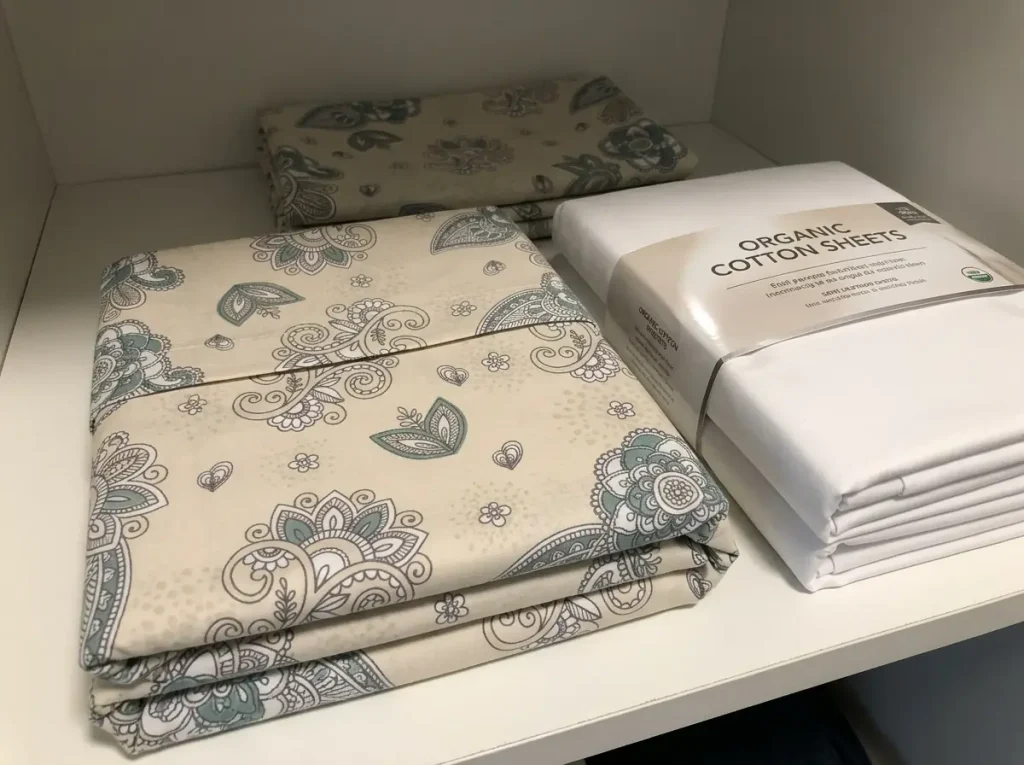
Start with the free move, before any of this becomes shopping. Go and read the label on the set that is on your bed right now. Fiber content, thread count, any statement of ply, any care instruction that hints at a finish.
Most people have never once turned that tag over, and it costs nothing to find out what you have been sleeping on for the last three years. That single act reframes every listing you look at afterwards.
The community’s own tiering is useful here, and blunter than anything a brand will tell you. r/Bedding splits mid-tier, around $300, long-staple, probably multi-ply, brand-name but not top grade, from what it calls primo: $500-plus for a King, extra-long-staple, single-ply, milled in Italy or Portugal. Most people are shopping in the first band while being sold the vocabulary of the second. That gap between the band you are buying in and the band the words describe is where the whole premium lives.
So the verdict. Past roughly 350 to 500 thread count in genuine long-staple cotton, paying extra for the word “Egyptian” buys provenance, not sleep. It is a bet on a supply chain that fails a DNA test nine times in ten, underwritten by seals that have already failed once at national scale, which is the same argument as what a certification on a sheet does and does not prove, arriving here from a different direction.
Buy the numbers instead of the adjective: a stated fiber, a credible single-ply count, a stated pocket depth, and a seller who volunteers those things before being asked. It is worth saying that trademarks can be policed properly when someone bothers. Supima, which does have an audit trail behind the name is the counter-case, and it shows the failure here is enforcement rather than the idea of naming a cotton.
Which brings the last point, and it is nearly a joke: a sheet that never claims an origin has nothing to verify. That is not a compromise. It is one fewer thing that can turn out to be false.
The Feather & Stitch 100% Cotton Percale Sheet Set is what that looks like on a shelf: 300 thread count, which is credible single-ply territory rather than a doubled number, a percale weave that tells you how it will sleep, and a stated 16-inch pocket. Its flaw is written on its face — it makes no origin claim, so it does not give you the thing people are actually buying when they reach for the word Egyptian, which is the presumption of something finer. It is the honest option, not the aspirational one.
And that is the pattern once you have looked at enough packaging. The sets that hold up are boring on the band. The ones carrying the most adjectives are the ones asking you to accept a word where a number should be.
That is what most premium bedding claims come down to: a marketing shortcut standing in for a spec. Textile fraud is the extreme version, and it gets the headlines, but the ordinary version is legal and just as expensive.
The Short Version
“100% Egyptian Cotton” is a claim about a place, and roughly nine in ten samples pulled off shelves worldwide failed the trademark holder’s own DNA test. Treat it as a claim to check, never as a grade to trust.
Two separate things go wrong behind that phrase. One breaks FTC rules: a “100%” claim sitting on a blend. The other breaks nothing at all: a genuinely Egyptian sheet made from short-staple cotton, entirely legal and entirely ordinary. Only one is fraud, and both sleep the same.
The numbers that survive scrutiny are staple length, ply and GSM. Country of origin is not one of them, and a seal is not one either.
After a season, look at the middle third of the fitted sheet in raking light. Long-staple gets smoother; short-staple stands up in loose fiber ends. That is the test the tag was never going to pass on your behalf.
Go turn over the tag on the set that is on your bed tonight. Whatever it says about fiber and thread count, that is the sheet you have been sleeping on, and finding out costs nothing.
Frequently Asked Questions
01Is 100% Egyptian cotton the same as 100% cotton?
Both are pure cotton, and “Egyptian” only adds a place. It does not guarantee extra-long-staple fiber, because Egypt grows ordinary short-staple cotton too. The staple length decides how the sheet performs, not the country.
02How can you tell if Egyptian cotton is real?
Not from the label alone, and not from a certification logo. Look for a stated ply beside the thread count, a GSM figure, and a price that is plausible for extra-long-staple fiber. Anything cheap above 600 thread count is arithmetically doubtful.
03What are the disadvantages of Egyptian cotton?
It costs considerably more than equivalent long-staple cotton from elsewhere, and its name is widely counterfeited. A genuine short-staple Egyptian sheet performs no better than ordinary cotton, so the premium can buy provenance rather than performance.
04Is Egyptian cotton worth the extra money?
Past roughly 350 to 500 thread count in genuine long-staple cotton, the extra buys the word rather than better sleep. A verified long-staple sheet with no origin claim usually gives the same result for less.
05Does a certification logo prove the cotton is Egyptian?
No. Welspun held the Cotton Egypt Association’s own gold seal when 750,000 of its sheets were found to contain no Egyptian cotton. A seal raises the odds; it is not a lab result.





Tried it on your own bed?
No comments yet. Tell us what you changed, and what the sheet did after a few washes.