







What’s in here6 sections
Somebody on r/Bedding asked it flat out: why is good bedding so expensive if it is just rectangular pieces of fabric? For linen the question has a real answer with numbers in it, and the honest part of that answer stops well short of the price on most tags. Flax has almost no stretch, which means the loom has to run slow or the yarn snaps, and that alone makes a linen sheet cost more than a cotton one before anybody prints a brand name on the package. What follows is what the plant costs, what the loom costs, where that floor ends, and the one number a label has to print before the rest of the price is anything but a story.
Quick Answer
Linen costs more because flax is a low-yield crop grown in three countries, only 15 to 25 percent of the stalk becomes usable fiber, and the fiber’s low stretch forces looms to run slow. That is the real cost floor. Everything above it is the word “linen” being sold, and GSM is how you tell them apart.
The plant is the first half of the price
Half the cost sits in the field, which is easy to say and worth showing, because the reason flax cannot get cheaper is agricultural and it does not move. Cotton responds to demand by being grown somewhere cheaper; flax has nowhere cheaper to go. If you want the other half of the argument, the one about whether linen earns its price at all, the pillar settles that with a weight threshold. This section is about what happens before anyone gets to weigh anything.
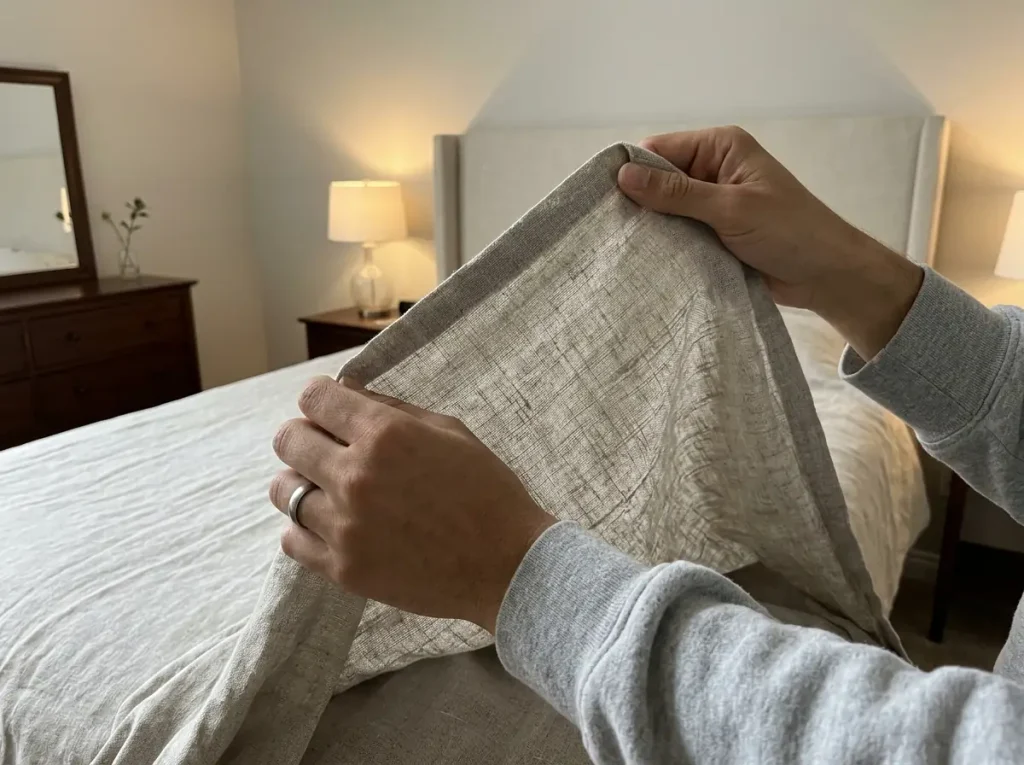
Where flax actually grows, and why that band is so narrow
Textile-grade flax comes almost entirely from a narrow coastal strip of France, Belgium and the Netherlands. That is not a marketing preference for European provenance. It is a climate window: flax for fiber wants a cool, damp, maritime growing season and a soil that holds moisture without waterlogging, and the strip that reliably delivers it is small. When the certification bodies wrote their standards they did not have to define a region so much as describe one, and the certifying body defines that growing region as exactly three countries.
Compare that to cotton, which grows across dozens of countries at wildly different labor costs, and the pricing logic of the two fibers separates. A cotton buyer facing a high quote sources the same grade somewhere else. A linen buyer facing a high quote is talking to a supply with no cheaper version of itself.
And most flax planted worldwide never becomes fabric at all. The bulk of the global crop goes to linseed for oil, which is a different plant variety grown for seed rather than stalk length. Textile flax is a minority use of a minority crop, which is why nobody has ever built cotton-scale infrastructure around it.
There are no economies of scale waiting to be found here. Small-batch production is not a choice the industry made for effect; it is the size the crop is.
How much of the plant you are really buying
Here is the number that reframes the whole thing: long-line fiber, the long parallel strands that become good linen yarn, runs roughly 15 to 25 percent of the raw stalk’s weight. The rest is shive, short broken tow fiber, and dust. Some of it gets sold on for insulation, composites and paper. None of it becomes your sheet.
So a mill buying a ton of retted flax is buying somewhere between three hundred and five hundred pounds of the thing it actually wants, and the cost of the rest is priced into what survives. That ratio is fixed by the plant, and no process improvement moves it much. Cotton, by contrast, comes off the plant as fiber already. One crop hands you the product; the other hands you a stalk with the product hidden inside it.
Lift the folded set before you read anything on the package. Two queen sets of the same size, the same fiber and the same declared count can differ by a third in weight, and the heavier one is the one with more fiber in it. Your hands measure grammage better than any front-of-package claim does.
Retting, scutching, hackling — three stages before a single thread
Getting the fiber out of the stalk takes three separate mechanical stages, and none of them can be hurried. Retting comes first, and it is a controlled rot: the stalks are laid out in the field for weeks and left to weather so bacteria break down the pectins gluing the fiber to the woody core. The farmer turns them, watches them, and decides when to stop it. Then scutching beats the dried stalks to break the woody core away, and hackling combs what survives into parallel strands sorted by length.
Three stages, each judgment-dependent, all of them before a single thread exists. And retting is the one that decides more than it appears to. Stop it too early and the fiber will not release cleanly, so the yield drops.
Let it run too long and the bacteria go past the pectin into the fiber itself, which gives you flax that spins fine, feels fine, and starts breaking down years later in ways no finishing can put back. That is a decision made in a field about how a sheet will behave in year four, by a person you will never hear about.
Which is the honest answer to the r/Bedding question. It is rectangular pieces of fabric, yes. The fabric started as a plant that had to be rotted on purpose, beaten, combed, and then spun on machinery running below its own capacity, and none of that had happened yet when the cotton in the next aisle was already fiber.
The loom cannot go faster, and that is the second half
The field explains the raw material. It does not explain why weaving linen costs more than weaving a cotton that arrived at the same mill on the same morning. That part is mechanical, and it is the piece almost nobody bothers to put in writing.
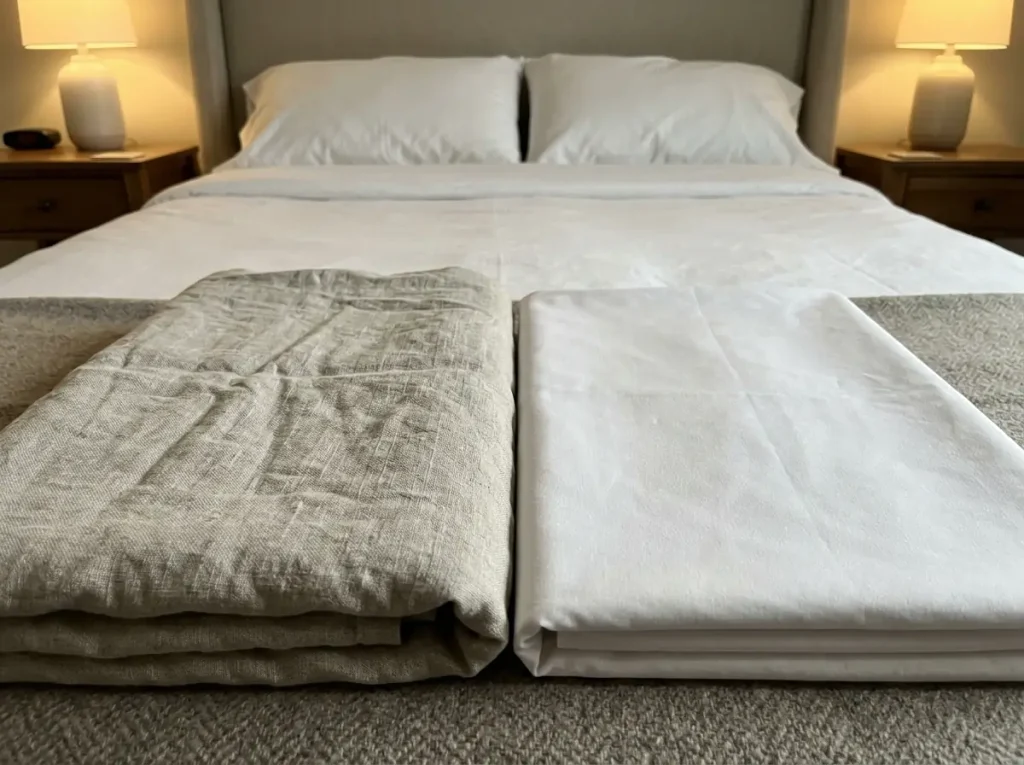
Why low stretch means a slow loom
Cotton fiber has a little give in it, and wool has a great deal. Flax has almost none. That matters at the loom because weaving is a violent process: the warp threads are held under tension and yanked apart hundreds of times a minute while the weft shoots between them. A fiber with some elasticity absorbs that.
A fiber without any transmits every shock straight to the point where the yarn is weakest, and then the yarn breaks and the machine stops.
So loom speed is set by the fiber, not by the mill. A linen loom runs at roughly 180 to 220 picks per minute, against a cotton loom that can run several times faster, because a low-stretch fiber gives an inelastic yarn that will not survive being driven any harder.
Fiber strength is not the problem: flax is stronger than cotton. It simply has nowhere to give.
Fewer meters of fabric come off the same machine in the same hour, and the machine and the operator cost the same either way. That is a real per-unit cost, and it is not a decision any mill made or could reverse. You cannot buy your way out of a fiber’s elasticity.
The same stiffness costs time before the loom, too. Flax yarn has to be spun with more moisture in it than cotton does, because damp fiber is more pliable and breaks less, so wet spinning is standard for the finer counts and it is slower and more equipment-heavy than spinning cotton dry. Then the warp has to be sized and handled gently on the way in. Every stage inherits the same constraint, and each one adds a little more cost that never appears as a line item anywhere the shopper can see it.
This is what “labor-intensive” actually means, and it is worth being precise because the phrase gets used as a shrug. It does not mean somebody is hand-finishing your pillowcase. It means the whole production chain runs at a lower throughput than the cotton chain running beside it, from field to finished bolt, for physical reasons nobody chose.
Why 100 thread count on linen is not what it is on cotton
Now the useful part. Because flax yarn is thicker and less flexible, a linen sheet commonly runs 80 to 150 thread count. On a cotton label that number would be a warning. On linen it is simply what a real single-ply flax yarn width produces when you weave it properly.
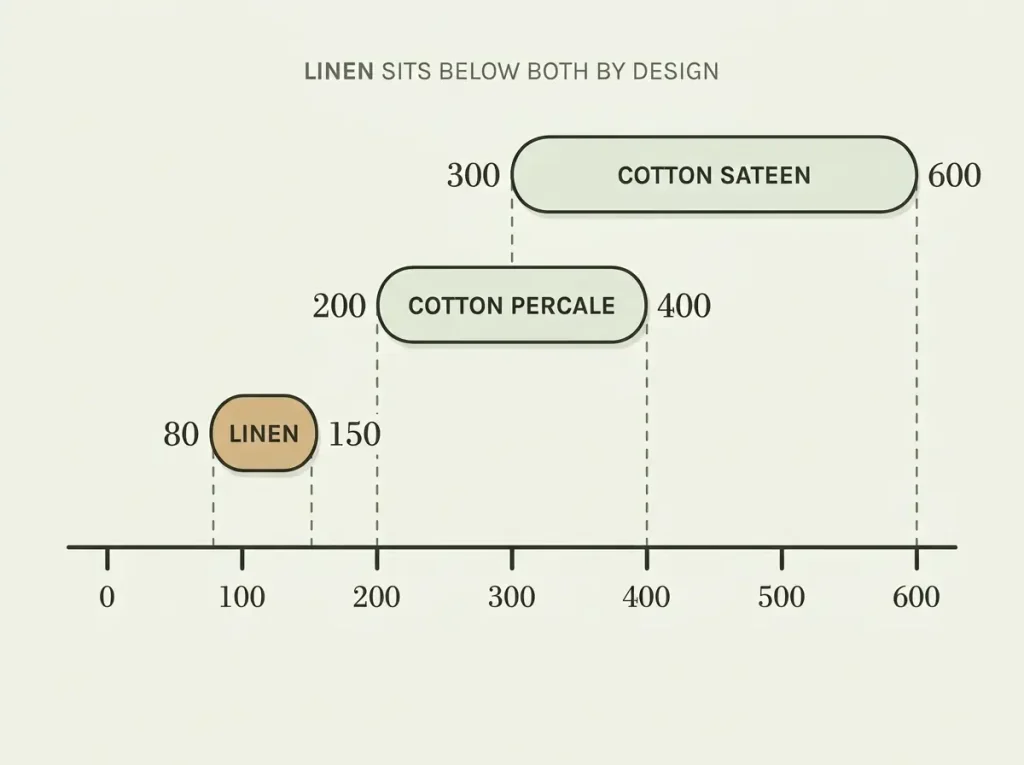
Anyone who learned to shop in the cotton aisle walks into linen carrying instincts built on a different fiber. Those instincts are correct for cotton and wrong here. A 400-count linen would not be a better sheet; it would be a sheet woven from yarn spun so fine that the fiber’s own stiffness fights it, which is why almost nobody makes one. The count is low because the yarn is thick, and the yarn is thick because that is where flax performs.
The slow loom leaves its signature in the cloth, too. Yarn thickness varies slightly along its own length in a way that machine-spun cotton mostly does not, and those variations show up as the faint slubs and irregularity you can see in good linen held up to a window. A linen sheet is never going to look as uniform as a percale. It is not supposed to.
Which sets up the one trap worth naming here. A linen listing that advertises a high thread count is telling on itself, because there are only two ways to get one: spin the flax unusually fine, which fights the fiber and produces a weaker sheet, or blend cotton in and count that. Neither is what you came for. The usual advice about reading thread count is not wrong; it is just written for a different fiber, and carried across to linen it points you at exactly the sets you should skip.
The number to read instead
If thread count is not the lever, something has to be, and the something is weight: grams per square meter. GSM tells you how much fiber is actually in the fabric, which is the thing you are buying, and it works the same way on any weave. It is also the number the category is quietest about.
That quietness is the point of the next section. Thread count survives on linen labels because it is familiar and reassuring and says nothing, in a category where what the weave decides that the fiber does not already gets underexplained. Weight is harder to spin. A number is a number.
Where the honest cost floor ends, by GSM
Everything so far explains a price genuinely higher than cotton’s. It does not explain the whole spread between two sets on the same shelf where one costs three times the other and both say the same word on the front. The tag on the expensive one usually has something to say about a family farm.
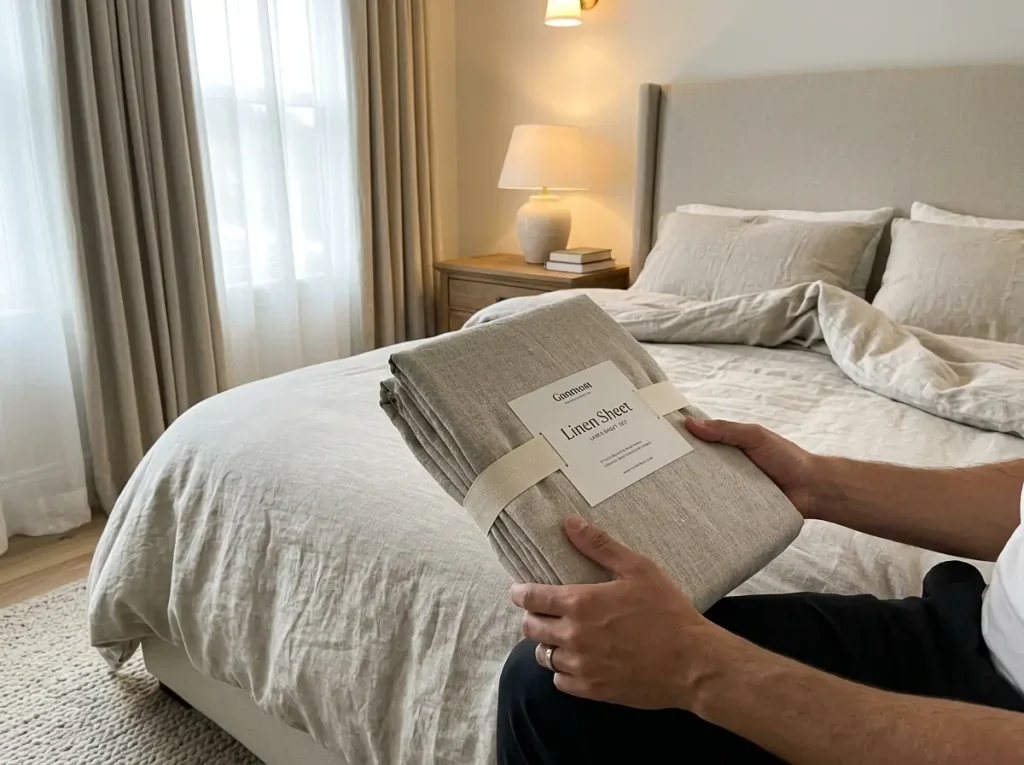
Neither tag tends to mention the weight. That silence is the tell.
What GSM measures, and why it survives washing when thread count does not
GSM is exactly what it sounds like: how many grams a square meter of the fabric weighs. It is a direct measure of how much flax is in front of you, and it cannot be gamed the way a count can. Thread count is a count of threads, so twisting two thin plies together and counting both inflates it without adding anything; weight has no equivalent trick, because a thin sheet weighs what a thin sheet weighs.
It also holds up over time in a way surface impressions do not. A new linen set often arrives with a finish or a wash on it that changes how the first few nights feel, and by wash five that is gone and only the fabric is left. The GSM does not change. Whatever weight you bought is the weight you will still have in year three, which makes it the only spec on the package that is describing the sheet rather than describing its first week.
The weight bands, and what each one is actually for
Broadly: under about 140 GSM is a light summer linen, thin enough to see the mattress through when it is on the bed and best treated as a warm-weather sheet rather than a year-round one. The 150 to 170 band is where most mid-priced sets live. Around 160 GSM gets described in the trade as the year-round sweet spot, and the pillar on this site set 180 GSM as the point where a set earns its price. Above 200 you are into heavyweight territory, which drapes in deep folds and takes longer to dry.
Those same bands do more than sort a price. The same weight bands decide how linen behaves in a cold room, because weight is what determines how much still air the fabric holds against you, which is what warmth actually is.
The bands also show themselves before the label does. Take two sets off the line and the heavier one falls in fewer, deeper folds that hold their shape; the thin one hangs closer to the outline of a bedsheet on a rack. Once you have seen the difference you can spot it across a room, and it is the reason people who have owned both stop reading the front of the package.
The set that declares its number, and the set that does not
Here is the two-tier market, stated as a pattern rather than an accusation. There are sets priced like linen that are genuinely mid-weight European flax, and there are sets priced like linen that are thin and coasting on the reputation of the word. From the front of the package they look the same, they cost roughly the same, and the difference between them is a number that one of them prints and the other does not. A set at a linen-typical price that will not tell you its weight anywhere on the listing is asking to be trusted on the word alone.
So the first thing to look for is not the origin story. It is whether the number is there at all. The DAPU 100% French Linen Sheets are useful here precisely because they print it: 170 GSM stated on the listing, French flax, sitting well below the heavyweight tier in price. That puts them right at the honest-but-thin edge this section is describing, and it is worth being clear about the limit of what the declaration proves.
The listing declares the GSM but carries no Masters of Linen certification, so the fiber can be French and the sheet can still have been woven in China, and the Amazon page gives you no way to check. Sourcing origin and manufacturing origin are two different label claims, and only one of them is usually printed. The number tells you what the fabric is. It says nothing about where it was made.
If the product page does not print a GSM, search the brand’s own site for the same set before you decide it is hiding something. Marketplace listings get truncated by the retailer, and plenty of brands publish the weight on their spec tab and lose it in the Amazon copy. If it is missing in both places, that is a real answer.
What the certification buys, and what it does not
GSM answers what the fabric is. It says nothing about where it was made, and that is the other half of what an expensive tag is charging for. Sometimes honestly.
European Flax and Masters of Linen are not the same claim
These two get treated as interchangeable and they are not remotely the same promise. European Flax certifies the fiber’s origin: the plant was grown and scutched in that three-country band. That is where its scope ends. Then there is the Masters of Linen certification, which audits every step from fiber to fabric, which goes further and requires spinning, weaving and knitting to happen inside the EU, the UK or Switzerland as well, with an independent body auditing it every year.
One certifies a plant. The other certifies a supply chain. And the gap between the two is exactly where brand markup lives, because a set can carry the first claim truthfully while everything after the harvest happened four thousand miles away.
The two even print differently once you know to look. European Flax turns up as a fiber claim inside the material description, next to the composition. Masters of Linen turns up as a mill claim near the manufacturer, because it is a statement about the mill. Where the logo sits on the package usually tells you which one you are being sold before you have read a word of it.
What “French Linen” legally permits
Follow that through and the label language stops being reassuring. A brand can buy French flax, ship the fiber out for spinning, weaving, dyeing and sewing, bring the finished sheets back, and call the result French Linen with nothing untrue on the package. The word is honest about the plant and silent about the manufacturing. A linen retailer’s own published brand comparison names several direct-to-consumer names doing exactly this.
I want to be careful here, because “made elsewhere” is not automatically “made badly” and this is where the internet usually overshoots. There are excellent mills outside Europe and there is mediocre linen woven inside it, sold as Belgian linen on the strength of the word alone. The problem is not the geography. The problem is that you are being charged the European price for a European claim that only covers the first stage, and you have no way to know which mill did the rest.
That is the mechanism behind a complaint that keeps recurring in r/Bedding, where a thread about never buying from Pottery Barn, West Elm or Williams Sonoma again drew 351 votes and 248 comments from people who paid the origin-story price and got an undisclosed-manufacturing product. One of the most detailed replies in that community points people toward Eastern European sellers on Etsy instead, naming Magic Linen and Lenok, on the grounds that it is the same fiber story without the brand layer on top. Same flax, fewer intermediaries.
What the audit costs, and why that is in your price
The honest part of a certified set’s premium is that proving a claim is not free. Masters of Linen certification costs the mill membership dues plus a yearly independent audit fee, per the body’s own published FAQ. Set against a mill’s turnover it is a modest line item, but it is a real, recurring, verifiable expense that exists only because somebody chose to be checked. An uncertified mill making equivalent fabric does not carry it.
Which is why the right order at the shelf is weight first, certification second, origin story last. The weight tells you what you are getting. The certification tells you how much of the claim has been checked and by whom. The story on the back of the package tells you what the marketing department decided to write.
The Sijo Stone Washed Organic French Linen sits at the other end of that scale from a set that says linen and verifies nothing: GOTS certified with declared French flax sourcing, which is paperwork somebody paid for and an auditor looked at. And it still does not print its GSM, which is the same labeling gap this article flags, on a set that got the rest of its documentation right. Stock on it also runs thin. The stonewashing on it is worth understanding separately, because what stonewashing actually changes about the fabric is mechanical rather than cosmetic and it affects how the set ages.
Email the brand one question before you buy at the top of the range: where was this woven? A brand with a certified European chain answers in a sentence because it is their selling point. A brand that sources European flax and weaves elsewhere either goes vague or answers about the fiber instead of the weaving, and the shape of the non-answer is the answer.
What This Actually Comes Down To
Roughly half the price is agricultural and it does not move. A low-yield crop from three countries, 15 to 25 percent of the stalk turning into usable fiber, and three slow judgment-dependent stages before a thread exists. Nobody can optimize that away, and the sets that cost more than cotton for that reason are not overcharging you.
The other half is mechanical. Flax has no stretch, so the loom runs at 180 to 220 picks a minute and produces less fabric per hour than a cotton loom on the same floor. That is also why a low thread count on a linen tag is normal rather than a warning, and why the number you were trained to read in the cotton aisle is the wrong tool here.
Past that floor, the thing that separates the honest tier from the story-priced one is GSM. A set at a linen price that will not print its weight is charging you for the word, and the fastest way to sort a shelf is to ask which sets are willing to tell you what they weigh.
After a season of washes, look at the folds rather than the surface. A well-made linen softens and keeps its body, falling in the same deep folds it did when it was new. A thin one starts hanging limp at the hem and going faintly translucent where it takes the most wear, usually at the foot of the bed and along the fitted sheet’s top edge. That is the check, and it is the one that decides the only number that matters in the end.
Lifespan is what converts a high sticker price into a low one: owners on r/Bedding report five years and more out of a properly cared-for heavyweight set, which puts the cost per year well under what a percale replaced every two to four years works out to, and the price per wash somewhere neither number captures. It is worth pairing with how the cost-per-year math actually works out over the full life of a set.
Before buying anything, go and look at what you already own. Find the weight on the packaging or the product page of the linen you have, or the linen you are about to buy. If the number is not there, that is the answer to the question you came with, and it cost you nothing to get it.
And if what you actually wanted from linen was the crispness and the cool rather than the texture and the story, a fully specced percale like the Feather & Stitch 300 thread count cotton set, single-ply with a 16-inch pocket, does that job at a fraction of the cost, though it has none of linen’s character or drape, so this is a comparison of reasons to buy rather than a swap for the texture.
Frequently Asked Questions
01What are the disadvantages of linen sheets?
They wrinkle permanently, they cost more per set, and they feel coarse for the first several washes. None of that changes with price, because it is what the fiber is. The trade you get for it is durability and a fabric that improves rather than degrades.
02Are linen sheets really worth the money?
Above roughly 180 GSM, usually. A well-made set that lasts seven years spreads its cost thin against a percale replaced every two to four. Below that weight you are paying linen prices for a fabric that will not last like linen.
03Is 100% cotton better than linen?
For crispness out of the package and a lower price, yes. For durability and a texture that improves with washing, no. Percale gets you cotton’s best version of what linen does on night one, and linen wins by year five.
04What sheets do wealthy people use?
Mostly heavyweight European linen and high-grade long-staple cotton percale, which are the same two fabrics available for far less without the brand name on them. The weight and the weave are what is actually being bought.
05Why is linen so expensive if flax is easy to grow?
Flax grows easily; usable fiber does not come out of it easily. Only 15 to 25 percent of the stalk is long-line fiber, extraction takes three slow stages, and the fiber’s low stretch forces the loom to run slow.




Tried it on your own bed?
No comments yet. Tell us what you changed, and what the sheet did after a few washes.