







What’s in here7 sections
- What Linen Actually Does, and Why That Doesn’t Change in Winter
- The Number Nobody Prints — What Weight Linen Has To Be
- The Duvet Does the Trapping — Linen Just Holds the Pocket
- When Linen Is the Wrong Call — and What Goes On Instead
- What a Much-Washed Linen Set Does Differently in Winter
- The Short Version
- Frequently Asked Questions
Somebody told you linen works all year, so you left it on the bed through November, and one night you got in and it was cool and it stayed cool. The advice was not wrong.
It was just missing the second half. Linen is a loose, open weave of a fiber that moves moisture away from you instead of holding it against your skin, and that does not stop being true in January. What changes in January is what sits on top of it.
So here is the whole answer for linen in winter: the weight that actually decides it, the layer that does the trapping, the point where linen becomes the wrong sheet, and what a much-washed set does differently once the cold arrives.
Quick Answer
Yes, linen works in winter, but only as part of a system: a real duvet on top and roughly 170 GSM or more underneath. Linen handles moisture and airflow; it does not insulate on its own. In a genuinely cold, under-heated room it is the wrong sheet, and flannel is the honest swap.
What Linen Actually Does, and Why That Doesn’t Change in Winter
Flax is a hollow fiber with a moisture regain of around 12 percent, against cotton’s 8.5 percent, which means moisture absorption happens inside the fiber itself before anything feels damp against your skin. That is not a seasonal property. Research into moisture-vapor permeability and thermal comfort in natural fibers puts numbers on what the fabric is doing, and the numbers do not know what month it is. The reason linen keeps you comfortable in July and the reason it keeps you comfortable in January are the same reason.
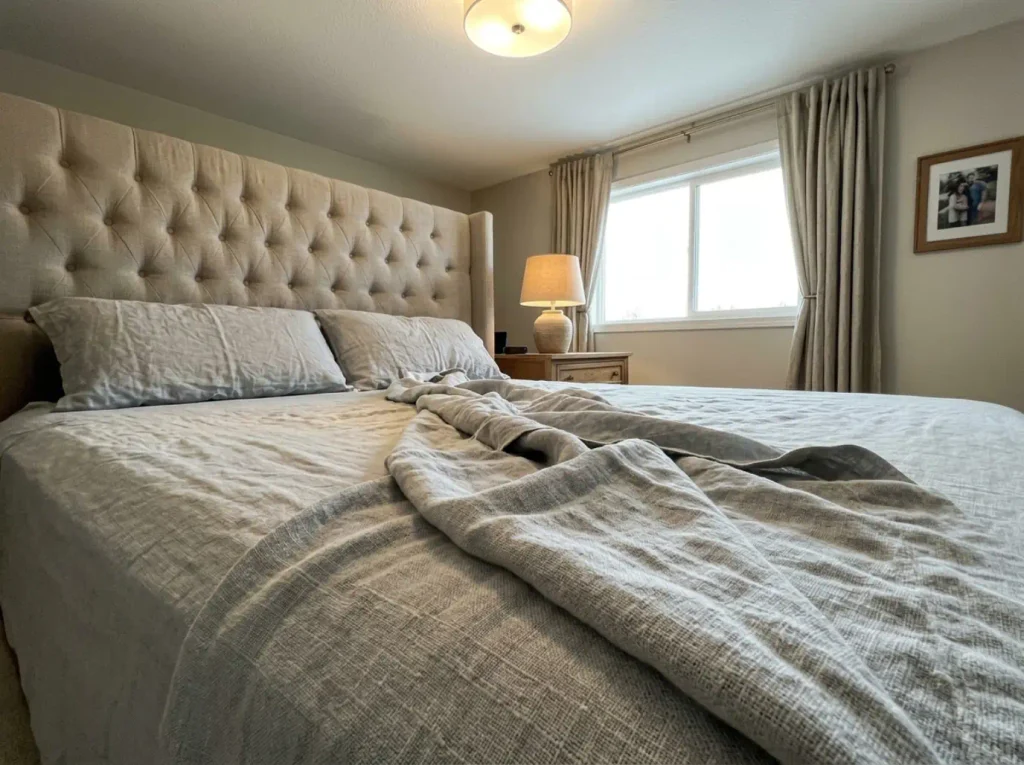
Where it gets confusing is the first touch. Flax conducts heat away faster than cotton does, measurably faster in lab conditions, so bare linen feels cool on contact in a way percale does not. That is a sensation, not a temperature reading of your night. And the loose weave that people call breathable is holding something specific: a pocket of still air, which is genuine insulation, as long as something above it keeps that air from being carried off.
The community framing you see everywhere is that the more breathable a fabric is, the warmer it sleeps. That is close, but the emphasis is backwards.
Breathability keeps you dry, and dry is what keeps you warm. What gets sold as thermoregulation is really just this: a moisture-wicking fiber moving vapor out before it can condense and chill you. Linen prevents the clammy-then-cold cycle that ruins a winter night; it does not make heat.
The First-Touch Problem
The coldest linen ever feels is in the first ninety seconds, before the warm air pocket has built up around you. Heat retention in a bed is mostly this pocket, and it takes a minute and a half to form.
That is the moment most people form their opinion of the whole set, and it is the moment they decide linen is a summer fabric and go looking for flannel that same week. The verdict gets delivered before the bed has reached steady state. If you want the full material-science version of why the fiber holds heat better than its reputation suggests, the deep dive on why flax holds heat better than its reputation suggests is a separate article on purpose, because this one is about whether the set stays on the bed in December.
The Number Nobody Prints — What Weight Linen Has To Be
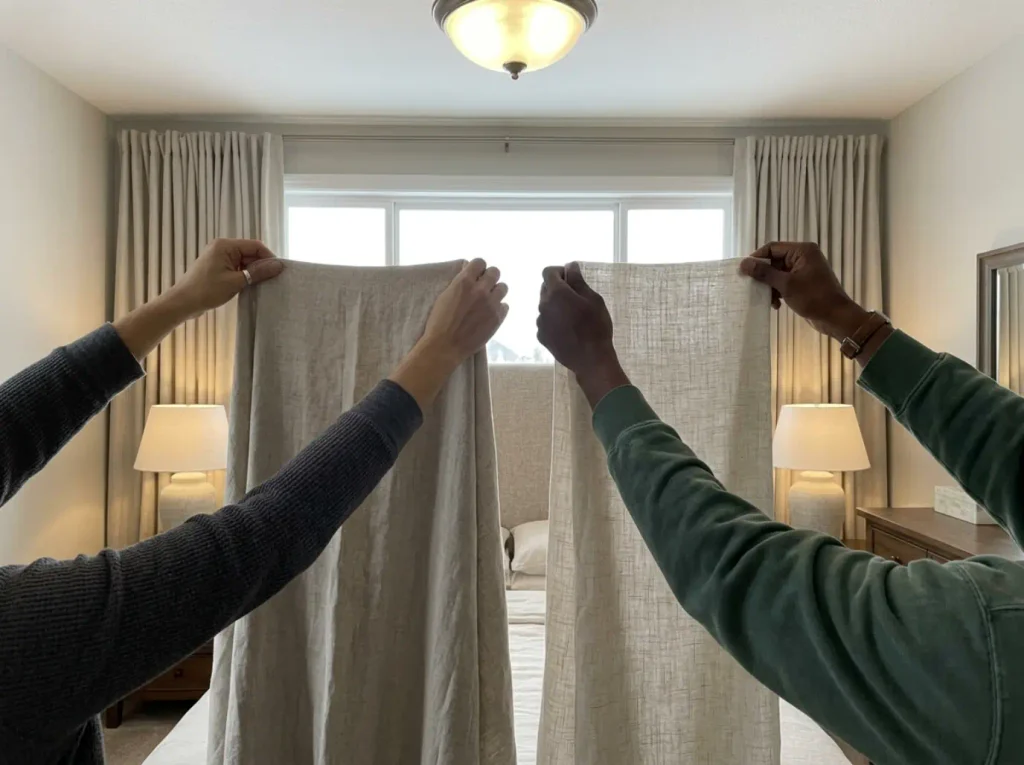
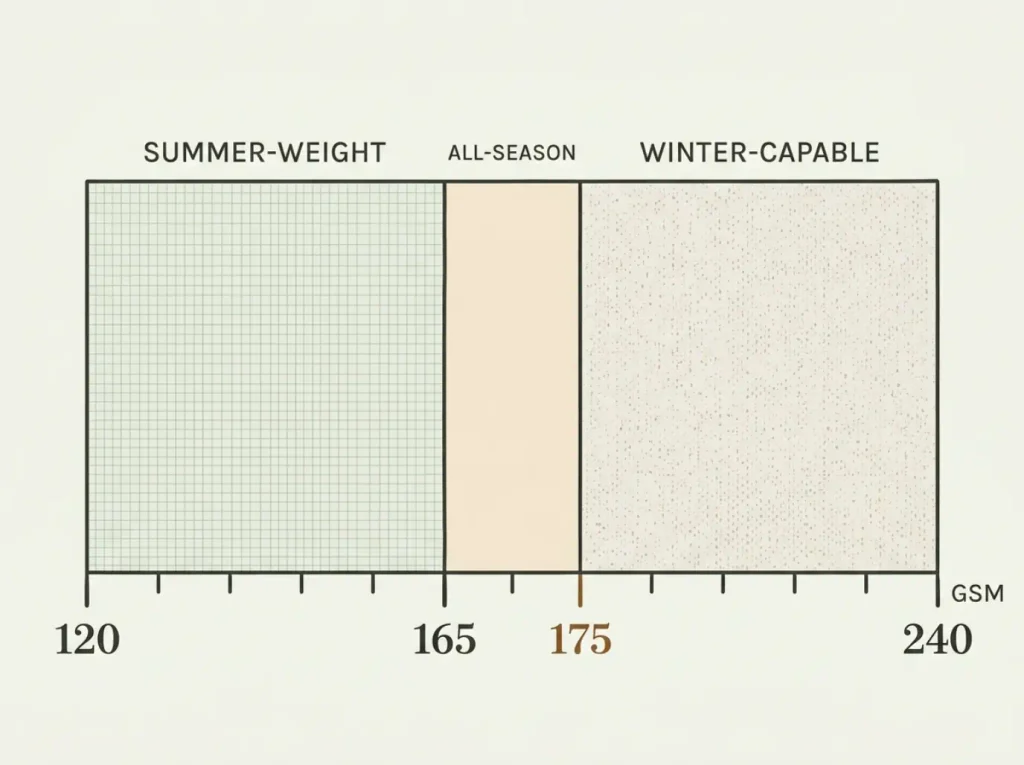
Before anything else: seasonal bedding is a weight problem before it is a fabric one. Every guide tells you to get good linen. None of them tell you what good weighs. Winter-capable linen clusters at 175 to 220 GSM. Below roughly 165 to 170 GSM you are holding a summer-weight sheet no matter what the listing copy promises about year-round comfort.
What GSM Measures, and Why Thread Count Doesn’t Help You Here
GSM is grams per square meter, what a mill would call the grammage of the cloth. It is the actual mass of fabric in a given area, and unlike thread count there is no way to inflate it: more grams means more flax, and that is the end of the argument. Thread count is a count of threads, which is why twisting two thin plies together and counting both has been standard practice for twenty years.
You cannot do that with weight. The scale does not care how the yarn was assembled.
When the Listing Doesn’t Print a Number
Plenty of listings simply do not give you the GSM. That absence is information in itself. A mill that has hit a real winter weight tends to say so, because the flax cost more and the number is the argument for the price. Silence usually means the number would not help the sale.
There is a test that needs no listing at all, and you can run it tonight on the set you already own.
Shake the flat sheet out over the bed and watch how it lands. Do it with the fitted sheet too if you like, though the flat one reads more honestly. A summer-weight linen floats down. A 200 GSM one drops.
If a listing gives weight in ounces per square yard instead of GSM, multiply by 34 to get close enough. The 7.7 oz/sq yd set that keeps showing up in durability complaints works out to about 261, but that figure is per linear yard of a narrower fabric, not per square meter of finished sheeting, which is exactly the kind of unit swap that makes two listings look comparable when they are not. If the seller will not give you GSM, ask.
If you want a set where the number is on the label rather than in a support email, the DAPU 100% French Linen Sheets declare 170 GSM in French flax, which is exactly the behavior this section is asking you to demand from a seller. Its flaw is written into that same number: at 170 GSM it sits right on the threshold, so in a genuinely cold room this set alone will not do it. It needs the duvet on top to do its job. It does not replace one.
“All-Season” Is a Tier, Not a Measurement
All-season linen is a marketing category. Nobody measures anything to earn the label, and in practice it lands at the bottom of the band, which is why the same set disappoints in January and is completely fine in April. The set did not change. The room did.
And the r/Bedding complaint about linen is worth reading correctly, because it is almost never about warmth. It is about durability: sets that “fell apart too fast,” one buyer’s lighter set tearing inside a year against a heavier Eastern-European set holding up past five years of daily use. Same fiber, opposite outcomes. The weight spec is what separated them, which means the number you are checking for winter performance is the same number that predicts whether the set survives to see a fourth winter.
The Duvet Does the Trapping — Linen Just Holds the Pocket
People swap the sheet when they are cold. The sheet is almost never the thing that is wrong. A sheet decides two things: whether you are dry, and how the bed feels against skin on the way in. Insulation is somebody else’s job, and it is measured in tog and fill power, not in anything printed on a sheet package.
Tog and Fill Power, in One Paragraph
Tog measures how well a duvet resists heat passing through it: higher tog, warmer bed, and it is a property of the whole finished duvet. Fill power measures how much space an ounce of down takes up when it lofts, so it is a measure of quality per unit of weight rather than of warmth itself: a high fill power gets you the same warmth in a lighter, less stifling duvet. A 13.5 tog duvet at 700 fill power and a 13.5 tog duvet at 400 both keep you equally warm. One of them just weighs less doing it.
The Two-Duvet Clip, and Why It Beats a Second Sheet Set
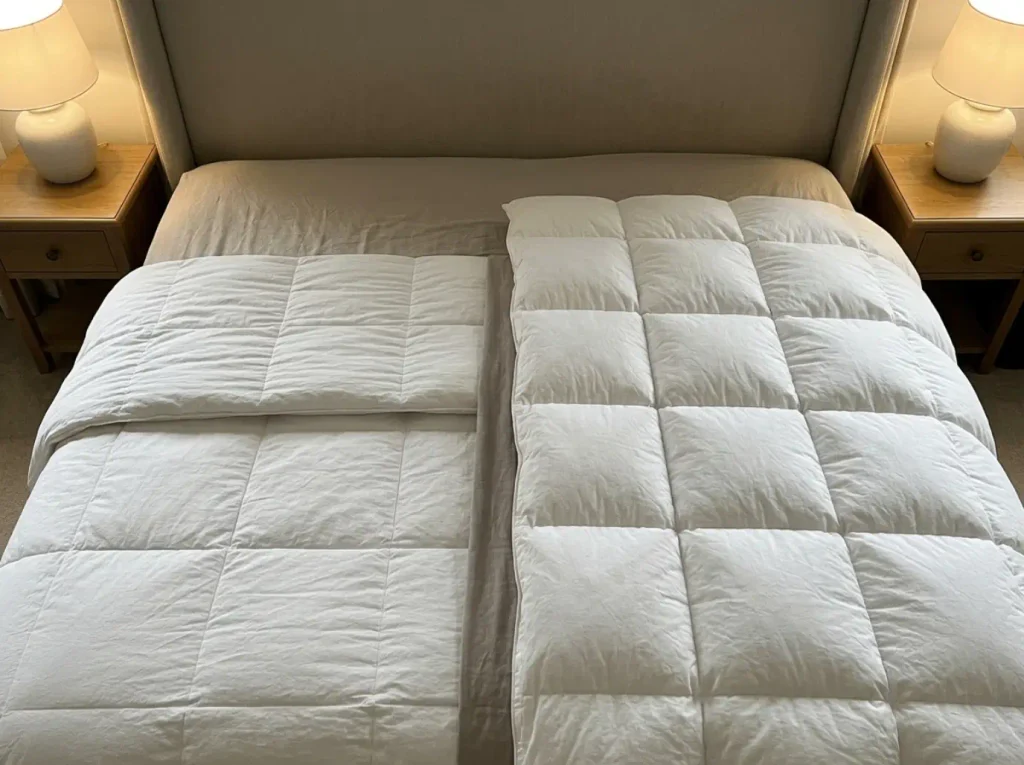
Here is the free version, and it is the one to try before you spend anything. A summer duvet insert at around 4.5 tog clipped to a mid-weight one at around 9 tog gives you 13.5 tog for winter, and in spring you unclip and put one away. If you already own two duvets, you already own your winter system.
The linen sheet never comes off the bed at all, because it was never the variable. That is cheaper than a second heavier sheet set, and it is what makes year-round linen a real option rather than a marketing line: the seasonal rotation happens above the sheet, not to it. What you are adjusting is the sleep temperature under the covers, not the room temperature outside them. Winter bedding and summer bedding stop being two different beds and become one bed with a different top layer.
If you do not have a second duvet to clip, the layer worth buying is the one that actually traps heat, not another sheet: the Cuddledown Dreamstead Down Alternative Comforter is all-season construction under a 235-thread cotton percale shell, with a synthetic fill around 500 fill power equivalent, so it washes at home and does not bother anyone with a down allergy. Its flaw is the fill: synthetic does not give you the same collapse-around-you feeling as real down, and if you have slept under good down before, this will read as flatter and less lofty over time.
Where you are cold tells you what is failing. Cold across the shoulders and the top of the chest is the duvet losing air at the neck opening, so tuck it behind your shoulders rather than letting it lie flat across them.
Cold underneath, along your back and legs, is the mattress and what is between you and it. A linen sheet is almost never the cause of either one.
Which is why “should I put my linen away for winter?” is usually the wrong question asked with real urgency. If you want the whole stack rather than just the top of it, here is the full winter build, in the order it goes on.
When Linen Is the Wrong Call — and What Goes On Instead
Every article on this subject is written by somebody who sells linen, so every one of them concludes that you should keep your linen. Sometimes you should not.
The Cold-Room Threshold
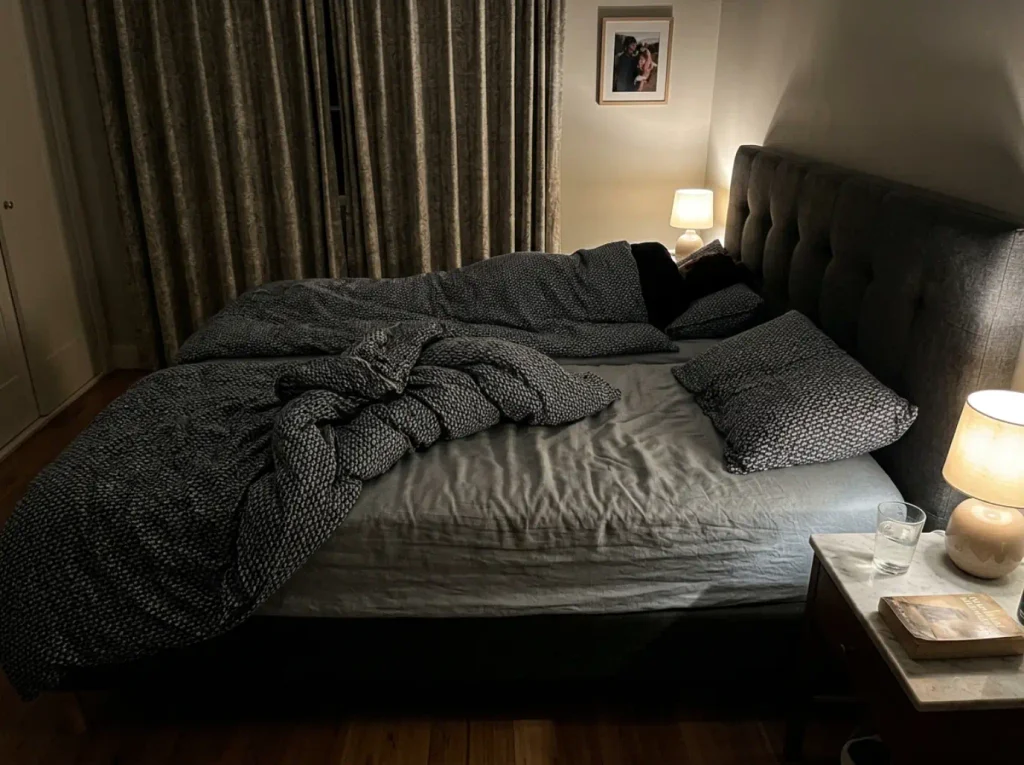
The room where linen stops being the right sheet is the genuinely cold bedroom, the under-heated one that never really warms up overnight, where you are managing cold rather than just sleeping through it. Linen does not fail there. It does exactly what it always does: it stays neutral and it keeps you dry.
But in that room, neutral is not what you want at the point of contact. You want a sheet that is actively adding warmth against your skin, and linen has never claimed to do that.
I will not give you a temperature number, because nobody has measured one and inventing one would just make this paragraph sound more confident than it deserves to. You already know whether your bedroom is that room.
The Free Fixes, Before You Change Anything
Four things to try before you buy a single item, in this order.
First, add a layer you already own on top, a blanket or a quilted bed cover or the spare duvet, because that is the variable and it costs nothing. Second, check the duvet’s neck opening, which is where most of the heat that you think is escaping through the sheet is actually escaping. Third, move the bed off the exterior wall if it is against one. Fourth, close the curtains before the room cools rather than after, which sounds like folk advice and is just thermal mass working the way thermal mass works.
If the added layer turns out to be the fix and you want a good one rather than whatever was in the closet, the Desert Breeze Alpaca & Sheep Wool Blanket is a 50/50 blend of alpaca and Peruvian sheep wool woven in Peru, and it does the trapping a duvet alone cannot in a cold room while staying a natural fiber that keeps moving moisture instead of sealing it in. Its flaw is bulk: it weighs and takes up noticeably more space than a synthetic blanket of equivalent warmth, so it is not the choice if you want something light to store or something you can throw in the machine without thinking about it.
What Goes On Instead
Flannel is the honest swap, and it is worth being precise about why, because it is not a general upgrade. Brushed cotton has a raised nap that traps air right at skin level. That is the one thing a cold room actually asks for and the one thing linen’s open weave is not built to do. The two fabrics are solving different problems, and in a cold room the flannel problem is the one you have.
A r/Bedding thread asking what to buy for extreme cold gets flannel and fleece plus heavy blankets as its top answer, and linen does not appear in the recommendation at all. The community found this threshold before anyone named it.
For the swap itself, the Pointehaven 180 GSM Flannel Sheet Set is 100 percent cotton, double-brushed, at a real winter weight rather than the thin flannel that shows up in a discount bin every October. Its flaw is how it ages: flannel pills with washing and gradually loses part of its brushed nap, which is the opposite of linen’s arc: linen improves in the wash and flannel spends down what it came with. There is a fuller treatment of when flannel is worth it and when it’s too much if you are on the fence.
And the swap is rarely the whole set. Most people who move to flannel for a cold spell keep the linen duvet cover on and change only the sheets, which makes sense: the cover is not touching you, so its fiber barely matters, and it is the piece that is genuinely annoying to change.
One Warm Sleeper, One Cold, One Bed
The shared bed is where this gets awkward. Two people, one sheet, opposite needs, and the sheet cannot be two things at once. That is not a limitation of linen, it is arithmetic, and it applies to any sheet you put down there. So stop treating the sheet as the variable.
Leave the linen underneath both of you, where it is doing the same neutral, moisture-moving job for each of you, and split the layer on top: one duvet clipped together for the cold sleeper, one layer unclipped for the warm one. If one of you runs hot year-round that is a different problem with a different answer, and it starts with the fiber rather than the layering. The clip system is not a preference here. It is the only mechanism available, because it is the only part of the bed that can be two different things at the same time.
Worth knowing that the warm half of that bed is a different article, because the partner who runs warm has a different problem, and it is not solved by taking layers off the cold one.
What a Much-Washed Linen Set Does Differently in Winter
Week one lies about almost every fabric. Linen is the rare one where week one lies in the other direction: you wash a new set expecting it to come out like the listing photo and it comes out stiffer and more wrinkled than it went in.
Why It Softens — Pectin, Not a Finish
Linen genuinely improves with washing, and the mechanism is chemical rather than promotional. Pectin is a natural binder that makes up somewhere between 1 and 5 percent of the flax fiber and holds it stiff, and it dissolves progressively in the wash. The fiber itself does not break down or thin. It stays structurally intact while the thing gluing it rigid washes away.
That is why the softening is permanent and why it does not behave like a resin finish on a percale, which feels wonderful in the shop and is gone by wash ten, taking the crispness with it.
Drape Gain Against Weave Opening
For winter specifically this cuts both ways, and nobody separates the two halves. A broken-in set drapes better, so it follows you and closes the air gaps at the shoulder and the hip, which is warmer. But heavy washing also opens the weave a little, so a very old set holds its air pocket slightly less tightly than it did new.
The net verdict is that a well-made set at five to ten years is not a worse winter performer than a new one; the drape gain roughly offsets the weave opening. What decides it is still the weight it started at, which is the same answer as three sections ago. There is more on how long linen sheets actually last if the durability question is the one actually keeping you up.
The community’s care answer is the same everywhere it gets asked, and the highest-engagement care thread in r/Bedding lands exactly where every other one does: cold wash, gentle cycle, air dry, and skip the dryer or keep it on the lowest setting it has. Pilling on a new set is reported as normal and as something that diminishes with washing rather than accumulating. That is the opposite of how flannel ages, which is why the two fabrics reward opposite amounts of patience.
Air-dry linen to just short of dry and put it on the bed damp. It finishes drying in place, the deep wrinkles set flat instead of sharp, and the weave closes back up the way it does not when a hot dryer beats it open. It is also the one step that keeps an older set performing closer to how it did in year two.
What To Actually Check on a Three-Year-Old Set
The honest test on an old set is drape, not hand feel.
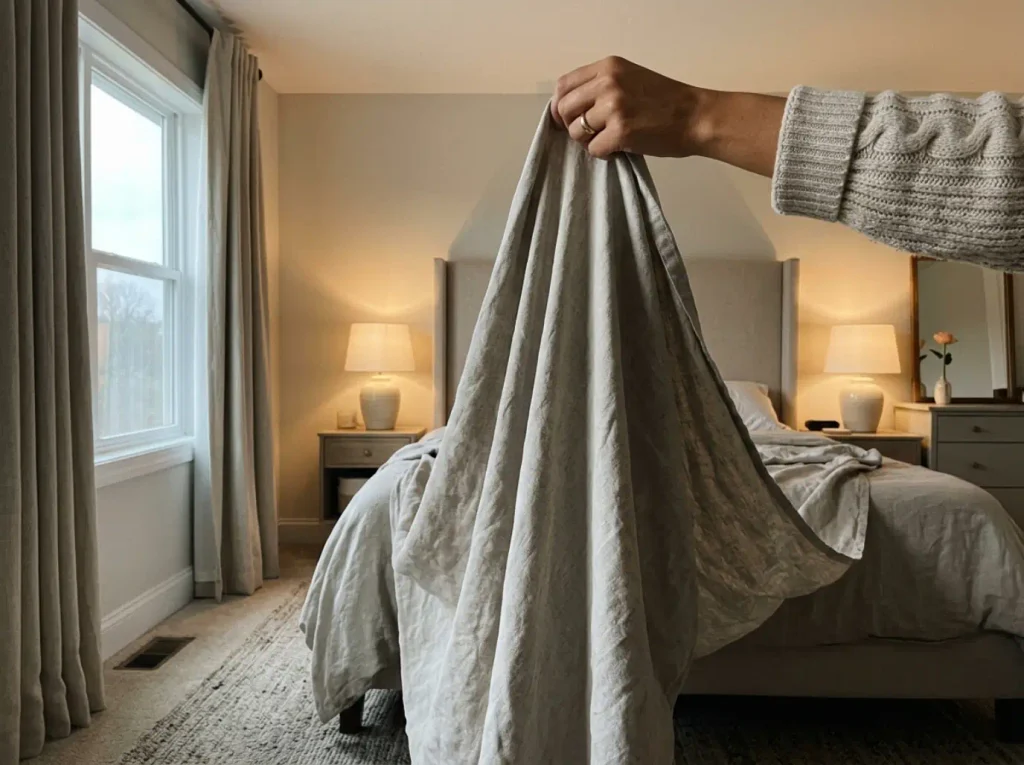
Pick the flat sheet up by one corner and watch what the rest of it does. A broken-in winter-weight linen falls into deep, heavy folds close to the vertical; a set that has thinned out too far spreads and lifts instead. Old linen feels lovely to the hand either way, which is precisely why the hand is a bad judge of it. And if you are now wondering whether one set can carry the whole year, that is a real question with a real answer: how many sets you actually need to rotate.
The Short Version
Check the weight before you change the sheet. At 175 GSM and up, linen stays on the bed through winter; under about 165 it is a summer sheet whatever the listing calls it, and no amount of layering fully fixes a sheet that was never made for the season.
If you are cold, look up, not down. The duvet does the trapping and the sheet holds the pocket, so clip a second duvet to the first before you buy anything at all. Most people who think they need new sheets need one more tog.
In a genuinely cold room, linen is the wrong sheet and flannel is the honest swap. Even then you usually keep the linen duvet cover, because it is not touching you and it is the annoying piece to change.
After a season of washes, pick the flat sheet up by one corner. If it still falls in heavy vertical folds it is doing its winter job. If it spreads and lifts, the weave has opened past the point where better drape can compensate, and the set has become a summer sheet by attrition.
Before you buy anything at all, go find the GSM on the set you already own. If it is not printed anywhere, shake the flat sheet out and watch how it lands. That answers it tonight, for free. And when the weather turns the other way, what comes off the bed when the weather turns is the same decision run backwards.
Frequently Asked Questions
01Are linen sheets warm enough for winter on their own?
No, and neither is any other sheet. Linen holds a pocket of still air, but a duvet has to trap it. At 175 GSM and up under a proper duvet, linen is a full winter sheet.
02What GSM should linen sheets be for winter?
Look for 175 to 220 GSM. Below roughly 165 to 170 GSM you have a summer-weight sheet, whatever the listing calls it. Many sellers do not print the number at all, which tells you something on its own.
03Why do my linen sheets feel cold when I get into bed?
Flax conducts heat away faster than cotton, so bare linen feels cool on contact. That is the first ninety seconds, not the night. The air pocket warms and the sensation goes.
04Should I swap linen for flannel in winter?
Only if the room itself stays cold overnight. Flannel’s brushed nap adds warmth right at skin level, which linen does not do. Most people who swap keep the linen duvet cover on and change only the sheets.
05Do old linen sheets still work in winter?
Yes. Washing dissolves the pectin that stiffens flax, so an aged set drapes better and closes air gaps at the shoulder and hip. A well-made set at five to ten years is not a worse winter performer.




Tried it on your own bed?
No comments yet. Tell us what you changed, and what the sheet did after a few washes.