







What’s in here6 sections
You have two tabs open and two sheet sets in them. One listing says microfiber, the other says polyester, they are a few dollars apart, and neither page explains what the difference buys you. So you scroll down to the fiber content label on the one that calls itself microfiber, and the tag says 100% polyester.
That is not a seller caught lying. Microfiber describes how thin the thread was spun, under one denier, finer than a single strand of silk. Polyester describes what that thread is made of, and one set can honestly wear both words at once. Here is what the tag is legally required to say, what actually separates a good synthetic sheet from a bad one, and what to look for when a listing hands you one word and nothing else.
Quick Answer
Microfiber is not a different fabric from polyester. It is polyester, occasionally nylon, spun finer than one denier. A sheet set can be labeled 100% polyester on the sewn-in tag and sold as microfiber on the package, both truthfully. The real comparison is fine polyester against coarse polyester, and neither word tells you which you are getting.
Microfiber Is a Thread Thickness, Not a Fabric
The two words are not opposites and never were. One names what the fiber is made of; the other names how finely it was spun, which is why a single sheet set can carry both without either claim being false. The contradiction you think you caught on the tag is two labeling systems talking past each other.
What Denier Actually Measures
Denier is a weight, not a quality grade: grams per 9,000 meters of fiber. A lower number means a finer thread, so denier is a measure of fiber fineness and nothing else. The threshold that turns ordinary polyester into microfiber is one denier, and that is the textile industry’s own definition of microfiber, a fiber under 1 denier and not a separate material.
Silk sits at roughly one denier, so anything sold as microfiber is spun finer than silk. That fact does more marketing work than any other number in bedding, and it says nothing whatsoever about what the sheet is made of.
What it is made of is almost always polyester: polyethylene terephthalate, the same polymer as a water bottle, extruded and drawn into filament. Occasionally it is nylon, which the trade calls polyamide. Bedding microfiber is typically a bicomponent filament split down to sub-denier during finishing, which is a manufacturing route rather than a material.
There is no third substance hiding behind the word, and in particular there is no plant in it: viscose and lyocell are regenerated cellulose and belong to an entirely different family. Spun polyester, spun finer.
Why the Tag Says Polyester and the Box Says Microfiber
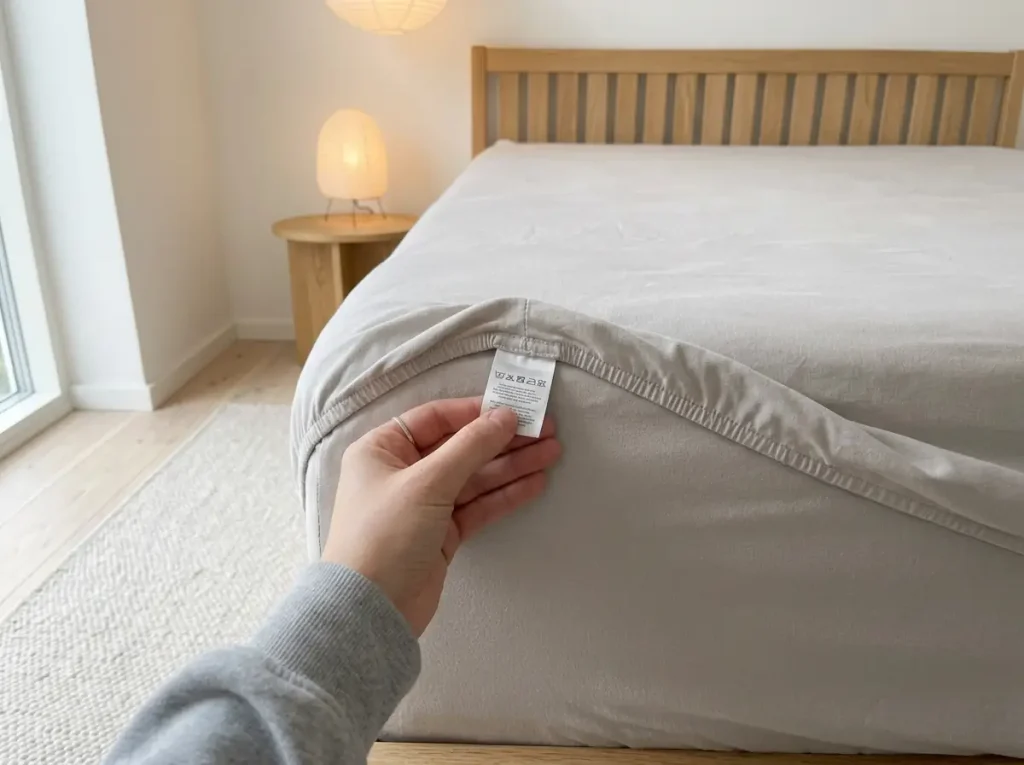
This is the part nobody in the search results puts up front, and it explains the whole confusion. Under the Textile Fiber Products Identification Act, the label has to name the actual fiber: the generic fiber name and its percentage by weight, in order of predominance, using only the names the rule recognizes. “Microfiber” is not one of those names. It cannot go on the fiber-content tag because it does not name a fiber; it names a fineness.
So the sewn-in tag says polyester because the FTC textile fiber rule makes it say polyester. The front of the package says microfiber because nothing stops it. A set can be double-brushed, sub-denier, premium-priced microfiber and still, legally, be 100% polyester on the only label that is regulated. Two sellers describing the identical cloth can pick different words and both be telling the truth.
The sewn-in tag is the only text on a sheet set that a regulation forced somebody to write. Everything else, the front of the package, the listing title, the bullet points, is written by whoever wanted to sell it. Read the tag first and the marketing second, in that order, and most of the confusion in this category dissolves before you have spent anything.
What This Means for the Two Tabs You Have Open
Read enough r/Bedding threads and the pattern is the same every time: people write about the two words as if they were choosing between rival materials, wanting to get away from “cheap polyester” and toward something better. But read what they actually complain about and it is never the fiber. It is thinness, it is pilling by month six, it is a set that felt fine in week one and looked tired by spring. The community has the right complaint and the wrong vocabulary, and the vocabulary was handed to them by the packaging.
The practical consequence is blunt. Two listings using the two different words tell you almost nothing about which one is better. They may be the same weight of the same fabric, brushed on the same machines, shipped from adjacent factories.
And a brushed microfiber and an unbrushed polyester of identical weight will feel like different fabrics in your hand while behaving identically in the wash, because the hand feel you are registering is a finishing step applied after the cloth already exists, not a property of the fiber inside it. If you want the fuller picture of what microfiber actually is, and what it does once it is on the bed, the pillar takes it apart in full. For the purposes of the two tabs, the denier fact is enough: you are not choosing between two materials.
What Actually Changes Between a Fine and a Coarse Polyester Sheet
If the word on the package is not the variable, something else has to be. It comes down to three things a listing will tell you only if you go looking: how much cloth is actually in the sheet, whether the surface was brushed, and how the threads cross. All three are decided in a factory long after anybody chose which word to print.

Worth saying before going further, because it undercuts the premise of the comparison: try to buy a bedding-grade polyester sheet set that is genuinely not microfiber and you will struggle. Search for one and the results come back microfiber almost without exception. The coarse-polyester side of this matchup has quietly gone extinct at retail, which means most of the time the choice in front of you is between two fine polyesters at different weights, wearing different words.
GSM Is the Number Worth Hunting For
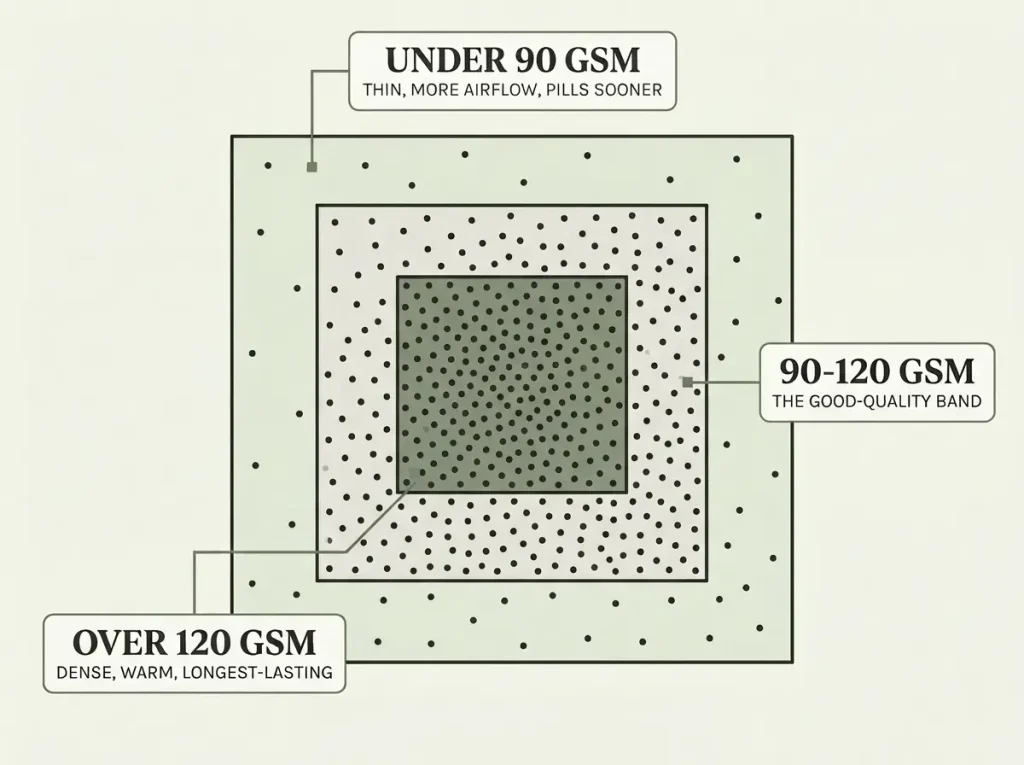
Grams per square meter: how much fiber is genuinely in the cloth. The Sleep Foundation names 90 to 120 GSM as the good-quality band for microfiber. Under 90 runs thin, and more air moves through it, which sounds like breathability until the set starts thinning at the corners.
Over 100 runs denser, warmer and lasts noticeably longer, with better tensile strength where the fitted sheet pulls hardest. That single figure predicts almost everything the two words on the front refuse to.
Here is the awkward part: the GSM number almost never appears on the fiber-content tag, because the tag is only required to carry fiber names and percentages. When a seller discloses GSM at all, it sits buried in the listing’s bulleted material description. And a seller who prices a set like a premium one while omitting the number has usually made a decision they would rather not print.
Brushing Is a Finish, Not a Fiber
Single-brushed and double-brushed describe a mechanical napping step: the woven cloth runs against rollers that raise a nap on one face or both. It is the single biggest driver of how a synthetic sheet feels in the hand, and it happens after the fabric exists. It also changes the drape, the way the cloth falls over the edge of the mattress: a brushed face hangs heavier and closer, an unbrushed one stands away. Which is why “microfiber” and “soft” are not synonyms, and why two sets with identical fiber content can feel a tier apart.
The Mellanni Iconic 4-Piece Sheet Set is this article’s own argument made concrete: its fiber content reads 100% polyester and its description reads double-brushed microfiber, on the same page, both true. It carries a 16-inch pocket, OEKO-TEX Standard 100 certification, and independent lab testing for abrasion, tear strength and pilling grade rather than adjectives, which is a rarer thing in this category than the marketing suggests. Its flaw is the one shared by everything in the category: it is still polyester with a smooth, dense face, so it holds warmth rather than moving air, and the brushing changes how it feels, not how it breathes.
Weave Still Runs the Show
Synthetic does not exempt a sheet from its weave. A sateen weave sits smoother and sleeps warmer because the floating threads close the surface; a percale weave, one thread over and one under, sits flatter and lets more air through the gaps. Exactly as in cotton, the weave decides more than the fiber does, and it is doing that work whether the package says microfiber or polyester.
There is outside evidence for this too. A 2024 washing-machine study found weave structure predicted microplastic shedding better than fiber type alone, with satin and plain-weave polyester blends shedding more than a tightly woven cotton twill. Construction, not the fiber name, drove the outcome.
And neither word is a cooling claim. Both are polyester, and the Sleep Foundation is direct about it: the tight weave that makes microfiber feel smooth is the same structure that stops air, and body heat, from moving through. Fine spinning does not make a fiber breathe. It makes it feel finer against skin, which people reliably mistake for the same thing.
Search the product page for the three letters GSM before you read a single bullet point. On a desktop that is Ctrl+F; on a phone it is the browser’s find-in-page. Five seconds, no purchase, and it sorts two listings faster than any amount of reading the descriptions will.
Where Each One Holds Up, and Why It Is Not the Word’s Doing
The comparison articles all land on the same two numbers, microfiber lasting two to three years and coarser polyester three to five, then quote them as if the fiber decided. The averages are real. The explanation attached to them is the last place the answer actually lives.
The Lifespan Numbers, Taken Apart
Most microfiber sold for beds is spun thin and low-GSM to hit a price point, because sub-denier fiber is what lets a manufacturer make a cloth feel acceptable while using less of it. Thin and low-GSM is what fails first. That is true at any denier, and it would be true of a coarse polyester built to the same weight. The two-to-three-year figure is a description of what the market mostly sells, not a property of fineness.
Where a fine surface genuinely does worse is friction. More filaments per square inch means more surface area, more contact points, and more of them being dragged against a slept-on side every night. That is the honest version of the claim the comparison articles make badly, and the mechanism itself belongs to the sibling article on what pills first on a microfiber set, and when, which takes it apart properly. The same pattern shows up on natural fiber, incidentally: sateen’s floating threads catch and pill before a percale’s do, for the identical reason, which is fairly good evidence that the surface, not the fiber name, sets the clock.
Where a Fine Polyester Genuinely Wins
Dimensional stability, and it is underrated. Synthetic filament resists tearing and shrinking better than cotton does, which is why a cheap microfiber set that has started to pill is still square on the mattress after fifty washes, while a cheap cotton one has crept off the corners and stopped reaching. Pilling is visible and annoying. Shrinkage is invisible until the morning the fitted sheet stops making it around the fourth corner, and then it is terminal.
At the top of the range, the MALOUF Double Brushed Microfiber Sheet Set is the same fiber as the cheapest set on the shelf, built heavier and brushed on both faces, which is exactly the proof that “microfiber” spans the entire quality range instead of naming a tier. Its flaw is logistical rather than textile: it ships on a two-to-three-day lead rather than straight out of a warehouse, so it is not the set to order the night the old one tears.
Heat, and What the Lab Actually Measures
Both are polyester. Neither is a cooling fabric, and saying so plainly is more useful than the hedging the search results do. Density and weave decide how much air moves, so a heavy, brushed set of either description sleeps warm, holds body heat against you and gives moisture nowhere to go, since neither fiber is moisture-wicking the way cotton or linen are. That is not a defect, it is what you bought, and for a cold sleeper in a cold room it is the reason to buy it.
For a hot sleeper it is the reason not to, and no amount of fine spinning changes that. If night sweats are the problem you are actually solving, the thermoregulation you need comes from a fiber that moves water, not from a finer version of one that does not. Where a synthetic set does earn its place on any bed is the laundry: both are machine washable, both tumble dry low and are quick-drying compared with cotton, and both come out close to wrinkle-resistant, which is the honest argument for guest room sheets. The tight surface is also dust mite resistant and allergen resistant in the plain sense that there is less for either to settle into, though nothing about it is biodegradable when the set finally goes.
The properties that actually predict whether a set will pill by month six are measured directly: abrasion resistance, tear strength, pilling grade, colorfastness after repeated washing. None of those tests asks whether the fabric is called microfiber, because the question is not answerable in a lab. What is answerable is how many rubs the surface survives before it breaks.
Pilling shows up unevenly, and the unevenness is the tell. The fitted sheet under the hips goes first, the pillowcases next, and the flat sheet can still look almost new when the set is finished. Judging a set by the piece that looks best is how people conclude their sheets lasted longer than they did.
Reading Two Listings When Each Gives You One Word
All of this comes down to a practical problem: two tabs open, eleven at night, and neither seller volunteering the number that matters. That is a solvable problem, and solving it costs nothing. Here is the order to do it in.
Start With the Free Move
Open the material description, not the title. Look for a GSM number. If one listing prints it and the other does not, that gap is itself the answer more often than not. Disclosure costs a seller nothing when the number is good.
The Utopia Bedding Full Sheet Set is the bare-bones case this section teaches you to recognize: 100% microfiber, a 15-inch pocket, and no GSM figure anywhere on the page. Which is fine, because it is honest about what it is: a guest bed, a kid’s bed, a spare set that lives in a closet eleven months a year. Its flaw is written into that same silence: no GSM disclosed is the tell that it sits at the thin end of the band, so expect pilling sooner than on a heavier set of the same fiber.
Then Read the Rest of the Page in This Order
- The fiber-content line, for what it excludes. “100% polyester” tells you it is not a blend. A blend with cotton or rayon behaves differently in the wash, and the tag is the only place that has to say so. The same line matters on a duvet cover, where a synthetic shell over a natural fill traps more than either would alone.
- The finishing word: brushed, double-brushed, peached. That word is doing more work on how the sheet will feel than either “microfiber” or “polyester” does.
- The pocket depth, against the mattress you own. Measure it with the topper on, then add two inches. The most common reason a cheap synthetic set gets returned has nothing to do with the fiber at all.
- The weight in your hand, if the set is in front of you rather than in a browser. A sheet with real GSM behind it has a heft the packaging cannot hide. Same information the number gives, arriving through a different sense.
One thing to treat as a red flag rather than a spec: a listing that quotes a thread count on a microfiber set has told you something real by accident. Thread count is close to meaningless on sub-denier fiber, where a “1800 thread count” claim is arithmetic rather than measurement. A seller leading with it has chosen the number that flatters over the number that informs. It is the same question asked in a different direction as the same question asked against bamboo instead of polyester, where the fiber name similarly hides everything that matters.
When Neither Listing Gives You Anything
Buy the cheaper one. At the budget bedding end of the shelf an undisclosed spec is usually undisclosed for the same reason at both price points, which means the premium is buying the brand name rather than the cloth. That is not cynicism, it is arithmetic: if two sellers withhold the same figure, the one charging less for the silence is charging you less for the silence.
The one thing this article deliberately does not settle is which bed a synthetic set belongs on in the first place. A guest room, a kid’s bunk and a cold sleeper’s own bed for the next five years are three genuinely different answers. That decision lives in which beds a microfiber set is genuinely the right answer for, and it deserves its own treatment rather than a paragraph here.
Wash a synthetic sheet set on its own rather than packed in with a full load. The 2024 shedding study found the amount of fabric in the machine raised microfiber release roughly in step with the load weight, while detergent dose changed nothing consistent. A lighter load also gives the cloth room to move, which is the same reason it comes out with fewer creases.
Conclusion
Three things to keep, and they fit on the back of a receipt.
Microfiber names a thread thinner than one denier. Polyester names what that thread is made of. One sheet set is routinely both, and the fiber content label has to say polyester because a federal labeling rule makes it.
GSM, brushing and weave decide feel, warmth and how long the set survives, and neither word on the front of the package discloses any of the three. When a listing gives you a word and no number, the word is the marketing and the number is the product.
The wash-twenty check: after a season of washing, look at the fitted sheet where your hips sit, not at the flat sheet. That is where a thin, low-GSM set shows what it really is, and it will show it there while the rest of the set still looks fine.
Open both tabs again and search each page for “GSM”. Whichever one answers has told you more in five seconds than the words on the front of either package managed in a paragraph.
Frequently Asked Questions
01What are the disadvantages of microfiber sheets?
They hold warmth, pill on the slept-on side and build static, and all three come from the tight, fine-spun surface rather than from the word itself. A low-GSM set shows every one of those faults sooner and more visibly than a heavier one of the same fiber.
02Is microfiber full of microplastics?
Microfiber sheets are polyester, so they shed plastic fibers in the wash. A 2024 study found weave structure predicted how much better than fiber type did, with satin weaves shedding more than tight ones. Washing a set on its own rather than in a packed load sheds less.
03Is it healthy to sleep on microfiber sheets?
For most people this is a comfort question rather than a health one: the surface is smooth, the tight weave resists dust mites, and the fiber holds no allergens of its own. What it does hold is warmth, and it builds static in dry air, which is usually what people mean.
04Is polyester the same as microfiber?
Not the same word, but usually the same fabric. Microfiber is polyester spun under one denier, so a set can legitimately carry both terms at once: polyester on the regulated fiber-content tag, microfiber everywhere else on the packaging.





Tried it on your own bed?
No comments yet. Tell us what you changed, and what the sheet did after a few washes.