







What’s in here7 sections
- What “Microfiber” Actually Names on a Package
- The Question Nobody Separates: Your Skin or the Drain
- What the Label Screens For, and the Two Changes That Cost Nothing
- Who Should Be More Careful, and Where This Stops Being a Fabric Question
- What Nobody Reports: Microfiber at Wash Twenty
- The Short Version
- Frequently Asked Questions
Somewhere around eleven at night, somebody types this question after reading a page that strings a lung-disease study, a cardiovascular study and a bowel-disease study together, none of which was about a bedsheet. Two of those studies were about factory air. One was about what people eat and drink. The sheet on the bed was never in the room.
And the word at the center of all of it, microfiber, is not even a material. It is polyester or nylon spun below one denier, roughly a tenth the thickness of a hair, and that fineness is the entire definition. So the safety question has been asked about the wrong noun. Here is what the label actually screens for, where the real concern lives (the drain, not the skin), and the two changes that cost nothing.
Quick Answer
Microfiber sheets are safe to sleep on for the overwhelming majority of sleepers. The real trade-offs are heat retention, winter static and plastic fiber shed into the wash water, not skin-contact dosing. The checkable fix: an OEKO-TEX Standard 100 number on the package, a wash before first use, and no fabric softener.
What “Microfiber” Actually Names on a Package
Before anything can be called safe or unsafe, it has to be one thing, and microfiber is not a material. It is a measurement. That is why two sets wearing the same word on the box can behave nothing alike, and why the aisle in front of you can hold a twelve-dollar set and a forty-dollar set both labeled the same way with a straight face.
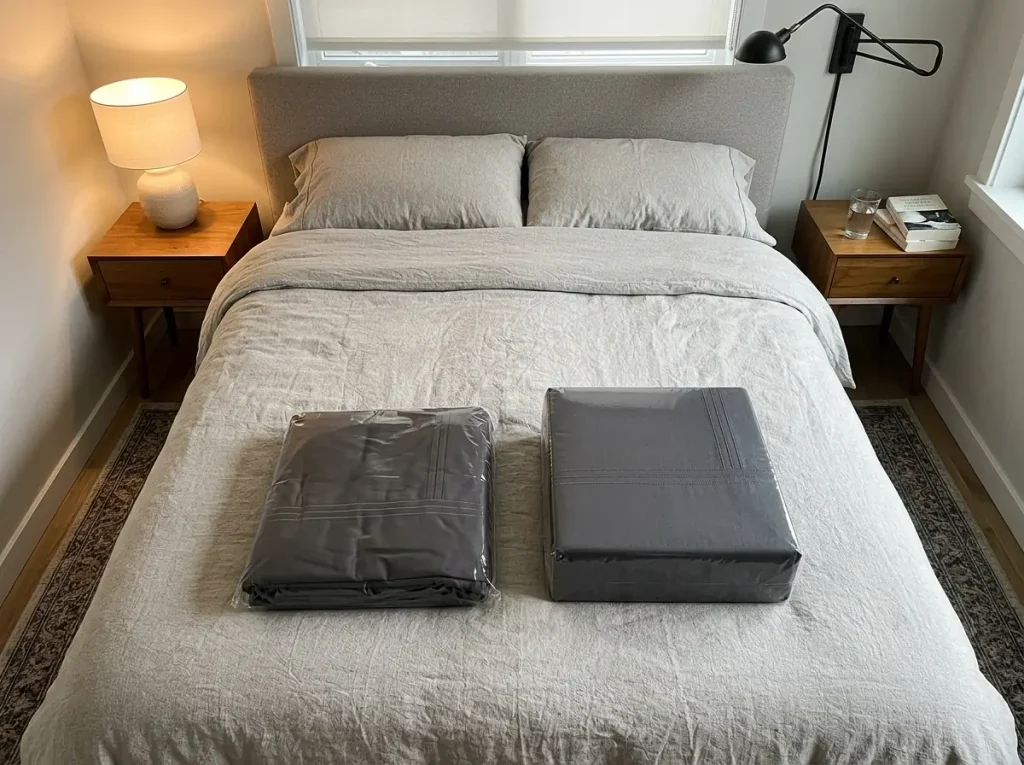
Microfiber means a sub-denier filament, whatever the polymer. In bedding that polymer is nearly always polyester, which on a technical spec sheet is polyethylene terephthalate, or PET, the same family as a water bottle. Occasionally nylon, rarely acrylic. Roughly ten times finer than a human hair. Nothing else about the word is a promise. Which means every safety question about microfiber is really a question about polyester, a fiber that has been in bedding for sixty years and is not an exotic input. If you want the fuller version of what microfiber actually is and what it does in bed, that is its own piece; this one only needs the part the safety question turns on. And since it is the same fiber at a different denier, the argument you are having is with polyester, not with a mystery substance.
The denier number is also why the fabric feels the way it does at all. Finer filaments mean more of them per square inch, more surface touching skin, and less air moving between them. That is the same property that makes it soft and the property that makes it warm. You cannot buy one without the other, and no certificate changes it.
It is worth noticing what this does to the specs people usually shop by. Thread count is close to meaningless on a microfiber set, because you are counting filaments so fine that the number stops describing anything; GSM, the weight of the cloth, tells you far more. And the breathability of the finished sheet is decided by how tightly those filaments sit together, which is why a sateen and a percale in the same fiber sleep differently. Temperature neutrality is not something microfiber offers at any price.
What separates one microfiber set from another is brushing and weave tightness, not the fiber name. A loose weave and a tightly brushed one wear the same word on the box and behave nothing alike.
The Mellanni Iconic 4-Piece Sheet Set is double-brushed polyester and its listing says 100 percent polyester without dressing it up, which is the label honesty this whole article rewards. Its flaw is written on the same line: anyone expecting a cotton hand will notice immediately, and in a room with poor airflow it holds more heat and moisture than an open percale.
A step up in construction, the MALOUF Double Brushed Microfiber Sheet Set is the same synthetic fiber at a tighter weave and a better brushing, and it is the cleanest way to see that the word on the box decides almost nothing. It ships in two or three days rather than overnight, and even double-brushed it is still fully synthetic: the static cling and the trapped heat come down, they do not go away.
The community calls the result sleeping in a sauna. Worth saying out loud, because that is a heat complaint and it keeps getting filed under the same worry as the chemical one. They are not the same worry, and the next section is about exactly that.
In the store, ignore the word microfiber entirely and hold the package up to the light with the fabric pressed flat against the plastic. If you can see daylight through the weave, air will move through it. If it reads as a solid sheet of color, it will sleep warm no matter what the front of the box promises.
The Question Nobody Separates: Your Skin or the Drain
There are two completely different worries hiding inside “is microfiber safe”, one of them well documented and one of them mostly borrowed. Almost every page ranking for this question answers them as if they were the same worry, and that is why nobody ever feels settled after reading one. A thread on r/Bedding resurfaces every year or two asking some version of is this fabric actually bad, or is that just a scary rumor, and the anxiety outlives every blog post that tries to close it.
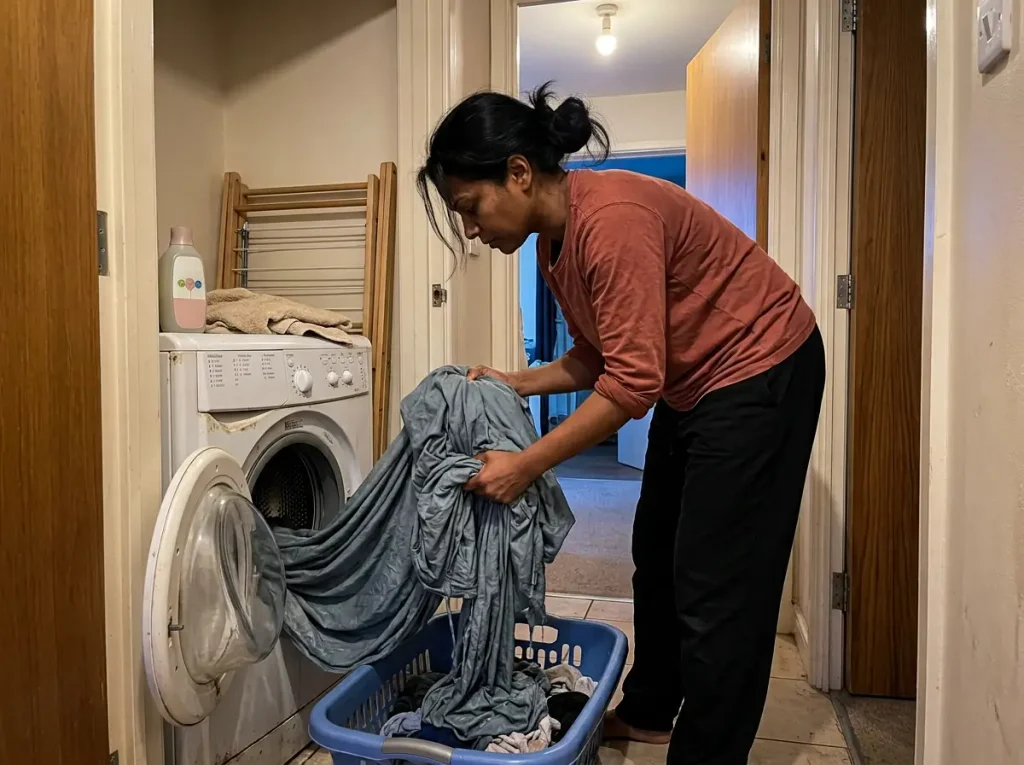
The environmental case is solid, specific and measured. A peer-reviewed washing-machine study measured up to 1.5 million microfibers shed per wash load of synthetic fabric, with a floor around 640,000 and a mass of 124 to 308 milligrams per kilogram of fabric washed.
Laundry wastewater in the same line of research runs 9,000 to 11,000 microplastic particles per liter, about 68 percent of it polyester. Those numbers are not in dispute and they are not small. Microfiber shedding is textile pollution, and every wash of a synthetic sheet set sends real plastic fiber down a real drain. Whatever else is unsettled here, the environmental impact of the wash cycle is the part that has been measured properly.
The personal-exposure case is where it gets thin. The claim that keeps getting recycled is that microfiber bedding raises phthalate levels in urine, and it is attributed to a University of California study. Except one page names UC Davis and another names UC Berkeley, for what reads as the identical claim, and neither gives a study title, an author, a year, a journal or a sample size.
That inconsistency is itself the finding. A study that changes home university depending on which blog you are reading has been copy-pasted, not read. This site takes an 800-thread-count label apart rather than repeating it, and a citation that cannot keep its own address deserves the same treatment. Treat it as unverified until a primary source surfaces.
None of that says the fiber is harmless to the planet. It says the fiber going down the drain and the fiber against your back are two separate arguments carrying two very different evidence levels, and collapsing them is how a reader ends up frightened of the wrong thing. If the comparison you are actually running is fabric against fabric rather than fabric against fear, how it stacks up against bamboo on the same bed is the more useful question.
Here is the part the alarming pages never account for. A bedsheet is the least dynamic textile in the house. It is not tumbled against skin like a workout shirt, not abraded like a sofa arm, and it spends its working hours lying flat under a duvet rather than in motion. Whatever the exposure mechanism is for a synthetic textile, a flat sheet lying still is the low end of it.
Meanwhile the studies being quoted at you were mostly measuring occupational exposure by inhalation, the air in textile flocking factories, or plastic in food and water. None of that is dermal absorption from a pillowcase. Thread titles like Microfiber sheets cause cancer? are what happens when that framing reaches somebody at bedtime.
What the Label Screens For, and the Two Changes That Cost Nothing
There is exactly one thing on a microfiber package that can be checked rather than believed, and there are two habits that do more than any purchase. Both belong before any talk of buying a different set.
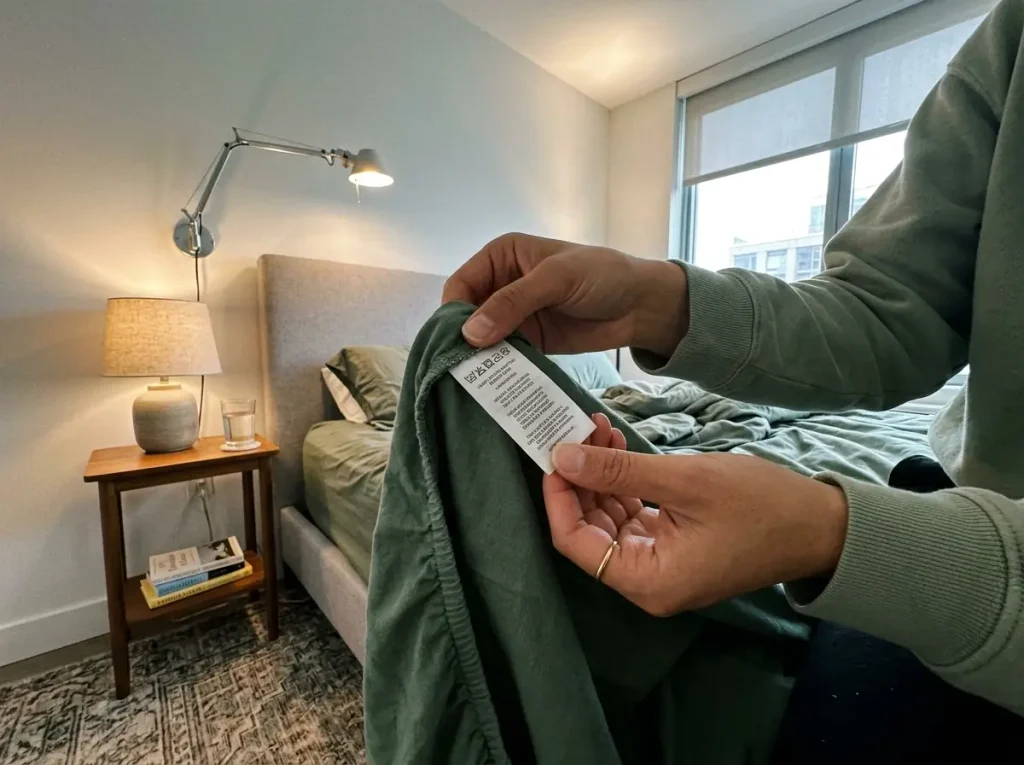
The checkable thing is a valid certificate number. OEKO-TEX Standard 100 tests finished fabric for more than a thousand substances, from azo dyes to flame retardants, and the list is the one people are actually worried about: formaldehyde, heavy metals including lead, cadmium and nickel, pesticide residues, phthalates, allergenic dyes, pH and colorfastness. Bedding sits in the stricter skin-contact product class. Critically, it tests the finished textile, the sheet you would actually touch, not a sample of raw polymer somewhere upstream.
What it does not test is everything else. Not the raw fiber, not the weave, not the construction, not a single thing about how the sheet will hold up. A certificate number is a chemistry receipt, not a quality grade, and it certifies the chemistry, never the construction. If you want the full scope of what OEKO-TEX and GOTS actually certify, that belongs to its own article; here it is a takeaway, not a syllabus.
Now the free part, which is most of the actual fix. You wash a new set once before it ever touches the bed, skip the fabric softener out of habit, and you are done before you have thought about it.
- Wash before first use. It carries off processing residues and the sizing applied at the mill.
- Skip fabric softener and dryer sheets. They coat the filament with a layer that is applied and released at dryer heat, and on a synthetic they do nothing that cold water and low heat do not do better.
- A cold wash, then dry low or line dry. High heat drying is what degrades a fine polyester filament and speeds up shedding.
That slick, almost waxy hand a brand-new microfiber set has is not the fiber. It is sizing, and it is gone on the first cycle. People who judge the fabric out of the package are judging a finish that will not be there by Tuesday.
The same first wash deals with the faint plastic smell a sealed set sometimes arrives with, which is off-gassing from the packaging and the finish rather than anything the fabric will keep doing. A set left to air for a day loses it without help. If you are washing a matching duvet cover at the same time, it gets the same treatment for the same reason.
If your worry is specifically the drain rather than your skin, there is one paid fix worth knowing about: a mesh laundry bag or an inline microfiber filter made to catch shed fiber. Independent lab testing has measured 79 to 86 percent reduction in fiber breakage and over 90 percent retention of whatever does break off. That is not folklore, those are real numbers from real testing.
No specific one is linked here, because every listing worth recommending was out of stock or discontinued when this went up. The category is what you are looking for, and it is easy to find once you know it exists.
A certificate number on a package is checkable, not decorative. OEKO-TEX runs a public label check: type the number and the issuing institute into it and either the certificate comes back or it does not. A box that prints the logo without a number has told you which of the two it is.
Who Should Be More Careful, and Where This Stops Being a Fabric Question
For most sleepers the honest answer to this whole question is yes, and it will sleep warm. But a few situations change the calculation, and one of them is not ours to answer at all.
If you sleep hot, or your bedroom has poor airflow, the closed weave is working against you and no certification changes that. Packaging that calls a synthetic set moisture-wicking is describing a finish, not a rescue: the filament moves damp along its surface, then the tight weave holds it against you anyway.
This is a comfort verdict, not a safety one, and the two get confused constantly because they arrive in the same complaint. The usual advice is that any sheet is fine if you just run the room cooler. After enough sleeping in a sauna reports on the same fabric, I think that has it backwards: the weave sets the floor, and the thermostat only moves you around inside it.
For sensitive skin, dermatology sources draw a line between two different things. One is friction-and-moisture irritation, heat plus trapped sweat aggravating skin that was already close to its limit. The other is a true textile allergy, rarer, and usually traced to dyes, finishes and resins rather than to the base polyester filament.
Different problem, different fix, and worth knowing they are not the same before deciding what to change. 🩺 And if a reaction shows up on this sheet and nowhere else, that is a question for a dermatologist, not a fabric question. That is the whole of what this article will say about it.
Back to the bed. There is a version of microfiber that is not a compromise at all, and it is the one chosen deliberately rather than settled for: a guest room, a kid’s bed, a second set for the week the good ones are in the wash. A cold sleeper in an underheated bedroom is the one person for whom the heat retention is the feature rather than the cost. That is a real use case with real advantages, mostly around cost and how little it cares about being mistreated.
The Utopia Bedding Full Sheet Set is the low-cost entry there, with a 15-inch pocket that will actually clear a mattress with a topper on it. Its flaw is a looser weave than the MALOUF, which means more pilling and more static building up over time; for occasional use that is a reasonable trade, and for the main bed of a hot sleeper it is not. If you have landed on microfiber on purpose, when microfiber is the right call covers the rest of that decision.
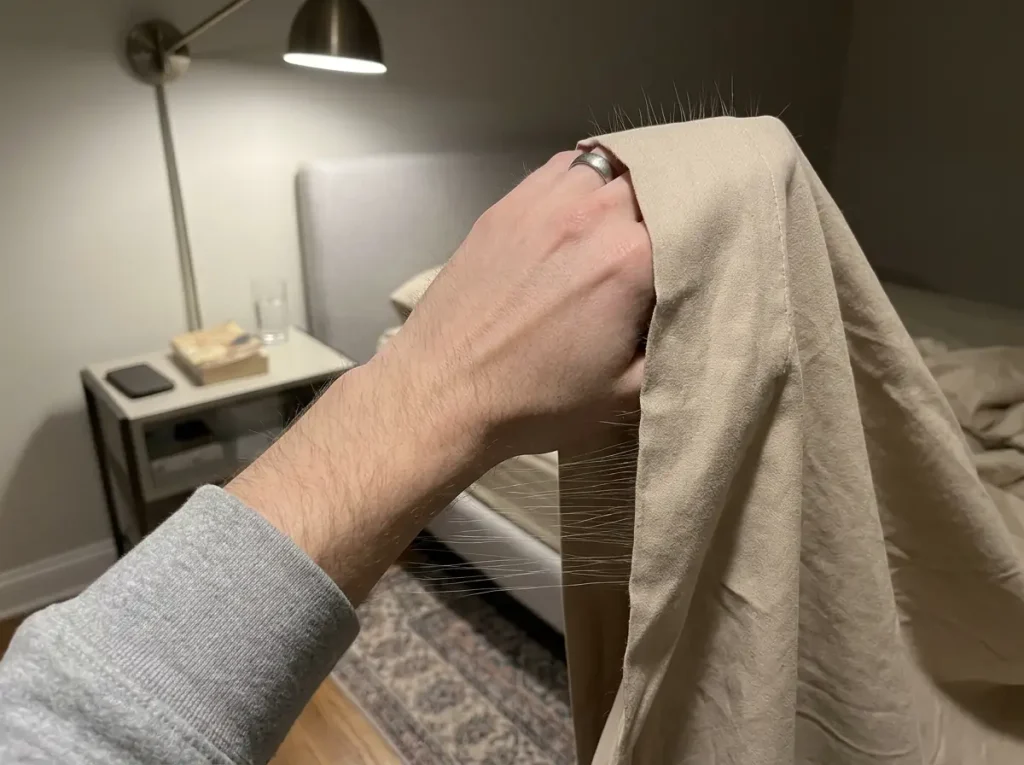
One more thing nobody warns about, because it sounds worse than it is. Static cling in dry winter air is real and it will surprise you at least once. Polyester holds a charge because it does not hold water, and the same dryness that lets it release moisture quickly leaves the charge nowhere to go.
In a humid August you will not notice it at all. It is a nuisance, not a hazard, and reading a small shock as evidence of something chemical is exactly the confusion this article exists to clear up.
The static fix on a synthetic is humidity, not softener. Run the bedroom above roughly 40 percent relative humidity through the dry months and the charge has somewhere to go. A softener sheet in the dryer treats the symptom for one cycle and leaves a coating behind for the rest of the set’s life.
What Nobody Reports: Microfiber at Wash Twenty
Every page arguing about this fabric is arguing about it new, and that is the part of the answer this niche is missing entirely. Week one lies about almost every sheet. The set that felt slick and cool out of the package is a different object by the end of a summer of washes.
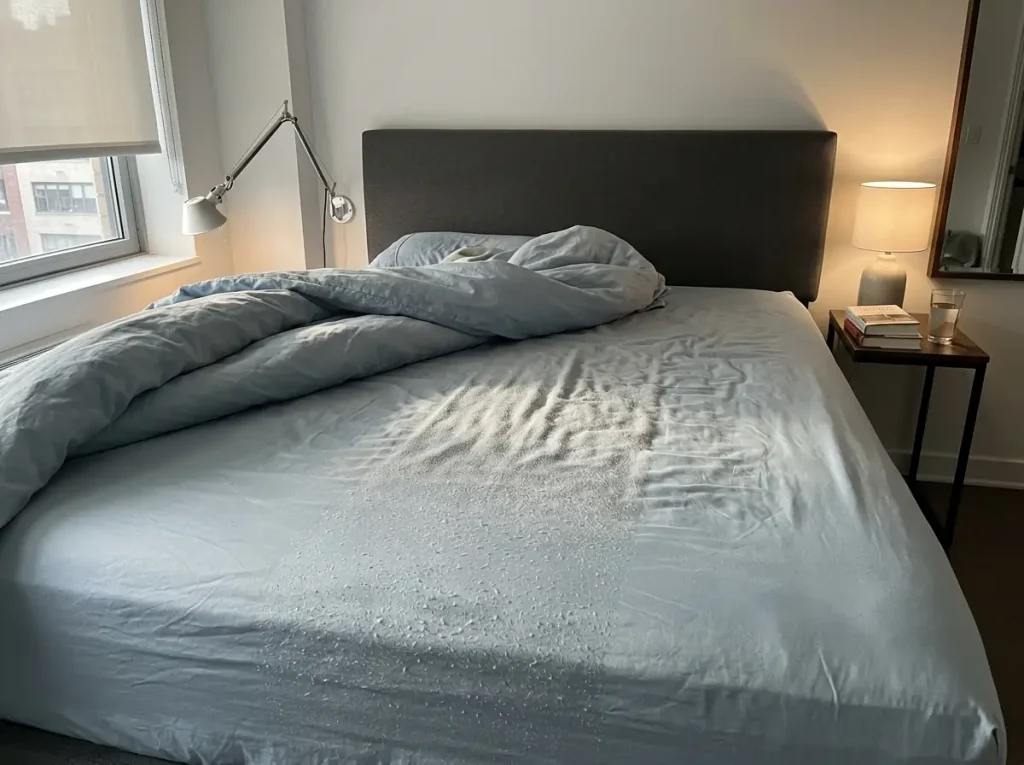
So here is the gap, stated as a gap. None of the five pages currently ranking for this question reports a wash count for shedding rate, static behavior or how a brushed or “cooling” finish holds up over time. Neither does any of the community threads that keep asking. Not one.
Inventing a number to fill that hole is exactly what got this topic into its current state, so it stays a hole. What the research does give is per-load shedding measurements, which is a snapshot, not a curve, and nobody has published the curve for bedding. And if a certification tag is what reassured you here, worth knowing that certified does not mean natural: the chemistry passed, the polymer is still a polymer.
What to watch instead of a number, since you have the set and the studies do not:
- Whether the surface still catches on dry skin the way it did new, or has gone smooth and slightly dead
- Whether pilling has started at the hip and the heel, where the friction actually is
- Whether the static changed with the season or with the wash count, which tells you whether it is the air or the fabric
Construction decides all three, which is the same variable from the first section coming back around. A double-brushed tight weave and a loose knit diverge exactly here, and the divergence shows up in the wash rather than in the package. That is the whole argument for paying more within the same fiber, and it is also what you give up on durability when you do not.
There is one end-of-life detail specific to synthetics that changes how you should read a worn set. Pilling on a synthetic does not shed the way it does on cotton. The filament is strong enough to hold the pill in place, so the pill stays attached and the fabric gets rougher, while a natural fiber like cotton gets thinner instead at the same wash count.
Same wash count, two completely different stories about what is wearing out. And the complaints that actually recur in the reviews are not chemical ones. They are the sheet balled at the foot of the bed by week three and a shock off the doorknob in January.
The Short Version
Microfiber is fine polyester, and it is safe to sleep on for the overwhelming majority of people. The trade you are making is heat, not health, and it is worth making with your eyes open rather than avoiding out of a fear assembled from studies about factory air.
The documented concern is the wash cycle, not the skin contact. The numbers on shedding are real, peer-reviewed and specific. The claims about what it does to a sleeper come with citations that change university depending on which page you read, and a claim that cannot keep its own address is a claim that nobody checked.
An OEKO-TEX Standard 100 number is the one thing on the package you can verify. Everything else on the box is adjectives.
After a season of washes, run a hand across the fitted sheet at the hip and the heel. If it has started to catch, that is construction wearing out, not chemistry, and it tells you more about what the set was made of than the package ever did.
Tonight: wash the set you already own before it goes back on the bed, leave the fabric softener out of that load, and give it a week. Then decide whether the problem was ever the fiber.
Frequently Asked Questions
01What are the downsides of microfiber sheets?
Microfiber sleeps warm and builds static in dry air, because the same closed, high-surface-area weave that makes it feel soft also traps heat and moisture against you. Over time it pills at the friction points, and on a synthetic the pill stays attached instead of shedding.
02Is microfiber full of microplastics?
Microfiber is a plastic fiber, so the real question is how much of it leaves the sheet in the wash. Peer-reviewed testing puts a single synthetic load at 640,000 to 1.5 million fibers. That is an environmental issue at the drain, not a skin-contact dose in your bed.
03What are the least toxic bed sheets?
Any sheet carrying a valid OEKO-TEX Standard 100 number has been tested for the chemical categories people worry about, whatever the fiber it is made from. The tag covers chemistry only. It says nothing about weave, construction or how long the set will last.
04Do microfiber sheets cause static shock?
Yes, in dry air, because polyester holds a charge it cannot release into humidity. It is worst in winter and harmless. Fabric softener is not the fix on a synthetic: raise the room humidity instead and the charge has somewhere to go.





Tried it on your own bed?
No comments yet. Tell us what you changed, and what the sheet did after a few washes.