







What’s in here8 sections
You are standing in front of two sheet sets, one promising it will outlast everything you own and the other promising 1800 threads, and neither package tells you the thing you actually want to know. Ask whether microfiber sheets are durable and you get a yes from the manufacturer and a flat “friends don’t let friends buy microfiber sheets” from a deal forum, which is not much of a consensus. Both are right, and that is the problem with the word.
Durability on a fabric is four separate measured properties: abrasion resistance, tear resistance, shrink resistance and fade resistance. Not one of them is the reason anybody ever throws a sheet set out.
So this article separates two questions the packaging deliberately fuses: whether the set is still intact, and whether it is still worth sleeping on. The answer arrives at the twentieth wash, not the first night.
Quick Answer
Yes, microfiber resists tearing, shrinking and fading better than budget cotton, and a set can go years without a hole. But pilling, odor retention and static arrive far sooner than the tight weave suggests. Durable and still worth sleeping on are not the same claim.
What “Durable” Actually Measures on a Sheet
The word is doing four jobs at once on that package, and only one of them has anything to do with why a set gets replaced. Splitting them apart is the whole job of this section, because every comparison further down depends on knowing which kind of lasting is being promised.
Denier, Not a Fabric — What Microfiber Actually Is
Start with what you are buying. Microfiber is a thickness, not a material: any fiber spun under 1.0 denier qualifies, and in bedding it is almost always polyester, drawn far finer than a human hair.
That matters because microfiber names a thread thickness, not a fabric, which means there is no new textile involved and no chemistry that cotton is missing. The durability story is denier, weave and finish. Nothing else.
Which also explains why “1800 thread count microfiber” is not describing a better sheet. It is describing the same polyester, spun thinner, counted more generously.
The Four Things “Durable” Can Mean, and the One It Usually Doesn’t
Abrasion resistance is the first, and it is measured properly. Labs run the Martindale abrasion test that measures how many rubs a fabric survives before it wears through, rubbing two swatches together in overlapping curves under set pressure until the fabric fails. Synthetic fiber genuinely outscores natural fiber on it. That part of the claim is not marketing; it is a number from a machine.
Tear strength is the second, shrinkage the third, colorfastness the fourth. A microfiber set does well on all four, and its wrinkle resistance is thrown in free, which is why the word sits so comfortably on the box.
And then there is the fifth property, the one that decides when a set goes in the donation bag: how the fabric looks and feels after months of home laundering. That one has its own standardized tests. It appears on no consumer package anywhere.
Why GSM Tells You the Weight and Nothing About the Fuzz
GSM, or grams per square meter, is the number sheet packaging should print instead of thread count. It is a genuine spec, and it still would not answer this question, because grammage measures weight and density and nothing else.
Pilling is graded separately, on a one-to-five visual scale after controlled rubbing. Two sets at the same GSM can land three grades apart depending on fiber twist, weave tightness and how hard the surface was brushed. The community worked this out on its own: one Reddit line, relayed in the research for this piece, puts it as bluntly as anybody needs. You should give zero damns about the thread count, it is a red herring.
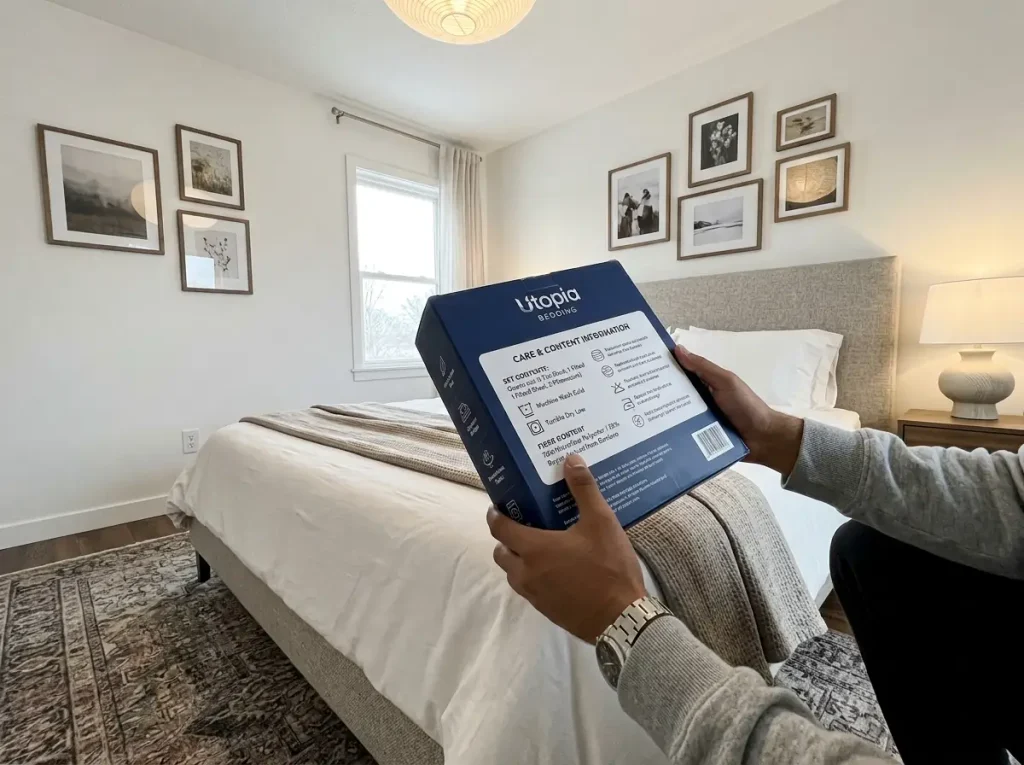
The honest tell is not on the front of the package at all. Turn it over and read the fiber-content block for one word: brushed or double-brushed. That single word is the finish decision that sets when the fuzz starts, and it is printed in six-point type under the wash symbols.
The Utopia Bedding Full Sheet Set is the plainest of the budget sheets in this category, brushed microfiber with a 15-inch pocket depth, bought honestly for the price and for the fact that it will not tear or shrink. Its flaw is printed in that same block: it is single-brushed, so the pilling starts noticeably sooner than on a double-brushed set, and there is nothing else about it that distinguishes it from any other polyester basic.
Read the back of the package before the front. The fiber-content block tells you the base fiber and whether the surface was brushed once or twice; the front tells you a thread count that, on microfiber, is counting the same polyester twice. If the back says nothing beyond “100% polyester microfiber,” assume single-brushed and buy accordingly.
Where Microfiber Genuinely Beats Cotton
Having taken the word apart, the fair thing is to hand microfiber the columns it wins before taking anything away. There are three of them, they are real, they are measurable, and they are the reason the fiber ended up on so many beds in the first place.
Tear and Abrasion, the Column Microfiber Wins Outright
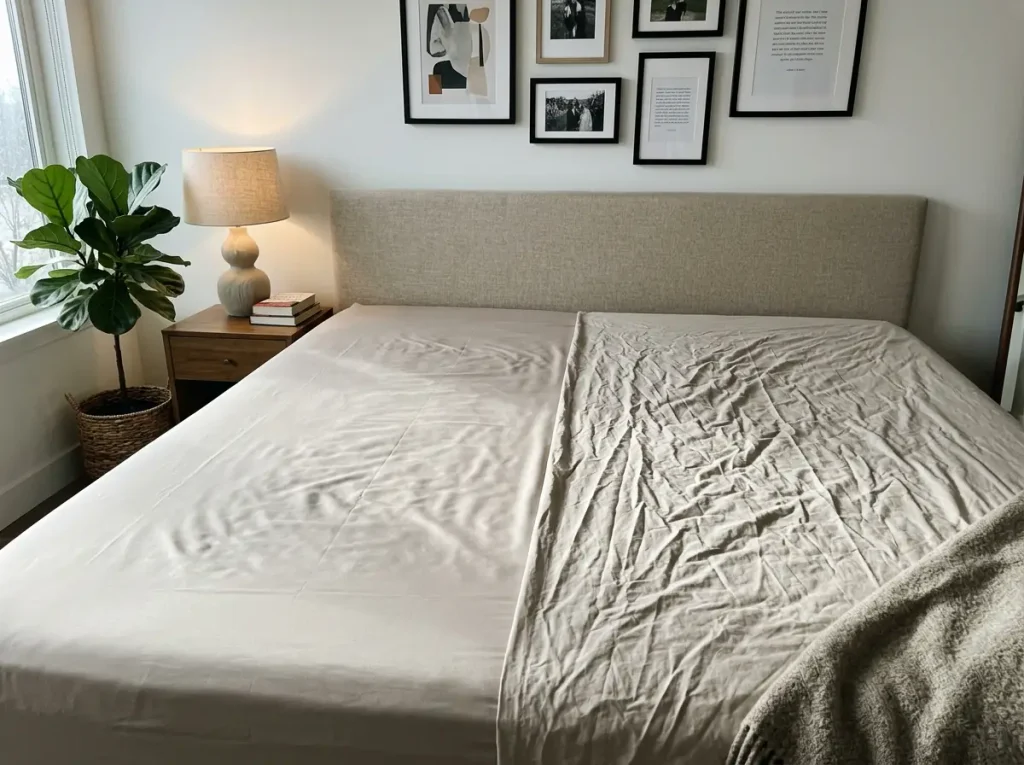
Fine synthetic fiber, packed tightly, resists rubbing itself apart better than short-staple cotton does. A microfiber set can genuinely go years without a hole, a thin patch or a split seam, and the people who report that are not wrong. If your last cotton set died because the fitted sheet wore through where your heel sits, microfiber solves that specific failure and solves it completely.
Shrinking and Fading in a Hot Dryer
Polyester does not need the temperature discipline cotton demands. Run a microfiber sheet through a hot wash and a hot dryer and it comes out the size it went in. Run a cotton one through the same cycle and it does not, and the damage is cumulative. You do not notice it in one wash, you notice it in August when the fitted sheet stops reaching the corner.
Which brings in the microfiber vs cotton durability comparison the whole article is really making. The Feather & Stitch 100% Cotton Percale Sheet Set is a useful set to weigh microfiber against precisely because it states its full spec: 100 percent cotton, percale weave, 300 threads of single-ply yarn, 16-inch pocket depth. That is a real sheet with real numbers rather than a hypothetical, and it will still be pleasant to sleep on when the microfiber has gone fuzzy.
Its flaw is the mirror image of everything above: percale wrinkles far more than microfiber straight out of the dryer, and run too hot it shrinks. Cotton’s behavior comes down to what staple length does to a cotton sheet: short-staple upland cotton is where the wear complaints come from, and the long-staple names on the expensive boxes, Pima cotton and Egyptian cotton, are buying their way out of exactly this failure.
The Hour-to-Dry Advantage, and Who It Actually Helps
Micro-denier polyester has a very high surface-area-to-mass ratio, and that is why the set is dry in an hour rather than four. In an apartment with no outdoor line and one set of sheets, that is not a footnote. That is the whole reason to own them.
The shrink advantage also shows up in a place nobody photographs: the fitted sheet’s corners still reaching a tall mattress after a summer of hot washes, at the point where the cotton set that started deeper has quietly surrendered two inches of pocket. Nobody blames the dryer. They blame the elastic.
What Happens at Wash Twenty
Everything up to here was measured on a machine rubbing two swatches together. The bed is a different test, and this is where the two stop agreeing.
The Three-Month Pillowcase, in the Community’s Own Words
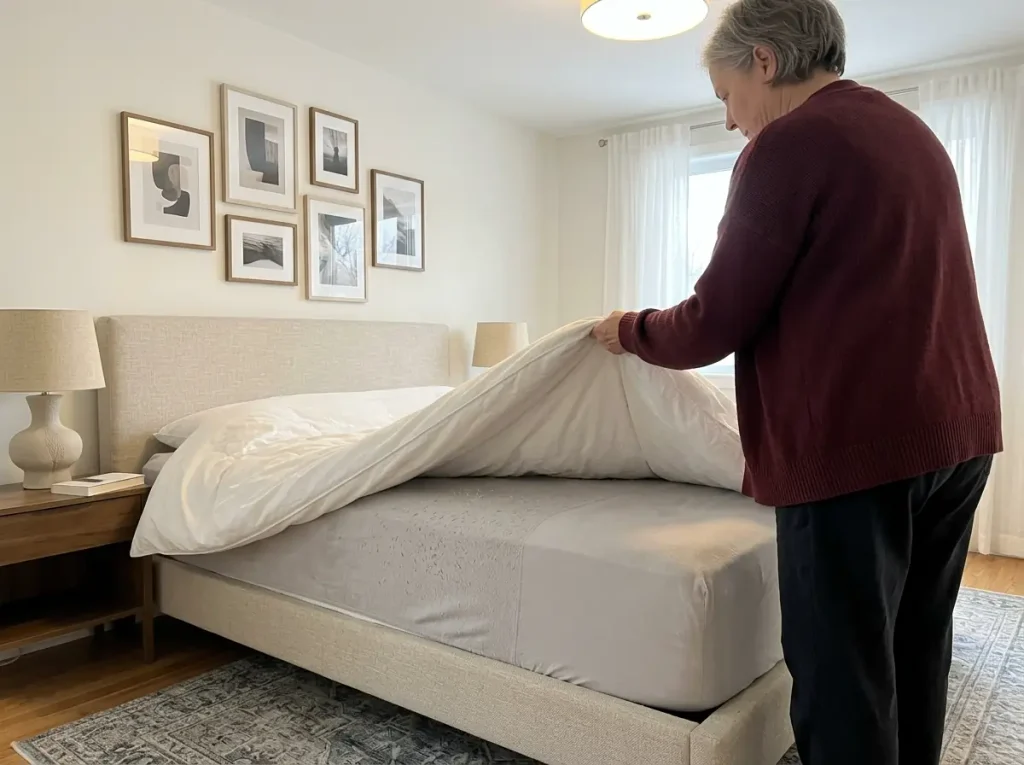
A verified Amazon buyer described the whole set going at roughly three months: every piece pilling, and a texture they compared to small grains of rice. The detail worth keeping is which piece they complained about: the pillowcase, uncomfortable against the face. Three months. That is inside the first season, not the third year, and it sits underneath every generic “two to three year lifespan” figure the comparison pages print.
The pilling does not arrive evenly either, which is exactly why people miss it until it is bad. It shows up first on the middle third of the fitted sheet and on the pillowcase, the two places a sleeper actually rubs, while the foot of the bed and the flat sheet’s top band still look new.
So you inspect the set, it looks fine, and you go on sleeping on the one square yard that isn’t. On a shared bed it goes on one sleeping side well before the other.
Why the Fuzz Happens: Fiber Twist, Not Bad Luck
Here is the mechanism, and it is the uncomfortable part. Friction lifts fiber ends off the surface into fuzz, and the fuzz tangles into balls that stay attached. The fibers manufacturers themselves name as worst for this are nylon, polyester and polypropylene, because of a mismatch between fiber type and twist. The same fineness that makes microfiber resist tearing is what makes it pill. It is not a defect and it is not a bad batch: it is the material working as designed, in the direction you did not want.
That mechanism is not specific to synthetics, incidentally, and the same thing decides whether a percale or a sateen pills first, because floating threads catch and abrade before flat-woven ones do. Another reviewer put the whole thing in six words: being 100 percent polyester, these sheets will pill. The community treats it as when, not if, and it does not sort by price tier.
Single-Brushed and Double-Brushed Are Not the Same Set
Since GSM predicts nothing here, the construction is where the difference actually lives. Brushing raises the surface fiber deliberately, and doing it twice, under tighter control, produces a denser and more uniform nap that takes longer to break down into fuzz.
The MALOUF Double Brushed Microfiber Sheet Set is the plain example of that decision, and it is worth the step up over a single-brushed basic if you are keeping the set on a bed slept in nightly. Its flaw is the one that has to be said out loud: it is still polyester, so double-brushing delays the pilling, it does not prevent it. A slower clock, not a different outcome. (It also currently ships in two to three days rather than overnight, which matters only if you needed sheets tonight.)
The frustrating part is that a formal way to measure all of this already exists. AATCC publishes the standard test methods labs use to grade fabric appearance after repeated home laundering, a real, standardized wash-count equivalent run by real labs. No sheet package cites it. The number they print instead is thread count.
Check the set with the back of your hand, not your eyes, and check the middle third of the fitted sheet rather than the folded corner. Pilling is a texture failure before it is a visible one, and the corner you fold is the part nobody sleeps on. If it catches, it has been catching for weeks.
The Smell That Washing Does Not Fix
Pilling is the failure people see. This is the one they smell, and it arrives on exactly the same fiber property that gets the sheets dry in an hour.

Why Cotton Can Hold Sweat and Polyester Cannot
At the standard testing atmosphere, cotton holds between 7 and 8.5 percent of its own dry weight as bound moisture inside the fiber. Polyester’s figure is close to zero. It physically cannot take sweat into the fiber; all it can do is push liquid to the surface and let it evaporate. Since microfiber is polyester spun under one denier, that limit applies to every microfiber sheet ever sold, whatever the finish is called.
The Oil Half of Sweat, and Why It Stays
Now the part that explains the day-after smell. Polyester is hydrophobic but oleophilic: it repels water and attracts oil. It moves the watery part of sweat efficiently and preferentially grabs the oily, lipid part, which does not rinse out in a normal wash and which is what odor-causing bacteria feed on. So the sheet comes out of the machine smelling of nothing, and by the second night the pillowcase smells of a person again.
That is worth saying plainly, because the usual explanation is wrong. Microfiber is not dirtier than cotton. The same chemistry that makes it shrug off water is the chemistry that holds onto the oily half of sweat, and washing does not undo it because washing is water.
What to Change Before Buying Anything
Before any purchase, three changes, and all three are free:
- Wash warmer rather than hotter, and wash more often. Weekly, not fortnightly.
- Drop the fabric softener entirely.
- Strip the whole set, pillowcases included, rather than swapping cases and leaving the fitted sheet another week.
Number two is the one to actually act on, and it is the mistake almost everybody makes on exactly this fabric. Softener feels like the answer to a sheet that has gone scratchy with pilling, and what it does is coat the fiber, slow the wicking, and leave the oils sitting on the surface longer. It makes both problems worse while feeling like a fix.
The moisture-wicking advantage itself is real, just narrower than the packaging implies. Micro-denier’s surface-area-to-mass ratio genuinely moves liquid faster than spun polyester or cotton yarn, and there is peer-reviewed comfort research on microdenier polyester’s moisture-management performance that measures it rather than asserting it.
It is a wicking-speed win. It is not an absorption win, and it is not breathability either, though all three get sold as the same thing.
Static, and the Words on the Package
One more thing gets worse with time rather than better, and it comes off the same low-moisture property as everything else here. It also makes a good place to read what the package is actually promising.

Why Polyester Holds a Charge and Cotton Does Not
Synthetic fibers pick up an electrical charge more readily than natural ones. Friction in the wash, in the dryer and in ordinary rolling-over transfers electrons, and on polyester the charge has nowhere to go, because cotton bleeds it away through its absorbed moisture, and polyester has no absorbed moisture to bleed it through. It gets worse in a dry, heated bedroom in winter, which is precisely when a cheap set is most likely to be the one on the bed.
The tell is not the shock reaching for the lamp. It is the fitted sheet clinging to itself coming out of the dryer in a way it did not do in the first six months, which is the surface finish having worn off and left the bare fiber behind.
“Cooling” on a Microfiber Package, Taken Apart
“Cooling” is not a measurement. Nobody certifies it, no standard defines it, and any set can carry it. On microfiber it is generally a treatment applied to the surface, and treatments wash out. Community testimony gathered for this piece has these finishes degrading within the first few washes, leaving one person describing the result as being wrapped in a curtain that is slowly becoming a sauna.
The Mellanni Queen Sheet Set from the Iconic Collection is brushed microfiber marketed under exactly that claim, and it is a useful set to read a label on rather than argue with a hypothetical. Its flaw is the claim itself: the cooling finish loses its force within a few washes, and underneath it the fiber is the same polyester, with the same tendency to static and the same tendency to pill as any other microfiber. Buy it for the price and the brushed hand if you like, but do not buy it for the word on the front.
Construction Versus Coating — The One Distinction on the Label That Survives
Here is the reading rule the rest of this collapses into.
A construction is something done to the yarn or the weave: double-brushing, weave density, ply. It survives the wash, because it is what the fabric is. A coating is something sprayed or bonded onto the finished cloth: cooling treatments, wrinkle-release, most things with a trademark symbol. It leaves.
So when a package gives you a marketing name, find out which of the two it is. If nobody will say, it is a coating. Once the coating is gone you have the closed weave and the polyester, doing what they always did. If you are weighing that against another fiber entirely, it is worth seeing how microfiber compares to a bamboo set on the same bed before deciding the problem was the brand.
If static is the complaint, pull the set out of the dryer while it is still slightly damp and finish it on the bed. The charge builds in the last ten minutes of tumbling, when the fabric is bone dry and still moving. Wool dryer balls help a little. Dryer sheets help for one night and then coat the fiber like softener does.
The Honest Verdict — Bought for Price, Retired for Texture
Everything above points at one distinction, and it is the one no comparison page draws: a sheet can be entirely intact and completely finished at the same time. That is not a paradox. It is two clocks running at different speeds.
Two Clocks — Structural Life and Comfortable Life
Structurally, a microfiber set really does last years, and the two-to-three-year lifespan everybody quotes is not a lie about the fabric holding together. It is probably conservative. Judged on holes alone these are long-lasting sheets.
Comfortably, the community reports these sets going off somewhere between three months and a year, on texture and on smell. Microfiber wear is a surface story from beginning to end.
Microfiber is almost never retired for a hole. It is retired for the fuzz, for the odor and for the static, and not one of those is what the word durable on the box was measuring. So the trade, stated once and plainly: you buy it for the price and for genuine resistance to tearing, shrinking and fading, and you spend that back in texture and odor performance long before the fabric gives up structurally.
Where the Trade Is a Good One
On a guest bed used twelve nights a year, this is the correct purchase and it is not close. Wash frequency is what kills these sheets, and a guest bed generates almost none.
Same for a child’s bed that gets stripped twice a week for reasons nobody wants to discuss, where a hot water wash and a fast tumble dry matter more than anything else on the box. Same for a spare set for the week the good ones are in the laundry. And in an apartment with no outdoor line, the hour-to-dry advantage genuinely decides it. If any of those describe your situation, cheap durable sheets are exactly the right answer, and microfiber is the right call and it is worth knowing when it isn’t.
Where It Is a Bad One
On a bed slept in every night for years, by a hot sleeper, the trade goes the other way. Daily use and body heat accelerate the two exact weaknesses this fiber has, which is why the three-month reports come from primary beds and not from spare rooms.
A cold sleeper gets a longer run out of the same set, simply because less sweat reaches the fiber. And on a shared bed the wear is uneven either way: the one who runs hotter pills their side first, and the set fails in halves.
The moment a set is really finished is not visual and it is not the smell either. It is the night the pillowcase wakes you up, because the fuzz has stopped being something you can see and become something you can feel against a cheek. That is the twentieth wash speaking, and it does not care what the front of the package said. It is the same test that settles every fiber argument on this site, which is why the twentieth wash decides between cotton and bamboo as well, and by the same method.
The Bottom Line
Microfiber earns its durability claim honestly on tearing, shrinking and fading, and loses it just as honestly on texture and smell, which happen to be the two things that actually put a set in the donation bag. Read the back of the package for the fiber-content block and for the word double-brushed; the big number on the front is measuring the yarn twice, not measuring lifespan. And take the softener out of the cupboard, because it is doing the opposite of what it looks like it is doing.
The wash-twenty check: after a season of washes, run a flat hand over the middle third of the fitted sheet and over the pillowcase, the two places a sleeper actually rubs. If it catches, the set is finished, whatever the rest of it looks like.
Tonight, wash the set without softener. Give it three weeks and check it with the back of your hand. Then you will know whether it was the sheets or the routine, and that costs nothing to find out.
Frequently Asked Questions
01What are the downsides of microfiber sheets?
Pilling, trapped heat, static buildup and odor that returns quickly after washing. None of those is a structural failure, which is why the set still looks intact while it stops being pleasant to sleep on.
02What is better, 100 percent cotton or microfiber?
Neither, until you say which kind of durability you need. Cotton for a bed slept in nightly for years; microfiber for guest beds, kids and anywhere an hour of drying time decides the week.
03How long do microfiber sheets actually last?
Two answers, and both are true. Structurally, years without a hole. Comfortably, community reports put the microfiber sheet lifespan at three months to a year before texture and smell make people replace it.
04Do microfiber sheets pill more than cotton?
More than long-staple cotton, yes, and for a specific reason: fine polyester fiber and its twist are the combination manufacturers flag as most prone to pilling. Short-staple budget cotton is closer to a tie.
05Does washing microfiber sheets stop them from smelling?
Partly. The oily part of sweat does not rinse out of polyester easily, so washing more often and skipping fabric softener entirely does more than washing hotter. Softener coats the fiber and makes it worse.





Tried it on your own bed?
No comments yet. Tell us what you changed, and what the sheet did after a few washes.