







What’s in here8 sections
- What the Label Has to Say Before You Pay for Silk
- What Silk Does at the Pillow, and What It Doesn’t
- Where a Silk Case Gives Out First: Closure, Seams and Slide
- Silk on One Pillow in a Shared Bed
- The Wash Clock: When the Sheen Goes and the Case Follows
- When a Cotton Case or a Bonnet Does the Same Job
- Two Numbers, Two Edges, and a Braid First
- Frequently Asked Questions
The package says “silk,” and that one word is carrying the whole sale. It does not tell you whether the fiber came from a farmed mulberry silkworm or from broken waste filament, how much cloth went into the case, or what keeps the pillow inside it by morning. Silk pillowcases are one of the few bedding buys where the label is close to the entire product, so it pays to read it the way a mill reads a spec sheet.
Momme, the one number most listings print, is a weight per square meter and not a quality grade, and above about 22 the extra grams buy a case that lasts longer rather than one that feels softer. What follows is what the label has to say, what the case changes at the pillow, where it gives out, how a shared bed handles one, how many washes it survives, and when a cotton case does the same job.
Quick Answer
A silk pillowcase is worth it as the one silk item if your hair tangles against cotton: its smooth surface drags less on hair and skin; it treats nothing. Buy by momme, a weight and not a grade, with 22 as the line. The catch: the case wears out in the wash, not on the pillow.
What the Label Has to Say Before You Pay for Silk
“Silk” on a package is where the question starts. On a pillowcase listing, three things carry real weight: the word mulberry, a momme figure, and whether “satin” is naming the fiber or only the weave. A grade comes close behind. The rest of the title, the “for hair and skin” and the adjectives, is decoration, and you can read past it.
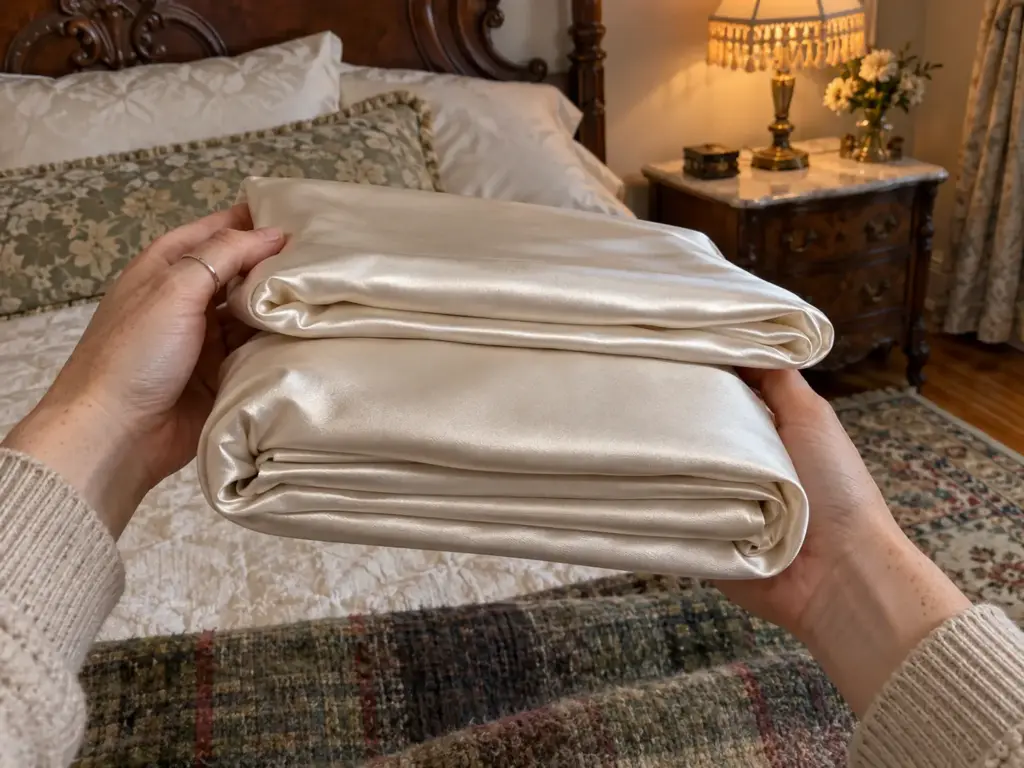
“100% Silk” Is Not the Same as Mulberry
Mulberry silk comes from Bombyx mori, a silkworm raised on mulberry leaves and farmed for exactly this purpose. What it spins unwinds into a single continuous filament that can run well past a kilometer, even in thickness and pale enough to take dye cleanly. That length is the point, and it is what a listing means by long-strand silk. A fabric woven from long filaments has almost no fiber ends showing on its face, which is why good charmeuse feels like one continuous surface, where cotton under a magnifier looks like a field of tiny cut hairs.
“100% silk” makes no such promise. It is true of wild silks, whose filament is coarser and less even, and it is true of spun silk, made from the broken and leftover filament of the reeling process, carded and twisted into yarn the way cotton is. Spun silk is real silk with far more fiber ends on the surface, and fiber ends are what pill and catch hair.
A listing that says “pure silk” with no mention of mulberry, no momme and no grade is not lying to you. It is just not saying which of these you are getting.
Grade is the third word worth reading. Silk is graded A through 6A, with 6A for the longest and most uniform filament, and The Spruce’s tester advises skipping anything below 6A, and any case that lists no momme at all. Grade and momme measure different things, and a listing can print one without the other. When it prints neither, the label is hiding the spec.
Momme Is a Weight, and 22 Is the Line
Momme began as a silk merchant’s unit: the weight, in pounds, of a piece 45 inches wide and 100 yards long. Converted to the measure the rest of textiles uses, one momme is 4.34 grams per square meter. That puts a 19 momme case at about 82 g/m², a 22 at about 95 and a 25 at about 108. Between 22 and 25 there are roughly 13 extra grams of silk in every square meter, about 14 percent more cloth.
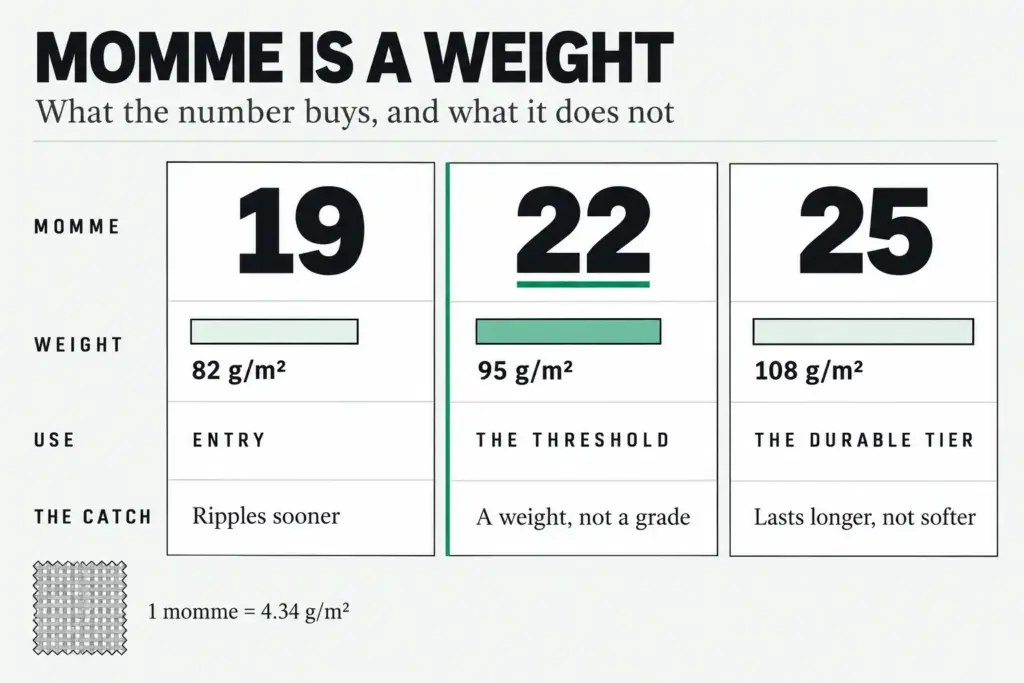
That is a weight, and only a weight. More filament per square meter makes a denser charmeuse that stands up to abrasion longer, and the testers who have washed these cases repeatedly put the mark of a good one at 22: Wirecutter calls 19 a common momme and 22 an excellent one, and Allure groups 16 to 19 as entry level and 22 to 25 as the top tier. Above 22, though, the extra grams buy durability, not feel.
In the first week a 25 and a 22 are close to indistinguishable against your cheek; what the heavier one changes is how many washes the face stays flat and smooth before it starts to ripple and lose its glide. The longer theory, with the sheet as the example, is in momme as a weight, in the sheet-side version.
So the bigger number is not automatically the better buy for you. For a case you mean to wash every week and keep for years, 25 earns its extra cloth. For a first try, where the real question is whether silk does anything for your hair at all, a lighter case answers it at a fraction of the outlay.
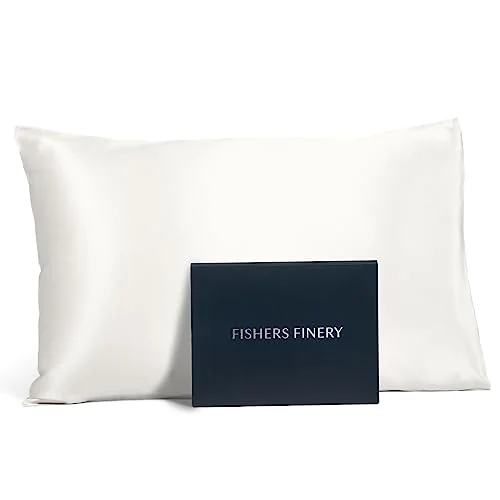
The Fishers Finery 19mm Pure Mulberry Silk Pillowcase is the cheap rung of the same maker whose 25 momme case has been washed and written about more than most: 19 momme mulberry, about 82 g/m², and a low-cost way to find out whether you like sleeping on silk. It is the thinnest case in the range, which both Allure and The Spruce treat as entry level, and one r/BuyItForLife commenter thinks 19 momme belongs on pajamas rather than a pillow; past that thinness, no complaint about it comes up again and again. Another reader in the same thread dug out an order confirmation from 2021 and is still sleeping on the 19 momme cases every day.
One person’s washing machine is not a guarantee, but it does say the lighter case need not be a one-season buy. If you would rather start exactly on the line, the Cuddledown Mulberry Silk Pillowcase is 22 momme and 6A, with an envelope closure and an OEKO-TEX label on the listing. The listing itself is the thin part: the page opens on a small boudoir size carrying only a handful of ratings, so choose the standard size before you buy and judge the reviews on that variant, not on the default one.
Silk vs Satin: One Is a Fiber, the Other Is a Weave
Silk is a fiber. Satin is a weave, in which each thread floats over several crossing threads before it dips under one, so the face of the cloth is mostly long, unbroken runs of yarn and light bounces off it in a sheet. Charmeuse is a satin weave made in silk, which is why a good silk case is glossy on one face and duller on the other; sateen is the same idea worked in cotton. And a “satin pillowcase” with no fiber named is almost always polyester.
One reader’s word for polyester satin is “plastic,” and it fits how the stuff behaves on a warm pillow. Polyester takes up almost no moisture, so whatever damp the night produces sits on the surface instead of going into the cloth, while silk, a protein fiber, takes water vapor in readily. On the shelf the two look identical. On the pillow, after a warm night, they do not.
Satin weaves also carry a weakness that has nothing to do with fiber: long floats snag. A commenter in the r/BuyItForLife thread called satin weaves “a little fragile and prone to snagging, regardless of the fiber,” which is worth remembering the first time a ring or a jagged fingernail catches the case. While you have the listing open, look for two more lines.
“Silk on both sides,” which LilySilk and Fishers Finery both print, tells you the back panel is not cheaper cotton or polyester. And the OEKO-TEX line is worth reading for what the OEKO-TEX label does and does not certify: it tests the finished cloth for harmful substances, not the quality of the silk in it.
Put two listings side by side and hunt for four things in the title and the bullets: mulberry, a momme number, a grade, and “both sides.” A listing that is missing two of the four is selling the word silk, not a case you can judge. Close it and move on.
What Silk Does at the Pillow, and What It Doesn’t
With the label sorted, the question becomes yours: does any of this change what happens to your hair and face on the pillow? Strip out the promises and what is left is a smaller claim than the packaging makes, and a sturdier one.

Less Drag on Hair, Not a Treatment
Picture turning over on a cotton case. Your hair is pinned between the cloth and the pillow, and every turn drags a few hundred strands across a surface studded with short fiber ends. That drag is what roughs up the outer layer of each strand.
A smooth filament surface lets hair slide instead of catch, and that, without the adjectives, is the whole mechanism. Curly and textured hair, which tangles where strands cross, has the most to lose. According to the American Academy of Dermatology’s hair-care advice for curly hair, you should “reduce friction against your pillowcase, which can make your hair frizzy and easier to break.”
Notice what that sentence says and what it leaves out. It names friction as the problem. It does not name silk as the answer, and the advice next to it is a loose pineapple ponytail or braid, which costs nothing.
The moisture half of the usual pitch is weaker than it sounds. Silk’s moisture absorption is about the same as cotton’s, so the idea that cotton drinks the moisture out of your hair while silk leaves it alone does not survive a look at the two fibers. What actually differs at the pillow is the surface, not the thirst.
The friction percentages that get passed around, one of them claiming about a third less friction than cotton, come from tests commissioned by silk brands. No independent trial that counts broken hairs after a month on silk against a month on cotton turned up, and until one exists the brand figure is advertising. The skin version of the claim works the same way: testers describe less pulling, fewer skin creases and fewer sleep lines on the face in the morning, which is a description of less drag, not a measured result.
A r/BuyItForLife reader who made the switch put the realistic outcome in one line: “my hair is way less frizzy in the morning.” That is the claim. For plenty of people it is enough.
The Free Version First: a Loose Braid, a Smooth Cotton Case, a Bonnet
The obvious move is to buy the silk case, and for a lot of sleepers it is the second-best move. The slickness that spares your hair also lets everything else move. Wirecutter’s tester on a well-known 22 momme case wrote that it “made my head slide off to the side,” and the case itself wandered around on the bed. The case that feels wonderfully slippery on the first night is the same one that leaves your head half off the pillow by morning, which is a good reason to try the free fixes first.
A loose braid or ponytail keeps the hair in one bundle, so fewer strands drag at all, and it is the advice the dermatologists give before any purchase. A satin bonnet, or a silk bonnet if you want the real fiber, puts the slick surface on the hair, where the friction happens, and leaves the pillowcase grippy enough to hold your head still; one Wirecutter commenter sticks with a satin bonnet because it is “inexpensive” and stays put when they turn over. And the cotton pillowcase in a sateen weave that may already be in your linen closet is smoother than a percale one, because its long floats leave fewer fiber ends on the face.
None of these is as pleasant against the cheek as silk. They do not have to be. They tell you, for nothing, whether drag was the problem.
Sleep with a loose braid for two weeks before you buy anything. If the morning tangles drop, the problem was strands dragging, and a silk case will add to the braid rather than replace it. If nothing changes after fourteen nights, a pillowcase was never the lever, and the money stays in your pocket.
The Heat Claim, in One Paragraph
Silk is sold as thermoregulating, and it does feel cool when you first lie on it, because its smooth face makes close contact with skin and pulls heat out of your cheek quickly. Charmeuse is also a closed, dense weave with almost no gaps for air, so once it has warmed to you it holds that warmth rather than shedding it. On a pillow the contact patch is a cheek and an ear, and you flip the pillow to the cool side anyway, so a silk case is not a cooling purchase whatever the listing says. The argument for silk across a whole bed is the heat question, which belongs to the sheet side, and it is argued there.
Where a Silk Case Gives Out First: Closure, Seams and Slide
The pillow is the easy part. A silk case fails at its edges, and the edges are what a product photo never shows, so start at the opening and work inward.
The Closure: Envelope or Zipper
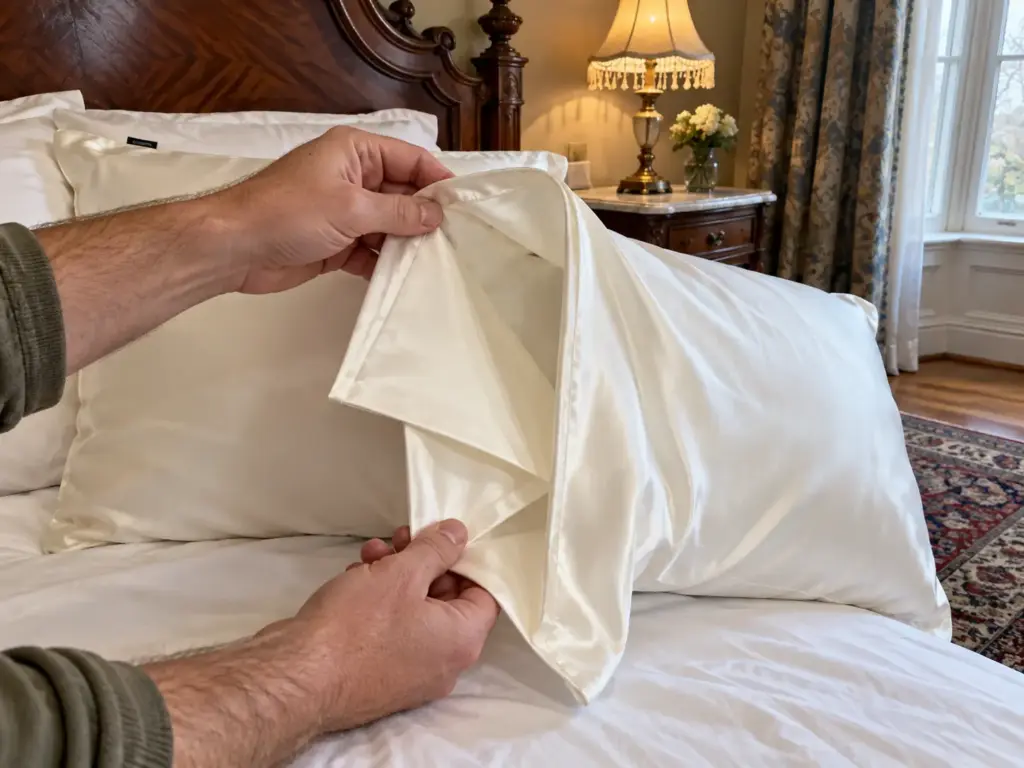
Every pillowcase has an open end, and on silk that end has two jobs: it has to keep a slick pillow inside a slick case, and it is the one place where the cloth gets stitched to hardware or folded back on itself. An envelope closure is an inner flap that tucks over the end of the pillow; a zipper closes the end with teeth sewn into a seam; an offset flap, the way Fishers Finery builds its side opening, sits in from the edge. The Spruce’s tester found out which one matters on a restless sleeper’s pillow: on a fabric as slippery as silk, the tester wrote, the invisible zipper is the line of defense against a pillow half out of its case by morning.
An envelope does the same job only if the flap overlaps deeply enough to stay tucked when the pillow gets shoved around, and the depth of that overlap is the number to look for in the photos. The full case for each closure, overlap measurements included, is in the full envelope-versus-zipper comparison.
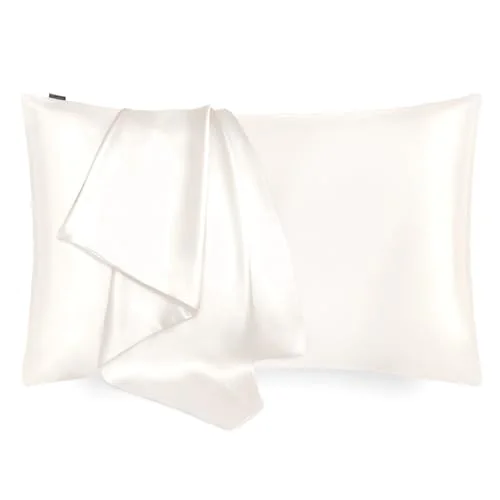
If you want a closure without a zipper and the spec printed in full, this is the case to look at.
The Seam Claim, and How Much of It Is Proven
One Wirecutter reader makes the case against zippers in capitals. Sewing a zipper in, the reader argues, “effectively creates not one but two rows of perforation along the entire width of the pillowcase,” and it is “double the horror if the seams are serged, which most are. French seams or no sale.” It is a vivid argument, and part of it rests on real mechanics.
Silk filament yarns are smooth, and smooth yarns slide against each other. Under strain, a line of stitches in a slick fabric can let the yarns beside it pull away, opening a row of small gaps next to the seam well before a single thread breaks; mills call this seam slippage, and every needle hole is a place where it can begin. A French seam folds the raw edge inside a second line of stitching, so there is no cut edge left to fray and the pull is spread over two rows. A serged seam wraps the raw edge in loops of thread, which stops the fraying but leaves the cut edge carrying the load.
But the other half of the argument is missing: a failure count. The same testers who report on these cases recommend zippered ones that held up through repeated washing and a year of nightly use, and The Spruce’s complaint about one zippered case was a few loose serger threads, a finishing flaw rather than a tear. So read the perforation line as one reader’s warning, not a finding.
The better call is to treat an envelope with French seams as a free tell worth looking for, not as a reason to rule out every zipper. Neither card on this page says French seams on its listing, and a “strong seam” describes a hope rather than a construction.
Turn a new case inside out before its first wash. A narrow closed tube with no raw edge showing is a French seam; a band of looped thread over a cut edge is serged. A serged case is not a reason to send it back, but it is the one to keep off the most restless pillow in the house and to wash in a mesh bag every single time.
When the Case Slides Off the Pillow
You wake up and the case has twisted a quarter turn around the pillow, the open end now somewhere near your shoulder and the pillow ready to slip off. That is silk against silk inside and silk against a cotton sheet outside, two low-friction surfaces stacked on each other, and the restless sleeper’s case gets worked loose a little more every night; a side sleeper who hugs the pillow pulls on it the same way. The same case that sits quietly in a still sleeper’s bed can wear first at its stitched edge in a restless one.
Size makes it worse, and the size printed on the listing hides it. Two cases that both call themselves a “standard” pillowcase print different dimensions: LilySilk lists 20 x 26 inches, Fishers Finery 20 x 28.
Those two extra inches of length are slack the pillow can travel into. (Queen and king pillowcases run longer still, so check which size your pillow is.) Measure your pillow before you order, pick the case that fits it snugly rather than generously, and if you are the one who turns all night, take the zippered or deep-envelope version; the comparison linked above walks through both.
Silk on One Pillow in a Shared Bed
So far the case has been one person’s decision. Most beds hold two people, and silk cases are mostly sold one at a time, so for a couple the buying question turns into two smaller ones: whose pillow, and what happens on wash day.

One Case Is a Decision About Whose Pillow
Wirecutter points out that most silk cases come singly rather than in pairs, and in a shared bed that is less of a problem than it sounds. Think of the usual split: one of you has long hair that knots overnight, and the other has short hair and a cotton case that would make no difference either way. One silk case goes on one pillow. The other pillow keeps its cotton, and nobody needs to convert the whole bed.
Mixing the two on one bed is fine. The cases never share a surface in a way that matters, and the cotton one will happily take the hot wash the silk cannot. What is worth a second thought is who sleeps how.
A stomach sleeper spends the night with a face pressed into the case and may like the glide; a hot sleeper who turns constantly may find it maddening the way a slick case lets the pillow skate across the sheet. The pillow under the case matters as much for that sleeper, and which pillow suits each sleeping position is a separate decision with its own measurements.
Two Cases, One Wash: the Rotation
A single silk case means that on wash day the pillow either goes bare or goes back to cotton, and the case comes back slightly worse each time. Two silk cases for the one pillow that wants silk solve both problems. Each case takes half the washes, so the clock in the next section runs at half speed, and the pillow never goes without.
The arithmetic is plain enough. Washed weekly, a single case reaches its twentieth wash in about five months; two in rotation reach it in about ten. One Spruce tester’s version of this is the shared-bed workaround in one sentence: the zippered case goes on the restless husband’s pillow when it comes up in the rotation, so the zipper goes to whoever moves most.
And there is a quieter outcome worth knowing about. The silk case usually ends up on the pillow of whoever wakes with tangles, and the partner’s ordinary cotton case, washed hot every week, tends to outlast it by a long way.
If you buy two silk cases, put both on the same pillow’s rotation rather than one on each pillow. Two cases sharing one pillow’s washes last about twice as long, and you learn whether the second sleeper even notices before you pay for a second pair.
The Wash Clock: When the Sheen Goes and the Case Follows
Week one lies for silk the way it lies for every fabric. The case is at its best straight out of the bag and starts losing its sheen within the first few washes, and that is when the real cost shows.
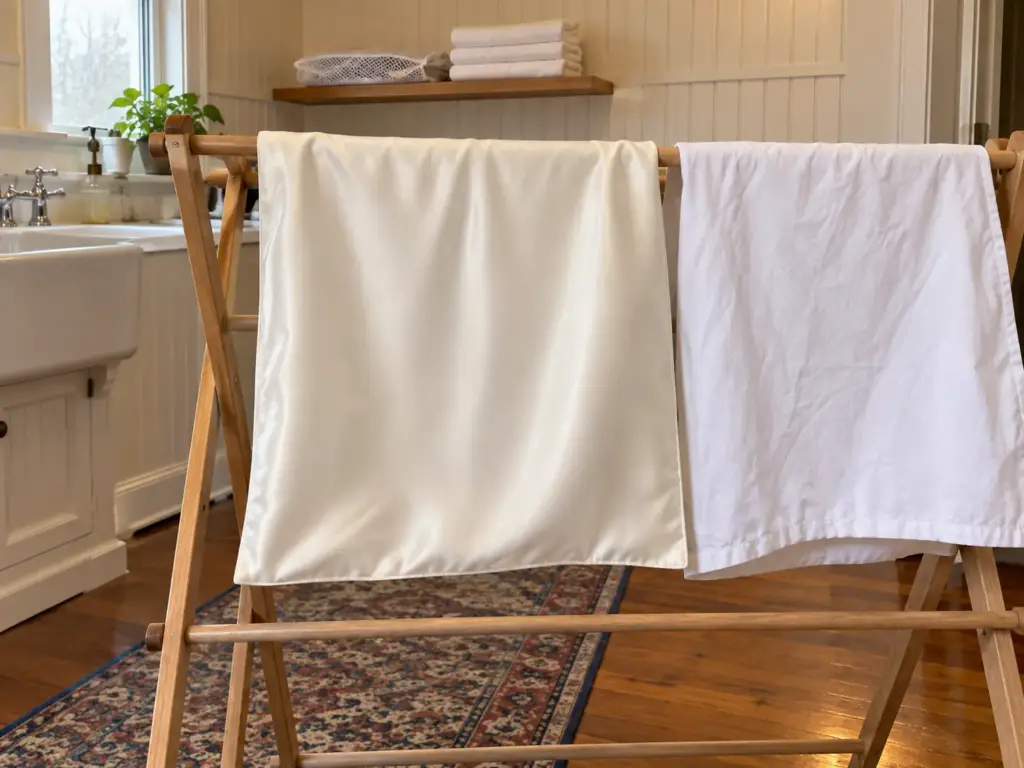
What Wash One Does to the Shine
The gloss on a new charmeuse case comes from its long floats lying perfectly flat and parallel, pressed that way at the end of finishing. Water relaxes the filaments and the surface loses that perfect alignment, so light scatters instead of bouncing off in one sheet. Wirecutter saw it on the LilySilk case: after the first wash it “assumed an almost matte finish that made it less slippery and more comfortable to sleep on.” It is the moment a lot of owners think the case broke.
It didn’t. It stopped looking like the photo.
The Spruce’s tester tracked a slower version on a heavier case. A 25 momme Fishers Finery “lost a little of its initial luster after … maybe six or so washes,” and since that is the case most people have washed and written about, it is the one to judge the clock by.
Other cases go faster or in different ways. A machine-washed case from another well-known brand “lost its original sheen and smoothness after a few washes” in The Spruce’s hands, and a third developed a slightly rippled surface over a year. Where you will see it first is not the middle of the case. The sheen goes at the fold lines, where the case gets creased in the drawer, and along the edge that rubs against the sheet every night, long before the face of the pillow looks any different.
Counting to Wash Twenty Against a Cotton Case
A cotton case can take hot water and a hot dryer, and at its twentieth wash it is still a pillowcase doing its job. A silk case washed cold and gentle reaches the same twentieth wash as a different question: how much of what you paid for was the sheen, and is it still there? That is the comparison to make before buying, and it works the same way for every layer on the bed, by counting washes, not years.
The reports from people who have kept silk for a long time spread wide, and they spread by how the cases were washed.
In the r/BuyItForLife thread, LilySilk owners describe cases “several years old” that “look as good as new” and “haven’t faded at all,” washed weekly with a gentle detergent and hung to dry, and another owner’s survived being “accidentally washed with regular sheets several times.” At the other end, a reader with a thin, inexpensive case machine-washed on gentle got two to three years out of it and concluded that “silk is never going to be a BIFL purchase.” A commenter comparing 22 and 23 momme thought the heavier one resisted abrasion better after many washes. Treat all of it as reports, not promises.
The care labels do not agree with each other, either. Fishers Finery’s says dry clean or hand wash, or a gentle machine cycle in a mesh bag, laid flat to dry; LilySilk’s allows hand or machine washing cold on gentle, hung to dry. The Spruce’s tester goes further and hand-washes all silk even when the label permits the machine.
The label sets the floor you should not go below; every step gentler than the label buys the case more washes, and how many of those you want to pay for in time is your call. Keep in mind too that the case and the pillow wear on separate schedules, and that the pillow’s own clock runs on fill, not on the cover.
Dye, Heat and the Care Label
Silk is a protein fiber, close kin to hair and wool. Many everyday detergents carry protease enzymes, which are built to break down protein stains, and on a silk case the protein they find is the case itself. That, more than superstition, is why every silk label asks for a mild or delicate detergent. Heat and strong alkali dull the filament surface too, and long hours of direct sun yellow and weaken it, which is why the labels say to air dry it out of the sun.
Dark silk adds one more risk, dye bleed. The Spruce flagged a deep red case from one brand for its “tendency to release dye,” with the advice to wash it separately, and anything that releases dye into the wash water will release a little into a pale pillow underneath when it is damp. A pillow protector under the case keeps the pillow itself out of that, and deciding on the washable layer underneath changes how much work the silk case has to do on its own.
Wash a new dark silk case alone for its first few washes, in cool water, and look at the water before you pour it out. Tinted water means the dye is still moving, so keep it away from pale sheets and off a pillow without a protector until the rinse comes out clear.
When a Cotton Case or a Bonnet Does the Same Job
After the label, the pillow, the seams, the shared bed and the wash clock, the last question is whether silk was the right tool at all. For many sleepers, a cheaper layer already does most of the work.

The Cheaper Layer That Cuts Most of the Drag
Think of it as a ladder, and climb only as far as you need. A loose braid costs nothing and cuts the number of strands that drag at all. A smooth cotton case in a tight sateen weave cuts a share of the drag and takes a hot wash without complaint.
A satin bonnet cuts more, because the slick surface moves with your hair instead of staying on the pillow. Only after those does silk come in, and even then the 19 momme rung is the low-risk way to try it; the 22 and 25 momme cases are for the sleeper who has already decided and is ready to wash on a clock.
Polyester satin sits off to the side of that ladder. It does a similar drag-cutting job on the hair, but it holds the night’s damp on its surface, sleeps warmer, and snags like any satin weave, so the label from the first section is how you tell it apart from silk before you pay. And for the whole stack around the pillow, the case, the protector and what each one is for, the place to start is what each pillow layer actually does.
When It Isn’t the Pillowcase
A pillowcase is a thin layer, and there is a lot it cannot touch. If your neck or shoulders ache in the morning, the cover is the wrong suspect: the height and firmness of the pillow underneath decide that, and changing the case will not move it. A skin or scalp complaint that stays the same whatever case is on the pillow is a question for a doctor, not for the bedding. Back on the bed, what a pillowcase can change is friction, a little moisture at the surface, and how the cloth feels against your face.
That last one is why silk stays on the pillows where it stays. The sleepers who keep using a silk case years in tend to be the ones who bought it for their hair and kept it for the feel against their face, not for anything the package promised.
Two Numbers, Two Edges, and a Braid First
Three things decide whether a silk pillowcase earns its place on your bed:
- The label has two numbers that matter. Mulberry, so you know the fiber, and a momme near 22, so you know the weight. Above that line you are buying washes, not softness.
- The case fails at its edges and in the wash. The closure and the seams give out before the face does, and the sheen fades at the folds within the first handful of washes.
- A braid or a cotton case comes first. They tell you for nothing whether drag was ever the problem.
Months from now, run your fingers along the fold lines and the edge that rubs the sheet, then turn the case inside out and look at the seam beside the opening: dull folds are the sheen doing what sheen does, but yarns pulling away from the stitch line mean the case is near its end.
Tonight, before you order anything, braid your hair loosely and sleep on the smoothest cotton case you already own. Then pay attention to the knots and the frizz over the next two weeks of mornings, because they will tell you whether a silk case is worth buying at all.
Frequently Asked Questions
01Is it worth getting a silk pillowcase?
A silk pillowcase is worth it if your hair tangles or frizzes against cotton and you are willing to wash the case gently on a schedule. It cuts drag on hair and skin and treats nothing. Try a loose braid or a smooth cotton case first, since both are free.
02What is the best silk pillowcase to buy?
The best silk pillowcase is the one whose label prints mulberry silk, a momme between 22 and 25, a 6A grade and silk on both sides. Then check the closure: an envelope with a deep overlap, or a zipper if you move a lot, in a size that fits your pillow snugly.
03What are the disadvantages of a silk pillowcase?
A silk pillowcase loses its sheen within the first washes, slides on the pillow and the sheet, and wears first at its closure and seams. Dark colors can release dye, it needs a cool, gentle wash, and most cases are sold one at a time, so a shared bed means deciding whose pillow gets one.
04Can I just put my silk pillowcase in the washing machine?
Only if its care label allows it, and many do on a cold, gentle cycle inside a mesh bag with a delicate detergent. Some makers ask for hand washing, and one tester saw a machine-washed case lose its sheen within a few washes.
05What does momme mean in silk pillowcases?
Momme is a weight, not a quality grade: one momme equals about 4.34 grams of silk per square meter. In pillowcases, 19 momme is entry level, 22 is the threshold for a good case, and 25 is the heavier, longer-lasting tier.





Tried it on your own bed?
No comments yet. Tell us what you changed, and what the sheet did after a few washes.