







What’s in here10 sections
- Three Layers, Three Jobs, One Order
- The Case: Choose It by Fiber and Weave
- What a Protector Is Made Of, and Why Breathability Sets the Ceiling
- The Closure: Why a Protector Creeps, and What Holds It
- What the Label Hides: “Waterproof”, “Hypoallergenic” and the Only Number That Counts
- Size: A Class With Slack, and Why the Wrong One Changes the Pillow
- Wash Cadence by Layer, and What Wash Twenty Does to the Barrier
- Two Sleepers, One Bed, and When It Isn’t the Cover
- Start With a Second Case, Then Listen to the Protector
- Frequently Asked Questions
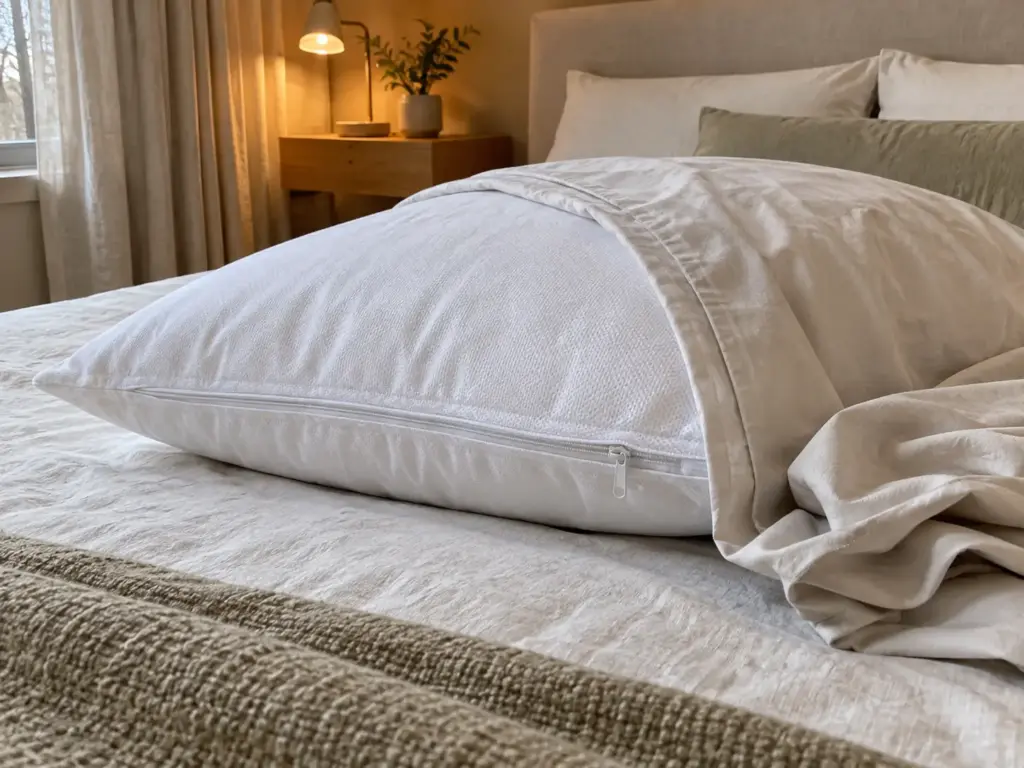
You zipped a protector onto the pillow on Sunday, slid the case over it, and by Thursday a white corner of the protector is poking out of the case’s open end, so your cheek lands on a slick, faintly crinkly fabric instead of the cotton you picked. That small slide shows how pillow cases and protectors usually get treated: as one purchase with two names.
They are two jobs done by two very different fabrics. The case is a woven surface, judged by how it handles skin, heat and moisture; the protector is a closed barrier whose construction decides how much air and vapor get through, and each one wears out on its own schedule. Below is the pillow as three layers, then the case, the protector, the closure, the label, the size, the wash, and the two situations where the cover is not what needs changing.
Quick Answer
A pillowcase and a protector are two layers, not alternatives. The protector goes on the bare pillow first and closes; pick it by what it blocks and how much air it passes, not by the word waterproof. The case goes over it as the surface you sleep on, chosen by fiber and weave. Use both, in that order.
Three Layers, Three Jobs, One Order
The two words get swapped as if buying one let you skip the other, and most of the confusion starts there. Before any fiber comes into it, the table gives each layer its job, its place in the stack and the thing it is judged by.
| Layer | Its job | Where it sits | What decides the choice | How often it is washed |
|---|---|---|---|---|
| Pillowcase | The surface you sleep on | Outermost, open at one end | Fiber and weave | Weekly, with the sheets |
| Protector | Catches sweat, skin oil and dust before the pillow does | On the bare pillow, zipped or flapped shut | What it blocks and how much air it passes | A slower clock, set by its care label |
| Pillow | Loft and support | At the center | Fill and loft for how you sleep | Rarely; replaced by fill and age |
The case is the surface you sleep on
The pillowcase is the only layer your face touches, so it takes the sweat, drool and face oil first and goes in the wash every week. It is also chosen last. A case changes what the surface feels like and how fast it gives up heat, but it cannot add a single inch of loft, which is why it comes after you settle pillow loft and sleep position, never instead of it. The week shows on the case before it shows anywhere else: the edge you sleep on creases and softens, and the open end, where hands push the pillow in, is where the hem starts to fray.
The protector is the layer that closes around the pillow
Consumer Reports describes a protector as an additional layer that sits between the pillow and the case, closing with a zipper or a fold-over flap. So the layer order runs pillow, protector, case, and the difference that matters is the word closing: the protector shuts around the pillow on every side, while the case only slips over it and stays open at one end.
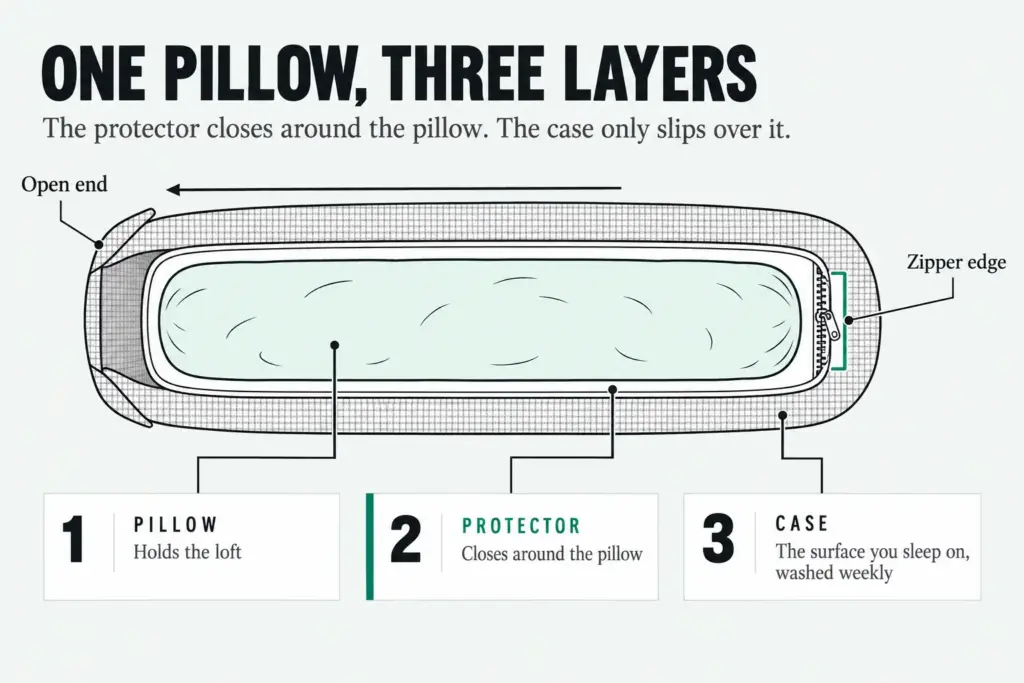
That closed layer is the functional one. One commenter in r/NoStupidQuestions put it as an undershirt and a dress shirt: the protector does the dirty work underneath, the case is the part you chose for how it looks and feels.
In effect the protector is the hygiene layer and the case is the comfort layer. Its real job is catching the oil and sweat that would otherwise soak into the pillow shell, which is what a protector actually does to a yellow stain: it moves the stain onto a layer you can wash. It is not a sleep surface. Most protectors carry a lining or a film that is stiffer and louder than any case, and the cotton-faced ones are made to absorb, which is the wrong property right under your cheek.
And when a protector creeps half out of the case by midweek, that is a fit problem, not bad luck. Two slick layers slide against each other, and a protector that is smaller or slipperier than the case has room to travel every time you turn the pillow over.
Count cases before you buy a protector. With two cases per pillow, one is always clean, so you can change the surface midweek without waiting for laundry day, and the protector underneath gets dirty more slowly. Several buckwheat-pillow owners in r/Bedding skip the protector entirely and just rotate two cases; it costs nothing to try for a month and see what the pillow still needs.
Where covers and shams fit
A pillow sham is a decorative case, usually with a flange or a back opening, meant for show pillows rather than for sleeping on; the square Euro sham that stands behind the sleeping pillows is the common one. A pillow cover is either the same idea for a throw pillow or a second case under another name. Neither closes around the pillow like a protector does, so neither protects it.
The Case: Choose It by Fiber and Weave
The case is the layer that touches skin, so fiber and weave decide how the pillow feels the first night and a month in. It is also the one layer you can change for free tomorrow, by pulling a different case out of the closet and sleeping on it for a few nights before deciding anything else.
Percale and sateen: the same cotton, a different hand
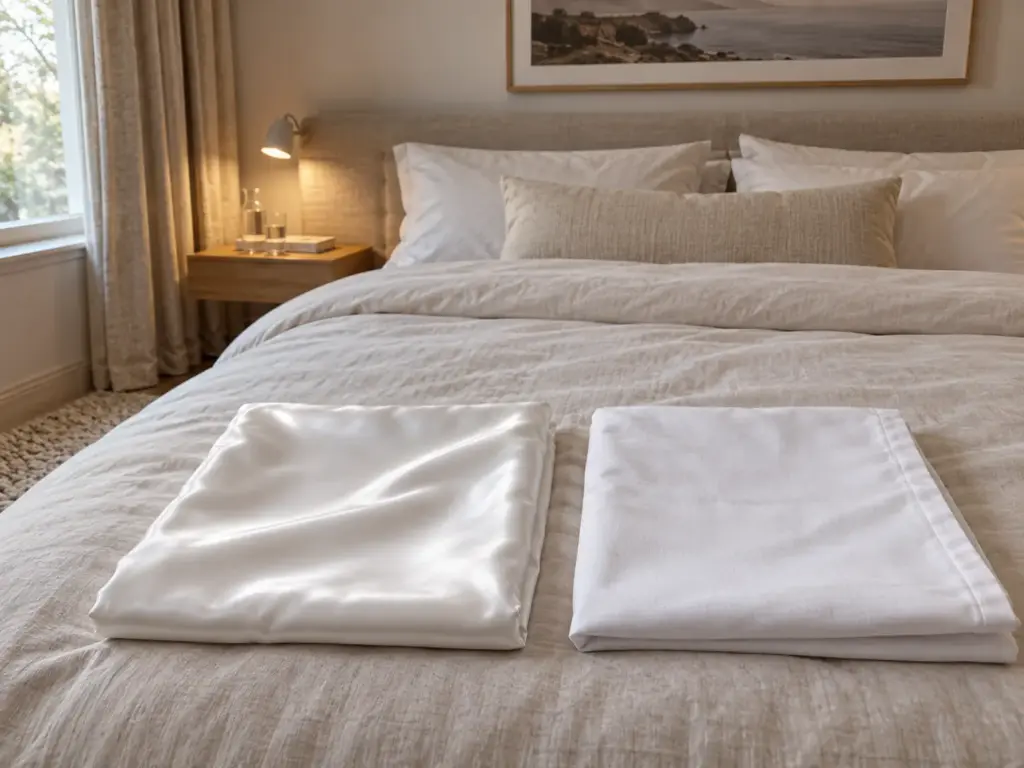
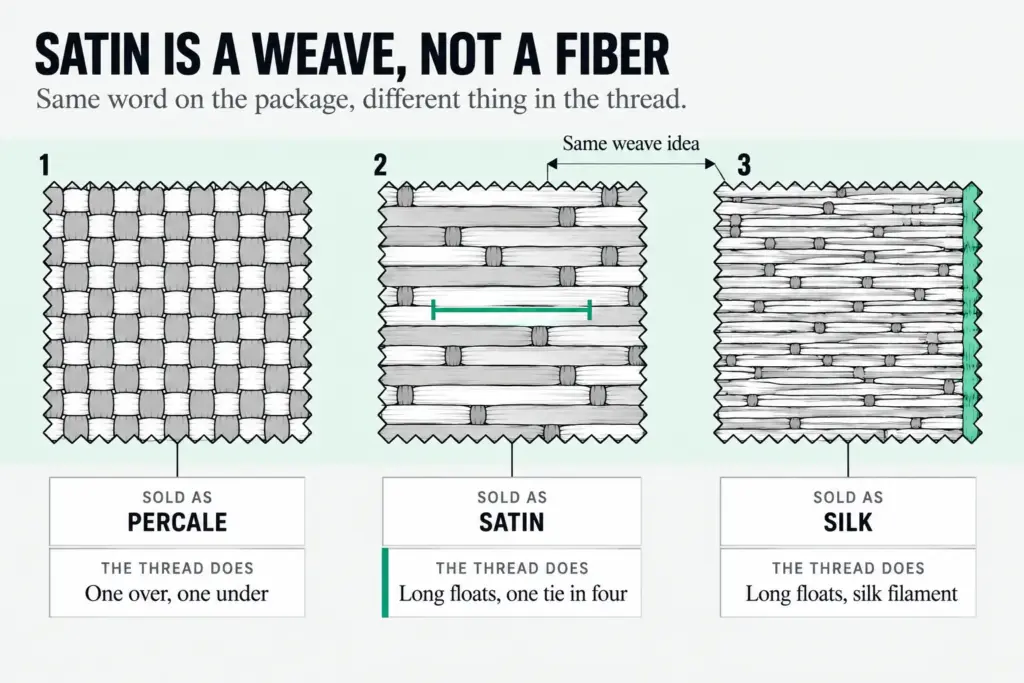
A cotton case is usually one of two weaves, and the fiber can be identical in both. In percale, each yarn goes over one crossing yarn and under the next, so every crossing locks and the cloth comes out flat, matte and full of tiny openings between threads. In sateen, a yarn skips across several crossing yarns before dipping under one, so long runs of thread lie on the surface. Those runs are what make sateen smooth and drapey, and they pack the cloth more tightly, which is why it holds a little more warmth against your face.
The whole comparison lives in sheet weaves by what the thread does; on a pillow, it decides how fast the surface lets go of heat. The label adds its own noise: Egyptian cotton names a country, while extra-long staple names the fiber length that makes a finer yarn.
For someone who flips the pillow looking for the cool side, percale is the better case, because the open weave lets moisture leave instead of sitting in the cloth. Sateen feels cooler for the first second because it is smooth, and then that density holds what your head gives off. It also shows its use in a particular place: the sheen dulls first on the half of the case your cheek rests on, while the far half stays shiny. A new percale case, meanwhile, often feels stiff out of the package (some of that crispness is finish, not cotton), and the real hand shows after the first few washes.
If you want a percale case with its spec stated, the Feather & Stitch 100% Cotton Percale Sheet Set is single-ply percale at 300 thread count, as the maker states it, and the pillowcases come in the set. That is the catch with it as a case purchase: you are buying fitted and flat sheets to get two cases, and the reviews are about the sheets, so there is little track record on the cases themselves. If your sheets are fine, a set is a lot of cloth for a case problem.
Silk is a weight, and satin is a weave
Silk cases are sold by momme, which is a weight of the cloth, how much silk goes into it. More momme means more silk in every square inch, a denser cloth and more material to wear through before it thins, so the number tells you more than the word mulberry does. The construction side, and why momme matters more than the fiber name, is covered in momme and construction, not fiber. Satin is a different kind of word. It names a weave, the same floating construction as sateen, usually woven from smooth filament yarn, and a satin case can be polyester (often sold as microfiber) or silk. When the label says satin and nothing else, assume polyester until it says otherwise, because polyester takes in almost no moisture and sleeps very differently from silk.
The Cuddledown Mulberry Silk Pillowcase is an example of a silk case with the weight printed: 22 momme, grade 6A, 100% mulberry silk, OEKO-TEX Standard 100 certified, with an envelope closure, all per the maker. Its weak point is the listing, not the silk. The page opens on the Boudoir size, 16.5 by 12.5 inches, with only a handful of ratings and one 1-star review, so the default selection will not fit a bed pillow. Pick the size variant before anything else, on this listing or any silk listing.
Care, per the maker, is a gentle cycle and air drying, and the hem and corners are what snag first in a household wash, so a mesh bag earns its place. For a hot sleeper, read why silk cools at first and then stops before choosing silk for temperature.
Bamboo, linen and what the label leaves out
Bamboo on a case is bamboo viscose: plant cellulose dissolved and spun into a new fiber, and the process decides how it wears far more than the plant does. It takes in moisture well and feels cool and slippery at first, but it loses strength when wet and tends to pill where the cheek rubs. Linen goes the other way, coarse for the first washes, softer with every one, and always full of wrinkles. Both labels name a fiber and stay silent on the weave and the weight, which are the two things that decide how the case sleeps.
What a Protector Is Made Of, and Why Breathability Sets the Ceiling
People buy a protector to keep the pillow safe, and fair enough, it does that. It is also the least breathable thing on the pillow, so what it is made of decides both the noise you hear when you turn your head and the warmth you feel an hour later.
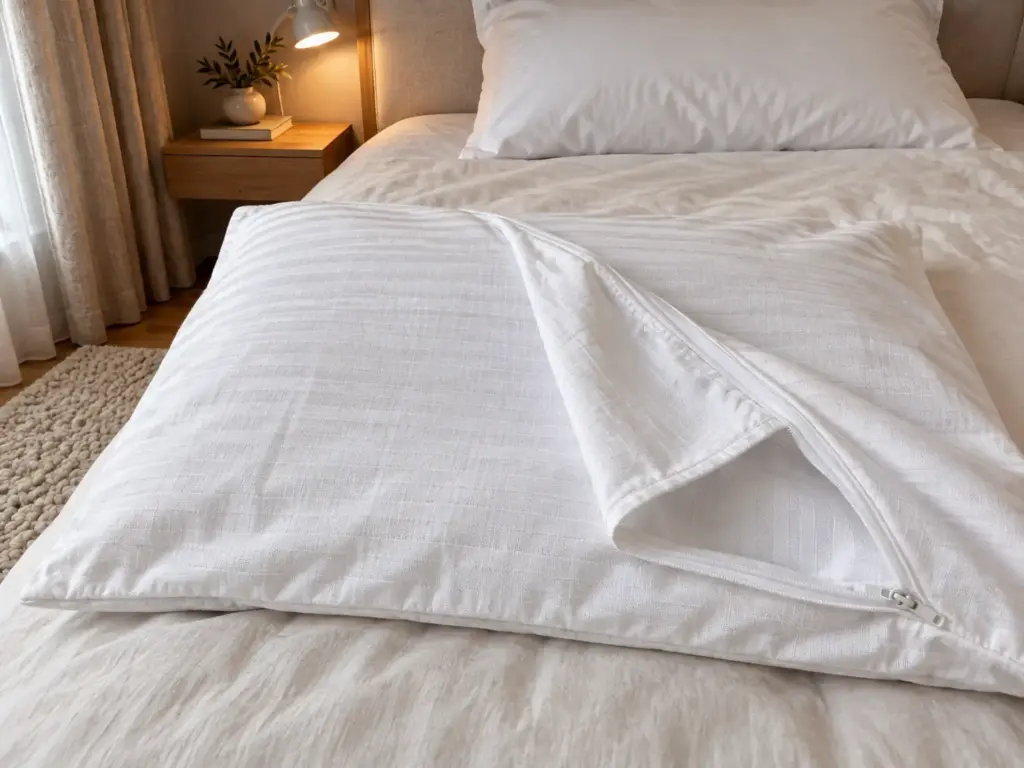
A woven cotton face, or a knit with a laminate behind it
Protectors come in two main constructions. The first is a woven cotton face, where the barrier is the density of the weave itself: the yarns sit so close that dust and most particles stay out, while air and water vapor still find the gaps. The second is a knit face, usually polyester jersey, bonded to a thin TPU film. Here the film is the barrier, and it stops liquid completely, which is the point of it, but vapor gets through slowly if at all.
Waterproof gets sold as the safe default, and for a pillow at risk of spills it is. For a warm sleeper on a foam pillow, though, a sealed film under the case is the wrong layer, and a tightly woven cotton face covers the dust and oil without closing the pillow off from air. These two packs show the two constructions side by side.
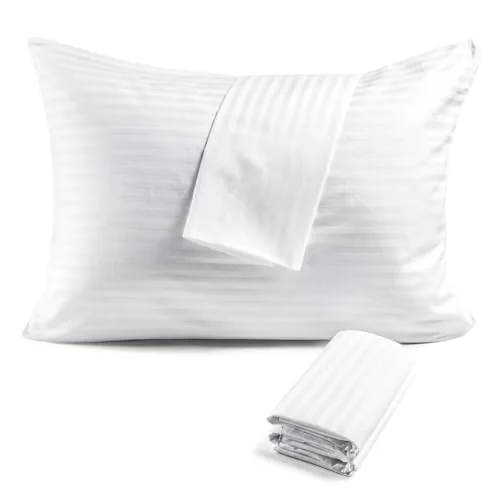
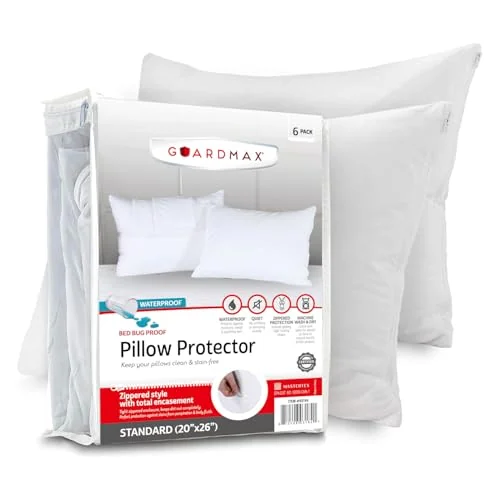
The balloon in that review is worth picturing. A sealed cover holds a pocket of air, and when your head lands, that air has only the zipper to escape through, so it pushes back, rustles, and leaks out slowly under your ear. It is a noise problem and a heat problem at the same time.
The least breathable layer sets the ceiling
The membrane decides most of it. Solid vinyl (PVC) is impermeable and traps heat; TPU and polyurethane films are thinner, quieter and let more vapor through, the same distinctions laid out for mattresses in the backing that traps heat.
On a pillow the effect is concentrated, because your head sits in one spot for hours. The moisture you give off in the night would normally pass through the case and spread into the fill. With a film underneath, it stops at the film and stays in the case, which is why a sealed protector can make a percale case feel clammy by morning even though the percale itself vents perfectly well.
So the protector caps what the case can do. A well-chosen percale on top of a sealed film sleeps closer to the film than to the percale, and the same rule runs through the whole bed: one closed layer is the layer that undoes the rest of the set.
To tell a woven barrier from a sealed one when the package will not say, press a single layer of the protector to your lips and blow. Through tight cotton you feel a faint stream of warm air on the other hand; through a laminated knit you feel nothing, and the fabric puffs out instead. Whatever your breath cannot get through, the moisture from your head cannot get through either.
Encasement vs protector
An encasement is a protector taken to the end of the idea: it zips the whole pillow shut along a long side, with no loose flap, so nothing goes in or out except through the fabric. The HOSPITOLOGY Pillow Encasement Sleep Defense System is one example, a polyester knit face over a membrane the listing calls breathable and waterproof, in standard 20 by 26 inch, sold in a 2-pack. The closed design is also its drawback: air gets trapped inside, and the buyer summary on the listing shows mixed opinions about the airtightness, across 232 mentions. An encasement suits a pillow you want fully sealed and loses to a woven protector on a pillow that already sleeps warm.
The Closure: Why a Protector Creeps, and What Holds It
Construction decides how the protector breathes; the closure decides whether it stays put. It is also where the protector and the case meet, so most midweek problems start here, and there are only two ways it is done.
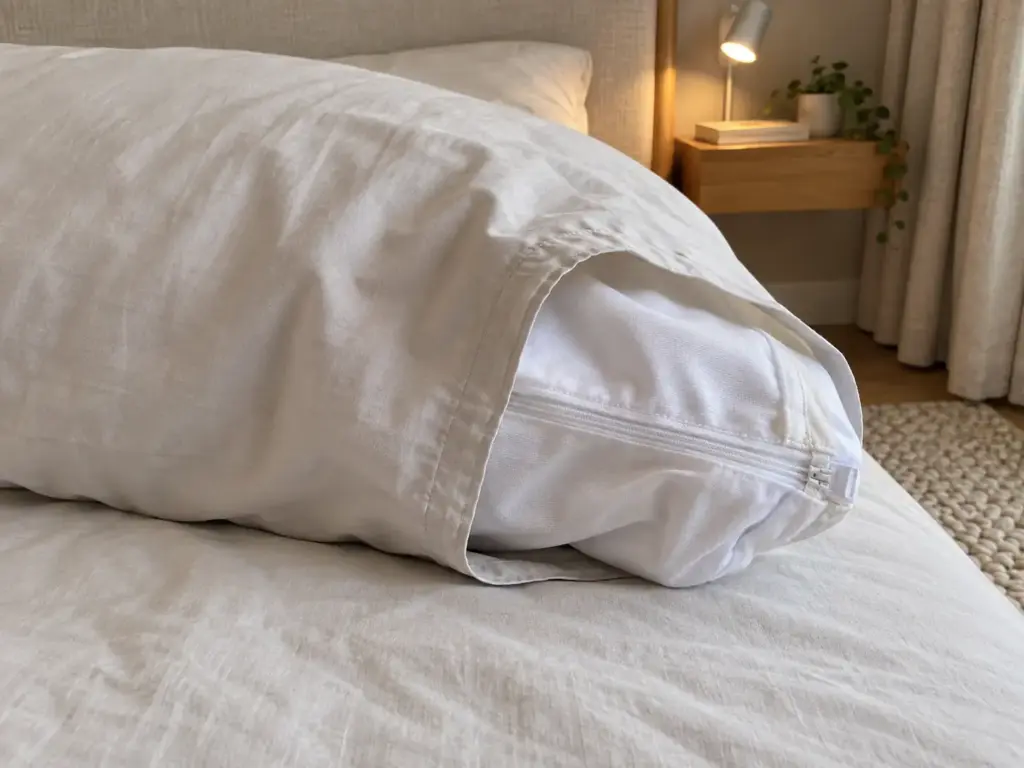
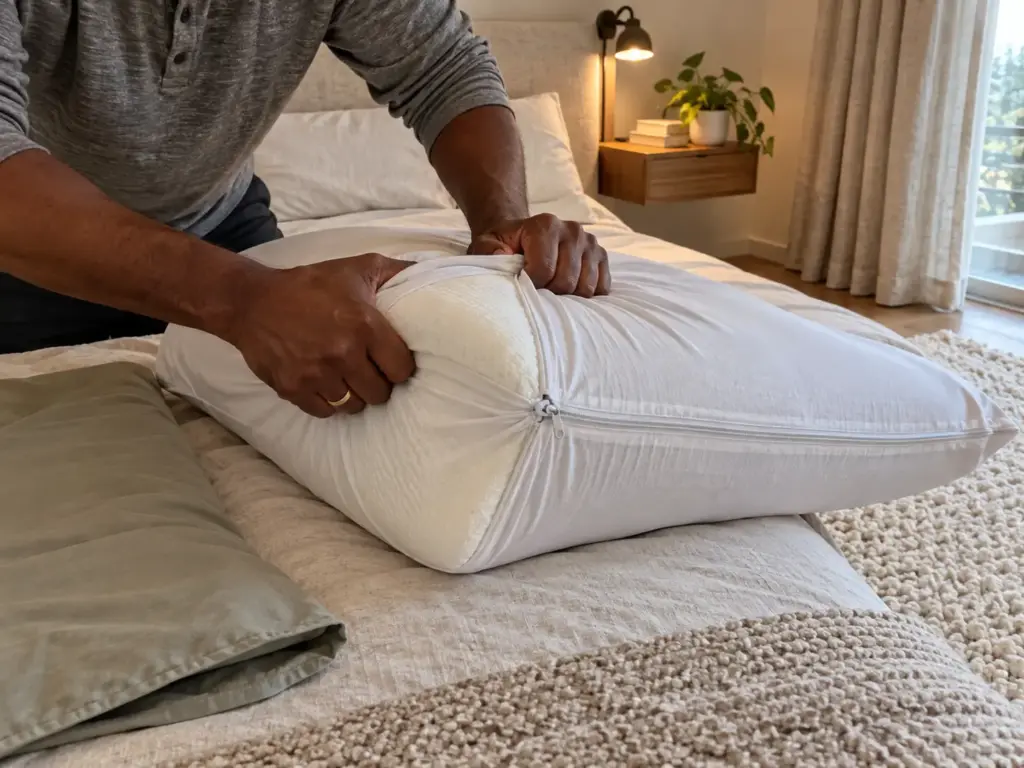
The zipper on the protector
The zippered protector is the common kind: most close with a zipper along one short end, some with a fold-over flap. The zipper is where wear and noise show first. The pull end takes every tug of every wash, and the last few teeth near the corner get strained when a full pillow is forced into a protector that is barely big enough. A reviewer of a popular allergy protector reported that its zipper could come undone from time to time, which turns a closed barrier into an open bag one night at a time.
Slide the pillow into the case zipper end first, so the zipper sits at the closed end of the case. Well, mostly: if you sleep near the closed end, turn it around, because the pull belongs wherever your cheek is not. Kept away from the opening, a raised tooth also stops catching the case’s hem every time you strip the bed.
The envelope on the case, and the protector that slips inside it
Cases close in their own ways. An envelope closure is an inner flap at the open end that the pillow tucks behind, and the silk case’s listing claims it keeps the pillow “snugly in place”. It holds the pillow inside the case. It does nothing to hold the protector inside the pillow’s case, and that is the complaint people repeat.
In an r/NoStupidQuestions thread, someone summed up the night a protector slides off: “When the first one falls off during the night, you sleep on the most uncomfortable pillow possible.”
A protector a size too large travels; one a size too small never slips at all, but it squeezes the pillow, which is a different problem. Whether a zippered case beats an envelope one is a question of its own. At this level, the point is that a slipping protector is about fit and friction, and a flap on the case keeps the stack in place better than an open end does.
What the Label Hides: “Waterproof”, “Hypoallergenic” and the Only Number That Counts
A protector package is crowded with claims, and only one of them comes with a test you can read. That test belongs to a certifier, not the maker, and it is more honest about washing than any of the words around it.
The one test with numbers on it
For a protector meant to keep dust mites out, Consumer Reports says the label should show a fabric pore size of no more than 6 microns and the words woven fabric. Certified protectors carry Certified Asthma and Allergy Friendly or Meets Certification Standards, from the program run by the Asthma and Allergy Foundation of America (AAFA). Its test requires blocking more than 99 percent of dust mite allergens before the first wash and 95 percent after 18 washes. Read that second number again: the certification itself admits the barrier loses some ground by wash eighteen.
Wash durability is the number nobody prints. According to Consumer Reports’ pillow protector guide, “Just remember that repeated washings can degrade a pillow protector’s permeability.”
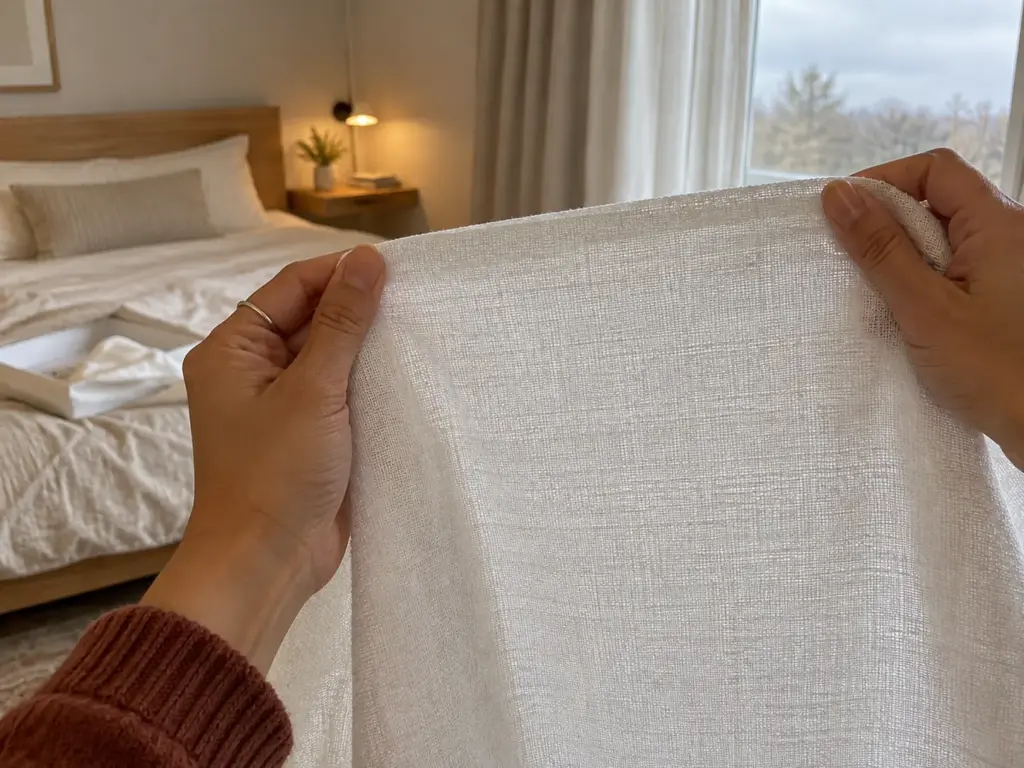
Keep the scope of that test in mind. It counts particles the fabric stops in a lab; it says nothing about how anyone in the bed feels, and it was never meant to. You cannot see 6 microns, either, but you can see tight from loose: hold a single layer up to a bright window in the store or at home, and a dense weave shows an even haze while a loose one shows pinpricks of light.
Thread count on a protector
FAUNNA prints 600 thread count on its cotton protector, with no ply stated. A count that high often means plied yarns counted more than once, which is why a 600 thread count is often 300 counted twice, so treat it as a claim about the yarn, not about the barrier.
The opposite worry comes up too. In r/Bedding, a buckwheat-pillow owner doubted that a “300TC cotton claiming to be an allergen protector” could do anything, since it “seems too thin to work.” A thin cotton can still be tightly woven. Thickness is not the test, and neither is the count: the pore size and the word woven are the things to look for.
Words with nothing behind them
Hypoallergenic has no number attached on any protector label. An antimicrobial coating is a finish, and finishes leave in the wash; the package never says how many washes it lasts. Waterproof tells you liquid stops and nothing about whether vapor passes, which is the property that decides heat. Water-resistant is the same claim at a lower volume, with no number behind it either.
Moisture-wicking is a finish too, and it leaves the same way. Bamboo on a protector is viscose, as on a case. Six words, zero measurements.
Size: A Class With Slack, and Why the Wrong One Changes the Pillow
Pillow sizes are sold as classes with slack built in, and on a protector that slack does not stay slack. It goes into the pillow.
Standard, queen and king, and the case that goes over them
The classes, as most listings give them: standard pillows run 20 by 26 inches, queen 20 by 30, king 20 by 36. Cases are cut a little larger than the pillow they are named for so it slides in, so the case size on the label is never the pillow’s exact size, and how much larger varies by brand; a queen case on a standard pillow is just a looser fit, not an error.
Odd shapes fall outside the classes altogether. Buckwheat pillows, king contour pillows and long pillows rarely fit a standard protector, and the long ones take their own case, which comes up in body pillows, by length and fill. Natural fibers make it worse: an r/Bedding buckwheat owner’s case “shrank in the washer/dryer” until it no longer fit. Getting the fit exactly right for each pillow shape is a topic of its own; the class is only the starting point.
A protector that is too small firms the pillow
A protector is meant to follow the pillow, not shape it. When it is too small, it compresses the fill on every side, and you end up sleeping on the same pillow with less loft and more firmness. FAUNNA buyers report exactly that pattern on standard-queen foam pillows, made worse by slight shrinkage after the first wash.
The common rule is to buy the protector in the size printed on the pillow’s tag. That holds for down and fiberfill, which squash to fit. A thick foam pillow does not squash, and a sealed protector needs room for its trapped air, which is why the Guardmax reviewer put a queen protector on a standard pillow.
For those two, one size up is the right number. If you can only close the zipper by flattening the pillow first, the pillow you will sleep on is the flattened one.
Measure the pillow across its fullest point with a soft tape, not along its flat edge, and compare that girth with the protector laid flat (width times two). A foam pillow that measures more than the protector’s girth will be squeezed; go a class up. Do it again after the protector’s first wash, since that is when cotton shrinks.
Wash Cadence by Layer, and What Wash Twenty Does to the Barrier
Each layer runs on its own clock, and the protector is the one usually judged brand new, before a single wash. The laundry is where it shows whether it was a good buy.
The case goes in the weekly load
Cases go in with the sheets in the weekly wash; they are the layer that touches skin, so that is the minimum. For an allergy-minded household, Consumer Reports relays advice from the Asthma and Allergy Foundation’s chief mission officer to wash bedding weekly in hot water, and the case belongs in that load; the right order for washing bedding covers what goes in first. With a second case per pillow, you can also swap the surface midweek without touching the protector.
That weekly load is also what ages a case, and each weave ages in its own place. Percale thins and softens where the cheek rests; sateen loses its sheen there first and can pill along the long surface threads; silk dulls faster in a hot wash and a hot dryer than it ever does on the pillow, which is why its makers ask for a gentle cycle and air drying. A case worn thin enough to show the protector’s color through it is done, whatever the calendar says.
The protector runs on a slower clock
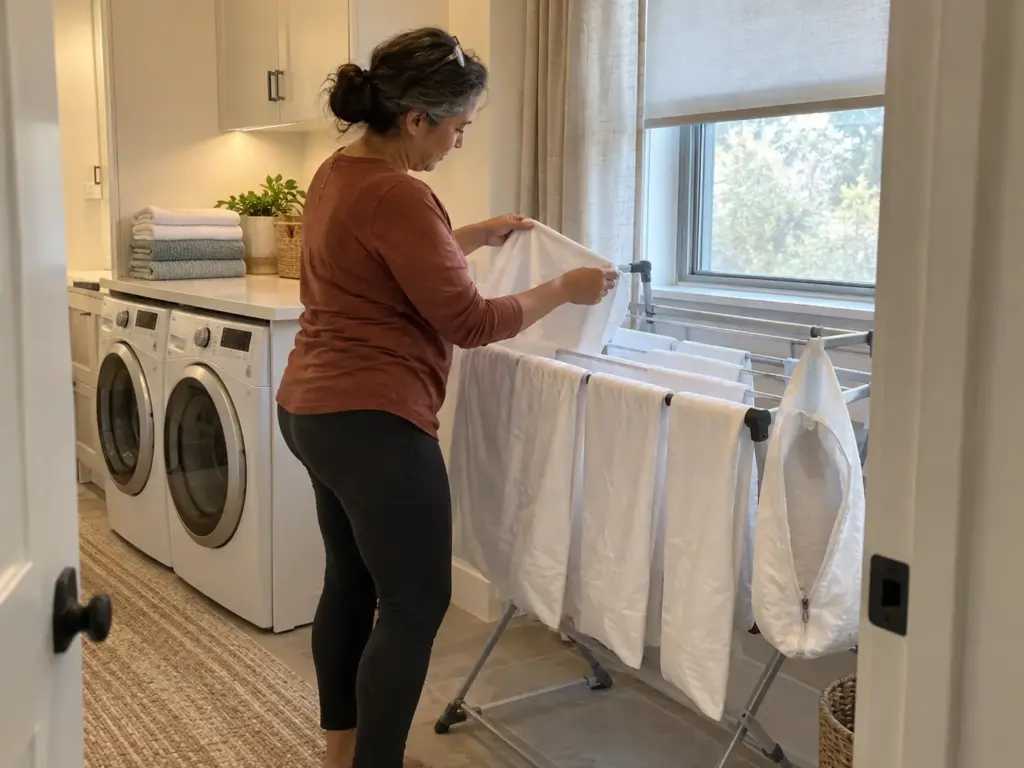
Protectors are not part of the weekly load by default. Monthly is the usual brand advice, and the care label beats any number here, including this one.
Now run that against the certification: the test stops at 18 washes. Washed monthly, a protector reaches eighteen washes in about a year and a half; thrown in weekly with the sheets, it gets there in about four months. Same protector, very different replacement date.
What changes first is the sound, not the look. A laminate gets stiffer as it ages and hot drying, so the crinkle under your ear grows louder well before you see anything wrong. A cotton protector shrinks instead, and the first wash shows most of it, so read the care label before that wash and tumble low if the label says low, never hot. Each layer aging at its own pace is the idea behind four clocks, not one lifespan.
Write the date you put a protector into service on its care label with a laundry marker. Monthly washing gives you roughly eighteen months before it passes the wash count its certification was tested to; the date turns that into something you can check instead of guess.
The pillow has its own clock, and it is not the wash
The pillow runs on its pillow fill and its age. A protector slows the yellowing and the grime, but it does nothing for loft, and the fold test tells you more than the calendar; how often to replace pillows, by fill walks through it. Washing the pillow itself is a separate decision from washing either cover, and many pillows take it badly (see a pillow that turns yellow after washing), so the pillow’s own care label decides that one.
Two Sleepers, One Bed, and When It Isn’t the Cover
Two pillows in one bed rarely age at the same speed, so one set of layers is rarely right for both. And this is also the place to draw the line between what the bed can fix and what it cannot.

Two pillows, two clocks
When two people share a bed, one usually sleeps warmer, one may drool or use a face cream, and one pillow gets more weight than the other. Treat them as two stacks. Each pillow gets its own protector with its own start date, and each gets two cases (the second is the spare case), so either sleeper can swap the surface without waiting for the other’s laundry day.
If one sleeps hot, that pillow gets the woven protector and a percale case; the other can take silk or sateen without anyone compromising. That split is a judgment from how the layers work, not a rule from a test, but it costs nothing beyond the cases you already own.
The wear shows in an odd way on a shared bed. A pillow that one person always sleeps on from the same side goes flat on that side and stays firm on the other, while the case on top looks identical on both pillows. The cover tells you nothing about what is happening inside.
When a flat, warm or yellow pillow is not a cover problem
A flat pillow is a fill problem, and a yellow one is mostly an age problem: a protector delays both and rescues neither. If the pillow fails the fold test or has gone yellow through the shell, a new cover will only hide it, and why pillows turn yellow and which ones come clean explains which ones are worth washing and which are done. A pillow that sleeps warm under a woven protector and a percale case is usually a fill or foam question, not a cover question.
If itching, congestion or wheezing keeps showing up whatever is on the pillow, that is a question for a doctor, not for a new protector. Everything this guide covers stays on the bed side: what the layers are made of, how they close, how they are washed and when they are replaced.
Start With a Second Case, Then Listen to the Protector
The pillow is three layers, stacked pillow, protector, case, and none of them can do another’s job: the protector closes and catches, the case is what you sleep on.
The protector is chosen by what it blocks and how much air it passes, a woven face for a warm sleeper and a sealed film only where liquid is the real risk. The case is chosen by fiber and weave, with percale for heat and momme, not the word satin, for silk.
Each layer has its own wash clock: the case weekly, the protector on its care label’s slower schedule toward the eighteen washes its test admits, the pillow by its fill.
After months of washing, listen to the protector before you look at it: a crinkle that has grown louder, a stiffer feel, or a zipper that no longer closes cleanly tells you the barrier is wearing before any stain does.
Tonight, put a second case into rotation for each pillow and swap it in midweek, then notice whether the pillow still feels warm or sticky by morning; if it does, the layer to look at is the protector underneath.
Frequently Asked Questions
01Do I need a pillow protector if I use a pillowcase?
Usually yes, because they do different jobs: the case is the surface you sleep on, and the protector closes around the bare pillow underneath to catch sweat and oil. A second case in rotation is the free step to try first.
02Are pillow protectors the same thing as pillowcases?
No, a protector sits between the pillow and the case, closes with a zipper or flap, and is judged by what it blocks and how much air it passes. A case is the sleep surface, chosen by fiber and weave.
03Do you need to wash pillows if you use protectors?
Less often, because the protector takes the sweat and oil first, but the pillow still keeps its own clock set by its fill and the fold test. Its care label decides whether and how it can be washed.
04Is it worth getting pillow protectors?
It is worth it on a pillow you want to keep clean and wash less, as long as the protector passes air. A sealed one on a pillow that already sleeps warm can cost more comfort than it saves.
05Can you sleep on a pillow protector without a pillowcase?
You can, but it is not made to be a sleep surface: most are stiffer and noisier than a case, and cotton-faced ones absorb right under your cheek. Think of it as the undershirt; the case goes on top.





Tried it on your own bed?
No comments yet. Tell us what you changed, and what the sheet did after a few washes.