







What’s in here11 sections
- How to Read a Pillow Fill Label (and What It Leaves Out)
- Down and Feather Pillows — What They Keep and What They Lose
- Polyester and Down Alternative — Why It Mats and Does Not Come Back
- Memory Foam, Solid and Shredded — Two Pillows Under One Name
- Latex Pillows — Shredded, Solid, and What Talalay Means
- Buckwheat, Wool, Kapok and the Minor Fills
- Heat Comes From Structure and Cover, Not the Word Cooling
- Choosing by Sleeper and Shared Bed, Free Fixes First
- Washing, Protectors and the Months After — What Each Fill Allows
- Read the Tag, Fold Before You Buy
- Frequently Asked Questions
You pull the pillow out by its corners, punch the middle, and it looks like a pillow again. By the second month it folds in the same place every morning, and stretching it no longer brings it back. That fold is the pillow fill talking (sellers also call it stuffing or filler), and the package never warned you about it.
The small tag sewn into the seam says what the fill may legally be, the front of the bag says something else, and neither one says how the fill behaves after months under a head. This guide starts with the label, takes each fill apart by what it does at month six, then covers heat, how to choose (free fixes first), and what each fill lets you wash.
Quick Answer
A pillow’s fill decides three things its label never states: how much height it keeps by month six, how much heat it holds, and whether it washes. Down and feather re-loft, polyester mats, foam and latex hold a shape, shredded fills shift. Choose by sleeping position and heat, and adjust the pillow you own before replacing it.
How to Read a Pillow Fill Label (and What It Leaves Out)
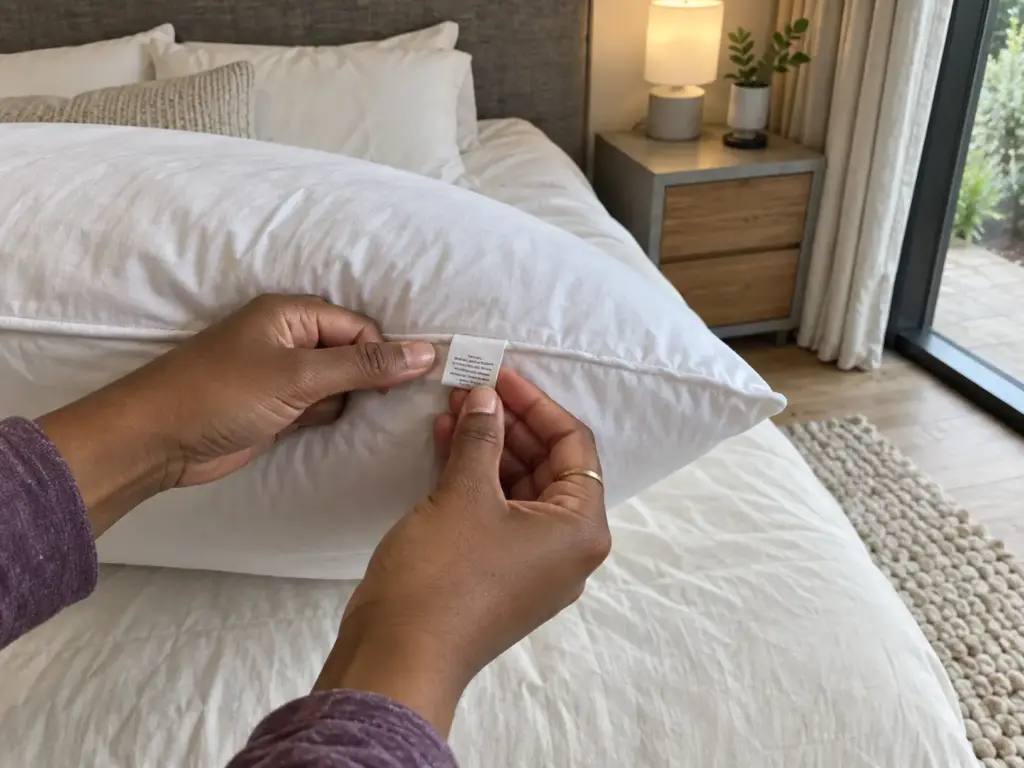
The front of the package sells a word: down, cloud, hotel, cooling. The only part of the label the law actually governs is the small white tag sewn into the seam, the one most people cut off the first night. Read that tag before anything else, because it is the one place where a word has to mean a number.
What “Down” Is Allowed to Mean
A pillow sold as down has to carry at least 75% down clusters, and there is no tolerance on that floor, according to the International Down and Feather Laboratory’s labeling Q&A. Loose down fiber does not count toward the 75%. So a down pillow can legally be one quarter something else, usually small feathers, and the word on the front is a floor rather than a recipe.
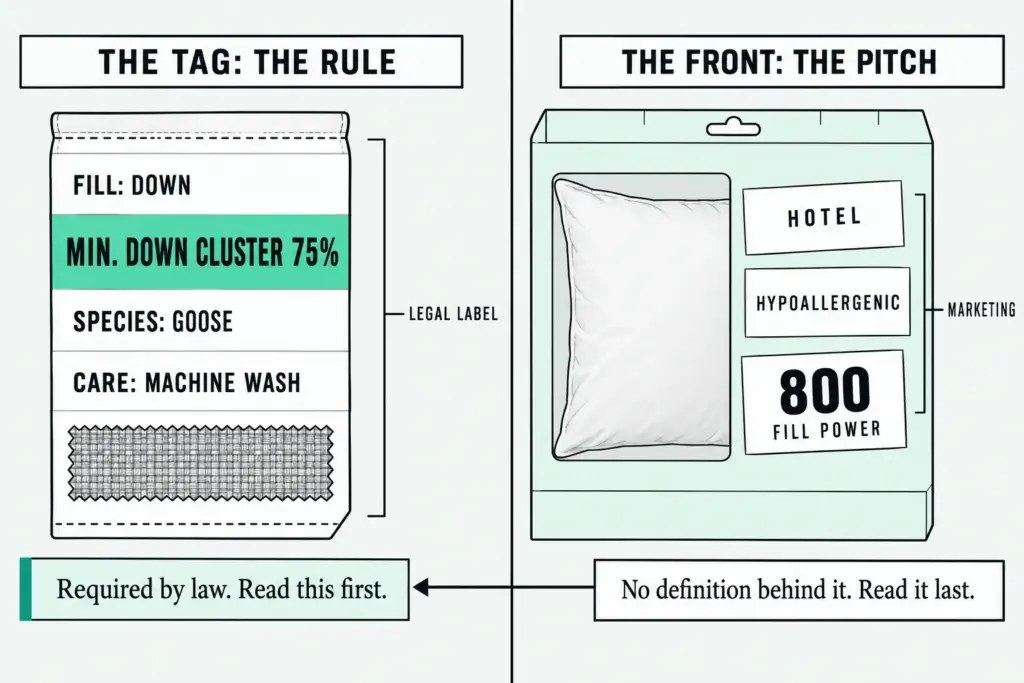
Blends follow the same logic. A pillow tagged 50% down and 50% feathers must hold at least half real down cluster, again with no tolerance. And a species name on the front, goose down or duck down, needs 90% of the plumage to be that bird. Two pillows that both say “goose down” can sit at 90% down and at 75% down, and they will not feel or age like the same pillow.
Fill Power Is Loft per Ounce, Not Support
US down products have to print the minimum down-cluster percent on a sub-label, as the USA-2000 down labeling standard spells out. Fill power is a different matter. The lab puts it plainly in what the US down labeling standard says about fill power: “Fill Power is not required on the law tag label.” When a brand prints the number anyway, the accepted tolerance is plus or minus 5%.
That tolerance answers the 700 versus 800 question better than any feel test. Fill power measures how much space an ounce of down fills, so a higher number means softer and lighter for the same weight. It says nothing about how well the pillow holds your head up. Support comes from the fill weight, how much is stuffed into the shell, and that figure is rarely printed (on a duvet, by contrast, warmth per ounce is what fill power buys on a duvet).
If a listing gives a fill power but no down percent, the number you need is missing. Ask for the law tag line or a photo of it before you order. A pillow at 90% down and one at the 75% minimum can print the same fill power and still behave like two different pillows.
“Hotel” and “Hypoallergenic” Are Label Words
“Hotel” has no definition at all. One r/Bedding commenter put it flatly: the word is a marketing word with nothing to do with what nicer hotels actually buy. Search Amazon for a gusseted goose down queen and dozens of titles carry “Hotel Collection” while leaving the down percent out entirely.
Hypoallergenic is stranger. On down, the standard ties that claim to a lab cleanliness result (an oxygen number and a turbidity reading on the washed fill), and the FTC expects the claim to be documented. On polyester, latex or foam, the same word can be printed with nothing on the tag behind it. Treat it as a statement about how clean the fill was when it left the lab, which is all a label can tell you.
The shell carries its own label, too. A high thread count on a pillow shell is there to keep feather quills from working through the cotton (that is what a down-proof shell means), and the lab adds that counting doubled yarns twice to inflate the number is not accurate. On a pillow, shell count is about containment, not softness.
Down and Feather Pillows — What They Keep and What They Lose
All that label work points to one concession. A real down pillow is the one fill that comes back when you shake it. It is also where the percent on the tag decides which pillow you actually bought. The month-six story depends on that ratio more than on the brand.
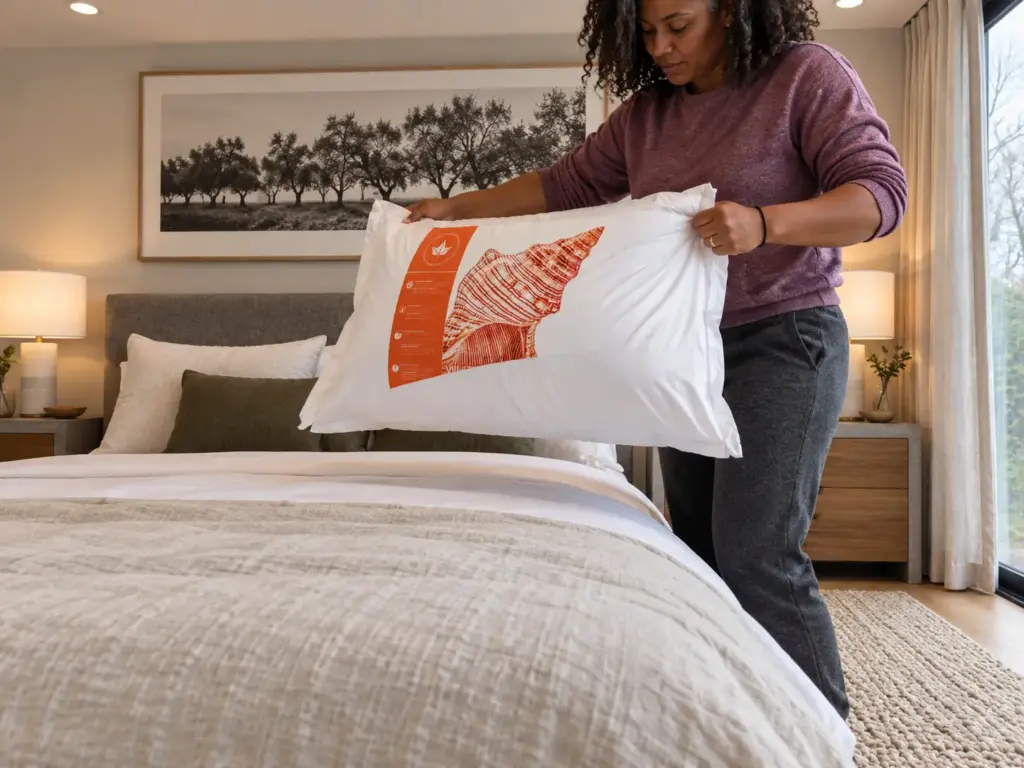
A Down Pillow at Month Six
Down clusters are tiny three-dimensional puffs with no quill, and they trap air between their filaments. Squash them all night and they flatten; shake and fluff the pillow in the morning and they open back up. That is the whole difference between down re-lofts while the cheap fill mats, and it applies to a pillow exactly as it does to a comforter.
The month-six surprise runs the other way from what most people expect. A firm down pillow arrives firmer than it ends up: one r/Bedding commenter who bought a firm 95% goose down at 750 fill power worried at first that it was too firm, and over time it “loosened up a little.” Break-in softens down. Nothing firms it up again.
So buy toward the firm side if you are between two. A pillow that starts slightly too firm settles into your height; one that starts too soft only gets softer. How long that settled pillow keeps working, and the signs it is done, are measured when a pillow is finished, by fill rather than by year.
Down Core, Feather Core, and the Ratio Between Them
Feathers have a quill. That spine gives a feather pillow more push and more weight than down, and it is also why a feather pillow crunches a little when you lie down. The mixed construction the r/Bedding regulars point to is a feather core with down surround: feathers in the middle for support, down around them for the feel against your face. One commenter has slept on a pair for three years, washes them once in a while, and calls them still going strong.
The ratio decides how that pillow behaves. More down means softer, lighter and quicker to re-loft; more feather means firmer, heavier and more likely to send a quill through the shell. The puredown goose feathers and down pillow set is a real feather-and-down pair with a gusset and a 100% cotton cover, which makes it a reasonable way into this fill on the budget side.
Read its law tag the moment it arrives, though. The listing title calls it Hotel Collection and never states the down percent, which is exactly the number the sub-label exists to give you. If the tag reads mostly feather, expect the firmer, crunchier end of the scale.
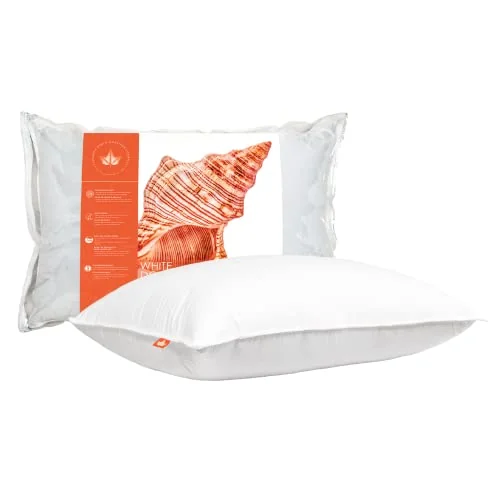
At the other end sits the one down pillow whose listing puts both numbers in its title.
The Shell Holds the Fill In, Not the Softness
“When the feathers poke out it’s annoying,” one r/Bedding commenter wrote, and the thread corrected the comment right away: down does not have feathers. Both halves of that exchange matter. A quill through the cotton is a feather problem, and it is a shell problem before it is a fill problem: a tight, high-count shell holds quills in, a loose one lets them walk.
Down is a feel, not a defect. If you want a pillow that pushes back, a soft down pillow will never do it, and that is a mismatch between fill and sleeper rather than a failure of the pillow.
Polyester and Down Alternative — Why It Mats and Does Not Come Back
Same shape, same cotton shell, often the same brand. The fill inside is a polymer fiber this time, and what it does by month six is the mirror image of down.

Down Alternative Is Polyester Under a Kinder Name
Down alternative is not a new material. It is polyester fiber, sometimes cut fine and clustered into little balls to imitate down’s loft, sometimes sold as microfiber (and microfiber and polyester are the same fiber at a different thickness, which is all the word adds). The label word changes; the fiber does not.
The Canadian Down & Feather Co. Soft Support microfiber down alternative pillow puts a 260 thread count, 100% cotton shell over that kind of fill, and the cotton is what you feel against your face. It changes the surface, not the aging. Underneath, the fill is still polyester, and the class complaint in r/Bedding applies to it as much as to any other: it compacts rather than springing back.
Matting Is Permanent, Fluffing Is Not
Fluffing a flat pillow every morning works on down. On polyester, fluffing moves the fibers around without restoring them, because a compressed polyester fiber does not recover its crimp the way a down cluster reopens. An r/Bedding poster described most cheap pillows as going flat “even after stretching them,” and the top reply named the mechanism: the polyester just compacts.
Watch where it fails. The center, where your head rests, flattens first. The edges, which take no weight, gather the displaced fiber into lumps you can feel through the case. By the time you notice a ridge along one side, the middle has already lost most of its height, and no punch or shake will put the fiber back.
That trade-off is spelled out further in what the cheap fills give up at month six. It is a fair trade on a guest bed. On the pillow you sleep on every night, it is a short clock.
Run your fingers along the edges of a polyester pillow, not the middle. Lumps at the corners mean the fiber has already migrated out of the spot your head uses, and the pillow is past what fluffing can fix.
The Washable Gusset Exception
One kind of polyester pillow earns a place on a bed you sleep in: the gusseted one you can put in a washing machine. A gusset is a strip of fabric sewn between the top and bottom panels, so the pillow is a box rather than a flattened envelope, and the fill has room to stand up. Washing and drying a polyester pillow per its care label opens up compacted fiber for a while.
The Beyond Down side sleeper pillow is built that way: polyester gel fiber, a 100% cotton cover, a 4.5-inch gusset, and a care label that calls it machine washable. It is still polyester under all of it. The wash slows the matting; it does not cancel it.
Memory Foam, Solid and Shredded — Two Pillows Under One Name
“Memory foam pillow” covers two objects that share almost nothing beyond the material. One is a single molded block. The other is crumbs of foam in a zippered bag. By month six they fail in completely different ways.
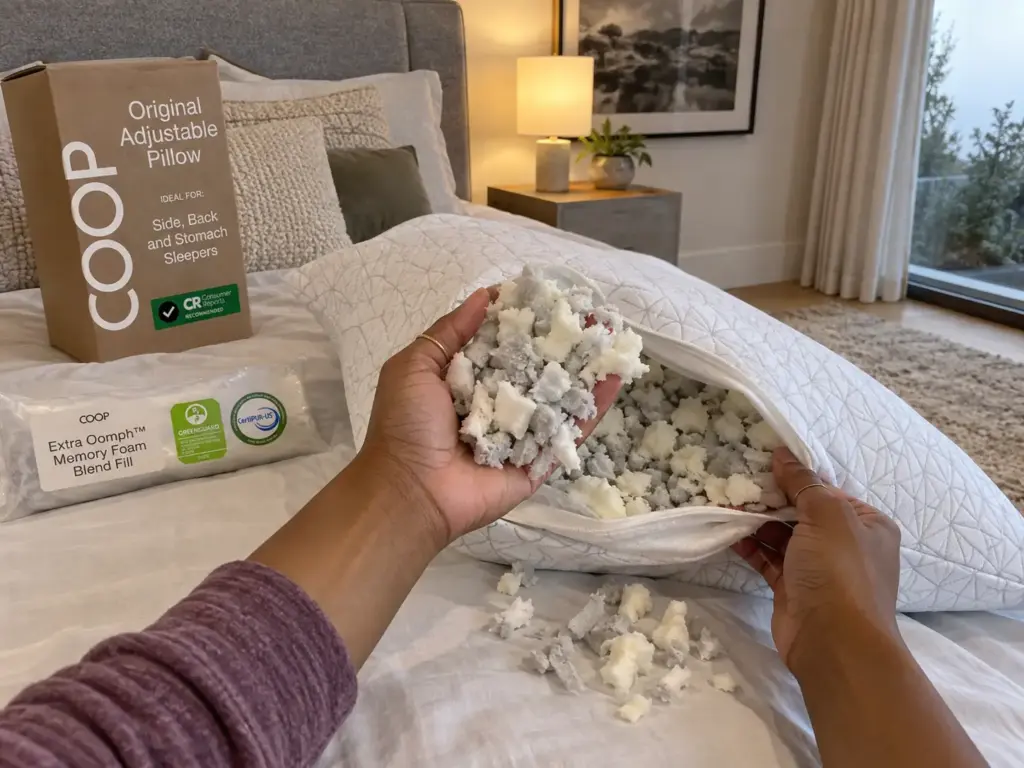
Solid Foam Keeps a Shape Until the Edges Go
A solid memory foam block holds the contour it was molded with, night after night, and that consistency is the reason people buy it. It does not need fluffing, it does not shift, and the height you measured in the store is the height you get. What it cannot do is change: if the block is too high for you, it stays too high.
Its age shows at the edges first. Foam that has been compressed and released thousands of times starts to crumble at the corners and turns yellow. Neither goes into a washing machine, because foam and latex only get spot-cleaned, so the yellow you see is the yellow you keep.
Shredded Foam Is a Pillow You Maintain
Shredded foam moves. Each piece slides against its neighbors, so the pillow molds around a shoulder and lets you add or remove fill through a zipper. The pitch is simple: buy the adjustable pillow and you never buy another one.
But adjusting is a habit, not a setting. One r/Bedding poster quit adjustable pillows because they ended up “constantly adding and removing foam,” and by month three that is what a lot of owners are doing. Shredded fill also drifts to whichever side you sleep on, which is the fill migration when you change positions that matters most for people who turn several times a night.
Before buying one at all, try the free version of adjusting. Unzip a gusseted pillow you already own, take out a handful of fill, sleep on it three nights, and decide. If you like the control, here is a pillow built around it.
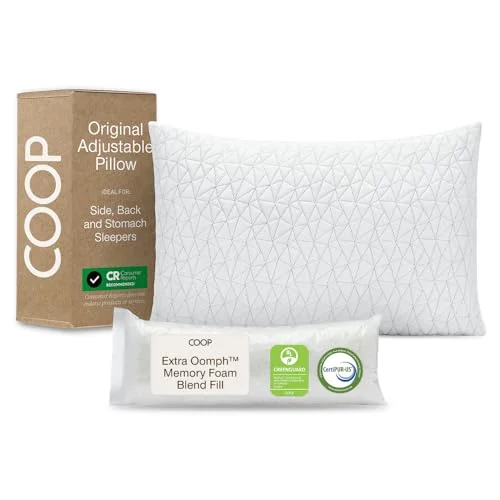
Keep the fill you take out of an adjustable pillow in a zip bag in the closet, not the trash. Shredded foam compresses over the months, and the handful you removed in week one is what brings the pillow back to height later.
Cooling Covers and Gel Are Cover Talk
Gel beads mixed into foam, “cooling” knit covers and graphite infusions all describe something added to the foam or wrapped around it. None of them changes what the foam itself is: a material that softens with warmth and holds it. How much heat a pillow keeps is a structural question, and it gets its own section below. For now, read “cooling” on a foam pillow as a description of the cover.
Latex Pillows — Shredded, Solid, and What Talalay Means
Latex is foam’s springier relative. It is more resilient and responsive than memory foam: it pushes back faster, it does not sink slowly under a head, and its boxes print a process name as though it were a grade.

Solid Latex Holds, Shredded Latex Moves
The same split as memory foam applies. A solid latex block holds one shape and one height. Shredded latex leaves air between the pieces, shifts under your head and can be adjusted through a zipper, which is why latex against foam at month three for back sleepers comes down to whether you want a fixed height or a movable one.
The Natural Latex Shredded Foam Pillow set of two is the shredded kind: natural latex pieces with an open-cell structure, in king size. It comes with one warning from the community. A commenter in r/Bedding returned a foam or latex pillow because it smelled so strongly of latex when they opened it, so plan on airing a new one before judging it (sellers call that smell off-gassing).
Talalay and Dunlop Are Two Ways of Making It, Not Two Grades
Talalay and Dunlop are names for two manufacturing processes. In broad terms, Dunlop latex is whipped into a froth, poured into a mold and baked, while Talalay is expanded under vacuum in the mold and frozen before it is baked, which tends to give a lighter, more even foam. Neither name tells you how firm a given pillow is, how high it stands or how long it lasts.
So read Talalay on a box the way you read a fill power without a down percent: it is a real word, but it is not the spec that decides the pillow. Height and firmness are.
The Smell When You Open the Bag
A smell that fades after a few days on a balcony or by an open window is an airing question. A pillow that stays too high is a different question entirely, and airing will not answer it. Keep the two separate, because returning a pillow for the smell and keeping one at the wrong height are opposite mistakes.
Height is where latex catches shared beds. One r/Bedding commenter loved their latex pillow and noted that their husband, a stomach sleeper, found it far too thick. Same fill, two heads, two heights.
Buckwheat, Wool, Kapok and the Minor Fills
What remains are the fills that sound old-fashioned and still sell. They either hold a shape or they clump, and none of them behaves like the polymer fills above.

Buckwheat Hulls Mold, Then Hold
Buckwheat hulls are the hard outer shells of the seed. Pressed together, they lock into whatever shape your head pushes them into and stay there. One r/Bedding commenter described it exactly: it will mold to your head and stay that way until you shift positions. That is a trait, not a fault, and it is also the work involved, because every time you roll, you push the hulls into a new hollow.
The Sobakawa traditional buckwheat queen pillow is the Japanese style: hulls in an organic cotton case. Expect to re-shape it each time you turn over, and expect a noisy pillow, because the hulls rustle when you do. In a shared bed, the sound of a hull pillow is usually the first thing the other person notices. Buckwheat also stays dry: the hulls never go in water.
Wool, Kapok and Cotton Clump
Wool, kapok and cotton are loose fibers, and with use they work into clumps the way a sweater pills at the elbows. Kapok, a silky plant fiber from the seed pods of a tropical tree, is the one sold as plant-based down, but in most pillows on the market it is a blend partner rather than the whole fill.
Bamboo on a pillow tag usually means viscose, a fiber made from bamboo pulp by the same process as bamboo sheets, and it more often describes a cover or a blend than a fill of its own.
The Layla adjustable fill kapok pillow is a good example: shredded memory foam with kapok fiber mixed in, behind a zipper. That makes its behavior mostly the foam’s, including the upkeep. The same adding and removing that comes with any adjustable pillow comes with this one.
Heat Comes From Structure and Cover, Not the Word Cooling
The three behaviors meet here. How hot a pillow sleeps depends on how much air the fill leaves between its parts and on what the pillow wears on the outside. The word on the front has nothing to do with it.
Air Gaps Against Solid Blocks
Feather, buckwheat, shredded latex and wool all leave pockets of air between the pieces of fill, so heat and moisture have somewhere to go. A solid foam block leaves none. It warms where your head rests and holds that warmth, which is why flipping a foam pillow to its cool side buys you only a few minutes before that side is warm too.
That is heat retention in practice. Polyester sits in between: loose when new, it loses the air between its fibers as it compacts.
Height plays into it too. A tall, dense pillow wraps more material around the side of your head and neck than a low one, so the same fill sleeps warmer tall than low. Your head also gives off moisture along with the warmth, and a fill with air gaps lets that damp air move off through the sides of the pillow, while a block keeps it at the surface against your cheek. So before buying a pillow for heat, check whether the one you own is simply too tall.
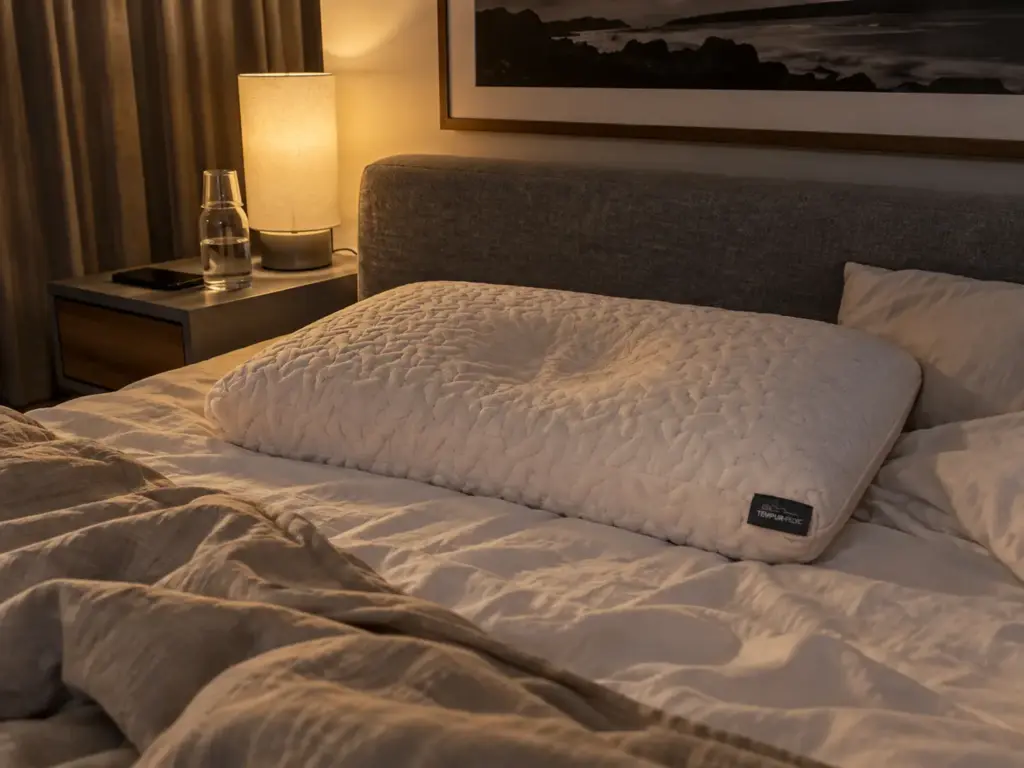
The Tempur-Pedic TEMPUR-Cloud pillow is a clear solid-block example: one piece of Tempur material, 5 inches high, under a removable polyester knit cover. It holds its contour well. It also holds what your head gives it, and that is not the profile of a cool pillow, whatever the cover feels like in the hand. A solid-foam pillow is also how one wrong layer undoes three on an otherwise well-chosen bed.
If you sleep hot, take everything off the pillow except one cotton case for a week. A polyester protector or a knit cover under the case can hold more heat than the fill does, and that test costs nothing.
The Cover Is Half the Pillow
What touches your face is the cover, and two covers can behave in opposite ways. A cotton percale case, woven one thread over and one under, leaves tiny gaps that let moist air out and takes up some moisture into the fiber itself. A polyester knit with a “cooling” finish feels cool in the store because the finish draws warmth on first contact; the finish is a coating, and coatings leave in the wash.
Then there is the layer people forget. A polyester protector zipped over the pillow and under the cotton case traps whatever the fill gives off, and the protector section below deals with it. The hot sleeper’s pillow is usually the one layer on the bed they never take off, never flip and never question.
The case is also the cheapest part of the pillow to change. Two or three cotton percale cases in rotation cost a fraction of a new pillow, and a fresh, dry case every night or two means the moisture the last one soaked up is gone from the bed instead of sitting under your face again.
Choosing by Sleeper and Shared Bed, Free Fixes First
After seven sections on what fills do, the choice is short. Your sleeping position and how warm you run decide it, and most “wrong pillow” complaints are about height, which costs nothing to fix.

Free Height Fixes Before You Buy Anything
Before a new pillow, try these on the one you have:
- Fold a soft pillow in half for a night (the fold test) to see whether you want more height.
- Slide a folded towel under a pillow that is close but low.
- Add or remove fill: take handfuls out of a gusseted or zippered pillow that is too high, or put some back if you overshot.
- Add a second, firmer pillowcase to tighten a loose pillow around its fill.
Each one tells you the height you actually need before you spend anything. Very roughly, a stomach sleeper wants low loft, a side sleeper with broad shoulders wants high loft to close the shoulder gap, and a back sleeper lands at medium-firm in between. The number itself depends on your shoulders and your mattress, so measure the loft before you pick a fill. A pillow that “never fits” is very often a height problem the fold would have shown in a minute.
One Bed, Two Pillows
Two people in one bed rarely need the same pillow, and the answer is a structure rather than a compromise. If one sleeps on their side and the other on their stomach, that is two heights, which means two pillows, possibly in two fills. A reader in r/Bedding planned exactly that for themselves alone: the least firm pillow for nights on their stomach and a firm one for side sleeping.
The stomach sleeper usually needs the lowest, softest pillow in the house, and the case of adjustable against thin foam for a stomach sleeper is worked out in detail elsewhere. For the person who cannot decide, one adjustable pillow is a reasonable compromise (a combination sleeper, who turns through every position in a night, is who it suits best); for side sleepers who hug something between the knees, what goes inside a long hugging pillow follows the same rules about shredded and fixed fill.
When two people share a bed, buy the pillows separately, never as a matched set of two. A set locks both sleepers into one fill and one height, and the person it does not fit ends up folding theirs every night.
The Fills at a Glance
Everything in the sections above, side by side:
| Fill | Height by month six | Heat | Wash |
|---|---|---|---|
| Down and feather | Re-lofts when shaken; a firm one softens a little | Air between clusters | Per the care label |
| Polyester (down alternative) | Mats and stays flat | Loses its air as it compacts | Gusseted washable versions only |
| Shredded foam | Shifts; needs topping up | More air than a block | Spot-clean the fill |
| Solid foam | Holds its contour until the edges crumble | Holds what it is given | Spot-clean only |
| Latex | Solid holds one height; shredded moves | Shredded leaves air gaps | Spot-clean only |
| Buckwheat | Molds and holds; re-shape when you roll | Air between hulls | Keep dry |
| Wool and kapok | Clump with use | Air between loose fibers | Per the care label |
When It Isn’t the Pillow
Sometimes the pillow is fine and something under it changed. A mattress that has started to sag lowers your shoulder and makes the same pillow feel too high; a new topper does the opposite. Check the bed before you blame the fill.
And some problems are not bedding at all. Neck pain that stays the same whichever pillow you use, waking with numb arms or hands, or trouble breathing at night are questions for a doctor, not for a pillow.
Washing, Protectors and the Months After — What Each Fill Allows
The third behavior comes last. Whether a fill can be washed decides how long the pillow stays clean, and the protector and the case are the layers that take the wear first.

Which Fills Wash and Which Only Spot-Clean
Down, feather and washable polyester can go in a machine, following the care label on that specific pillow (the label, not a general rule, sets the temperature and the dryer heat). Some labels say tumble dry low, some say air dry, and a few pillows ask for hand-wash only. Solid foam, latex and shredded foam get a spot clean, never a soak. Buckwheat hulls stay dry; the case washes, the hulls do not.
That split decides almost everything about a pillow’s later life. A pillow you can wash can be brought back from a stain; a foam core cannot, and the question of yellowing comes down to shell against fill, washable against foam core. It also decides whether you need extra protection: a protector earns its place only if the pillow can’t be washed.
Protectors and Cases as the First Layer
A washable zippered pillow protector under the regular case is the cheap layer that takes the staining before the fill does. One r/Bedding commenter keeps their down pillows in washable zippered protectors and says they still fluff up perfectly after at least ten years. That is a longevity report rather than a wash count, but it shows what the layer is for.
Know the limit, too. A protector is a protector that moves the stain: the yellow ends up on the protector instead of the shell, and the fill underneath still ages on its own schedule. For what each layer over the fill actually does, from the case to the protector to the shell, the cases guide goes layer by layer.
When the Fill Is Finished
A fill shows its age first as height and then as odor. A pillow that will not hold your head where it used to, even after a wash and a fluff, has reached the end, whatever its age.
Foam is the exception in the other direction. Because a foam core cannot be washed through, it is the one fill you replace rather than clean after a bad stretch, and the foam core exception after being sick explains where that line sits. For everything else, the replacement clock is set by the fill rather than the calendar.
Read the Tag, Fold Before You Buy
Three things decide a pillow, and the label covers none of them directly:
- The tag tells you the legal floor, not the behavior. A “down” pillow can be a quarter feather, fill power can drift 5% either way, and “hotel” means nothing.
- Every fill has a month-six answer. Down re-lofts, polyester mats, solid foam holds until its edges crumble, and shredded fills need upkeep.
- Heat is structure plus cover. Air between the pieces of fill and a cotton case beat a foam block wrapped in a “cooling” knit.
Months from now, check how much height the pillow still holds after a wash and a shake; that height, not the softness, is what tells you the fill is still working.
Tonight, fold the pillow you already own in half, or unzip it and take out a handful of fill. Sleep on it that way for a week and notice whether you wake with the old morning fold in the same place.
Frequently Asked Questions
01What is the best filling to have in a pillow?
The best pillow filling is the one whose height, heat and washability match how you sleep, not one fill that suits everyone. Down and shredded fills can be adjusted or fluffed back; polyester and solid foam cannot. Settle the height first, then the fill.
02What is the difference between a 700 and an 800 fill power down pillow?
Fill power measures loft per ounce, so 800 is softer and lighter than 700 for the same weight of down. The accepted tolerance is plus or minus 5%, and neither number says anything about support, which comes from how much fill is in the shell.
03What is the most expensive type of pillow filling?
High fill power down and natural latex usually sit at the top, well above polyester and shredded foam. What you pay follows the fill and the shell together, so a high down percent in a tightly woven cotton shell costs more than either one alone.
04What is the cheapest filling for pillows?
Polyester fiberfill, sold as down alternative, is the cheapest pillow filling, and it is also the one that mats for good. It compacts rather than springing back, so a cheap pillow stays cheap only until it goes flat around month six.
05Can you take fill out of a pillow to change its height?
Yes, on a gusseted or zippered pillow with loose fill, and it is the free fix to try before buying another pillow. Take out a handful, sleep on it a few nights, and repeat. Solid foam and solid latex blocks cannot be adjusted this way.




Tried it on your own bed?
No comments yet. Tell us what you changed, and what the sheet did after a few washes.