







What’s in here10 sections
- A Pillow Is a Gap You Can Measure
- Side Sleepers Fill the Shoulder Gap
- Back Sleepers Need Less Than They Think
- Stomach Sleepers Almost Need No Pillow
- Combination Sleepers Need a Loft That Changes
- What Each Fill Does by Month Three
- Free Fixes Before You Buy Anything
- Two Sleepers, Two Positions, One Bed
- Measure the Gap, Then Give It a Week
- Frequently Asked Questions
A pillow that felt right in the store tends to feel great for about twenty minutes, which is the exact window r/Bedding posters keep describing, and by morning your head has rolled toward the mattress while the pillow sits half under your shoulder.
The words on the bag are no help. For side sleepers, contour and orthopedic are not tested against any standard: each one is a loft range in disguise, and pillow loft is a height. Choosing a pillow by sleep position means filling one gap, the space between your head and the mattress, and that space is set by two things you can check at home: how wide your shoulder is and how far the mattress lets it sink. What follows takes that measurement, applies it to each position, follows each fill out to month three, puts the free fixes ahead of any purchase, and ends with two people sleeping two different ways in one bed.
The pillow is chosen by the gap between your head and the mattress in the position you wake up in: one pillow at night, and it stops at your neck, never under your shoulders.
| Sleeping position | Loft | Fill that fits | The free fix first |
|---|---|---|---|
| Side | High: fills ear to shoulder tip, less on a soft mattress or a topper | Shredded latex or shredded foam that keeps its height | Pillow under the neck, not the shoulder; a pillow between the knees |
| Back | Medium to low: the chin stays off the chest | Medium fill, or an adjustable with about half the fill out | Pull the wings out from under the shoulders; a rolled towel at the neck |
| Stomach | Flat, or none under the head | Soft fill that squashes flat, such as down alternative | Try the head on the mattress; a flat pillow under the hips |
| Combination | A loft you can change | Adjustable shredded fill | Take fill out before buying a second pillow |
A Pillow Is a Gap You Can Measure
The label calls it a position, but what it is really selling is a height, and that pillow loft is made of two inputs. Consumer Reports frames it the same way: the position you sleep in and how soft your mattress is should decide how thick or firm the pillow is, and loft comes down to how much filling sits inside. There is no one-size rule. The goal is a neck that stays in line with the spine, and loft is the only tool a pillow has to get it there.
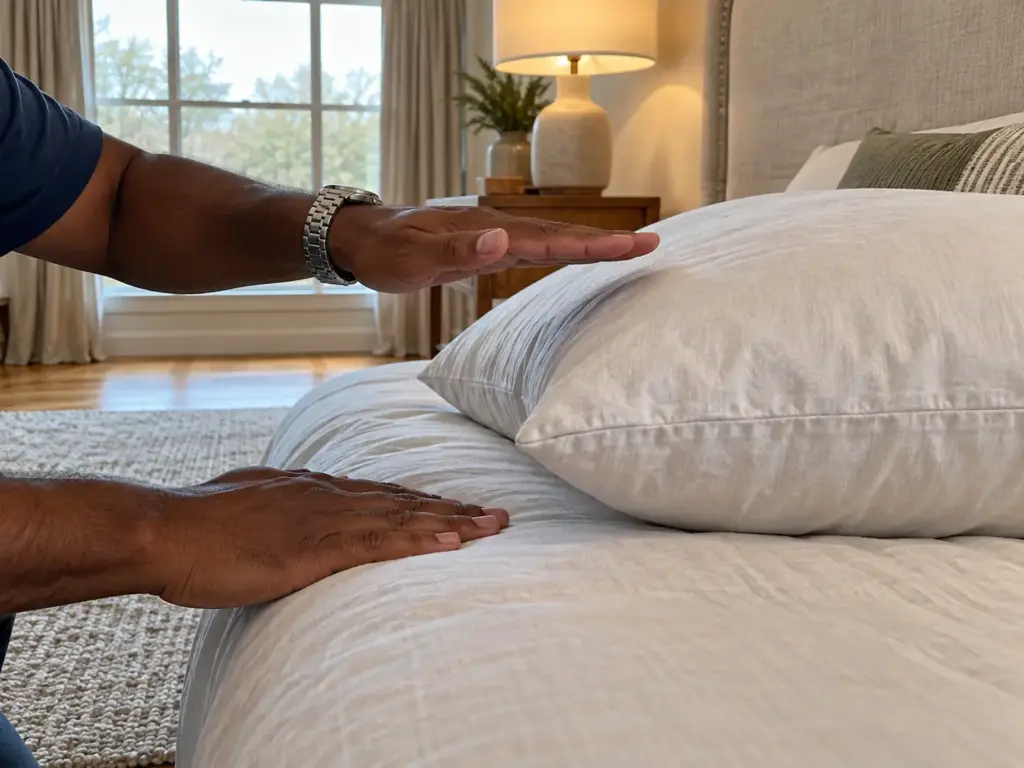
Firmness is a separate question, and the two get mixed up all the time. A firm pillow that is too low is still too low.
Shoulder width minus what the mattress swallows
Lie on your own bed, on your side, the way you actually fall asleep, with your arm where it usually goes. The space between the side of your head and the mattress, with your neck level, is the number the label never prints.
You can get at it two ways. The arithmetic version: measure from your ear to the outer tip of your shoulder, then subtract how far that shoulder sinks into the mattress when you lie on it. The direct version is easier: have someone hold a ruler upright on the mattress beside your head while your neck is level and read the gap, which already has the mattress baked in.
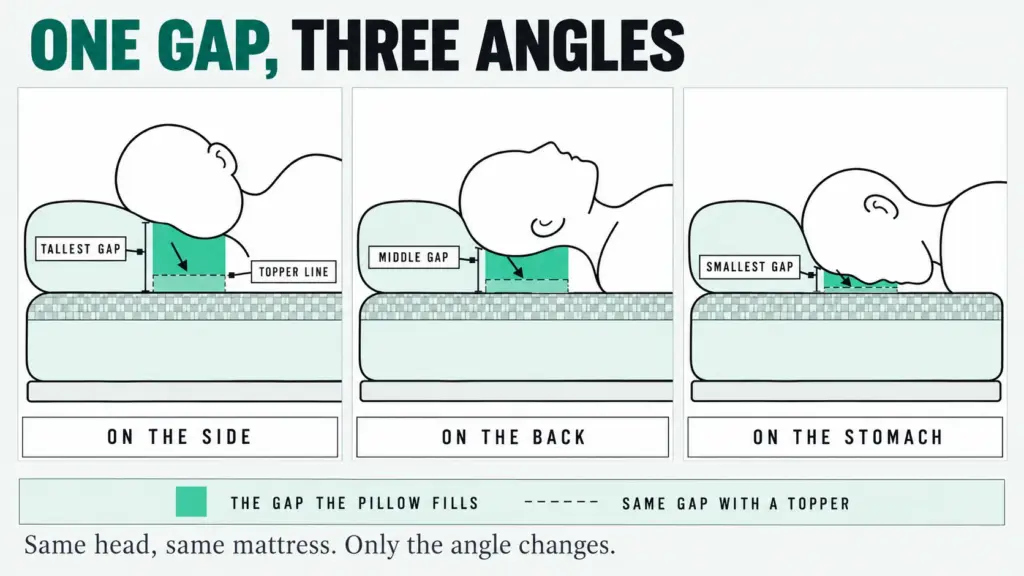
This is a working method, not a certified test, and it does not need to be more precise than a ruler. A quarter inch either way disappears the first time the fill settles. What it does is give you a target before you read a single bag, so the word on the package becomes something you can check against instead of something you have to trust.
You will see inch bands quoted for each position: four to six inches for side sleepers, three to five for back, one to two for stomach. That is what retailers commonly quote, and no clinic or independent tester publishes those numbers. They are a reasonable middle, but the band assumes a medium mattress and a medium shoulder, and the reader with broad shoulders on a firm mattress, or narrow shoulders on a pillow-top, falls outside it in opposite directions. Measure first, then see where the band lands.
One r/Bedding poster found the answer by accident: a flat pillow that felt wrong lying down felt right once it was stood on its edge. Nothing about the pillow got firmer. There was simply more fill under the head, which is a height problem, and it had looked like a softness problem.
Take the measurement on the bed you sleep on, not on the floor or a sofa. A carpet gives almost nothing under the shoulder, so a floor reading comes out taller than the loft you need, and the pillow bought to match it sits too high on a real mattress.
Why a soft mattress or a topper lowers the answer
Cornerstone Physiotherapy puts the mattress rule plainly. On a firmer mattress you need a thicker pillow so the head and neck line up over the shoulders; on a memory-foam topper or a pillow-top, a slightly thinner one, because the lower shoulder sinks further into the bed. The shoulder is doing the work in both cases. Every inch the mattress swallows is an inch the pillow no longer has to fill.
So the standard advice to buy whatever is labeled for your position breaks as soon as the mattress is soft. A side sleeper on a plush pillow-top can need less loft than a side sleeper on a firm innerspring, by a margin bigger than the gap between the side and back bands on the bag. Two people with the same shoulders, the same position and the same pillow can get opposite results on two different mattresses.
You can watch it happen on one bed. A pillow that fits on the bare mattress is a little too tall the week a topper goes on, because the shoulder now sinks further while the head stays where the pillow holds it. If you ever added a topper for warmth, the same reasoning that decides where a topper goes into the layer order decides the pillow: anything soft under the shoulder lowers the loft you need. And it works the other way when an old mattress gets replaced by a firmer one, which is why a pillow that was perfect for years can feel wrong on the first night in a new bed.
The mattress also changes with time. A dip that forms where the shoulder lies every night lowers the shoulder slowly, and the pillow that matched the new mattress is a fraction too tall by the end of the first year (the change is too slow to feel, which is the problem). Measuring again costs nothing.
Side Sleepers Fill the Shoulder Gap
On your side the gap is at its widest: the full distance from ear to shoulder tip, less whatever the mattress gives. That makes side sleeping the high-loft case. And it is also where the fit most often fails for a reason that has nothing to do with the pillow itself, because the shoulder ends up in the wrong place.
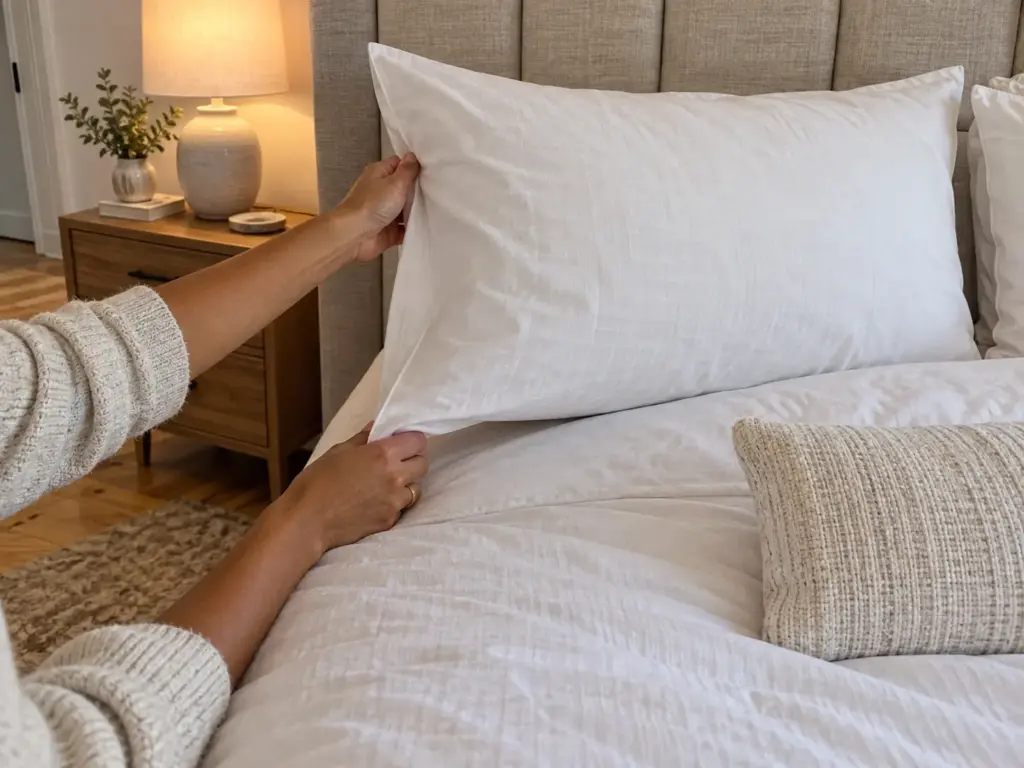
High loft, and the pillow ends at the neck
Picture the pillow edge pinned under your shoulder and your head tilted down toward the mattress. The pillow is tall enough, but half of that height is going to the shoulder, so the head gets less than it needs. Consumer Reports, citing a chiropractor, describes the target as neck and spine horizontal with shoulders and hips stacked, and is blunt about the rest: the pillow goes under the neck, not the shoulder. Slide the pillow up so its edge stops at the neck, and some side sleepers find their current pillow was right all along.
How high is high comes from your own measurement. A firm mattress pushes the number up, a soft mattress or a topper brings it down, and the bands on the bag are only a starting point. Where a pillow is almost right, Cornerstone suggests rolling a towel into the gap left between the neck and the bed rather than buying a taller pillow.
There is a trap in testing it. A pillow that is right when you first lie down can turn out too tall once an arm slides under it and lifts the head, which a lot of side sleepers do within minutes. So the check is where your neck sits after ten minutes, lying the way you actually lie, not on the first lie-down when you are holding still on purpose.
The evidence behind any one pillow is thin. Spine-health notes there is limited research on pillows for side sleepers, and the one small study it cites favored latex over feather. The position rules in this article are the consensus of clinicians and testers, not a law, which is a good reason to trust a measurement on your own bed over a label.
The knee pillow is part of the setup
Spine-health and Cornerstone both add a pillow between the knees for side sleepers. It keeps the upper leg from rotating down toward the mattress, and that keeps the stack the head pillow was measured for: shoulders over hips, the top shoulder not rolling forward. When the top knee drops, the shoulder follows a little, and the gap at the head changes with it.
It does not need to be a special product. A spare standard pillow folded once, or a throw rolled thick, does the same job for the first week, while you find out whether you even keep it there.
If the knee pillow is on the floor every morning, it is too thick: it pries the knees apart and you kick it out in your sleep. A thinner one, or the same pillow folded the other way, tends to stay put through the night.
Back Sleepers Need Less Than They Think
On your back, the gap behind the neck is small, so the loft question flips. The risk is no longer a pillow that is too low but one that is too tall, which pushes the chin toward the chest. This is the position most often sold too much pillow.

Medium to low, with a towel for the neck gap
You are on your back with your chin tucked down, on a pillow somebody bought for a side sleeper. That pillow is doing exactly what it was made to do, filling a shoulder-width gap, except you no longer have one. Consumer Reports describes the back sleeper’s target as shoulders in line with hips and neck in line with spine, and a side-sleeper loft cannot hold that line.
Cornerstone’s version is a fairly flat pillow with a small rolled towel in the curve at the back of the neck. The towel fills the curve, so the pillow itself does not have to be thick, and that split is the whole idea: support where the neck curves, very little under the back of the head. Spine-health makes the same point from the other side, saying a single all-purpose pillow is likely too high for the back and too low for the side.
Before you buy anything, pull the wings of the pillow (its two outer corners) out from under your shoulders, which Consumer Reports recommends for back sleepers. A pillow pushed down onto the shoulders props the upper back and tips the head forward, and pulling it up so it ends at the neck puts the height where the neck needs it, with no purchase at all.
Some pillows labeled for back sleepers come with a fixed bump molded under the neck. It suits the neck it was shaped for, and not much else. The fill under the cover and the weave of the cover decide how that bump behaves after a few hours: a solid foam contour holds its shape and its warmth, a stiff, tightly woven shell keeps a shredded fill from settling into the curve. If you are between two pillows, the flatter one with a towel usually beats the contoured one.
A pillow under the knees
Cornerstone also puts a pillow under the knees for back sleepers. Any pillow you already own does it, and the one you take off the stack at night is a good candidate.
Stomach Sleepers Almost Need No Pillow
Face down, the gap between the head and the mattress is close to zero. The question is not which pillow, but how little pillow, plus one flat piece that goes somewhere other than under the head.
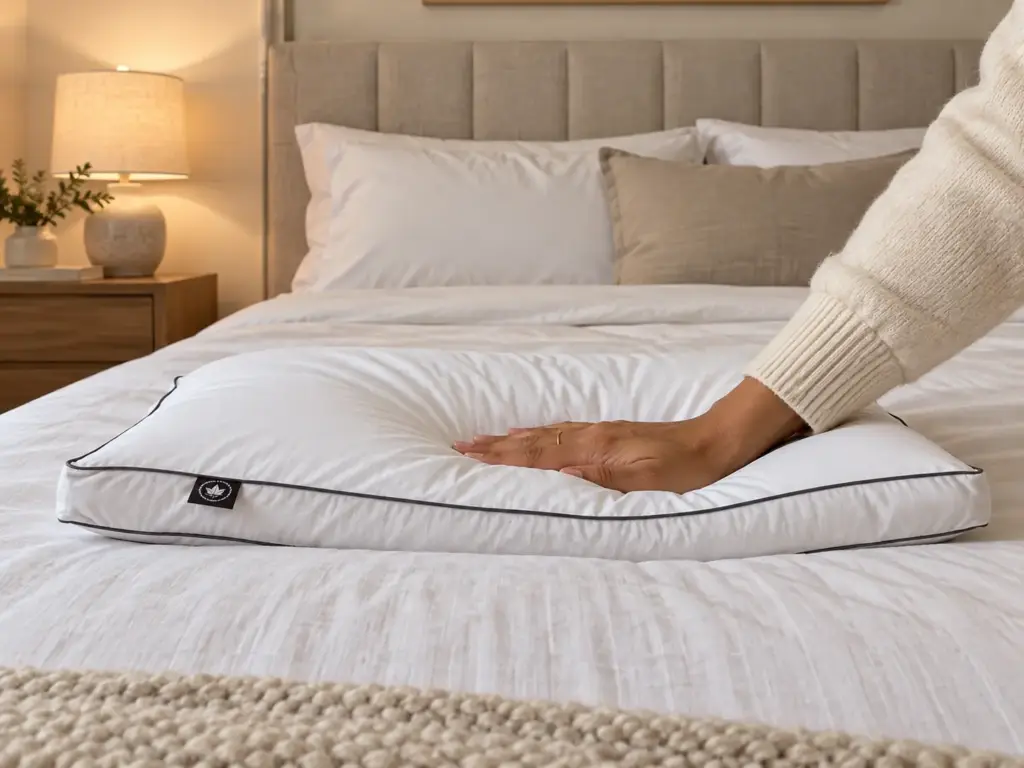
Flat, soft or none under the head
Say you sleep with your head at the very edge of a firm pillow because the middle is too tall. At that point the pillow is not holding your head at all. It is propping your shoulder, and your head is turned on top of it at whatever angle the edge allows. One r/Bedding stomach sleeper described exactly this with a moderate, quite firm pillow, and the pillow was the wrong height the moment the head moved toward the middle.
Spine-health says the pillow for this position should be relatively flat, or the head should rest directly on the mattress; Cornerstone says a flatter pillow or none at all. Try none first. A few nights with your head on the mattress, or on a folded towel if bare mattress feels too low, tells you more than any bag will, and it costs nothing.
If you want something under your head, the fill matters more than the height printed on the bag. You want a soft, compressible fill that squashes flat under the weight of your head instead of holding a set loft. Down and down-alternative clusters do that: they move out of the way. Shredded foam and latex push back, which is what a side sleeper is paying for and the opposite of what you need.
That is the job the Canadian Down & Feather Co. Soft Support Microfiber Down Alternative Pillow is built for: a microfiber down-alternative fill inside a 260-thread-count cotton shell, soft enough to squash flat under your head. It is the least expensive pillow named in this article.
The trade-off comes with the fill rather than the brand. A soft fill flattens because flattening is the point, so it will never hold a side sleeper’s height, and no repeated complaint about this particular pillow turned up in the reviews and threads read for this article.
A flat pillow under the hips
Spine-health and Cornerstone both suggest a flat pillow under the abdomen or pelvis for stomach sleepers. It keeps the hips from sinking into the mattress further than the shoulders do, so the line from the head to the hips stays flatter. A thin pillow works; so does a folded bath towel.
The stomach position rarely lasts all night. On r/Bedding, one reply comes from a sleeper who keeps a fairly flat king pillow and simply folds it in half when rolling onto the side, and another layers a thin standard pillow under a fat, firm square one. Both are solving the same thing: a position that changes during the night while the pillow stays the same height. That problem has its own section.
Combination Sleepers Need a Loft That Changes
Side wants the tallest pillow, back wants a lower one, stomach wants almost nothing, and a combination sleeper uses two or three of those positions in a single night. One fixed loft cannot serve two positions, and the middle setting is wrong for both of them in opposite directions. The answer is a height you can change, and you may already own one.

One fixed loft is too high for one position and too low for another
An r/Bedding poster who sleeps on their side and rolls onto their stomach drew the pillow she wanted: tall in the middle, with flat wings on either side. The replies were practical. Fold a flat king pillow when you turn to your side; overlap a thin pillow on a thick one so there is a high end and a low end. People keep reinventing the same shape because the problem is the same.
Spine-health describes that shape for combination sleepers: higher areas for the side, lower areas for the back, and a mixed fill or buckwheat that can be pushed around. The principle is moldable fill. A pillow you can shove from the middle to one edge in the dark gives you two lofts in one case, which a solid slab cannot do.
Stated as a rule, the middle loft is the expensive mistake. A pillow halfway between your side height and your back height is too low every time you are on your side and too high every time you are on your back. It averages out on paper, never on the bed.
Take fill out before you buy a second pillow
Adjustable pillows turn loft into a dial. Consumer Reports engineer Misha Kollontai, describing the Plank adjustable pillow by Brooklyn Bedding, says side sleepers “may want to try removing about a quarter of the filling”, and back sleepers about half. The numbers come from one pillow’s fill, so read them as a direction rather than a spec: side keeps most of it, back loses a lot.
If you already have an adjustable pillow, unzip it before you shop. Many people never open the zipper at all, and a pillow that feels too tall in every position may simply be full.
The community has a cheaper trick for nights that are almost right: a very thin pillow kept as a booster. Treat it as a swap rather than a stack. When the pillow you have is close, you change the insert or the thickness under your head instead of piling a second pillow on top, which keeps you at one pillow at night.
There is a practical limit to all this. A loft that is perfect at full fill on your side has to be unzipped and emptied when you roll onto your back, and nobody does that at night. So an adjustable pillow works best when the fill is shredded and loose enough to push around by hand, set somewhere close to the position you spend most of the night in.
Take fill out in two or three rounds, not all at once, and sleep on each setting for a few nights. Keep what you remove in a zipped bag with the date on it: shredded fill settles, and a month later you may want a handful back.
The adjustable that earns a card
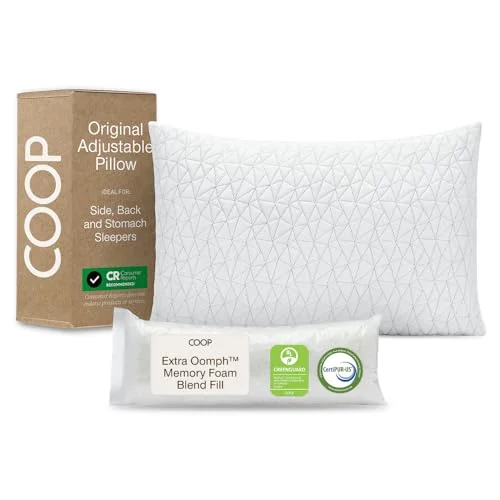
If the free fix confirms what you suspected, that you need a height you can change, the Coop Home Goods Original Adjustable Pillow is the adjustable this whole measurement argument points to. It is filled with cross-cut shredded memory foam blended with microfiber, it ships with an extra bag of fill, and you set the loft by adding or removing handfuls.
Consumer Reports rates it for support regardless of size or sleep position, recorded little or no change in height in its 96-hour resilience test, and calls it the only fully machine-washable pillow in its roundup. The catch is heat. CR found it sleeps slightly warm, and the memory-foam core is the part to watch if you run hot, while any shredded fill can lump over months (a property of the fill, not a finding about this pillow).
What Each Fill Does by Month Three
Everything up to here was about height on the night you set it. This section is about whether that height is still there after a season, which no shop and no first night can tell you. No source tracks pillows to month three: Consumer Reports’ test of shape retention loads each pillow with 225 pounds at 98.6°F for 96 hours, which is four days. So what follows is how each fill is known to behave, from what it is made of and what clinicians and long-term owners report, not a test result.

Feather and down flatten, polyfoam dents
The r/Bedding version of the problem is vivid. A feather-heavy pillow feels amazing when you lie down, then a few hours later it has flattened and starts to feel like cardboard. A down chamber pillow folds around the head like a taco, with nothing left underneath to hold the neck. In both cases the failure is support after hours, not softness at first touch, and a shop cannot show you either one.
The mechanism is in the fill. Feathers are quills: they compress, they shift out from under the weight, and they do not spring back on their own. Down clusters loft beautifully but tend to move away from pressure, which suits a stomach sleeper and frustrates a side sleeper. Cornerstone says both flatten over time and puts them at the short end of a pillow’s life.
Polyfoam fails differently. Cornerstone describes the natural indentations that develop with use: a dent forms where your head lands every night, and the pillow keeps its height everywhere except the one place it matters. Solid memory foam holds its shape better but, in Cornerstone’s words, retains heat, and it responds slowly, which bothers someone who changes position and finds the old head-shaped hollow still there.
Replacement follows the fill, not the calendar. Consumer Reports cites the Asthma and Allergy Foundation of America’s two years; Cornerstone says one to two, sooner for feather and down. The fold test and the full schedule are in how often to replace pillows by fill, and they are worth a look before you decide a pillow has failed.
Shredded foam and latex hold their height
Shredded fill is foam cut into small pieces, so instead of one block that dents, you get hundreds of pieces that shuffle and can be pushed back. Consumer Reports recorded little or no change in height and fluffiness for the Coop shredded pillow over its 96 hours, and the reason is mechanical: there is no single surface to wear a hollow into. Shake it, and the pieces redistribute.
Latex pushes back against the head rather than sinking under it, and it does not take on a dent the way polyfoam does. Cornerstone’s objection is that a latex pillow is often one piece and cannot be adjusted easily, so if the height is wrong, it stays wrong for the life of the pillow. Shredded latex removes that objection.
The Natural Latex Shredded Foam Pillow, King, Set of 2 is shredded natural latex in an open-cell structure, sold as a pair, which suits the two-pillow bed later in this article. Latex is the fill that came out ahead of feather in the one small study spine-health cites for side sleepers, and because this one is shredded, you can take some out to match your measurement. The king length gives a side sleeper room to move the pillow without the edge ending up under the shoulder. Nothing in the reviews, the clinic pages or the threads read for this article raised a repeated complaint about it, though that is a search, not a test, and shredded latex can still bunch toward the edges the way any loose fill does.
That bunching is how a shredded pillow fails at month three, if it fails. Look for a lump at the edge you sleep on and a thin patch in the middle. The pillow that held its shape for one night can still dent or drift by the third month, and a fill you can push back by hand is the one where that is a two-minute fix instead of a new purchase.
Heat follows the same split. Cornerstone says memory foam retains heat, and a solid slab has no gaps in it, while shredded fill leaves gaps between the pieces. The word cooling on a pillow has no standard behind it; often it is a cover finish that feels cool in the shop and can wash out of the cover over time. In a bed that runs warm, the pillow can be the layer that caps everything else: a hot sleeper’s bed often comes down to one wrong layer, and a solid-foam pillow is that layer.
Once a week, hold a shredded pillow by one short end and shake it, then the other end, and knead the middle back up. Fill migrates toward wherever your head pushes it, and a weekly shake keeps a lump from setting while it is still loose enough to move.
The cover and the core wash differently
Washability is a fill property, not a feature. The Coop pillow goes in the machine whole; the solid-foam PureLUX pillow in the same Consumer Reports roundup has a washable cover over a core that can only be spot-cleaned. A solid foam core cannot take a whole-pillow wash, so the cover is the only part that goes in the machine. Before you pick a fill, decide how you will clean it, because what is inside decides how it comes clean.
The shell matters too. A down-alternative pillow like the Canadian one carries a cotton shell woven tight enough to keep the fiber in, while shredded foam pillows tend to use a zippered outer cover that comes off and washes like a pillowcase.
For a core that cannot go in the machine, the cheap move is another layer: a zippered pillow protector over the pillow, under the case, so that a protector moves the stain onto a layer you wash instead of letting it reach the foam. It costs a little height, a few millimeters, which matters only to a stomach sleeper.
Free Fixes Before You Buy Anything
Most of the questions above can be answered with the pillow already on your bed. The r/Bedding name for the alternative is the pillow graveyard: the closet shelf of pillows that each felt right for twenty minutes. The fixes below go in order, cheapest first, and each one is judged the same way.

One pillow, and the wings out from under the shoulders
Start by subtracting. According to Consumer Reports’ pillow testing, “Pillow lovers, take note: A decorative stack is fine during the day, but sleep experts agree that using a single pillow at night is best.” Two pillows under the head add two lofts together, and the result is almost always taller than any position needs, with the neck pushed upward all night.
But one pillow in the wrong place is still wrong, so move the one you keep. Consumer Reports says never to sleep with your shoulders on the pillow: on your back, pull its wings out from under the shoulders; on your side, tuck it under the neck rather than the shoulder. In both positions the pillow ends at the neck. This fix can change the effective loft noticeably, and it costs nothing.
You may have heard of the 2-2-1 pillow rule. It is decor, not sleep: a styling formula for a made bed with two large pillows, two medium and one accent. Pile them on in the morning, and keep one under your head at night.
Towel roll, folded king, thin booster swap
Once you are down to one pillow, these fine-tune it. Some r/Bedding regulars call it pillow alchemy, and it uses things you already own.
- Roll a bath towel and set it under your neck, either alone or under the edge of a thin pillow. One poster keeps this trick for nights at a hotel with hopeless pillows; a tighter roll is taller, a looser one lower.
- Fold a flat king pillow in half when you roll onto your side, and unfold it when you go back to your stomach or back. One pillow, two lofts.
- If you own an adjustable pillow, take fill out: about a quarter for side sleeping, about half for back sleeping, per the Consumer Reports engineer quoted above.
- Keep a very thin pillow as a booster and swap it in for your regular one on nights when your regular one is too much, rather than stacking it on top.
- Add the second pillow where the position asks for it: between the knees on your side, under the knees on your back, flat under the hips on your stomach.
None of these costs anything, and each one tells you something about the loft you need before you spend money on it. If the towel roll makes the night better, you have learned you need more fill at the neck, not a firmer pillow.
Judge it by where you wake, after a week
Cornerstone makes the point that we have very little control over how we sleep at night. You fall asleep in one position and wake in another, so where you wake is the more honest report. That is the position the pillow should be judged in. If you fall asleep on your back and wake on your side every morning, you are a side sleeper with a back-sleeping habit at bedtime.
Shop feel is a bad test, and the first night is barely better. A new pillow is at full loft, the fill has not settled, and you are paying attention to it, so it tends to win the first night against an old pillow you have stopped noticing. Give any change five nights, and seven is better, so judge on the seventh morning: where your head is, where the pillow is, whether you had to move it in the dark.
Some people never find the one pillow. A poster with nine of them on r/Bedding simply rotates them, and for a combination sleeper whose positions change with the season or the mattress, that is a fair answer. The pillow is also one of several clocks in the bed, and it wears out on a different schedule from the sheets and the duvet, so it is worth checking it when you check the rest: the whole bedding set runs on four clocks, and the pillow is the fastest of them. If you do buy something, a sleep trial with a return policy is the only fair way to give it that week.
Two Sleepers, Two Positions, One Bed
A pillow is usually chosen for one sleeper, but a shared bed often holds two people in two positions. Two people cannot share one loft any more than they can share one height measurement, and the pillow is also where the question sometimes stops being about bedding at all.

Two pillows, the same case size
One r/Bedding stomach sleeper mentions, almost in passing, that her husband has a rectangle pillow for his side sleeping. That is the arrangement that works. A side sleeper and a stomach sleeper need lofts at opposite ends of the range, and a pillow in the middle would be too low for him and too high for her, in opposite directions, every night.
So each person gets their own pillow, chosen by their own measurement. Use the same case size for both (two standards, two queens) so the bed still looks like one choice and the cases match. From the doorway, two pillows of the same size in the same cases read as a made bed; the difference in loft is invisible, and it is the only thing that needed to differ.
There is a second reason two people can need different lofts even in the same position: the mattress may not treat them the same. A heavier sleeper usually sinks further into the same mattress, which lowers the shoulder and lowers the loft they need. Two side sleepers on one bed can still need two different pillows. Measure each side separately, each person on their own half of the mattress.
Two pillows also solve the washing problem. A shredded pillow and a down-alternative pillow do not clean the same way, and with one per person, each can follow its own schedule.
When it is not the pillow
Pain that does not change when the pillow changes, or that persists after several weeks, is a question for a doctor, not for the bedding: Mayo Clinic’s guidance on when neck pain needs a professional lists neck pain that “persists after several weeks of self-care”, and the NHS gives a similar few-week line.
Back on the bed side, look at the mattress before you buy a third pillow. A mattress that has dipped where one person lies changes that person’s loft by itself, and no pillow keeps up with a hollow that deepens every month. Then check the room and the rest of the layers: a pillow is the last piece of a stack, and the stack below it sets where the shoulder lands.
Measure the Gap, Then Give It a Week
Three things decide it. The pillow fills one gap, between your head and the mattress in the position you wake up in, and the mattress is part of that sum: a soft bed or a topper lowers the loft, a firm one raises it. The fill decides whether that height is still there in three months, so choose by what is inside, not by the position printed on the bag. And the free moves come first: one pillow, wings out from under the shoulders, a towel at the neck, fill out of an adjustable.
When the pillow has been on the bed for a season, fold it in half and see if it springs back, find where the dent or the lump has settled, and check whether your neck still lands where it did in the first week.
Tonight, take the stack down to one pillow and pull it up off your shoulders so it ends at your neck. Then pay attention to the next seven mornings, not the first night: where your head is when you wake up, and whether the pillow is still under it.
Frequently Asked Questions
01How do I choose a pillow by sleep position?
Measure the gap between your head and the mattress in the position you wake up in, then choose a pillow whose loft fills it. Side sleepers need the most height, back sleepers less, stomach sleepers almost none. A soft mattress or topper lowers the number.
02What is the best pillow for combination sleepers, or for every position?
An adjustable pillow with shredded fill works best, because you can take fill out and push what remains around by hand. One fixed loft is too high for one position and too low for another, so a height you can change beats a middle setting.
03What is the 2-2-1 pillow rule?
The 2-2-1 rule is a decorating formula for a made bed: two large pillows at the back, two medium in front, and one accent pillow. It has nothing to do with sleep. At night, one pillow under your head is the arrangement that keeps the loft right.
04Does my mattress change which pillow I need?
Yes. A soft mattress or a memory-foam topper lets your shoulder sink further, so you need a lower pillow, while a firm mattress needs a taller one. Cornerstone Physiotherapy gives the same rule. Measure again whenever the mattress or the topper changes.
05Should I sleep with one pillow or two?
Sleep with one pillow under your head, as Consumer Reports recommends, because two stacked pillows add their lofts together and push your neck upward. Keep the decorative stack for daytime. If one pillow is almost right, swap in a thinner one instead of adding another.





Tried it on your own bed?
No comments yet. Tell us what you changed, and what the sheet did after a few washes.