







What’s in here7 sections
Someone in an r/Frugal thread bought mid-grade 400-thread-count cotton, washed it weekly exactly the way the label said to, and had it worn through in spots at a year and a half. A quick search had promised six years.
Nothing was done wrong; the number was just measured in the wrong unit. A fabric’s life is counted in cycles of friction, not in months on a wall calendar, and that is how the industry that makes the fabric has always measured it. So the real answer to how often to replace bed sheets has four parts: the honest range, the unit that actually decides it, what moves your own number up or down, and what a second set is really buying you.
Quick Answer
Replace good long-staple cotton sheets every 2 to 4 years, budget blends every 1 to 2, and linen anywhere from 5 to 10 years or more. Every one of those ranges quietly assumes about one wash a week. Wash count, not the calendar, is what actually moves your number.
The Honest Range, and What It Assumes
How long do sheets last, then. Here is the number you came for, without hedging. A good set of 100% long-staple cotton gives you roughly two to four years. A budget set or a cotton-polyester blend gives you one to two.
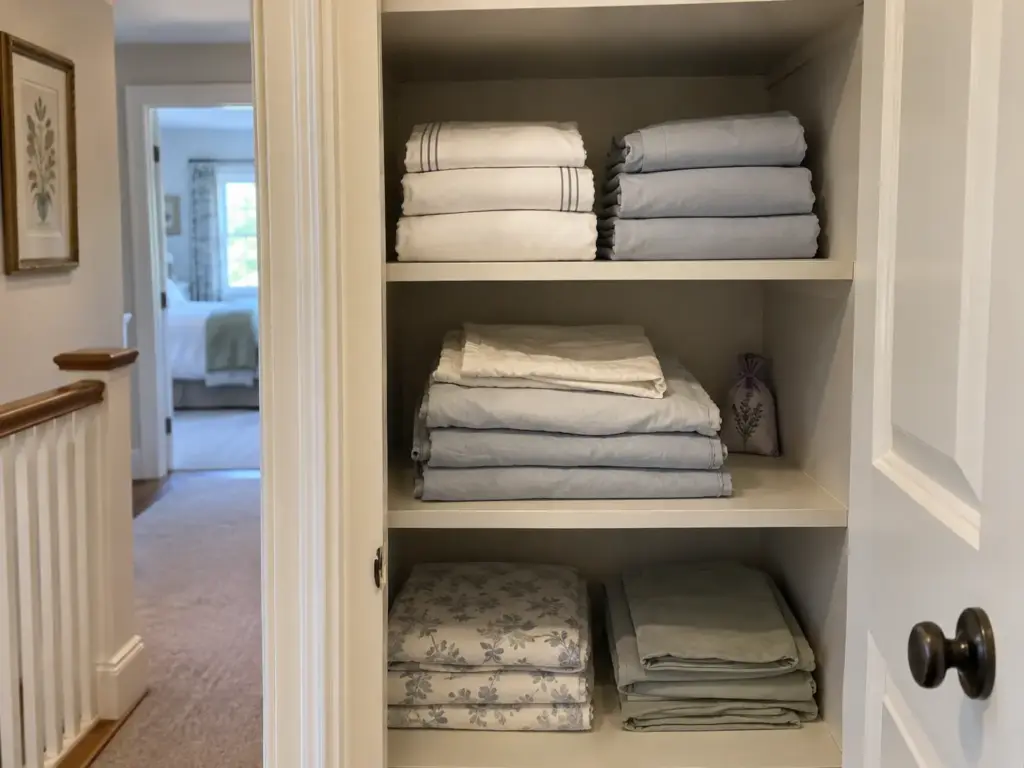
Linen runs five to ten years and, at a heavy enough weight, considerably beyond that. Those are real figures for sheet lifespan and they hold up against what real owners report. What almost nobody states next to them is the replacement frequency they assume.
Now the part that never gets printed next to them. Every one of those ranges assumes about one wash a week. Not two. Not one every three weeks because the set lives in a guest room.
Take the assumption away and the number means nothing, which is exactly why the same set gives one household five years and another eighteen months.
You can see that scatter in any thread where people actually report what they own. A Costco set at five years and still going. A Brooklinen owner at seven-plus.
On the other end, LL Bean sheets that tore in under six months, and a Red Land Cotton set that one owner said barely lasted a year despite the price. Price is plainly not the variable separating those outcomes, which is also why two sets bought the same week can be years apart.
Part of the reason the label never helps here is that the label is answering a different question. Cotton Incorporated’s own durability data found that 58% of people equate “good quality” with durable or long-lasting, while only 23% connect it to fiber or material strength. Durability is an engineered, measured property of the fiber. Most buyers experience it as a vague impression, so that is what gets sold to them.
And the set that fails first is almost never the one that felt worst in week one. Week one is thread finish. Year two is staple length.
Why the Calendar Is the Wrong Unit
Those numbers scatter so far because time is not what destroys a sheet. Friction is. Time is just the thing we happen to measure while the friction accumulates, and when the friction rate changes between two households, the years stop lining up.
The textile industry never had this confusion, because it has never measured fabric life in months. It measures cycles to failure. A swatch goes on an abrasion tester and gets rubbed until it visibly changes, and the number of rubs it survived is the rating. General contract upholstery has to clear 15,000 double rubs; heavy duty is 30,000.
The standardized methods behind that rating are the Wyzenbeek and Martindale tests, written up as ASTM D4157 and the AATCC procedures alongside it, and what they measure is the number of cycles a fabric endures before it shows an objectionable change in appearance. Nobody publishes that number for sheets. The mechanism deciding when yours give out is identical.
What a wash cycle actually does to a thread
A washing machine is an abrasion tester you paid for. Every cycle drags the fibers across each other and across the drum under load, and each pass pulls a few short fibers loose from the yarn. That is not a metaphor for wear; it is the wear, and thread wear is cumulative: nothing a later wash does puts a fiber back.
Weave density decides how fast it shows, because a tightly woven percale has less thread exposed to rub than a loose one at the same fiber quality.
The same process is why pills are short fibers working their way out under exactly this friction, and the pill is just the loose fiber that has not managed to leave yet.
Hot water and high dryer heat speed the whole thing up, because heat swells and weakens the fiber right when it is being rubbed hardest. A set washed hot and dried on high reaches the end of its life roughly 40% faster than the same set washed cool and dried on low or hung. Same product, same house, same age. Forty percent.
Wash a set weekly and it absorbs 52 full wash-and-dry cycles a year. That is the number the calendar was hiding the whole time.
Stop counting from the purchase date and start counting washes. Write the month you started using the set on the care label in laundry marker, then estimate: weekly is about 52 a year, every two weeks is 26. A set at 150 washes is old regardless of whether that took three years or six.
The second clock nobody counts: nights on the bed
The machine is only half of it. A sleeper shifts position somewhere between 10 and 40 times a night, 365 nights a year, and every one of those shifts is fabric moving against fabric under the weight of a person. That friction never shows up in any wash-count estimate, and it is silently running the entire time the sheet is on the bed.
Which is why the guest set in the cupboard settles the argument on its own. Same fiber, same purchase date, a fraction of the cycles from both sources, and it still looks new. If age were the variable, it would be worn out too.
Why the same product gives two people five years and eighteen months
The r/Frugal thread has both outcomes for the same product line in it. The person who opened it wore theirs through at eighteen months, washing weekly. Another owner of the same line reported five years, rotating two sets and washing every other week. One product, two routines, and a gap you could fit another entire set of sheets into.
The community names the machine itself as the bigger variable, and it is more specific than most buying guides manage. As u/roamingwidgeteer put it in that thread: “Your washing machine will make the difference between 1.5 years and 10 years. A good quality front loader puts much less stress on the fabric during a wash cycle than a top loader that shears the clothing back and forth.”
Shears is the right verb. A top-loader’s agitator does mechanically what the abrasion tester does deliberately.
One more thing the wear pattern gives away: it does not arrive evenly. The thinning shows up first in the middle of the bed and along the top-sheet hem, where the friction concentrates, not at the corners that get yanked hardest every laundry day.
What Moves Your Own Number
Here is what the range cannot do. It was written for one sleeper washing weekly, and almost nobody is that person. So take the general number and make it yours, because the adjustments are large enough to matter more than the starting figure did.
Material: staple length is the number the label won’t give you
Staple length is the length of the individual cotton fiber before it gets spun, and it is the single biggest material predictor of how long a sheet lasts. Long fibers twist into a yarn with fewer loose ends to work free; short ones shed constantly. The r/BuyItForLife regulars have this exactly right. As u/Warm_Yard3777 said there: a short-staple cotton “is more likely to pill or tear. A long staple cotton (Egyptian cotton or its US equivalent, Pima cotton) is generally sturdier.”
Thread count tells you almost nothing about this, and the community is blunter about it than the industry is. “Thread count is mostly marketing bs after like 400-500,” as one commenter in the same thread put it. A 300-count long-staple percale will usually outlast a 600-count short-staple sateen, and the label makes the second one sound like the better buy.
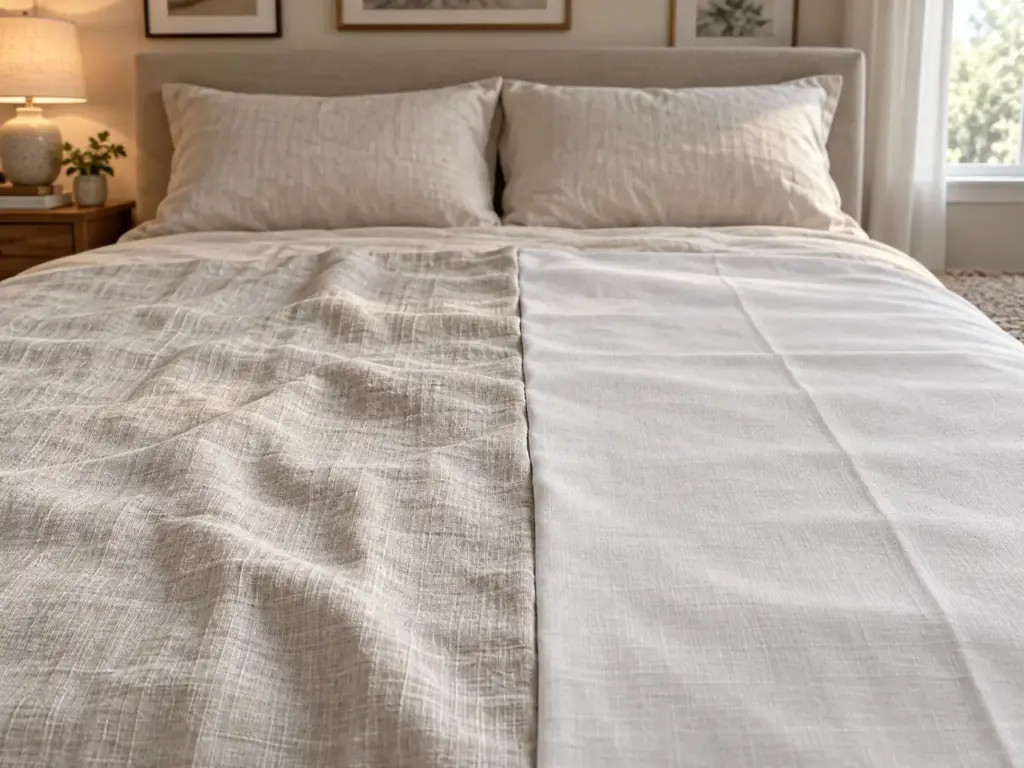
Linen sits at the far end of the range for a structural reason: flax fiber is longer and stronger than cotton to begin with, and it gets stronger when wet rather than weaker. It is also one of the few categories where the label sometimes states the thing that matters. The DAPU 100% French Linen Sheets declare 170 GSM on the listing, which is grams per square meter, an actual measurement of how much fabric is there, the spec almost no cotton set will give you. Its flaw is in that same number: 170 GSM is a medium-light linen and will not reach the 10-to-15-year end that heavier weights do, and linen creases visibly and permanently, so it is the wrong pick for anyone who wants a bed that looks pressed. If that end of the range is where you are shopping, it is worth knowing how far the linen end of the range actually stretches, by GSM.
For completeness at the other end of the material question: bamboo runs shorter than either.
Who and what is in the bed
Household size is the variable every published range quietly ignores. The two-to-four-year figure is written for a single adult washing weekly, and a single adult is the one household the number is actually accurate for. Everyone else is reading somebody else’s answer.
Two adults roughly double both the friction and the body-oil load on one set. The bed gets twice the shifting per night and twice the skin contact per hour, and there is no version of the arithmetic where that does not cost you. A two-to-four-year range for a single sleeper realistically becomes eighteen months to two years for a shared bed. That adjustment is not printed anywhere, and it applies to most of the people reading this.
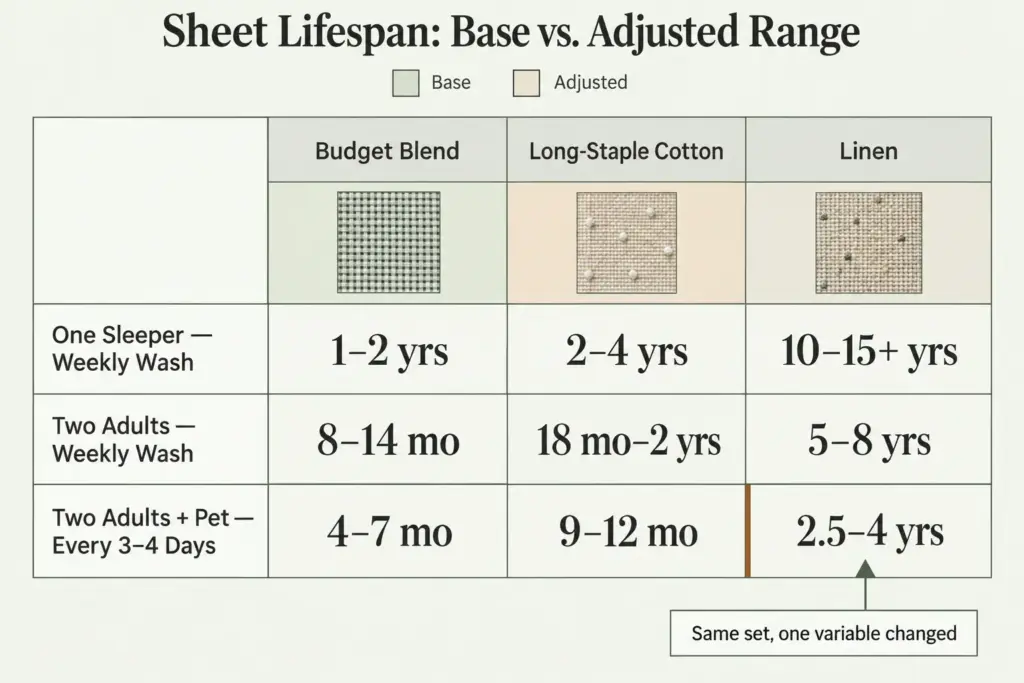
Pets on the bed are the other household variable, and where they sleep decides how much it costs you. Pets under the covers, under the sheet rather than lying on top of the duvet, shorten the sheet clock faster than anything else in a normal house. The usual advice moves from weekly to changing the bedding every three or four days, which takes a set straight from 52 cycles a year to something closer to 100.
Claws are a separate failure mode entirely, and they are fixable. One owner in the r/Frugal thread traced the holes in her sheets to cats and a dog landing on an unmade bed, started making the bed and trimming claws, and reported no holes in three years since.
The wash routine, which is worth more than the price tag
This is the lever with the widest range attached to it, and it costs nothing to pull. Cold water and low or line drying against hot water and high heat is worth roughly 40% of the set’s life, as u/WasteZone2020 summarized in the r/Frugal thread: “Wash cold, dry on low or hang dry (this saves the fibers and expends the life cycle by ALOT).”
The usual advice is to buy quality sheets over budget sheets. And better sheets do last longer. But after enough same-product, different-outcome reports from real owners, the wash routine holds up as the stronger predictor of the two.
An expensive set washed hot every week will lose to a mid-priced one washed cold and hung. That is the whole reason the LL Bean set tore at six months while the Costco set made five years.
Four settings do most of the damage, and they are worth naming separately because people usually change the wrong one. A hot water wash swells and relaxes the fiber before the drum has even started working on it. Tumble drying on high is the harshest thing that happens to a sheet all week, because heat and abrasion arrive together.
A harsh detergent, or simply too much of it, leaves residue that stiffens the yarn so it abrades against itself. And fabric softener is the one that surprises people: it coats the fibers, which feels good for a month and then traps the oils and grit that grind the set down, on top of destroying the absorbency you bought cotton for in the first place.
Air drying undoes most of that in one move. A set hung to finish, or pulled from the dryer slightly damp, skips the part of the cycle that does the real harm.
If you only change one setting, make it the dryer, not the washer. Cold water saves the fiber; high dryer heat is what destroys the fitted sheet’s elastic, and the elastic usually gives out years before the fabric does. Low heat, pull the set out slightly damp, and put it straight on the bed to finish.
What Rotation Actually Buys
Before you replace anything or buy anything, there is a fix that costs nothing and is the most repeated piece of advice in every real thread on this subject. It is usually given as a vague tip. It is not a tip. It is arithmetic, and it is the same mechanism this article has been building toward.
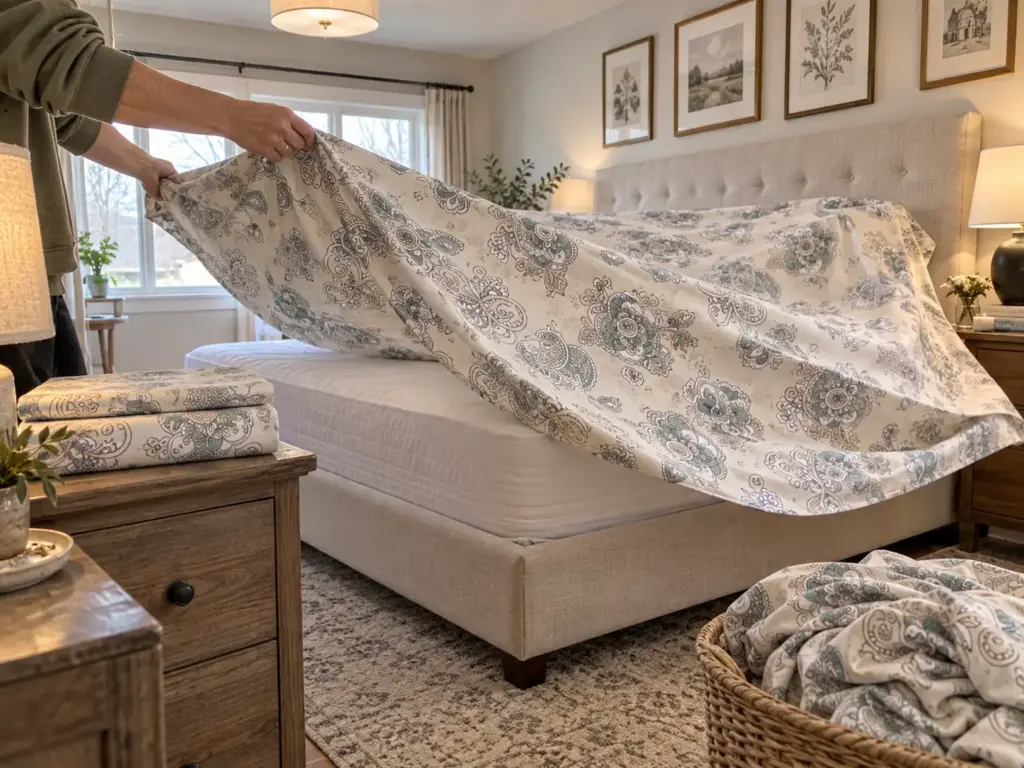
The arithmetic: 52 cycles becomes 26
One set washed weekly takes 52 cycles a year. Split that weekly wash across two sets and each one takes 26, which is half the mechanical stress per year, per set. Nothing else changed.
You did not buy better fabric, you did not change the water temperature, you just stopped putting all the friction on one set. Three sets in rotation takes each one down to about 17.
That is the entire reason rotation works, and it comes with results attached in the threads where people actually report years. One commenter in r/Frugal described rotating two sets and washing every other week; her oldest set was five years old and she said it looked basically brand new. Every two weeks across two sets is 13 cycles a year each. At that rate, five years is 65 cycles, which is barely more than one year of single-set weekly washing.
Buying the second set without doubling the spend
Start by rotating what you already own. Most houses have a spare set in a cupboard that is doing nothing but proving the guest-set point from earlier, and putting it into the rotation tonight is free.
If you genuinely only own one, a second set is not double the annual spend. It is the same spend arranged differently, because each set now lasts substantially longer.
The honest way to compare any two sets is total cost of ownership, not what you hand over at the till. Work out the sheet set cost per year — what it cost divided by the years it actually lasted — and the comparison turns over completely. A budget set replaced every twelve to eighteen months and a good long-staple set that runs four years land in much the same place annually, and a linen set that runs ten frequently comes out cheapest of the three.
Rotation improves that figure for every one of them at once, because it is the denominator it changes. One r/Frugal commenter treats this deliberately, buying inexpensive sets from discount stores specifically so several can rotate at once, his reasoning being that when one fails you replace just that one cheap set instead of losing the whole rotation at the same time. That is a real strategy, not a compromise.
If you would rather the rotation be built on the class of fabric this article credits with the two-to-four-year range, the Feather & Stitch 100% Cotton Percale Sheet Set is a 300-thread-count cotton percale with a 16-inch pocket, which is the one-over-one weave that lets air through and the pocket depth that actually clears a mattress with a topper on it. Its flaw is in the same spec: 300-count percale is not the far end of the durability range, and on a weekly hot wash with high-heat drying it will land at the short end of its own two-to-four years rather than the long one. Rotated and washed cold, it lands at the other end. That difference is the whole article.
What rotation does not fix
Rotation slows fabric wear. It does not protect the elastic the same way, because the dryer heat that degrades elastic is also per-cycle, and elastic fatigue arrives on a much shorter schedule: the elastic has far fewer cycles in it to begin with. So a rotated set can end up with fabric in genuinely good condition and a fitted sheet elastic that no longer grips anything. When that happens, the elastic runs on its own clock and the fitted sheet is what needs replacing, not the set.
There is a side effect of rotating that nobody mentions, and it is useful. Two sets alternating make the ending obvious. The older one goes on the bed and that night feels different, immediately, because you have the newer one for comparison.
A single set never gives you that. It ages under you one week at a time, and you notice at the point where it has a hole in it.
When the Schedule Stops Mattering
Every number in this article is a planning figure. A planning figure is not a verdict on the set that is on the bed right now, and confusing the two is how people throw out sheets with two good years left and keep sleeping on ones that finished last spring.
What the date is actually for
The date tells you two things: when to start paying attention, and when to put the next set in the budget. That is its whole job.
Once you are inside the range, the set stops being judged by its age and starts being judged by hand, on its actual signs of wear — and there are four checks you can do tonight, and the two-of-four rule that turn those checks into an actual answer. Go do them. That question is not a calendar question and this article cannot answer it.
The triggers that overrule any schedule
Some things end a set regardless of what the math says. A hole. Elastic that will not hold a corner through one night. A smell that survives a proper wash.
Any one of those finishes a set at nine months as decisively as at nine years, and no amount of “but it should have lasted longer” changes what is in your hands.
The rest of the bed runs on its own clocks
None of this transfers to the rest of the bed, and treating the bedding as one unit with one replacement date is the most common way people get this wrong. The rest of the set is on four separate clocks: pillows run on fill, not on years, and a comforter outlasts the sheets under it by years because it is not being rubbed and washed 52 times a year.
The same logic applies inside the sheet set itself. The fitted sheet almost always goes first, and by a wide margin, because it takes the sleeping friction and the elastic stress and the same wash count as everything else. Retiring the flat sheet and the pillowcases alongside it is throwing out a year or more of perfectly good spares.
When a fitted sheet fails, keep its flat sheet and pillowcases and buy a single replacement fitted sheet in the same size rather than a whole set. Pillowcases wear on a faster clock than the flat sheet because of hair oils and nightly face contact, so those orphaned spares get used up long before the flat sheet does.
Count the Sets in Your Cupboard Tonight
Two to four years for good cotton is a real number, and it assumes about one wash a week. Count your washes, not your months, and the wild scatter in everyone else’s reported lifespans stops being mysterious.
Two adults, a pet that sleeps under the covers, or a hot wash finished with high dryer heat each pull that number down hard. Cold water and a second set each push it back up, and neither one requires you to buy better fabric than you already own.
Rotation is not a tip, it is arithmetic. Two sets take 26 cycles a year each instead of 52, and that alone is worth more than most upgrades you could pay for.
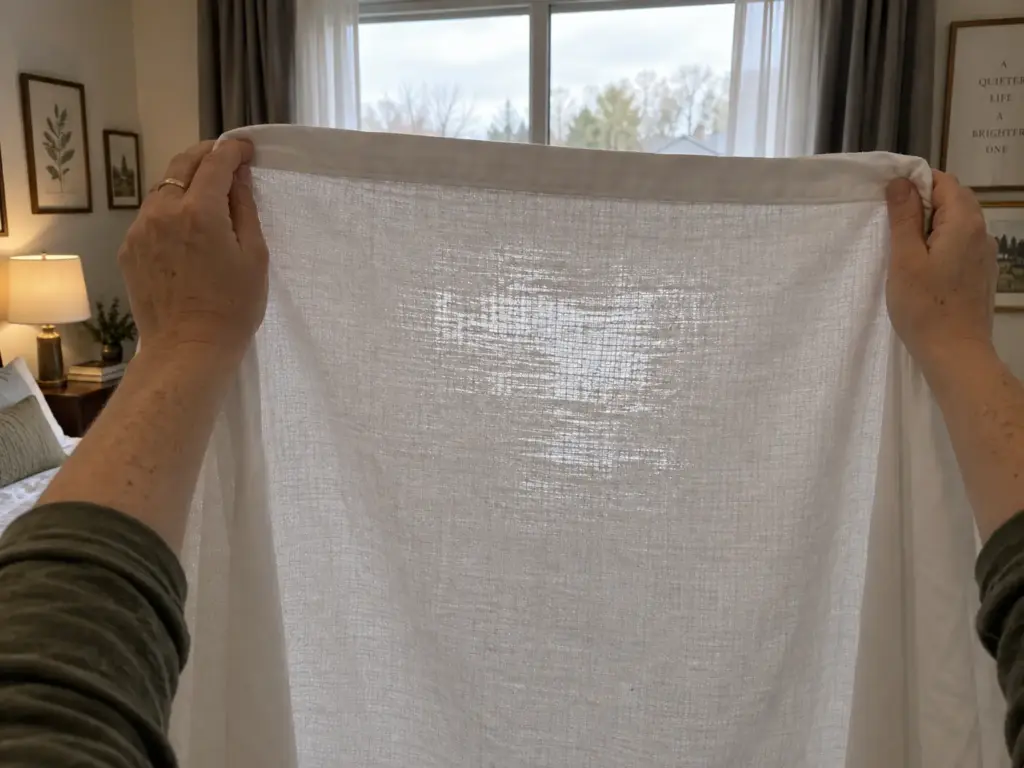
After about twenty washes, hold the middle of the flat sheet up to a window. That is where the friction concentrates, and thinning shows there long before the hem or the corners give any sign at all.
So: count the sets in your cupboard tonight. If the answer is one, that set is absorbing every cycle on its own, and the cheapest thing you can do for it is a second one, not a better one.
Frequently Asked Questions
01How long do bed sheets typically last?
Two to four years for good long-staple cotton, one to two for budget blends, and five to ten or more for linen. Every one of those figures assumes about one wash a week. Wash more often, or hot, and they all drop.
02Do more expensive sheets last longer?
Not reliably. Real owners report seven years from mid-priced sets and under six months from expensive ones. Staple length, wash temperature and rotation predict lifespan far better than the price does.
03Does having two sets of sheets make them last longer?
Yes, and roughly double. One set washed weekly takes 52 wash cycles a year; two sets alternating take 26 each, which is half the mechanical wear per set. Three sets take about 17 each.
04Should I replace the whole set when the fitted sheet wears out?
Usually not. The fitted sheet almost always fails first, and often from elastic rather than fabric. Keep the flat sheet and pillowcases as spares and replace the fitted sheet on its own.
05How often should you replace sheets if two people share the bed?
Closer to eighteen months to two years for good cotton, against two to four for a single sleeper. Two adults roughly double both the friction and the body-oil load on the same set.





Tried it on your own bed?
No comments yet. Tell us what you changed, and what the sheet did after a few washes.