







What’s in here8 sections
- Zippered vs envelope starts with which layer you mean
- Why an envelope is the default for the case you sleep on
- When an envelope lets the pillow out, and what to try before buying a zipper
- The protector is where a zipper belongs
- Does a zipper make a case a barrier?
- What each closure does on wash day and after months of washing
- Zip the layer underneath, tuck the one you lie on
- Frequently Asked Questions
You roll over in the dark and your cheek lands on bare foam, the case bunched at one end and half the pillow out of it. That is the whole zippered vs envelope question in one bad night, and it usually gets answered as if a pillow wore a single layer. An envelope fastens nothing: its flap lies over the pillow and stays put through friction and the pillow’s own weight. A zipper does fasten, and what it leaves behind is a hard line of teeth wherever it ends up under your face.
So the answer depends on which layer you mean, because the case and the protector beneath it want different closures. On the case, the number that settles it is the overlap, and the wider map of the three layers and the job each one does sits behind this one question.
On the case you sleep on, an envelope is the default and a zipper earns its place in a few specific beds; on the protector underneath, a zipper is normal, and it goes into the case zip end first.
| Your bed | The protector underneath | The case you lie on |
|---|---|---|
| Cotton or linen case, regular pillow | Zipper, zip end into the case first | Envelope |
| Silk or satin case | Zipper, zip end into the case first | Zipper, or a deep envelope |
| Firm or overstuffed pillow | Zipper or full encasement | Zipper |
| Restless or stomach sleeper | Zipper | Zipper, if a snug envelope still lets go |
| Case too big for the pillow | Zipper | Neither: a case sized to the pillow |
Zippered vs envelope starts with which layer you mean
The table gives two answers because a made pillow carries two layers, and the question tends to fold them into one. Pull a pillow out of its case at the foot of the bed and you are usually holding three things: the pillow, a protector zipped around it, and the case you picked for how it feels.

The case and the protector are different jobs
Consumer Reports describes a pillow protector as an extra layer that sits between the pillow and the case, closing with a zipper or a fold-over flap. The stack runs in that order: pillow, protector zipped shut, case over the top. The protector is meant to stay on the pillow for weeks at a time, so a closure that grips suits it, and no cheek ever touches it.
The pillowcase is the opposite job. It comes off every week, it is the only fabric your face meets, and anything hard in it ends up under your jaw sooner or later. That makes the protector the layer a zipper was made for and the case the layer where a zipper is optional. Whether the inner layer belongs on your pillow at all is a separate call, and whether a pillow needs a protector comes down to the pillow’s care tag; from here on the protector is taken as given, and only its closure is in question.
Back envelope, side-open, zipper: what each one actually is
The side-open case is the plain one: a tube closed on three sides with one short end left open, what r/Bedding calls side-load or open-ended. It is the baseline the other two closures are compared against. When it slips, the corners at the open end show first, because nothing at that end holds them in.
A back envelope, in Blissy’s description, uses two overlapping back panels instead of a zipper or button, and the panels overlap by several inches in the center to form a hidden pocket. The community names for it are back enclosure, envelope sham and French tuck. A hidden zipper, which some listings call an invisible zipper or a concealed zipper, runs along one side of the case and closes it all the way round, with nothing open anywhere. That zipper closure is the third option, and the one the rest of this article keeps testing against the envelope.
Between the first two, what people notice is mostly looks. One r/Bedding poster searched for a silk case with a back enclosure because, in the poster’s words, “I don’t like having zippers,” and in a side-load case the pillow edge shows unless the case “is exactly the right size (which it never is).” That parenthesis is the side-open case’s whole weakness. It has nothing to tuck behind.
Why an envelope is the default for the case you sleep on
If nothing fastens an envelope, it is fair to ask why it is the default on the layer you lie on. The answer is that what bothers sleepers about a zipper is one part of it, the teeth and the pull, and where they end up by morning, rather than the idea of a closed case.
What an envelope does with no hardware
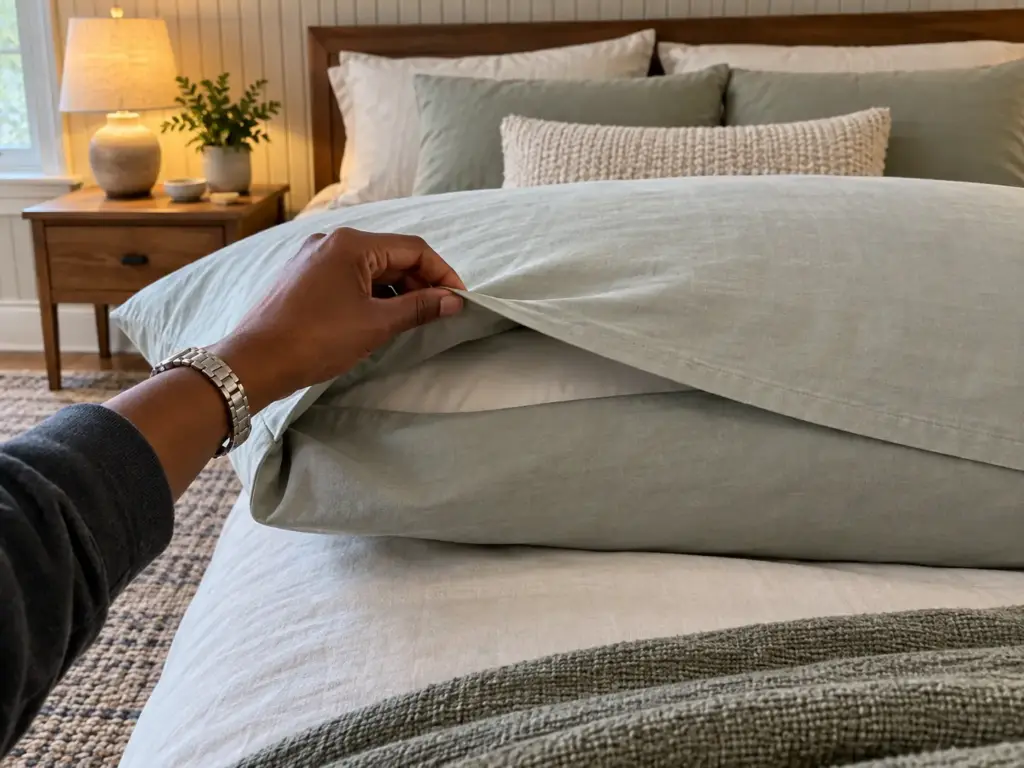
Two overlapping panels, one lying over the other, and the pillow shell inside holds them shut. Blissy puts the usual overlap at 4 to 6 inches. Set that against a standard pillow, which is about 20 inches across its short side: the slit in the back runs those 20 inches, and a band of fabric 4 to 6 inches deep lying over it is the entire closure. The flap works as a pocket, and the pocket is exactly as deep as the overlap.
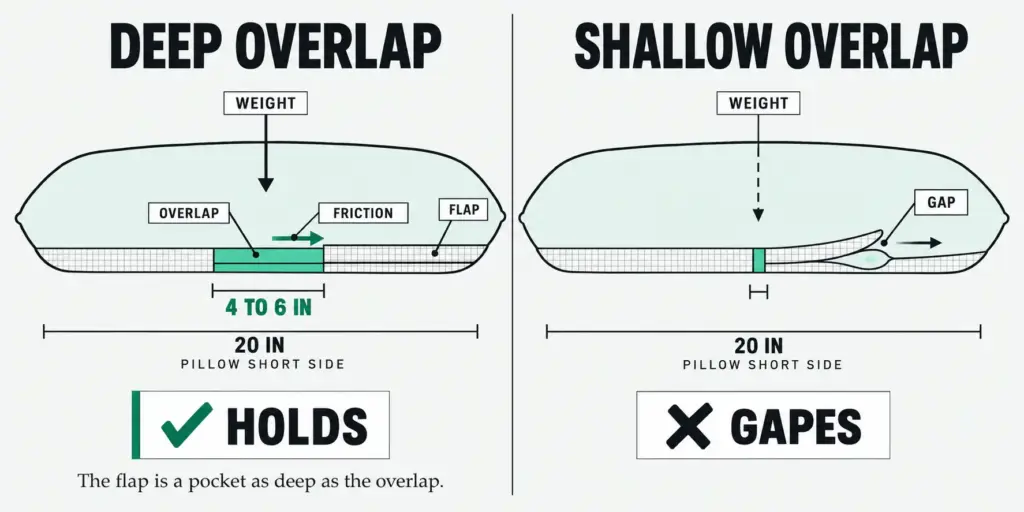
That makes overlap depth the spec to look for, and most listings never print it. With a deep overlap, the pillow has to shift a long way across the inner panel before the outer flap lifts off it; with a shallow one, the first good shove of the night opens a gap.
But 4 to 6 inches is a range, not a rule, and where your bed sits in it depends on what is inside the case. On a soft cotton case over a squashy pillow, even the low end holds, because the cotton surface grips and the pillow barely pushes back. Swap in a firm pillow, or swap cotton for silk, and the same 6 inches can let go. The overlap only works as well as the friction between the panels and the pressure the pillow puts on them.
Measure the overlap on a case you already own before shopping for a new one. Lay it flat, slide a hand into the envelope pocket and run a tape from the fold to the edge of the inner panel. Under 4 inches on a standard pillow, you are below the range one maker calls typical, so watch that case first. On a listing that gives no figure, look at the photo of the back: the seam line of the inner panel shows how deep it goes.
What a zipper costs the cheek
Hunker sums up the trade plainly: zippers and buttons do a better job of keeping the pillow inside the case, but a restless sleeper may end up rolling onto them, and they can break over time. That is the cost, hardware against skin: a strip of teeth and a zipper pull sitting in a surface your face moves across all night, and a side sleeper’s cheek stays on that surface for hours. A hidden zipper along one side is easy to keep away from your face when the bed is made and harder by morning, because a pillow gets turned, flipped and folded long before you wake.
What the zipper gives back, per Mulberry Park Silks, is defined corners and a case that looks the same on both faces, so a print can run all the way round. Those are real advantages. They are just advantages for the person looking at the bed, not the one lying in it.
The looks and the bed-making
An envelope makes one face of the case thicker where the panels double up, and Hunker notes the slightly asymmetrical look that comes with it. On a made bed that side goes down against the mattress, where the flap disappears and the smooth panel faces up. A zippered case has no wrong side at all, which suits a bed made in a hurry.
For most people, the trade comes down to a slightly lumpy back nobody sees against a line of teeth somebody feels. Easy call.
When an envelope lets the pillow out, and what to try before buying a zipper
An envelope is the right default and still the closure most often reported as failing, with the pillow creeping out by morning. A stomach sleeper on r/Bedding who flattens the pillow every night describes it as “always creeping out of the case,” and in another thread a partner who steals the blankets “cannot keep a pillowcase on his pillow to save his life.”

What decides whether it holds
Three things, and the sources agree on all of them. The first is how much the sleeper moves, since every turn drags the pillow a little against the flap. The second is how firm the pillow is, and how much pillow loft there is to push with: Mulberry Park notes that a firm pillow is more likely to work itself out of an envelope closure, because it presses on the flap from inside instead of settling into the pocket.
The third is the fabric’s grip. Cotton has a surface of short fiber ends that catch on each other, so the two panels hold where they touch. Silk and satin are smooth filament with almost nothing to catch, and an r/Bedding poster says flatly that in those fabrics the pillow will “slide out because silk/satin is so slippery.” Same overlap, same pillow, a different result.
The warning comes before the escape. The edge of the inner panel stops lying flat and stands up into a ridge you can feel through the case, and then a strip of pillow appears at the opening. Catch it at the ridge and the tuck takes ten seconds.
The free fixes first
The reflex answer to a pillow that keeps escaping is to buy a zippered case. Most of the time that solves the wrong problem. Hunker names the usual cause of a failing envelope as a case that is the wrong size for the pillow (sizing is its own topic, so one clause will do here): a case cut for a bigger pillow leaves the flap with nothing to press against, and it rides loose. A case sized to the pillow comes first, and it costs nothing if the right one is already in the closet.
After that, the community’s fixes, none of which needs a purchase:
- Tuck the flap deeper, pulling the inner panel all the way over the pillow’s end before the outer panel goes on top.
- Fold a bigger case inside itself, a tip from r/Bedding: a king case with its extra length folded back in gives a deeper pocket.
- Search for shams rather than pillowcases, because, as the same thread points out, shams usually have a center-back or side envelope closure instead of an open side.
- Sew two or three buttons along the opening of an ordinary case, if you sew.
Find out which way your pillow travels before deciding where the opening goes. Make the bed, lie on the pillow the way you sleep for a minute, then get up and look: the pillow moves away from where your head and arm push, and it leaves through whatever opening sits on that side. Put the opening at the other end and the push works for the flap instead of against it.
When a zipper is the right fix
Some beds beat every tuck. Mulberry Park names two of them, restless sleepers and anyone on a firm pillow, and slippery fabric is the third. In those three cases a zippered pillowcase wins on retention, and the hard line under your cheek is the price you pay for it.
Silk sits awkwardly in that list, and a zipper closure suits it no better than it suits anyone’s cheek. It is the fabric where an envelope fails most often, and also the one where a zipper is hardest to ignore, since the whole point of a silk case is the smooth surface under your face. The Cuddledown Mulberry Silk Pillowcase shows the bind: 22 momme, grade 6A mulberry silk and OEKO-TEX Standard 100 per the maker, with what the listing calls a “secure envelope closure,” yet the page opens on its Boudoir size, 16.5 by 12.5 inches, with 3.3 stars from just 3 ratings, and it is still silk, the fabric r/Bedding says an envelope lets slide. Pick the standard size before anything else, and treat the word secure as a reason to check the overlap rather than proof of it.
The momme figure on that listing is a weight, which is how silk is measured in momme rather than by name, and how a silk case holds up wash after wash is part of the momme and wash story of silk sheets.
The protector is where a zipper belongs
Move one layer in and the argument turns over. The hardware that bothers a cheek on the case does no harm on the protector, because the cheek never gets there.
Zip end into the case first
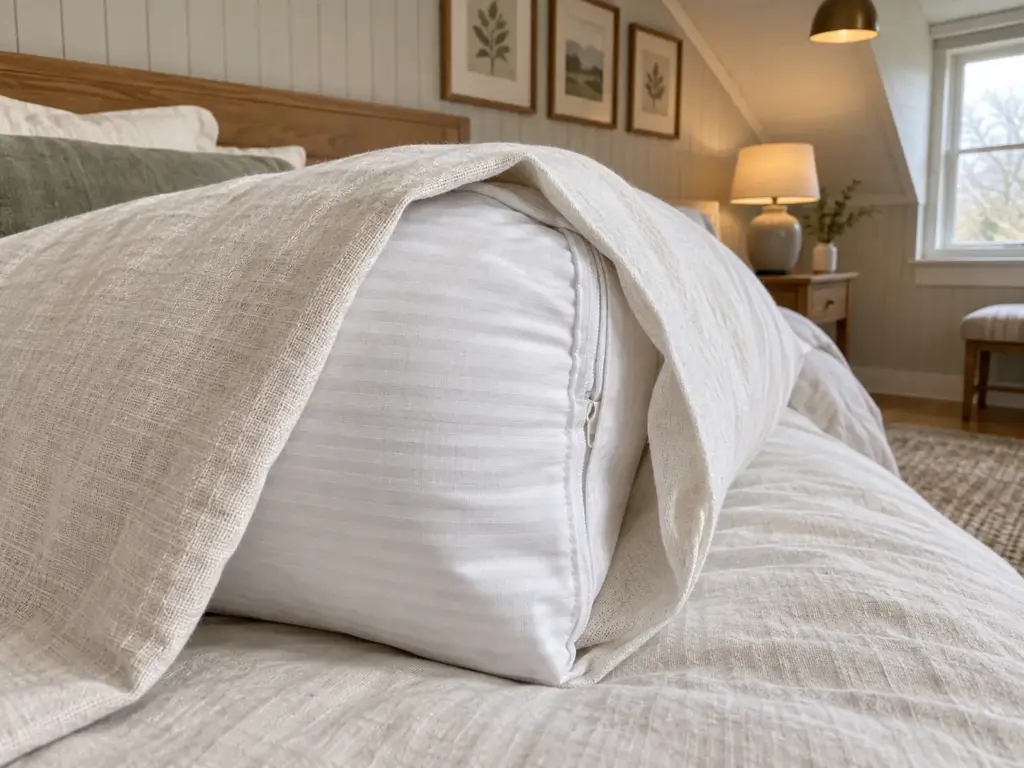
Hold the protector before the case goes on and find the end with the pull. That end goes into the case first. The pull then sits buried at the closed end of the case under a layer of cloth, and the end you handle every morning, the open one, holds nothing but plain fabric.
Get it backward and the pull rides at the opening, where it is the bump you feel through a thin case when you flip the pillow and the first thing to catch the hem when you strip the bed. Consumer Reports puts the protector between pillow and case; the zip-end rule just decides which way round it goes. Two layers, two closures: a zipper where nobody lies, and whatever you like where somebody does.
Zipper protector or full encasement
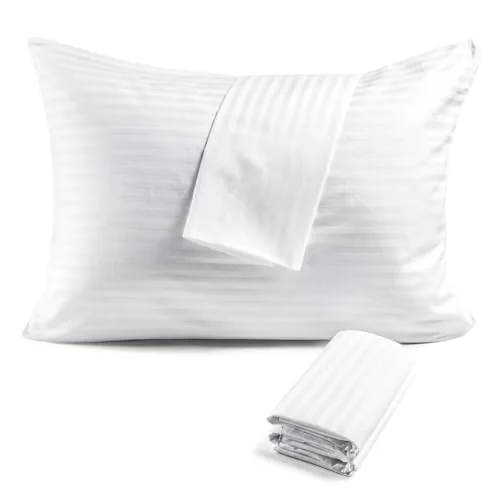
The cheapest inner layer has no zipper at all: a second, older pillowcase pulled on under the good one gives you something washable between pillow and face (whether that is enough is the sibling question above). When a real protector is wanted, there are three ways it gets built, and each closure costs something different.
A woven cotton protector closes with a zipper and lets air through the gaps of its weave, so the zipper is the only thing it adds. A jersey knit protector has a stretchy polyester face bonded to a film, and the film, not the zipper, is what seals it. A full encasement zips the whole pillow shut along one side and is built to let nothing in or out except through the fabric.
Sealing has a cost, and it shows up as trapped air. The Guardmax Jersey Knitted Pillow Protector is a jersey-knit polyester face over a TPU laminate with a nylon coil zipper, and the trade-off is written right there in its reviews: one buyer says it barely breathes and that it will “balloon up when you lay on it,” while the zipper reviews come out mixed. When your head lands in the middle, the air has nowhere to go but outward, so the corners and the zipper end puff up like a cushion with its valve shut and sink back slowly.
An encasement takes that further. The HOSPITOLOGY Pillow Encasement Sleep Defense System pairs a polyester knit face with a membrane the listing calls breathable and waterproof, closed along one side, in a 2-pack. Air trapped inside is the complaint that repeats, and the buyer summary reports “mixed opinions about the airtightness,” which is the plain cost of a pillow sealed on six sides.
For a pillow that only needs a washable layer, the woven cotton construction does the closing without the film. The FAUNNA 600TC 100 percent Cotton Pillow Protector is 100 percent cotton in a 4-pack, 600 thread count as the maker states it (no ply given), OEKO-TEX certified, with a silent zipper, in standard 20 by 26 inches. Buyers report it shrinks slightly after washing, and the size note says it runs small on standard-queen foam pillows, so on a thick foam pillow the zipper has to work to close over it.
Does the protector’s closure matter for what you sleep on?
Only indirectly. The closure decides whether the protector stays on and where its hardware ends up, and once it is zipped and fed in zip end first, it is out of the way for good. What the protector is for, and what a protector actually stops, down to the zipper tape and the needle holes, is the other half of the subject. For this question, the payoff is simpler: with the zipper on the layer underneath, the case on top can be the soft, hardware-free envelope you wanted in the first place.
Does a zipper make a case a barrier?
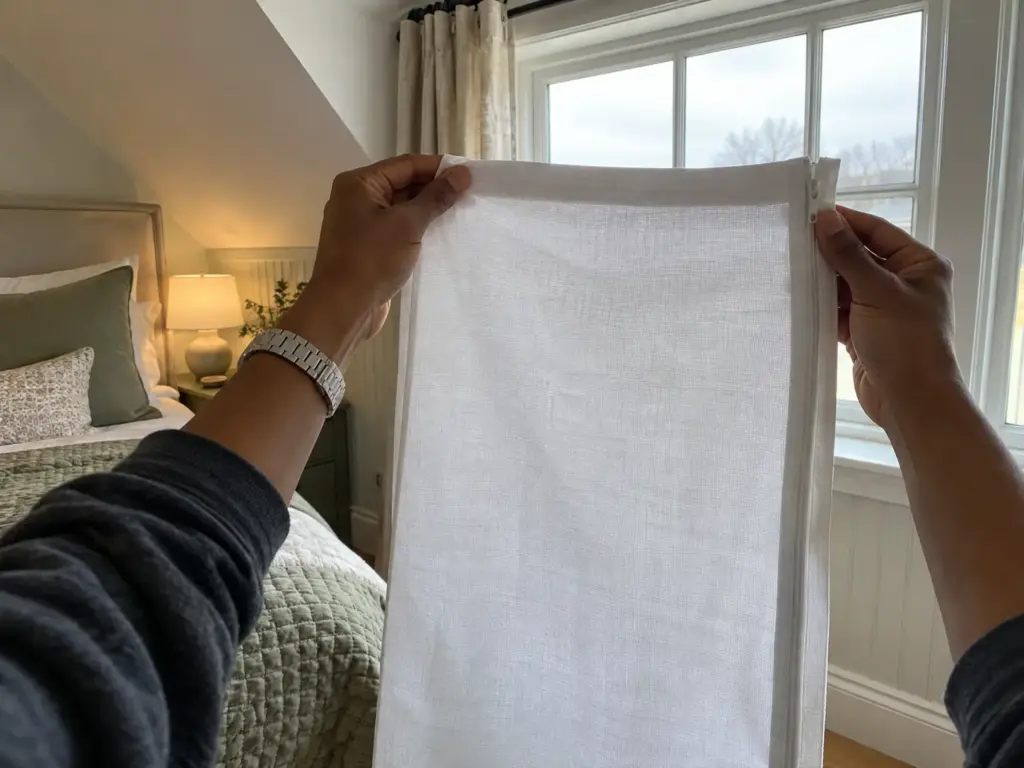
Some brands sell the zipper as the serious option, the allergen barrier of the two. Blissy’s version is that because a zippered case is fully sealed, it “creates a much stronger barrier against dust mites and allergens,” while envelope closures have a built-in gap. Picture two boxes on a shelf, one with a zipper photographed on the front: the claim makes that one look like the careful choice.
What the brand claim leaves out
A seal is only as tight as what it seals. The claim says nothing about how close the yarns sit in the weave, nothing about the zipper tape, and nothing about the stitching that joins the panels, and those are the places where fine particles get through. A zipper adds one closed line around one opening. The cloth on either side of that line is the actual wall, and it either is a tight one or it is not.
So the zippered case looks like the cautious pick and often is not, because the weave was never part of the claim. And an envelope’s overlap is also a gap of a different shape, a seam that laps over by inches rather than an open slot, and neither closure promises anything without the fabric to back it.
What the label has to show instead
There is one test you can read on a box. According to Consumer Reports’ pillow protector guide, a protector meant to keep dust mites out should pass it: “check that the product label displays a fabric pore size (the size of openings in the weave) of no greater than 6 micrometers or microns.” The same guide asks for the words woven fabric on the label. Put a zipper on an open weave and you have an open weave that zips.
Six microns is far too small to see, but tight and loose are not. Stretch a single layer over your hand and hold it toward a bright window: a dense weave lets through a flat, even glow, and a loose one shows a grid of bright points where the yarns cross. None of this is a promise about allergies, which are a question for a doctor; it only describes what gets through cloth, and the cloth is where the answer sits, not the zipper.
Read a protector box for two things in print: a pore size in microns, and the words woven fabric. A box that leads with the zipper and prints neither is selling you the closure, and the closure was never what stopped anything.
What each closure does on wash day and after months of washing
A listing can show a closure on day one. What it cannot show is how that closure comes out of the machine, and how well it still holds once the fabric has been through months of washing.

Wash day with a zipper
Mulberry Park’s care note is short: zip before washing, securely, so the zipper does not break or snag, and put silk in a fine mesh wash bag. An open zipper in a drum is a row of small hooks loose among everything else in the load, and the snagging and abrasion land on whatever they catch, the case’s own edge included. So the zipper adds a chore of about ten seconds, every single wash.
Zip the case closed, then turn inside out before it goes in the mesh bag. The teeth end up inside, rubbing against the case’s own cloth instead of the rest of the load, and the face you sleep on comes out without the fine scuffs a loose zipper leaves.
Wash day with an envelope
Nothing to zip and nothing to snag. The flap can fold over on itself and bunch in the dryer, so take the case out promptly rather than leaving it in a warm tangle, and follow the care label for temperature and drying, since it knows the fabric better than any general rule. A flap that comes out with wrinkles is also a flap that sits badly on the pillow that night, so a quick shake before it goes back on is worth the habit.
What the months do to each
Blissy, which sells zippered silk, admits the envelope’s long-term weakness in its own words: the overlap “can shift or loosen as the fabric ages,” with no hard closure holding anything in, just gravity and fabric friction. The mechanism is a weave that relaxes with washing. Wash after wash the yarns settle, the surface fibers lie flatter, and the two panels grip each other a little less, so an overlap that held firmly at first starts to let the pillow wander.
A zipper has the opposite problem: a part that can fail. One r/sewing thread gives the only months-scale report on both, from one person and two silk cases. The first, with a zipper, “ripped at the zipper” after almost two years. The envelope replacement “ripped after 9 months,” at the hem seams on both sides of the envelope edge.
One owner proves nothing about the average case. But it does break the neat idea that no hardware means nothing to break. An envelope has a weak seam too, the hem along the flap’s edge, which takes the strain every time the pillow is pushed in and pulled out, and on that case it went first. Each closure wears where the stress lands, and that clock runs alongside the separate wash clock each layer of the bed keeps.
Zip the layer underneath, tuck the one you lie on
- Treat the question as two: a zipper on the protector, where no face ever goes, and an envelope on the case, unless silk, a firm pillow or a restless sleeper rules it out.
- Before buying a zippered case, check the overlap and whether the case is sized to the pillow, because those two cause most escapes.
- Feed the protector into the case zip end first, so the pull ends up buried at the closed end and never under your face.
A few months of washing in, lie on the case and feel whether the flap still sits flat over the pillow’s end, then run the protector’s zipper from end to end to check it still slides without catching.
Tonight, pull the case off, check that it fits the pillow, and put it back with the flap tucked deep and the opening at the end your head does not push toward. In the morning, look at the opening before you look at anything else: if the pillow edge is still covered, the case was never the problem.
Frequently Asked Questions
01Is an envelope pillowcase better than a zippered one?
On the case you sleep on, usually yes: an envelope keeps hardware away from your face, and a zipper wins only on silk, a firm pillow or a restless sleeper. The protector underneath is where a zipper belongs, fed into the case zip end first.
02What is the difference between a back envelope and a side-open pillowcase?
A back envelope closes with two panels that overlap across the back of the case, while a side-open case is the plain tube with one short end left open. The envelope gives the pillow a pocket to sit in; the side-open case has nothing to tuck behind, so the pillow edge can show.
03What is an envelope style pillow cover?
An envelope style pillow cover closes by overlap alone, one panel lying over another with no zipper or button anywhere. The flap stays shut through friction and the pillow’s own weight, so the depth of the overlap and the grip of the fabric decide how well it holds.
04How much overlap should an envelope pillowcase have?
One maker, Blissy, gives 4 to 6 inches as the typical overlap for an envelope pillowcase, and that is the figure to look for on a listing. Measure it against your own pillow: a firm pillow or a silk case needs the deep end of that range.
05Why does my pillowcase turn yellow?
What usually yellows is the pillow’s shell under the case, as sweat and skin oil soak through, and a protector moves that stain onto a layer you can wash.





Tried it on your own bed?
No comments yet. Tell us what you changed, and what the sheet did after a few washes.