







What’s in here7 sections
Silk is the only bedding that keeps its promise for about four seconds. Your hand lands on it in the shop and the fabric is genuinely, measurably cold. That part is not marketing, and it is not a trick of the lighting.
The trouble is that the property producing that chill is heat leaving your skin by direct contact, and the property that keeps a sweating sleeper comfortable at four in the morning is air and vapor moving through a weave. Those are two different mechanisms, and every page that answers are silk sheets good for a hot sleeper treats them as one word: cooling.
So here is what the cool touch actually is, why the moisture story is the one that decides the night, what momme does to the answer, who silk genuinely suits, and what a season of washes leaves behind.
Quick Answer
Silk feels cool on first contact because it conducts heat away fast, but it does not move heat and moisture through the night the way an open weave does. It suits a cool or average sleeper who wants the feel. A true hot sleeper does better with percale — and gets silk’s real benefit from a pillowcase.
What the Cool Touch Actually Is
Everybody has done the hand test. You are in a shop, you put your palm on a folded silk set, and it is cold in a way that cotton next to it simply is not. That test is not lying to you.
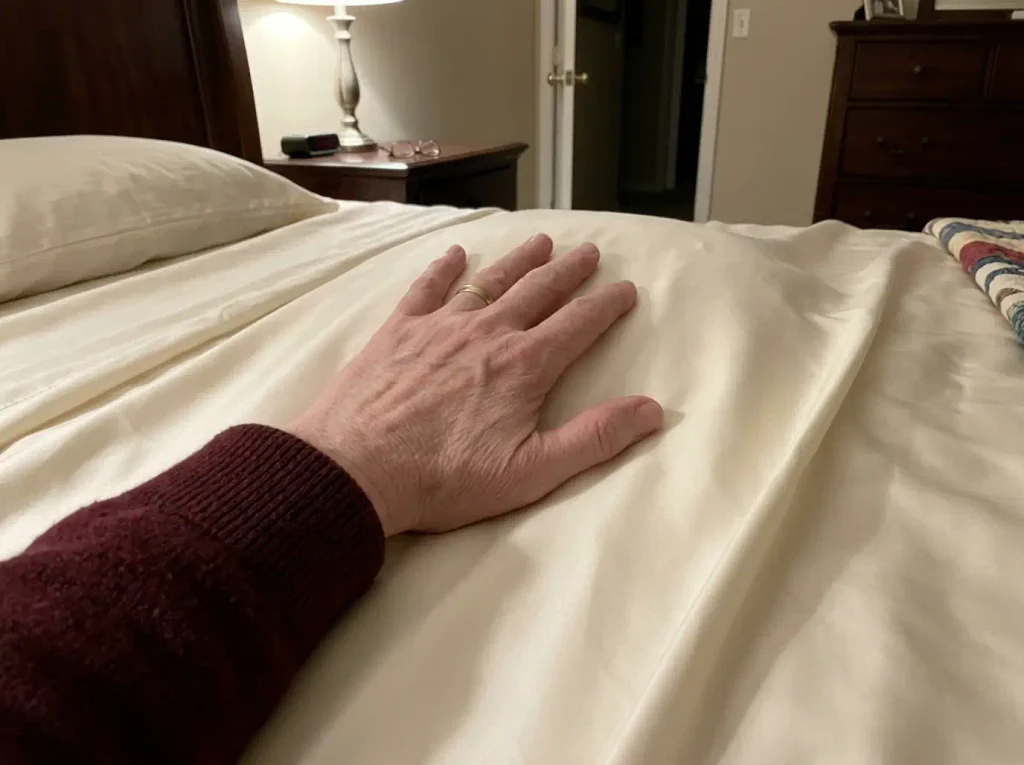
Mulberry silk is a protein filament with a smooth, roughly triangular cross-section, and that shape puts a lot of fiber in continuous contact with your skin with very little trapped air in between. Heat crosses that contact fast. Your hand loses warmth quickly, your nerves read fast heat loss as cold, and the fabric gets credit for a temperature it does not have.
Here is where it stops. Thermal conductivity is a one-time transaction. The fabric is cold because it is at room temperature and you are not, and once the patch under you has climbed to your own body temperature, there is nothing left to conduct anywhere. That takes a minute or two.
Everything after that minute is a different question entirely, and it has a different answer.
That second question is breathability, and it is settled by the weave rather than by the fiber. The same split shows up between bamboo and linen, where one fiber wins the first touch and the other wins the whole night. Real thermoregulation across a night is airflow, not first contact: air has to be able to move through the structure, carrying warm humid air out and drier air in, and how much of it does depends on weave density. That requires gaps.
And the weave nearly every silk sheet uses is charmeuse, a satin-structure float where the warp thread rides over four before ducking under one. Habotai, the plain, lighter alternative, turns up mostly in linings and low-momme weight goods rather than on beds. Four-over-one is what produces the gloss and the drape that people buy silk for in the first place.
It is also, by construction, a closed and continuous surface. The shine and the airflow come from the same decision, in opposite directions.
Which means the shop test and the bed are measuring two different things, and only one of them is repeatable. The cool touch comes back every time you move onto a fresh patch of sheet, which is exactly why silk is wonderful for the hour you spend falling asleep and irrelevant by three in the morning.
Nobody rolls onto virgin sheet at three in the morning. You are lying in a hollow you have been warming for four hours.
Do the hand test twice. Touch the fabric, then leave your palm flat on it for a full sixty seconds and touch a fresh spot with your other hand. If the warmed patch now feels like any other sheet, you have just watched conduction run out — and that is the whole first minute of your night, compressed.
One buyer in the r/Bedding thread on silk bedding described their set as about as warm as their down duvet, which reads as an outrageous claim until you realize they arrived at this exact split from the wrong end: in bed, at night, having bought the fabric on the strength of a hand test.
The Moisture Problem Nobody Mentions
Read the brand pages and read the threads and you get a flat contradiction. Every retailer says silk wicks moisture. The people sleeping on it say, in the words of one commenter, that it is terrible at moisture management. Both of them are describing something real, and the argument only resolves once you split the word “wicking” in half.
Moisture-wicking is two stages, not one, and only the second one cools you. Moisture has to move to the surface of the fabric, and then it has to evaporate from there, which is where the evaporative cooling actually happens. Skip the second stage and nothing has been managed: the water has simply been relocated.
Silk genuinely does the first part: it has real moisture regain, meaning the fiber pulls water into itself rather than beading it off. That absorption is a measurable property, it is the thing the marketing pages are pointing at, and they are not making it up.
What they leave out is that absorption without an evaporation path just means the damp is now inside the fiber and still against your skin. And the closed charmeuse surface is the reason there is no path, because the same four-over-one float that gives the gloss also gives vapor nowhere to leave from. This is why a fabric that feels worse to the hand can be better at four in the morning: an open percale is not holding onto anything. It is passing it through.
The tell is subtler than waking up wet, and it is the reason people stay confused about their own sheets for months. The parts of the bed you are not lying in stay cool to the touch all night.
The fabric keeps passing its own hand test while failing you, so every time you reach across at 4 a.m. and feel cold silk under your palm, the sheets get acquitted again. Meanwhile you are damp in the one patch that is not being tested.
If night sweats are the whole problem rather than the heat, that is a different question with its own answer, and it is worth reading before you decide a fiber is at fault.
And before you buy anything at all: the room is the bigger lever. A sheet is a few hundred grams of fabric arguing with an entire volume of air, and it loses. Get the bedroom into the National Sleep Foundation’s recommended 60 to 67°F sleep range and then re-test whatever is on the bed, because a 74-degree room will beat silk, percale and linen equally.
Momme, Weave and Weight
Silk is the one category where the number on the listing genuinely predicts what will happen in your bed — and almost nobody buying silk knows what it means, partly because it is not thread count and partly because the sets that would rather you did not check simply do not print it.
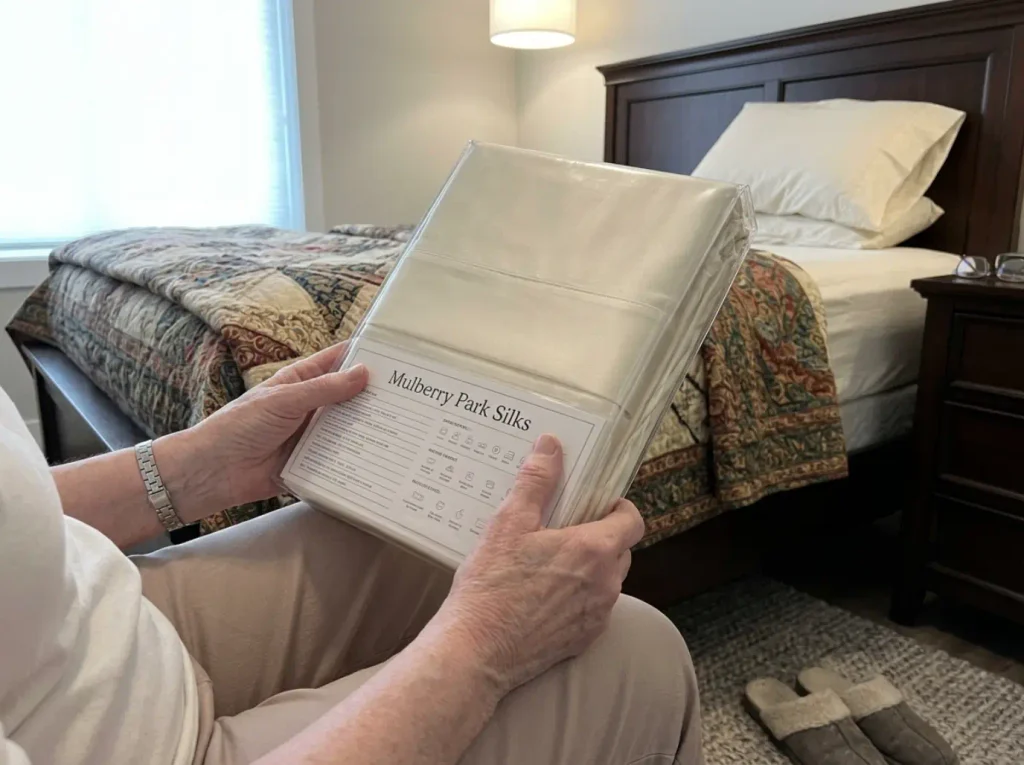
Momme is a density measurement. It is the weight, in pounds, of a piece of the fabric measuring 45 inches by 100 yards. That is all it is: a weight. It is not a quality score, it is not a grade, and a higher number is not automatically a better sheet. What a higher number reliably means is more silk per square inch of your bed.
Before the number, though, one word on the listing decides whether the number even applies. Satin is not a fiber. It names a satin weave, a float structure, and it can be woven out of anything. Polyester satin is the cheap version sold under silky marketing, and it is the single most common mislabel in the category.
So if a listing says satin sheets and never names the material, assume polyester until the fiber line says otherwise. A protein fiber and a petroleum one behave nothing alike against skin: real silk is a continuous filament fiber, unlike the short staple fiber lengths spun into cotton yarn, and polyester holds heat where silk at least absorbs. Momme only means something once you know you are looking at silk at all.
Which sets up a trade that runs directly against the way silk is sold. Lighter momme, in the 16 to 19 range, has less material in the structure and moves more air. Heavier momme, 25 to 30, insulates and holds body heat: same fiber, same protein, opposite behavior in the bed.
And 22 momme, the sheet-aisle default and the weight most likely to be marketed as cooling, sits on the insulating side of the middle. That is not a scandal; it is just a number doing what numbers do while a label says something else on top of it.
So the spec bundle worth looking for on any silk listing is four things: momme, grade, certification and pocket depth. A set that states none of the four is not being coy, it is hiding, and that is information you can use before you have touched the fabric.
Two of the four need reading carefully, though. OEKO-TEX Standard 100 certifies a finished textile against substances harmful to health, genuinely worth having, entirely unrelated to whether you overheat. And Grade 6A is a silk grade: a raw-cocoon grading that describes the thread before anyone wove it. It predicts nothing about your night.
The momme number is the only figure on a silk listing that behaves like a real spec, and it is routinely buried under the one that sounds more impressive.
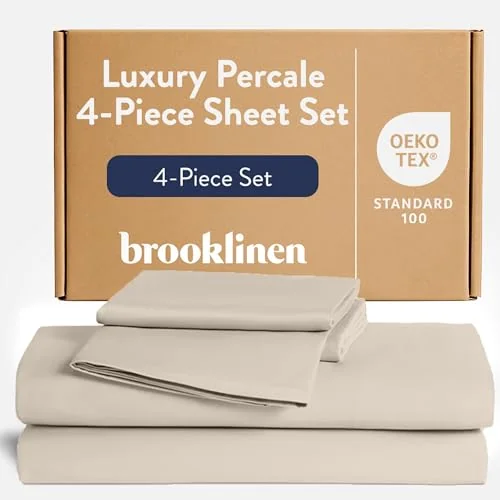
Here is a set that publishes all four, which makes it the useful specimen for learning to read a listing, and what a satin-structure weave does that a plain weave doesn’t is the mechanism sitting underneath every one of these numbers.
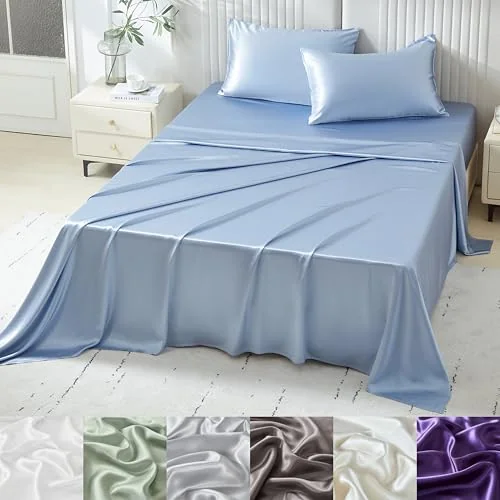
If a silk listing gives you a grade and a certification but no momme, treat the omission as the spec. A seller who has 19 momme to advertise advertises it; a seller who says Grade 6A four times and never gives you a weight is choosing which number you get to compare.
Who Silk Actually Works For
Start with the layer that costs nothing, because the sheet is one layer of four and it is the smallest of them. Drop the room into the 60 to 67 band. Take the top sheet out of the stack entirely and sleep under the duvet cover alone for a week. Then re-test.
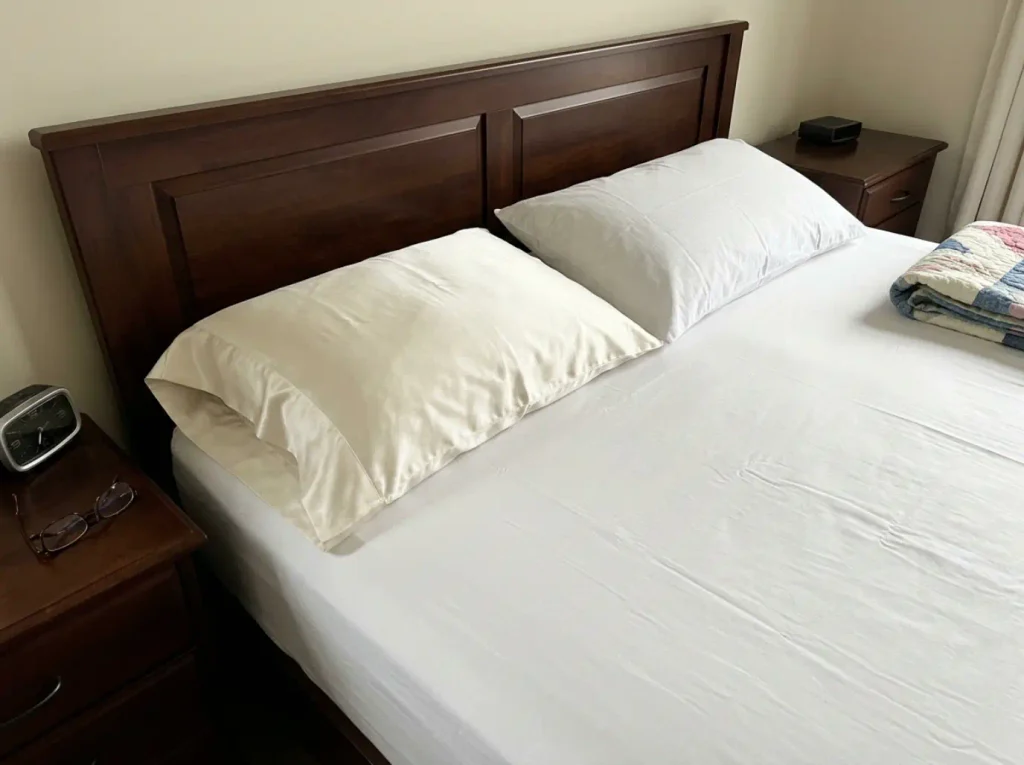
Half the people who arrive at this question convinced they need a different fiber are running a mattress that holds heat and a bedroom four degrees too warm, and no sheet in any material fixes either of those.
With that out of the way, the honest split. Silk genuinely suits the cool or average sleeper who wants the drape, the feel against the face, and the hair and skin benefit. That reader is not being sold a lie, they are simply not the reader this article is for. If your temperature question is already settled and what you want is the buying detail, the full silk buying guide covers momme, care and tiers without the hot-sleeper argument running through it.
Then there is the middle case, which is most people. The benefit that actually pulls people toward silk is hair friction, or rather the lack of it, along with less hair frizz in the morning and a smoother surface for anyone with skin sensitivity on the face. All of that happens at the pillow and nowhere else. So buy the pillow.
The Cuddledown Mulberry Silk Pillowcase carries the same 22 momme, Grade 6A and OEKO-TEX bundle as the full set above, which makes it a genuine spec-for-spec comparison rather than a downgrade, and it is one item to hand-wash instead of four. Its flaw is that it is still silk: hand wash, no dryer, same as everything else in the fiber. What you save is money and a whole-bed commitment, not the care.
The community arrived at this from the receipt end: across three separate r/Bedding threads asking whether silk is worth it, the recurring advice is to try a pillowcase before committing to a set.
And then the reader who genuinely overheats, who should not buy silk at all. The answer there is an open plain weave. Percale is one thread over and one under, which leaves interstices between every crossing the way a sateen float does not, which is the evaporation path charmeuse does not have. Worth knowing that cotton sleeps hot too when the weave is wrong, because the fiber name on the package is not the answer, the weave name is.
The Feather & Stitch 100% Cotton Percale Sheet Set is 300 thread count single ply with a 16-inch pocket, and it is the set that gets reused across this whole cluster for exactly that reason. Its flaw is the one you are choosing on purpose: a percale hand is never as smooth or as glossy as silk. It wins on airflow and loses on the sensation that made you look at silk in the first place.
One more thing about a shared bed, since it explains an argument a lot of couples have about the same set of sheets. Conduction is a skin-contact property, so a cold sleeper is getting the version of the sheet the marketing describes, every night, accurately, and the warmth retention that ruins the night for one of you is the reason the other one likes it. They are not being stubborn. They are on the same fabric having a different experience of it.
Run the split across two layers instead of arguing about one. A silk pillowcase on a percale bed gives the hair and skin benefit at the only place it happens, on top of a weave that still moves air for six hours. It is also the cheapest way to find out whether you actually like silk against you all night, because a pillowcase you regret is one item.
What a Season of Washes Does to It
The r/Bedding thread people actually read is titled, roughly, here are mine after three washes. That is the bar the category gets judged on by the people who own it, and it is a bar no brand page has ever tried to clear. Week one lies about everything in bedding, and silk more than most, because week one is when the gloss is at its absolute peak. Wash twenty is where the honest reading lives.
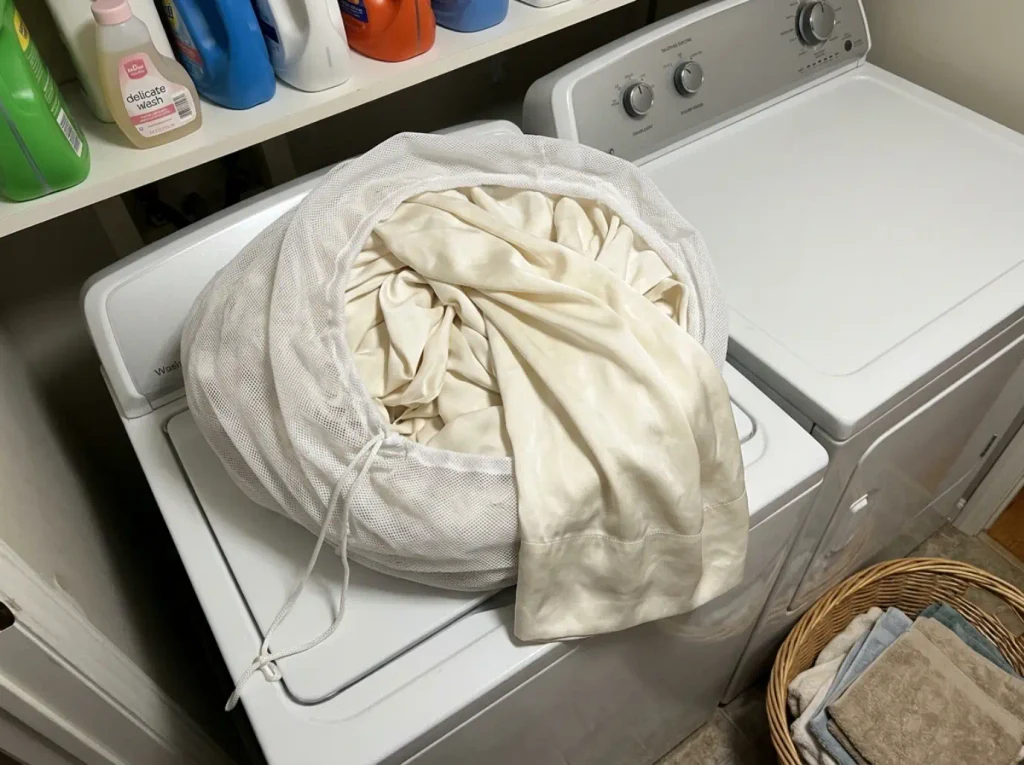
The care burden is the honest cost and it is worth stating flatly before anything else. Hand wash in a cold water wash, or the gentlest machine cycle with the set inside a mesh laundry bag so nothing catches. An enzyme-free detergent, because enzymes digest protein and silk is protein. No bleach, ever, and no fabric softener.
Air dry out of direct sun rather than tumble dry, and if a crease genuinely bothers you, a low-heat iron on the reverse side.
The care label on your specific set is the authority and it overrides anything written here, but every one of those steps is a step you will still be performing in month six, on a Sunday, when the percale in the cupboard needs nothing but the machine.
What changes with washing is the gloss, and the gloss was most of what you paid for. The surface dulls first and it dulls gradually enough that you notice it in a photograph rather than in the room. The hand stays smooth long after the sheet has stopped looking like the listing, which is a strange kind of consolation, since the thing that survives is the part you cannot see.
What does not change at all is the conduction. Silk that felt cool new still feels cool to the hand at wash forty, because the fiber cross-section is not something washing edits. The shop test stays valid, and stays useless, for the entire life of the set. That is worth sitting with for a second: the one property that never degrades is the one that was never predicting your night in the first place.
The failure, when it comes, is almost never dramatic. Nobody’s silk sheets tear.
What happens is that a set requiring a hand wash quietly becomes the set you stop putting back on the bed, and after a season the percale wins by attendance. If the wash routine is the part you are currently talking yourself into, you already have your answer. The pillowcase is one item; four sheets are a Sunday.
And if you have landed on the other side of this and want the whole thing rather than one layer, the full set for a hot sleeper, layer by layer works through the mattress, the protector and the duvet in the same order of leverage.
The Short Version
The cool touch is real, and it is conduction, and it stops mattering roughly two minutes after you get into bed and the patch beneath you reaches your own temperature.
Silk absorbs moisture but does not move it out. A closed charmeuse surface gives vapor nowhere to evaporate from, and that single structural fact is what decides how the night goes: not the fiber, not the price tier, not the word on the box.
If what you want is the feel, buy one pillowcase and put a breathing weave under the rest of you. If what you want is the heat solved, buy an open plain weave and spend the difference on the room.
After a season, check the gloss rather than the hand. The surface dulls long before the fabric stops feeling smooth, and the dulling is the honest measure of how the set is aging. The hand will keep telling you it is fine.
Before you buy anything: drop the room a few degrees and take the top sheet out for a week. It costs nothing and it takes seven nights. If you still wake up hot on the same sheets you already own, the fiber was never the problem you were solving.
Frequently Asked Questions
01What are the disadvantages of silk sheets?
Care, mostly. Silk needs hand-washing or the gentlest cycle in a mesh bag, no dryer and no fabric softener. It also insulates more than its cool first touch suggests, and the gloss dulls with washing well before the fabric feels any different.
02Do silk sheets make you sweaty?
They can. Silk absorbs moisture into the fiber but has no open structure to evaporate it from, so damp stays against skin. That is the mechanism behind the common complaint, even though brands describe the same property as wicking.
03What type of sheet material is best for hot sleepers?
An open plain weave — percale cotton or linen. One thread over, one under leaves gaps for air and vapor to pass through, which is what moves heat away from you over a whole night rather than for the first minute.
04Does sleeping on silk sheets make you hot?
Not immediately, but it can by the middle of the night. Heavier momme silk insulates, and the smooth charmeuse surface most sheets use traps warm air against you once the initial cool-to-the-touch effect has passed.
05Are silk sheets good for hot sleepers who want the hair and skin benefit?
Use a silk pillowcase instead. The hair and skin claim happens at the pillow, so a single case gives you the benefit with one item to hand-wash, and the rest of the bed can be a weave that actually breathes.




Tried it on your own bed?
No comments yet. Tell us what you changed, and what the sheet did after a few washes.