







What’s in here6 sections
Every pillow protector package promises the same thing, that the pillow underneath needs one, but the fact that decides it is printed on a small tag sewn into the pillow you already own. A protector is a second shell with a zipper, and a second shell only matters when the first one, the pillow’s own cover, can’t go through a wash. Ask r/BuyItForLife for a cover that will make a pillow last and the first reply is “It’s called a trash bag,” which is closer to the truth than the packaging: seal a pillow completely and it is protected from everything, including the sleep you bought it for.
So do you need a protector? The tag test comes first, then who earns one, who can skip it, and what owning one costs, with what each layer does on the bed covered in its own guide.
Quick Answer
Not always. Check the pillow’s care tag tonight. If it says spot clean only (most foam and latex), if the pillow was expensive, or if you sweat, drool or sleep in hair oil, a woven cotton protector earns its place. On a cheap washable pillow it is optional, and a second pillowcase underneath does the job for free.
The Pillow’s Own Tag Decides It
The verdict hangs on a line of print on the pillow, not on anything the protector’s box says, and most people buy the protector before they have ever turned the pillow over to read it.
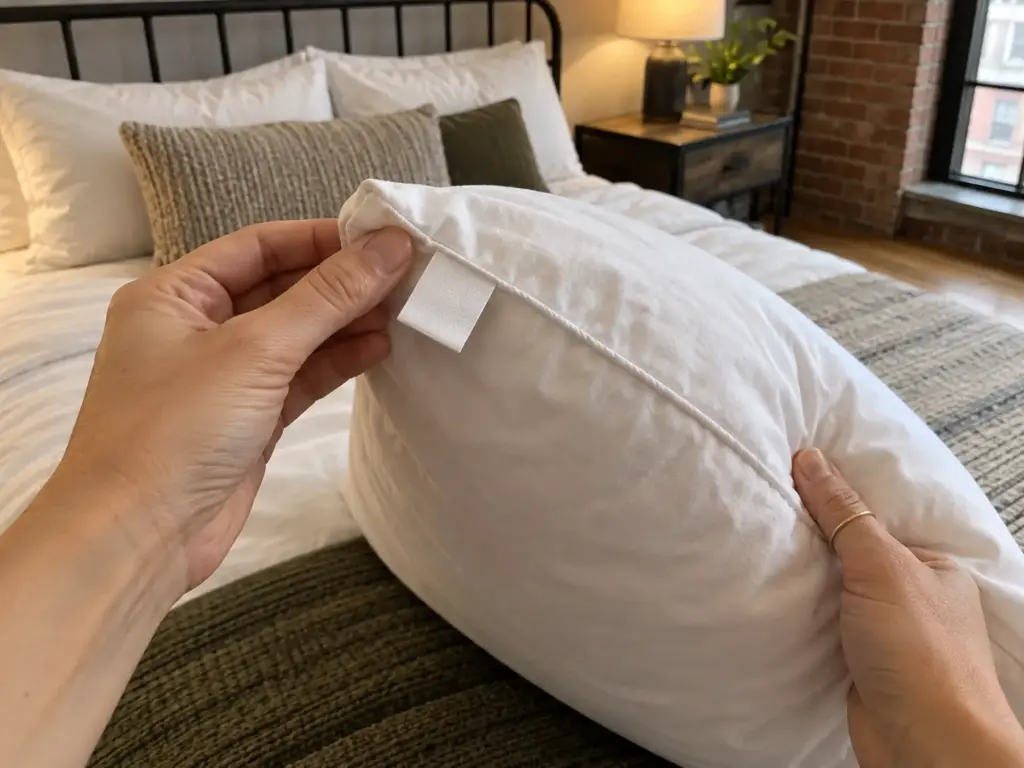
What the care tag allows
Picture the new pillow still half out of its bag, the tag between your fingers. It says one of two things: machine wash or spot clean only. Polyester fiberfill and many down and feather pillows usually land on the first side, memory foam and latex on the second, because a foam core soaks up water and gives it back over days.
Treat all of that as a tendency, not a rule. The care label on the pillow in your hand outranks anything general, including this paragraph. Some shredded-foam pillows are sold as washable with the fill removed, and some down pillows say dry clean.
Now read the protector box with the tag in mind. The phrase it leans on is some version of protecting your investment, and that phrase quietly assumes a pillow you can’t clean. It makes sense for a latex pillow and very little for a fiberfill one that can go in the washer on Saturday morning.
Take a photo of the care tag the day the pillow comes out of the bag. Tags are the first thing to fade, fray or get snipped off for comfort, and a year from now the question of whether this core can take water, and at what temperature, will have no answer left on the pillow itself.
A pillow you cannot wash cannot be reset
Whatever reaches the shell of an unwashable pillow stays there. Sweat dries off and leaves salts, skin oil and the residue of whatever was on your hair in the fibers of the cover and the top of the core. A washable pillow gets reset every time it goes through the machine. An unwashable one only accumulates, and spot cleaning lifts what sits on the surface while pushing some of the rest deeper.
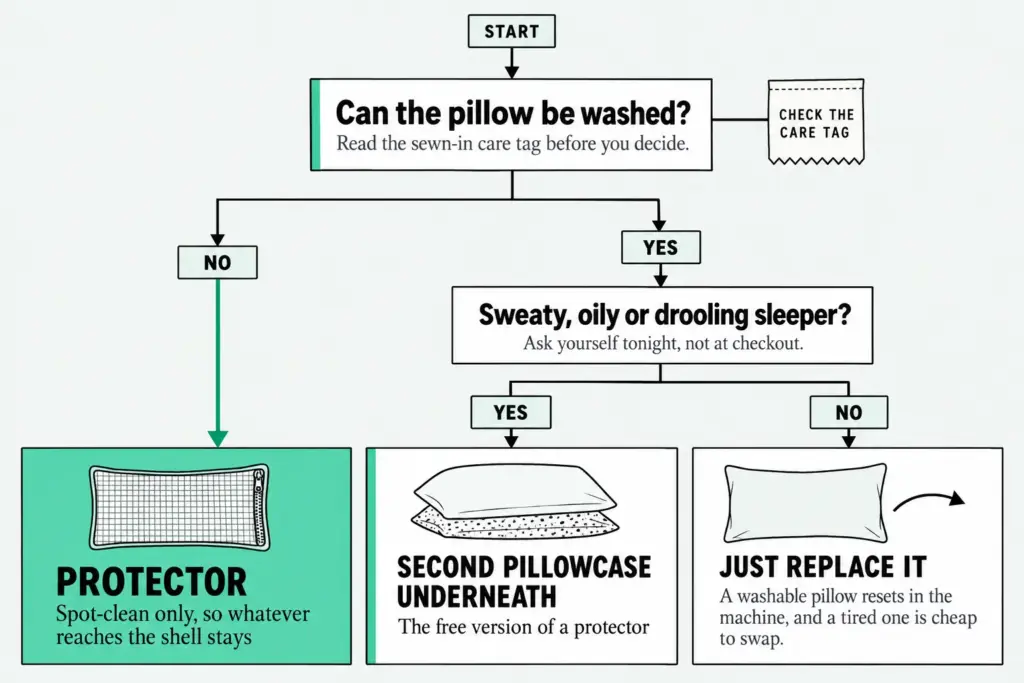
That is the whole case for a protector in one line: on a foam or latex pillow, the protector becomes the only shell that ever gets reset.
A pillow you can wash is cheaper to reset than to wrap
If the tag says machine wash, the math flips. A fiberfill pillow is often the cheapest thing on the bed, and its own shell is already the sacrificial layer: it takes the oil, goes in the washer and comes out reset. A protector would be a second layer doing the same job, so you would wash two things instead of one, to guard something you will replace in a couple of years anyway.
There is one catch with washing everything, and it is fit. A r/Bedding poster found that a buckwheat pillow’s case “shrank in the washer/dryer,” and cotton covers can do the same in smaller amounts, so a pillow that felt right in the store can feel firmer after a month of laundry. Getting case, protector and pillow to agree on size is a subject of its own, but it starts with the same tag.
When a Protector Earns Its Place
None of that makes protectors a scam. Some pillows really do need a barrier, and the reason is almost never that the pillow is delicate: it is about what reaches the shell, and whether anything can take it back off.
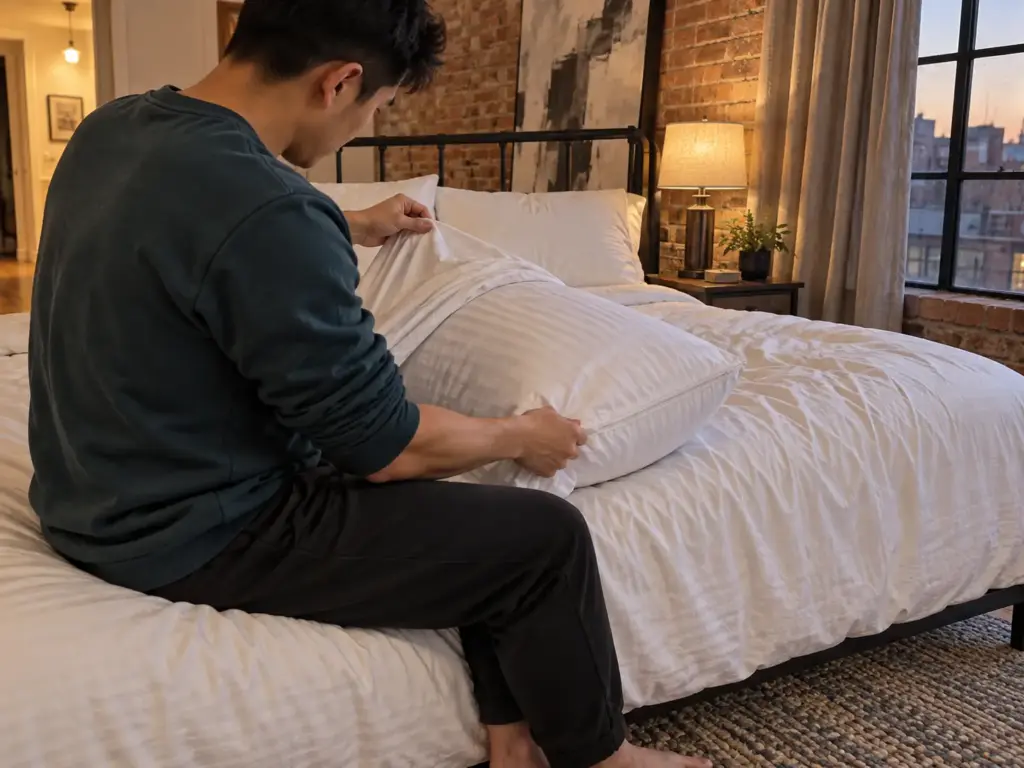
An unwashable core, or one you paid a lot for
Foam and latex are the clear cases, and the down pillow you spent real money on is close behind: down can be washed, but drying it all the way through is slow work and a damp center clumps, so most people try it once. On all of these the shell is fixed in place, and the only layer you can wash freely is one you add. A protector is exactly that: a shell you can unzip. It goes directly on the pillow, closed with a zipper or a fold-over flap, and the pillowcase goes on over it.
The obvious choice for an expensive down pillow is the most protective cover on the shelf, the waterproof one. It is the wrong one. Down keeps its loft by moving air in and out of the clusters every time you shift your head, and a sealed back stops that air, so the pillow you were trying to protect goes flat and hard. For these cores, the protector to look for is woven cotton, which lets air through the gaps between its yarns and still takes the oil and the wash for the pillow.
Sweat, skin oil, drool and hair products
Everything that reaches a pillow comes from the head: sweat, the oil skin makes all night, drool if you sleep on your side with your mouth slightly open, and whatever leave-in conditioner or hair oil went on before bed. A pillowcase catches most of it and passes the rest through, because a case is a woven sheet with gaps, not a barrier. You can wash the case every week and still watch the shell underneath go from white to cream to a definite yellow, and why pillows turn yellow has the chemistry behind that shift. On a sleeper like that, the protector is the layer that takes what gets past the case, goes in a hot wash, and gets replaced without the pillow ever leaving the bed.
The FAUNNA 600TC Cotton Pillow Protector is a plain example of that construction: 100% cotton, woven, OEKO-TEX certified, with a silent zipper, sold four to a pack in standard 20 x 26 inch, so there is always a spare while one is in the wash. The 600 is the maker’s count with no ply stated, so read nothing into it. Buyers on its listing say it shrinks slightly in the wash and runs small on standard-queen foam pillows, so if your pillow sits on the fat side of standard, size up before the first wash takes the fit tighter still.
Look at the zipper end of a protector that has been on a bed for a while and you will usually see the first stain there, because that end sits at the open mouth of the pillowcase, the part the case covers least.
The side of a shared bed that wears first
In a shared bed one pillow almost always yellows first, whoever sweats more or goes to sleep with wet hair, so protect that one and leave the other alone. How the stain moves off the pillow and onto the cover, and how often each layer should be washed, is all in what a protector actually stops.
When You Can Skip It, and What to Do First
Now the other half, the one the packaging leaves off: the cases where a protector is money spent on a problem a cheaper move already handles.
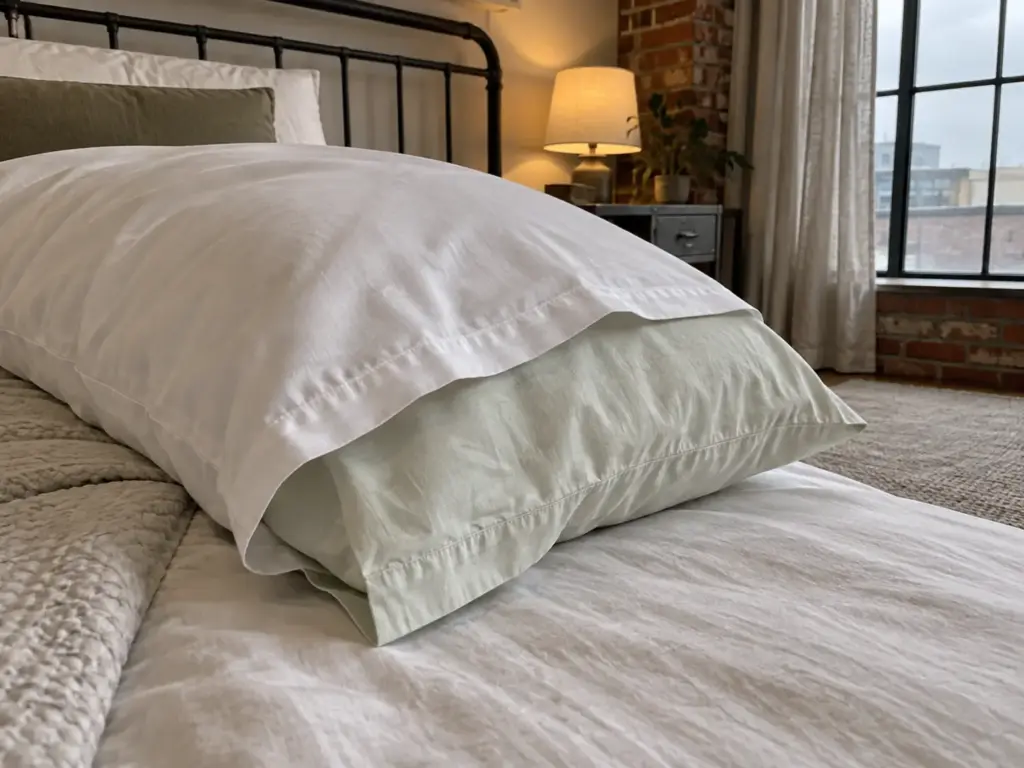
The free version: a second pillowcase underneath
When a r/Bedding poster asked whether a thick, tightly woven cotton protector was worth buying, wary that a 300-count one “seems too thin to work,” the answer was simply “I just use 2 pillowcases,” with a second poster adding “this is what I do.” On r/BuyItForLife someone goes one step further: two cases and a folded towel laid on top. The logic holds up. A second case under the first is a second woven shell, and unlike a protector it gets washed on the same day as the outer case, every week, with nothing extra to remember.
What it can’t do is stop liquid. A case is a weave with gaps, two cases are a denser weave with gaps, and a spilled glass of water or a heavy night of drool goes through both. Give the setup a week, or better, a month, because oil takes weeks to show on a white shell and a week of looking clean proves very little.
Between washes, one r/BuyItForLife poster fluffs the pillow in the sun, which costs nothing but a clear afternoon.
Run the second-case test for a full month, then peel both cases back in daylight and look at the center of the pillow’s face, not the edges. If the shell is still the white it was, the free version is doing a protector’s job. A cream tint there already means oil is getting through two weaves, and that pillow wants either a wash or a real protector.
A washable pillow near the end of its life
Protect every pillow from day one, say the protector boxes, and on a new pillow that is defensible. On a two-year-old fiberfill pillow that is already lumpy and folds in half without springing back, it means paying to guard something you are about to throw out. Consumer Reports puts the replacement window at two years or sooner, and a protector stretches that a little; it does not cancel it. The clock that matters here is when to replace a pillow, by fill, and a cheap pillow at the end of that clock is better replaced than wrapped.
Where the free fix stops working
The second case stops being enough in two situations. The first shows up at the end of the month: you peel the cases back and the shell has already picked up color, which means oil and sweat are getting through two layers of weave. The second is written on the tag. If the pillow is spot clean only, anything that does get through two cases has nowhere to go, and a clean-looking first month says nothing about the second year.
Either way, that is the point to go back to the cases where a protector earns its place. But if the pillow underneath is already yellow and stiff, a protector zipped over it only hides the shell from view, and when a yellow pillow is done is the better read before you buy anything.
What Owning One Costs, and the One Number Worth Reading
A protector is a trade, and the box only prints one side of it.
The crinkle, the heat and the firmer pillow
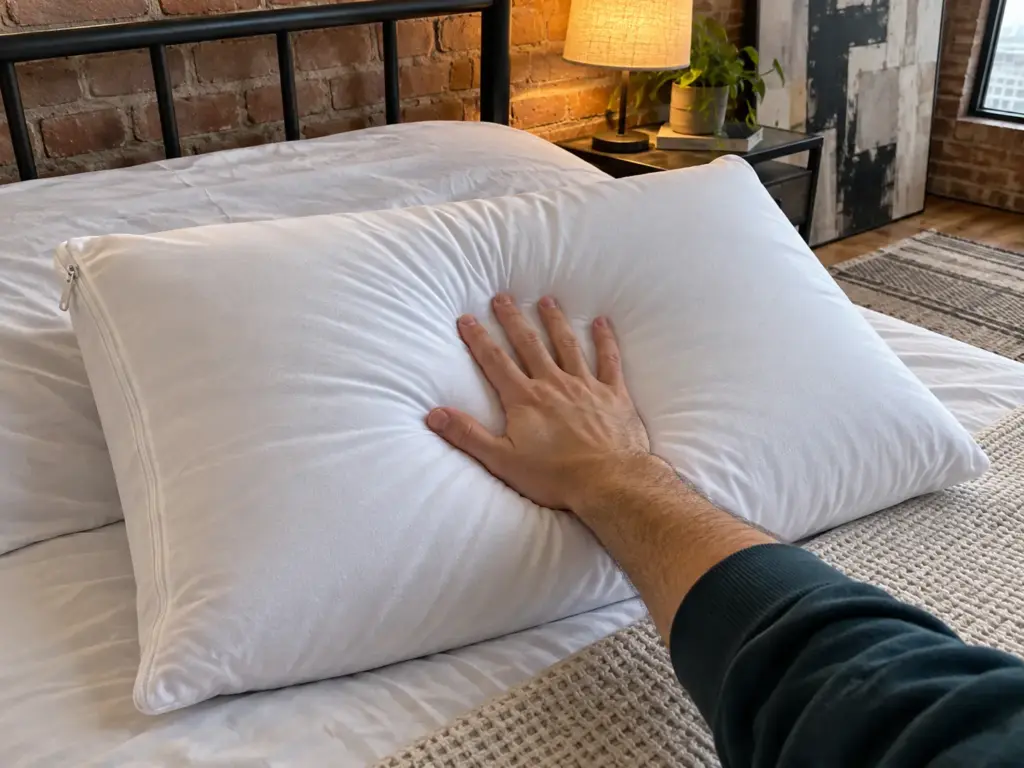
Zip a waterproof protector onto a new pillow and you find out on the first night. One r/BuyItForLife poster says it “feels like a crinkled paper bag, and makes the same noise,” and another in the same thread describes a sealed one as “like sleeping on a balloon. The pillow loses all that fluffiness.”
Both complaints come from the same construction. A laminated back, usually a thin TPU film bonded to the inside of the fabric, is what stops liquid, and it stops air just as well. Every time your head presses down, the air inside the pillow needs somewhere to go; with a sealed back it can’t escape through the face, so the pillow pushes back like an inflated cushion and the fill never settles around your neck.
The Guardmax Jersey Knitted Pillow Protector is that construction, sold four to a pack: a soft polyester jersey knit face over a TPU laminate, a nylon coil zipper, fully waterproof. It does what the back is there for, and liquid stays out of the pillow. One Amazon reviewer spelled out the price you pay for that: they “don’t breath, or breath so slowly it’s the same as not breathable… they will balloon up when you lay on it.” The same reviewer’s workaround is to buy the queen size for a standard pillow, which gives the trapped air somewhere to go and takes some of the balloon out.
A sweaty sleeper looks like exactly the person a waterproof protector was made for, and is the one it suits least. A film that won’t pass vapor keeps the damp in the pillowcase, right against your face, so for a hot sleeper the answer is woven cotton, which takes the oil and lets the vapor through.
A cover cut too small causes a quieter version of the same problem on any pillow, sealed or not, because it compresses the fill before you lie down. The crinkle is audible the first night; the firmer pillow takes about a week to notice. Mattress protectors carry the same trade one size up, and the mattress-protector backing that traps heat is its own story.
Six microns, woven, and eighteen washes
Protector packaging leans on thread count and the word hypoallergenic, and neither tells you what the fabric holds back. The number that does is pore size, the width of the openings in the weave.
According to Consumer Reports’ pillow-protector guide, “check that the product label displays a fabric pore size (the size of openings in the weave) of no greater than 6 micrometers or microns.” Next to that number, look for the words woven fabric.
The certification numbers carry a shelf life of their own. AAFA’s test, as Consumer Reports reports it, has certified protectors blocking more than 99 percent of allergens before the first wash and 95 percent after 18 washes. Read that as a spec, not a promise: the barrier is rated for a countable number of washes. Eighteen weekly washes is about four months; eighteen monthly ones, a year and a half.
Consumer Reports adds that repeated washing can degrade a protector’s permeability, so a protector is a consumable in its own right, the half of the purchase the box never mentions.
On a protector, skip the thread count entirely. A big number on the front can be plied yarn counted more than once, and it says nothing about the gaps. Turn the package over and look for two things: a pore size in microns, six or under, and the word woven. If the label carries neither, the barrier claim on the front is a phrase, not a measurement.
When it is not the bedding
Pain that doesn’t change when you change the pillow, a rash, or trouble breathing at night is a question for a doctor, not for a protector, and none of the label numbers above answer it. Everything on this page is about the pillow and what goes over it.
Read the Tag, Run the Second Case, Then Decide
The decision comes down to three moves, in this order:
- Read the pillow’s care tag first. Machine washable and cheap means a protector is optional; spot clean only or expensive means it earns its place.
- Use a second pillowcase underneath for a month before buying anything, and judge it by the color of the shell, not by how the bed looks.
- If you do buy one, buy woven cotton with a pore size of six microns or less on the label, and plan to replace it like any other layer that wears out.
A few months into weekly washing, unzip the protector and compare its zipper end and its face with the pillow under it: a dull, cream-gray cover over a pillow that is still the color it was is a protector doing its job and nearing the end of it, one of the full set’s clocks worth keeping an eye on.
Tonight, slide a second pillowcase under the one already on your pillow and leave the pillow alone. In a month, peel both back and look at the center of the shell, where your cheek lands.
Frequently Asked Questions
01Do you need a pillow protector and a pillowcase?
Usually both, because the protector is a second shell that sits under the case rather than a replacement for it. The exception is a washable pillow you launder on schedule, where a pillowcase alone, or two of them, can do the job.
02Do you put the pillowcase over the pillow protector?
Yes, the protector goes directly on the pillow and zips closed, and the pillowcase goes on over it. The case takes the frequent wash and the protector a less frequent one, so the layer you see is the one you launder most.
03Is it worth getting a pillow protector?
It is worth it for a pillow you cannot wash, such as foam or latex, and for an expensive down pillow. On a cheap washable pillow near the end of its life, replacing the pillow later costs less than protecting it now.
04Is it bad to not use a pillowcase?
It is not a hazard, but without a case the pillow’s own shell takes every bit of sweat and oil the case would have caught. That shell yellows and stiffens faster, and on an unwashable pillow it never gets reset.
05Will a pillow protector make my pillow hotter?
A protector with a sealed or laminated back can, because the film that holds liquid out also holds air and vapor in. A woven cotton protector lets both through its gaps, so read the construction on the label, not the claim on the box.





Tried it on your own bed?
No comments yet. Tell us what you changed, and what the sheet did after a few washes.