







What’s in here6 sections
You slept well on a hotel pillow with a word stitched on its case, ordered what the page called the same one, and the pillow that came out of the bag stands lower under your head than the one you remember. One verified buyer of a pillow sold as Blue Label Firm wrote the whole complaint in a single line in September 2026: “It is not firm as stated.” Pillow firmness labels describe a pillow only for as long as the word and the pillow stay together, and nothing about a case, a listing or a product-line name keeps them together. This article follows the word to the places it gets printed, says what the hotel pair behind the Blue and Green names holds, opens one listing that argues with its own title, and ends on three questions that work without trusting any label.
Quick Answer
A soft, medium or firm word on a pillow tells you what one seller or one hotel line meant by it, not how the pillow will sit under your head. Where the word is printed decides how far to trust it: cases get swapped and listing fields get retyped, but height in inches holds.
The argument underneath all of this has its own article, why pillow loft and firmness need two numbers, and this one stays on the labels.
A Firmness Word Lives in Four Places
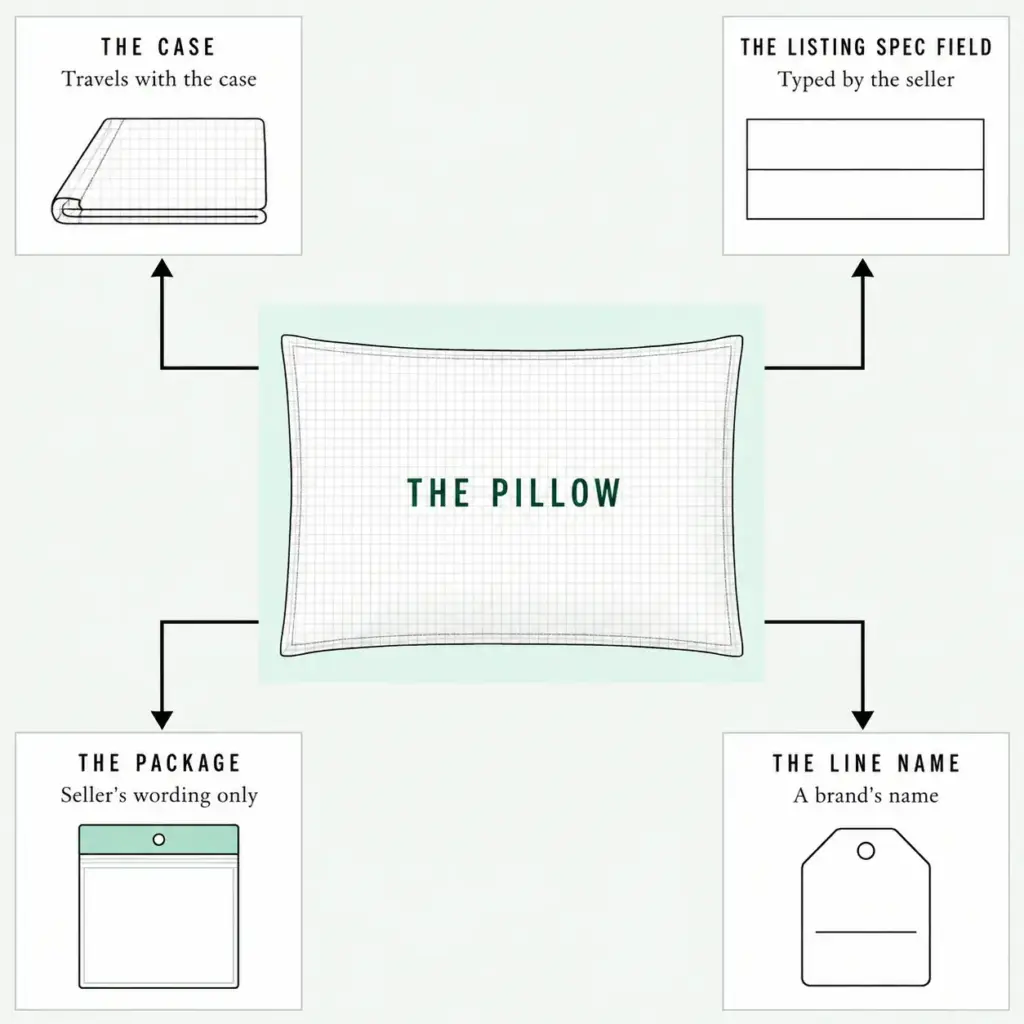
A firmness word does not hover over a pillow. It is stitched, printed or typed somewhere, and each somewhere has its own owner, who can change the word without touching the fill. There are four such places: the case, the listing, the line name and the package.
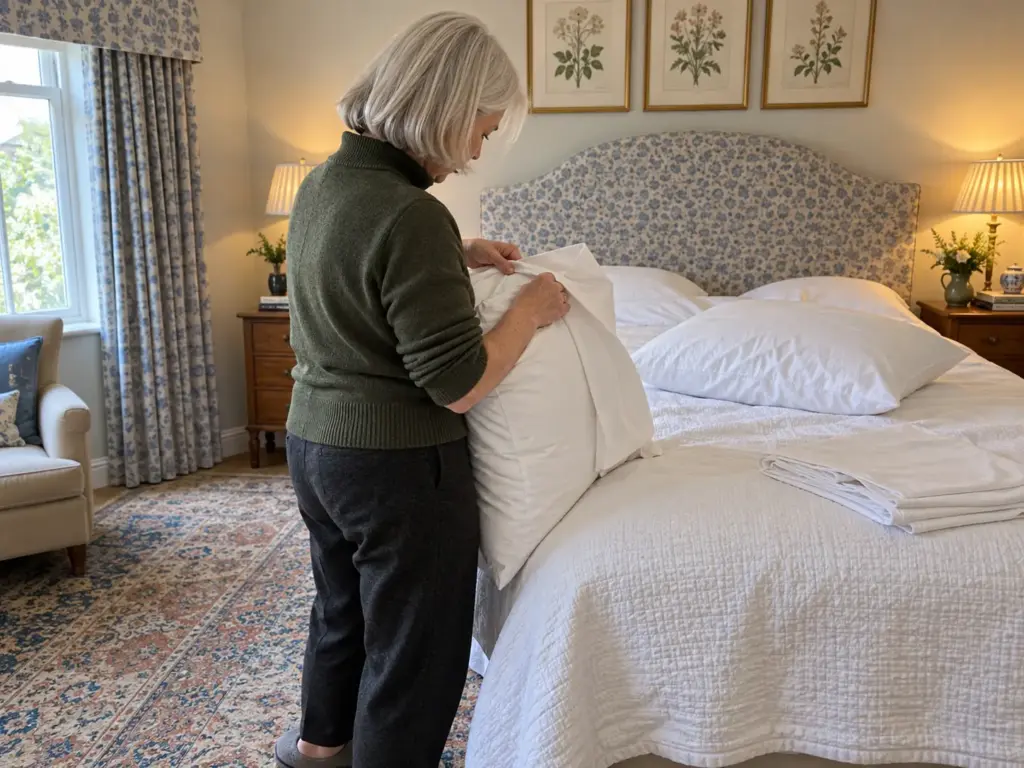
On the case: the word that travels with the fabric
A word embroidered on a pillowcase describes the case. It describes the pillow only until someone moves one without the other.
In a Dull Men’s Club thread, a traveler staying at a hotel for work noticed pillows embroidered “soft” and “firm,” and the commenters placed that habit at IHG and Holiday Inn. One of them added that the cases “often aren’t in the correct pillow case these days,” and that “you start feeling around and can tell they’re all the same.”
That is one commenter about one chain, not a finding about hotels, but it shows the mechanism cleanly: an embroidered label follows the fabric, and fabric gets changed on laundry day.
Strip the bed and the case leaves with its word, and what stays on the mattress is the same pillow with no label at all. What each layer of a pillow’s case does lays out the layers, and how a case closes, zippered or envelope, changes how easily the word and the pillow part company.
In the listing: the spec field and the title
A product page keeps the word in at least two boxes that two different people can fill in. The title is copy, written to sell. The spec field is a line of data, and it is the one a shopping filter would sort by.
On a single Amazon page the variant selector can carry a Material Type of Firm while Item Firmness Description, further down in Features and Specs, says something else. A shopper who searches by title and a shopper who filters by spec meet two different words for the same pillow, and it can happen with no one lying. The third section opens a page where it does.
In the line name: when the word is a brand’s
Blue Label is Choice Hotels’ name for its firm pillow, and Green Label is its name for the soft one. Once a word becomes a product-line name, it stops describing a feel and starts naming a thing that belongs to its maker. Other sellers list pillows as Blue Label Firm too, and the name goes wherever the listing goes, while the fill and the height stay wherever they were made. The next section looks at what Choice’s pair holds.
The fourth place is the package or hang tag, which repeats the word in the seller’s voice. It is one more surface the seller controls, and it goes in the recycling the day the pillow comes out of it. So a word travels with whichever part moves: cases get swapped, line names get copied, spec fields get typed and packages get thrown away. None of the four is a measurement.
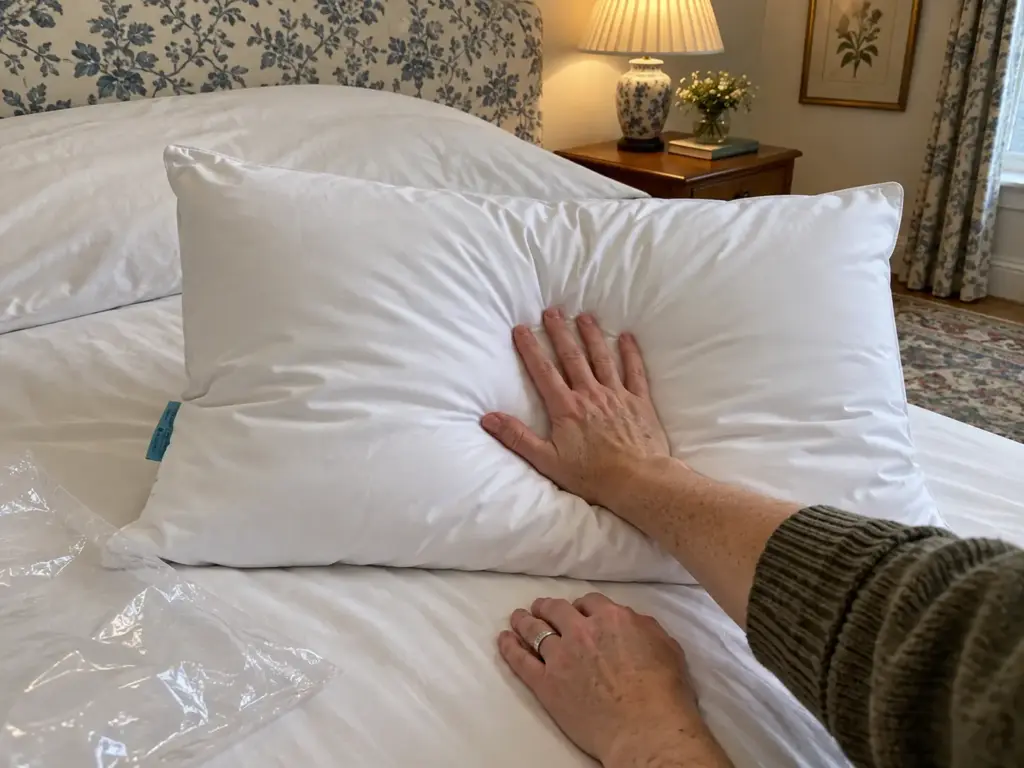
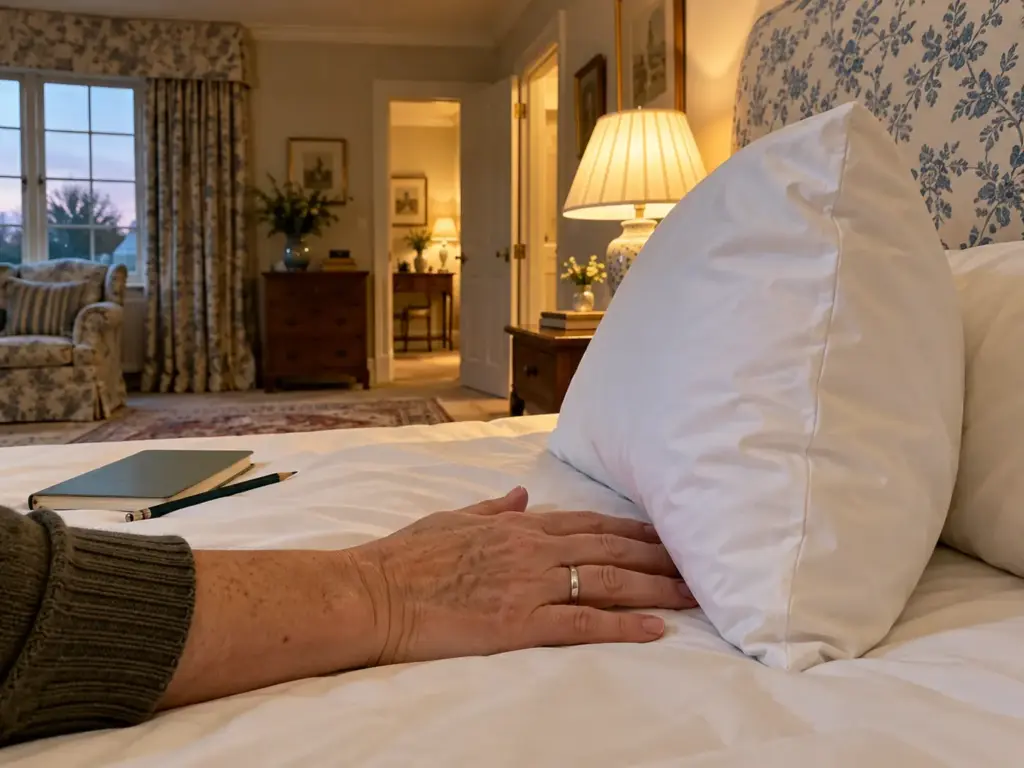
Take the case off and set the pillow on the bare mattress by itself. Look at it from the side, press it once, and only then put the case back. If the word you were counting on was sewn into that case, you have just seen what the pillow does without it.
The Hotel Pair: What Blue and Green Label Actually Name
Blue Label Firm and Green Label Soft are a named pair of hotel pillows, so it is worth saying what the pair is before the names get taken for soft, medium and firm in general.
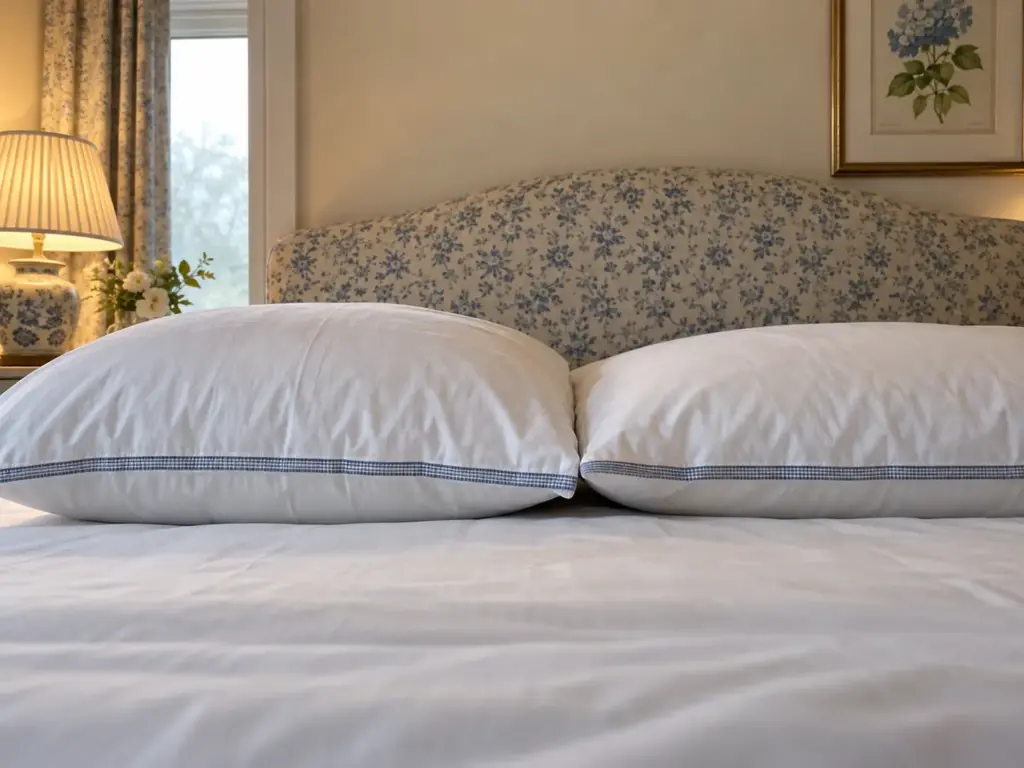
What the two names hold: height and fill
On a seller’s page for Choice Hotels’ pair, the Blue Label Firm is listed at 4 to 5 inches tall and the Green Label Soft at 3 to 4. Both are polyester, both machine washable. That puts about an inch of height between the pillow called firm and the pillow called soft, a smaller gap than the words suggest.
The same page describes the firm as “the soft pillow’s supportive and lofty counterpart” and tells the buyer, “You will still get the same soft feel.” On that page, firm does not mean another feel. It means more fill of the same kind.
Why the fill name changes with the seller
Ask what the Blue Label is filled with and the answer depends on the page.
One seller prints polyester, Microfil®. A Choice-brand Amazon listing that now shows as unavailable gave it as “34 Oz Luminesse Microdenier Polyester Fiber Fill.” Another seller’s page says “Luminesse microdenier fiber.” That is one pillow with two fill names, and neither gets crowned here: both describe polyester fiber.
The seller’s own copy credits the firm pillow’s difference to “added fill weight,” which is the same argument as fill weight, not the name on the tag.
Polyester sold as microfiber or microdenier is the same family of fiber spun fine, and the same polyester under different names is how it picks up a new label at every seller. A fill name tells you whose catalog you are standing in. The weight and the height tell you what is inside the pillow.
What a copy keeps and what it leaves behind
A name is cheap to copy. A height and a fill weight cost money to match.
One reviewer who gave a Blue Label Firm listing five stars wrote that they had “slept on the blue label choice hotel during my honeymoon and fell in love,” ordered one for home, and “just realized it wasn’t a choice hotel pillow… Can’t tell a difference.” For that buyer the copy kept the feel along with the name, which is the best case a label can offer: sometimes it works. The trouble is that nothing on the case tells you which time you are getting.
What a copy leaves behind is the guarantee. The original’s height and fill weight are printed on the original’s page, and a copy sold under the same name can leave them out, as the next section’s page does for height. Neither Choice pillow carries a link here: the Choice-brand listings for the Blue Label were showing as unavailable in mid-October 2026, and no Choice-brand listing for the Green Label Soft turned up on Amazon at all. To see how a polyester fill behaves once it has been slept on, what each fill does by month six is the next stop.
The Listing That Disagrees With Its Own Name
A label can argue with itself on a single page. A Standard-size Blue Label Firm pillow on Amazon does it, and it takes one scroll to see.
Title says Firm, the spec table says Medium
Start at the top of the page. The title and the variant selector say Firm.
Scroll down to Features and Specs, and Item Firmness Description reads Medium. The page’s own comparison module goes further and calls the pillow a “Medium support pillow.” Same page, same pillow, two words.
Which one you meet depends on how you shopped: a search by title files it as firm, and a filter by spec files it as medium. The shopper who trusts one never sees the other.
The free check costs a scroll: read the spec table before the reviews, and hold it against the title.
The pillow in question is the Pillowtex Standard Blue Label Firm, a 20 by 26 inch Standard with a 230 thread count cotton case around what the seller calls “down-like polyester fiber that compresses to the touch.” That description is a feel, not a measurement, and the page never turns it into one: it prints the footprint and a thread count for the case, and no height in inches. It is named here to show where the word fails, not as a pick. Its own spec table carries the objection (Medium against the Firm in the title), and a verified buyer, quoted below, makes the same objection from the bed.
What a buyer who trusted the title wrote
The reviews on that page split along the same seam. A three-star verified buyer in September 2026 wrote, “It is not firm as stated,” and added that it is “unlike the Blue Label Firm Pillow from the Cambria Hotel it is supposed to be like according to the seller.” Another wrote, “Had to send it back it was not as firm as stated.” A third put it the other way round: “They are firm, but soft at the same time.”
Read together, they are three people measuring one pillow against the single word its title gave them. None of them names the field that would have explained the gap. Reviews are where most shoppers go to settle a doubt like this, and here they only widen it: the split inside the comments mirrors the split inside the listing. Where a page contradicts itself, the table is the better first read.
Scroll to the spec table before you read the reviews. If it uses a different word than the title, a review saying the pillow is not as firm as stated may be right about the title and wrong about the pillow, so read it as a note on the listing before you treat it as a verdict on the fill.
What to Check Instead of the Word
If the word is someone else’s to retype, the check has to move to things they cannot retype. That leaves three questions, one number, and one test that does not need a label.
Three questions for any firmness label
First: is the word a product-line name, like Blue Label, or a generic word, like firm? A line name belongs to its maker, so a copy can borrow it and an original can keep it, and neither tells you the fill. A generic word, whether soft, medium or firm, is whatever the seller decides it is.
Second: does the spec field agree with the title? When one says firm and the other says medium, the page has told you it cannot settle the question, and you should not expect the pillow to.
Third: how many inches tall is it? Choice’s pair differs by about an inch, and that inch is exactly the part the words skip. A listing that prints no height has handed you the word and nothing to check it against.
| Question to ask | Where to look | What a mismatch tells you |
|---|---|---|
| Is the word a line name or a generic word? | The title, and the maker’s own page for the line | A line name belongs to its maker and can be copied; a generic word is the seller’s to define |
| Does the spec field agree with the title? | Features and Specs, next to the variant selector | The page cannot settle its own question |
| How many inches tall is it? | The height line on the page, or a tape measure at home | No height means the word is all you were given |
The number that survives: inches under your head
Height in inches survives a change of case, seller and name, because it is measured on the pillow instead of typed about it. Consumer Reports’ support test measures the angle between head and torso, and its finding is plain: “Pillows that minimize the angle between the head and the torso score better.” That angle is why one inch is worth knowing, and the press test and the height check show how to read the height under your head without needing a label.
One caution on the number itself: a pillow’s standing height is not the gap under your head, which also depends on body weight, shoulder width and how far the mattress sinks. Compare inches with inches, one pillow against another, and keep the pillow you like as the ruler.
The free version takes a minute. Press the heel of your hand into the middle of the pillow you liked, let go, and note how far it comes back, which is its recovery.
Then lay it on the mattress and measure how high it stands at the center with a tape measure, or lay your hand beside it if you know your own span. Write the number down and hold it against the next listing’s inches. For which height suits which sleeper, whether you sleep on your side, back or stomach, the sleep-position guide takes it from there.
Why a lab does not read the label either
Consumer Reports tests pillows by loading them: a 225-pound even load inside a chamber at 98.6 °F and 80 percent humidity, held for 96 hours. Then, in its words, “We measure the thickness and firmness of the pillow after we take it out of the chamber and again after hand-fluffing it.” The lab never asks what the case says. It asks how far the pillow comes back, and a label is not a test of that.
At home the same idea runs on a smaller scale. A pillow that has gone low is telling you about its fill, not about the word on its case, and the sibling guide’s advice is to fold it before you replace it, which costs nothing and answers the question a label cannot.
Before ordering a replacement, write two things on one note: the pillow’s height in inches and the one word on its case. Hold the next listing against the inches. The word is only worth keeping if the new page prints it too.
Strip the Case, Press the Pillow, Write Down the Inches
The word on a pillow has an address, and each address has an owner: the case belongs to whoever washes it, the spec field to whoever typed it, the line name to whoever sells the line. A line name like Blue Label holds one maker’s fill and height, and copies keep the name without promising either. So ask the three questions, take the inches, and treat firm and soft as the start of a comparison, not the end of one.
Once the pillow has been through a few months of nights, press it, fluff it by hand and measure it again. If it no longer comes back, or no longer stands at the height you wrote down, that is the fill talking, and which fills a shake can fix tells you whether a fluff is worth the try.
Tonight, strip the case off the pillow you like best and set it bare on the mattress. Press it, measure how high it stands, and write the number where you will find it, on the back of an envelope or in your phone. Then put the case back and read the word on it next to the number.
Frequently Asked Questions
01Do soft, medium and firm mean the same thing on every pillow?
No. Each maker or seller decides what the word means, so one brand’s firm can sit where another brand’s medium does. Choice’s own hotel pair differs by about an inch of height. The reasoning behind that is in why pillow loft and firmness need two numbers.
02What do the Blue Label and Green Label hotel pillows mean?
Blue Label and Green Label are Choice Hotels’ names for its firm and soft pillows, a product line with its own fill and height rather than a scale. One seller’s page lists the Blue Label Firm at 4 to 5 inches tall and the Green Label Soft at 3 to 4 inches.
03Where is the firmness of a pillow written?
Pillow firmness labels sit on the case or its embroidery, in a listing’s title and spec field, in a product-line name, and sometimes on the package. None of them is a measurement. The height in inches is the number you can compare across sellers.
04Can a pillow’s listing say firm and still be medium?
Yes, a listing can print firm in its title and medium in its own spec table, and one Standard-size Blue Label Firm page on Amazon does exactly that. Read the spec field before the reviews, then check the height in inches.
05How do you tell if you need a soft or firm pillow?
The height that keeps your head level in your usual sleep position matters more than any word on the case. Start by measuring the pillow you already sleep well on, then see pillow height by sleep position for which heights suit which sleepers.





Tried it on your own bed?
No comments yet. Tell us what you changed, and what the sheet did after a few washes.