







What’s in here7 sections
- The Night: What Each Fill Does From Lights-Out to the Morning Shake
- Side Sleepers and the Claim That Down Can’t Hold Them
- Allergies, the Cover and Where a Doctor Starts
- The Wash You Will Really Do
- Which One to Buy, by Sleeper, Allergy and Wash
- Choose by Fill Weight and Wash, Then Check the Pillow Again in the Morning
- Frequently Asked Questions
Somewhere in the second half of the night the pillow under your head stops being the height you lay down on, and nothing on the box said it would. The label gave a fill name, and the fill name is the least useful number in a down vs down alternative pillow choice: height comes from how much fill sits in the case and how well that fill springs back after hours of being pressed, and the word on the tag says almost nothing about either. This page takes the night first, then the claim that down can’t hold a side sleeper, the layers your face actually touches, the wash you will really do, and one fill per reader. The slow version of the same fills, month by month, is in what each fill does by month six.
Five rows settle most of the choice before the details start. Read down the column that matches how you sleep and how you wash.
| What you are deciding | Down | Down alternative |
|---|---|---|
| Height under the head overnight | Sinks under the head by design and is meant to come back with a shake | Flattens where the head rests; the fill guide explains why shaking does not undo it |
| After the wash | The maker’s care card says dry clean or professional wash only | Listings say machine washable; the care label on the pillow has the last word |
| The layer you touch | The maker’s “hypoallergenic” measures how clean the down is, not mites | No mite result for the fill either; certification programs test a cover’s outer fabric |
| What the seller says vs what it does | The maker routes its 625 down to front and back sleepers; the Soft weight has the least fill and is the flattest | A washable alternative sold to side sleepers has reviewers calling it too soft or flat |
| Who it suits | Front and back sleepers, and anyone who accepts a professional wash | Anyone who will wash at home; side sleepers, after the free height fixes |
The Night: What Each Fill Does From Lights-Out to the Morning Shake
The table gives each verdict in a row, but a pillow lives its verdict over one night, and that is where the two fills first part ways.
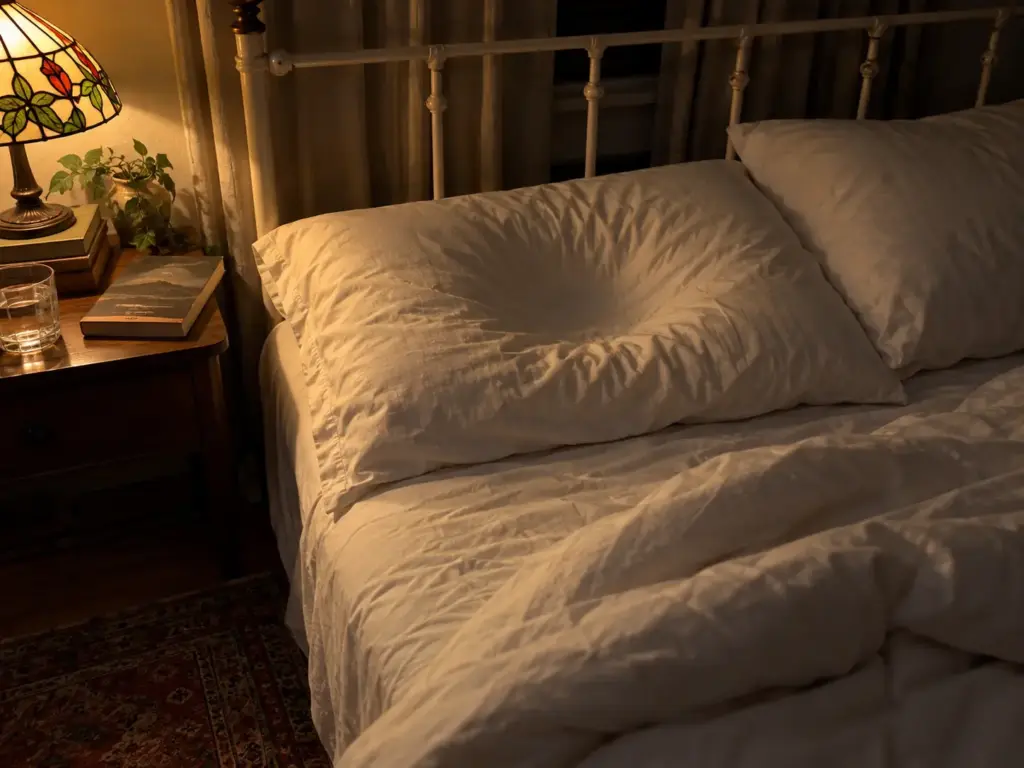
What the head does to the fill in the first hours
Down is built to give. The maker of the 625 down pillow in this article says its down sinks under the weight of the head by design, asks for a vigorous shake before first use, and puts the wait for full loft at about a week. So the first night on a new down pillow is not that pillow’s best height, and a pillow that sinks at hour three is behaving, not failing. What counts is the morning, when the question becomes whether the fill comes back.
An r/Bedding thread, about four years old by its own comments, describes the other version of the night: a feather pillow that is floaty at bedtime and flat by the second hour, and a side sleeper’s feather pillow gone hard and too flat after an hour or two. One commenter adds that down flattens out faster than feathers.
That is one person’s report, not a measurement, but it breaks the tidy story that the fill with the better reputation also holds its height better through the night. Down sinks by design and may recover, feather flattens and may not, and the polyester alternative has its own way of ending the night (that comes in the side-sleeper section). A pillow that ends the night somewhere other than where it started is also the whole difficulty of combination sleepers, who change position and so change which part of the pillow is under the head.
The morning shake, as a test you run
This is your own check, not a measurement, and it costs nothing. Run it on the pillow you already own, in three looks:
- At lights-out, with the pillow plumped the way you normally leave it, press your palm on it and note the height.
- At wake-up, before you touch it, note where the dent is and how deep it goes.
- After one hard shake and a minute to settle, note whether the dent has filled back in.
What the three looks say is mechanism, not diagnosis. A dent that fills back in after the shake means the fill is springing back, and the sink was the fill giving, which is what down is built to do. A dent that is still there after the shake means that part of the fill has stopped coming back, and more shaking will not change it. How much height returns is exactly what this test reads off your own pillow, and I won’t guess a figure for it.
The same three looks work on a down alternative, and they read differently. With a polyester or microfiber fill, the dent at wake-up is the main event, because the fill does not sink by design: it simply gives where the head presses and may stay given.
Compare the dent with the spot a hand’s width away. If the rest of the pillow is still plump and only the head’s spot is low, the pillow has stopped recovering in one place, and the answer is a fold or a second layer rather than a harder shake. If the whole pillow has gone low evenly, the fill weight was light from the start, and that is a reason to look at a heavier fill, not a reason to blame the fiber.
Take three phone photos of the pillow from the same angle: at lights-out, at wake-up, and after the shake. Memory edits a night down to “it was fine” or “it went flat”, and three photos side by side show the dent that is still there when the shake is done.
Where the quill and the lumps show up
The feather poke in the middle of the night is usually the quill, not the fill’s name. Down is soft plumage with little or no quill; feather keeps a long one, and the thread’s word for the result is “pokey”. A pillow sold as down can still carry feather in the mix, and what the tag percentages allow is worked through in the fill guide, so it is not repeated here.
Later come the lumps. The same thread has a commenter saying that after a while all feather and down clumps at least a little, and the advice from the readers is to fluff the pillow daily and it lasts. That is the quietest piece of care in this article and the cheapest, and it returns in the wash section, where one reviewer’s year with a pillow shows where the height really came from.
Side Sleepers and the Claim That Down Can’t Hold Them
A pillow that sinks under the head raises the claim that follows down around: that it gives a side sleeper less support. The claim deserves a test before anyone believes it, because it rests on a mechanism that is only half the story.
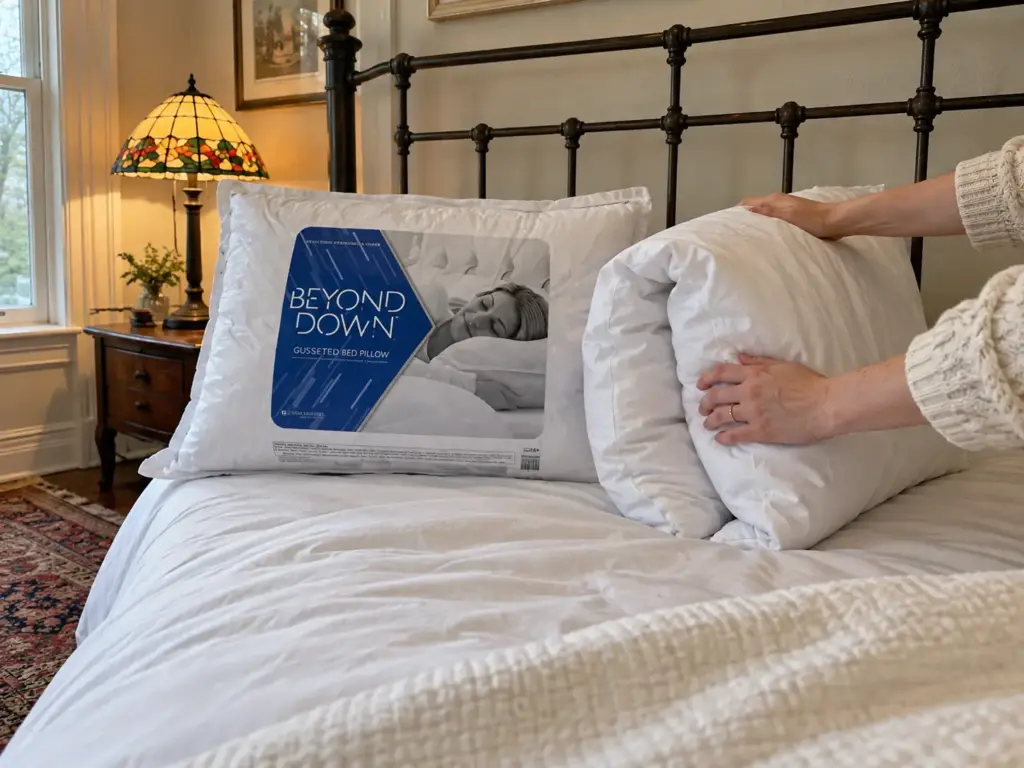
What the claim rests on
The mechanism is compression. A side sleeper needs a column from the mattress up to the ear that clears the shoulder, so a fill that compresses under the head gives away part of that column. That is true as far as it goes. What it leaves out is that compression depends on how much fill is packed into the case, and the top replies in the r/Bedding thread point the other way: the highest-loft down holds fine for a side sleeper.
One of those voices is a side sleeper with a medium-firm down pillow who reports losing about half an inch of loft in six months and still finding the pillow thick. That is one user’s estimate, not a measurement, and the other side of the argument also has exactly one voice. So neither camp has a test. Each has a guess about the same variable, and the variable is not the name on the tag.
What the maker’s own sleeper map leaves out
The 625 down pillow comes in three fill weights, and the maker sorts them by sleeper. Soft suits front sleepers; Medium and Firm suit front and back sleepers. No side sleeper is named anywhere on the map.
It is the same white down in the same kind of case at three weights, and the Soft one has the least fill and is the flattest. Fill power, the 625, is how many cubic inches an ounce of that down fills, so it says how lofty the down is and not how much of it sits in the pillow. Height at the head comes from the amount of fill in the case, not from the word down.
That is a seller’s map and it should be read as one: it tells you where the maker is willing to send you, which leaves the side-sleeper question open instead of closing it in either direction. How many ounces buy how many inches is not printed on the pillow, so no ratio is offered here. The direction is safe to rely on: more fill in the same case sits taller under the head, and less sits flatter.
Where a pillow gives out is just as telling. Reviewers of a polyester pillow describe it flattening wherever the head rests. A dent in one spot with a still-plump edge is what fill pressed in one place looks like, and it is why the fill weight, not the fill’s name, is the number to chase.
Don’t over-read the timing in these reports. The polyester reviews put the change at two months and at four, and the down report in the thread at six, but those are different people on different beds and nobody measured anything. What the night test in the first section adds to the month-six view of the fill guide is a look at fill recovery tonight, before the washes and the weeks have a say.
The free fixes before any purchase
The first is to fold a flat pillow in half for side sleeping. A commenter in the thread does exactly that, and the head gets roughly double the thickness at no cost. Another commenter puts a flat memory foam pillow of about 3 inches under an all-down pillow so the down can’t go flat enough to break the posture, which makes the second pillow the part doing the holding. Both fixes treat height as the problem, which is what it is, and neither needs a new fill.
Do the fold on the pillow that has gone flat, lie in your usual position, then measure the folded thickness with a ruler and write the number down. That figure is a number you can carry to the shop or the listing, and it beats the words soft, medium and firm when you compare any pillow you are thinking of buying.
Then read the height you need off the gap between the mattress and your ear, which loft read against the gap to the mattress shows how to measure, topper included. Only then does a purchase make sense.
A washable down alternative sold to exactly this sleeper makes a fair test of the claim. The Beyond Down Side Sleeper Pillow, King has polyester gel-fiber fill, a 100 percent cotton cover and a 4.5 inch gusset, the strip of fabric that gives the pillow height at the side of the head, and its listing’s care section says machine washable. Its reviewers have the same complaint the claim levels at down.
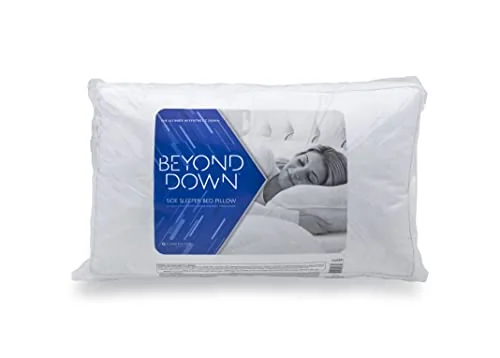
So the alternative sold to side sleepers draws the complaint that down is accused of, and all three reviews are about height. That is why neither fill name decides this. For the side sleeper on a budget, what a side sleeper gives up maps the trade-offs by pillow type.
Allergies, the Cover and Where a Doctor Starts
“Hypoallergenic” decides a lot of pillow purchases, and a pillow can answer only part of it honestly: which layer you touch, and what a label actually tests.

Which layer your face actually touches
Three layers sit between you and the fill: the pillowcase, the pillow protector if you use one, and the pillow’s own shell. The first two come off and can go in a hot wash when their labels allow it, while the fill almost never does. That order matters more than the fill’s name, because the layer that gets washed hot is the one against your face and the fill underneath gets whatever its care card allows (the next section has that card).
What each layer does is laid out in the cases guide, and the care tag decides the cover says when a protector earns its place. The maker of the 625 down pillow asks that it be used with a case and a zippered cover at all times, which is a statement about caring for the pillow and not a result about mites.
There is a trade-off to name. A reader in the thread puts a protector under the case and says the loft comes back more slowly. A layer under the case is one more thing between the head and the fill, and the cost that reader reports is slower spring-back.
What “hypoallergenic” measures on a down pillow
The word is a label, and a label measures something specific. The maker of the 625 down pillow defines it, for its own down, as at most 4.8 mg of oxygen per 100 g of down, a measure of organic matter in the down. That is a cleanliness figure for the down. It is not a dust-mite result, and it shouldn’t be read as one.
A test of mites looks different. The Asthma and Allergy Foundation of America runs a certification program that tests whether the outer fabric of a pillow or a cover blocks dust mites, so what a certification can check is the fabric on the outside, not the fill inside.
The warmth comparison makes the same point from the other side: the word has no standard of its own behind it. If symptoms stay the same whatever the bed does, that is a question for an allergist or a doctor, not for a pillow. Back at the bed, the practical result holds: a certified outer fabric is something you can check, and the word on the fill is not.
The room matters as much as the fill
Dust mites thrive above 50 percent indoor humidity, according to Nationwide Children’s Hospital’s dust-mite guidance, so the room is as much a part of the answer as the pillow. For bedding, the hospital advises washing linens weekly in water at 130 °F, and for an item that can’t be washed, sealing it in a plastic bag and putting it in the freezer for 24 hours.
Read that as guidance for the bedding layer, not a treatment for anything, and read it against the care labels you actually have. A pillowcase can take that water if its label allows. A down pillow’s care card, as the next section shows, doesn’t allow a home wash at all, and the freezer is the hospital’s fallback for an item that can’t be washed.
The Wash You Will Really Do
The cover can take a hot wash, but the pillow underneath has its own care card, and the choice between the two fills is often decided by the wash you will actually do, not the one you wish you did.
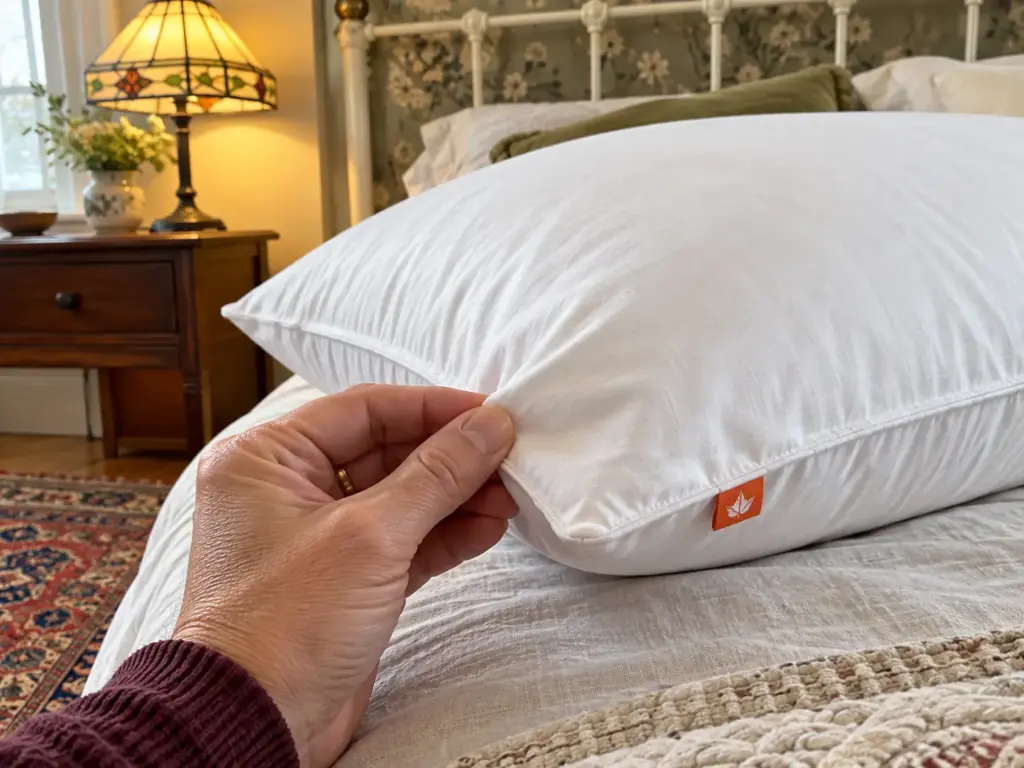
Down: the care card says professional
The maker’s care card for the 625 down pillow says dry clean or professional wash only. A home wash, it says, can shrink the pillow and loosen the stitching, and a fill that stays damp clumps and can grow mildew. The care card is the first thing a pillow tells its owner, and an easy one to skip before the first wash. A reader in the r/Bedding thread learned it the hard way: a 15-year-old down pillow went through the machine by accident and came out with feathers everywhere.
That turns the real question into whether you will take the pillow somewhere to be cleaned, not whether down can be cleaned. For a reader who will, down is the fill built to come back with a shake. For one who won’t, the care card asks for something the owner will never do.
The Canadian Down & Feather Co. Soft 625 Fill Power White Down Pillow, Queen is the down side of this comparison: 625 fill power white duck down in a 500 thread count cotton shell, sold in Soft, Medium and Firm. In the Soft weight, the maker’s map sends it to front sleepers.
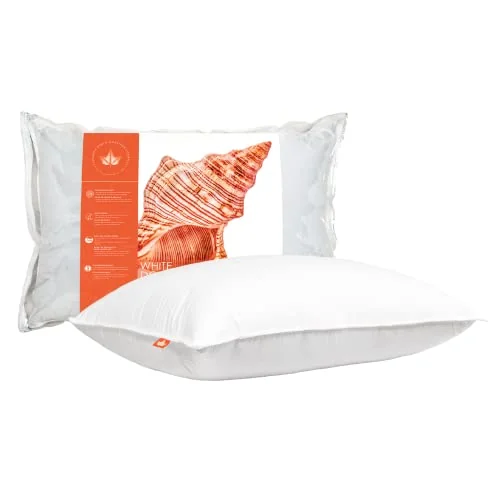
The care card is the cost of choosing down, and the review is a second cost for the Soft weight: that buyer expected a soft pillow and got one that stays puffed up. Both surprises shrink if you read the card and the weight before the order, which is the whole argument for choosing by fill weight.
Down alternative: a listing claim, not a promise
On the polyester and microfiber side, the wash is a claim in a listing. The washable alternatives say machine washable in their care sections or their titles, and a claim in a listing is not a care label, so read the label on the pillow you receive before the first cycle. The one checkable item is a certification: the microfiber Queen’s listing title carries an Oeko-Tex number, which you can look up instead of taking on faith. What the polyester label does and does not screen for is covered in the microfiber guide, and it says nothing about what a fill does to a person.
The Canadian Down & Feather Co. Soft Support Microfiber Down Alternative Pillow, Queen is the washable route you can run at home: microfiber fill in a 260-thread-count, 100 percent cotton shell. No wear complaint turned up for it. The lower reviews cite where it was made and a thickness that didn’t match what the buyer expected, and its washability comes from the listing, not from anything the reviews confirm.
What the daily care really is
Fluffing, not washing, is the care most pillows get. An Amazon reviewer of the Beyond Down King (2014) reports it in good shape a year on, but only because it was fluffed nightly: the care kept the height, not the fill. The thread says the same of any pillow, fluff it daily and it lasts.
The other clock is the calendar. The Asthma and Allergy Foundation of America advises replacing a pillow every two years, a rule of thumb from a post dated 2019 that ignores what the pillow is filled with. Replacing a pillow by fill rather than by year is the version that does not.
Wash the case and the pillow as two separate jobs. The case unzips and takes the hot wash; the pillow inside has its own instructions. Treating them as one object is how a care card ends up ignored on laundry day.
Which One to Buy, by Sleeper, Allergy and Wash
The table above sorts by attribute. This section sorts by reader: three questions, in the order that rules out the most, ending in one fill each.

Start with how you sleep
Side sleepers first, because theirs is the least settled answer. Read the height you need from the gap between the mattress and your ear, then from the fill weight, and try the free fixes before spending anything: the fold, the thin pad. If you have run those and still want a new pillow, pick by fill weight, because either fill can be too flat at a light weight. The Soft down has the least fill of its three, and the alternative sold to side sleepers draws flat reviews, so the name on the tag settles nothing here.
Back sleepers and front (stomach) sleepers get a clearer start. The maker’s own routing leans down for them, Soft for front sleepers and Medium or Firm for back sleepers, and pillows for back sleepers that hold their height explains how to land on the height that fits the gap behind the head. A routing from a seller is a starting point, not a verdict, but it is the only sleeper map either fill has.
Then the wash you will really do
Two honest answers exist. If the answer is “professional or never,” the pillow is down, and you book the professional wash instead of hoping. If the answer is “the machine on a Sunday,” the pillow is the alternative, and the listing’s machine-washable line is a claim to check against the label on the pillow in your hands. Either way the case takes the hot wash.
This is where the cheap fill and the expensive fill meet. The alternative is the route for the reader who will not pay for professional care, and that, not its height, is its real saving. A down pillow that never gets the professional wash its care card asks for is a pillow whose card will not be followed. Warmth doesn’t enter any of this; the heat and the fill math belong to the warmth comparison already linked above.
The choice that lasts is the one that matched the wash, not the one that matched the sleeper.
Put the two questions together and the pairings sort themselves. A back sleeper who will pay for the professional wash has the cleanest case for down, in a Medium or Firm weight per the maker’s routing. A back sleeper who runs the machine on a Sunday should buy the alternative and accept that its recovery is the part to watch.
A side sleeper who runs the machine on a Sunday is the reader who most needs the free fixes: buy the alternative, but hold the fold and the thin pad in reserve, because the reviews of the one sold to side sleepers say the height fades. And a side sleeper who will pay for professional care has the one open case, down at a heavier weight than the Soft, with the thin pad under it, since the maker’s map names no side sleeper and the thread’s reports are one voice each. Every one of those pairings ends in the same place: read the care card first, and measure the gap before the fill.
Then the cover, not the fill, for allergies
Where an allergy shapes the choice, narrow it to the layer a label can test. A cover whose outer fabric is certified by a program like the one named above is a check a reader can make; the word hypoallergenic on a fill is not. The Oeko-Tex number on the microfiber Queen is the other checkable item in this comparison. That leaves the cover as the one layer you can choose with evidence.
A shared bed means buying for each head, not for the bed. In the r/Bedding thread, a parent whose toddler sleeps across the pillow keeps two down pillows, one each, and the same logic lets one sleeper run down while the other runs the washable alternative.
The fill guide has a section on that case, one bed with two pillows.
Choose by Fill Weight and Wash, Then Check the Pillow Again in the Morning
Three things carry over from everything above.
- Fill weight sets the height under your head. More fill in the same case sits taller, and the word on the tag does not.
- The wash you will really do decides between the fills. Professional or never means down; the machine on a Sunday means the alternative, with the label read first.
- The cover is the layer a label can test, so choose it with the evidence and leave the word hypoallergenic on the fill unclaimed.
For later, once the pillow has been through months of shaking and washing where the care card allows it: lie down on it after a night and a shake, and compare the dent and the height with the first week. A pillow that used to fill back in and now holds its dent has told you what it has stopped doing, and so has any new lump.
The free change for tonight is the morning shake. Do it hard, once, and watch how long the dent takes to fill. If it doesn’t, fold the pillow in half before you shop for another.
Frequently Asked Questions
01Are down alternative pillows as good as down pillows?
Not automatically: it depends on the sleeper, the wash and the fill weight, not on the name. Down comes back when shaken out, and the alternative survives a home wash. Neither wins on both counts. The fill guide covers what each does by month six.
02What are the disadvantages of using a down pillow?
The main drawbacks are care and sink: the maker’s care card for its 625 down pillow says dry clean or professional wash only, and down sinks under the head until you shake it back. Feather mixed in adds quill poke, and over time all feather and down clumps a little.
03Can you wash a down alternative pillow?
The listings say machine washable, but the care label on the pillow you receive has the last word, so read it before the first cycle. The one checkable claim on the microfiber Queen is the Oeko-Tex number in its listing. Settings for cycles and drying come from that label.
04Is down alternative toxic?
A label can only tell you what it certifies, and a certification number in the listing is something you can look up. That is the whole claim a label supports, and the microfiber guide covers what the polyester label screens for.
05Do down pillows need a cover?
The maker of the 625 down pillow says to use it with a case and a zippered cover at all times, and the cover is the layer that takes the hot wash. Whether a protector earns its place depends on the pillow’s care tag.





Tried it on your own bed?
No comments yet. Tell us what you changed, and what the sheet did after a few washes.