







What’s in here6 sections
You lift your head off a flat pillow in the morning and find a thin, tired slab; you shake it, it stands up, and the next night it is lying flat again before you have turned over twice. One poster on r/LifeProTips in 2012 described the same loop: they “always briefly rustle them but after awhile they just flatten out again”. Fluffing works because a shake moves fill that has shifted and adds none, so what comes back depends on what is inside the case. This guide shows how to fluff a pillow in order, why force leaves it lower, what each fill gives back, and the month count that says the fill, not your hands, is the problem.
Quick Answer
A hand pass brings back fill that has shifted, not fill that is gone, and it takes about a minute.
- Take the case and the protector off the bare pillow.
- Lift it by two diagonal corners and shake lightly.
- Squeeze the ends in and out like an accordion.
- Turn it a quarter and repeat until it has gone full circle.
- Lay it down and let it rest five to ten minutes.
- Run it daily for down and loose fiber, and count how long it holds.
If the shape is fine and the height itself is the doubt, start with why pillow loft and firmness need two numbers, then come back here for the hands.
The Fluffing Routine, in Order
This is the one repair for a flat pillow that needs no purchase, and the whole routine takes about a minute. The three steps run in a fixed order because each one prepares the next.

Take the case and the protector off first
The pillow is in one hand and the case is already over the back of a chair. Leave it there. Casper’s guide says it is “best to remove any pillowcases or protectors before fluffing”, and the mechanism is easy to see. A snug case and a zippered protector hold the fill in a tube, so when you shake, the cover and the fill move as one piece and nothing inside gets loose enough to redistribute.
The bare pillow is the only version that can be reshaped. Everything goes back on when the pass is over, and the pillow protector earns its place again between passes, because it is the layer that keeps sweat and skin oils out of the fill.
Do the pass while the bed is half made. Lay the bare pillow down when you finish, strip and smooth everything else, and the rest it needs costs you no extra time. The case goes back on a pillow that has stopped moving.
Lift by the corners, shake lightly, squeeze like an accordion
Take two diagonal corners and shake the pillow up and down. A commenter in the 2012 r/LifeProTips thread describes it as shaking “it lightly up and down, letting gravity do most of the work”, and that is the right size of motion: the fill drops, loosens and falls back through the case.
Then hold the opposite ends and push them toward each other and pull them apart, again and again. The Sleep Foundation’s guide says this “breaks up clumps of fill and forces air into the pillow to restore its loft”. A clump is fill that has stuck to itself, and the squeeze is what pulls it apart.
Turn it a quarter and let it rest
Rotate the pillow 90 degrees and do both movements again, until it has been all the way round. The same Reddit commenter works to a full 360 degrees, and Puredown’s guide names the 90-degree turn as well. A full pass takes about 30 seconds according to Boll & Branch and Puredown, and Puredown puts the daily version at about 10 seconds.
Then stop touching it. Down Inc says the pillow keeps rising for 5 to 10 minutes after the pass. Plump it and drop it straight under a head, and you are asking the fill to hold a shape it has not finished taking, which is the version that is flat again within the hour. Heat is a separate tool: the dryer, the sun and fresh air do the same job with warmth, and the care label sets different rules for each fill, so none of them belongs in a hand routine.
Firm, Not Hard: Why Force Makes It Lower
Every step above says “lightly”, and the instinct runs the other way: a harder shake feels like more effort for more height. It is the reverse.
What the guides warn, and what none of them says
Boll & Branch puts the warning most bluntly: “Don’t clap too hard, though, because you might actually make your pillow flatter with too much force.” Casper says the same from the other side: “Be careful not to shake the pillow too aggressively, or you might risk disrupting the fill and flattening it.” The 2012 Reddit commenter, for the record, says “lightly”.
None of the three gives a reason. A rule with no reason is easy to ignore at the moment a pillow looks stubborn, which is exactly the moment it matters.
Why the middle ends up lower
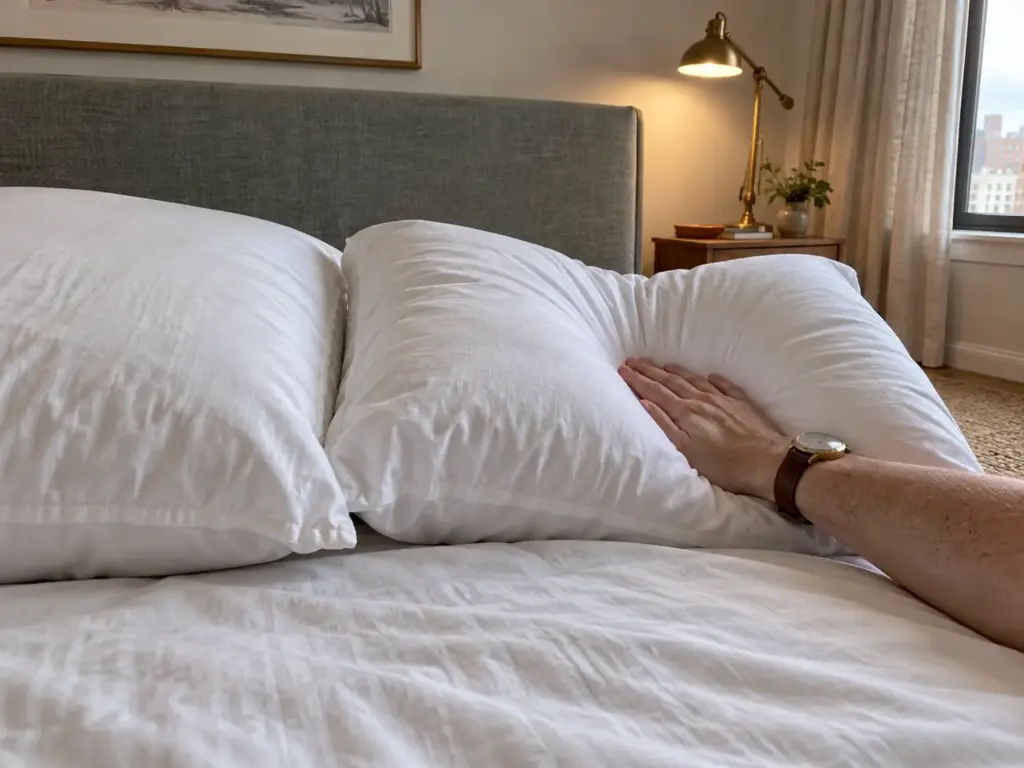
What follows is my own explanation, not a measured result. The likeliest reason is that a hard shake throws loose fill toward the ends of the case, where there is room for it, and leaves the middle, where your head lands, with less. The ends then stand up, which looks like success, and a flat hand pressed into the center sinks into a shallow dip. A pillow with fat ends and a dip is not a fluffed pillow.
The second half of the explanation is plainer. Moving fill is not adding fill. A shake cannot raise the pillow height above what its total fill allows, so force only changes where the fill sits, and a hard shake can put it in the wrong place.
After the rest, press one flat hand into an end and the other into the middle. If the end pushes back and the middle gives, the fill has been herded outward, and the next pass should be gentler, not longer.
Light, turned, repeated
What replaces force is repetition: the lift, the gentle shake, the accordion, the quarter turn, and then again. Many light passes beat one heavy one because each pass moves a little fill a short way, and the quarter turn keeps changing which part of the case the fill falls toward. Nothing ends up piled in one place.
This also explains the loop in that 2012 post, where a rustled pillow flattens out again after a while. A pillow that stands for an hour and then lies down is usually fill that moved and then moved back. The fix for that is the full routine and the rest, not a stronger version of the same shake. A solid block gets no shake at all, as the next section explains.
What a Shake Brings Back, Fill by Fill
Light hands do the same work on every pillow, and the result is not the same, because a shake can only move fill that is loose. What is in the case sets what comes back, and what each fill does by month six is its own subject. Here a fill is named only for what a shake can reach.
Down and feather: the short pass works
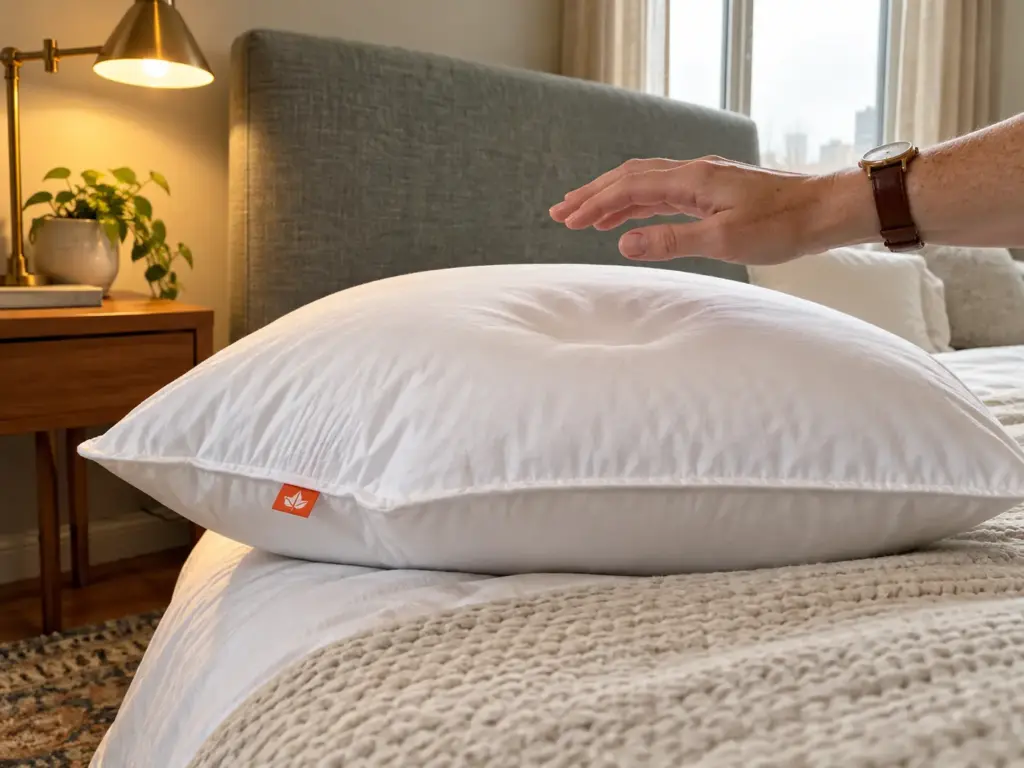
Down is clusters, and clusters spring back. Boll & Branch writes that “natural fibers like down and feather are able to quickly return to their original shape”. The Sleep Foundation says down and down alternative “compress easily beneath weight, often requiring daily fluffing”. Both statements hold at once: it recovers fast, and it needs the pass often.
The morning check for these fills sits in down against down alternative by fill weight.
The Canadian Down & Feather Co. Soft 625 Fill Power White Down Pillow is the example. It is white down at 625 fill power in a 500-thread-count cotton shell, and a short pass is the right size of job for it: a round, full shape inside the minute the routine takes.
Reviewers are mixed on how flat it sits and how full it is filled, and some call it overpriced. A good shake settles the shape without settling the question of how much fill went in.
Feather is stiffer. The puredown Goose Feathers and Down Pillow, Hotel Collection, Set of 2 is goose feather and down in a gusseted 100 percent cotton shell, and quills are a stiffer fill than soft clusters. That makes it the pillow where the warning against force matters most. Reviewers say it gets flat as soon as they lay their head on it, and they rate its support and flatness as mixed.
A review cannot tell you whether that comes from the fill or from how the pillow was handled. Do the full routine once, leave it for ten minutes, and see where it sits.
Polyester fiberfill: longer, and it fades
Boll & Branch is direct about synthetic fill: it “might take more time or effort” to bring back to its original shape. Polyester microfiber is made of “fine, delicate strands”, in the words of the Canadian Down & Feather Co. listing, and it is “plush like down, but denser”.
A strand of polyester fill has no cluster to spring back with. How well it recovers depends on how the strands are packed, which a hand can only reshape.
The Canadian Down & Feather Co. Soft Support Microfiber Down Alternative Pillow has this fill in a 260-thread-count cotton shell. The three-star review readable on its page, from 2023, is about where it was made rather than the fill, so the warning that counts comes from its own listing, which calls it “a flatter-style pillow”. Budget more hand time, and expect a shape that looks right in the mirror and sits lower in the middle once weight is on it.
Old polyester is where the routine runs out. One commenter in that 2012 thread wrote that a pillow too old and filled with polyester “will be very difficult, to nearly impossible to fluff out enough”, and another said many pillows use fillings that “break down over time and can’t be brought back”. Broken-down fill is not fill that has shifted. No amount of lifting returns it.
Shredded foam and latex: loose pieces, so yes, up to a point
Shredded fills are loose pieces, so they move. The Sleep Foundation’s guide says: “Despite being less prone to clumping, shredded memory foam and shredded latex may also need regular fluffing”. The catch is that a piece of foam does not spring open the way a down cluster does. It moves where you push it and stays there.
Shredded against solid memory foam covers why the construction decides whether a shake helps at all.
The Coop Home Goods Original Adjustable Pillow is cross-cut memory foam mixed with microfiber, in a zippered 20 by 30 inch cover, and its listing says extra fill is included. That is the one repair here that adds fill: when moving what is loose no longer lifts the pillow, you put some back. Several customers report a strong smell, and value for the cost is mixed.
The Natural Latex Shredded Foam Pillow, King, Set of 2 is the latex pillow of the set, with natural Sri Lankan latex in an organic cotton cover that carries Oeko-Tex Standard 100. Reviewers say it is too firm, the pieces come in many irregular sizes, and one top review calls it “very heavy and firm, and not for everyone”. A shake will redistribute those pieces, but it will not make them softer.
On an adjustable pillow, put the fill back a handful at a time and rest the pillow between handfuls. Pieces settle after they move, so the height you see right after adding fill is higher than the height you will sleep on.
Solid foam, solid latex and buckwheat: nothing loose to fluff
The Sleep Foundation is plain about these: solid foam, solid latex and buckwheat pillows “do not require conventional fluffing, though they may still need the occasional freshening up”. A block has no loose fill to redistribute.
Puredown’s guide tells readers to knead solid foam and latex, and my reading of that advice is that pressing a block moves nothing, so at most it warms the material and lets it spring open again. That reading is mine, and it claims little. Latex against buckwheat covers what holds once the head moves.
The table below puts the limit of each fill in one place.
| Fill | What a shake moves | How often | Where it stops |
|---|---|---|---|
| Down and feather | Clusters that spring back | Often daily | Worn-out or washed-clumped fill |
| Polyester fiberfill | Strands, reshaped by packing | Often, with a longer pass | Old fill that has broken down |
| Shredded foam | Loose pieces | When it packs down | Pieces do not spring open; add fill if adjustable |
| Shredded latex | Loose pieces | When it packs down | Pieces vary in size and stay firm |
| Solid foam, solid latex, buckwheat | Nothing loose | No conventional fluffing; occasional freshening | A block has no fill to move |
How Often, and the Month Count That Says It’s the Fill
Knowing what a shake can reach still leaves two questions: how often, and when the routine has stopped being care and started being a symptom.
Daily for down and loose fiber, less often for the rest
Casper tells readers to “aim to fluff your pillow daily” and, in the same guide, to fluff it “as often as you’d like”. Puredown and Down Inc say daily or routinely, and Puredown adds a deeper refresh every few months. Those are their numbers.
The cadence that fits your pillow depends on what is in the case. Down and loose fiber take the short daily pass, about 10 seconds by Puredown’s count. Shredded foam and latex need it when they pack down. A solid block needs it when needed, never daily.
So “daily” is the number that depends. Applied to a block it is wasted effort, and applied to down it is the minimum.
Consumer Reports describes how it measures what a pass gives back: “We measure the thickness and firmness of the pillow after we take it out of the chamber and again after hand-fluffing it.” The lab loads the pillow for four days first. The closer a pillow comes back to its original height and firmness, the higher its resilience score. The gap between the loaded height and the fluffed height is the part a shake gives back, and it is the part you can influence.
The tell: a pass that holds for less time each month
The test is mine, offered as a test rather than a finding. Pick a baseline: after a full pass and a rest, note how late into the night the pillow keeps its height.
Check again a month later, and a month after that. If the same pass buys less of the night each time, the fill is losing what the pass was working with. A pillow that needed it once a week now wants it every day, then every night.
Casper puts a version of this in its own words: “if you’re waking up to fluff your pillow, or fluffing it multiple times to get to sleep, that could be a sign it’s time to replace your old pillow.” That is Casper’s claim, and what to do once the tell shows is a separate job. The fold test before you replace it holds the test and the replace decision, so this guide does not repeat them.
A pillow near the end of what fluffing can do stands only when it is first plumped, and it is flat by the time the lamp goes out.
Keep the test in your phone’s notes: the date, and whether the pillow was still standing when you turned the lamp off. Three entries a month apart show a trend that memory smooths over.
When a washed pillow stays in clumps
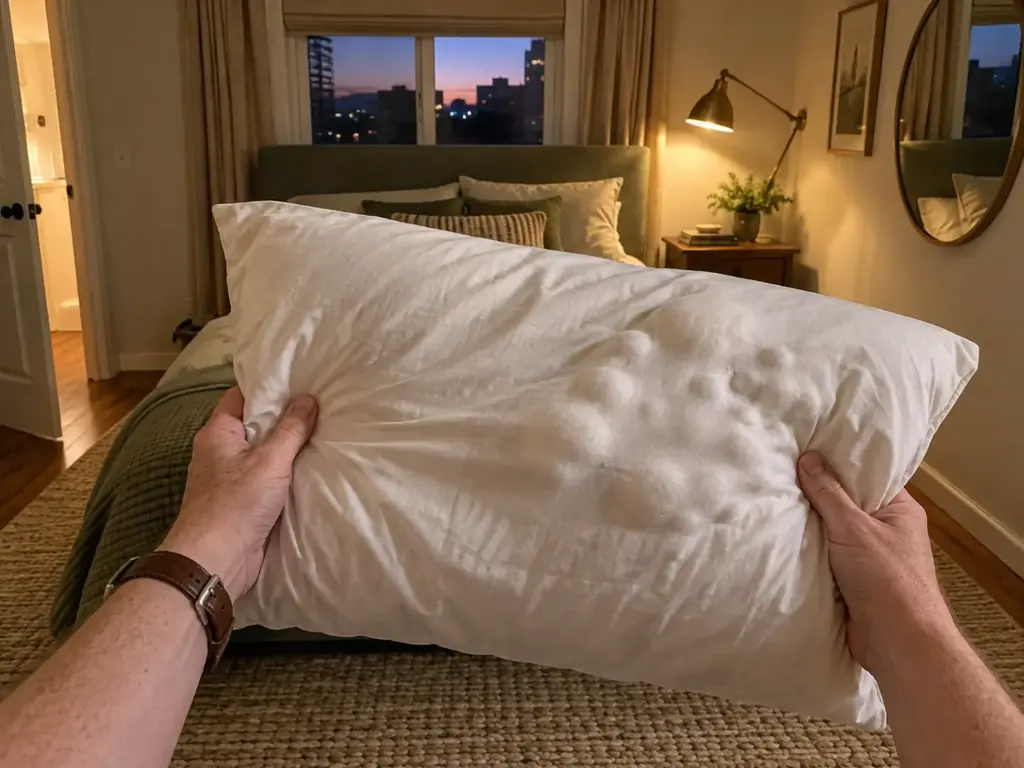
Some of what looks like worn-out fill is fill that was washed badly. In a 2023 r/LifeProTips request, the poster had washed the cases about a year earlier, and “the feathers have been clumped up and never returned to their original state”. A year of hand work had not undone it. The accordion squeeze breaks up fresh clumps, but fill that has dried into knots can outlast any number of passes.
If a pillow clumps after a wash and stays that way through the full routine, that is a fill problem and not a technique one, and the count above no longer matters.
Bare Fill, Light Hands, and How Long the Pass Holds
Three things to carry out of this:
- Fluff the bare fill. Lift by the corners, shake lightly, squeeze the ends in and out, turn a quarter, and let it rest.
- Keep your hands light. Force makes the middle lower, so light and repeated beats heavy and once.
- Know your fill. What comes back depends on what is in the case, and a solid block does not need fluffing at all.
For later, watch how long a pass holds its height as the months go by. The pillow that holds for less of the night each time you check is telling you something the shake cannot fix.
Tonight, do the routine once on the bare fill, give it its ten minutes, and notice how long it holds. That is your baseline, and it costs nothing.
Frequently Asked Questions
01How do I get my pillows fluffy again?
Take the case off, lift the pillow by two corners, shake it lightly, squeeze the ends in and out like an accordion, then turn it a quarter and repeat. It brings back fill that moved, not fill that is gone.
02How do you fluff a pillow?
Take the case off, hold the pillow by two diagonal corners, shake gently up and down, then work the ends in and out like an accordion. A full pass takes about 30 seconds. Many light passes beat one hard shake, which can leave the middle lower.
03Can I put pillows in the dryer to fluff them?
Some fills tolerate low heat and some do not, and solid foam is not among them, so the dryer is a separate job from the hand routine. The cycle for each fill is in which fills the dryer is for.
04How long does it take for a pillow to fluff up?
A pass takes about 30 seconds, and the pillow keeps rising for 5 to 10 minutes after it, so give it that long before judging the height. A pillow that does not rise in that time has probably lost its fill.
05Can you fluff a memory foam pillow?
A solid memory foam pillow has no loose fill to move, so it does not need conventional fluffing, though it may still need an occasional freshening up. A shredded one does move, and an adjustable one can have fill added or taken out.





Tried it on your own bed?
No comments yet. Tell us what you changed, and what the sheet did after a few washes.