







What’s in here8 sections
- Two Measurements the Box Folds Into One
- The Bands Disagree, and the Loaded Number Is the One That Counts
- What the Mattress and Your Frame Change About the Number
- “Firm” Is a Seller’s Word
- Two Ways a Pillow Goes Wrong, and Only One Needs a New Pillow
- Free Fixes Before You Buy Anything
- Read the Height Under Your Head, Not the Label
- Frequently Asked Questions
The box says medium. By 2 a.m. your head has pressed that medium into something lower, and the number printed on the package is no longer the height you are sleeping on. A pillow has one height on a counter and a lower one under a head, and only the second is in your bed.
Loft and firmness are two measurements the label folds into one: loft is the height a pillow has at rest, and firmness is how much of that height survives a head.
This article pulls them apart, shows why the printed bands contradict each other, what the mattress changes, what “firm” can and cannot mean, the two ways a pillow goes wrong, and the free fixes that come before any purchase.
Quick Answer
Loft is how tall a pillow stands at rest; firmness is how much of that height is left once a head is on it. They are separate measurements. The pillow that fits is the one that holds your head level after it compresses, not the one with the right number on the label.
Two Measurements the Box Folds Into One
Every later argument in this article depends on keeping two words apart, so they come first, before any band or brand.

What loft measures (and when it is measured)
Loft is height at rest: the pillow on a flat surface, nothing pressing on it, a ruler held against its thickest point. That makes it the one number a factory can print the same way every time, which is why it is the number on the box. What it cannot tell you is how long the pillow stays that tall once someone lies down.
What firmness measures (and why it is not the same thing)
Firmness is how much of that height survives a load. Two pillows with the same printed loft can sit at different heights under a head: a tall pillow with soft fill settles to medium, while a firm, low pillow barely moves at all. The printed number and the number in use agree only while the fill holds. The easiest place to see the gap is the dent a head leaves, and how much of it is still there after the head is gone. No box prints the drop between rest height and loaded height, so the only way to learn it is to watch it happen, which the checks in the last section let you do.
The first week’s height is not the settled height, either. One r/Bedding commenter called a firm replacement “almost too hard at first”, so judge a new fill after weeks, not nights. Which fill holds its height longest comes down to what the fill is made of, and that article takes the question from there.
Why the label can only print the first one
A label can carry a number only if the number comes out the same in every warehouse. Rest height does.
Firmness depends on the load, on how long it is applied and on what the fill did last month, so the label falls back on a word: soft, medium, firm, medium firm. The measurement is real; the word describing it is tied to nothing. Section four takes that word apart.
The Bands Disagree, and the Loaded Number Is the One That Counts
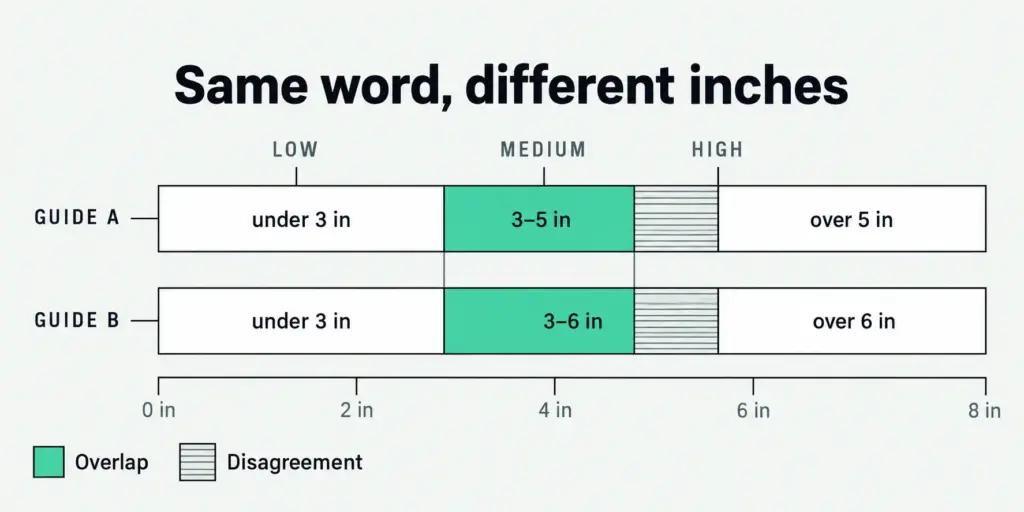
Printed loft bands do exist, and they contradict each other, so if you read one chart and then another you can end up with two answers for the same pillow.
The same word, different inches
Low loft is under 3 inches on every chart. After that the lines move.
Medium loft runs 3 to 5 inches on three of the charts and 3 to 6 on a fourth, and high starts above 5 inches on two of them and above 6 on another. Side sleepers are told 4 to 6 inches by one maker and 5 to 7 by another, and stomach sleepers are sent to 4 to 5 inches on one chart while the rest call for low loft. Nothing stands behind low, medium and high, so each seller draws its own lines.
A pillow that stands 5.5 inches at rest is medium on one chart and high on another, and both are correct by their own definition.
Rest height versus the height under your head
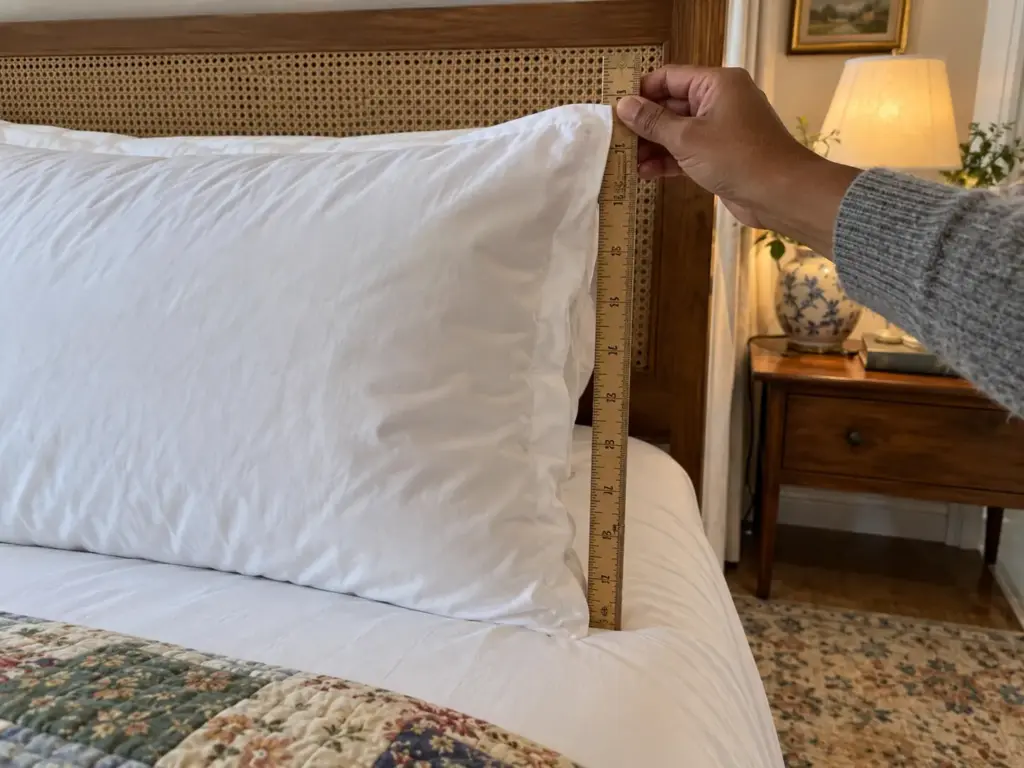
Rest height is what a ruler reads on a counter. Loaded height is what your head sees after a few minutes on the pillow, and the bands describe the first while the bed uses the second. That is how a pillow can measure exactly right on the counter and still let your head drop toward the mattress once you lie on it: the chart was never talking about that height. The comparison that means something is between two pillows measured the same way, not between two labels.
Measure the same pillow twice: once on a counter, and once with your head on it, with a ruler stood upright on the mattress beside it while someone reads the height from the side. The difference between the two readings is the number the box leaves out, and it takes a minute to find.
Which number to trust when two guides disagree
The number to trust is the one you can measure yourself: how far your head sits above the mattress with the pillow compressed under it. A printed band is a rough sorting word for narrowing a shelf, nothing more. Inside one maker’s chart the order still holds, since that maker’s low sits under its medium and its medium under its high; the trouble starts when you carry a word from one chart to another, or read a rest height as if it were a loaded one.
So write down two things before you shop: the height your head needs above the mattress, and the rest height of any pillow you are considering. If a listing gives only a word and no inches, it has told you nothing you can compare. If it gives inches, remember they were taken with no head on the pillow, and expect the number in use to be lower by an amount the listing will not state.
The fill sets that amount more than the inches do, which is why a tall pillow with soft fill and a shorter one with springy fill can land at the same height by morning. Doing that measurement properly for each sleeping position is its own job, and the article on how to measure the loft instead of guessing it walks through it.
What the Mattress and Your Frame Change About the Number
Measuring raises the next problem. The number to hit is not fixed, because the pillow works against a mattress that gives way too, and against the frame lying on it.

A soft mattress lowers the target
Mattress firmness works against the pillow: the softer the mattress, the deeper the shoulder sinks into it, and the smaller the shoulder gap the pillow has to fill. That gap is the mattress’s work, not the pillow’s. So advice that sets the height by sleeping position alone breaks on a soft mattress or a thick mattress topper: the pillow that is right on a firm bed runs tall on a soft one, because the head and the shoulder have both moved down.
Carry a spare pillow from the guest room to the main bedroom and it fits differently, for no reason the box can give. The reason is two mattresses that give differently.
If the house has two beds, give the same pillow one night on each before judging it. A pillow that works in the guest room and fails in the main bedroom is reporting on the mattress, and no refill will change that.
Shoulders, head size and weight
Shoulder width sets how big the gap is to begin with: a wider shoulder holds the head farther from the mattress when you lie on your side. Head size and weight set how far the pillow compresses and how far the mattress gives. One sizing chart singles out sleepers under 130 pounds and over 230 pounds as the extremes, which is a reminder that every band was drawn for someone in the middle. If you sit at either edge, the printed range is a starting point at best.
Position sets the range (and its sibling articles)
Position sets the range of pillow height, and the per-position numbers live in their own articles. Side sleeping leaves the widest gap between ear and mattress, so it asks for the tallest pillow; back sleeping asks for less, and stomach sleeping for the least, because the face is already close to the mattress. The detail for each is in pillows for back sleepers that hold their height and in the piece on stomach sleepers, where thin foam and adjustable fill compete. Two people in a shared bed rarely fit one pillow either, because the heavier shoulder presses its side down further, and the same is true of one person who turns through three positions on one pillow.
“Firm” Is a Seller’s Word
Firmness is the half of the pair you cannot see in a listing. The word is used everywhere and defined nowhere, so this section sets out what it can mean and how to feel it.

Two definitions in circulation
Firm gets used for two different properties. One is resistance to compression: how hard you have to push before the pillow gives. The other is shape retention: whether it comes back once the push stops, which is its resilience. They are not the same thing.
A soft down fill gives way at once yet springs back when you sit up, while a packed polyester fill that has matted resists the push and keeps the dent. Which of the two gets called firm depends on which property the seller chose to look at.
The pick everyone names for a sinking head, a firm pillow, only helps if it also returns. Without that, it is a hard dent.
You can test both without buying anything. Press a flat palm into the middle of the pillow and see how far it goes, which is resistance. Take the palm away and watch whether the pillow recovers, which is return. Folding it in half and letting go is a harsher version of the second test, and it comes back in the last section.
Hold the palm press for ten seconds before you let go, then count how long the pillow takes to come back. A fill that returns in a couple of seconds is holding its shape; one that is still dented when you look away is the one that will be lower by next winter.
What a lab actually measures
CHOICE, the Australian consumer-testing organization, splits the question into three tests. In CHOICE’s lab method for testing pillows, the fold test is described this way: “We look at how well a pillow flips back to its original shape when folded over.” Its fatigue test puts each pillow under 100 kg for 96 hours, and its sink test uses a 5 kg head-shaped probe and measures the deformation.
The weighting is telling: fatigue 35 percent, comfort 30 percent, fold 20 percent, sink 15 percent. The biggest slice of the score is how a pillow holds up under load, and comfort, the thing you judge in a showroom, comes second.
On the foam side, ASTM D3574-17 applies to “slab, bonded, and molded flexible cellular products known as urethane foams.” That is a foam standard, not a pillow standard, so a pillow’s “firm” is not tested to any shared method.
Why a color or a “medium firm” tag is not a scale
A listing tag is a seller’s label. “Medium Firm” on the adjustable pillow in the last section is the listing’s own wording, on a seller’s scale no other seller shares, and a color-coded firmness chart is the same thing in paint: one brand’s blue and another brand’s blue mean nothing to each other.
Firmness also moves. A fill that feels firm on day one can ease after a few weeks, and a tag printed at the factory cannot hold that. For what the trade costs in one particular fill, see what memory foam gives up for its firmness.
Two Ways a Pillow Goes Wrong, and Only One Needs a New Pillow
A wrong pillow has two different causes, and which one you have decides whether money is needed at all.

The pillow that lost its height
This is a fill problem. The fill has compacted or shifted, and the pillow is no longer the height it was. One r/Bedding commenter described memory foam that “started to compact and spread out around my head” after about a year. Down and its alternatives lose height differently, as laid out in down against down alternative, and foam splits again between shredded against solid foam.
It is counted in months, not nights, and the tell is a pillow you re-fluff a little earlier each month. This is the case replacement is for.
The pillow that never fit
This is a bed problem. The pillow was always the wrong height for this mattress and this frame, so an identical new one will be wrong in the same way. The fix is the gap, not the fill: raise it, fold it, take fill out. Only the first kind of wrong pillow is solved by buying another.
When it isn’t the pillow at all
If an ache or numbness does not move when the pillow changes, or it keeps coming back with headaches, that is a question for a doctor, not for a pillow. Mayo Clinic’s guidance on when neck pain needs a doctor puts the line at pain that lasts beyond several weeks of looking after it at home, or that arrives with headache, weakness, numbness or tingling. Everything else in this article is height and fill, and that part you can sort out on your own bed.
Free Fixes Before You Buy Anything
Everything above can be tested on the bed you already own, before a purchase, and the order matters, because the free fixes also tell you what to buy if you do end up buying.

The fold and press checks
Fold the pillow in half and let go: does it flip back, or does it stay folded? Then press a palm into the middle and note how far it goes and how fast it returns. A pillow that stays folded and keeps its dent is showing you when a pillow is finished, and from there the fix stops being free. One that passes both is a candidate for the small adjustments below.
Raise it with a towel, lower it by taking fill out
A folded or rolled towel under the pillow raises it. In the r/Bedding thread’s words, “it’s easiest to just bolster the height of the pillow by putting folded towels underneath.” Folding the pillow itself for height is less reliable: one reviewer reported that when you fold it and put your head down, “it just mushes down at the impact of your head”, so fold-for-height gets tested, not assumed.
To lower a pillow, remove fill, a handful at a time.
Use one pillow instead of two stacked, and slide it so your shoulder sits on the mattress rather than on the pillow’s edge. If a replacement feels hard at first, give it the weeks mentioned earlier before judging it. And if there is an extra bag of fill in the closet, remember that putting it back changes the pillow’s character, so add fill a handful at a time too.
Change one thing a week: a towel, or fill out, never both at once. Two changes together and you cannot tell which one moved the height, or which one to undo.
If a pillow has to be bought: adjustable fill
When the free fixes run out, the purchase worth naming is the one that makes them repeatable: adjustable loft. The Coop Home Goods Original Adjustable Pillow in Queen is cross-cut memory foam with microfiber fill, 20 by 30 inches, with extra fill in the box, so taking fill out and putting it back is how it is meant to be used and your own mattress, not a printed band, judges the height.
The listing calls it “Medium Firm”, which by now you know is the seller’s word, and it lists CertiPUR-US and GREENGUARD Gold certifications.
Buy it as something to adjust, not as a height to trust on arrival: a 3-star Queen reviewer found it “VERY flat upon arrival and even after manual fluffing”, and a reviewer of the King size, a different variant, wrote in October 2026 that it was “already flattening” after a couple of months even with all the extra fill put back in. Run the fold and press checks the first day it arrives. If the fill matters more than the adjusting, look at fills that stay put once the head moves instead.
Read the Height Under Your Head, Not the Label
Three things carry over. Loft and firmness are two measurements, and the one that counts is the height under the head. The bands on a box are one maker’s lines, so measure instead of trusting them. And a wrong pillow is either a fill that lost its height or a bed it never fit, and only the first needs a new pillow.
Come back to the pillow after a few months and look at the dent: if it still fills back in when the head leaves, the fill is holding, and if it sits there, the height you set has already gone.
Tonight, slide a folded towel under the pillow, or pull a handful of fill out of it, and leave everything else alone. Over the next week, notice whether you still reach for the second pillow, and whether the one you have stays where you set it.
Frequently Asked Questions
01What does loft mean for a pillow?
Loft is the height a pillow has at rest on a flat surface, before a head presses on it, and it is the number most boxes print. It is separate from firmness, which decides how much of that height is left under the head.
02What firmness of pillow is best?
The best firmness is the one that keeps your head level once the pillow compresses, and that depends more on your mattress and shoulders than on the box. Test it with a palm press and a fold before trusting the label.
03What do the different MyPillow firmness colors mean?
A color-coded firmness scale belongs to the brand that prints it, so the same color does not line up with another maker’s medium or firm. Compare pillows by measuring loft and testing the press, not by color.
04How can I tell at home whether a pillow is too high?
Lie in your usual position and have someone check from the side whether the pillow lifts your head above the line of your shoulders or leaves a gap. Take fill out, or swap in a thinner pillow, for one night to compare.
05Can I change a pillow’s height without buying a new one?
Yes: slide a folded towel under the pillow to raise it, or take fill out of an adjustable pillow to lower it. A pillow that has flattened for good is a fill problem, and that is the case for a replacement.





Tried it on your own bed?
No comments yet. Tell us what you changed, and what the sheet did after a few washes.