







What’s in here6 sections
You lift your head off the pillow, press a fist into the middle, and it goes down like dough. A pillow too flat to hold a head is a complaint that arrives fast: one poster on r/LifeProTips wrote that their bed pillows got “about 3 weeks max” before they went flat. A shake moves fill that has shifted and adds none, so the first question is whether the fill is still in there or just sitting in the wrong place. Below: the morning test that tells the two apart, why the spot under your head goes first, the free fixes in the order they work, and the fold test that says when to stop shaking.
Quick Answer
A pillow that is low only under the head and still stands up at the ends has a hollow, and shaking and turning usually brings it back tonight. A pillow that is flat all over and stays flat after a shake has lost its fill, and it is finished. Check the ends before you touch the middle.
If the height side of this is new to you, why loft and firmness need two numbers explains what a pillow can lose over time and what it never had to begin with.
Hollow Under the Head or Flat All Over: The Morning Test
“Flat” is one word for two different failures. The first is cheap to fix and the second is a new pillow, so the whole job this morning is knowing which one is lying on your bed, and whether the loft height you are missing is gone or just moved.
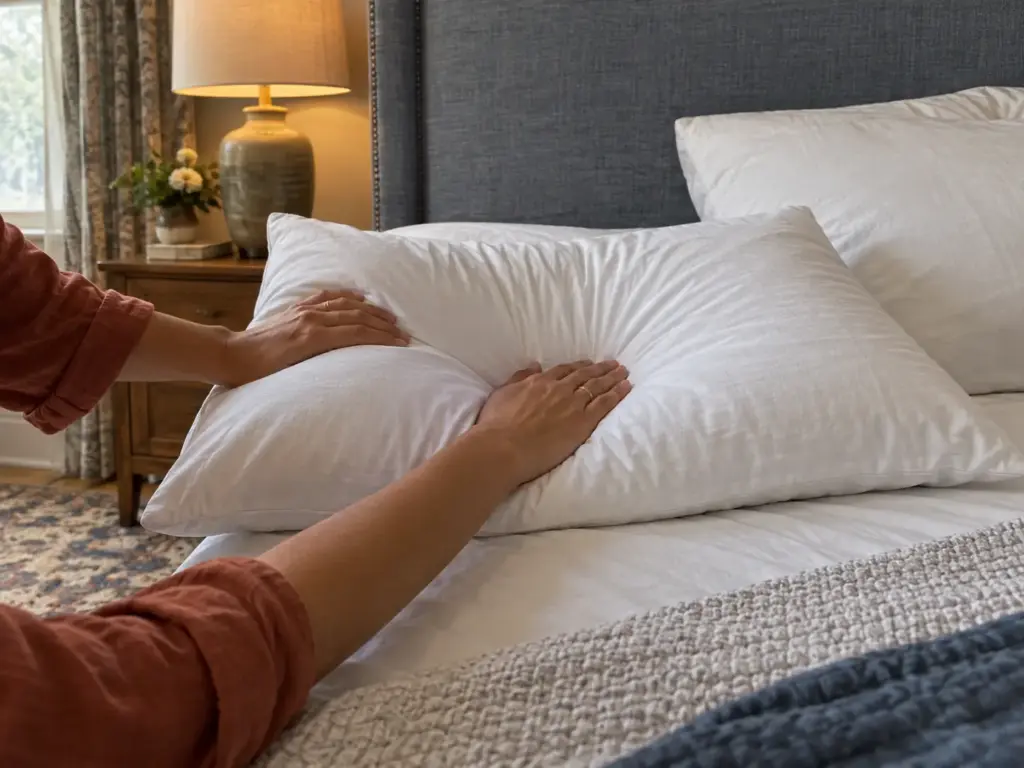
Look at the ends before you touch the middle
Take the pillow off the bed and set it on the mattress so the light comes from the side. Now look at it at mattress level, not from above. A hollow reads as a shape: the middle is low, a shallow dish where the head lands, and both ends still hold their loft.
A pillow that has lost its fill reads differently. The whole thing sits low, and when you press the middle the pillow spreads out sideways instead of pushing back, and the dent stays where you left it.
That split is a test, not a published rule. No source draws the line exactly this way, so treat it as something to check with your hands rather than a finding. It works because of fill shift: a hollow is fill that has been pushed out of one spot, while a flat-all-over pillow has fill that no longer stands up anywhere.
In the second kind your head sinks through the whole pillow, not just the middle, and it can show up on day one. A 3-star reviewer of an adjustable memory foam pillow titled the review “Pillow was VERY flat upon arrival and even after manual fluffing,” which describes a pillow that was the second failure from the box.
Do the look-and-press before you make the bed, while the pillow still holds the shape of the night. Once you have shaken it the evidence is gone, and the next morning is your next chance to read it.
One shake, then press it
Squeeze the pillow from both ends toward the middle, shake it hard, shape it back into a rectangle, and press the middle again. Sleep Foundation describes fluffing as something that helps restore loft “by aerating and redistributing the fill,” and the verb matters: redistributing means moving what is there. It adds nothing.
If the hollow fills in, the ends and the middle even out and the pillow pushes back when pressed, you were looking at a shift. If it springs up for a few minutes and the dish is back before you have finished the bed, there is no spare fill to move.
The lab version of this is Consumer Reports’ pillow test: a heavy evenly distributed load for 96 hours in a chamber held at body temperature and 80 percent humidity, which is a fair imitation of four days of head weight and sweat. As the testers put it, “We measure the thickness and firmness of the pillow after we take it out of the chamber and again after hand-fluffing it.” The gap between those two readings is the part a shake can give back. Whatever is left after the hand-fluffing is gone for good.
Why a solid-foam pillow can’t be shaken
Fill type decides whether a shake can reach anything at all. According to Sleep Foundation, down and down alternative compress easily and ask for daily fluffing, shredded memory foam and shredded latex may need it too, and solid foam, solid latex and buckwheat “do not require conventional fluffing.” There is nothing loose in them to shake.
That is where the advice to fluff it every morning breaks. On a solid foam pillow that is flat all over, the cell structure itself has broken down. One mattress retailer’s guide puts it bluntly: when solid foam goes flat, it’s finished.
Shaking it is wasted effort, and every night you wait is another night on a pillow at the wrong height. If you are not sure which build you own, what each fill does by month six lays out how every fill ages, so you know whether a shake was ever on the table.
Why the Spot Under Your Head Goes First
The hollow is not random. It sits exactly where your head lands, and knowing why tells you which fix applies and which cause to take away.
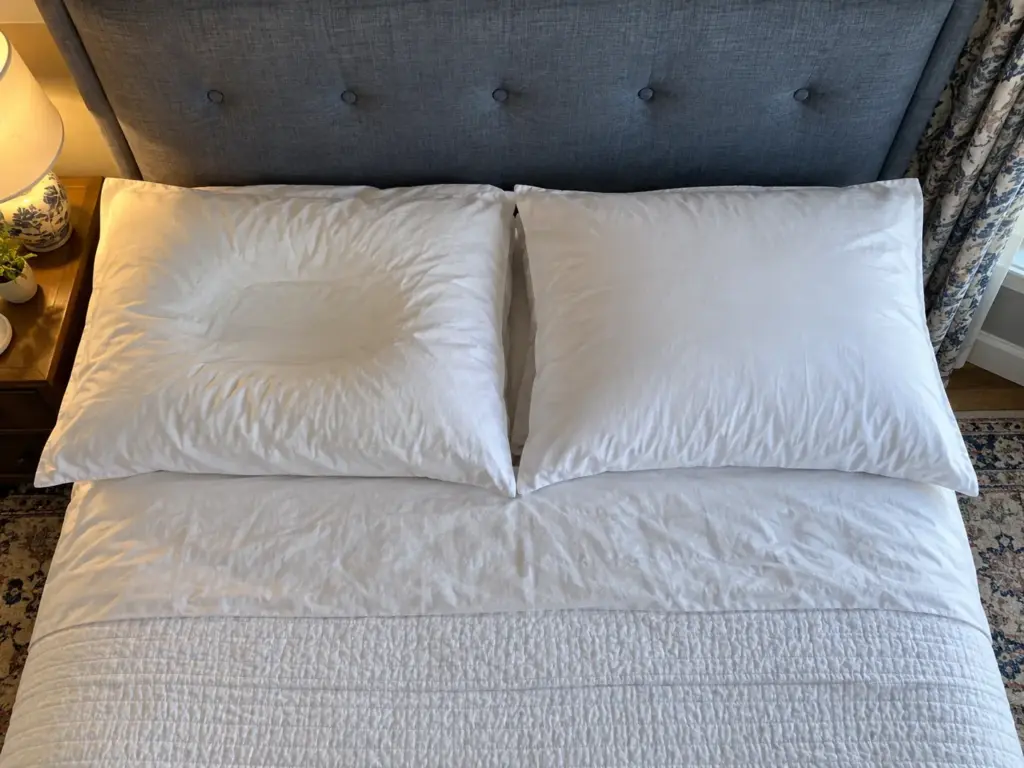
The same few inches, every night
Most people put their head in the same spot every night, so the pillow ends up with a sleep spot. One retailer’s guide says it directly, “that’s the spot that dies first,” and it is a single source, so read it as one report rather than a rule. Sleep Foundation backs up the mechanism without the slogan: compression happens “especially if you sleep in the same position and only use one area of the surface.”
That is why a pillow can look fine from the foot of the bed and still be flat in one spot when you look from the side. The ends carry almost no load, so they stay full, and the middle takes every night. It also explains why turning the pillow helps: it puts your head on fill that has not been packed down yet.
One gap deserves an honest note. A poster who gets three weeks and a brand that promises a year or more do not meet in any source, and nothing says which set-up collapses early. The working guess is a thing to check, not a finding: an early collapse with a loose fill is often a shift a shake returns, while the same pillow after months of matting is not.
What sweat does to fill
Sweat and moisture work on the same few inches. Sleep Foundation notes that pillows “easily absorb moisture, which flattens the fill and reduces the loft,” and that sweat, dead skin and oils can weigh the fill down. Moisture in the fill is a slower problem than a shift. A shake does not dry anything, which is why a damp pillow can look better after fluffing and sag again by the next morning.
A housekeeper in the same r/LifeProTips thread put it plainly: “It seems like sweat and oils make them flatter.” Another commenter said that keeping oils and moisture out slows the breakdown. The two reports point at the same layer, which is the one directly under the case.
The layer under the case
The housekeeper’s routine has two parts: a zippered cotton protector under the pillowcase, and a shake, fluff and shape every time the bed is made. The case on a pillow that has been flat for a while is usually the cleaner of the two sides. The fill beneath it is what holds the sweat.
The FAUNNA 600TC 100% Cotton Pillow Protector is that kind of layer, a zippered protector: 100 percent cotton at 600 threads, OEKO-TEX certified, with a quiet zipper, sold as a 4-pack. It slows sweat and oil on their way to the fill, but that is all it does. It does not put height back, so a pillow that is already flat stays flat under it. Whether you need one at all is a separate question, and the answer is a protector only if the pillow can’t be washed.
Case size is a one-sentence question. A pillow that rattles around in a case that is too big looks limp whatever the fill is doing, and what “standard” pillowcase size actually means settles that without a tape measure.
When you change the case, press your palm flat on the middle of the pillow. Fill that feels cool or damp there will not respond to a shake until it has dried, so air it first and shake it second.
The Free Fixes, in the Order They Work
If the cause is one spot and some moisture, then the fixes are about moving the fill, drying it and spreading the load. None of them costs anything, and all of them only work on a fill that can still be moved.
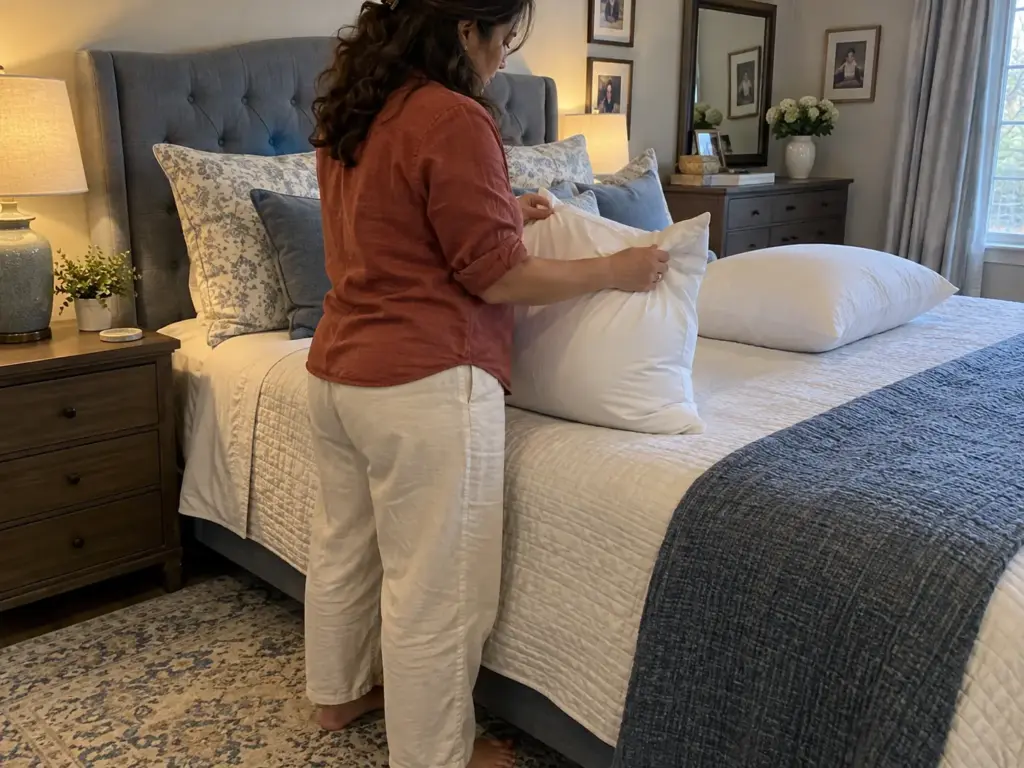
Shake and shape it every time you make the bed
The shake comes first because it is the one free fix for a hollow, and the housekeeper’s habit is the right size for it: shake, fluff and shape the pillows every time the bed is made, so no spot stays packed down for long. Hold the two short ends, push them toward each other, shake, and bring it back to a full rectangle.
It works on shredded foam too, as long as there is loose fill inside, and on a down pillow it is the daily habit. How well it works depends on the construction, which is the whole subject of shredded against solid memory foam. A pillow with a solid core gives a shake nothing to move.
The dryer, only for the right fills
For polyester fill and down, the dryer is the next step, once the care label says the pillow can go in: low heat, or the no-heat setting that only tumbles it, a couple of tennis balls or dryer balls, 15 to 20 minutes, then check the middle for damp or cold patches before the pillow goes back on the bed. The same mattress retailer warns that high heat melts synthetic fill and damages down, and Sleep Foundation adds that some fill materials need a low setting and regular checking.
One commenter’s report of a firm fiber pillow fits this: it goes flat after a while and needs to be fluffed again with washing and drying. That works for fiber. It does not work for foam, which belongs nowhere near a dryer, and down against down alternative by fill weight covers how the two fills differ when they come out of one.
Heat is the one mistake here that cannot be undone. A pillow dried too hot has melted synthetic fill or damaged down, and no shake gives that back.
Open the dryer at the 15-minute mark and press the middle. If it still feels cool or damp, run it up to the 20-minute mark and press it again. If it is still wet after that, finish it in the sun instead of adding heat.
Air it in the sun, turn it every few days
Sun airing is the quiet fix. Several hours outside on a dry day lets the fill dry and open up, but bring it in before evening, because left out overnight it picks the humidity back up and comes in damper than it went out.
Then turn it. Rotate the pillow and flip it every few days so your head lands on fill that has not been compressed yet. That advice comes from a single retailer source, but it follows from everything above about one spot taking the nightly load. Good fill recovery depends on this: a shake brings back loft only if the fill is not already packed solid in one place.
One fix here adds fill rather than moving it. It belongs to adjustable pillows, and it waits for the last section.
When a Shake Doesn’t Bring It Back: The Fold Test and What Next
The free fixes have a ceiling. They move and dry the fill that is there, and they cannot make a pillow taller. This is the test that says when to stop shaking.
Fold it in half and let go
Fold the pillow in half, hold it for a few seconds, and let go.
The same mattress guide says it this way: “A pillow with life left in it springs back open. One that stays folded… has lost its structure.” That takes seconds and costs nothing.
A pillow that opens up again has life in it, and the shake, the turn and the protector are worth another round. One that stays folded is finished. At that point the pillow is no longer a repair job, and what is left is how long this kind of fill was ever going to last.
Why lifespans disagree so much
Sleep Foundation puts polyester-filled pillows at about a year, a high-quality latex pillow at five years or more, and memory foam and down at two to three. A German down-industry association says pillows used every night should be replaced after five years at the latest. Set those beside a three-week report from a forum and a couple-of-months report from a 3-star review, and you get a spread of a factor of two or more.
No source says which set-up collapses early, so this guide picks no number for pillow lifespan. The fill decides, not a year, and how often to replace pillows, by fill not by year works through it one fill at a time.
An adjustable pillow buys height, not durability
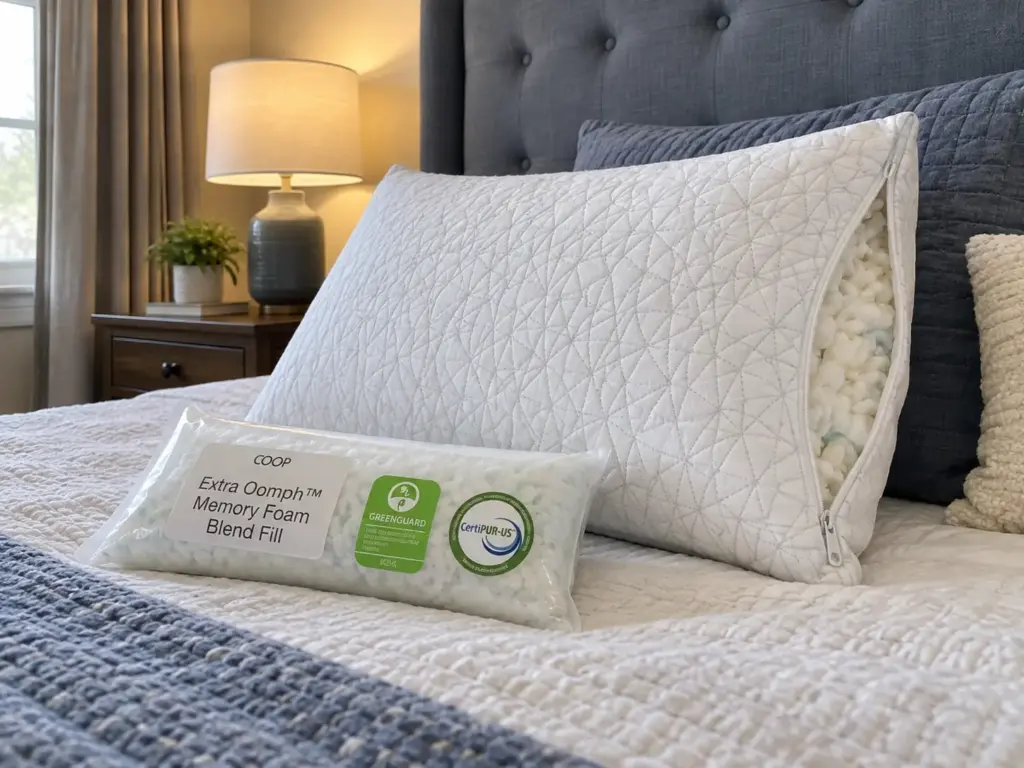
An adjustable pillow is the one fix in this guide that adds fill. The Coop Home Goods Original Adjustable Pillow, Queen is cross-cut memory foam blended with microfiber (76 percent polyurethane foam, 24 percent polyester gel fiber), ships with a bag of extra fill of the same material, and has a machine-washable cover. You can put height back with the fill that came with it.
What it does not buy back is durability, and the reviews say so. A 3-star reviewer of the King size wrote, “it’s already flattening… and it’s still flattening” after a couple of months, even with all the extra fill added. The Queen reviewer quoted earlier found it flat out of the box.
A commenter on r/LifeProTips says Coop pillows “haven’t gone flat.” Those reports disagree, and they stay in disagreement here.
One more detail from the reviews: an adjustable pillow can take a while to settle after a top-up. One reviewer said it took forever to fluff up after adding all the fill, so judge it after that wait, not on the first night.
Stacking a second pillow to rebuild height is untested here. A poster who tried a two-in-one pillow case said it feels weird on the neck, and the height question behind stacking a second pillow is where that logic is worked out.
The Layla Sleep Adjustable Fill Kapok Pillow, King is the same class from another brand, shredded memory foam with kapok fiber, and the same limit applies: it gives height back, not durability.
When the neck ache doesn’t change with the pillow
A neck ache or numbness that does not change when the pillow changes, or headaches that keep coming back, goes to a doctor, not to a pillow. Persistence after several weeks of looking after yourself, headache, weakness, numbness or tingling are the thresholds Mayo Clinic’s neck pain guide gives for calling a professional. This article does not say whether a flat pillow causes any of it, and it stops there.
Look at the Ends, Shake Once, Fold Before You Buy
Three things carry the rest. Look at the ends first, because a low middle with standing ends is a hollow and a low pillow all over is not. Run the free fixes before any purchase, in order: shake, dryer or sun for the right fills, and a turn every few days. Then fold it, because a pillow that stays folded has stopped being a repair job and the replace decision is the only one left.
The check for later is simple: once the pillow has been through a few weeks of nights, note how fast the hollow comes back after a shake. If it is back by the next morning, the fill is spent. If it holds for days, the routine is working.
Tonight, take the pillow off the bed and look at it from the side, shake it once, and leave it alone. At the next bed-making, look at it again and see how much of the dish has come back.
Frequently Asked Questions
01Why do my pillows go flat so fast?
Your head lands on the same few inches every night, and sweat and skin oils add weight to the fill under it, so that spot packs down first. A fill that has only shifted comes back with a shake, and a matted one does not. Turning the pillow every few days spreads the load.
02Can you make a flat pillow fluffy again?
Yes, when the fill has only shifted, because a shake, a turn and a short low-heat dryer cycle can bring a hollow back on polyester or down. Not when the pillow is flat all over after a shake, and not solid foam, which has no loose fill to move.
03What should you do if a pillow is too flat?
Look at the ends first: if they still stand and only the middle is low, shake the pillow and turn it. If it stays flat all over, fold it in half and let go. One that springs open has life left, and one that stays folded does not.
04Is a flat pillow better than a fluffy one?
Neither is better in general, because the right height depends on how you sleep, and the problem is a gap that does not match your position rather than flatness itself. Measure that gap in your usual position instead of guessing, as the pillow-by-position guide shows.
05Can you stack a second pillow to make up the height?
Stacking a second pillow to rebuild height has not been tested well enough to call it a fix, so this guide makes no claim either way. One forum poster who tried a two-in-one pillow case said it feels weird on the neck. The combination sleepers guide covers the height logic.





Tried it on your own bed?
No comments yet. Tell us what you changed, and what the sheet did after a few washes.