







What’s in here7 sections
You are standing over the bin with a sheet balled up in your hands, and every page you opened on the way here told you to make a tote bag out of it. You asked whether to throw it away. Nobody answered.
The reason the honest answer is not a flat “never” is that a sheet is either cellulose or it is plastic, and those two things have completely different endings once the truck comes. One will biodegrade like yard waste. The other behaves like a drink bottle. So here is the test that separates a sheet that is genuinely finished from one that is only tired, the three cases where the bin is the correct call today, and the ten minutes of work you owe a dead sheet before you let it go.
Quick Answer
Throwing a sheet straight in the trash is right when it is torn past a rag-sized scrap, contaminated by mold, bedbugs or staining that will not wash out, or a synthetic blend nobody local will take. Thin, faded, stained-but-intact and dead-elastic sheets all still have somewhere to go first.
Thin and Faded Is Not the Same as Finished
The intro promised a test, and the test starts by throwing out the two words everybody judges a sheet by. Worn and old describe nothing you can look at. A sheet can be fifteen years old and structurally perfect, and it can be two years old and finished, and neither of those facts is visible from across the room.
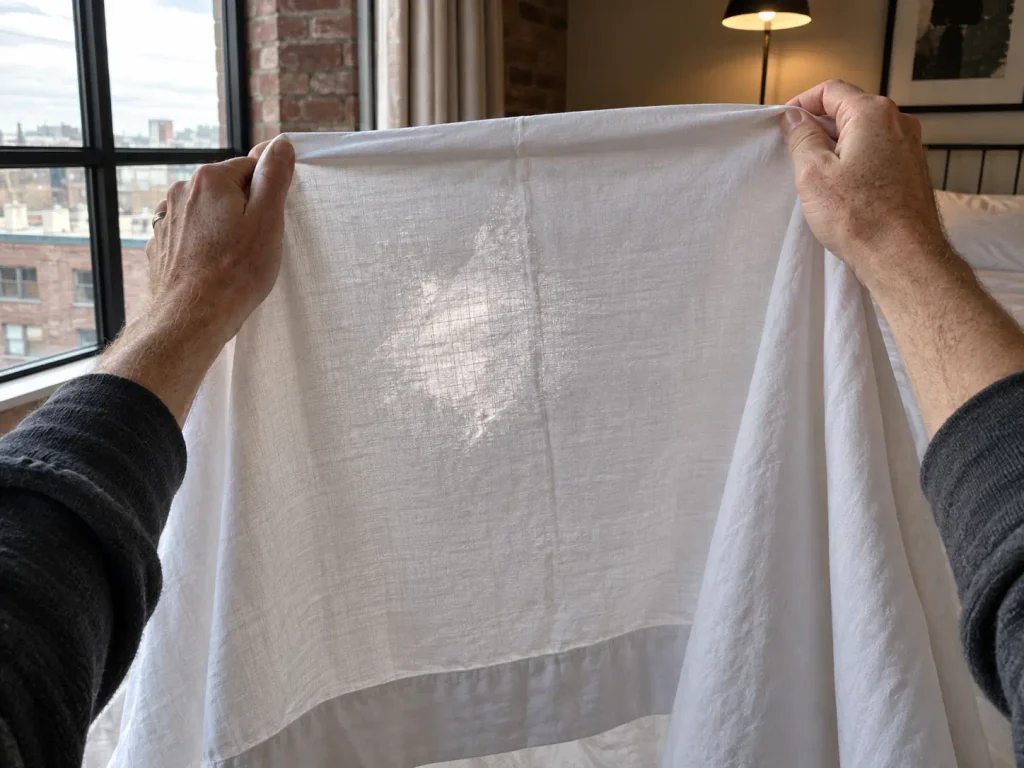
What you are actually sorting is cosmetic wear against structural wear, and only one of them is a verdict. Fading is cosmetic. So is the softening that comes from forty wash cycles, and so is an old stain that has already survived a hot wash and settled in for good.
None of that is the sheet failing at its job. A sheet that has gone from crisp white to a soft ivory is still holding a sleeper off a mattress every night, which is the entire job description. Cosmetically tired sheets are, in fact, exactly what a shelter or a thrift store wants.
Structural wear looks different, and it reads in four signals: sheer patches rather than an even thinning of the whole panel, a hole that is bigger this week than it was last week, seams splitting along the stitch line, and dead elastic that no longer returns to shape. That is the weave giving up, and a weave does not come back.
A genuinely threadbare sheet fails all four at once; a torn sheet has simply reached the end of one of them early. And note that thinning fabric on its own is not on that list, while elastic casing failure is. If the elastic is the part that has gone, the elastic tells you before the fabric does and that is a different clock with its own threshold.
Hold the sheet up to a window. Most advice stops there, which is why it is useless, because everyone’s old sheet lets some light through. You are not looking at how much light comes through. You are looking at whether it comes through evenly.
An even glow across the whole panel is age, and age is not a disqualification. A bright patch where the rest of the panel is dimmer is the weave failing in that spot specifically, and a bright patch is a hole that has not finished arriving yet.
Do the light test at night with a phone flashlight held behind the sheet instead of at a window in daylight. A window lights the whole panel at once and your eye compensates; a moving point of light behind the fabric makes an uneven patch jump out the moment it passes over it. Run it down the center third of the sheet first, because that is where it will be if it is anywhere.
Then confirm with your hands. Pinch the fabric on either side of the thin patch and pull gently across the grain, not hard, just enough to load it. Fabric that holds is thin. Fabric that opens under a gentle pull is done, and it will open on the bed within a month regardless of what you decide today.
The third check is the seam: run a thumbnail along a hem and see whether the stitching still has fabric to hold onto. A seam pulling away from its own stitching is a verdict on the whole panel, not a repair job, because the thread has not failed; the cloth it was sewn through has.
The wear is not distributed randomly, and this is the part that makes people misjudge their own sheets. Failure concentrates where the sleeper loads it: the center third of a flat sheet, the hip zone of a fitted one. A sheet can be flawless at the hem and finished in the middle, which is exactly why checking a corner tells you nothing at all and why the sheet always seems to tear “suddenly”.
r/BuyItForLife brackets the honest sheet lifespan better than any chart. One thread has someone doing the math on a cheap set that was visibly falling apart at four years and asking whether paying more actually buys a decade. Another has an LL Bean fitted sheet that tore at nine years, and the comments spent their time reframing it, not as a failure but as a fair retirement. Falling apart is the community’s catch-all for everything from pilling to a split seam, and it is exactly the vague phrase the light-and-tug test exists to replace.
The Three Cases Where the Bin Is Right Today
The last section was about a sheet wearing out slowly. This one is about the sheets that skip the process entirely, where the fabric may be structurally perfect and the bin is still the correct answer, immediately, this afternoon.
The first is bedbug exposure. The EPA’s bed bug prep guidance is the standard here, and the instruction is specific: infested textiles go into sealed plastic bags and out to an exterior bin, not carried loose through the house to the curb.
The bagging is not tidiness. It is the step that stops the problem from seeding the next room on the way out. If the item is worth saving, a household dryer on high heat for thirty minutes handles anything that can take that heat, which is most cotton and very little else on the bed.
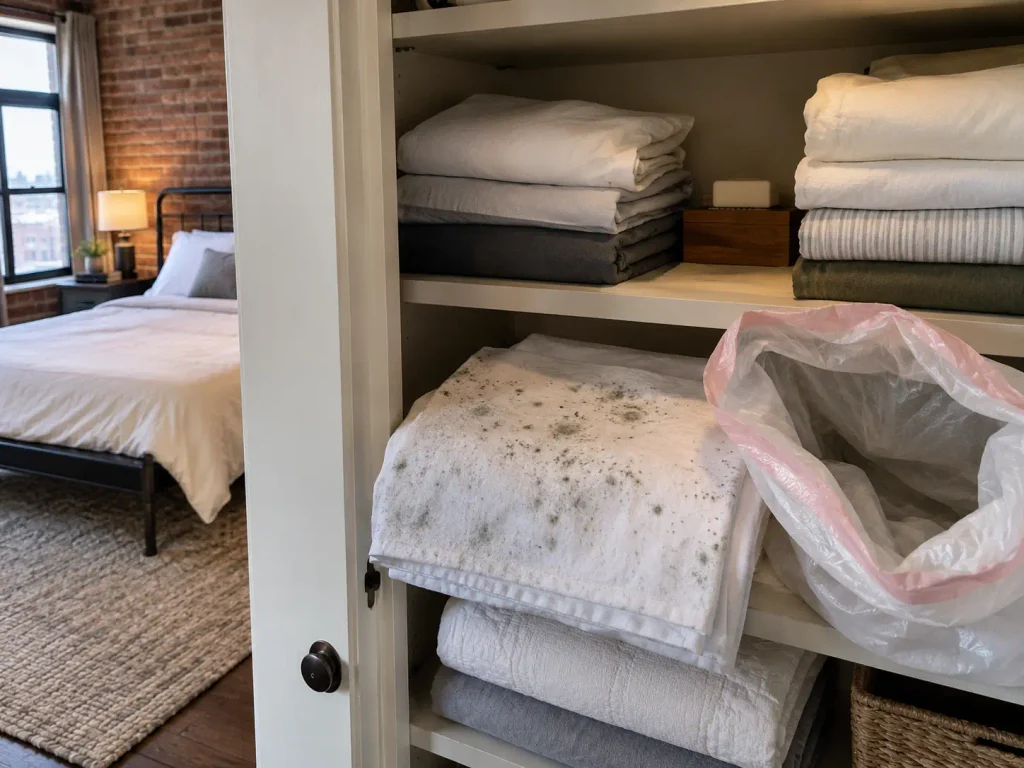
The second is mold. Visible growth on stored linens, almost always from a damp closet or from being folded away not-quite-dry. Mold is a contamination rather than a stain, and the difference matters because a stain is a cosmetic argument and a contamination is not. It does not belong in a donation bag and it does not belong in a textile recycling bin either.
The third is a bodily fluid stain that will not wash out after a hot cycle, said plainly once, and that is the whole sentence. Bag it and bin it. This is a hygiene call, not a medical one, and it needs no more words than that.
Give a contaminated sheet exactly one hot wash before you decide. One. If the mark is still there when it comes out, a second attempt will not change the answer, and every extra cycle you run on it is heat and water spent on a sheet you have already decided about. Set it up so the wash is a test with a result, not a ritual you repeat until you feel better about the bin.
What those three share is the argument that actually matters, and it is not squeamishness. In all three the sheet stops being a textile and becomes a problem you would be handing to somebody else: a shelter volunteer sorting a donation bin, or a worker on a recycling line. That is the reason, and it is also why it is worth knowing what a shelter can actually take before you put anything in a bag with a good conscience.
And notice what none of the three has anything to do with: age. A two-year-old sheet with mold on it goes today. A fifteen-year-old sheet that is only thin does not go anywhere near the bin. The birthday is not a trigger and never was.
The damp-closet case is the one people get wrong, and they get it wrong because the sheet went into the cupboard clean. Linen and heavy cotton hold more residual moisture after a short dry cycle than they feel like they are holding, and a sealed cupboard over a humid summer does the rest. The smell arrives before the spots do. If a stored set smells faintly of a basement when you unfold it, that is the warning, and it is a rewash, not yet a bin.
Where the Sheet Goes After the Bin, by Fiber
Both previous sections decided whether the sheet goes in. This one is about what happens next, which is the part of the decision nobody puts in front of you, because the answer depends entirely on what the sheet is made of.
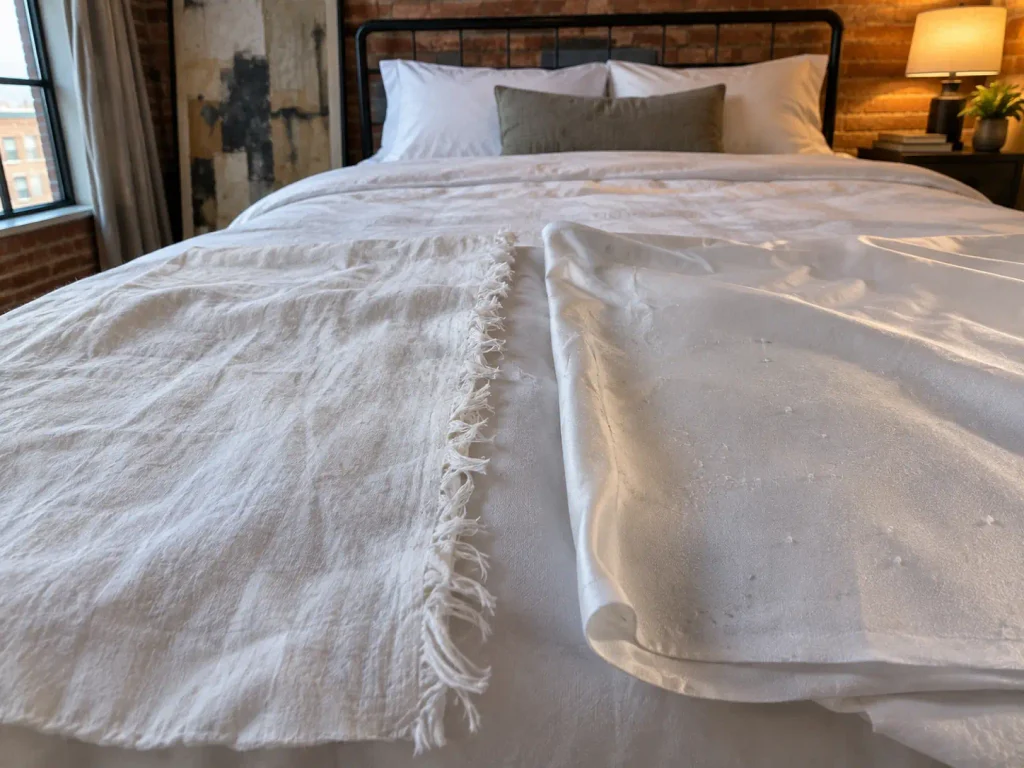
Cotton and linen are cellulose, the same compound that makes up plant cell walls. In the ground they behave roughly like other plant matter, and Cotton Incorporated’s breakdown of what happens to a fiber in the ground puts cotton’s decomposition on the order of months under the right conditions rather than decades. A cotton sheet in a landfill is closer to yard waste than to packaging.
Polyester is PET, the same polymer as a water bottle, spun into a filament instead of blown into a bottle. It does not rot. It fragments. Published estimates for a polyester textile in landfill run somewhere between twenty and two hundred years, and treat that as a range rather than a number, because nobody has run the experiment cleanly. What matters more than the span is the mechanism: the breakdown that does happen produces microplastic rather than soil. And if you are about to except your microfiber set from this paragraph, microfiber is polyester, spun finer, and the denier changed, the molecule did not.
Which makes the blend the worst of the three, and this is the one that surprises people. A poly-cotton blend will not biodegrade like the cotton half and cannot be cleanly separated like a single-fiber sheet, so it has the lowest practical recycling ceiling of anything on the bed. It inherits the limitation of both fibers and the advantage of neither.
The scale of the textile waste is worth having in front of you. The EPA’s own textile-waste numbers put textiles at 17 million tons of municipal waste generated in 2018, of which 11.3 million tons were landfilled.
The overall textile recycling rate is 14.7%, and for sheets and pillowcases specifically it is 15.8%. Roughly one sheet in six that leaves a house is actually captured by a recycling stream. If you want the rest of that story, where a sheet actually goes once it is in the recycling bin is a separate question with its own uncomfortable answer.
That number is not a scolding. Read it the other way around: the default outcome for a discarded sheet is already the landfill, whatever anybody’s intentions were, so the real question in this article is not whether the bin is acceptable in the abstract. It is whether this particular sheet had a better exit available and you are about to skip it.
You can identify the fiber without the label, which is useful because the label is usually illegible by year five anyway. Take a small cut at a hem and tear it.
Cotton tears with a short, dry sound and the torn edge frays into separate fibers you can see. Polyester resists, then gives all at once, and the edge curls very slightly instead of fraying, and that curl is the filament remembering it was melted into shape. A poly-cotton blend does a bit of both and sounds muffled.
Take the Rags Off First
By this point the verdict is in, and there is exactly one step between the verdict and the bin. It is free, it takes ten minutes, and it is the step the community has been doing for three generations without anybody writing it down as a step.
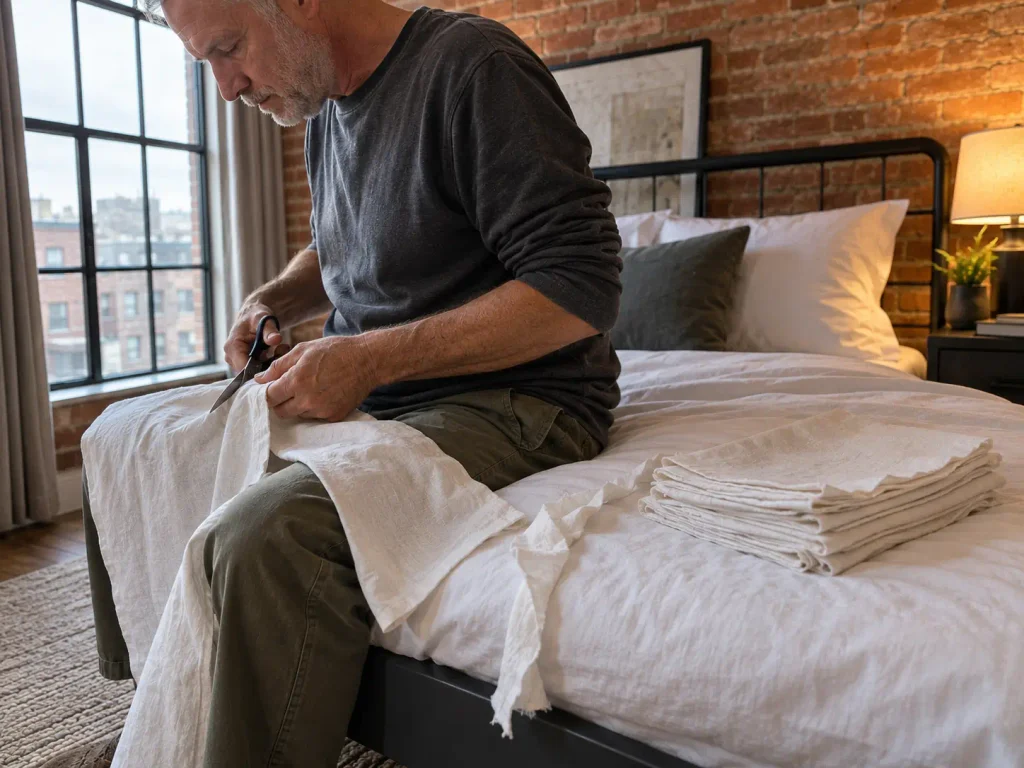
You harvest fabric from the panels that survived, which means you cut around wear rather than through it. The rule is a single threshold: anything bigger than your hand is worth keeping, anything smaller is not worth the drawer space. That is the whole method. People overthink this into a craft project and then never do it, which is how an entire sheet’s worth of usable cloth ends up in a bag.
Cut from the ends and the sides, never the middle. The middle is where the wear is, and the panels that are still structurally sound are precisely the ones nobody slept on, which means the hems, the tuck allowance that spent its life folded under the mattress, and the outer thirds of a flat sheet. On a fitted sheet, the corners are the part to skip entirely: the elastic casing makes them useless for every purpose a rag has.
Cotton rags are worth having and polyester ones are not, and it is the same fiber argument from the last section arriving at the kitchen counter. Cotton absorbs because cellulose takes water into the fiber. Polyester pushes water off, which is a virtue in a jacket and a defect in a cloth, because a polyester sheet cut into rags produces things that smear a spill around rather than lift it. If the sheet you are dismantling is a blend, cut fewer and expect less.
r/CleaningTips has a long-running and completely unresolved thread about whether to reuse or toss cleaning rags, which tells you this question is genuinely live in real kitchens. And across r/BuyItForLife, cutting worn sheets into rags gets described as the tried-and-true classic that goes back to our grandparents. It is a habit, not an invention.
The anti-sell, since it needs saying out loud: if you are cutting rags out of a sheet you were about to throw away, you should not then be buying a bag of cotton rags. The sheet is the supply. That was the entire point.
Tear the cotton ones instead of cutting them. Snip an inch into the hem with scissors, then pull. Woven cotton tears dead straight because the yarns run straight, and a torn edge sheds far less lint than a cut one. A scissor-cut rag will leave fuzz on everything it touches for its first three or four washes. A torn one skips that phase entirely, and it is faster.
What is actually worth keeping
The outer panels of a flat sheet become kitchen and workshop cloths, which is the obvious use and the one that empties the pile fastest. The hem bands, already finished on both edges and strong along their length, cut into ties for staking plants or bundling cable. The fitted-sheet corners go in the bin with the middle, never in the rag bin.
The one that repays a whole sheet, though, is the drop cloth. A single flat sheet covers more floor than two bought canvas cloths, and unlike plastic sheeting it stays put underfoot instead of sliding when you step on it. A cotton sheet takes a drip and holds it where it landed, while plastic lets the paint pool and then transfers it to your sock. Keep one whole sound panel uncut for this and you will not buy a drop cloth again.
When the Bin Is the Honest Answer
Everything so far has assumed the alternatives were available to you. For a lot of people reading this they are not, and that assumption is the thing the rest of the internet leaves out of a decision it keeps making on your behalf.
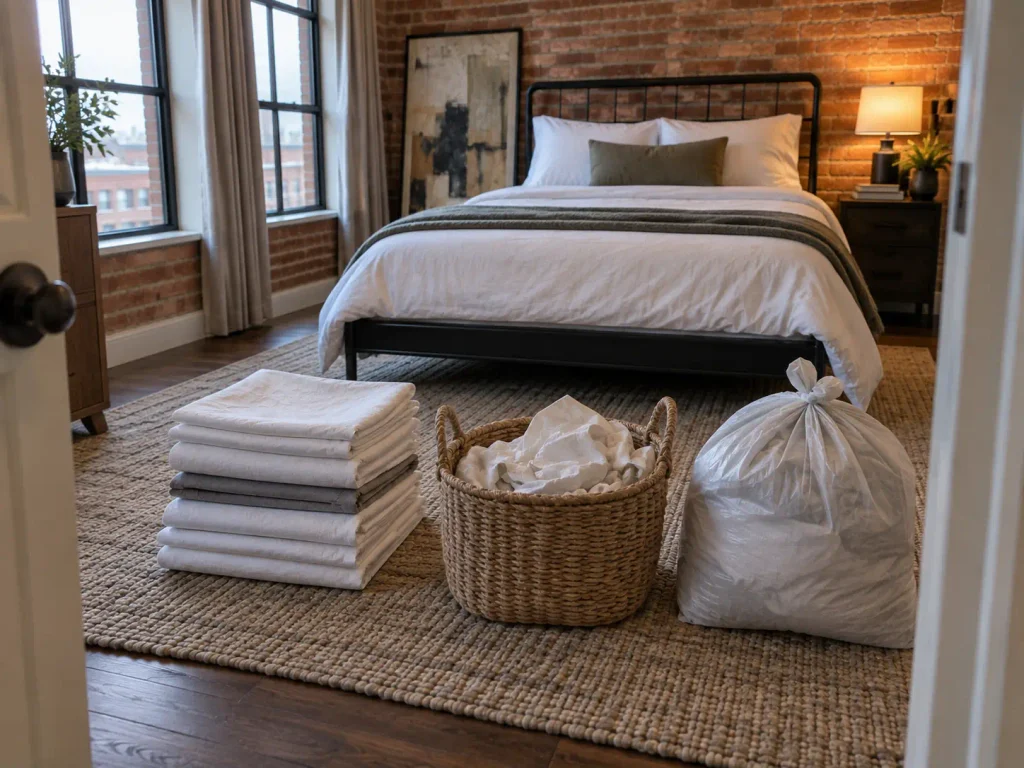
A 14.7% national capture rate is not a nation of people refusing to participate. It is what happens when most households have no convenient drop-off, when curbside takes no fabric at all, and when the mail-back programs that do exist cost money and a trip to the post office. “Just recycle it” is advice that quietly assumes a grocery-store take-back bin two miles away. Plenty of readers do not have one within fifty.
The donation route has a hard edge too, and it is not negotiable by good intentions. A shelter has intake standards. A sheet that fails them is not donatable no matter how much anybody wishes otherwise, which is the entire reason the first two sections exist: to tell you which side of that line you are on before you drive anywhere.
So the honest hierarchy runs: donate if it passes intake, recycle if a real route exists near you, harvest what is usable, then the bin, without ceremony. Every step above the bin is better than the bin. Not one of them is available to everybody, and the pillar covers the full sort — keep, donate, recycle or toss in more detail than one node can.
And here is the part that actually moves the number. The EPA’s own curve puts landfilled textiles at 1.71 million tons in 1960 against 11.3 million tons in 2018, a roughly six-fold rise. That is a purchasing problem dressed up as a disposal problem. Agonizing over one dying sheet at the bin changes nothing about that curve; buying single-fiber sets that survive long enough to wear out honestly does, which is the real content of why some sets die young and others last for years.
Which brings the guilt to its actual address. The decision that determined this sheet’s ending was made at a checkout years ago. A poly-cotton blend from the bottom of the shelf was always going to end in a landfill, and no amount of care at disposal time changes what it is made of.
You are not deciding this sheet’s fate right now. You are administering a decision somebody already made.
So: a torn, contaminated or unrecyclable synthetic sheet, in a household with no drop-off within reach, belongs in the trash. That is guilt-free disposal, and putting it there is not a failure. It is the last correct step in a sequence that was mostly decided elsewhere.
Conclusion
Hold it up to the window before you decide anything at all. An even glow is age, somebody still wants that sheet, and it should not be in your hands over a bin. A patchy glow is the weave failing in one spot, and that sheet is yours to finish.
Mold, bedbug exposure and staining that survived a hot wash go today, bagged and sealed. Not because the sheet is old, but because passing it on hands the problem to a volunteer sorting a donation bin, and that is a worse outcome than the bin by a distance.
Cut the rags off before it goes. Ten minutes, outer thirds and hems only, tear rather than cut. It is the only part of a finished sheet that was ever going to be useful again, and the alternative is buying cloth you already own.
Whatever replaces this set, look at it hard at the twentieth wash rather than the first. The first wash tells you about the finish; the twentieth tells you whether the hem stitching and the center panel are going to wear out slowly and give you years, or fail all at once and put you back over this bin in eighteen months.
Hold the one in your hands up to the window tonight. If the light comes through evenly, it is not finished. Put it back on the bed for another season.
Frequently Asked Questions
01Can I throw bed sheets in the garbage?
Yes. Household bedding is legal in the regular trash everywhere in the US and nothing in a sheet counts as hazardous waste. The real question is whether a better exit was available to you first, not whether the bin is permitted.
02How often should you throw away your bedsheets?
There is no interval, and any article giving you one in years is guessing. Condition decides, not the calendar. The light test and the tug test read condition in about a minute, and they work the same on a two-year-old sheet as on a fifteen-year-old one.
03How do I get rid of old bedsheets?
Four exits, in order: donate it, recycle it, harvest it for rags, then bin what is left. Which one applies is decided by the sheet’s condition rather than your preference, and only the first two depend on what is available near you.
04Should I just throw out old pillows?
Pillows follow a different rule than sheets, because the fill collapses long before the cover wears out. That also changes the disposal answer: most donation programs will not accept used pillows at all, so the options below the bin are narrower from the start.
05Is it bad to throw away sheets made of polyester?
Polyester does not break down the way cotton does, so it stays in a landfill far longer and fragments into microplastic rather than soil. It is also the hardest fiber to recycle, which means the purchase mattered more than the disposal ever will.





Tried it on your own bed?
No comments yet. Tell us what you changed, and what the sheet did after a few washes.